
Science Strategy Metrics for Progress and Future Goals

- Slides: 16
Science Strategy, Metrics for Progress and Future Goals L. Ruby Leung, PNNL E 3 SM Chief Scientist
E 3 SM strategies defined by goals and vision
Three overarching science drivers U. S. energy sector is vulnerable to: • • • Decreasing water availability Changing characteristics of storms, floods, and droughts Increasing air and stream temperatures and heat extremes Increasing wildfires Sea level rise Coastal inundation
Model development and simulation strategies • More significantly new capabilities in every other version • V 1: evolving from v 0 (CESM 1) with new ocean and sea ice models, interactive ice shelf and ocean circulation, important development in the atmosphere and land models • V 3: nonhydrostatic atmosphere for convection permitting modeling, more scaleaware cloud/convection parameterizations, FATES vegetation dynamics model, terrestrial-aquatic processes, wave model, ice sheet model, etc. • More evaluation, analysis, and use-inspired science questions in a complementary cycle • V 2: more extensive use and evaluation of the regional refinement capability to address questions relevant to energy mission • V 4: more extensive evaluation of convection permitting simulations, some science questions related to coastal vulnerability to storms and sea level rise
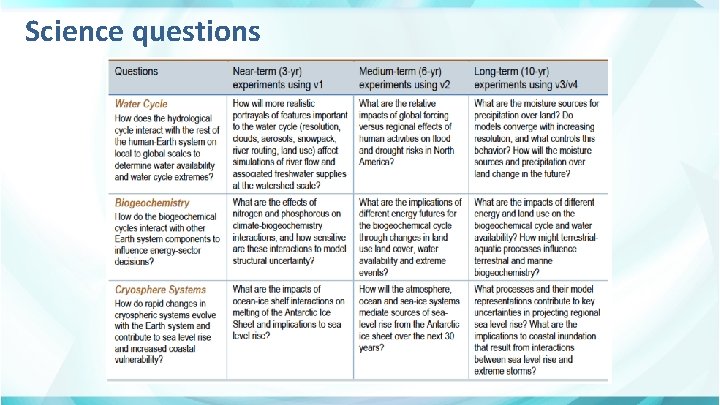
Science questions
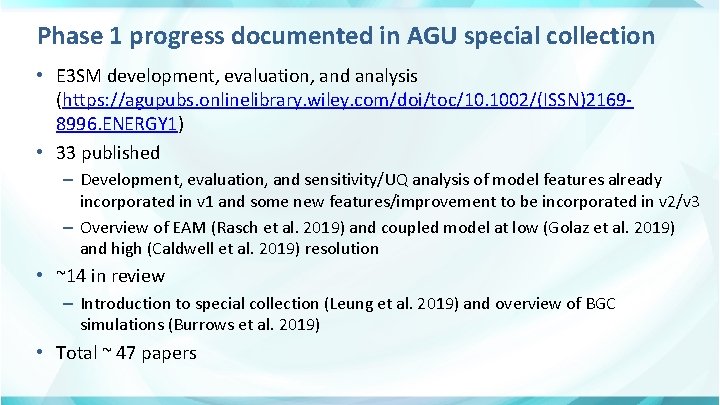
Phase 1 progress documented in AGU special collection • E 3 SM development, evaluation, and analysis (https: //agupubs. onlinelibrary. wiley. com/doi/toc/10. 1002/(ISSN)21698996. ENERGY 1) • 33 published – Development, evaluation, and sensitivity/UQ analysis of model features already incorporated in v 1 and some new features/improvement to be incorporated in v 2/v 3 – Overview of EAM (Rasch et al. 2019) and coupled model at low (Golaz et al. 2019) and high (Caldwell et al. 2019) resolution • ~14 in review – Introduction to special collection (Leung et al. 2019) and overview of BGC simulations (Burrows et al. 2019) • Total ~ 47 papers
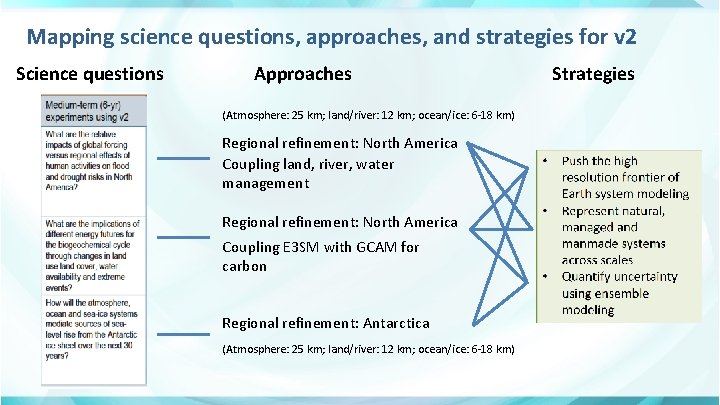
Mapping science questions, approaches, and strategies for v 2 Science questions Approaches (Atmosphere: 25 km; land/river: 12 km; ocean/ice: 6 -18 km) Regional refinement: North America Coupling land, river, water management Regional refinement: North America Coupling E 3 SM with GCAM for carbon Regional refinement: Antarctica (Atmosphere: 25 km; land/river: 12 km; ocean/ice: 6 -18 km) Strategies
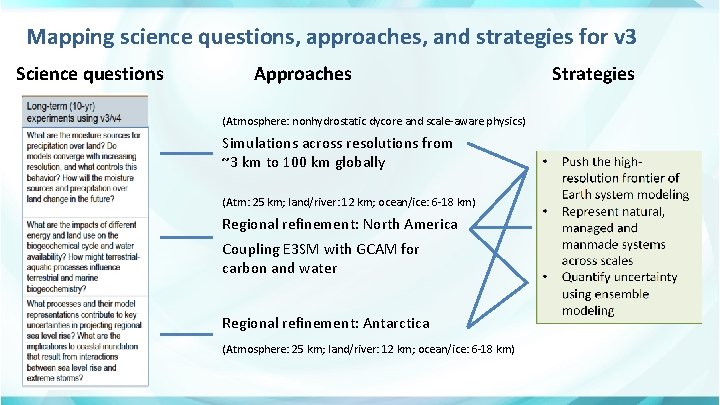
Mapping science questions, approaches, and strategies for v 3 Science questions Approaches (Atmosphere: nonhydrostatic dycore and scale-aware physics) Simulations across resolutions from ~3 km to 100 km globally (Atm: 25 km; land/river: 12 km; ocean/ice: 6 -18 km) Regional refinement: North America Coupling E 3 SM with GCAM for carbon and water Regional refinement: Antarctica (Atmosphere: 25 km; land/river: 12 km; ocean/ice: 6 -18 km) Strategies
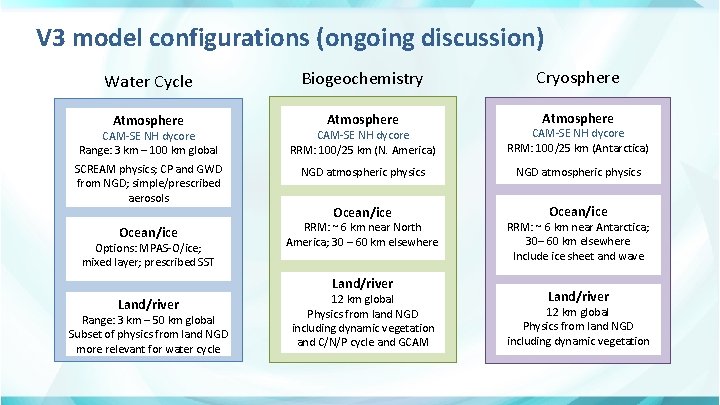
V 3 model configurations (ongoing discussion) Water Cycle Biogeochemistry Cryosphere Atmosphere CAM-SE NH dycore Range: 3 km – 100 km global CAM-SE NH dycore RRM: 100/25 km (N. America) CAM-SE NH dycore RRM: 100/25 km (Antarctica) SCREAM physics; CP and GWD from NGD; simple/prescribed aerosols NGD atmospheric physics Ocean/ice RRM: ~ 6 km near North America; 30 – 60 km elsewhere Land/river 12 km global Physics from land NGD including dynamic vegetation and C/N/P cycle and GCAM Options: MPAS-O/ice; mixed layer; prescribed SST Ocean/ice Land/river Range: 3 km – 50 km global Subset of physics from land NGD more relevant for water cycle Ocean/ice RRM: ~ 6 km near Antarctica; 30– 60 km elsewhere Include ice sheet and wave Land/river 12 km global Physics from land NGD including dynamic vegetation
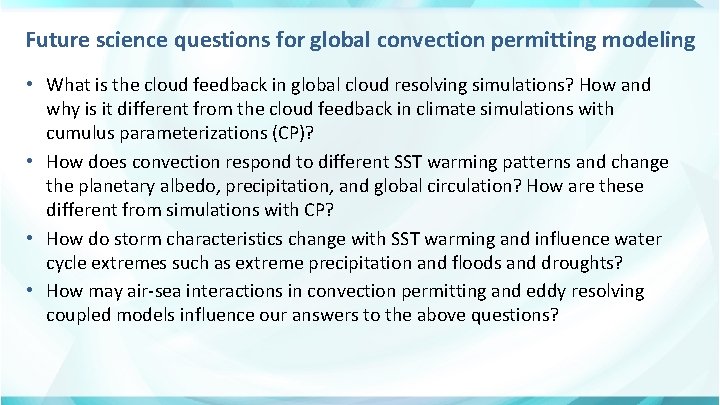
Future science questions for global convection permitting modeling • What is the cloud feedback in global cloud resolving simulations? How and why is it different from the cloud feedback in climate simulations with cumulus parameterizations (CP)? • How does convection respond to different SST warming patterns and change the planetary albedo, precipitation, and global circulation? How are these different from simulations with CP? • How do storm characteristics change with SST warming and influence water cycle extremes such as extreme precipitation and floods and droughts? • How may air-sea interactions in convection permitting and eddy resolving coupled models influence our answers to the above questions?
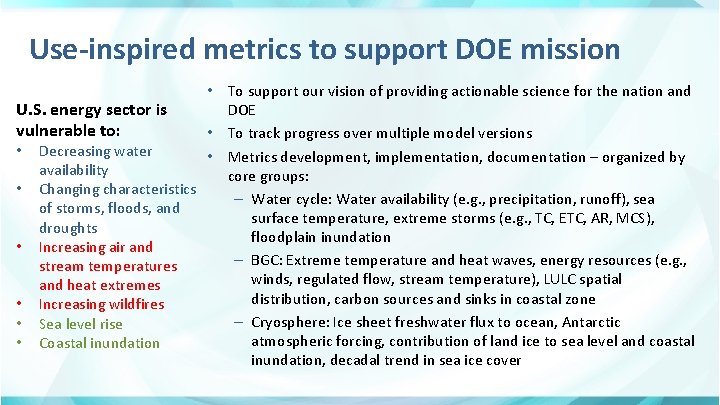
Use-inspired metrics to support DOE mission • To support our vision of providing actionable science for the nation and U. S. energy sector is DOE vulnerable to: • To track progress over multiple model versions • Decreasing water • Metrics development, implementation, documentation – organized by availability core groups: • Changing characteristics – Water cycle: Water availability (e. g. , precipitation, runoff), sea of storms, floods, and surface temperature, extreme storms (e. g. , TC, ETC, AR, MCS), droughts floodplain inundation • Increasing air and – BGC: Extreme temperature and heat waves, energy resources (e. g. , stream temperatures winds, regulated flow, stream temperature), LULC spatial and heat extremes distribution, carbon sources and sinks in coastal zone • Increasing wildfires – Cryosphere: Ice sheet freshwater flux to ocean, Antarctic • Sea level rise atmospheric forcing, contribution of land ice to sea level and coastal • Coastal inundation, decadal trend in sea ice cover
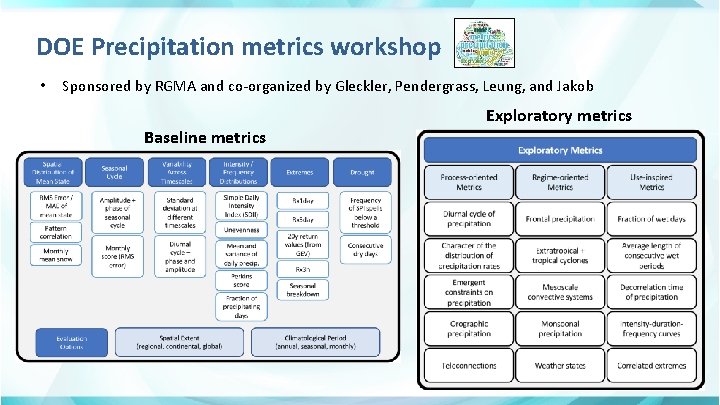
DOE Precipitation metrics workshop • Sponsored by RGMA and co-organized by Gleckler, Pendergrass, Leung, and Jakob Exploratory metrics Baseline metrics
Model features and simulation capabilities from ecosystem and university projects • • • Superparameterization – ECP (Taylor) Ice sheet – Pro. SPect (Price) Aerosols for convective scale modeling – EAGLES (Ma) Coastal processes – ICo. M (Wolfram) and Inter. FACE (Rowland) Large ensemble simulation (Di Lorenzo) Decadal prediction (Teng)
Considerations for future development • Desire for a single model for different science drivers using different configurations • Use of RRM (e. g. , tropical channel) vs. uniform resolution mesh in convection permitting modeling • Global convection permitting modeling vs. MMF • Initialization of high resolution coupled simulations – data assimilation capability • Simulation campaigns requiring different resolutions and complexities on future computers • Ensemble modeling on future computers • Role of AI/ML in E 3 SM: parameterization development, surrogate model for UQ analysis and coupled model initialization
Questions
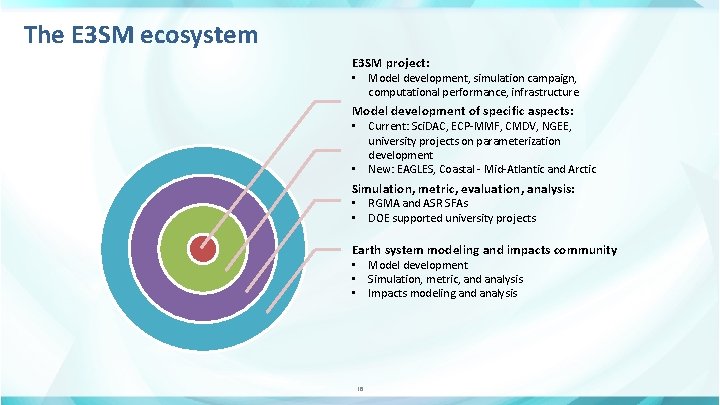
The E 3 SM ecosystem E 3 SM project: Model development, simulation campaign, computational performance, infrastructure • Model development of specific aspects: Current: Sci. DAC, ECP-MMF, CMDV, NGEE, university projects on parameterization development New: EAGLES, Coastal - Mid-Atlantic and Arctic • • Simulation, metric, evaluation, analysis: RGMA and ASR SFAs DOE supported university projects • • Earth system modeling and impacts community Model development Simulation, metric, and analysis Impacts modeling and analysis • • • 16