
Science Security Strategy Pace of Biotechnology Development February
Science. Security. Strategy. Pace of Biotechnology Development February 2018 Presented by: Rocco Casagrande, Ph. D. Research conducted by: Froggi Jackson, Ph. D. and Louise Sumner Work funded by DHS S&T, under Scott White, Ph. D.
Goals of the Study Assess developments in biotechnology to estimate: • The time between when a new trait is discovered/understood in a microorganism until that trait can be manipulated beyond what is seen in nature • These data inform us as to when an adversary could imbue a pathogen with traits that make it more usable in a weapon than the most dangerous natural strains • The time over which a cutting edge technique in biotechnology can be accessed by individuals of modest skill • These data inform us about the time when a powerful technique could be usable by an adversary with little technical training
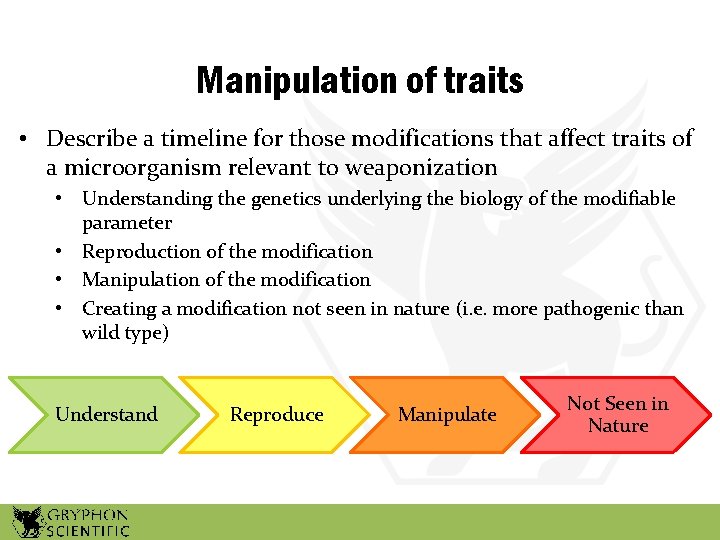
Manipulation of traits • Describe a timeline for those modifications that affect traits of a microorganism relevant to weaponization • Understanding the genetics underlying the biology of the modifiable parameter • Reproduction of the modification • Manipulation of the modification • Creating a modification not seen in nature (i. e. more pathogenic than wild type) Understand Reproduce Manipulate Not Seen in Nature
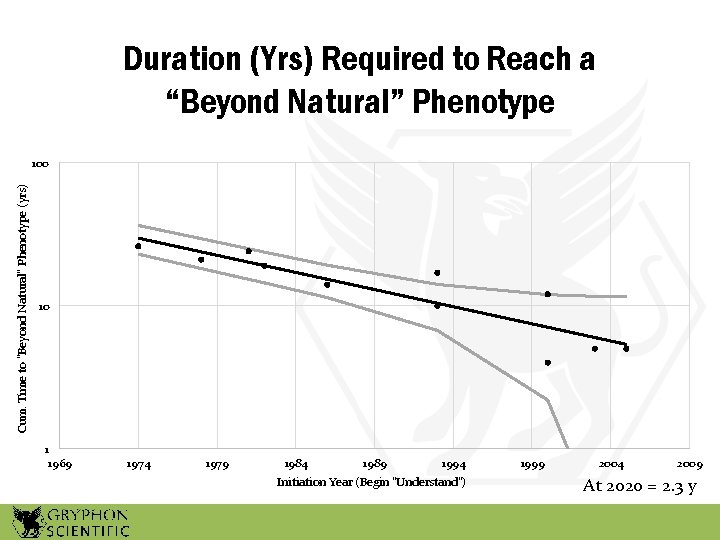
Cum. Time to "Beyond Natural" Phenotype (yrs) Duration (Yrs) Required to Reach a “Beyond Natural” Phenotype Initiation Year (Begin "Understand") At 2020 = 2. 3 y
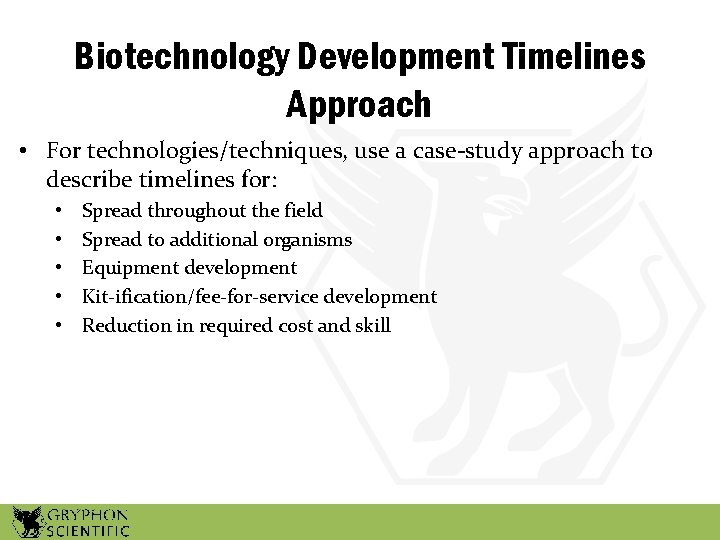
Biotechnology Development Timelines Approach • For technologies/techniques, use a case-study approach to describe timelines for: • • • Spread throughout the field Spread to additional organisms Equipment development Kit-ification/fee-for-service development Reduction in required cost and skill
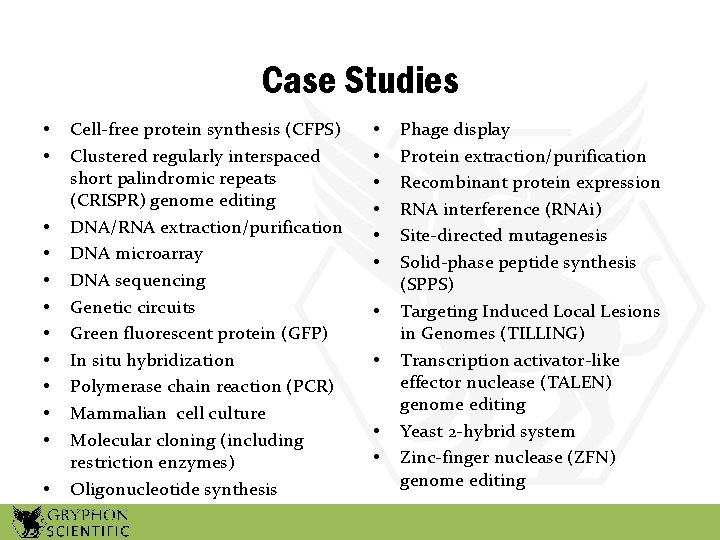
Case Studies • • • Cell-free protein synthesis (CFPS) Clustered regularly interspaced short palindromic repeats (CRISPR) genome editing DNA/RNA extraction/purification DNA microarray DNA sequencing Genetic circuits Green fluorescent protein (GFP) In situ hybridization Polymerase chain reaction (PCR) Mammalian cell culture Molecular cloning (including restriction enzymes) Oligonucleotide synthesis • • • Phage display Protein extraction/purification Recombinant protein expression RNA interference (RNAi) Site-directed mutagenesis Solid-phase peptide synthesis (SPPS) Targeting Induced Local Lesions in Genomes (TILLING) Transcription activator-like effector nuclease (TALEN) genome editing Yeast 2 -hybrid system Zinc-finger nuclease (ZFN) genome editing

Example Case Study of Biotechnology Development Timeline: PCR Development Timeline Event Resource. Thresholds Year Technical Resources (Education/Skill) Financial Resources Enabling discoveries -14 to -9 N/A First discovery 0 (1985) High Ultra High Essential equipment development 0 High Ultra High Essential technical advancement (Taq) 0 High Reproduced in other labs 1 High Essential equipment / materials commercially available 2 Medium Improved price / accessibility of equipment 3 Medium Low Reproduction outside academic laboratory (commercial service) 4 Low Commercial kit available 5 Medium Taught at undergraduate level 6 Low Medium 6 to 7 High Improved equipment commercially available (q. PCR) 11 Medium Taught at high school level 12 Low 18 to 25 Low Essential technical advancements (Pfu; q. PCR) Further developments; improved price / accessibility of equipment
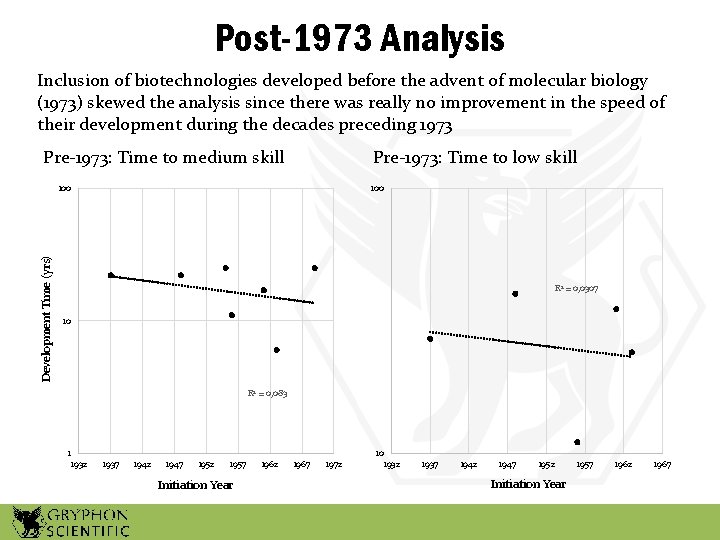
Post-1973 Analysis Inclusion of biotechnologies developed before the advent of molecular biology (1973) skewed the analysis since there was really no improvement in the speed of their development during the decades preceding 1973 Pre-1973: Time to medium skill Pre-1973: Time to low skill Development Time (yrs) 100 R 2 = 0, 0307 10 R 2 = 0, 083 1 1932 1937 1942 1947 1952 1957 Initiation Year 1962 1967 1972 10 1932 1937 1942 1947 1952 Initiation Year 1957 1962 1967
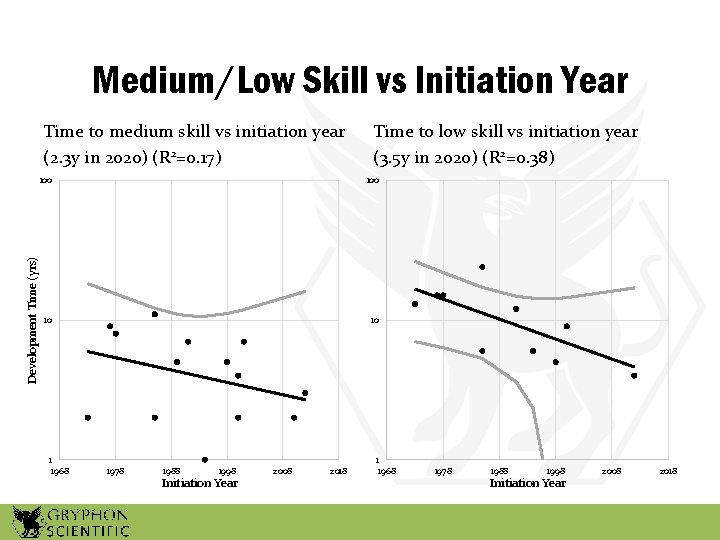
Medium/Low Skill vs Initiation Year Time to medium skill vs initiation year (2. 3 y in 2020) (R 2=0. 17) Time to low skill vs initiation year (3. 5 y in 2020) (R 2=0. 38) Initiation Year
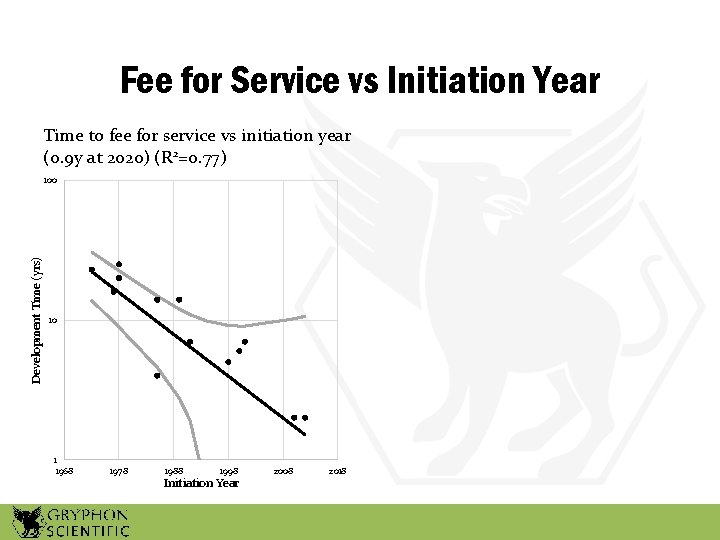
Fee for Service vs Initiation Year Development Time (yrs) Time to fee for service vs initiation year (0. 9 y at 2020) (R 2=0. 77) Initiation Year
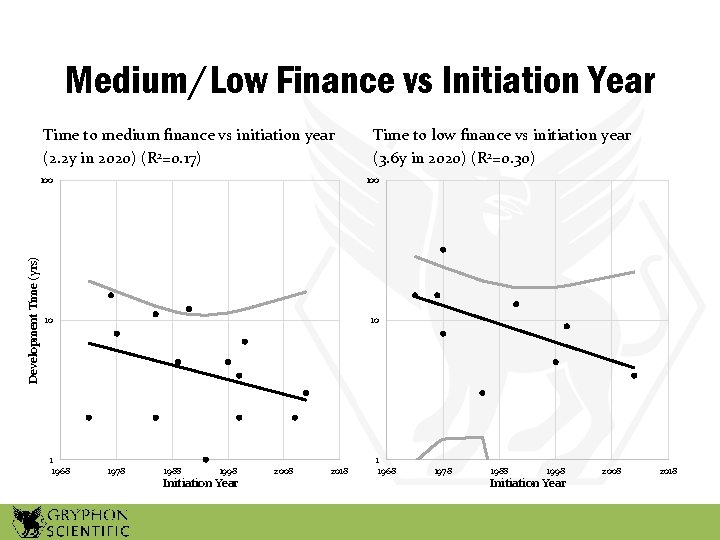
Medium/Low Finance vs Initiation Year Development Time (yrs) Time to medium finance vs initiation year (2. 2 y in 2020) (R 2=0. 17) Initiation Year Time to low finance vs initiation year (3. 6 y in 2020) (R 2=0. 30)
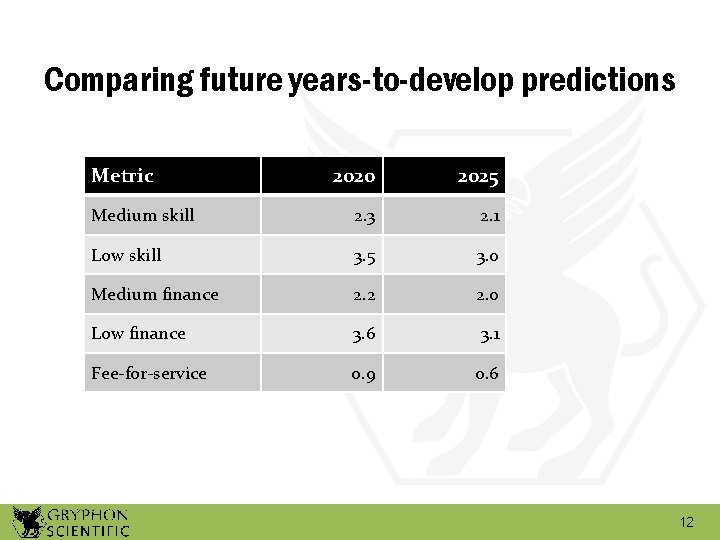
Comparing future years-to-develop predictions Metric 2020 2025 Medium skill 2. 3 2. 1 Low skill 3. 5 3. 0 Medium finance 2. 2 2. 0 Low finance 3. 6 3. 1 Fee-for-service 0. 9 0. 6 12
Conclusions • Conclusions: • The time between the scientific understanding of a trait is established and the ability to manipulate it beyond what is seen in nature is already short, and getting shorter. • We can expect that once complex traits are understood in the most dangerous pathogens, scientists will describe the ability to create even more dangerous strains in less than five years • The time that a powerful biotechnology technique, discovered by experts, gets into the hands of those with more modest skill sets is already short, and getting shorter. • • The pace at which biotechnology outsourcing is developing is accelerating the fastest We can expect that a powerful new technique will be taught in college courses in less than five years
- Slides: 13