
Science Research Investigation Vertebrate Power Point Presentation KANGAROO
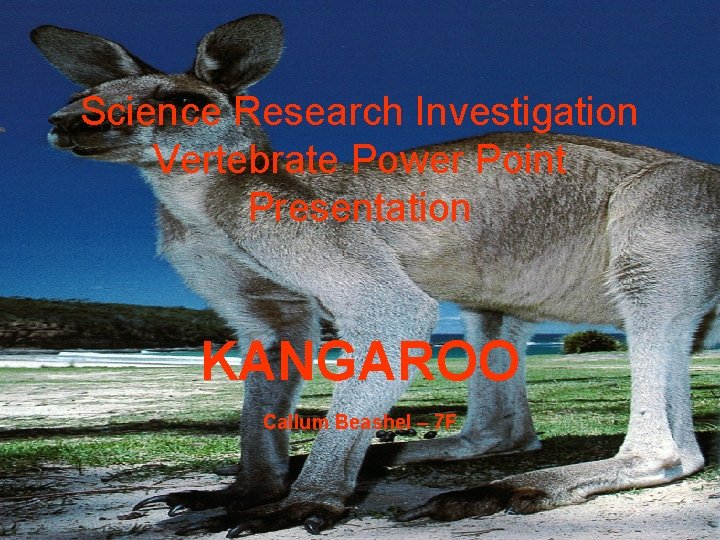
Science Research Investigation Vertebrate Power Point Presentation KANGAROO Callum Beashel – 7 F

1. What is the scientific name of the animal? The scientific name of the kangaroo is Macropodidae. The 2 main types of kangaroo are: Eastern Grey Kangaroo – Macropus Giganteus Red Kangaroo – Macropus Rufus. It got its name when the first European explorers landed and asked the aboriginals “what is this strange creature hopping around” and the aboriginals replied “kangaroo” meaning “I don’t understand you. ” The explorers thought it was the name of the animal so it was then called the ‘kangaroo’.
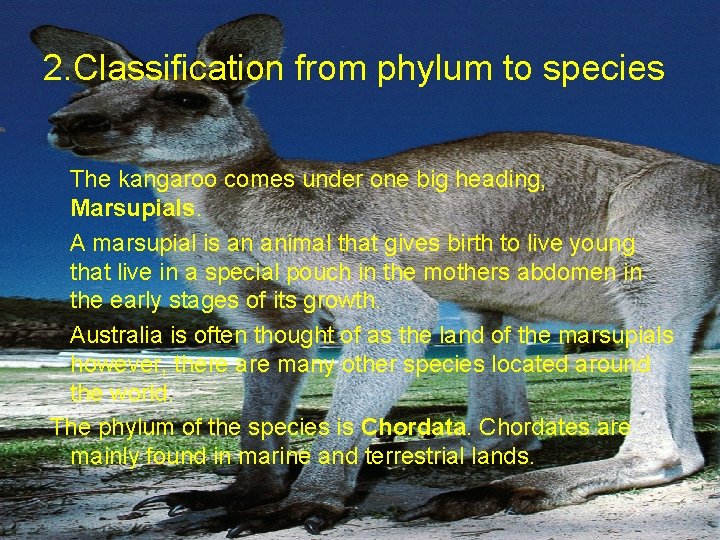
2. Classification from phylum to species The kangaroo comes under one big heading, Marsupials. A marsupial is an animal that gives birth to live young that live in a special pouch in the mothers abdomen in the early stages of its growth. Australia is often thought of as the land of the marsupials however, there are many other species located around the world. The phylum of the species is Chordata. Chordates are mainly found in marine and terrestrial lands.
3. Description • A kangaroo is a Macropod (big foot). There are 60 different kinds of kangaroo with over 12 close relatives. They live mostly in grasslands with rocks, bushes and trees. They only live in Australia in nearly every state. They eat grass and shrubs which they pick out with their paws to eat. They are nocturnal animals. They only come out at night to eat their food at dusk or dawn and rest during the rest of the day. Although some types of kangaroo are commonly found around Australia, some are endangered. Only 6 types have ever disappeared.
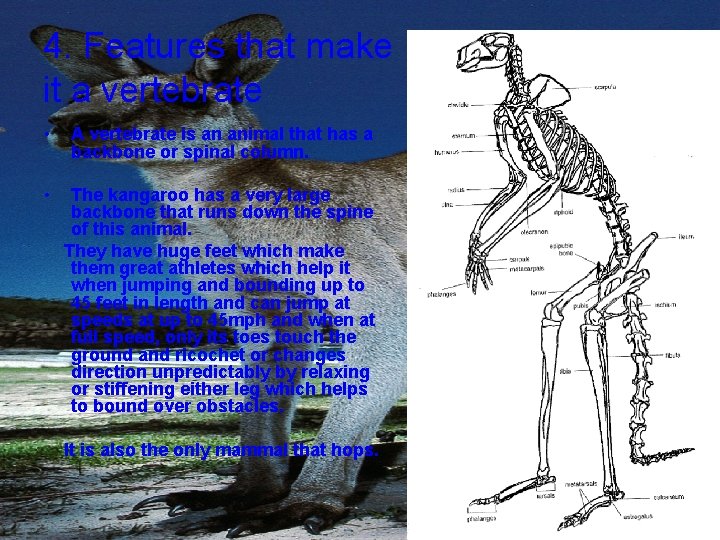
4. Features that make it a vertebrate • A vertebrate is an animal that has a backbone or spinal column. • The kangaroo has a very large backbone that runs down the spine of this animal. They have huge feet which make them great athletes which help it when jumping and bounding up to 45 feet in length and can jump at speeds at up to 45 mph and when at full speed, only its toes touch the ground and ricochet or changes direction unpredictably by relaxing or stiffening either leg which helps to bound over obstacles. It is also the only mammal that hops.
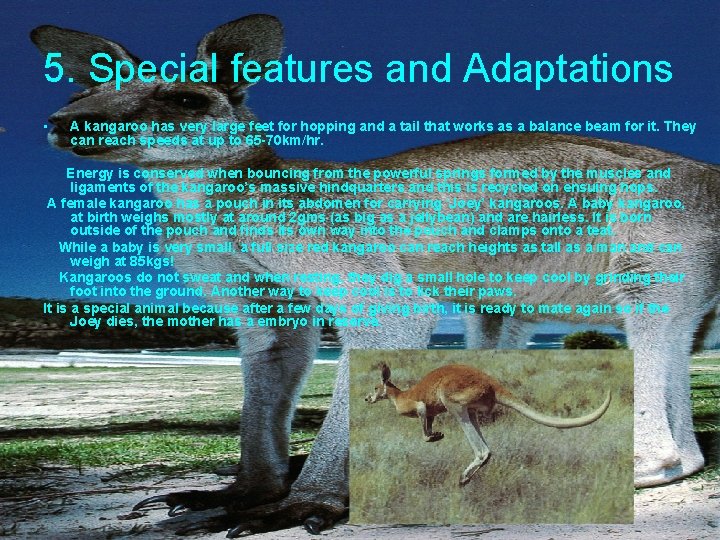
5. Special features and Adaptations • A kangaroo has very large feet for hopping and a tail that works as a balance beam for it. They can reach speeds at up to 65 -70 km/hr. Energy is conserved when bouncing from the powerful springs formed by the muscles and ligaments of the kangaroo’s massive hindquarters and this is recycled on ensuing hops. A female kangaroo has a pouch in its abdomen for carrying ‘Joey’ kangaroos. A baby kangaroo, at birth weighs mostly at around 2 gms (as big as a jellybean) and are hairless. It is born outside of the pouch and finds its own way into the pouch and clamps onto a teat. While a baby is very small, a full size red kangaroo can reach heights as tall as a man and can weigh at 85 kgs! Kangaroos do not sweat and when resting, they dig a small hole to keep cool by grinding their foot into the ground. Another way to keep cool is to lick their paws. It is a special animal because after a few days of giving birth, it is ready to mate again so if the Joey dies, the mother has a embryo in reserve.
6. Habitat and environment that it lives in • The red kangaroo lives in an arid interior wherever there is grasslands and a few trees for shade during the day. The red kangaroo favours open country mainly where the average rainfall is approximately 500 mls. The grey kangaroo lives on the east coast of Australia and occupy nearly all of the N. S. W. They also live in a small portion of the Northern Tasmania. These kangaroos mainly eat grass during the night and rest during the day.
7. Status • Is the kangaroo in danger? Yes and no, depending on the type of kangaroo. Today kangaroos outnumber humans 10 to 1 because of the environment. The BIG kangaroos (red and grey) flourish in numbers while some of the smaller kangaroos numbers are declining. Australians have done an excellent job in protecting their wildlife. Only 6 species of kangaroo have disappeared. Some species are common while others are endangered.
8. Reason why I chose this animal • The reason why I chose this animal is because it is important to us and they are only found here in Australia so, we should not kill them out. These animals are iconic to Australia and deserve to be appreciated instead of killed for its fur and for food. When watching these animals bounce around, it moves so smoothly and calmly which is awesome to watch. In this assignment, I’ve learnt that these amazing creatures are more than what we think so we should not kill them. Also, I have learnt that there are more species of kangaroo than I thought there would be. These animals should not be taken for granted.
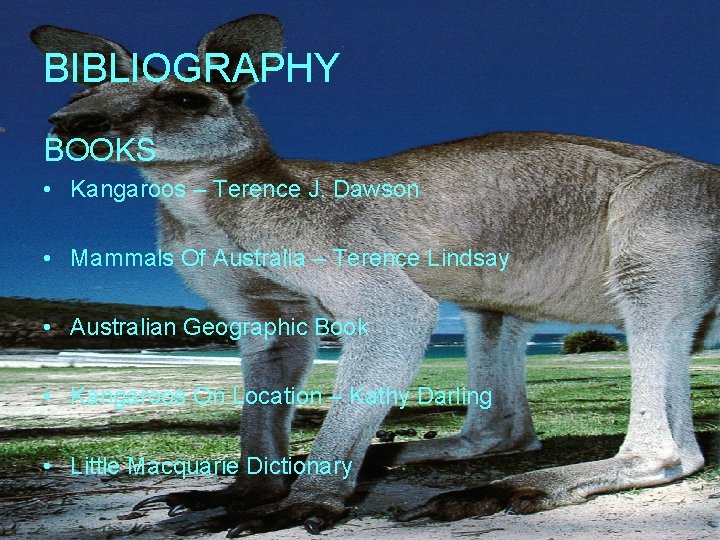
BIBLIOGRAPHY BOOKS • Kangaroos – Terence J. Dawson • Mammals Of Australia – Terence Lindsay • Australian Geographic Book • Kangaroos On Location – Kathy Darling • Little Macquarie Dictionary
- Slides: 10