
Science Program Enabled by an EIC Detector Based
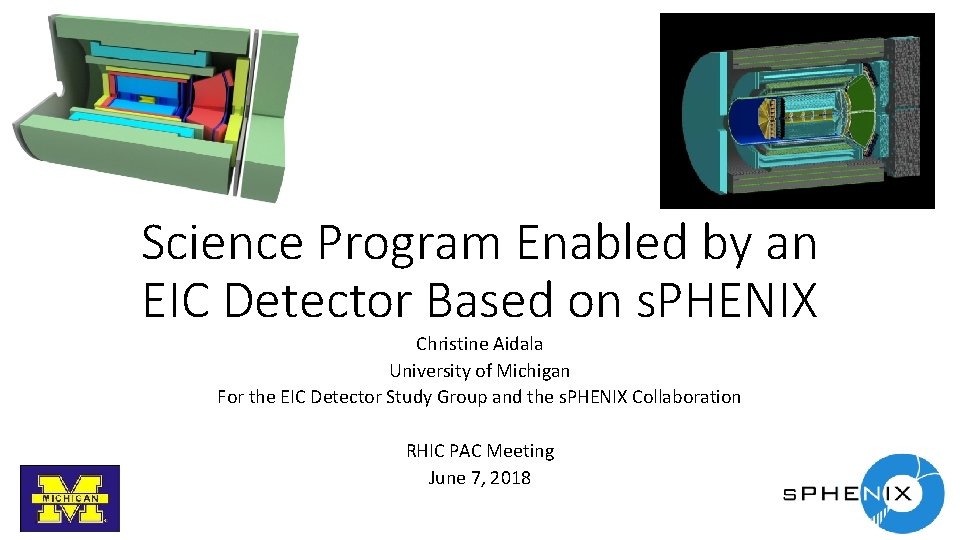
Science Program Enabled by an EIC Detector Based on s. PHENIX Christine Aidala University of Michigan For the EIC Detector Study Group and the s. PHENIX Collaboration RHIC PAC Meeting June 7, 2018
Physics case for an Electron-Ion Collider • How are the quarks and gluons, and their spins, distributed in space and momentum inside the nucleon? How do the nucleon properties emerge from them and their interactions? EPJ A 52, 268 (2016) • How do color-charged quarks and gluons, and colorless jets, interact with a nuclear medium? How do the confined hadronic states emerge from these quarks and gluons? How do the quark-gluon interactions create nuclear binding? • How does a dense nuclear environment affect the quarks and gluons, their correlations and their interactions? What happens to the gluon density in nuclei? Does it saturate at high energy, giving rise to a gluonic matter with universal properties, in all nuclei, even the proton? C. Aidala, PAC meeting, 6/7/18 2
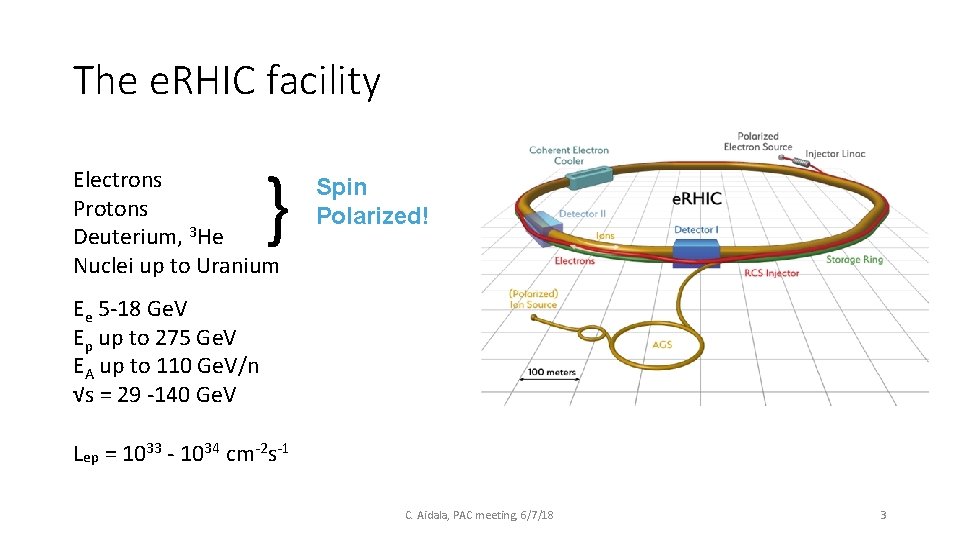
The e. RHIC facility } Electrons Protons Deuterium, 3 He Nuclei up to Uranium Spin Polarized! Ee 5 -18 Ge. V Ep up to 275 Ge. V EA up to 110 Ge. V/n √s = 29 -140 Ge. V Lep = 1033 - 1034 cm-2 s-1 C. Aidala, PAC meeting, 6/7/18 3
Charge from ALD April 5, 2018 Dear Dave and Gunther As you know, the e. RHIC design team is close to completing the pre-conceptual design report, the NAS Study Panel is expected to publish its assessment of the value of a US based EIC in the May time frame, and DOE may declare CD-0 for an EIC sometime in the second half of 2018. In this context it will be important that we have a clear and up-to-date understanding of the value of s. PHENIX as the basis of a Day-1 e. RHIC detector. The e. PHENIX Letter of Intent now is four years old and urgently requires an update that takes into account the developments in detector technology and interaction region design. I am therefore asking you to establish a detector study group consisting of members of the s. PHENIX Collaboration and other individuals interested in EIC science from outside the s. PHENIX Collaboration to update the Letter of Intent for an EIC detector built around the Ba. Bar solenoid in the context of the e. RHIC pre-CDR. The Letter of Intent should contain an outline of the expected physics program for the detector in the first five years of running, using estimates of the luminosity development anticipated for initial EIC operation. In parallel, I am asking you to perform a cost estimate of the construction costs in FY 2018 dollars. This estimate should be performed with the methodology that the NPP Director for Project Planning and Oversight of Accelerator Projects, Diane Hatton, has developed for the EIC and that Elke Aschenauer and her group are using to develop a cost estimate for a generic EIC detector in conjunction with the ongoing pre-CDR cost estimation process. Please, do not include the cost estimate in the updated Letter of Intent, but transmit it as a separate document. A brief presentation on the physics capabilities of the detector should be prepared for the PAC meeting in June 2018. After receiving comments from the PAC, I expect to be able to provide feedback and further guidance with respect to the process and goals of developing the updated Lo. I. The final versions of the revised Lo. I and the associated cost estimate should be submitted to me by September 30, 2018. The NPP Director for Project Planning and Oversight of Detector Projects, Maria Chamizo Llatas, will then convene a review with external experts, as appropriate. These are exciting times for all those interested in the physics of an EIC. The facility is finally at the doorstep from concept onto the path toward realization. I hope that this request will build on and further strengthen the excitement of all those within the s. PHENIX collaboration who are looking forward to participation in a future EIC physics program. Best regards Berndt s. PHENIX configuration based on MIE reference design + MVTX C. Aidala, PAC meeting, 6/7/18 4
Charge has been useful in ramping up efforts • Have created such an EIC Detector Study Group, co-convened by myself and Nils Feege of Stony Brook. Biweekly meetings in conjunction with the s. PHENIX Cold QCD Topical Group. • eic-dsg-l@lists. bnl. gov • Charge has been useful in ramping up efforts to examine in realistic detail how s. PHENIX could be transformed into an EIC detector. • Integration with s. PHENIX including envelopes necessary for readout, services, and mechanical support. • EIC detector design actively being discussed within s. PHENIX Office of System Integration. • Time of engineers and some relevant experts tied up in DOE CD-1/3 a review for s. PHENIX until late May; more availability now. C. Aidala, PAC meeting, 6/7/18 5
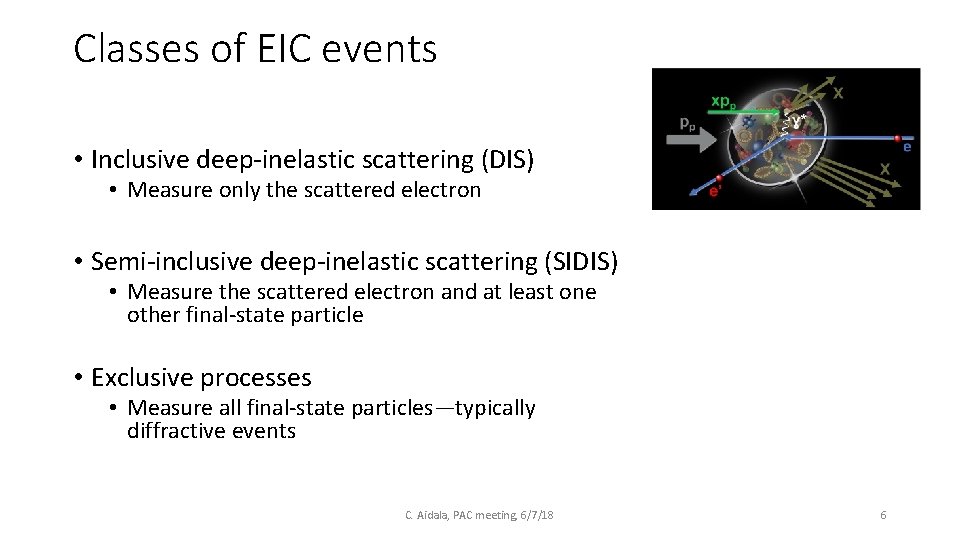
Classes of EIC events • Inclusive deep-inelastic scattering (DIS) • Measure only the scattered electron • Semi-inclusive deep-inelastic scattering (SIDIS) • Measure the scattered electron and at least one other final-state particle • Exclusive processes • Measure all final-state particles—typically diffractive events C. Aidala, PAC meeting, 6/7/18 6
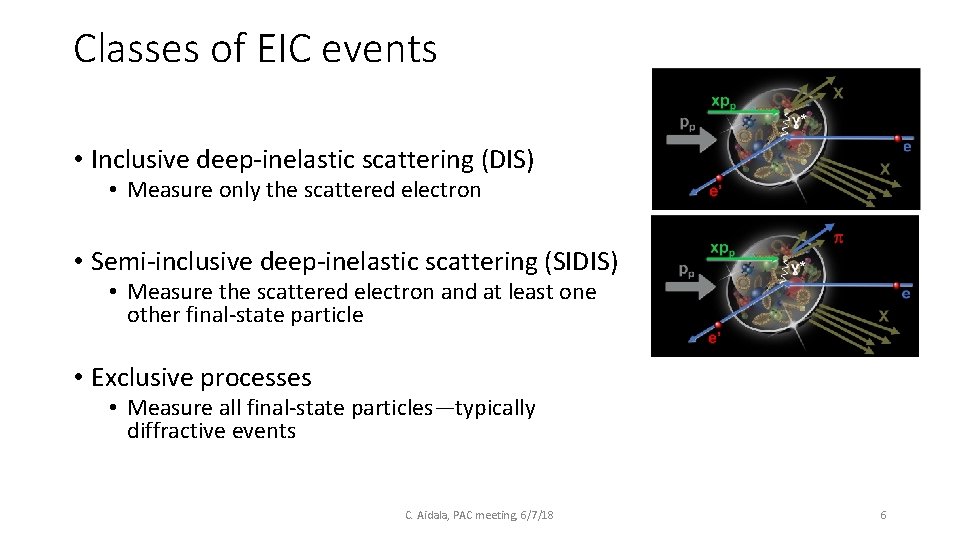
Classes of EIC events • Inclusive deep-inelastic scattering (DIS) • Measure only the scattered electron • Semi-inclusive deep-inelastic scattering (SIDIS) • Measure the scattered electron and at least one other final-state particle • Exclusive processes • Measure all final-state particles—typically diffractive events C. Aidala, PAC meeting, 6/7/18 6
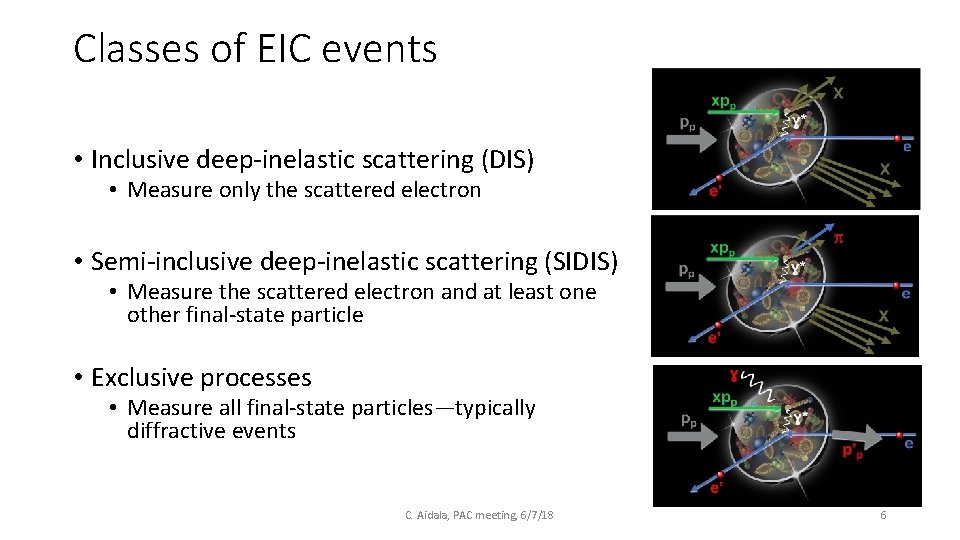
Classes of EIC events • Inclusive deep-inelastic scattering (DIS) • Measure only the scattered electron • Semi-inclusive deep-inelastic scattering (SIDIS) • Measure the scattered electron and at least one other final-state particle • Exclusive processes • Measure all final-state particles—typically diffractive events C. Aidala, PAC meeting, 6/7/18 6
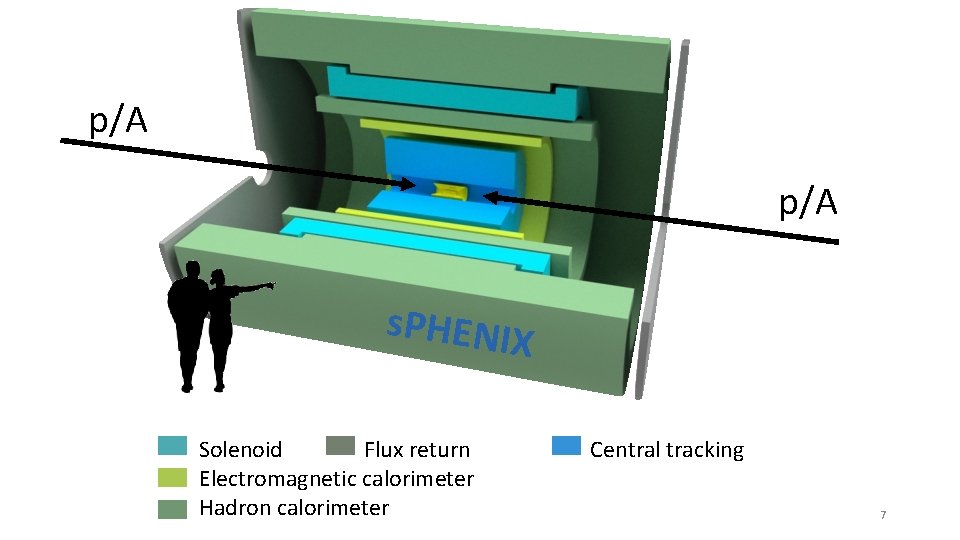
p/A s. PHENIX Solenoid Flux return Electromagnetic calorimeter Hadron calorimeter Central tracking 7
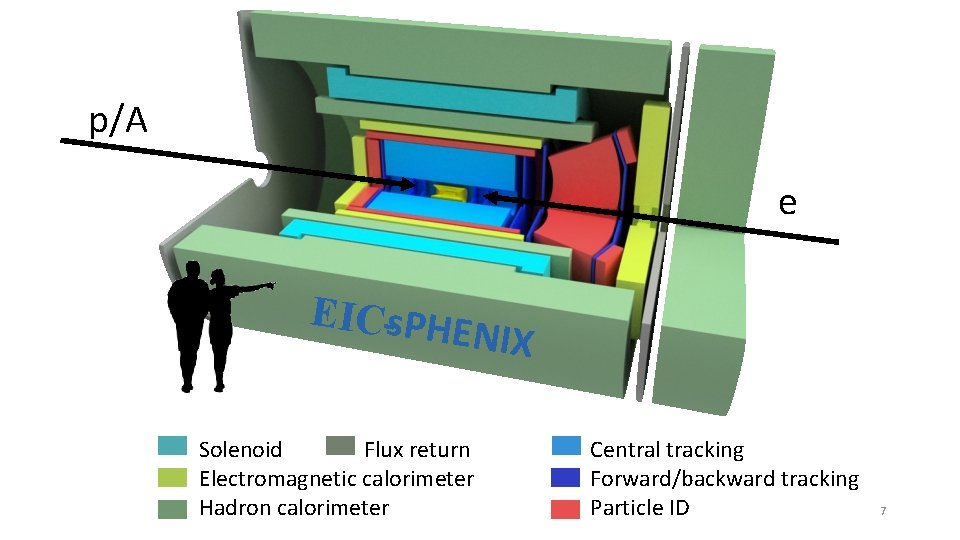
p/A e EIC-s. PHE NIX Solenoid Flux return Electromagnetic calorimeter Hadron calorimeter Central tracking Forward/backward tracking Particle ID 7
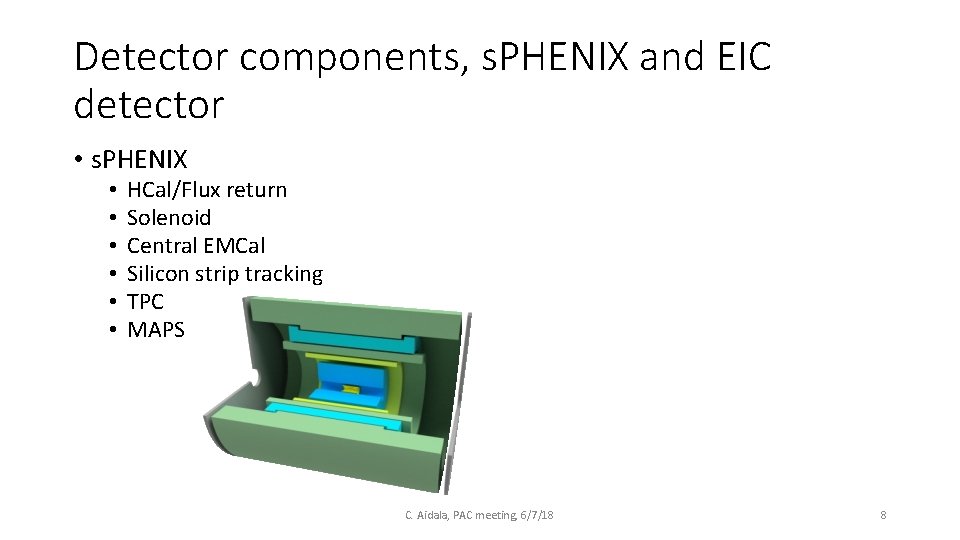
Detector components, s. PHENIX and EIC detector • s. PHENIX • • • HCal/Flux return Solenoid Central EMCal Silicon strip tracking TPC MAPS C. Aidala, PAC meeting, 6/7/18 8
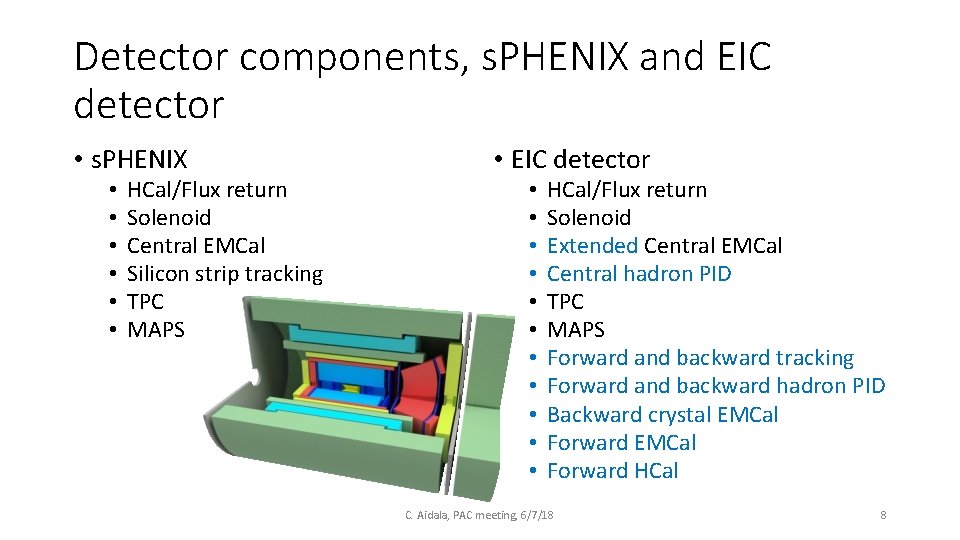
Detector components, s. PHENIX and EIC detector • s. PHENIX • • • HCal/Flux return Solenoid Central EMCal Silicon strip tracking TPC MAPS • EIC detector • • • HCal/Flux return Solenoid Extended Central EMCal Central hadron PID TPC MAPS Forward and backward tracking Forward and backward hadron PID Backward crystal EMCal Forward HCal C. Aidala, PAC meeting, 6/7/18 8
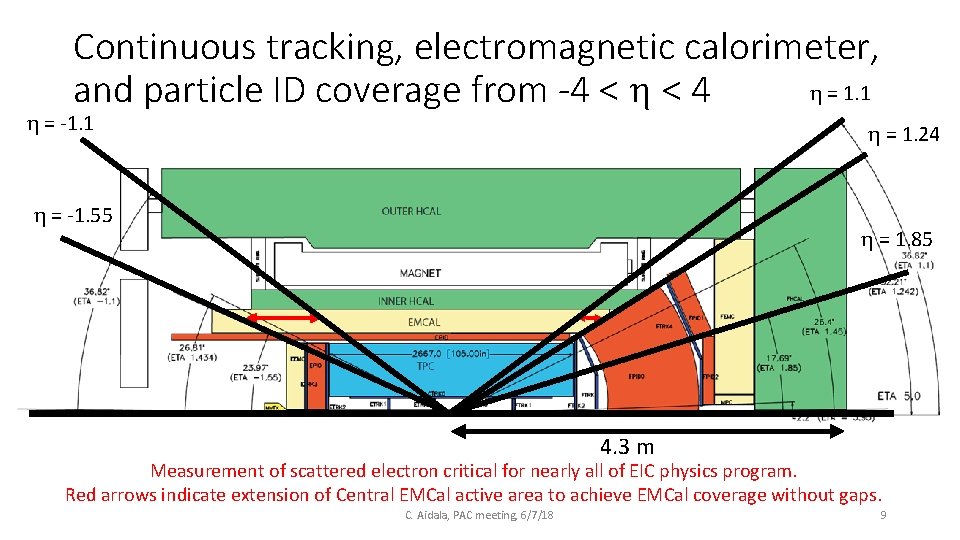
Continuous tracking, electromagnetic calorimeter, h = 1. 1 and particle ID coverage from -4 < h < 4 h = -1. 1 h = 1. 24 h = -1. 55 h = 1. 85 4. 3 m Measurement of scattered electron critical for nearly all of EIC physics program. Red arrows indicate extension of Central EMCal active area to achieve EMCal coverage without gaps. C. Aidala, PAC meeting, 6/7/18 9
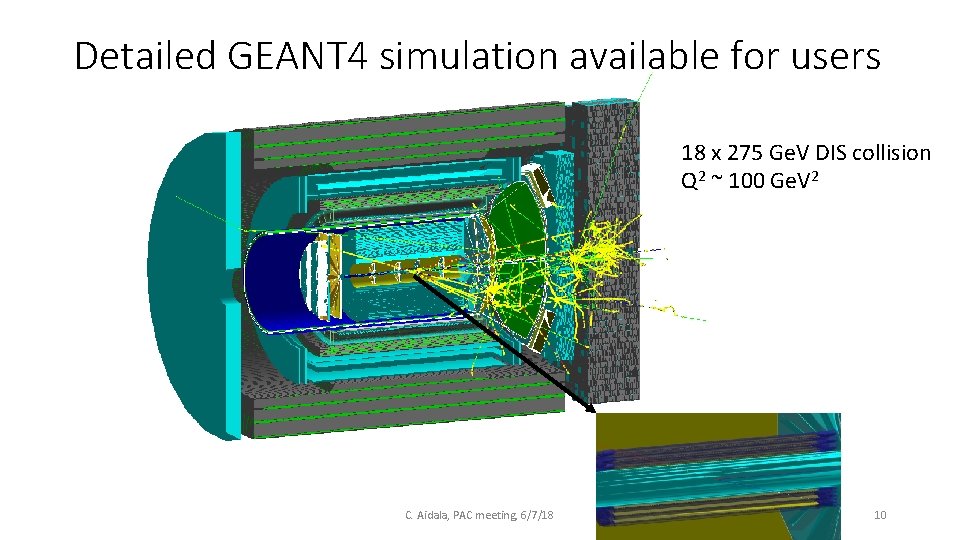
Detailed GEANT 4 simulation available for users 18 x 275 Ge. V DIS collision Q 2 ~ 100 Ge. V 2 C. Aidala, PAC meeting, 6/7/18 10
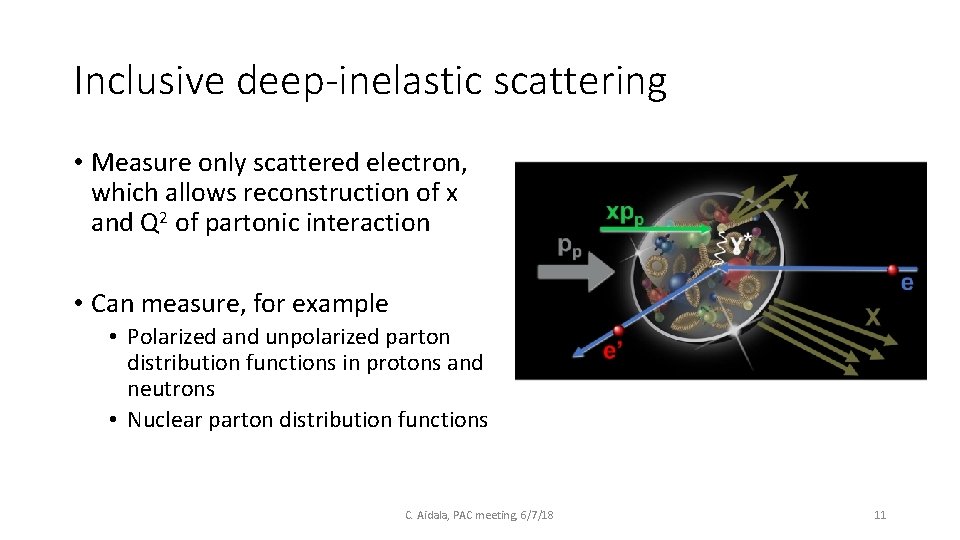
Inclusive deep-inelastic scattering • Measure only scattered electron, which allows reconstruction of x and Q 2 of partonic interaction • Can measure, for example • Polarized and unpolarized parton distribution functions in protons and neutrons • Nuclear parton distribution functions C. Aidala, PAC meeting, 6/7/18 11
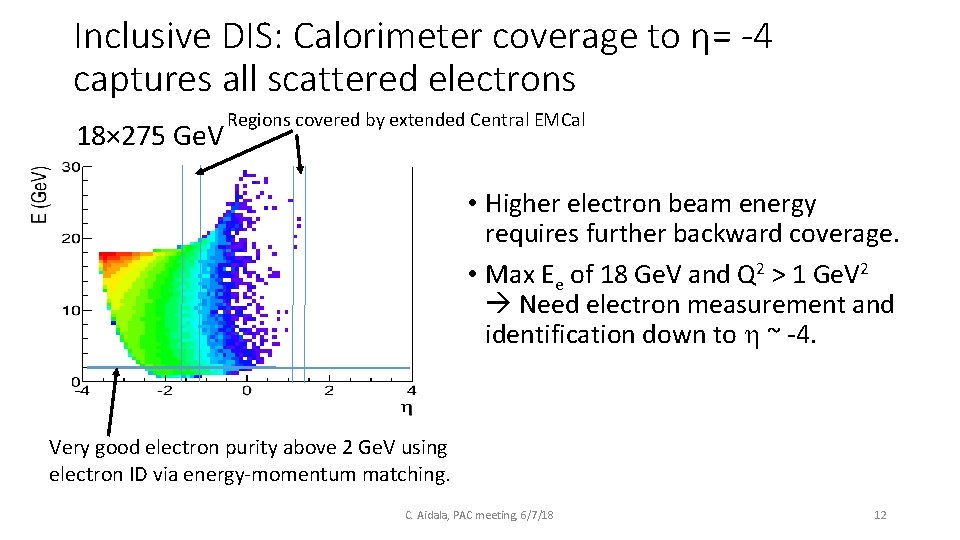
Inclusive DIS: Calorimeter coverage to η= -4 captures all scattered electrons 18× 275 Ge. V Regions covered by extended Central EMCal • Higher electron beam energy requires further backward coverage. • Max Ee of 18 Ge. V and Q 2 > 1 Ge. V 2 Need electron measurement and identification down to h ~ -4. Very good electron purity above 2 Ge. V using electron ID via energy-momentum matching. C. Aidala, PAC meeting, 6/7/18 12
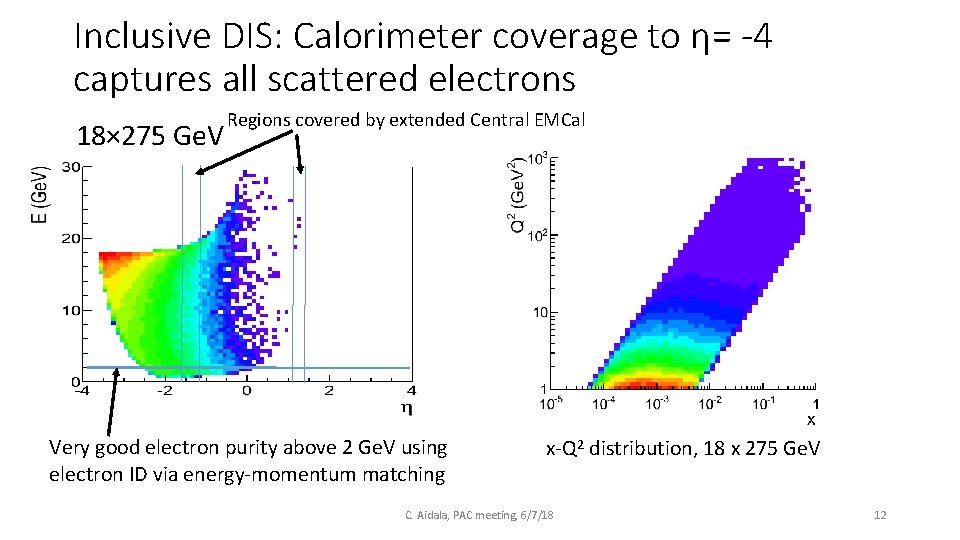
Inclusive DIS: Calorimeter coverage to η= -4 captures all scattered electrons 18× 275 Ge. V Regions covered by extended Central EMCal Very good electron purity above 2 Ge. V using electron ID via energy-momentum matching x-Q 2 distribution, 18 x 275 Ge. V C. Aidala, PAC meeting, 6/7/18 12
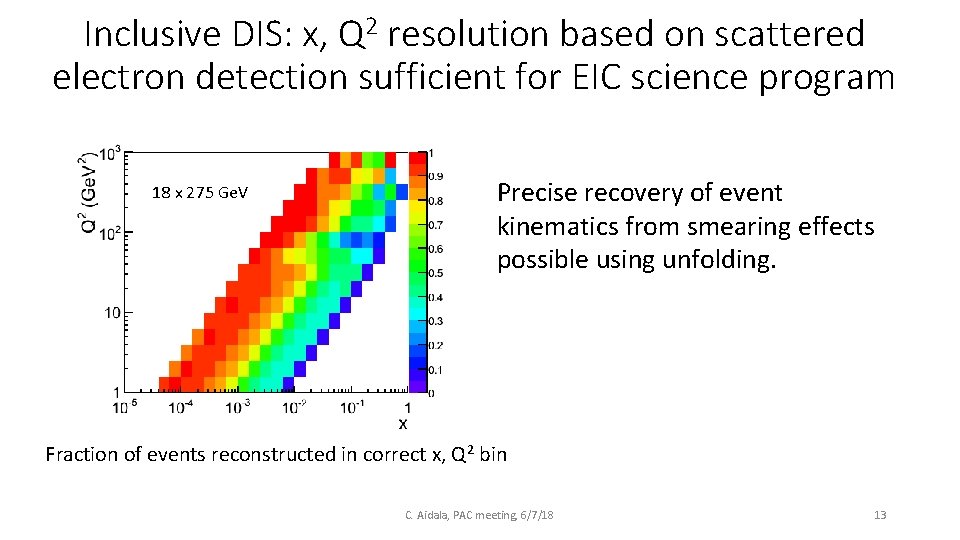
Inclusive DIS: x, Q 2 resolution based on scattered electron detection sufficient for EIC science program 18 x 275 Ge. V Precise recovery of event kinematics from smearing effects possible using unfolding. Fraction of events reconstructed in correct x, Q 2 bin C. Aidala, PAC meeting, 6/7/18 13
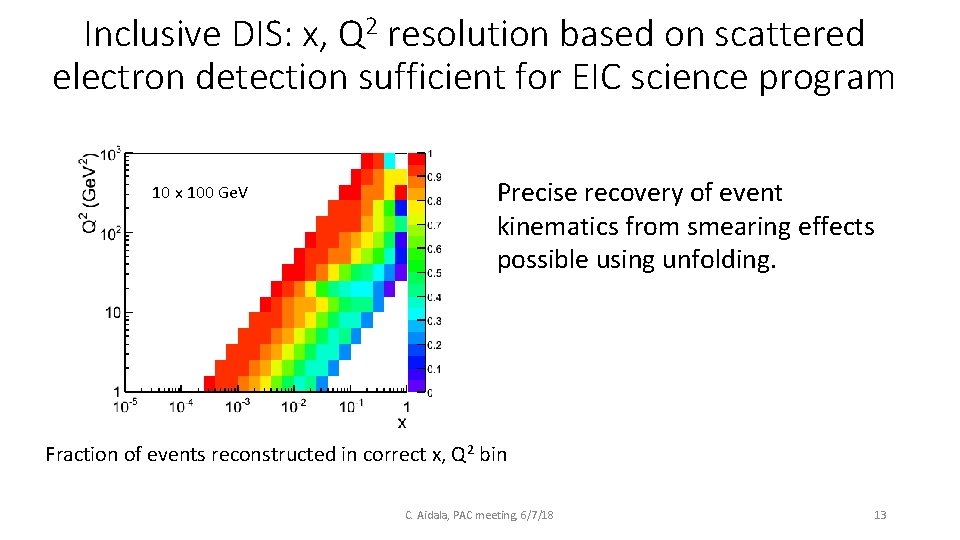
Inclusive DIS: x, Q 2 resolution based on scattered electron detection sufficient for EIC science program 10 x 100 Ge. V Precise recovery of event kinematics from smearing effects possible using unfolding. Fraction of events reconstructed in correct x, Q 2 bin C. Aidala, PAC meeting, 6/7/18 13
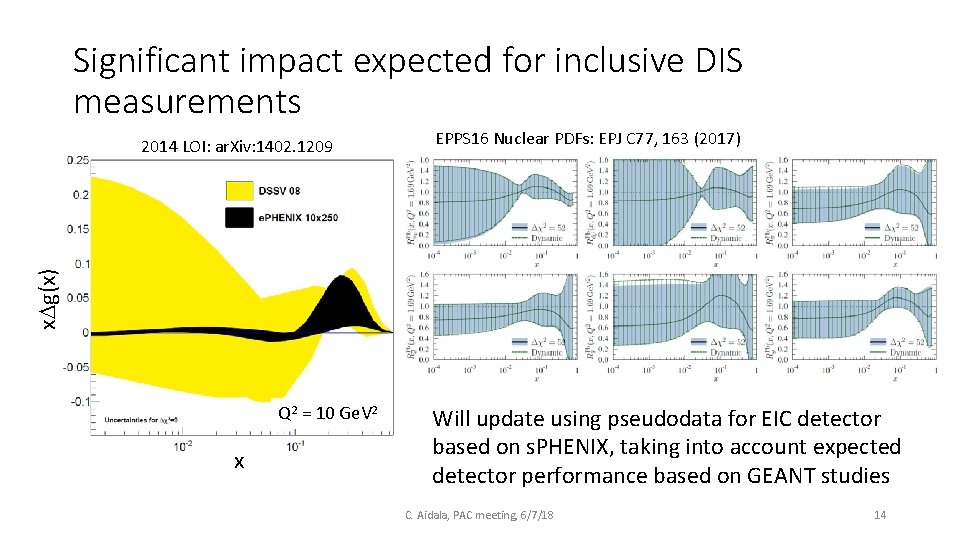
Significant impact expected for inclusive DIS measurements EPPS 16 Nuclear PDFs: EPJ C 77, 163 (2017) x. Dg(x) 2014 LOI: ar. Xiv: 1402. 1209 Q 2 = 10 Ge. V 2 x Will update using pseudodata for EIC detector based on s. PHENIX, taking into account expected detector performance based on GEANT studies C. Aidala, PAC meeting, 6/7/18 14
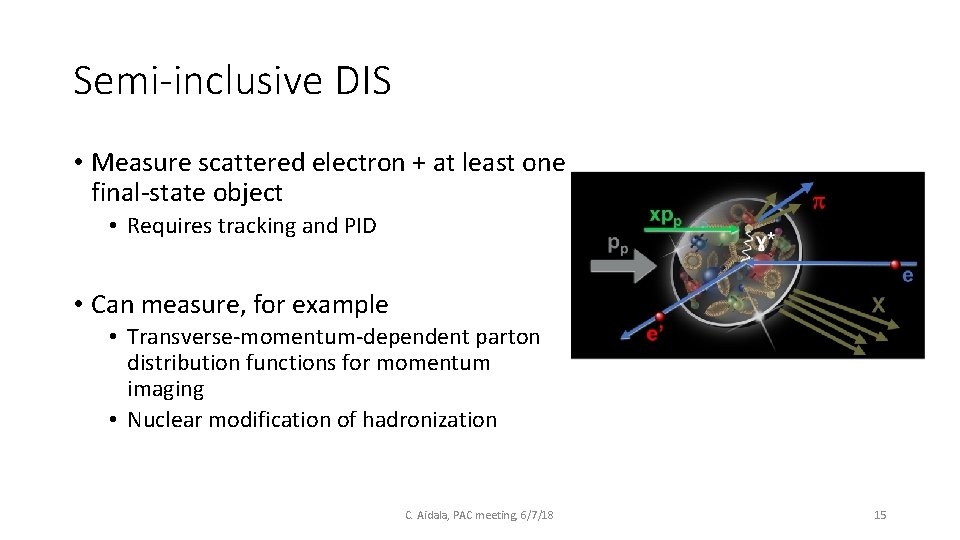
Semi-inclusive DIS • Measure scattered electron + at least one final-state object • Requires tracking and PID • Can measure, for example • Transverse-momentum-dependent parton distribution functions for momentum imaging • Nuclear modification of hadronization C. Aidala, PAC meeting, 6/7/18 15
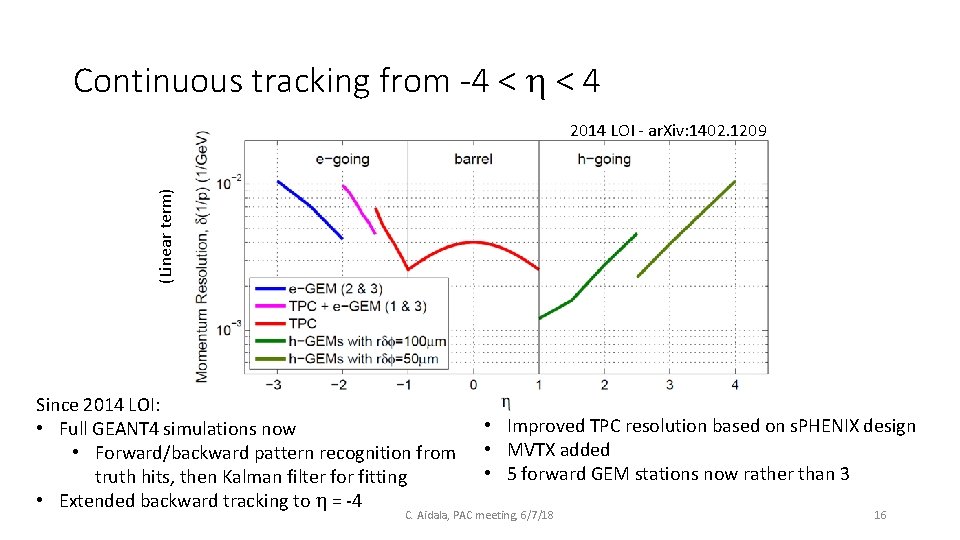
Continuous tracking from -4 < h < 4 (Linear term) 2014 LOI - ar. Xiv: 1402. 1209 Since 2014 LOI: • Full GEANT 4 simulations now • Forward/backward pattern recognition from truth hits, then Kalman filter for fitting • Extended backward tracking to h = -4 • Improved TPC resolution based on s. PHENIX design • MVTX added • 5 forward GEM stations now rather than 3 C. Aidala, PAC meeting, 6/7/18 16
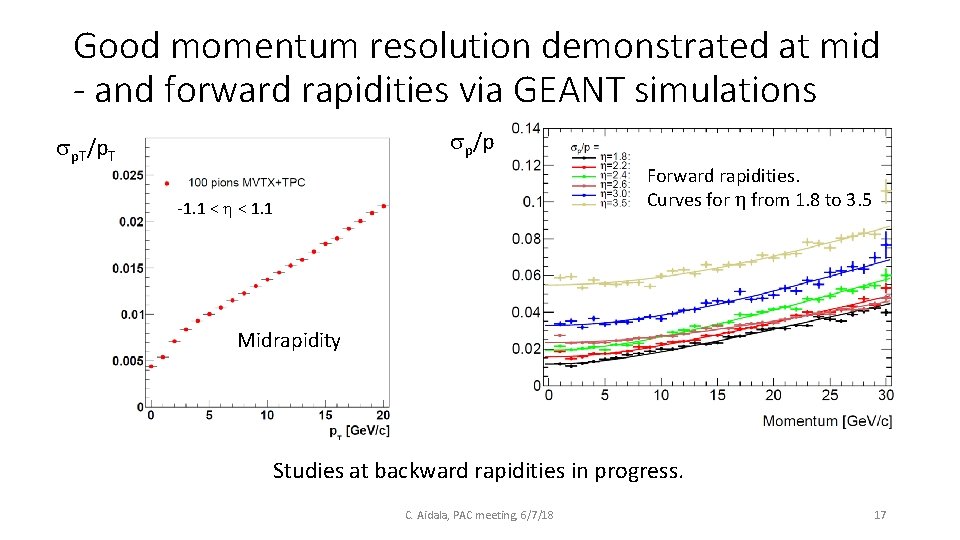
Good momentum resolution demonstrated at mid - and forward rapidities via GEANT simulations sp/p sp. T/p. T Forward rapidities. Curves for h from 1. 8 to 3. 5 -1. 1 < h < 1. 1 Midrapidity Studies at backward rapidities in progress. C. Aidala, PAC meeting, 6/7/18 17
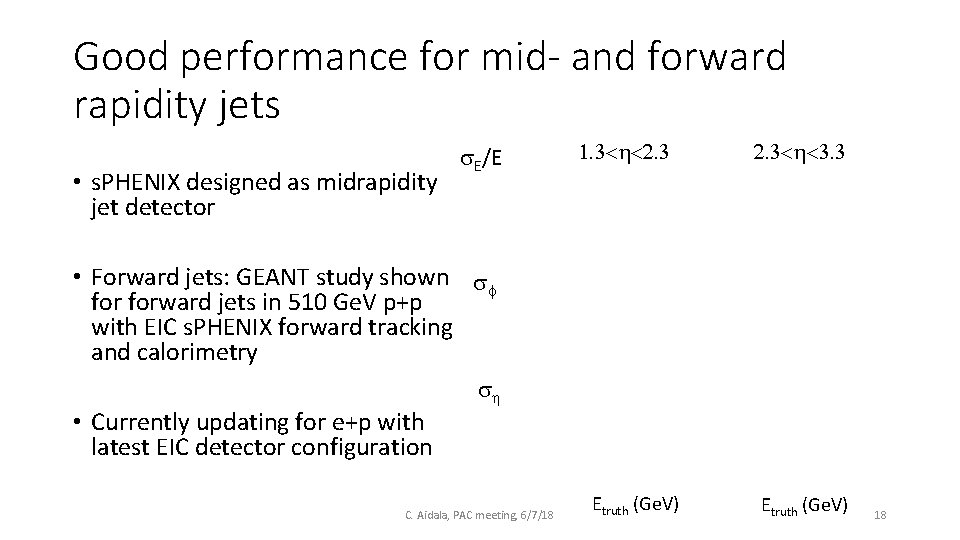
Good performance for mid- and forward rapidity jets • s. PHENIX designed as midrapidity jet detector s. E/E 1. 3<h<2. 3<h<3. 3 • Forward jets: GEANT study shown sf forward jets in 510 Ge. V p+p with EIC s. PHENIX forward tracking and calorimetry • Currently updating for e+p with latest EIC detector configuration sh C. Aidala, PAC meeting, 6/7/18 Etruth (Ge. V) 18
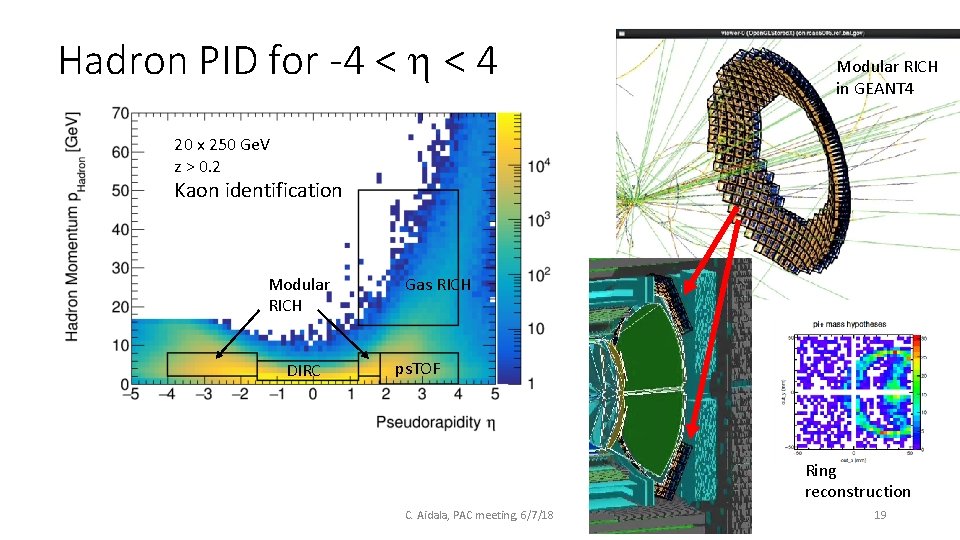
Hadron PID for -4 < h < 4 Modular RICH in GEANT 4 20 x 250 Ge. V z > 0. 2 Kaon identification Modular RICH DIRC Gas RICH ps. TOF Ring reconstruction C. Aidala, PAC meeting, 6/7/18 19
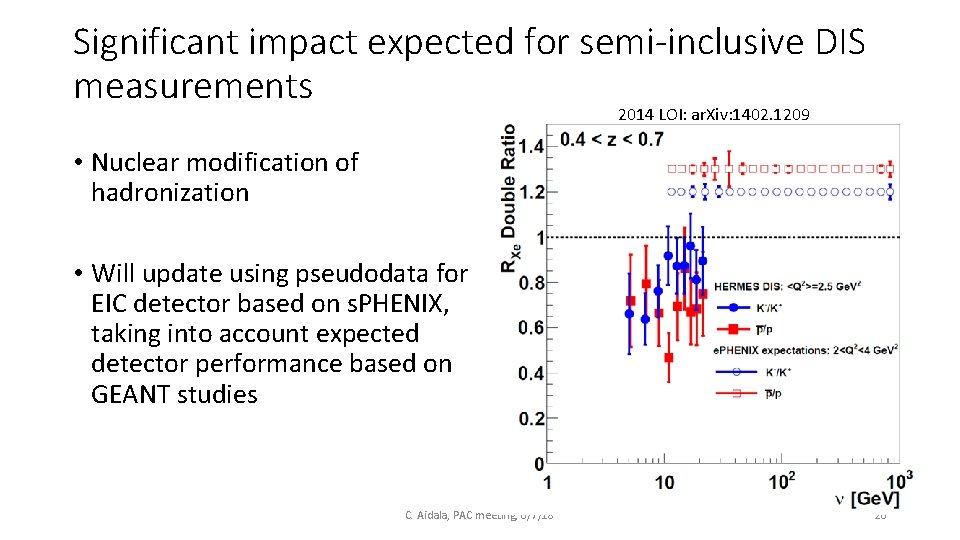
Significant impact expected for semi-inclusive DIS measurements 2014 LOI: ar. Xiv: 1402. 1209 • Nuclear modification of hadronization • Will update using pseudodata for EIC detector based on s. PHENIX, taking into account expected detector performance based on GEANT studies C. Aidala, PAC meeting, 6/7/18 20
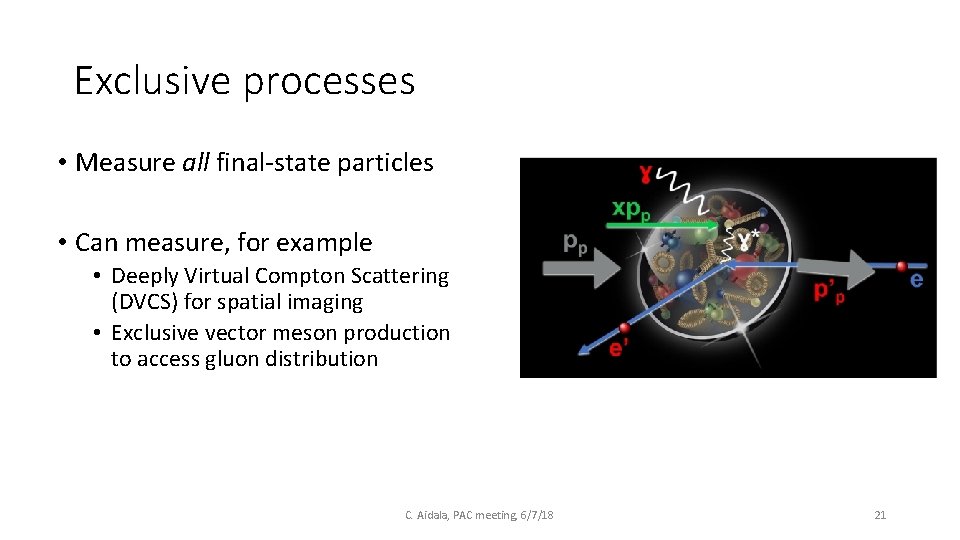
Exclusive processes • Measure all final-state particles • Can measure, for example • Deeply Virtual Compton Scattering (DVCS) for spatial imaging • Exclusive vector meson production to access gluon distribution C. Aidala, PAC meeting, 6/7/18 21
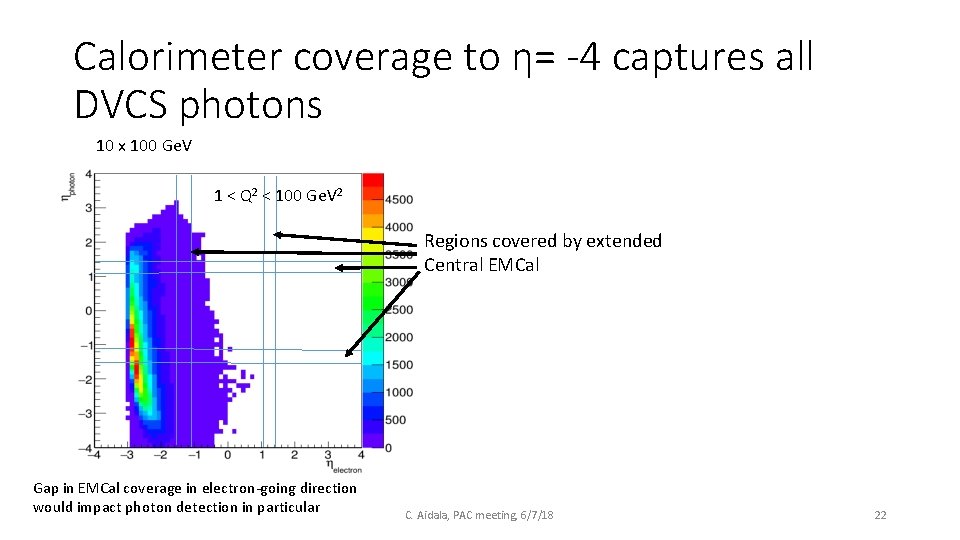
Calorimeter coverage to η= -4 captures all DVCS photons 10 x 100 Ge. V 1 < Q 2 < 100 Ge. V 2 Regions covered by extended Central EMCal Gap in EMCal coverage in electron-going direction would impact photon detection in particular • less for higher energy electron beam C. Aidala, PAC meeting, 6/7/18 22
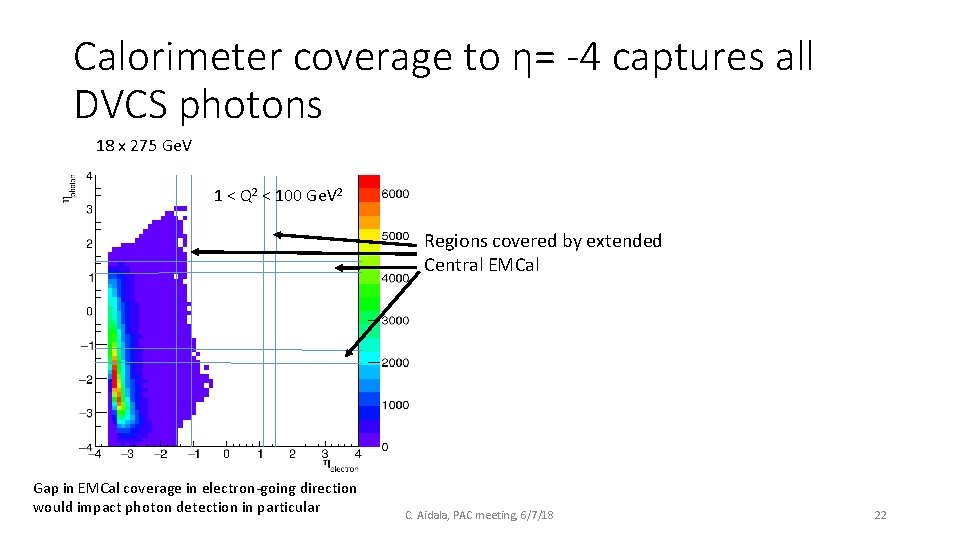
Calorimeter coverage to η= -4 captures all DVCS photons 18 x 275 Ge. V 1 < Q 2 < 100 Ge. V 2 Regions covered by extended Central EMCal Gap in EMCal coverage in electron-going direction would impact photon detection in particular • less for higher energy electron beam C. Aidala, PAC meeting, 6/7/18 22
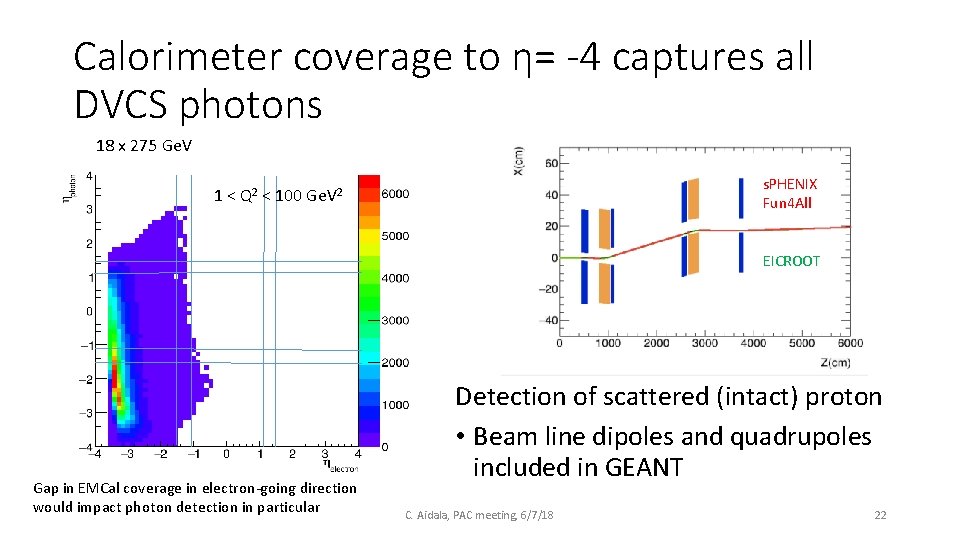
Calorimeter coverage to η= -4 captures all DVCS photons 18 x 275 Ge. V s. PHENIX Fun 4 All 1 < Q 2 < 100 Ge. V 2 EICROOT Gap in EMCal coverage in electron-going direction would impact photon detection in particular • less for higher energy electron beam Detection of scattered (intact) proton • Beam line dipoles and quadrupoles included in GEANT C. Aidala, PAC meeting, 6/7/18 22
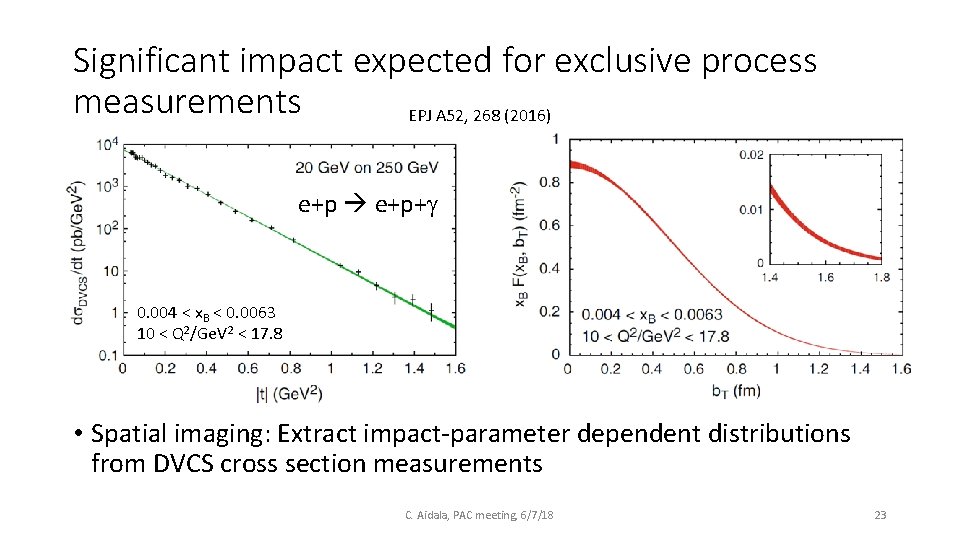
Significant impact expected for exclusive process measurements EPJ A 52, 268 (2016) e+p+g 0. 004 < x. B < 0. 0063 10 < Q 2/Ge. V 2 < 17. 8 • Spatial imaging: Extract impact-parameter dependent distributions from DVCS cross section measurements C. Aidala, PAC meeting, 6/7/18 23
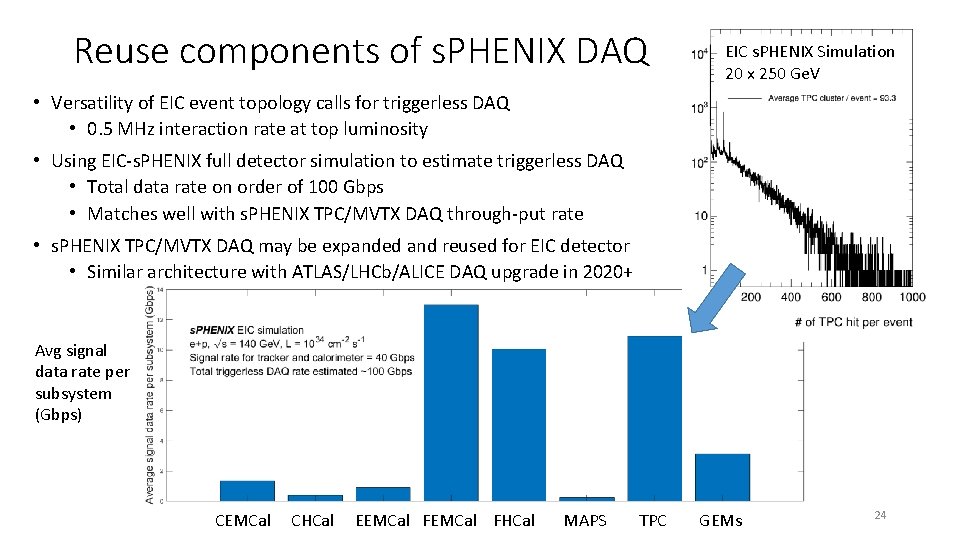
Reuse components of s. PHENIX DAQ EIC s. PHENIX Simulation 20 x 250 Ge. V • Versatility of EIC event topology calls for triggerless DAQ • 0. 5 MHz interaction rate at top luminosity • Using EIC-s. PHENIX full detector simulation to estimate triggerless DAQ • Total data rate on order of 100 Gbps • Matches well with s. PHENIX TPC/MVTX DAQ through-put rate • s. PHENIX TPC/MVTX DAQ may be expanded and reused for EIC detector • Similar architecture with ATLAS/LHCb/ALICE DAQ upgrade in 2020+ Avg signal data rate per subsystem (Gbps) CEMCal CHCal PAC meeting, 6/7/18 EEMCal. C. Aidala, FEMCal FHCal MAPS TPC GEMs 24
Additional studies are underway • Fully integrated tracking with appropriate resolutions for combined TPC + forward/backward tracking stations • Impact of projective geometry for electron-direction EMCal • Reconstruction of kinematics based on hadronic activity • Complements kinematics reconstruction based on scattered electron • Necessary to measure charged-current DIS events (unmeasured outgoing neutrino) • Charm tagging in low-multiplicity environment of EIC • Exclusive J/Psi production • Spectator tagging in collisions between electrons and light and heavy ions C. Aidala, PAC meeting, 6/7/18 25
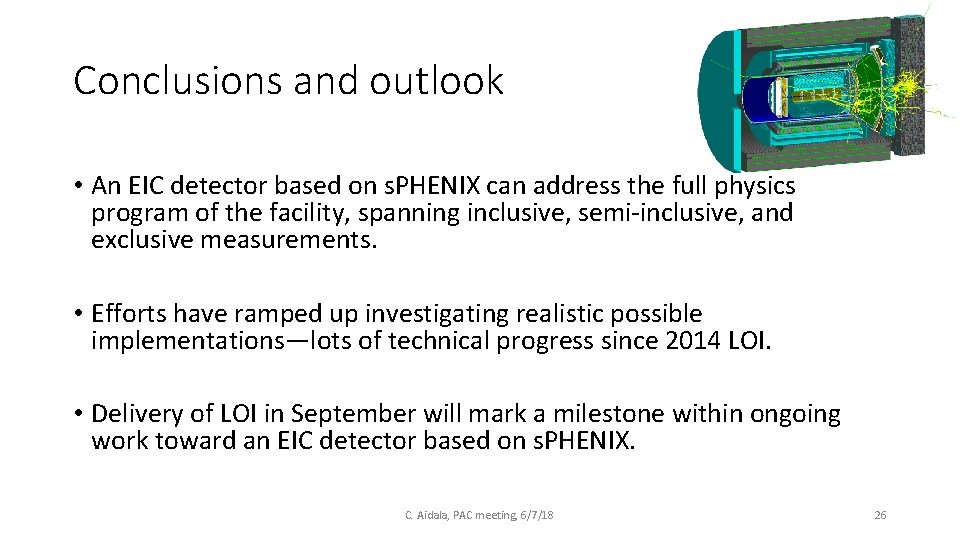
Conclusions and outlook • An EIC detector based on s. PHENIX can address the full physics program of the facility, spanning inclusive, semi-inclusive, and exclusive measurements. • Efforts have ramped up investigating realistic possible implementations—lots of technical progress since 2014 LOI. • Delivery of LOI in September will mark a milestone within ongoing work toward an EIC detector based on s. PHENIX. C. Aidala, PAC meeting, 6/7/18 26
Backup C. Aidala, PAC meeting, 6/7/18 27
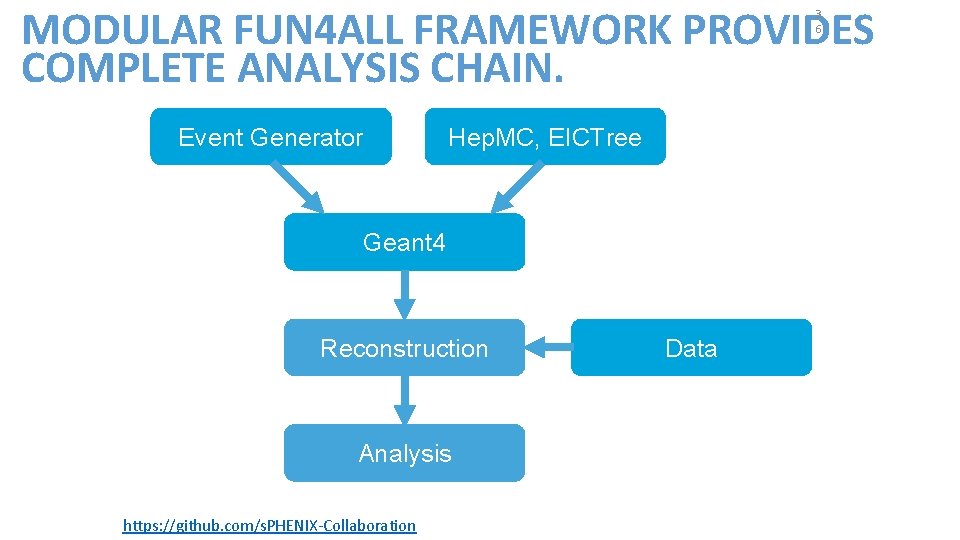
MODULAR FUN 4 ALL FRAMEWORK PROVIDES COMPLETE ANALYSIS CHAIN. 3 6 Event Generator Hep. MC, EICTree Geant 4 Reconstruction Analysis https: //github. com/s. PHENIX-Collaboration Data
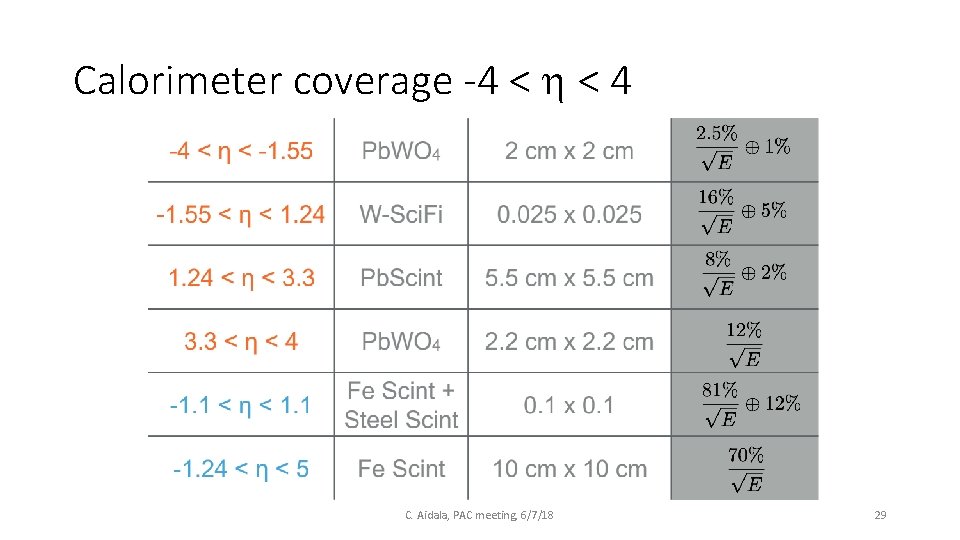
Calorimeter coverage -4 < h < 4 C. Aidala, PAC meeting, 6/7/18 29
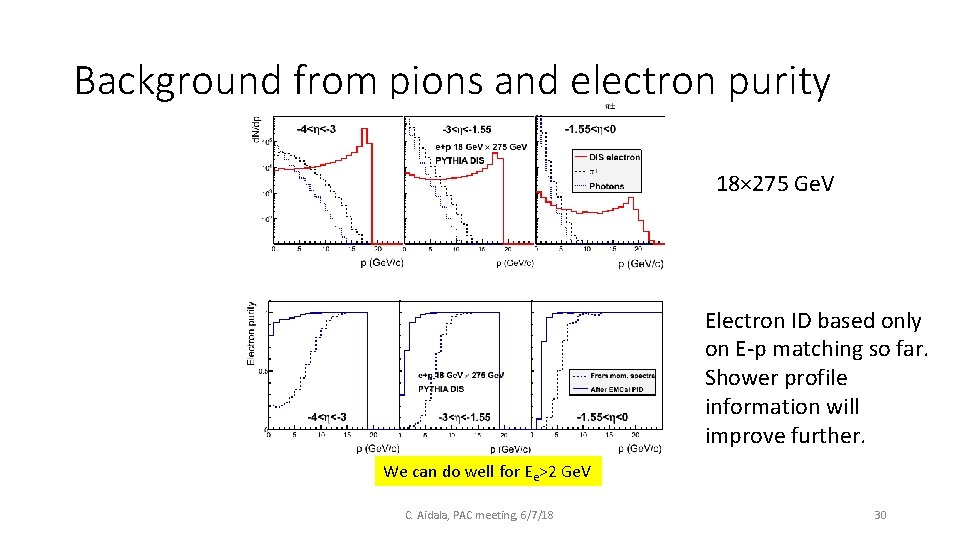
Background from pions and electron purity 18× 275 Ge. V Electron ID based only on E-p matching so far. Shower profile information will improve further. We can do well for Ee>2 Ge. V C. Aidala, PAC meeting, 6/7/18 30
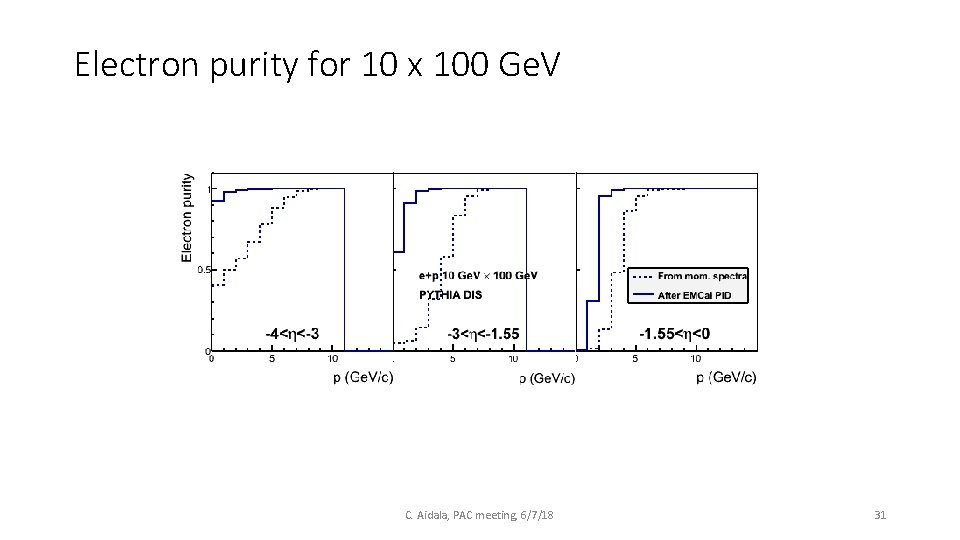
Electron purity for 10 x 100 Ge. V C. Aidala, PAC meeting, 6/7/18 31
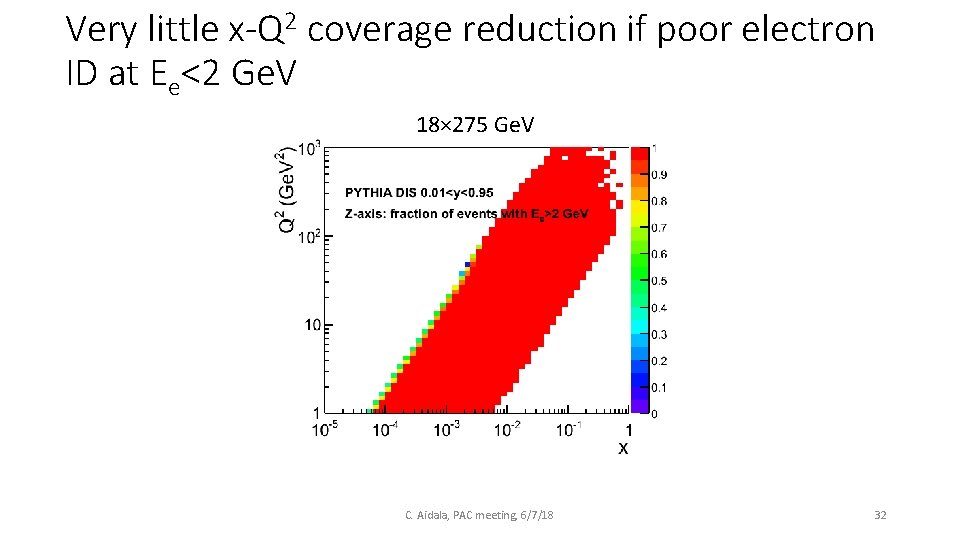
Very little x-Q 2 coverage reduction if poor electron ID at Ee<2 Ge. V 18× 275 Ge. V C. Aidala, PAC meeting, 6/7/18 32
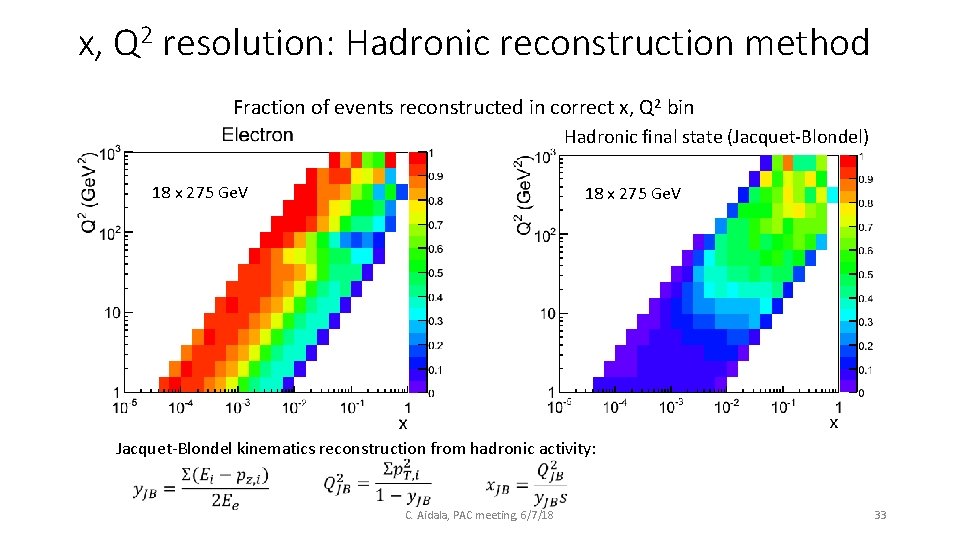
x, Q 2 resolution: Hadronic reconstruction method Fraction of events reconstructed in correct x, Q 2 bin Hadronic final state (Jacquet-Blondel) 18 x 275 Ge. V Jacquet-Blondel kinematics reconstruction from hadronic activity: C. Aidala, PAC meeting, 6/7/18 33
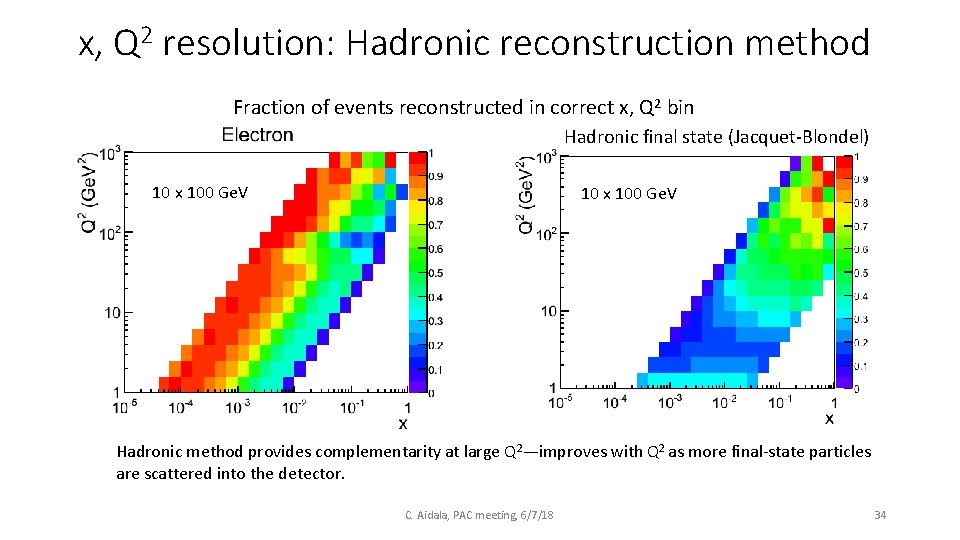
x, Q 2 resolution: Hadronic reconstruction method Fraction of events reconstructed in correct x, Q 2 bin Hadronic final state (Jacquet-Blondel) Hadronic 10 x 100 Ge. V Hadronic method provides complementarity at large Q 2—improves with Q 2 as more final-state particles are scattered into the detector. C. Aidala, PAC meeting, 6/7/18 34
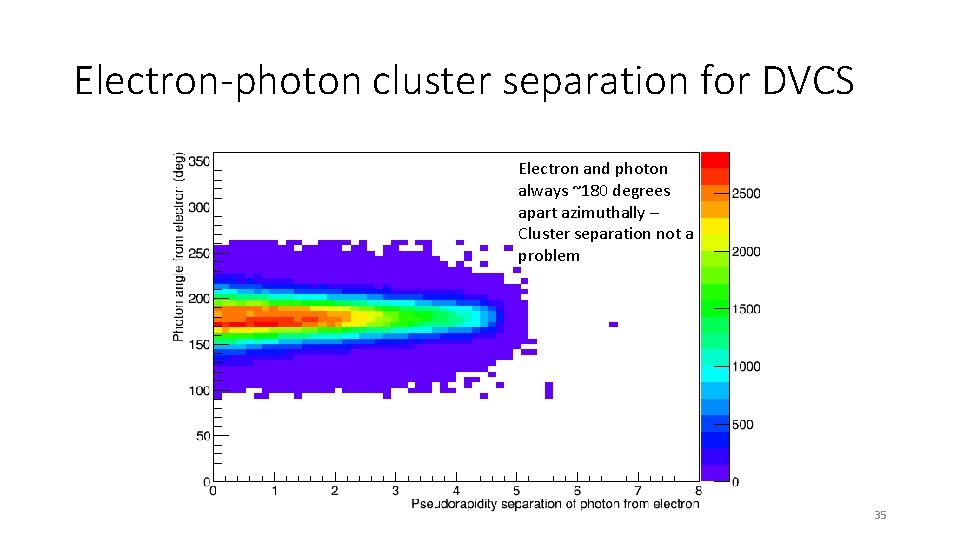
Electron-photon cluster separation for DVCS Electron and photon always ~180 degrees apart azimuthally – Cluster separation not a problem C. Aidala, PAC meeting, 6/7/18 35
- Slides: 43