
SCIENCE PRESENTATION ON SOME NATURAL PHENOMENA SUBMITTED BY
SCIENCE PRESENTATION ON {SOME NATURAL PHENOMENA} SUBMITTED BY: ROHIT ROLL NO: 872 CLASS: 8 TH B SUBMITTED TO: MR. GURPREET SINGH
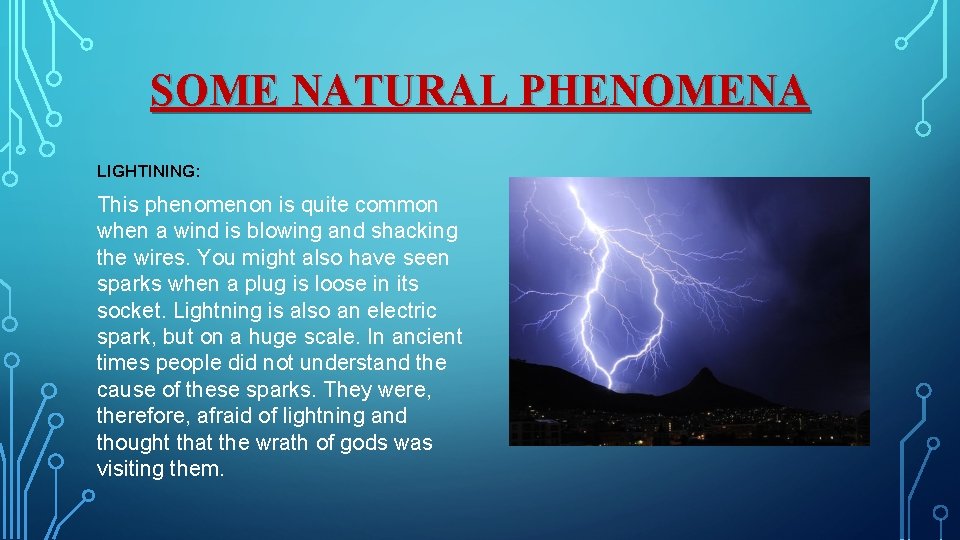
SOME NATURAL PHENOMENA LIGHTINING: This phenomenon is quite common when a wind is blowing and shacking the wires. You might also have seen sparks when a plug is loose in its socket. Lightning is also an electric spark, but on a huge scale. In ancient times people did not understand the cause of these sparks. They were, therefore, afraid of lightning and thought that the wrath of gods was visiting them.
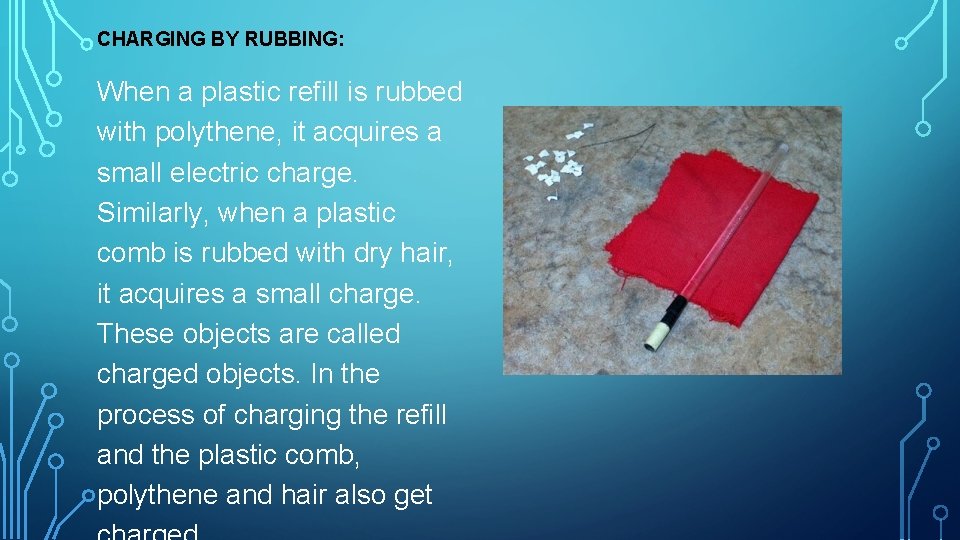
CHARGING BY RUBBING: When a plastic refill is rubbed with polythene, it acquires a small electric charge. Similarly, when a plastic comb is rubbed with dry hair, it acquires a small charge. These objects are called charged objects. In the process of charging the refill and the plastic comb, polythene and hair also get
TYPES OF CHARGES AND THEIR INTERACTION: It is a convention to call the charge acquired by a glass rod when it is rubbed with silk as positive. The other kind of charge is said to be negative. The electrical charges generated by rubbing are static. They do not move by themselves. When charges move, they constitute an electric current. The current in a circuit which makes a bulb glow, or the current that makes a wire hot, is nothing but a motion of charges.
TRANSFER OF CHARGE: The aluminium foil strips receive the same charge from the charged refill through the paper clip (remember that metals are good conductors of electricity). The strips carrying similar charges repel each other and they become wide open. Such a device can be used to test whether an object is carrying charge or not. This device is known as electroscope. The process of transferring of charge from a charged object to the earth is called earthing.
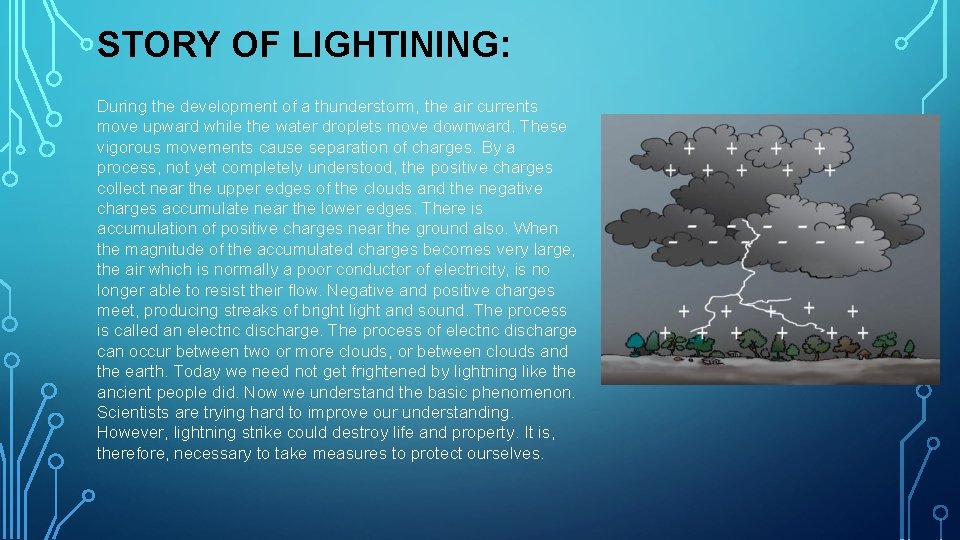
STORY OF LIGHTINING: During the development of a thunderstorm, the air currents move upward while the water droplets move downward. These vigorous movements cause separation of charges. By a process, not yet completely understood, the positive charges collect near the upper edges of the clouds and the negative charges accumulate near the lower edges. There is accumulation of positive charges near the ground also. When the magnitude of the accumulated charges becomes very large, the air which is normally a poor conductor of electricity, is no longer able to resist their flow. Negative and positive charges meet, producing streaks of bright light and sound. The process is called an electric discharge. The process of electric discharge can occur between two or more clouds, or between clouds and the earth. Today we need not get frightened by lightning like the ancient people did. Now we understand the basic phenomenon. Scientists are trying hard to improve our understanding. However, lightning strike could destroy life and property. It is, therefore, necessary to take measures to protect ourselves.
LIGHTNING SAFTEY: During lightning and thunderstorm no open place is safe. • Hearing thunder is an alert to rush to a safer place. • After hearing the last thunder, wait for some time before coming out of the safe place. • Get out of and away from open water. • Get away from tractors and other metal farm equipment • Get off of and away from motorcycles, scooters, golf carts and bicycles. Put down golf clubs. • Stay away from wire fences, clotheslines, metal pipes, rails and other metallic paths which could carry lightning to you from some distance away.
DO’S AND DON’TS DURING A THUNDERSTORM: Outside Inside the house Open vehicles, like motorbikes, tractors, construction machinery, open cars are not safe. Open fields, tall trees, shelters in parks, elevated places do not protect us from lightning strokes. Carrying umbrella is not a good idea at all during thunderstorms. If in a forest, take shelter under shorter trees. If no shelter is available and you are in an open field, stay far away from all trees. Stay away from poles or other metal objects. Do not lie on the ground. Instead, squat low on the ground. Place your hands on your knees with your head between the hands. This position will make you the smallest target to be struck Lightning can strike telephone cords, electrical wires and metal pipes (Do you remember, lightning is an electrical discharge? ). During a thunderstorm contact with these should be avoided. It is safer to use mobile phones and cordless phones. However, it is not wise to call up a person who is receiving your phone through a wired phone. Bathing should be avoided during thunderstorms to avoid contact with running water. Electrical appliances like computers, TVs, etc. , should be unplugged. Electrical lights can remain on. They do not cause any harm.
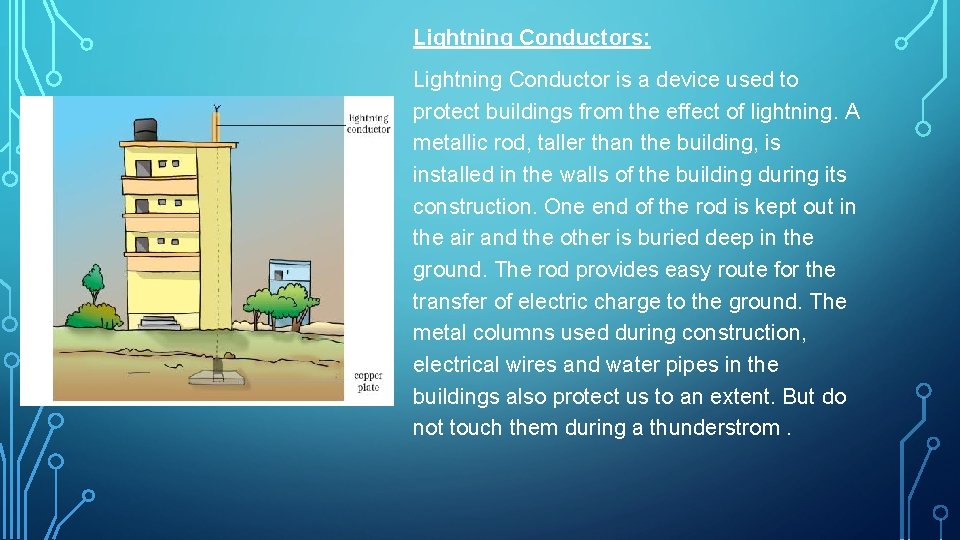
Lightning Conductors: Lightning Conductor is a device used to protect buildings from the effect of lightning. A metallic rod, taller than the building, is installed in the walls of the building during its construction. One end of the rod is kept out in the air and the other is buried deep in the ground. The rod provides easy route for the transfer of electric charge to the ground. The metal columns used during construction, electrical wires and water pipes in the buildings also protect us to an extent. But do not touch them during a thunderstrom.
EARTHQUAKE: These natural phenomena can cause large scale destruction of human life and property. Fortunately, these phenomena can be predicted to some extent. The weather department can warn about a thunderstorm developing in some area. If a thunderstorm occurs there is always a possibility of lightning and cyclones accompanying it. one natural phenomenon which we are not yet able to predict. It is an earthquake. It can cause damage to human life and property on a huge scale. A major earthquake occurred in India on 8 th October 2005 in Uri and Tangdhar towns of North Kashmir. Before that a major earthquake occurred on 26 th January 2001 in Bhuj District of Gujarat.
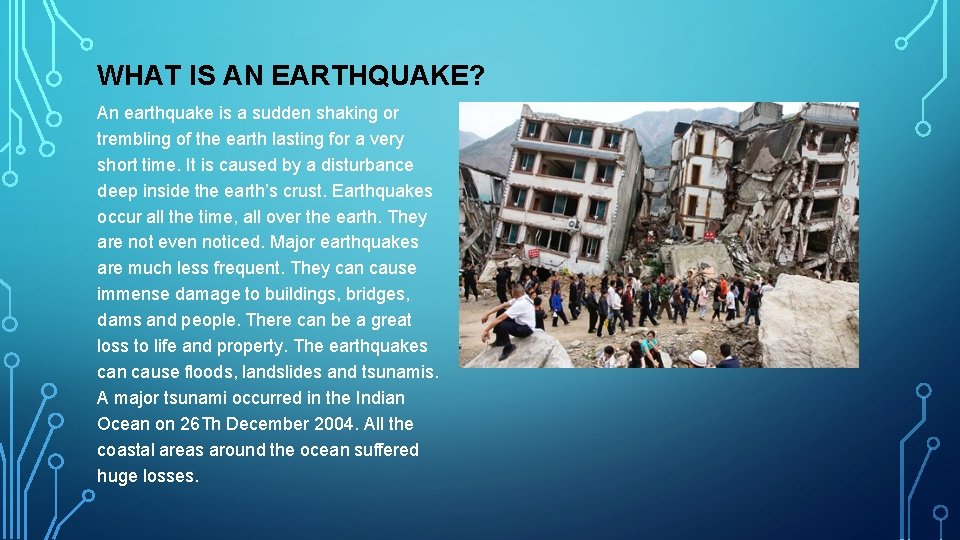
WHAT IS AN EARTHQUAKE? An earthquake is a sudden shaking or trembling of the earth lasting for a very short time. It is caused by a disturbance deep inside the earth’s crust. Earthquakes occur all the time, all over the earth. They are not even noticed. Major earthquakes are much less frequent. They can cause immense damage to buildings, bridges, dams and people. There can be a great loss to life and property. The earthquakes can cause floods, landslides and tsunamis. A major tsunami occurred in the Indian Ocean on 26 Th December 2004. All the coastal areas around the ocean suffered huge losses.
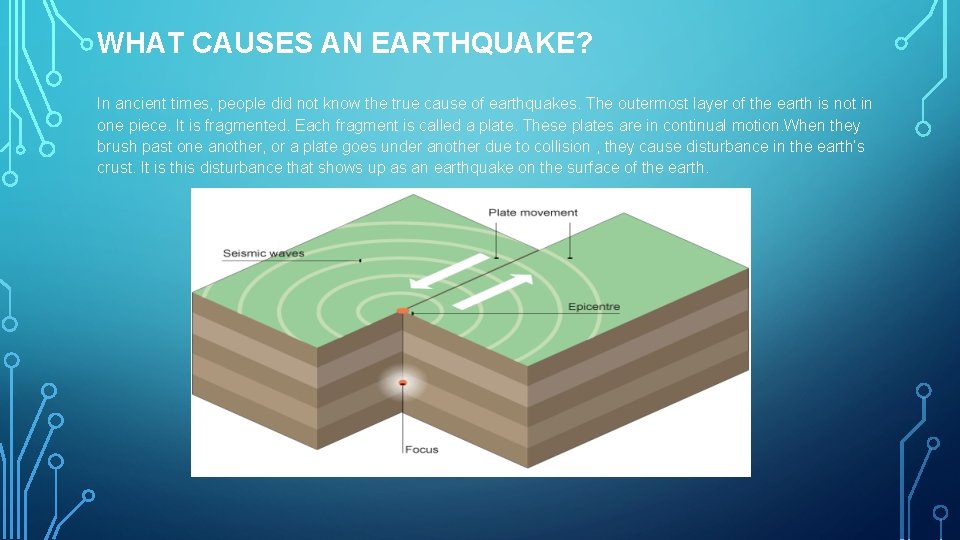
WHAT CAUSES AN EARTHQUAKE? In ancient times, people did not know the true cause of earthquakes. The outermost layer of the earth is not in one piece. It is fragmented. Each fragment is called a plate. These plates are in continual motion. When they brush past one another, or a plate goes under another due to collision , they cause disturbance in the earth’s crust. It is this disturbance that shows up as an earthquake on the surface of the earth.
PROTECTION AGAINST EARTHQUAKE: People living in seismic zones, where the earthquakes are more likely to occur, have to be specially prepared. First of all, the buildings in these zones should be designed so that they can withstand major tremors. Modern building technology can make it possible. It is advisable to make the structure simple so that it is ‘Quake Safe’. • Consult qualified architects and structural engineers. • In highly seismic areas, the use of mud or timber is better than the heavy construction material. Keep roofs as light as possible. In case the structure falls, the damage willnot be heavy. • It is better if the cupboards and shelves are fixed to the walls, so that they do not fall easily. • Be careful where you hang wall clocks, photo-frames, water heaters etc. , so that in the event of an earthquake, they do not fall on people. • Since some buildings may catch fire due to an earthquake, it is necessary that all buildings, especially tall buildings, have fire fighting equipment in working order. The Central Building Research Institute, Roorkee, has developed knowhow to make quake proof houses. In the event that an earthquake does strike, take the following steps to protect yourself:
1. IF YOU ARE AT HOME: • TAKE SHELTER UNDER A TABLE AND STAY THERE TILL SHAKING STOPS. • STAY AWAY FROM TALL AND HEAVY OBJECTS THAT MAY FALL ON YOU. • IF YOU ARE IN BED, DO NOT GET UP. PROTECT YOUR HEAD WITH A PILLOW. 2. IF YOU ARE OUTDOORS: • FIND A CLEAR SPOT, AWAY FROM BUILDINGS, TREES AND OVERHEAD POWER LINES. DROP TO THE GROUND. • IF YOU ARE IN A CAR OR A BUS, DO NOT COME OUT. ASK THE DRIVER TO DRIVE SLOWLY TO A CLEAR SPOT. DO NOT COME OUT TILL THE TREMORS STOP.
- Slides: 14