
SCIENCE PRACTICES Laboratory Exercises Gravimetric Analysis What It
SCIENCE PRACTICES Laboratory Exercises
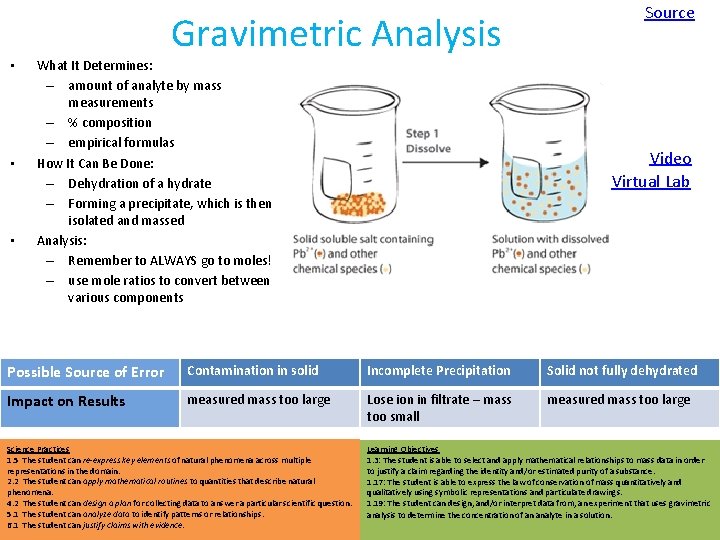
Gravimetric Analysis • • • What It Determines: – amount of analyte by mass measurements – % composition – empirical formulas How It Can Be Done: – Dehydration of a hydrate – Forming a precipitate, which is then isolated and massed Analysis: – Remember to ALWAYS go to moles! – use mole ratios to convert between various components Source Video Virtual Lab Possible Source of Error Contamination in solid Incomplete Precipitation Solid not fully dehydrated Impact on Results measured mass too large Lose ion in filtrate – mass too small measured mass too large Science Practices 1. 5 The student can re-express key elements of natural phenomena across multiple representations in the domain. 2. 2 The student can apply mathematical routines to quantities that describe natural phenomena. 4. 2 The student can design a plan for collecting data to answer a particular scientific question. 5. 1 The student can analyze data to identify patterns or relationships. 6. 1 The student can justify claims with evidence. Learning Objectives 1. 3: The student is able to select and apply mathematical relationships to mass data in order to justify a claim regarding the identity and/or estimated purity of a substance. 1. 17: The student is able to express the law of conservation of mass quantitatively and qualitatively using symbolic representations and particulate drawings. 1. 19: The student can design, and/or interpret data from, an experiment that uses gravimetric analysis to determine the concentration of an analyte in a solution.
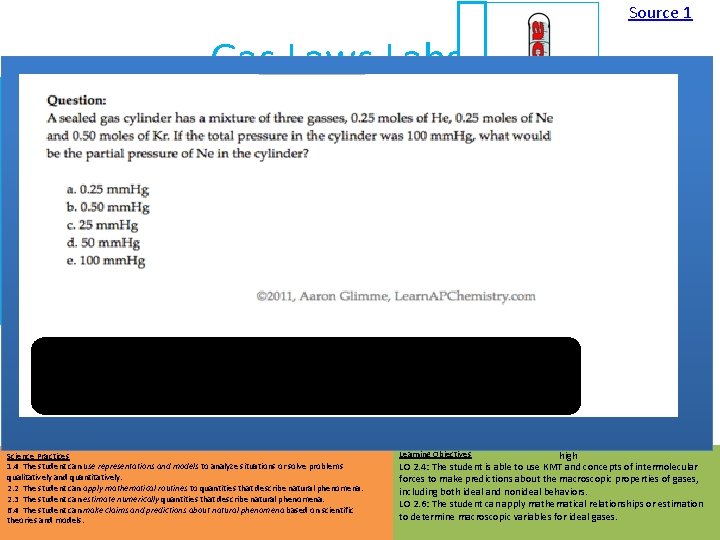
Source 1 – Determination of Molar Volume of a Gas Laws Labs • Determination of Molar Mass of a Volatile Liquid How It’s Done/Analysis: – Volatile liquid heated until completely vaporized – PV=n. RT to solve for n: • Temperature of water bath=T • Small hole in stopper means Pressure = room pressure • Volume=volume of flask – Divide Mass of recondensed unknown by moles, compare to known molar mass to ID unknown – Assume vapor completely recondenses If lose vapor, then mass would be too low, and moles http: //chemskills. com/? q=ideal_gas_law would be low Diffusion : Graham’s Law Demo • How It’s Done/Analysis: – Ends of glass tube plugged with soaked cotton – White ring is NH 4 Cl ppt – Ppt will not be exactly in middle… Science Practices 1. 4 The student can use representations and models to analyze situations or solve problems qualitatively and quantitatively. 2. 2 The student can apply mathematical routines to quantities that describe natural phenomena. 2. 3 The student can estimate numerically quantities that describe natural phenomena. 6. 4 The student can make claims and predictions about natural phenomena based on scientific theories and models. Learning Objectives – After rxn, eudiometer lowered into water until levels equal so pressure inside room and tube are same Use Dalton’s Law to subtract Pwater Sources of error: • Mg left: mol es of H 2 too low • Air bub ble Molar mass of NH 3 is lower than MM of HCl, so ring will be toward at right side of tube star Graham’s Law can be used to t: establish ratios which can be volu applied to distances me of gas too high Source 2 Video 1 – Video 2 Video 3 • • LO 2. 4: The student is able to use KMT and concepts of intermolecular forces to make predictions about the macroscopic properties of gases, including both ideal and nonideal behaviors. LO 2. 6: The student can apply mathematical relationships or estimation to determine macroscopic variables for ideal gases.
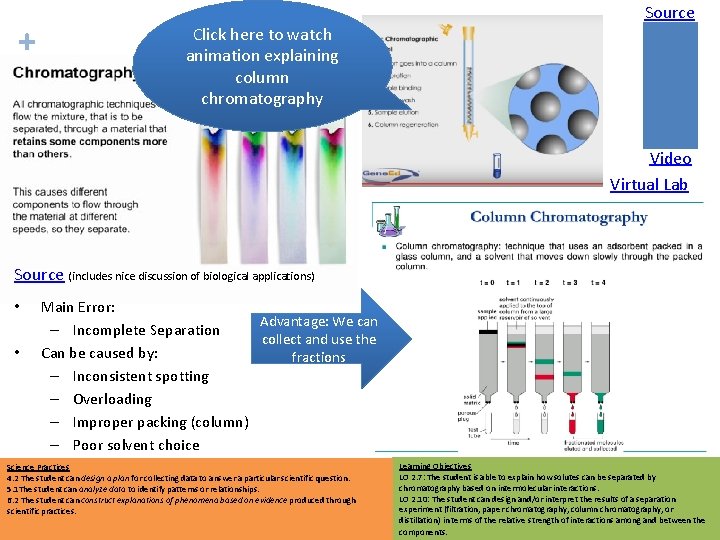
+ Click here to watch animation explaining column chromatography Source Chromatography Video Virtual Lab Source (includes nice discussion of biological applications) • • Main Error: Advantage: We can – Incomplete Separation collect and use the Can be caused by: fractions – Inconsistent spotting – Overloading – Improper packing (column) – Poor solvent choice Science Practices 4. 2 The student can design a plan for collecting data to answer a particular scientific question. 5. 1 The student can analyze data to identify patterns or relationships. 6. 2 The student can construct explanations of phenomena based on evidence produced through scientific practices. Learning Objectives LO 2. 7: The student is able to explain how solutes can be separated by chromatography based on intermolecular interactions. LO 2. 10: The student can design and/or interpret the results of a separation experiment (filtration, paper chromatography, column chromatography, or distillation) in terms of the relative strength of interactions among and between the components.
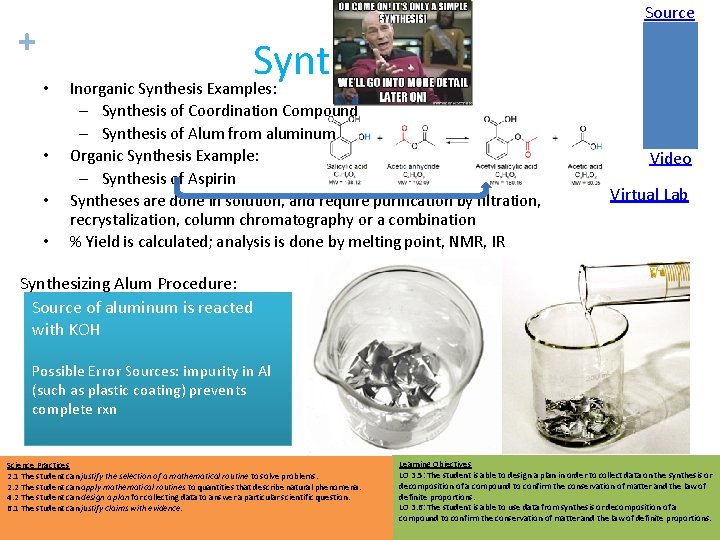
Source + • • Synthesis Inorganic Synthesis Examples: – Synthesis of Coordination Compound – Synthesis of Alum from aluminum Organic Synthesis Example: – Synthesis of Aspirin Syntheses are done in solution, and require purification by filtration, recrystalization, column chromatography or a combination % Yield is calculated; analysis is done by melting point, NMR, IR Video Virtual Lab Synthesizing Alum Procedure: Source of aluminum is reacted H Mixture heated until no Al(s) is left Filter and collect alum crystals Recrystallize alum in ice bath 2 SO 4 is added to ppt Al(OH)3 with KOH Possible Error Sources: some Al(s) Possible Error Sources: incomplete Possible Error Sources: crystals escape Possible Error Sources: crystals form Possible Error Sources: impurity in Al precipitation remains undissolved to filtrate, crystals not washed well too quickly, incomplete (such as plastic coating) prevents and remain wet recrystallization complete rxn Science Practices 2. 1 The student can justify the selection of a mathematical routine to solve problems. 2. 2 The student can apply mathematical routines to quantities that describe natural phenomena. 4. 2 The student can design a plan for collecting data to answer a particular scientific question. 6. 1 The student can justify claims with evidence. LO: Learning Objectives LO 3. 5: The student is able to design a plan in order to collect data on the synthesis or decomposition of a compound to confirm the conservation of matter and the law of definite proportions. LO 3. 6: The student is able to use data from synthesis or decomposition of a compound to confirm the conservation of matter and the law of definite proportions.
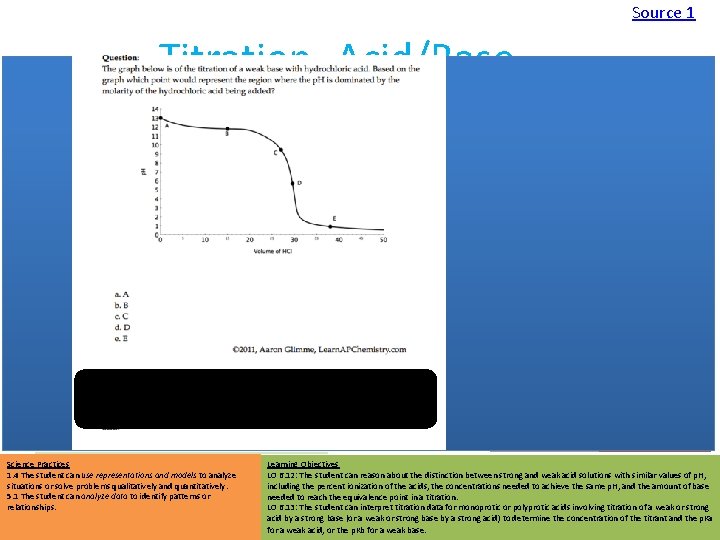
Source 1 Titration- Acid/Base • Assumption: Endpoint is equivalence point – This is not true – we actually “overshoot” before indicator changes Source 2 • Possible Sources of Error: – Overshoot Endpoint • Moles of titrant (and therefore analyte) too high – Not reading to bottom of meniscus Source Video Virtual Lab Strength of Acids affects shape of graph: • Moles of titrant too low – Concentration of titrant not what expected • Be sure to rinse buret with titrant first to control for this Science Practices 1. 4 The student can use representations and models to analyze situations or solve problems qualitatively and quantitatively. 5. 1 The student can analyze data to identify patterns or relationships. Polyprotic acids have multiple end points: Learning Objectives LO 6. 12: The student can reason about the distinction between strong and weak acid solutions with similar values of p. H, including the percent ionization of the acids, the concentrations needed to achieve the same p. H, and the amount of base needed to reach the equivalence point in a titration. LO 6. 13: The student can interpret titration data for monoprotic or polyprotic acids involving titration of a weak or strong acid by a strong base (or a weak or strong base by a strong acid) to determine the concentration of the titrant and the p. Ka for a weak acid, or the p. Kb for a weak base.
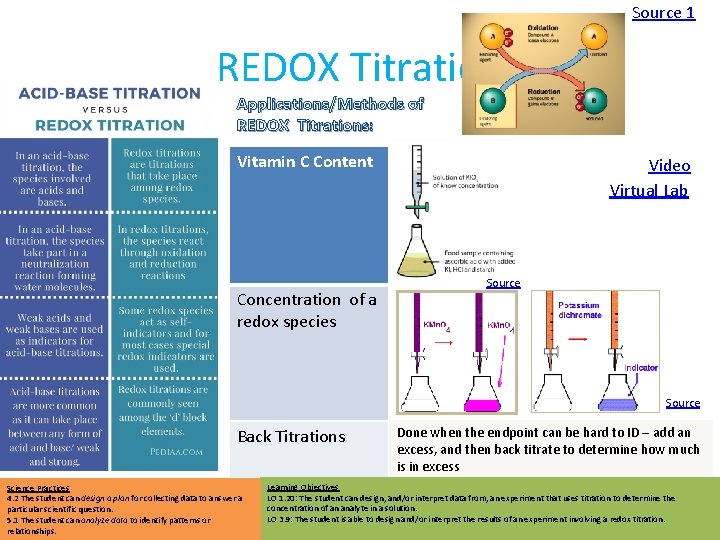
Source 1 • • • Endpoint can be Or REDOX determined by Or an indicator: potentiometer: that shows the presence of a particular species: REDOX Titration Applications/Methods of REDOX Titrations: Vitamin C Content Video Virtual Lab Source • Starch indicates presence of iodine Concentration of a redox species Source Back Titrations Science Practices 4. 2 The student can design a plan for collecting data to answer a particular scientific question. 5. 1 The student can analyze data to identify patterns or relationships. Done when the endpoint can be hard to ID – add an excess, and then back titrate to determine how much is in excess Learning Objectives LO 1. 20: The student can design, and/or interpret data from, an experiment that uses titration to determine the concentration of an analyte in a solution. LO 3. 9: The student is able to design and/or interpret the results of an experiment involving a redox titration.
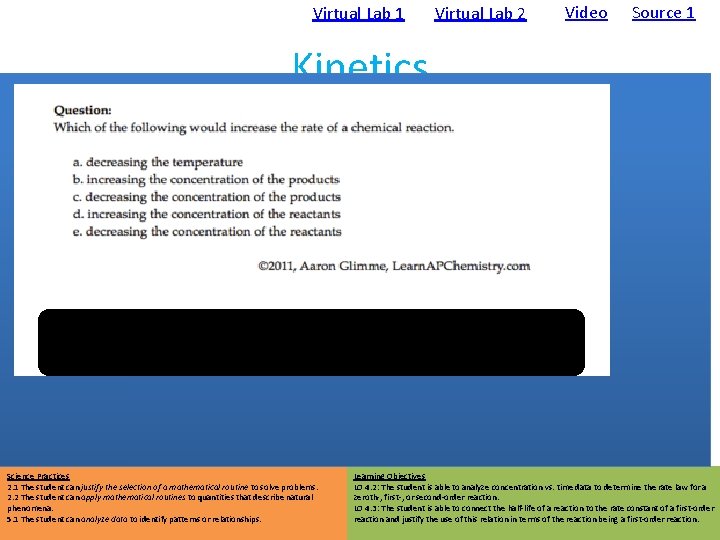
Virtual Lab 1 • Using Spectrometry: Time (s) 1 st Order Plot Video Source 1 Kinetics • Data: Zero Order Plot Virtual Lab 2 2 nd Order Plot • Clock Reactions – Reactions that have a delayed physical change due to mechanism which only has a later step show color change – Concentration vs. time data can be gathered • It is important that there is a relatively low [S 2 O 3 -] so that the I 3 - will accumulate and show the color change – Analysis • rate law from straight-line graph • k from integrated rate law • Ea from Arrhenius Equation Blue in the presence of starch Science Practices 2. 1 The student can justify the selection of a mathematical routine to solve problems. 2. 2 The student can apply mathematical routines to quantities that describe natural phenomena. 5. 1 The student can analyze data to identify patterns or relationships. Learning Objectives LO 4. 2: The student is able to analyze concentration vs. time data to determine the rate law for a zeroth-, first-, or second-order reaction. LO 4. 3: The student is able to connect the half-life of a reaction to the rate constant of a first-order reaction and justify the use of this relation in terms of the reaction being a first-order reaction.
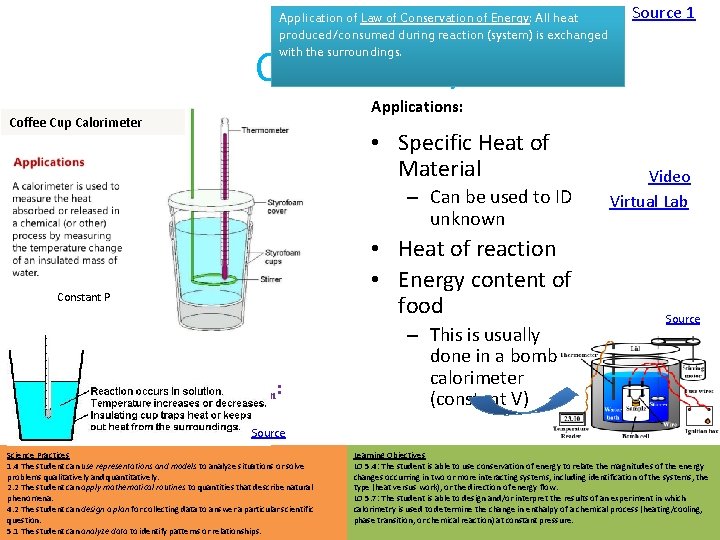
Application of Law of Conservation of Energy: All heat produced/consumed during reaction (system) is exchanged with the surroundings. Source 1 Calorimetry Applications: Coffee Cup Calorimeter Assumption: • the calorimeter is isolated • so the surroundings are only the calorimeter setup, which includes the water • the calorimeter itself has a heat capacity, as it will absorb some heat. • So… qsurr = -qrxn Constant P qsurr = qcal+q. H 2 O+sys qcal = CcalΔT Therefore: -qrxn= CcalΔT + m. H 2 O+syscΔT Then we can use qrxn find ΔHrxn: ΔHrxn =qrxn/molreact • Specific Heat of Material – Can be used to ID unknown • Heat of reaction • Energy content of food – This is usually done in a bomb calorimeter (constant V) Video Virtual Lab Source Science Practices 1. 4 The student can use representations and models to analyze situations or solve problems qualitatively and quantitatively. 2. 2 The student can apply mathematical routines to quantities that describe natural phenomena. 4. 2 The student can design a plan for collecting data to answer a particular scientific question. 5. 1 The student can analyze data to identify patterns or relationships. Learning Objectives LO 5. 4: The student is able to use conservation of energy to relate the magnitudes of the energy changes occurring in two or more interacting systems, including identification of the systems, the type (heat versus work), or the direction of energy flow. LO 5. 7: The student is able to design and/or interpret the results of an experiment in which calorimetry is used to determine the change in enthalpy of a chemical process (heating/cooling, phase transition, or chemical reaction) at constant pressure.
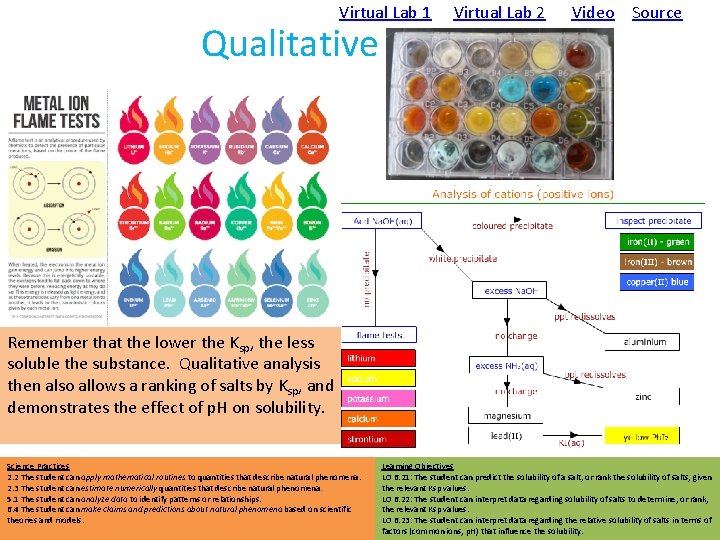
Virtual Lab 1 Virtual Lab 2 Qualitative Analysis Video Source Remember that the lower the Ksp, the less soluble the substance. Qualitative analysis then also allows a ranking of salts by Ksp, and demonstrates the effect of p. H on solubility. Science Practices 2. 2 The student can apply mathematical routines to quantities that describe natural phenomena. 2. 3 The student can estimate numerically quantities that describe natural phenomena. 5. 1 The student can analyze data to identify patterns or relationships. 6. 4 The student can make claims and predictions about natural phenomena based on scientific theories and models. Learning Objectives LO 6. 21: The student can predict the solubility of a salt, or rank the solubility of salts, given the relevant Ksp values. LO 6. 22: The student can interpret data regarding solubility of salts to determine, or rank, the relevant Ksp values. LO 6. 23: The student can interpret data regarding the relative solubility of salts in terms of factors (common ions, p. H) that influence the solubility.

NOW… Just for Fun Some “Harry” Problems
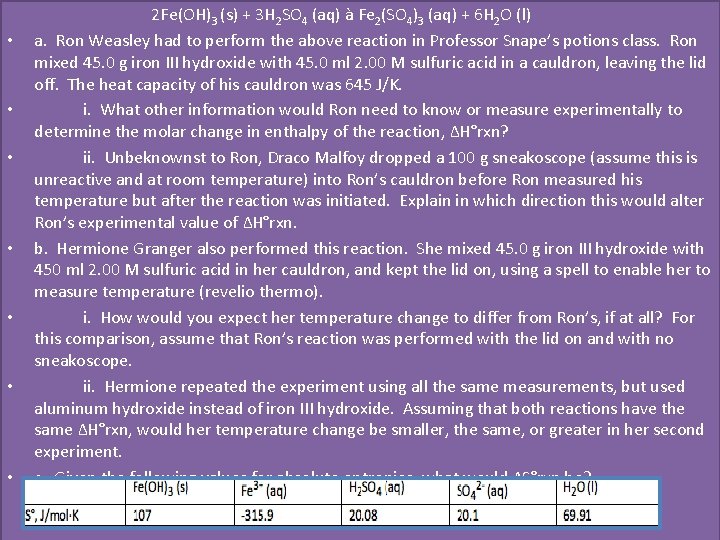
• • 2 Fe(OH)3 (s) + 3 H 2 SO 4 (aq) à Fe 2(SO 4)3 (aq) + 6 H 2 O (l) a. Ron Weasley had to perform the above reaction in Professor Snape’s potions class. Ron mixed 45. 0 g iron III hydroxide with 45. 0 ml 2. 00 M sulfuric acid in a cauldron, leaving the lid off. The heat capacity of his cauldron was 645 J/K. i. What other information would Ron need to know or measure experimentally to determine the molar change in enthalpy of the reaction, ∆H°rxn? ii. Unbeknownst to Ron, Draco Malfoy dropped a 100 g sneakoscope (assume this is unreactive and at room temperature) into Ron’s cauldron before Ron measured his temperature but after the reaction was initiated. Explain in which direction this would alter Ron’s experimental value of ∆H°rxn. b. Hermione Granger also performed this reaction. She mixed 45. 0 g iron III hydroxide with 450 ml 2. 00 M sulfuric acid in her cauldron, and kept the lid on, using a spell to enable her to measure temperature (revelio thermo). i. How would you expect her temperature change to differ from Ron’s, if at all? For this comparison, assume that Ron’s reaction was performed with the lid on and with no sneakoscope. ii. Hermione repeated the experiment using all the same measurements, but used aluminum hydroxide instead of iron III hydroxide. Assuming that both reactions have the same ∆H°rxn, would her temperature change be smaller, the same, or greater in her second experiment. c. Given the following values for absolute entropies, what would ∆S°rxn be? +
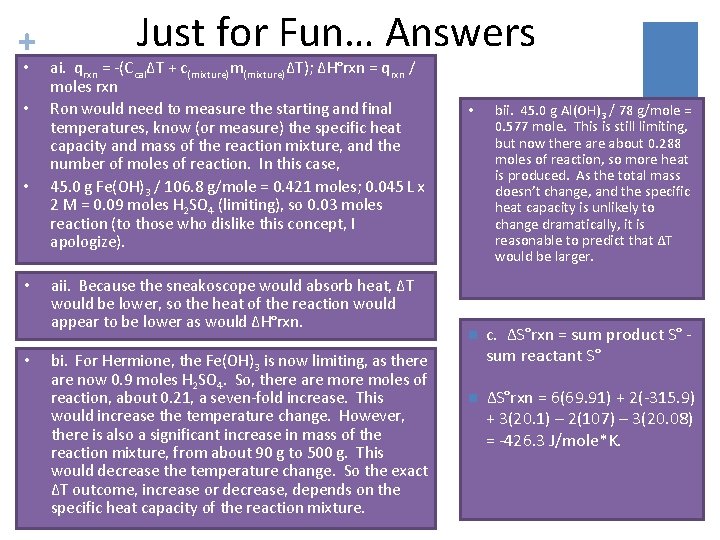
+ • • • Just for Fun… Answers ai. qrxn = -(Ccal∆T + c(mixture)m(mixture)∆T); ∆H°rxn = qrxn / moles rxn Ron would need to measure the starting and final temperatures, know (or measure) the specific heat capacity and mass of the reaction mixture, and the number of moles of reaction. In this case, 45. 0 g Fe(OH)3 / 106. 8 g/mole = 0. 421 moles; 0. 045 L x 2 M = 0. 09 moles H 2 SO 4 (limiting), so 0. 03 moles reaction (to those who dislike this concept, I apologize). aii. Because the sneakoscope would absorb heat, ∆T would be lower, so the heat of the reaction would appear to be lower as would ∆H°rxn. bi. For Hermione, the Fe(OH)3 is now limiting, as there are now 0. 9 moles H 2 SO 4. So, there are moles of reaction, about 0. 21, a seven-fold increase. This would increase the temperature change. However, there is also a significant increase in mass of the reaction mixture, from about 90 g to 500 g. This would decrease the temperature change. So the exact ∆T outcome, increase or decrease, depends on the specific heat capacity of the reaction mixture. • bii. 45. 0 g Al(OH)3 / 78 g/mole = 0. 577 mole. This is still limiting, but now there about 0. 288 moles of reaction, so more heat is produced. As the total mass doesn’t change, and the specific heat capacity is unlikely to change dramatically, it is reasonable to predict that ∆T would be larger. n c. ∆S°rxn = sum product S° - sum reactant S° n ∆S°rxn = 6(69. 91) + 2(-315. 9) + 3(20. 1) – 2(107) – 3(20. 08) = -426. 3 J/mole*K.
- Slides: 13