
Science of Sources Lesson 27 Legislative Evidence The



















- Slides: 58
Science of Sources
Lesson 27 Legislative Evidence
The science of sources deals with deducing the legal rulings based on evidence derived from Shari`ah sources.
First: Evidence Shari`ah sources are utilized in the following order: Qur’an, Sunnah, consensus (Ijma`), and reasoning based on analogy (Qiyas).
Qur’an The Qur’anic rulings are unquestionable, as each word was revealed by Allah to the Prophet (SAWS), and is preserved from corruption, until the end of time.
The Qur’anic texts concerning meaning are either conclusive or presumptive (Refer to lesson 21)
Sunnah is defined as all that was said, done, or tacitly approved by the Prophet (SAWS).
Sunnah: a) Confirms a ruling in the Qur’an in broad terms,
b) Explains in detailed form all that was mentioned in the Qur’an in broad terms,
c) Restricts what is mentioned in categorical terms,
and d) Specifies what is mentioned generally,
or e) Establishes a ruling that was not outlined in the Qur’an.
Concerning the number of transmitters, the Sunnah is either Mutawatir (well-known) or Ahad (singular). (Refer to lesson 22)
The Sunnah which is Mutawatir is a narration from the Prophet (SAWS) that can be traced back to the Prophet himself without any doubt.
The well-known Sunnah is where the transmission can be traced back to the Prophet with great probability of its being authentic, along with great conclusiveness of its attribution to the Companions.
The singular (Ahad) Sunnah is not confirmed in its authenticity.
All the above types should be accepted, either as a certain or predominant evidence.
The Prophet's (SAWS) personal thoughts, inclinations, personal habits, and the way in which he dealt with his everyday affairs, are not considered abiding legislation, unless they contain some element of guidance to be followed.
Consensus is the agreement of the majority of Muslim scholars who exercise Ijtihad (independent reasoning based on religious sources), after the Prophet's death, pertaining to a legal ruling.
There is some disagreement on the validity of this method of deriving Islamic rulings.
Analogy means to draw a similitude between two similar incidents. One can be judged directly according to the authentic text while the other can not, and both have common attributes relevant to the same ruling.
The use of analogy is considered an authentic means of deducing Islamic rulings according to the majority of scholars.
The pillars on which analogy is built are: i- the source (on which the analogy is based)
ii- the branch (what is to be equated to the source),
iii- the ruling of the source (based on an authentic text),
iv- the “effective case” (an attribute of the source which was the cause of the ruling, and which is shared by the branch)
The effective case should be a characteristic which is: a) Obvious b) accurately defined c) conducive to the wisdom behind the ruling d) not restricted to the source alone.
The scholars of jurisprudence differ regarding the validity of the following evidence: * application of discretion * public interest * prevalent customs * presumption of continuity * the laws of (pre-Islamic) predecessors * and the particular school of thought of a Companion.
The Application of Discretion The application of discretion means to prioritize: - an exceptional ruling over a common one due to a more substantiated proof, - a special ruling over a general one, - or a latent analogy over an evident one.
Public Interests Public interests are those interests for which no explicit ruling exists to allow or forbid.
Prevalent Customs Prevalent customs are practices that are known and followed by people, but which do not contradict a piece of evidence, do not permit what is prohibited, do not prohibit what is permitted, and do not annul a religious duty.
Presumption of Continuity Presumption of continuity means to maintain a ruling that was valid in the past until a real need to change it emerges.
The (sacred) law of (pre-Islamic) predecessors Is what is proven to be in confirmity with our law.
The School of Thought of a Companion The school of thought of a Companion is what is pertinent to him other than his narrations of the Hadith
Proofs from Qur’an and Sunnah
Legislative Evidence When the Prophet of Allah (SAWS) intended to send Mu`adh Ibn-Jabal to Yemen, he asked: How will you judge when you are asked to rule on something? He replied: I shall judge in accordance with Allah’s Book.
He asked: (What will you do) if you do not find any guidance in Allah’s Book? He replied: (I shall act) in accordance with the Sunnah of the Prophet of Allah (SAWS).
He asked: (What will you do) if you do not find any guidance in the Sunnah of the Prophet of Allah (SAWS) and in Allah’s Book? He replied: I shall do my best to reach a ruling and I shall spare no effort.
The Prophet (SAWS) then patted him on the breast and said: Praise be to Allah Who has helped the messenger of the Messenger of Allah to find something which pleases the Messenger of Allah. ” (Reported by At-Tirmidhi)
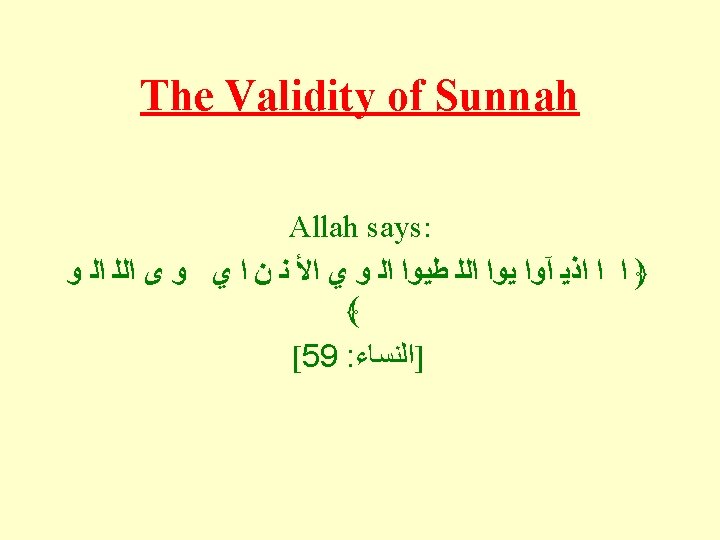
This means: “O you who believe! Obey Allah and obey the Messenger (Muhammad SAWS), and those of you (Muslims) who are in authority. (And) if you differ in anything amongst yourselves, refer it to Allah and His Messenger (SAWS). ” (Surah An-Nisa’: 59)
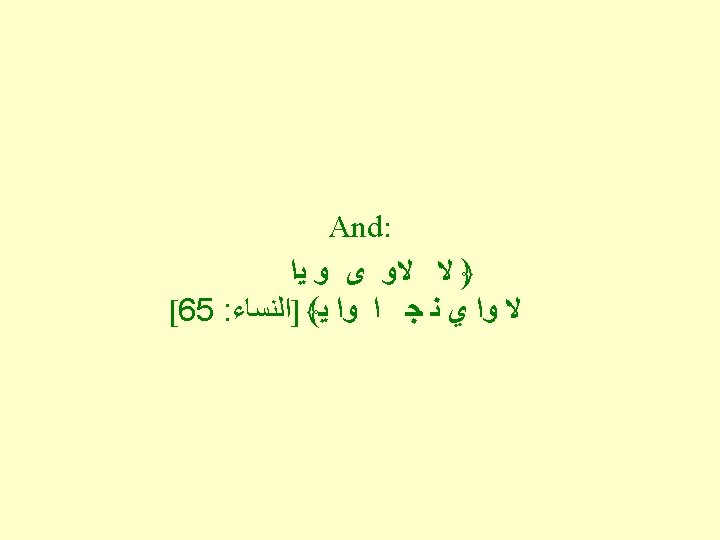
This means: “But no, by your Lord, they can have no Faith, until they make you (O Muhammad SAWS) judge in all disputes between them, and find in themselves no resistance against your decisions, and accept (them) with full submission. ” (Surah An-Nisa’: 65)
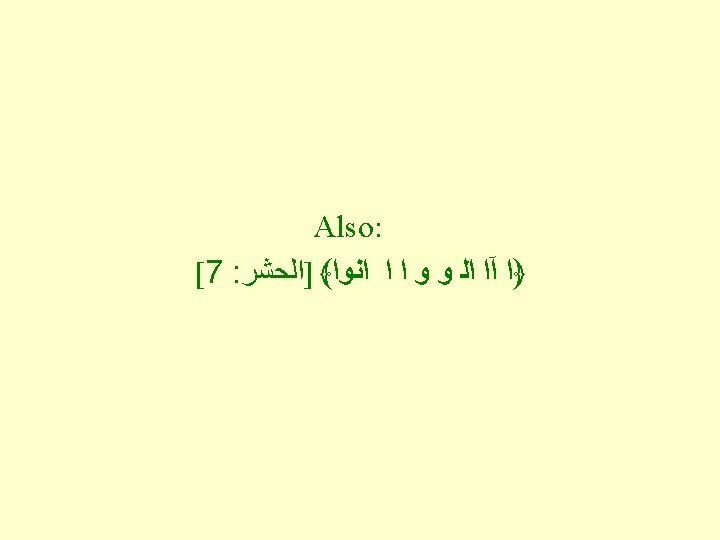
This means: “And whatsoever the Messenger (Muhammad SAWS) gives you, take it, and whatsoever he forbids you, abstain (from it). ” (Surah Al-Hashr: 7)
This means: “Say (O Muhammad SAWS): Obey Allah and the Messenger (Muhammad SAWS). ” (Surah Al-`Imran: 32)
This means: “He who obeys the Messenger (Muhammad SAWS), has indeed obeyed Allah. ” (Surah An-Nisa’: 80)
This means: “It is not for a believer, man or woman, when Allah and His Messenger have decreed a matter that they should have any option in their decision. ” (Surah Al-Ahzab: 36)
This means: “O you who believe! Obey Allah and obey the Messenger (Muhammad SAWS), and those of you (Muslims) who are in authority. ” (Surah An-Nisa’: 59)
This means: “If only they had referred it to the Messenger or to those charged with authority among them, the proper investigators would have understood it from them (directly). ” (Surah An-Nisa’: 83)
This means: “And whoever contradicts and opposes the Messenger (Muhammad SAWS) after the right path has been shown clearly to him, and follows other than the believers' way. We shall keep him in the path he has chosen, and burn him in Hell - what an evil destination. ” (Surah An-Nisa’: 115)
Consensus The Prophet (SAWS) said : “And that you could not all agree on an error. ” (Reported by Abu Dawud)