
Science of Hadith Introduction Introduction Muslims are agreed

- Slides: 17
Science of Hadith Introduction
Introduction • Muslims are agreed that the sunnah of the Prophet Muhammad (Peace be upon him) is the second of the two revealed fundamental sources of Islam. • During the lifetime of Prophet Muhammad (peace be upon him) and after his death , his companions used to refer to him directly, when quoting his sayings.
Introduction • The next generation to Tabi’een (successors) used to follow their steps and quote the Prophet (peace be upon him ) directly, while others would still mention the link. ( he is usually a Sahabi or senior Tabi’ee) • After the fitnah (civil war) happened , some sects appeared within the Muslim nation.
Introduction • Various groups supported their views by fabricating some ahadeeth. • The need for verification of each Hadith arose. • Imam Malik (d. 179) said : “ The first one to utilize the Isnad/sanad was Ibn Shihab Alzuhri (d. 124)
Introduction • A hadith is composed of two parts: the matn (text) and the isnad / sanad ( chain of reporters) • A text may seem to be logical and reasonable but needs an authentic isnad with reliable reporters to be acceptable.
Introduction • Imam Abdullah ibn Al-Mubarak (d. 181). H said: “The isnad is part of the religion, had it not been for the isnad, whoever wished to, would have said what ever he likes. ”
Introduction • Ibn Sireen (d. 110) said: ” They would not ask about the isnad, but when the fitnah happened they said: Name to us your men. So the narrations of Ahla-alsunnah would be accepted, while those of Ahl-albida’h would not be accepted. ”
A brief history of Mustalah al. Hadith
A brief history of Mustalah al. Hadith • As time passed, more reporters were involved in each isnad / sanad. • The situation demanded strict discipline in the acceptance of Ahadith. • The set of rules governing this area of knowledge is called “Mustalah al-Hadith. ”
A brief history of Mustalah al. Hadith • Among the early writing about these rules, the work of Al-Imam Ashafie (d. 204) in his book called Al-Risalah, Imam Muslim (d. 261) in his introduction to his sahih and the notes found in Jami Atthirmithi (d. 279)
A brief history of Mustalah al. Hadith • The first work that was comprehensive and purely dedicated to the rules of Mustalah Al-Hadith is what was written by Al. Ramahurmuzi (d. 360). [ ]ﺍﻟﻤﺤﺪﺙ ﺍﻟﻔﺎﺻﻞ ﺑﻴﻦ ﺍﻟﺮﺍﻭﻱ ﻭﺍﻟﺴﺎﻣﻊ
A brief history of Mustalah al. Hadith • The next major contribution was Ma’rifat Ulum Al-hadeeth by Al-Hakim (d. 405) H. He covered fifty classifications of Hadith, but still he left some points untouched. • Abu Nu’aim Al-asbahani (d. 430) completed some of the missing work.
A brief history of Mustalah al. Hadith • Then came Al-Khateeb Al-Baghdadi (d. 463) with his work Al-Kifayah fi ilm Al-Riwayah. ( )ﺍﻟﻜﻔﺎﻳﺔ ﻓﻲ ﻋﻠﻢ ﺍﻟﺮﻭﺍﻳﺔ and his 2 nd work (Al-Jami’ Li-Akhlaaq Alraawy wa Adab Al-sami’) ( ﻼﻕ ﺍﻟﺮﺍﻭﻱ ﻭآﺪﺍﺏ ﺍﻟﺴﺎﻣﻊ ) ﺍﻟﺠﺎﻣﻊ ﻷﺨ
A brief history of Mustalah al. Hadith • Then came Al-Qadi Iyad (d. 544) with his work ( ) ﺍ ﻹﻟﻤﺎﻉ ﻓﻲ ﺿﺒﻂ ﺍﻟﺮﻭﺍﻳﺔ ﻭﻗﻮﺍﻧﻴﻦ ﺍﻟﺴﻤﺎﻉ “ Al-lma’ Fi thabth Al-riwayah wa Kawaneen Al -sama’ “
A brief history of Mustalah al. Hadith • Then came Ibn salaah (d. 643) with his famous work “ ”ﻋﻠﻮﻡ ﺍﻟﺤﺪﻳﺚ “ the science of Hadith” commonly known as Muqadimah Ibn al-salah, it contained series of lessons taught by Ibn Alsalah in Al-Ashrafiyah School in Damascus.
A brief history of Mustalah al. Hadith • Imam Al-nawawi (d. 774) summarized Almuqqadimah in a book called Al-Irshad, and then he summarized Al-Irshad in his book Al-taqrib ( )ﺍﻟﺘﻘﺮﻳﺐ • Imam As-suyouti wrote a commentary on Altaqrib and called it Tadrib al-Rawy
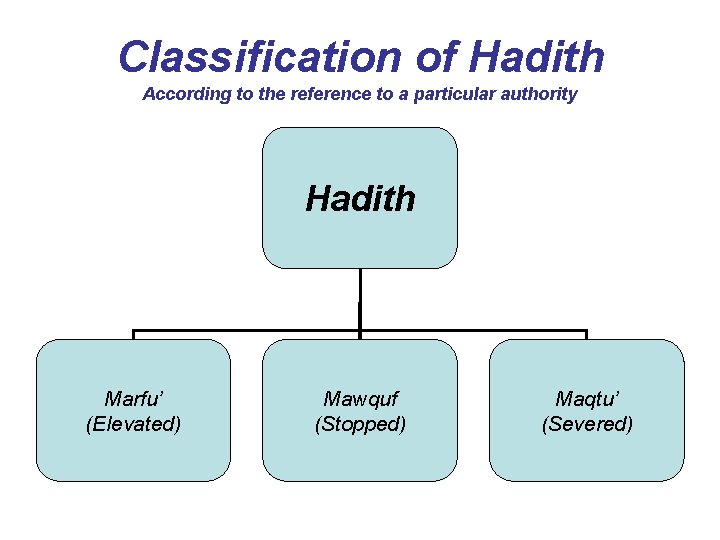
Classification of Hadith According to the reference to a particular authority Hadith Marfu’ (Elevated) Mawquf (Stopped) Maqtu’ (Severed)