
Science is a businessyours Your science career is

Science is a business—yours! • Your science career is just as important as your science. • Think of your career as a business that you need to manage.
The business of research • Think of the Research Panel Process as the vehicle for managing your career. • Understand the Research Panel Process, embrace it, don’t run from it. • A well-written PD is key in getting the evaluation you deserve! • A well prepared panel package is your best chance at being appropriately evaluated!
Preparing for panel • Most important step—properly prepare your position description (PD) • Use the most up-to-date version of The Forest Service Guide to Preparing Research Scientist Position Descriptions (The Guide) – Includes the Research Grade Evaluation Guide (RGEG) • Review examples of good PDs • Solicit reviews of your PD from your PL and AD!
Why are there panels? • Your program and accomplishments change over time • It is important to you and the agency that you are recognized for the level at which you are performing and the reputation you have within the scientific community. • OPM mandates agencies to have evaluation procedures for their research positions • All USDA research scientists are paneled, and the Forest Service has established procedures for panels
Cycle of review • New scientists—within 3 years of appointment • GS-13 and below—every 4 years • GS-14 and above—every 5 years • Exceptions may be allowed with supervisor and AD approval
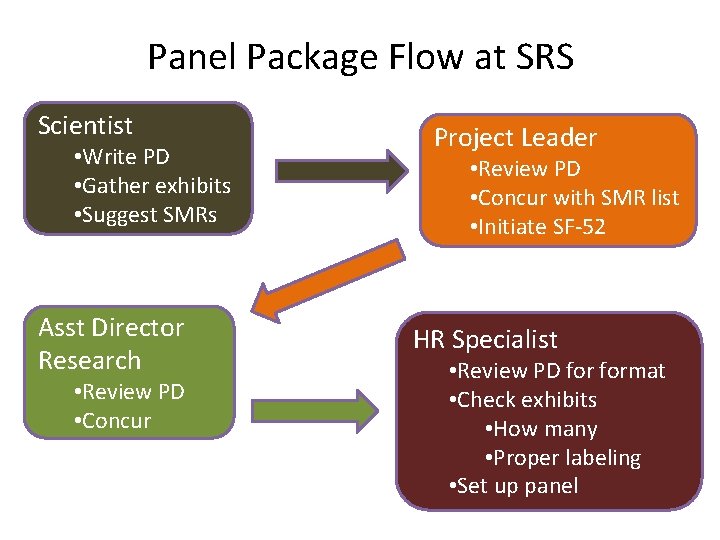
Panel Package Flow at SRS Scientist • Write PD • Gather exhibits • Suggest SMRs Asst Director Research • Review PD • Concur Project Leader • Review PD • Concur with SMR list • Initiate SF-52 HR Specialist • Review PD format • Check exhibits • How many • Proper labeling • Set up panel
II. Scientist Responsibilities • Write PD • Gather exhibits • Suggest SMRs
Writing the PD
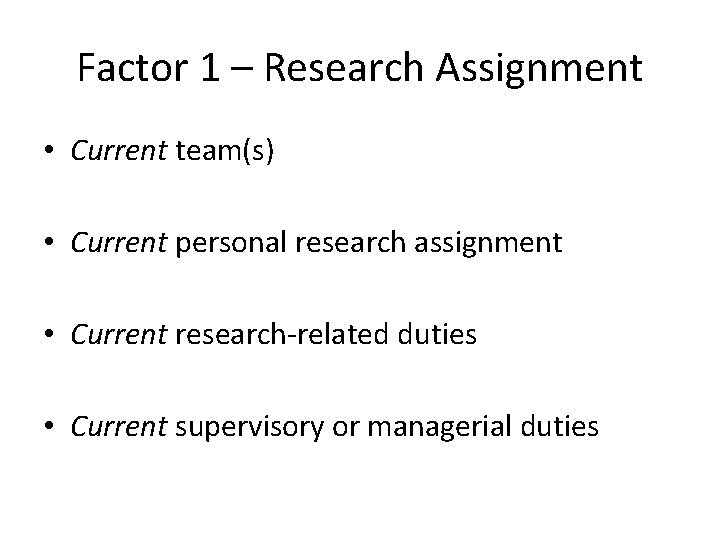
Factor 1 – Research Assignment • Current team(s) • Current personal research assignment • Current research-related duties • Current supervisory or managerial duties
Factor 2 – Supervision received • About how you are supervised • Not about your supervisory duties • Amount of independence you have • Your technical authoritativeness • Who decides/controls what
Factor 3 – guidelines and originality • Guidelines available to be used in your research – How useful are they? • Creativity needed to use available guidelines to complete the research • Synopsis of your creativity
Factor 4 – contributions, impact & stature • About you and what you’ve done • • • It’s not just your CV What was your role in addressing problems? What is the significance of what you did? What is different because of what you did? Who can best tell the SMR about what you have done and how important it is?
What composes a panel?
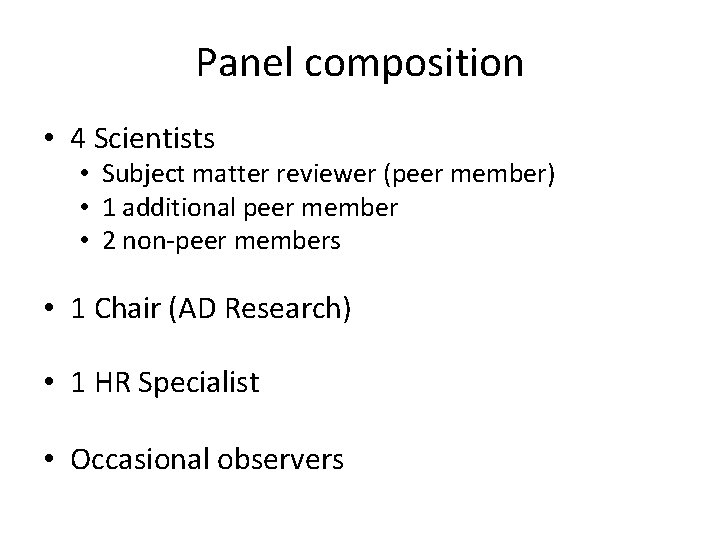
Panel composition • 4 Scientists • Subject matter reviewer (peer member) • 1 additional peer member • 2 non-peer members • 1 Chair (AD Research) • 1 HR Specialist • Occasional observers
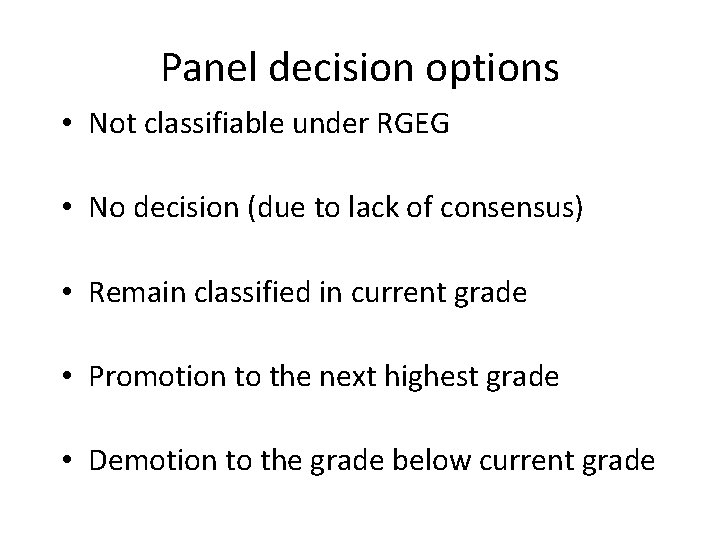
Panel decision options • Not classifiable under RGEG • No decision (due to lack of consensus) • Remain classified in current grade • Promotion to the next highest grade • Demotion to the grade below current grade
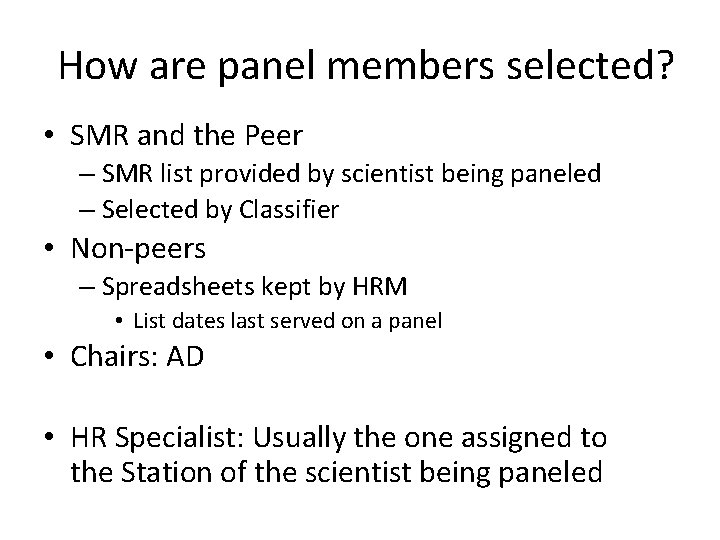
How are panel members selected? • SMR and the Peer – SMR list provided by scientist being paneled – Selected by Classifier • Non-peers – Spreadsheets kept by HRM • List dates last served on a panel • Chairs: AD • HR Specialist: Usually the one assigned to the Station of the scientist being paneled
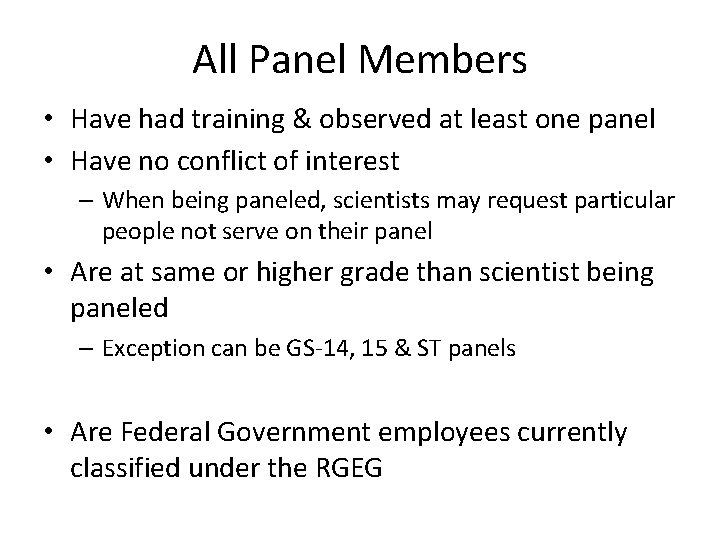
All Panel Members • Have had training & observed at least one panel • Have no conflict of interest – When being paneled, scientists may request particular people not serve on their panel • Are at same or higher grade than scientist being paneled – Exception can be GS-14, 15 & ST panels • Are Federal Government employees currently classified under the RGEG
SMR • Meets all requirements of panel members • Has served on at least one panel • Should be in the same peer group as scientist • Should be in the same series
Role of: • The Chair – Moderates/leads discussion – Runs the panel • HR Specialist – Acts in an advisory role – Assists Chair • SMR – Act as expert on work of the scientist being paneled
Role of all Scientists • Voting members • Participate in discussion to achieve consensus for each factor
Responsibilities of the Chair • Review panel worksheets from panel members • Prepare to lead and lead panel discussion • Review & edit panel report • Lead discussion during panel debrief
Responsibilities of HR Specialist • Coordinate panel set-up • Collect & review panel worksheets • Write panel report/recommendation letter • Participate in discussion during panel debrief
Responsibilities of All Members • Assure confidentiality of all documents and discussions pertaining to the panel – Shredding paperwork – Erasing from hard drive • Have documents to HR Specialist in a timely manner • Fully participate in panel discussion
Miscellaneous • Making copies of your PD—wait – HR checks PDs format • Just need the e-copy attached to the SF-52 in Tracker – HR will let you know if your PD needs edits first • Want to put everything on a CD? – Talk to HR and your supervisor prior to submission • How long before the panel is held?
Your Package—What to Include • Up to 6 properly labeled exhibits – 8 -10 copies of each • List of at least 3 possible SMRs (more is better) • 10 hard copies of final PD – e-copy to HR • AD-332 Cover Sheet – Specially modified for research – Do not fill in blocks 10 -17
- Slides: 25