
SCIENCE Intuition leads to the flat Earth society
- Slides: 14
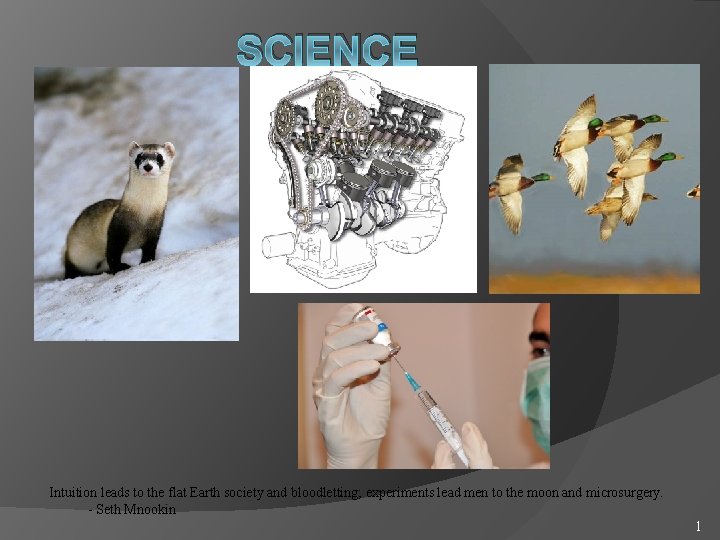
SCIENCE Intuition leads to the flat Earth society and bloodletting; experiments lead men to the moon and microsurgery. - Seth Mnookin 1
SCIENCE AS A WAY OF KNOWING � Science assumes that the world is knowable. � Science seeks to… ○ Search for testable evidence. ○ Form hypotheses and theories. �Hypothesis: Prediction based on prior knowledge and observation. �Theory: Broad explanation based on many experiments and high amounts of data. ○ Find additional evidence to strengthen or disprove current theories. 2
SCIENCE AS A WAY OF KNOWING � Scientists never work alone; they always collaborate as part of the process. �They check each other for errors. �Divide up a problem and work on it in groups. 3
Scientific Design � Reproducibility �Experiments must be designed and recorded such that they can be exactly reproduced by other researchers. � Controlled Studies �Comparisons are made between experimental and control populations. 4
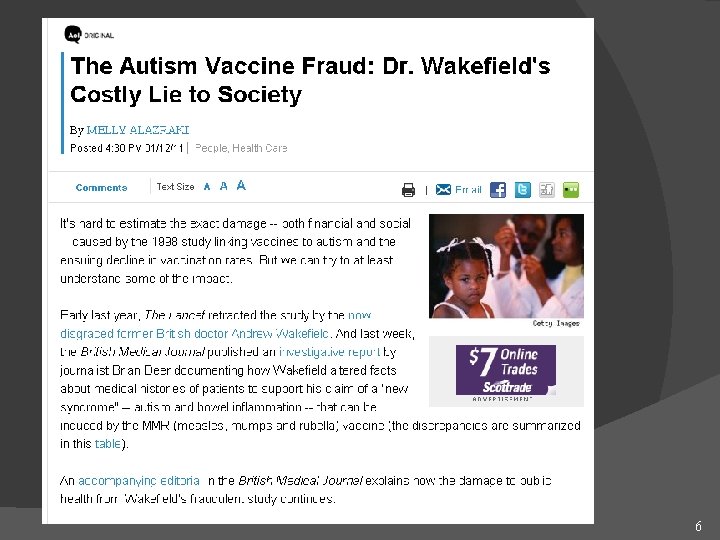
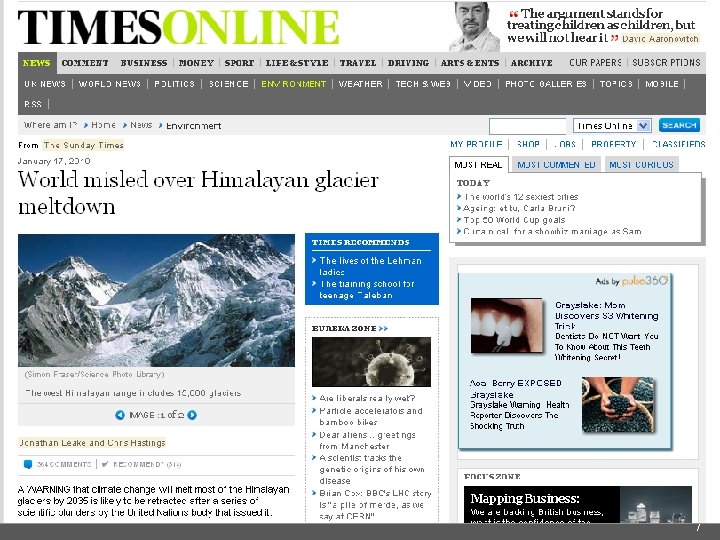
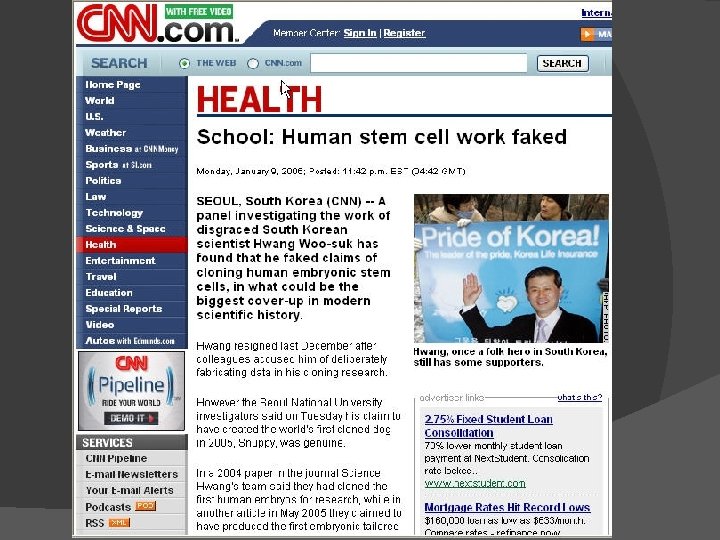
Scientific Fraud There are many examples of published studies or report that have been later found incorrect, misleading, or fraudulent. � These are always detected, eventually due to the scientific method and peer review. �The net effect is loss of time, resources, and public mistrust. � Significant recent examples: �MMR Vaccine / Autism study �Speed of Himalayan glacier melting �Human stem cell cloning study � 5
6
7
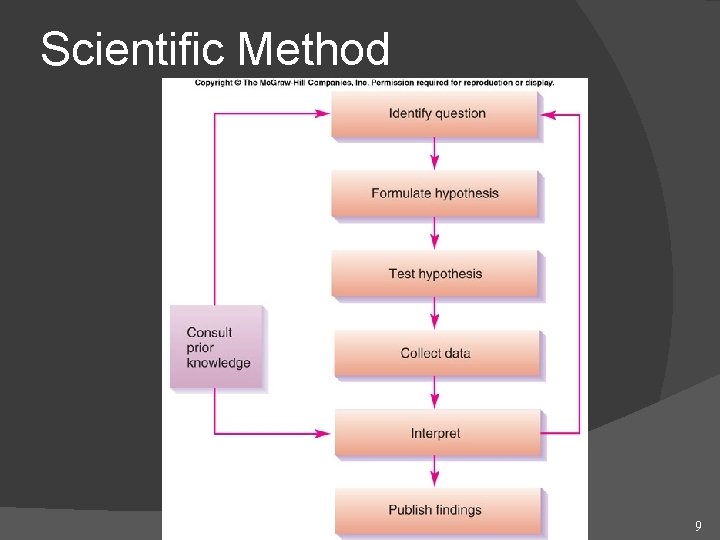
Scientific Method 9
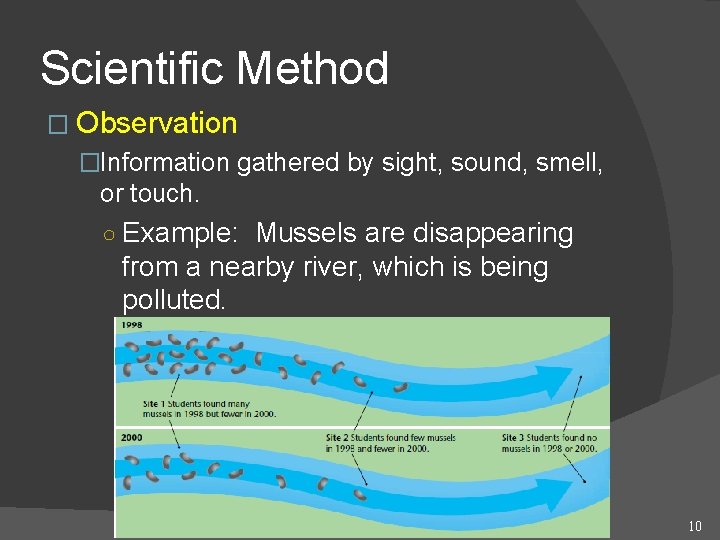
Scientific Method � Observation �Information gathered by sight, sound, smell, or touch. ○ Example: Mussels are disappearing from a nearby river, which is being polluted. 10
Scientific Method � Hypothesis �A testable explanation for an observation. ○ A hypothesis can be proven wrong, but never proven true. ○ Ex: Fertilizer from a nearby golf course is washing into the river and killing the mussels. � Prediction �What will happen if the hypothesis is correct? ○ Ex: Mussels will die when exposed to the fertilizer. 11
Scientific Method � Experiment �Test hypothesis under controlled conditions. �Variables: Things that change during an experiment �Independent variable: the one thing that you purposely change in an experiment ○ Ex: Presence of fertilizer �Dependent variable: the thing that will be change in response to the independent variable. ○ Ex: Number of mussels �Experimental Group: Receives the variable ○ Ex: Mussels exposed to fertilizer �Control Group: Does not receive the variable. Used for comparison ○ Ex: Mussels in clean water 12
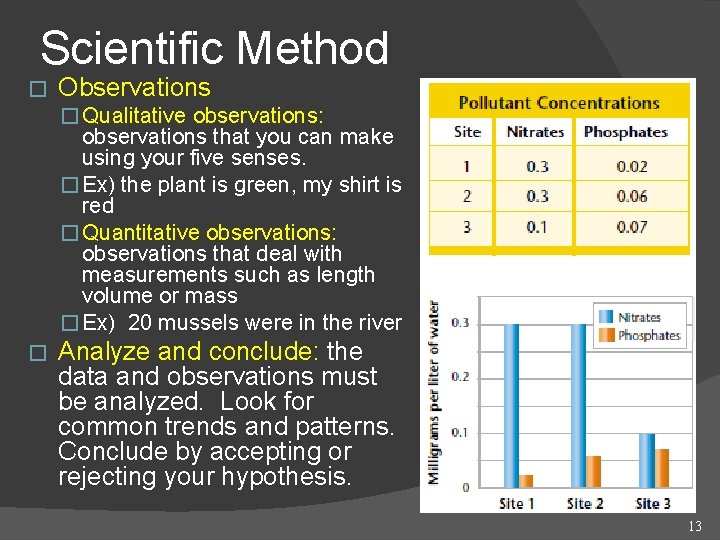
Scientific Method � Observations � Qualitative observations: observations that you can make using your five senses. � Ex) the plant is green, my shirt is red � Quantitative observations: observations that deal with measurements such as length volume or mass � Ex) 20 mussels were in the river � Analyze and conclude: the data and observations must be analyzed. Look for common trends and patterns. Conclude by accepting or rejecting your hypothesis. 13
Law vs. Theory � Theory: a thoroughly tested model that explains why experiments give certain results � Law: a concise statement that summarizes the results of a broad variety of observations � Law of gravity would say that objects fall to earth while theory of gravity would explain why.