
Science Fair Title Slide Title A project needs

- Slides: 15
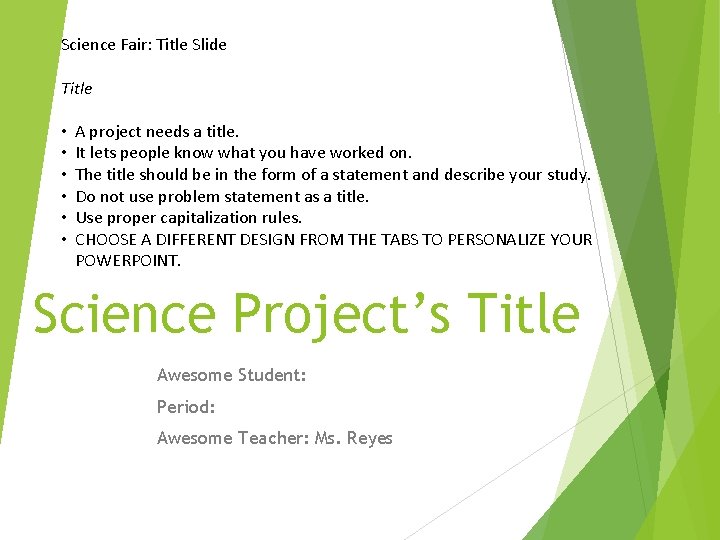
Science Fair: Title Slide Title • • • A project needs a title. It lets people know what you have worked on. The title should be in the form of a statement and describe your study. Do not use problem statement as a title. Use proper capitalization rules. CHOOSE A DIFFERENT DESIGN FROM THE TABS TO PERSONALIZE YOUR POWERPOINT. Science Project’s Title Awesome Student: Period: Awesome Teacher: Ms. Reyes
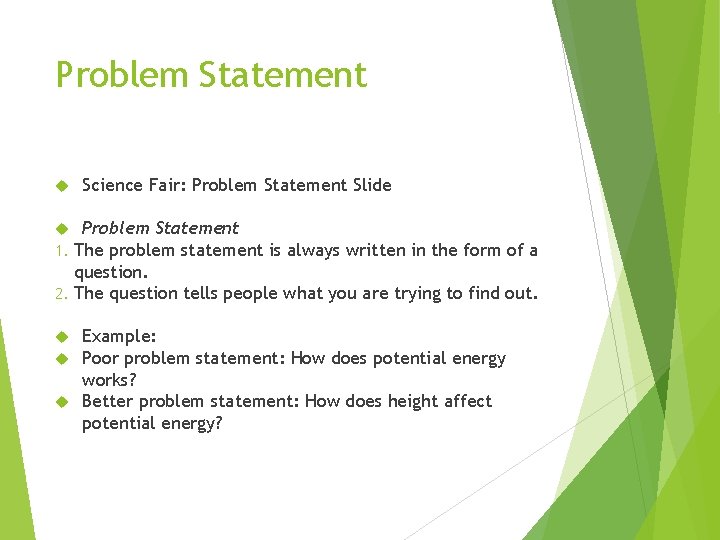
Problem Statement Science Fair: Problem Statement Slide Problem Statement 1. The problem statement is always written in the form of a question. 2. The question tells people what you are trying to find out. Example: Poor problem statement: How does potential energy works? Better problem statement: How does height affect potential energy?
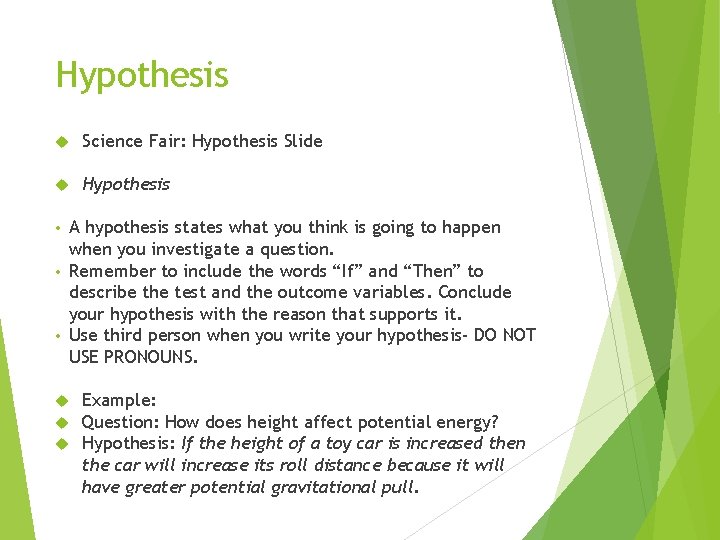
Hypothesis Science Fair: Hypothesis Slide Hypothesis A hypothesis states what you think is going to happen when you investigate a question. • Remember to include the words “If” and “Then” to describe the test and the outcome variables. Conclude your hypothesis with the reason that supports it. • Use third person when you write your hypothesis- DO NOT USE PRONOUNS. • Example: Question: How does height affect potential energy? Hypothesis: If the height of a toy car is increased then the car will increase its roll distance because it will have greater potential gravitational pull.
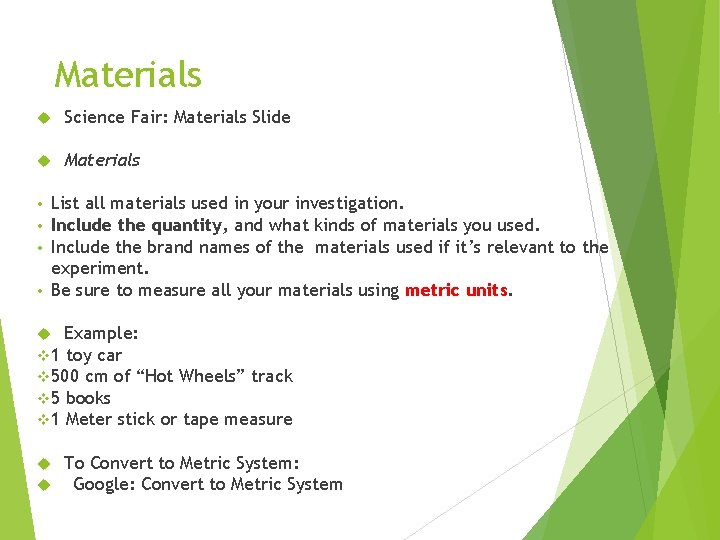
Materials Science Fair: Materials Slide Materials List all materials used in your investigation. Include the quantity, and what kinds of materials you used. Include the brand names of the materials used if it’s relevant to the experiment. • Be sure to measure all your materials using metric units. • • • Example: v 1 toy car v 500 cm of “Hot Wheels” track v 5 books v 1 Meter stick or tape measure To Convert to Metric System: Google: Convert to Metric System
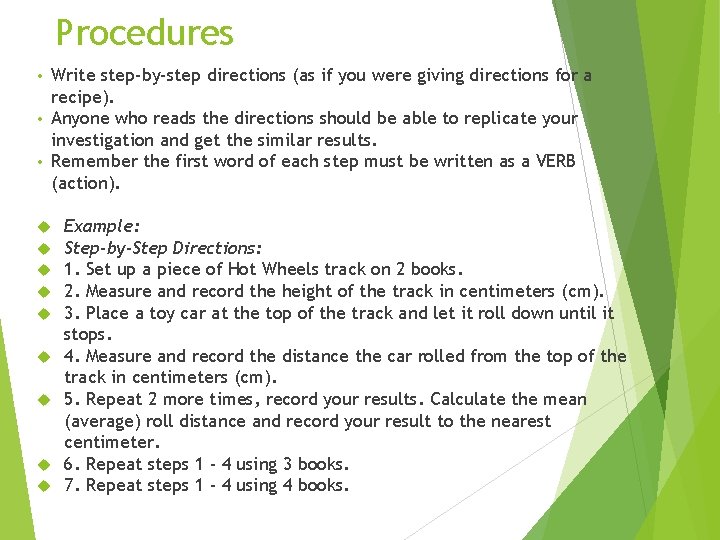
Procedures Write step-by-step directions (as if you were giving directions for a recipe). • Anyone who reads the directions should be able to replicate your investigation and get the similar results. • Remember the first word of each step must be written as a VERB (action). • Example: Step-by-Step Directions: 1. Set up a piece of Hot Wheels track on 2 books. 2. Measure and record the height of the track in centimeters (cm). 3. Place a toy car at the top of the track and let it roll down until it stops. 4. Measure and record the distance the car rolled from the top of the track in centimeters (cm). 5. Repeat 2 more times, record your results. Calculate the mean (average) roll distance and record your result to the nearest centimeter. 6. Repeat steps 1 - 4 using 3 books. 7. Repeat steps 1 - 4 using 4 books.
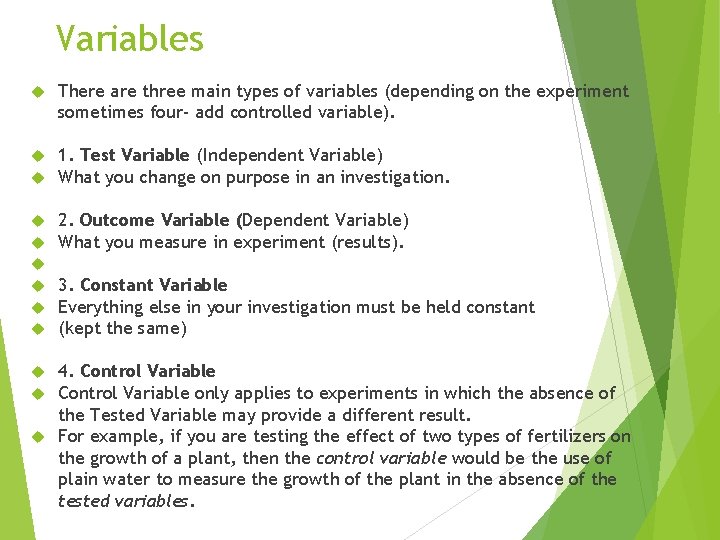
Variables There are three main types of variables (depending on the experiment sometimes four- add controlled variable). 1. Test Variable (Independent Variable) What you change on purpose in an investigation. 2. Outcome Variable (Dependent Variable) What you measure in experiment (results). 3. Constant Variable Everything else in your investigation must be held constant (kept the same) 4. Control Variable only applies to experiments in which the absence of the Tested Variable may provide a different result. For example, if you are testing the effect of two types of fertilizers on the growth of a plant, then the control variable would be the use of plain water to measure the growth of the plant in the absence of the tested variables.
Data – Table Chart Tested Variables Repetitions #1 Repetitions #2 Repetitions #3 Mean Results (Average) MANDATORY DATA: • Table Chart- including all tested variables, the results per repetition (trials), and the mean (average) per tested variable. • Graphs – use ONLY the mean result per tested variable. • Pictures – No people visible on the picture. OPTIONAL DATA: • Video – No people visible on the video. • Qualitative observations (using the 5 Senses: sight, touch, smell, hearing and taste) • Quantitative observations (using numbers) • Surveys • Diagrams
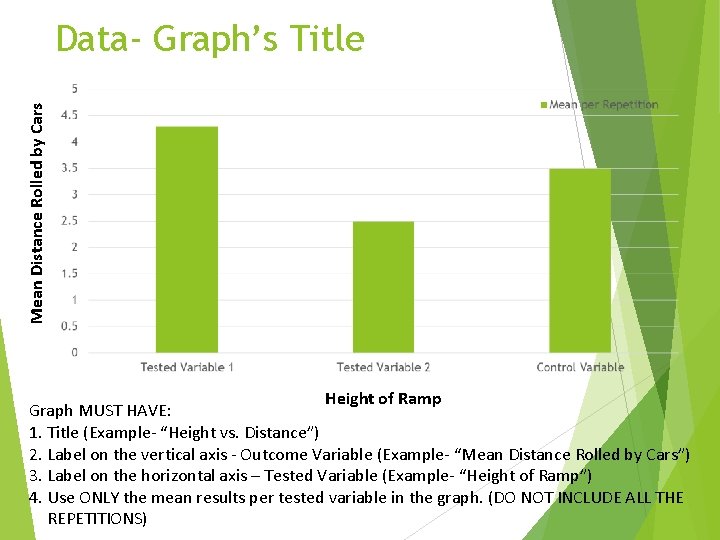
Mean Distance Rolled by Cars Data- Graph’s Title Height of Ramp Graph MUST HAVE: 1. Title (Example- “Height vs. Distance”) 2. Label on the vertical axis - Outcome Variable (Example- “Mean Distance Rolled by Cars”) 3. Label on the horizontal axis – Tested Variable (Example- “Height of Ramp”) 4. Use ONLY the mean results per tested variable in the graph. (DO NOT INCLUDE ALL THE REPETITIONS)
Data - Pictures – No people visible on the picture.
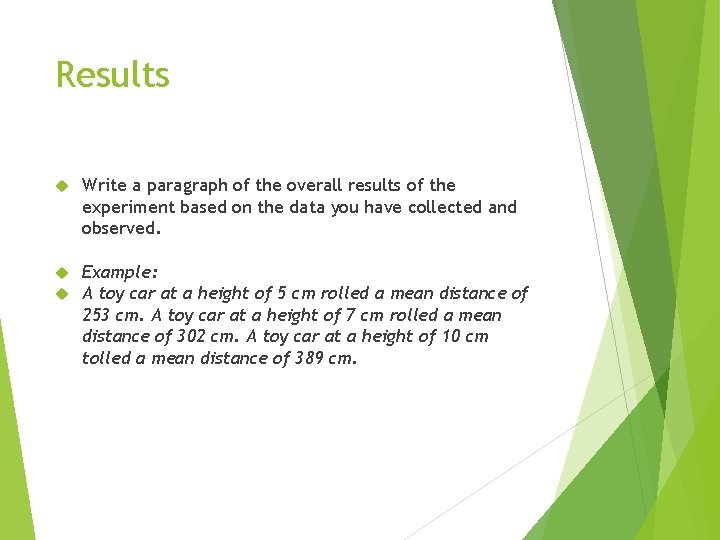
Results Write a paragraph of the overall results of the experiment based on the data you have collected and observed. Example: A toy car at a height of 5 cm rolled a mean distance of 253 cm. A toy car at a height of 7 cm rolled a mean distance of 302 cm. A toy car at a height of 10 cm tolled a mean distance of 389 cm.
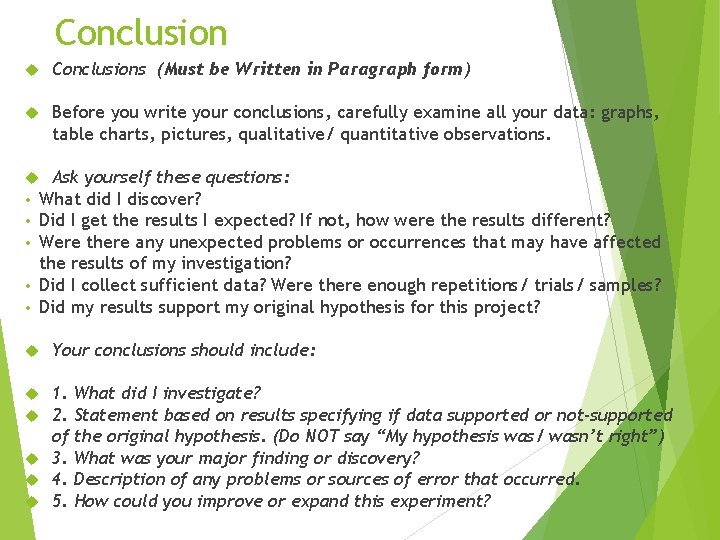
Conclusion Conclusions (Must be Written in Paragraph form) Before you write your conclusions, carefully examine all your data: graphs, table charts, pictures, qualitative/ quantitative observations. Ask yourself these questions: • What did I discover? • Did I get the results I expected? If not, how were the • Were there any unexpected problems or occurrences results different? that may have affected the results of my investigation? • Did I collect sufficient data? Were there enough repetitions/ trials/ samples? • Did my results support my original hypothesis for this project? Your conclusions should include: 1. What did I investigate? 2. Statement based on results specifying if data supported or not-supported of the original hypothesis. (Do NOT say “My hypothesis was/ wasn’t right”) 3. What was your major finding or discovery? 4. Description of any problems or sources of error that occurred. 5. How could you improve or expand this experiment?
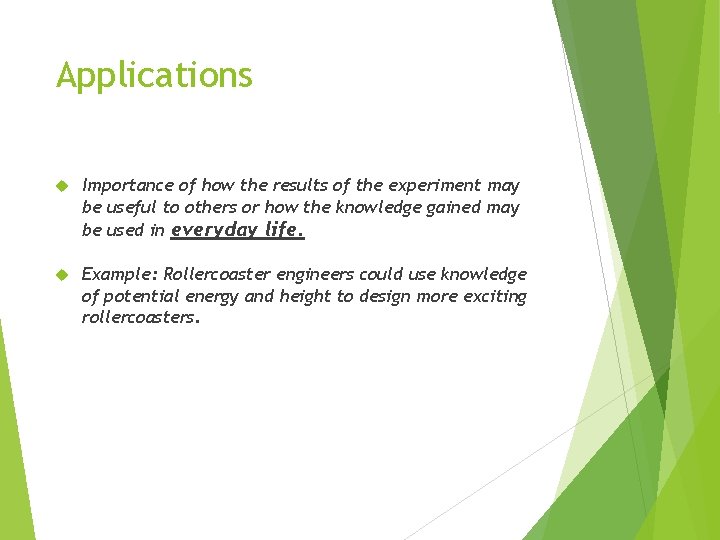
Applications Importance of how the results of the experiment may be useful to others or how the knowledge gained may be used in everyday life. Example: Rollercoaster engineers could use knowledge of potential energy and height to design more exciting rollercoasters.
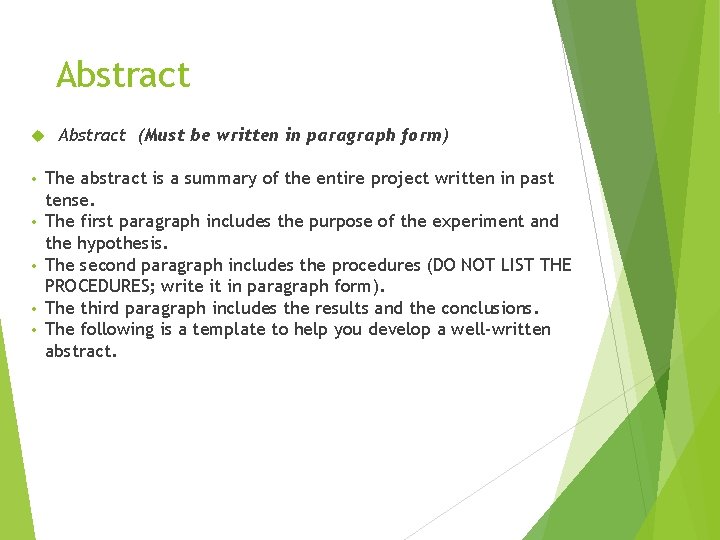
Abstract • • • Abstract (Must be written in paragraph form) The abstract is a summary of the entire project written in past tense. The first paragraph includes the purpose of the experiment and the hypothesis. The second paragraph includes the procedures (DO NOT LIST THE PROCEDURES; write it in paragraph form). The third paragraph includes the results and the conclusions. The following is a template to help you develop a well-written abstract.
Background Information 1 – 2 paragraphs explaining what you have investigated and learned about your project’s topic.
Bibliography Minimum of three (3) reputable resources Must be written in APA style The following website is a great tool to create the bibliography: www. Citation. Machine. net