
SCIENCE EXPERIMENT CRAZY PUTTY By Angel Aguilar MATERIALS
SCIENCE EXPERIMENT (CRAZY PUTTY) By: Angel Aguilar
MATERIALS • 2 containers (1 smaller than the other, preferably a film canister) • Water • Food coloring • PVA glue (a type of white glue also known as Elmer's glue) • Borax solution (about 1 teaspoon of borax)
BACKGROUND INFORMATION What is Borax? Borax is an important boron compound, a mineral, and a salt of boric acid. Powdered borax is white, consisting of soft colorless crystals that dissolve easily in water. It is used for water purification as well as a fire retardant. Borax was first discovered in dry lake beds in Tibet and was imported via the Silk Road to Arabia. Borax first came into common use in the late 19 th century when Francis Marion Smith’s Pacific Coast Borax Company began to market and popularize a large variety of applications under the 20 Mule Team Borax trademark, named for the method by which borax was originally hauled out of the California and Nevada deserts in large enough quantities to make it cheap and commonly available.

PROCEDURES 1. Fill the bottom of the larger container with glue. 2. Add a few squirts of water to the container and stir. 3. Add 2 or 3 drops of food coloring and stir. 4. Add a squirt of borax (possibly a bit more depending on how much glue you used). 5. Stir the mixture up and put it into the smaller container. By now the mixture should be joining together. Repeat the same procedure, except add three tablespoons of water the second time.
BIG QUESTION What happens if I combine water, food coloring, glue, and borax? Which putty result will have a better texture depending on the amount of water?
HYPOTHESIS I believe that if I mix all these materials with only a few squirts of water, I will get a gooey substance that will be similar to the toy “Putty” because of the name. (According to research)

THE EXPERIMENT I will have two containers of the ingredients. The first will have more glue than water and the other will have more water than glue. I will put the same amount of bromine and food coloring into the two containers. I will mix them and come back to see the results of both substances.
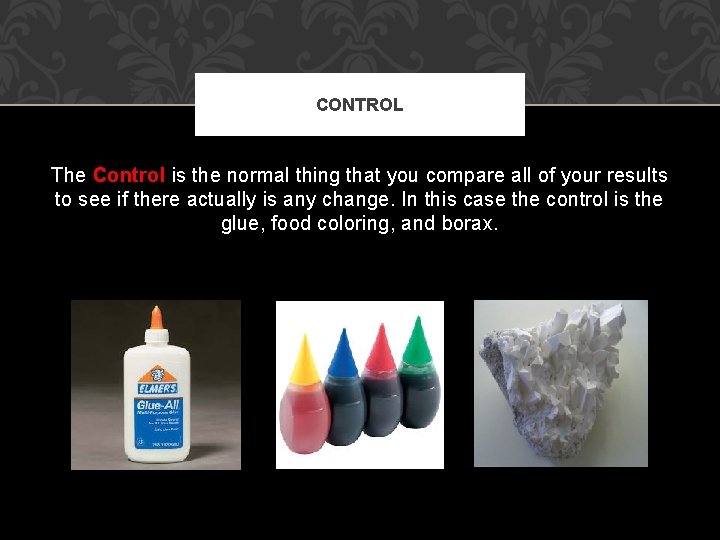
CONTROL The Control is the normal thing that you compare all of your results to see if there actually is any change. In this case the control is the glue, food coloring, and borax.
INDEPENDENT VARIABLE The Independent Variable is the thing I am changing, and that will affect the results of experiment. In this case the independent variable is the amount of water used in each container.
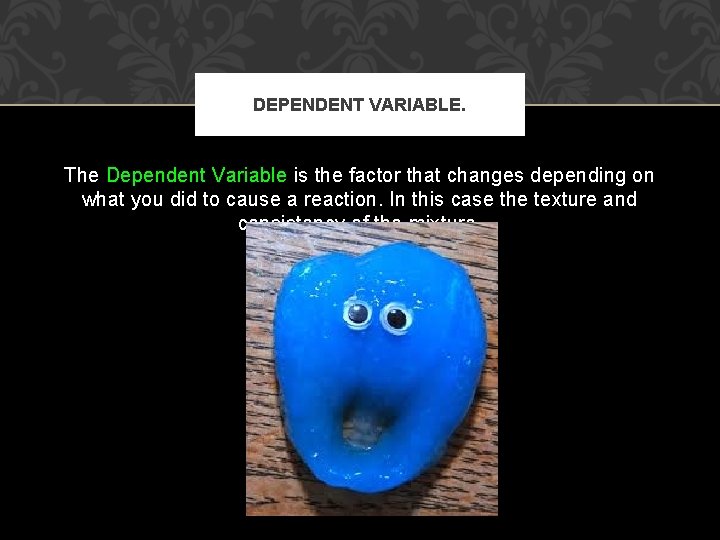
DEPENDENT VARIABLE. The Dependent Variable is the factor that changes depending on what you did to cause a reaction. In this case the texture and consistency of the mixture.
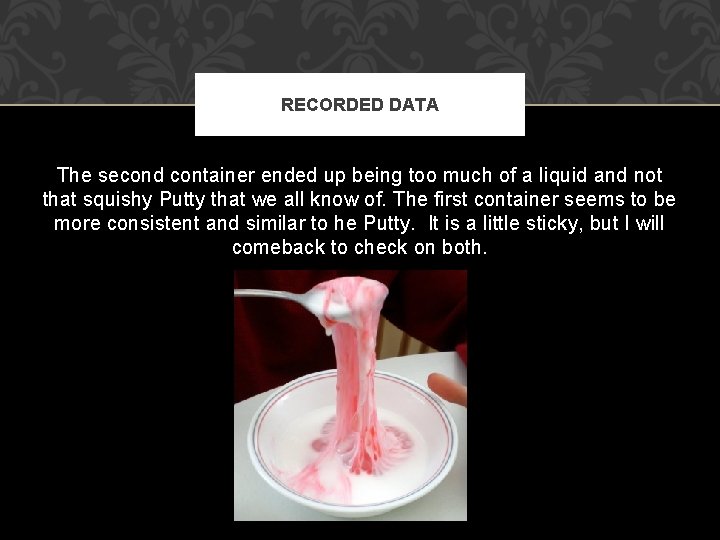
RECORDED DATA The second container ended up being too much of a liquid and not that squishy Putty that we all know of. The first container seems to be more consistent and similar to he Putty. It is a little sticky, but I will comeback to check on both.
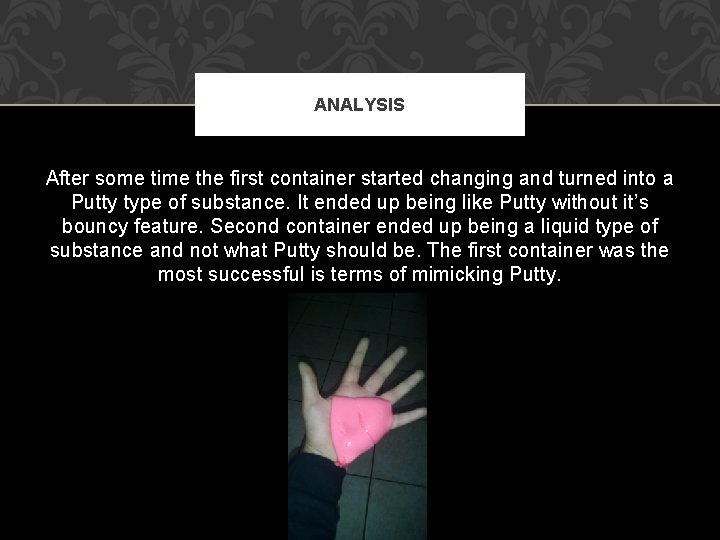
ANALYSIS After some time the first container started changing and turned into a Putty type of substance. It ended up being like Putty without it’s bouncy feature. Second container ended up being a liquid type of substance and not what Putty should be. The first container was the most successful is terms of mimicking Putty.
WHAT IS HAPPENING? The PVA glue you use is a type of polymer called polyvinyl acetate (PVA for short), while the borax is made of a chemical called sodium borate. When you combine the two in a water solution, the borax reacts with the glue molecules, joining them together into one giant molecule. This new compound is able to absorb large amounts of water, producing a putty like substance which you can squish in your hands or bounce.
CONCLUSION Once the ingredients were mixed and left alone for a few minutes, the components turned into a Putty type of substance. Putty is also bouncy but mine was not as bouncy as I expected it to be. I’m guessing I put too much glue instead of water and it ended up having it’s squishy form without it being so bouncy. I made a little error there but the fact that it’s semi bouncy and still squishy makes me feel like I succeeded. The second container was a total failure and was mostly liquid. Overall the first container was the most successful, proving my hypothesis to be correct with the first container but not the second one. What I’ve learned is too much water will result in a liquid substance rather than a squishy reformable material.
- Slides: 14