
Science Earth Space Science GED Support Kristina Gonzales
- Slides: 15
Science Earth & Space Science GED Support Kristina Gonzales, BS, MHA
Earth & Space Science Gonzales, Spring 2017
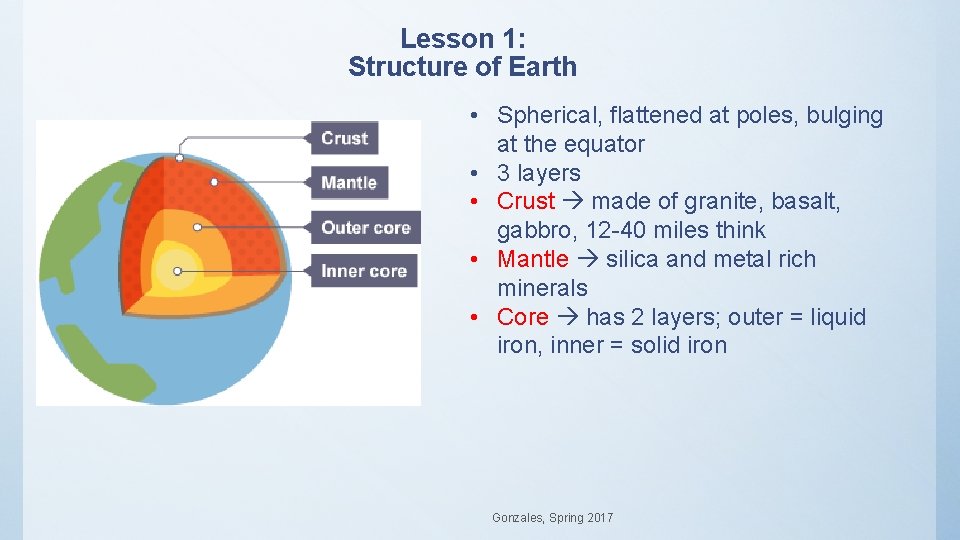
Lesson 1: Structure of Earth • Spherical, flattened at poles, bulging at the equator • 3 layers • Crust made of granite, basalt, gabbro, 12 -40 miles think • Mantle silica and metal rich minerals • Core has 2 layers; outer = liquid iron, inner = solid iron Gonzales, Spring 2017
Lesson 1: Structure of Earth • Theory of plate tectonics phenomena of earths crust; seafloor spreading, formation of major landforms, and how continents move • Earths crust is made up of tectonic plates (fit like a puzzle together) • These plates move together • At the boundaries between plates major landforms form and earthquakes occur • 3 types of plate boundaries, or margins: 1. Constructive margin 2 plates are moving apart & new crust is forming 2. Destructive margin 2 plates are colliding and crust is being destroyed 3. Transform, conservative margin 2 plates are sliding by one another & no crust is created • https: //www. youtube. com/watch? v=7 Kt. PQis 2 L 0 c Gonzales, Spring 2017
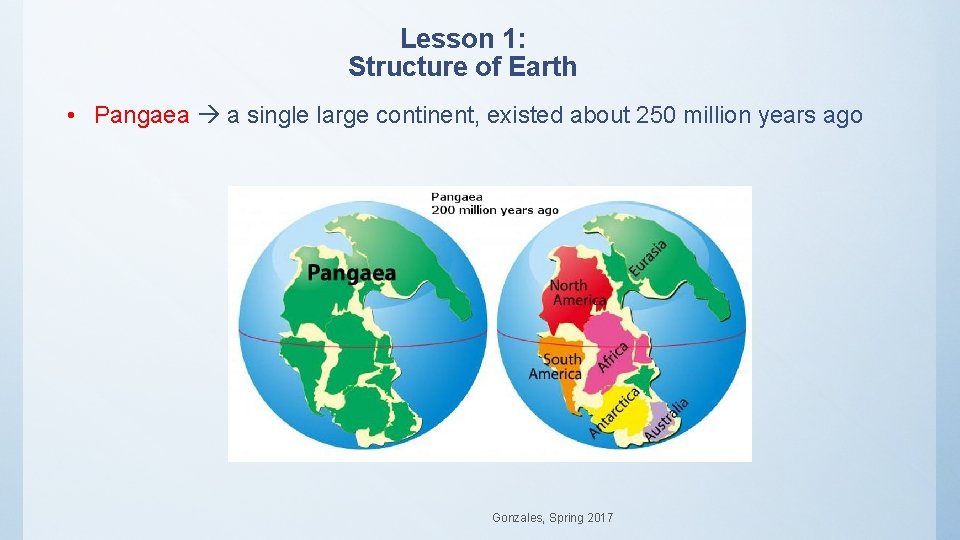
Lesson 1: Structure of Earth • Pangaea a single large continent, existed about 250 million years ago Gonzales, Spring 2017
Lesson 2: Earth’s Resources • Resource anything that is needed by humans to survive • Natural resource: air, H 2 O, soil, minerals, energy • Soil layer of loose disintegrated rock, organic matter, living organisms, air, and water • Minerals naturally forming inorganic substances with a crystalline structure of which rocks are made • Energy resources fossil fuels, flowing water, wind, solar energy, geothermal energy • 2 types of resources: • nonrenewable takes million of years to form naturally • Renewable supply will not run out, unlimited supply • Solar energy • Resource cycles through the environment • water Gonzales, Spring 2017
Lesson 2: Earth’s Resources • People harm the natural resources through consumption, overuse, & pollution • The ozone layer is deplete by the release of compounds called CFCs • Conservation any action taken to preserve natural resources and protect the natural environment Gonzales, Spring 2017
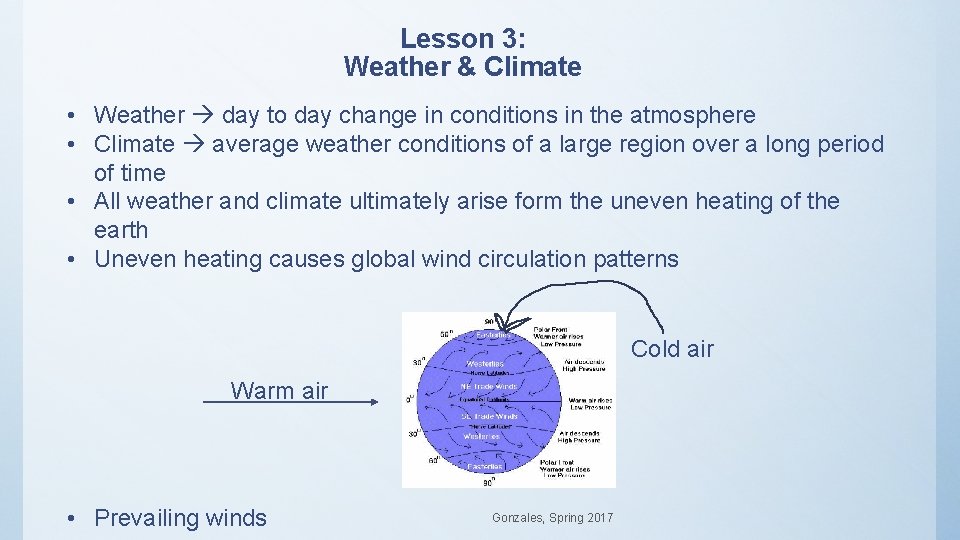
Lesson 3: Weather & Climate • Weather day to day change in conditions in the atmosphere • Climate average weather conditions of a large region over a long period of time • All weather and climate ultimately arise form the uneven heating of the earth • Uneven heating causes global wind circulation patterns Cold air Warm air • Prevailing winds Gonzales, Spring 2017
Lesson 3: Weather & Climate • Major influence on weather and climate, caused by uneven heating of Earth, is the ocean currents • Ocean currents caused by the wind and by variations in the density of water • Ocean currents help transfer heat from equatorial regions to the poles • Daily weather patterns caused by movements of air masses, large bodies of air with similar temperature, humidity, and pressure • • Front boundary between 2 air masses Cold front cold air mass overtakes & displaces a warm air mass Warm front warm air mass rises over a cold air mass Occluded front cold front catches up with a warm front & the 2 weather system merge Gonzales, Spring 2017
Lesson 3: Weather & Climate • Precipitation water released from clouds in form of rain • Meteorologists study short term weather patterns and data Gonzales, Spring 2017
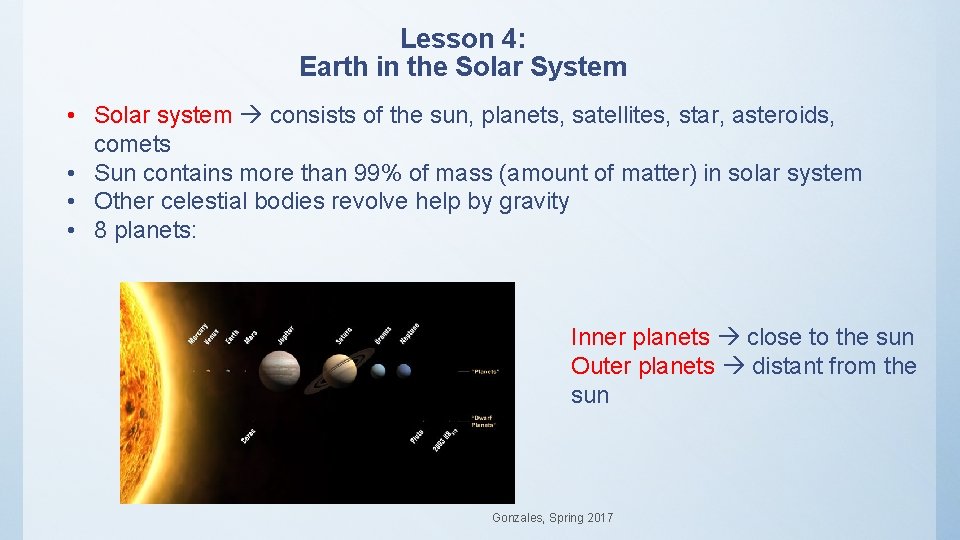
Lesson 4: Earth in the Solar System • Solar system consists of the sun, planets, satellites, star, asteroids, comets • Sun contains more than 99% of mass (amount of matter) in solar system • Other celestial bodies revolve help by gravity • 8 planets: Inner planets close to the sun Outer planets distant from the sun Gonzales, Spring 2017
Lesson 4: Earth in the Solar System • Earth is 70% covered by water; only planet that life exist • The moon is the largest satellite in solar system • No atmosphere, some surface ice • Revolves around earth every 27 days • During lunar month, moon goes through phases • Changes in the proportion of its surface that is in shadow • 29 days Gonzales, Spring 2017
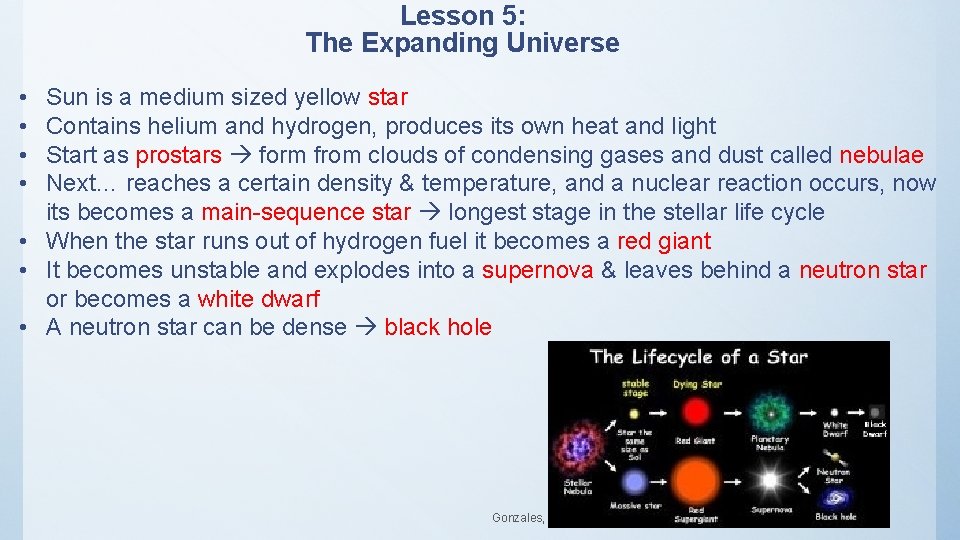
Lesson 5: The Expanding Universe • • Sun is a medium sized yellow star Contains helium and hydrogen, produces its own heat and light Start as prostars form from clouds of condensing gases and dust called nebulae Next… reaches a certain density & temperature, and a nuclear reaction occurs, now its becomes a main-sequence star longest stage in the stellar life cycle • When the star runs out of hydrogen fuel it becomes a red giant • It becomes unstable and explodes into a supernova & leaves behind a neutron star or becomes a white dwarf • A neutron star can be dense black hole Gonzales, Spring 2017
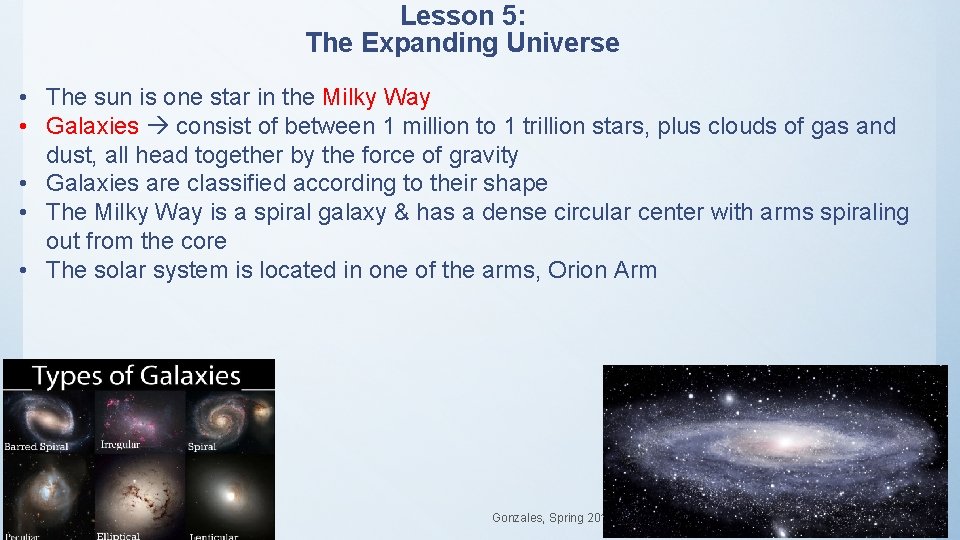
Lesson 5: The Expanding Universe • The sun is one star in the Milky Way • Galaxies consist of between 1 million to 1 trillion stars, plus clouds of gas and dust, all head together by the force of gravity • Galaxies are classified according to their shape • The Milky Way is a spiral galaxy & has a dense circular center with arms spiraling out from the core • The solar system is located in one of the arms, Orion Arm Gonzales, Spring 2017
Lesson 5: The Expanding Universe • • The Milky Way is par of a group of galaxies called the Local Group There are 27 known galaxies is this group Universe mostly is empty space with galaxies spread around It has other bodies: • brown dwarfs objects that are less massive than a star but more massive than a planet • Pulsars thought to be rotating neutron stars that emit pulses of energy at regular intervals • Quasars distant star like objects that emit more energy than a hundred galaxies • Cosmologist study the origin, properties, and evolution of the universe • One theory = Big Bang • http: //www. sciencechannel. com/video-topics/space-videos/the-big-bang/ Gonzales, Spring 2017