
SCIENCE BACKGROUND PHYSICAL SCIENCE LESSON 1 MR CONKEY

SCIENCE BACKGROUND PHYSICAL SCIENCE LESSON 1 MR. CONKEY
WHAT IS SCIENCE? Take 5 minutes with your shoulder partners and come up with a definition for science.

SCIENCE – A SYSTEM OF KNOWLEDGE AND THE METHODS USED TO FIND THAT KNOWLEDGE. • Curiosity leads to discovery

WHAT IS TECHNOLOGY? Again, take a few minutes to come up with a definition for technology with your shoulder partners.

TECHNOLOGY – THE USE OF KNOWLEDGE TO SOLVE PRACTICAL PROBLEMS. Science and Technology are interdependent, meaning that as one advances the other does too. • Example: Studies in Physics led to transistors which led to advances in space and computer sciences.
WHAT IS CHEMISTRY? WHAT IS PHYSICS? Come up with the definitions for Chemistry and Physics with shoulder partners.
CHEMISTRY – THE STUDY OF THE COMPOSITION, STRUCTURE, PROPERTIES, AND REACTIONS OF MATTER PHYSICS – THE STUDY OF MATTER AND ENERGY AND THE INTERACTIONS BETWEEN THE TWO THROUGH FORCES AND MOTION.
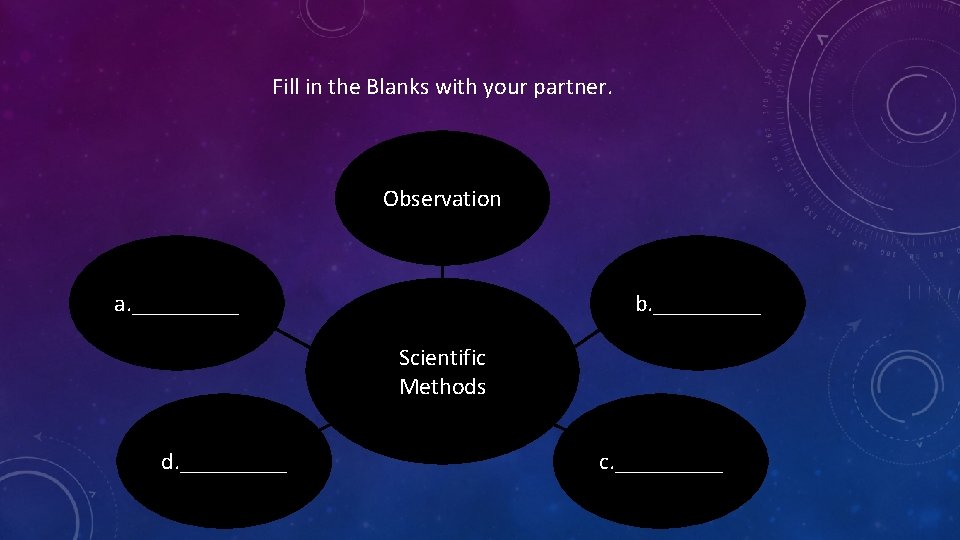
Fill in the Blanks with your partner. Observation a. _____ b. _____ Scientific Methods d. _____ c. _____
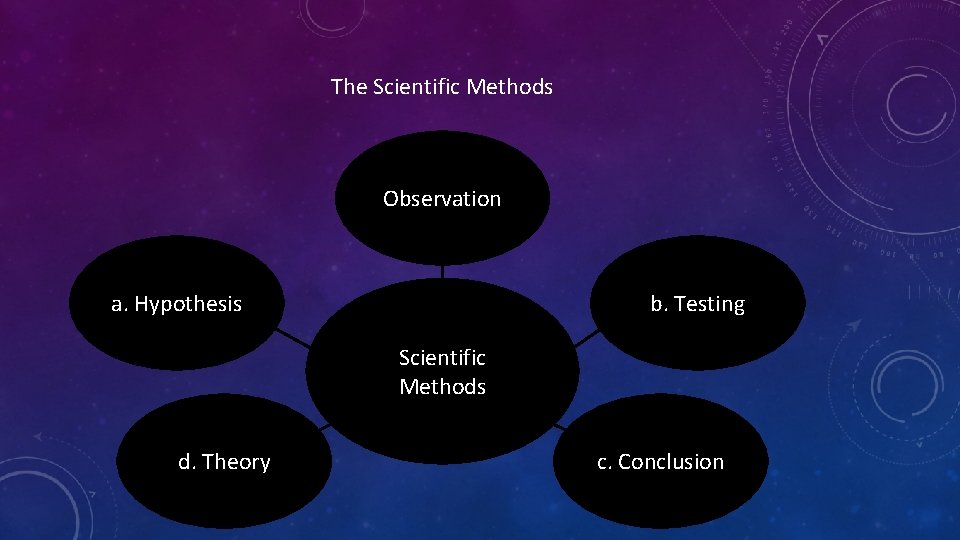
The Scientific Methods Observation a. Hypothesis b. Testing Scientific Methods d. Theory c. Conclusion
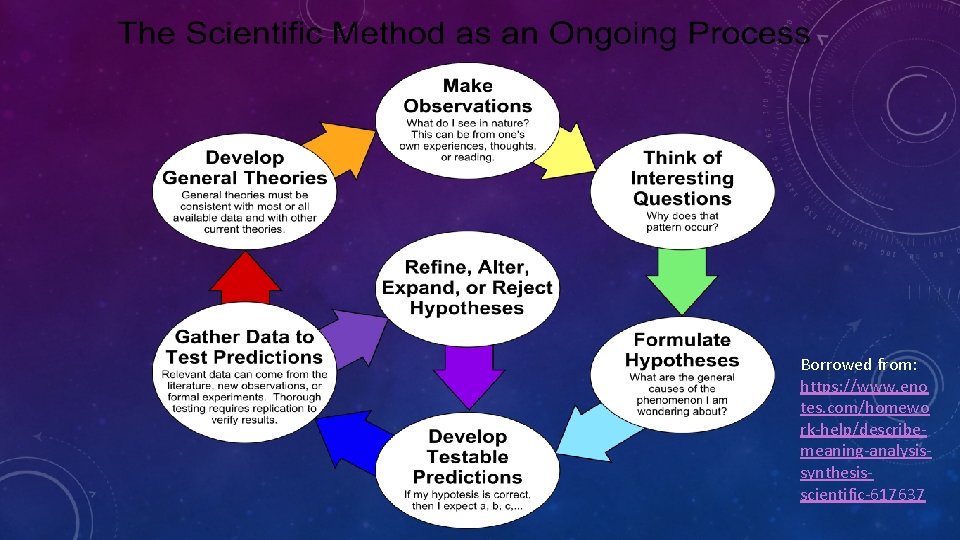
Borrowed from: https: //www. eno tes. com/homewo rk-help/describemeaning-analysissynthesisscientific-617637
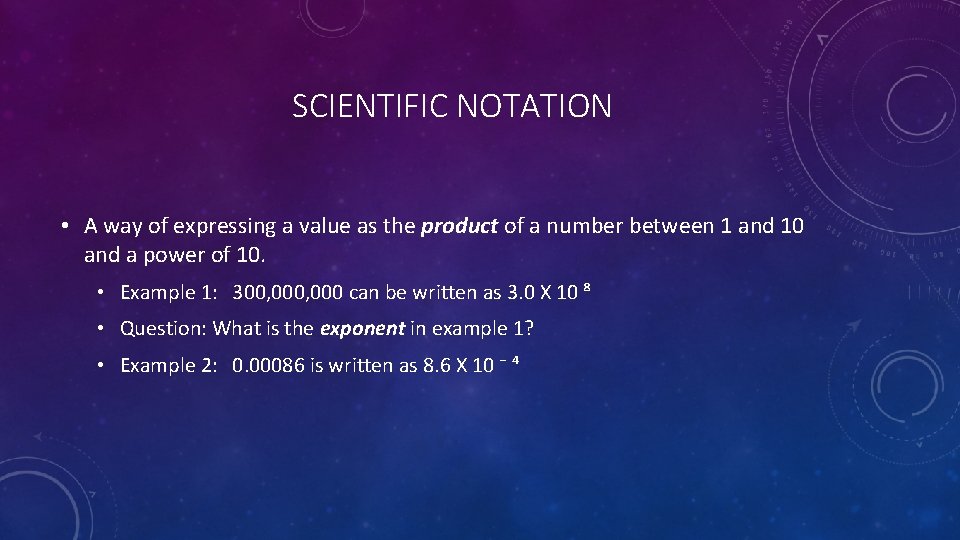
SCIENTIFIC NOTATION • A way of expressing a value as the product of a number between 1 and 10 and a power of 10. • Example 1: 300, 000 can be written as 3. 0 X 10 ⁸ • Question: What is the exponent in example 1? • Example 2: 0. 00086 is written as 8. 6 X 10 ⁻ ⁴
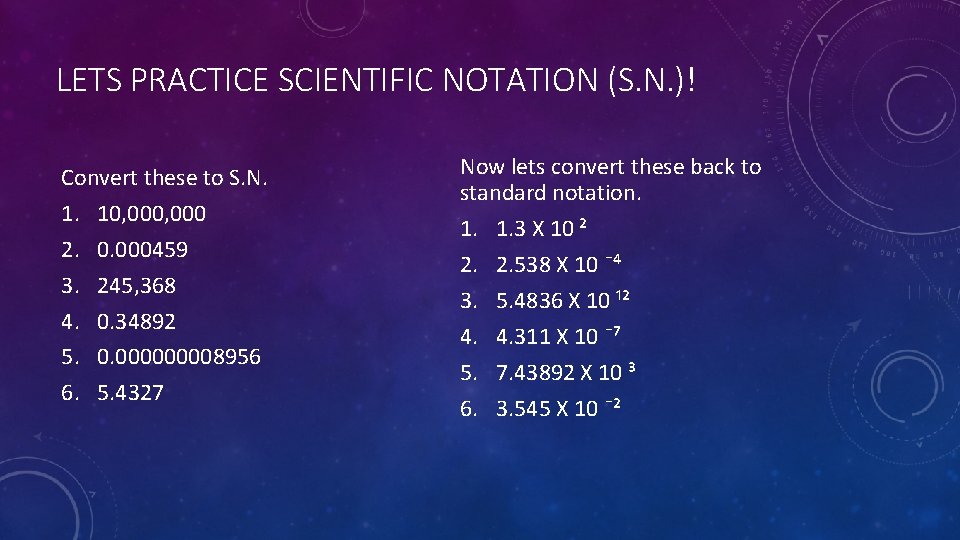
LETS PRACTICE SCIENTIFIC NOTATION (S. N. )! Convert these to S. N. 1. 10, 000 2. 0. 000459 3. 245, 368 4. 0. 34892 5. 0. 00008956 6. 5. 4327 Now lets convert these back to standard notation. 1. 1. 3 X 10 ² 2. 2. 538 X 10 ¯⁴ 3. 5. 4836 X 10 ¹² 4. 4. 311 X 10 ¯⁷ 5. 7. 43892 X 10 ³ 6. 3. 545 X 10 ¯²
SOLVING MULTIPLICATION AND DIVISION PROBLEMS USING SCIENTIFIC NOTATION • When multiplying numbers in S. N. , you multiply the two numbers Before the multiplication sign and then Add the exponents together. • Example: Calculate how far light travels in 500 seconds by multiplying the speed of light by how many seconds. (3. 0 X 10 ⁸ m/s) speed of light X (5. 0 X 10 ² s) 500 seconds in S. N. (3. 0 X 5. 0) (10 ⁸ ⁺ ²) (m/s X s) = 15 X 10 ¹⁰ = 1. 5 X 10 ¹¹
SOLVING MULTIPLICATION AND DIVISION PROBLEMS USING SCIENTIFIC NOTATION (CONT. ) • When dividing numbers in S. N. , you divide the numbers before the power of ten and then subtract the exponents. • Example: Calculate how long it takes for sunlight to reach Earth. 1. 5 X 10 ¹¹ m distance from the Sun to the Earth 3. 0 X 10 ⁸ m/s speed of light 1. 5 3. 0 X 10 ¹¹¯⁸ s = 0. 50 X 10 ³ s = 5. 0 X 10 ² s
PROBLEM SOLVE USING SCIENTIFIC NOTATION A parking lot has a length of 1. 1 X 10 ³ meters and a width of 2. 4 X 10 ³ meters. What is the area of the parking lot (in scientific notation)? • Hint: What is the formula for the area of a rectangle?
DIVISION PRACTICE You are travelling at approximately 30 m/s on a train. Your destination is Hogwarts which is roughly 3. 8 X 10 ⁵ m from your home town (starting point). How long will it take you to get to Hogwarts? (Please round your answer to three decimal places and report it in S. N. )
INTERNATIONAL SYSTEM OF UNITS (S. I. ) UNITS • A modified version of the metric system • Includes Base Units, Derived Units, and S. I. Prefixes. • S. I. Unit for length (straight-line distance between two points) = meter (m) • S. I. Unit for mass (quantity of matter in an object) = kilogram (kg)
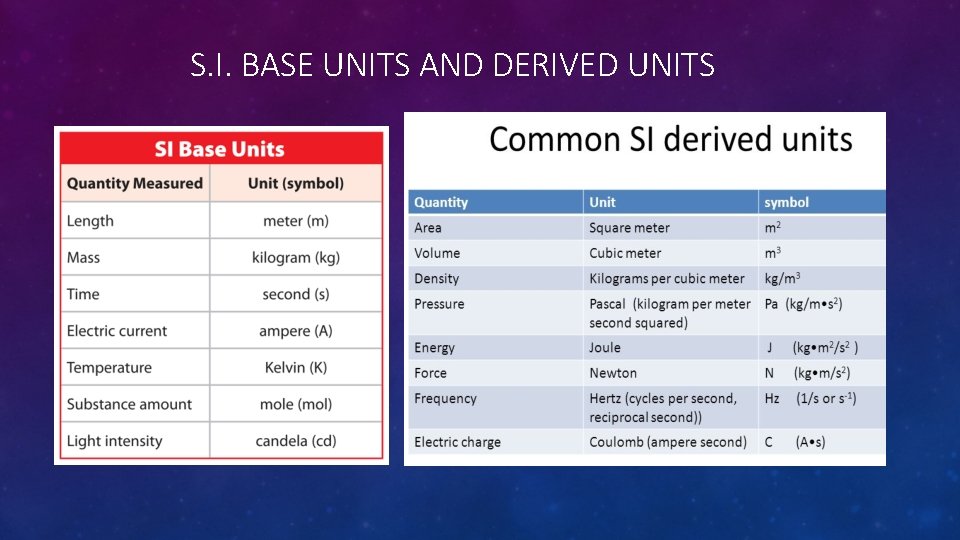
S. I. BASE UNITS AND DERIVED UNITS
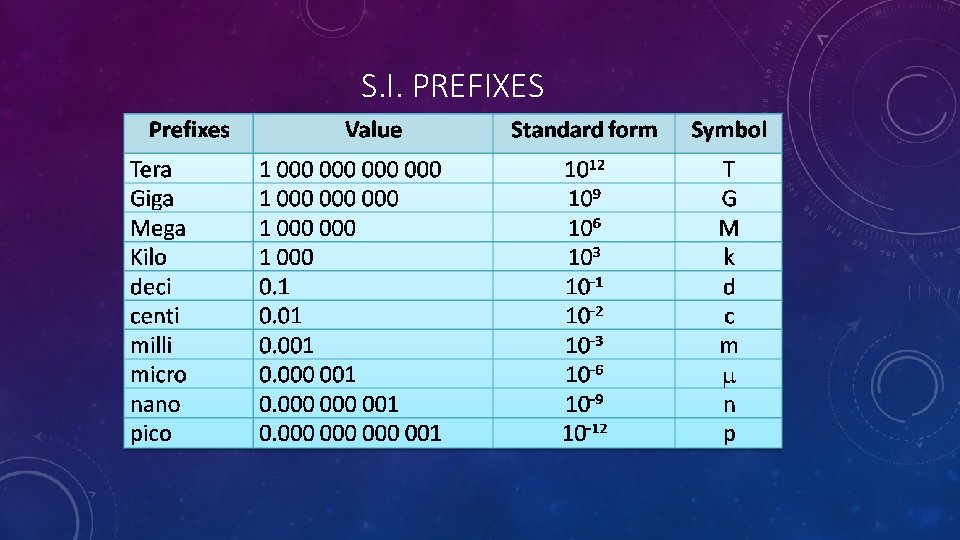
S. I. PREFIXES
- Slides: 19