
Science and Religion in Victorian England Overview of

- Slides: 15
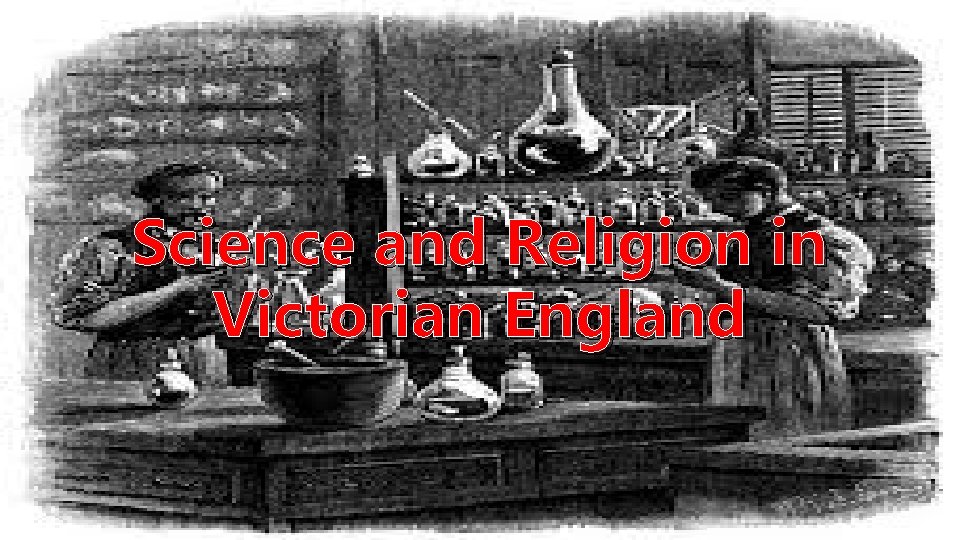
Science and Religion in Victorian England
Overview of the key ideas In science and technology, the Victorians invented the modern idea of invention -- the notion that one can create solutions to problems, that man create new means of bettering himself and his environment. At the beginning of the nineteenth century in Britain, religious faith and the sciences were generally seen to be in beautiful accordance. The study of God's Word, in the Bible, and His Works, in nature, were assumed to be twin facets of the same truth. One version of this belief had been manifested in William Paley's Natural Theology (1802), which repeated the argument that natural objects show evidences of design, thus showing the existence of a designing God. Paley's work was enormously influential for its emphasis on nature as God's creation, even though, by the 1830 s, few Christians saw a need to prove God's existence, preferring to take this as an act of faith. The Bridgewater Treatises (1833 -36) showed how natural theology could be reconfigured in various ways to meet new discoveries. Their sales figures also showed that there was a substantial market for non-technical works of science.
Harmony between Science and Faith This harmony between science and faith, mediated by some form of theology of nature, continued to be the mainstream position for most men of science, and most interested individuals, right up to the 1860 s, at least. But it did come under threat. In the 1820 s and 1830 s, some working-class radicals saw a chance of using certain versions of the sciences for political ends. Some forms of the sciences, especially those emanating from France, seemed to suggest a restricted (or even nonexistent) role for God in the universe, and thus to undermine the Anglican politico-religious establishment. Such materialist forms of science were as abhorred by most respectable men of science, as they were championed by working-class radicals. Science and Progress Industrial Revolution: the developments that transformed Great Britain, between 1750 and 1830, from a largely rural population making a living almost entirely from agriculture to a town-centered society engaged increasingly in factory manufacture. As many thousands of women throughout rural Britain saw their spinning wheels become redundant and their jobs disappear into the factories, they moved to the cities. The towns offered a better chance of work and higher wages than the countryside, where many families were trapped in dire poverty and seasonal employment. On the other hand, the countryside was healthier. The Industrial Revolution gathered steam, and accelerated the migration of the population from country to city. The result of this movement was the development of horrifying slums and cramped row housing in the overcrowded cities.
The threats were not only from France, however. British men of science, particularly geologists, were also making discoveries which threatened the literal meaning of Genesis. The effect of these discoveries on faith has, however, been oft-exaggerated. Clerical geologists were quite able to find ways to reinterpret Genesis in the light of their discoveries, with no harm done to their faith. Even the majority of evangelicals were, by the 1840 s, willing to accept non-literal interpretations of Genesis which could be fitted with the latest accepted discoveries in geology or astronomy. The few people who stressed the threat to faith of these discoveries tended to be the working-class radicals, while the extreme evangelicals who promoted Scriptural Geology to retain a literal reading of Genesis were an equally vocal minority. The reaction to Darwin's Origin of the Species (1859) should also be seen in this light: while some people played up its radicalism, others were quite able to fit it into their religious worldview. It depended as much on the reader's existing beliefs and agenda as on anything intrinsic to the work itself. https: //www. youtube. com/watch? v=L 2 GX 3 Agk. Jog
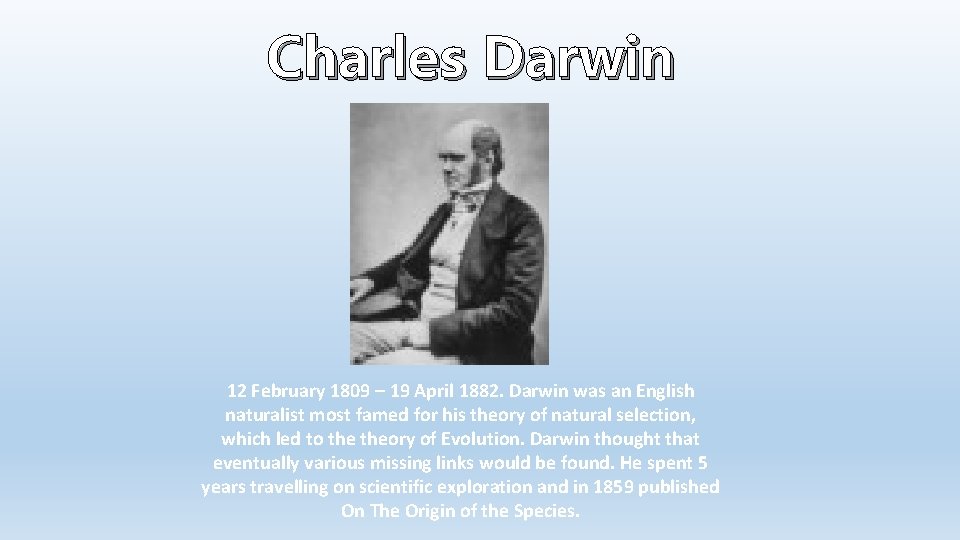
Charles Darwin 12 February 1809 – 19 April 1882. Darwin was an English naturalist most famed for his theory of natural selection, which led to theory of Evolution. Darwin thought that eventually various missing links would be found. He spent 5 years travelling on scientific exploration and in 1859 published On The Origin of the Species.
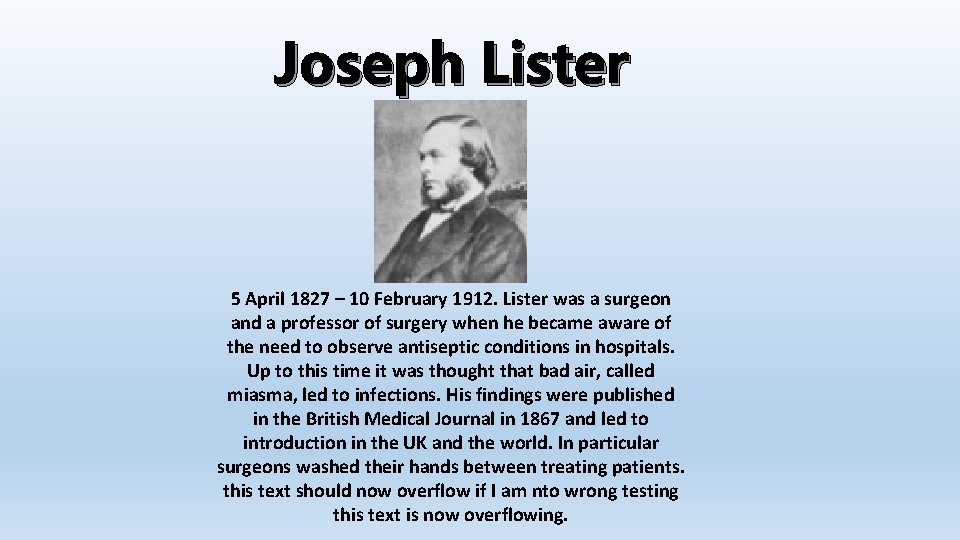
Joseph Lister 5 April 1827 – 10 February 1912. Lister was a surgeon and a professor of surgery when he became aware of the need to observe antiseptic conditions in hospitals. Up to this time it was thought that bad air, called miasma, led to infections. His findings were published in the British Medical Journal in 1867 and led to introduction in the UK and the world. In particular surgeons washed their hands between treating patients. this text should now overflow if I am nto wrong testing this text is now overflowing.
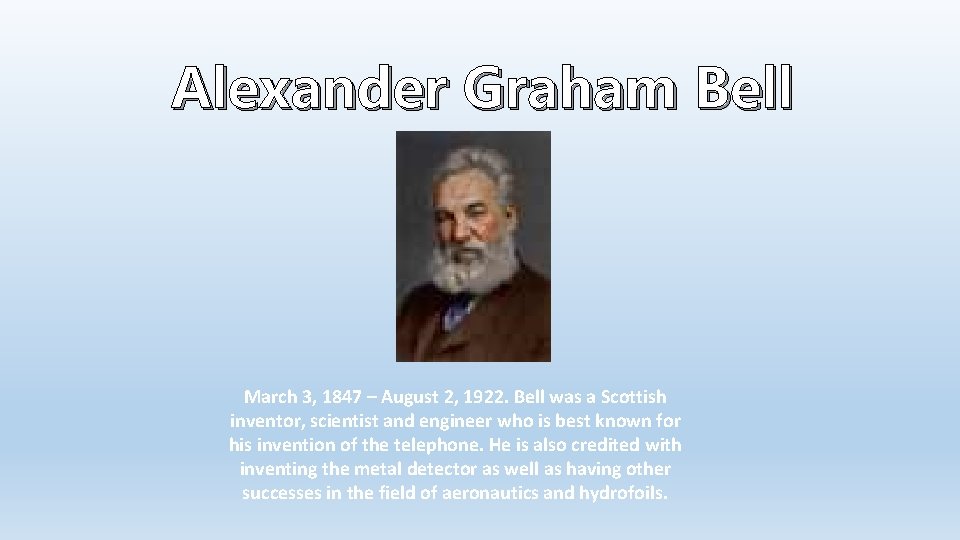
Alexander Graham Bell March 3, 1847 – August 2, 1922. Bell was a Scottish inventor, scientist and engineer who is best known for his invention of the telephone. He is also credited with inventing the metal detector as well as having other successes in the field of aeronautics and hydrofoils.
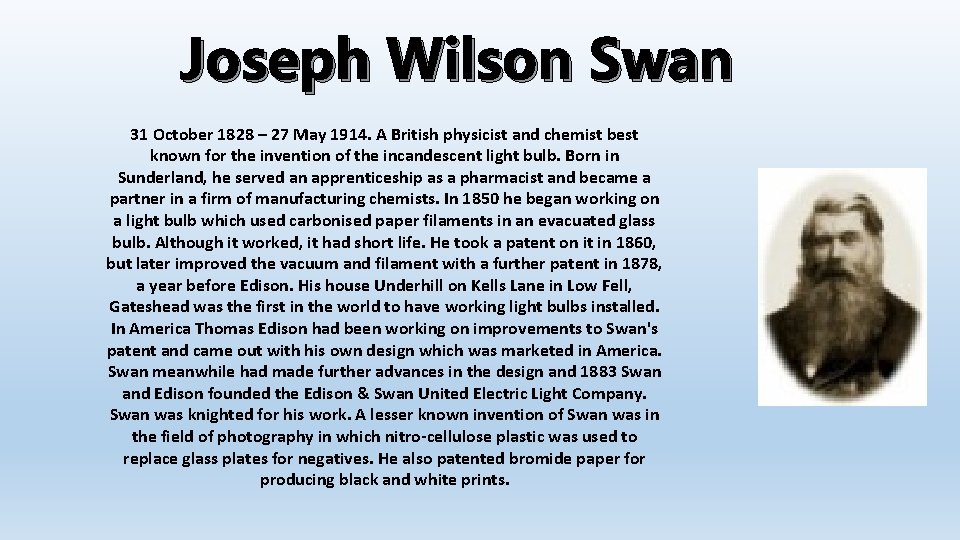
Joseph Wilson Swan 31 October 1828 – 27 May 1914. A British physicist and chemist best known for the invention of the incandescent light bulb. Born in Sunderland, he served an apprenticeship as a pharmacist and became a partner in a firm of manufacturing chemists. In 1850 he began working on a light bulb which used carbonised paper filaments in an evacuated glass bulb. Although it worked, it had short life. He took a patent on it in 1860, but later improved the vacuum and filament with a further patent in 1878, a year before Edison. His house Underhill on Kells Lane in Low Fell, Gateshead was the first in the world to have working light bulbs installed. In America Thomas Edison had been working on improvements to Swan's patent and came out with his own design which was marketed in America. Swan meanwhile had made further advances in the design and 1883 Swan and Edison founded the Edison & Swan United Electric Light Company. Swan was knighted for his work. A lesser known invention of Swan was in the field of photography in which nitro-cellulose plastic was used to replace glass plates for negatives. He also patented bromide paper for producing black and white prints.
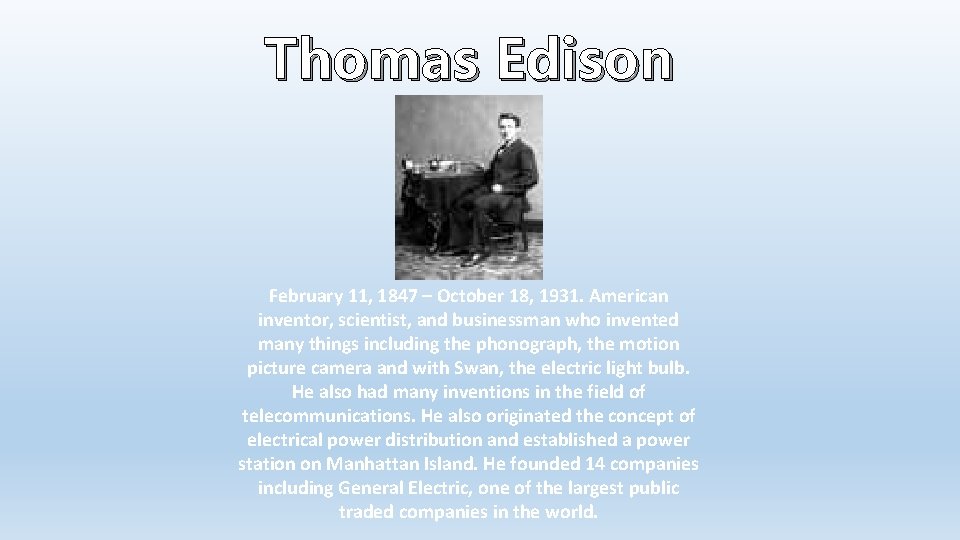
Thomas Edison February 11, 1847 – October 18, 1931. American inventor, scientist, and businessman who invented many things including the phonograph, the motion picture camera and with Swan, the electric light bulb. He also had many inventions in the field of telecommunications. He also originated the concept of electrical power distribution and established a power station on Manhattan Island. He founded 14 companies including General Electric, one of the largest public traded companies in the world.
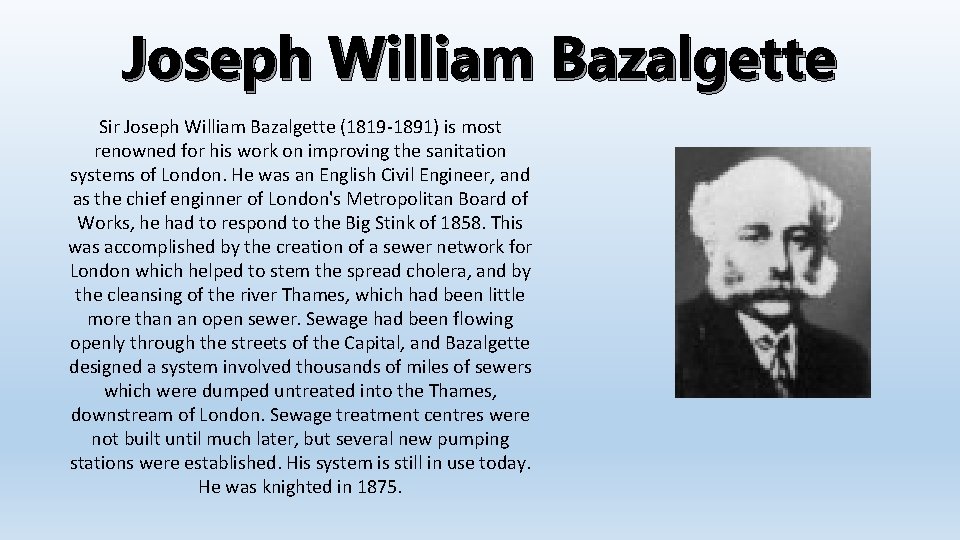
Joseph William Bazalgette Sir Joseph William Bazalgette (1819 -1891) is most renowned for his work on improving the sanitation systems of London. He was an English Civil Engineer, and as the chief enginner of London's Metropolitan Board of Works, he had to respond to the Big Stink of 1858. This was accomplished by the creation of a sewer network for London which helped to stem the spread cholera, and by the cleansing of the river Thames, which had been little more than an open sewer. Sewage had been flowing openly through the streets of the Capital, and Bazalgette designed a system involved thousands of miles of sewers which were dumped untreated into the Thames, downstream of London. Sewage treatment centres were not built until much later, but several new pumping stations were established. His system is still in use today. He was knighted in 1875.
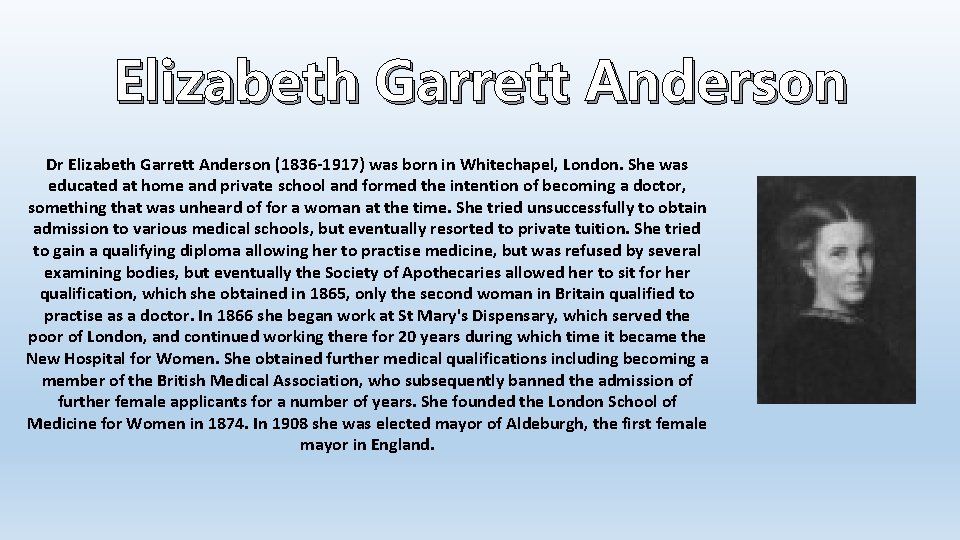
Elizabeth Garrett Anderson Dr Elizabeth Garrett Anderson (1836 -1917) was born in Whitechapel, London. She was educated at home and private school and formed the intention of becoming a doctor, something that was unheard of for a woman at the time. She tried unsuccessfully to obtain admission to various medical schools, but eventually resorted to private tuition. She tried to gain a qualifying diploma allowing her to practise medicine, but was refused by several examining bodies, but eventually the Society of Apothecaries allowed her to sit for her qualification, which she obtained in 1865, only the second woman in Britain qualified to practise as a doctor. In 1866 she began work at St Mary's Dispensary, which served the poor of London, and continued working there for 20 years during which time it became the New Hospital for Women. She obtained further medical qualifications including becoming a member of the British Medical Association, who subsequently banned the admission of further female applicants for a number of years. She founded the London School of Medicine for Women in 1874. In 1908 she was elected mayor of Aldeburgh, the first female mayor in England.
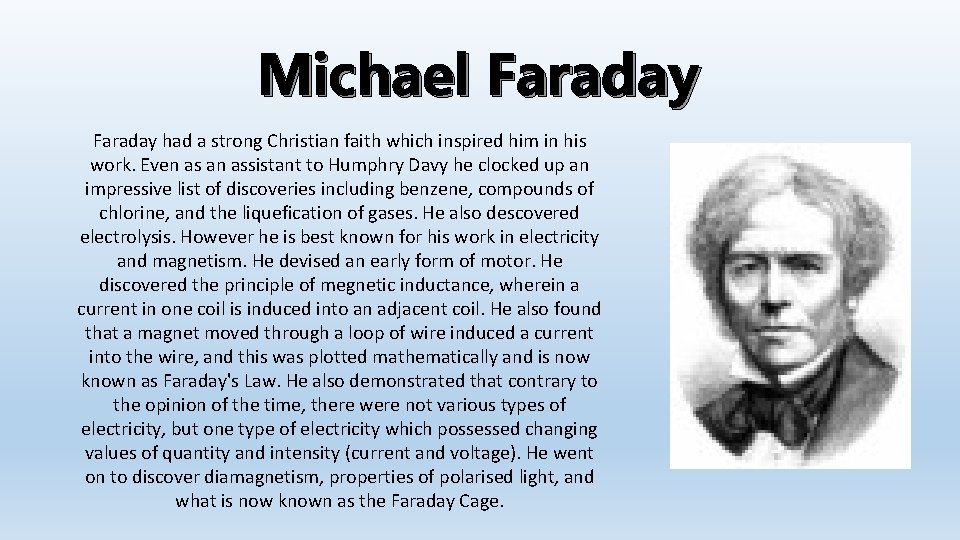
Michael Faraday had a strong Christian faith which inspired him in his work. Even as an assistant to Humphry Davy he clocked up an impressive list of discoveries including benzene, compounds of chlorine, and the liquefication of gases. He also descovered electrolysis. However he is best known for his work in electricity and magnetism. He devised an early form of motor. He discovered the principle of megnetic inductance, wherein a current in one coil is induced into an adjacent coil. He also found that a magnet moved through a loop of wire induced a current into the wire, and this was plotted mathematically and is now known as Faraday's Law. He also demonstrated that contrary to the opinion of the time, there were not various types of electricity, but one type of electricity which possessed changing values of quantity and intensity (current and voltage). He went on to discover diamagnetism, properties of polarised light, and what is now known as the Faraday Cage.
Victorian Science • Many scientific discoveries were made in the Victorian era, leading to more speculation about para sciences, or the more non-mainstream antithesis to each field of study. In literature, this led to speculation and theories about the extent and power of science, or scientific explanations for superstition. For example, the planet Neptune was discovered in 1843, and War of the Worlds, by H. G. Wells was published in the same era, in 1898, preceded by Robert Potters’ The Germ Growers, and a newly emerging culture of reimagined Martian Science Fiction. The Victorian era also gave rise to a new genre – Victorian ghost stories heavily inspired by gothic literature, but also modern advances in psychology and revival of folklore. In The Turn of the Screw, advances in psychological study are clearly reflected. Gothic Literature ranges many points of focus, such as Emilie Brontë’s Wuthering Heights – which has one particular focus on the entrapment of women and the dangerous ways in which they can escape this – or Edgar Allan Poe’s The Fall of the House of Usher, which explores the Gothic themes of death and madness. • Equally, a popular belief in science led to a Victorian notion of ghost hunting – of using science, as it was becoming so far advanced – to explain what previously was inexplicable. Victorians, far from using local priests and salt to rid themselves of ghosts, took up newly developed camera technology, and tried to capture the spirts themselves. They also took it upon themselves to find, and chemically test ectoplasm left over from apparitions. Consequently, séances and mediums also rose in popularity, and people all across the world were enjoying contact with spirits and dead relatives.
Scientific Facts • Victorians invented the word ‘scientist’ • The rise in popularity of séances in the USA was induced by two teenage girls. • The term dinosaur, another huge scientific advancement, was coined in 1842. • Ghost stories appear in many ancient civilisations, such as Homer’s Odyssey, in which ghosts of the dead appear • The first Gothic Novel was written in 1764