
Science and Commerce Scientific Revolution While the Renaissance
- Slides: 7
Science and Commerce
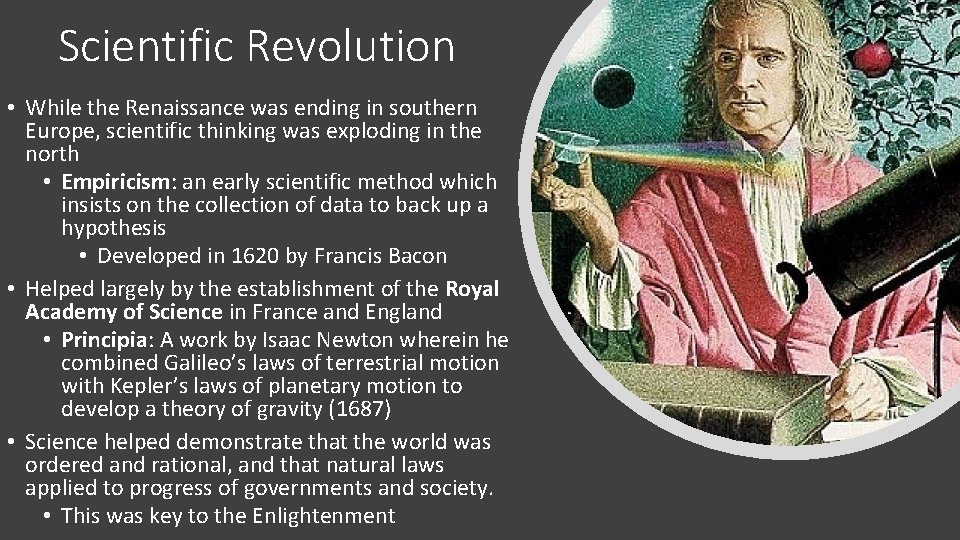
Scientific Revolution • While the Renaissance was ending in southern Europe, scientific thinking was exploding in the north • Empiricism: an early scientific method which insists on the collection of data to back up a hypothesis • Developed in 1620 by Francis Bacon • Helped largely by the establishment of the Royal Academy of Science in France and England • Principia: A work by Isaac Newton wherein he combined Galileo’s laws of terrestrial motion with Kepler’s laws of planetary motion to develop a theory of gravity (1687) • Science helped demonstrate that the world was ordered and rational, and that natural laws applied to progress of governments and society. • This was key to the Enlightenment
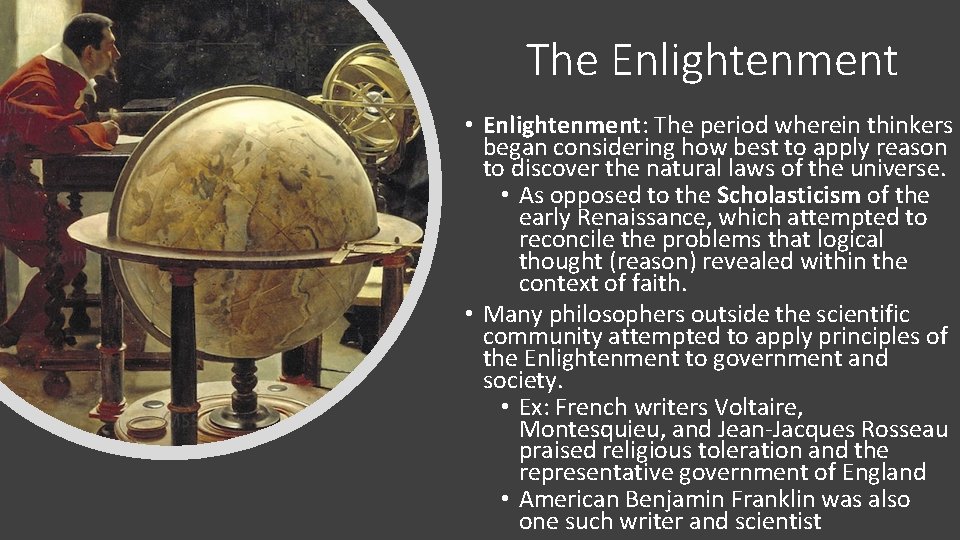
The Enlightenment • Enlightenment: The period wherein thinkers began considering how best to apply reason to discover the natural laws of the universe. • As opposed to the Scholasticism of the early Renaissance, which attempted to reconcile the problems that logical thought (reason) revealed within the context of faith. • Many philosophers outside the scientific community attempted to apply principles of the Enlightenment to government and society. • Ex: French writers Voltaire, Montesquieu, and Jean-Jacques Rosseau praised religious toleration and the representative government of England • American Benjamin Franklin was also one such writer and scientist
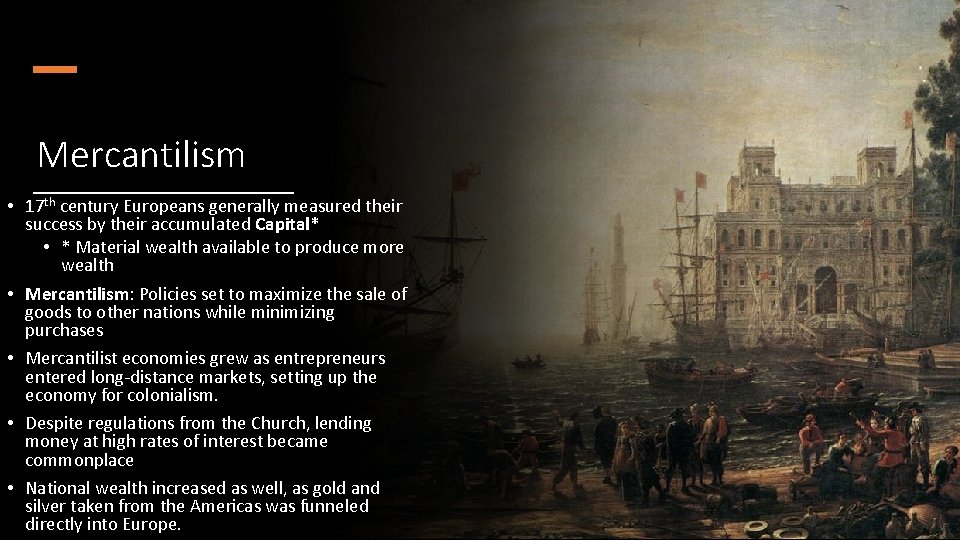
Mercantilism • 17 th century Europeans generally measured their success by their accumulated Capital* • * Material wealth available to produce more wealth • Mercantilism: Policies set to maximize the sale of goods to other nations while minimizing purchases • Mercantilist economies grew as entrepreneurs entered long-distance markets, setting up the economy for colonialism. • Despite regulations from the Church, lending money at high rates of interest became commonplace • National wealth increased as well, as gold and silver taken from the Americas was funneled directly into Europe.
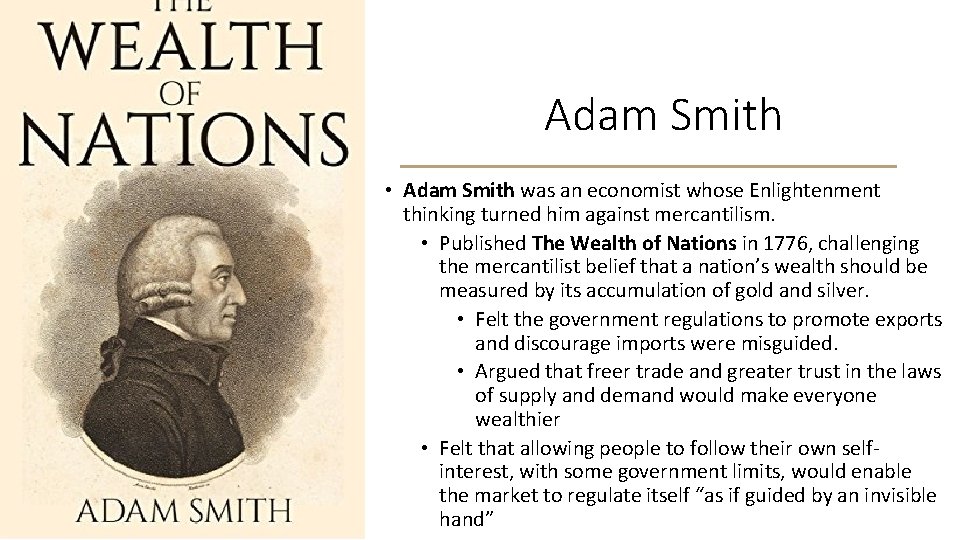
Adam Smith • Adam Smith was an economist whose Enlightenment thinking turned him against mercantilism. • Published The Wealth of Nations in 1776, challenging the mercantilist belief that a nation’s wealth should be measured by its accumulation of gold and silver. • Felt the government regulations to promote exports and discourage imports were misguided. • Argued that freer trade and greater trust in the laws of supply and demand would make everyone wealthier • Felt that allowing people to follow their own selfinterest, with some government limits, would enable the market to regulate itself “as if guided by an invisible hand”
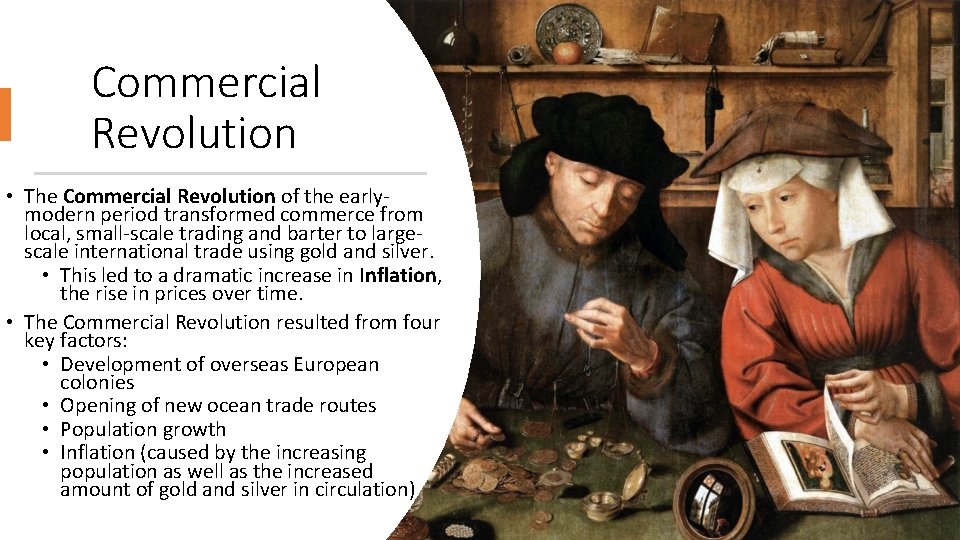
Commercial Revolution • The Commercial Revolution of the earlymodern period transformed commerce from local, small-scale trading and barter to largescale international trade using gold and silver. • This led to a dramatic increase in Inflation, the rise in prices over time. • The Commercial Revolution resulted from four key factors: • Development of overseas European colonies • Opening of new ocean trade routes • Population growth • Inflation (caused by the increasing population as well as the increased amount of gold and silver in circulation)
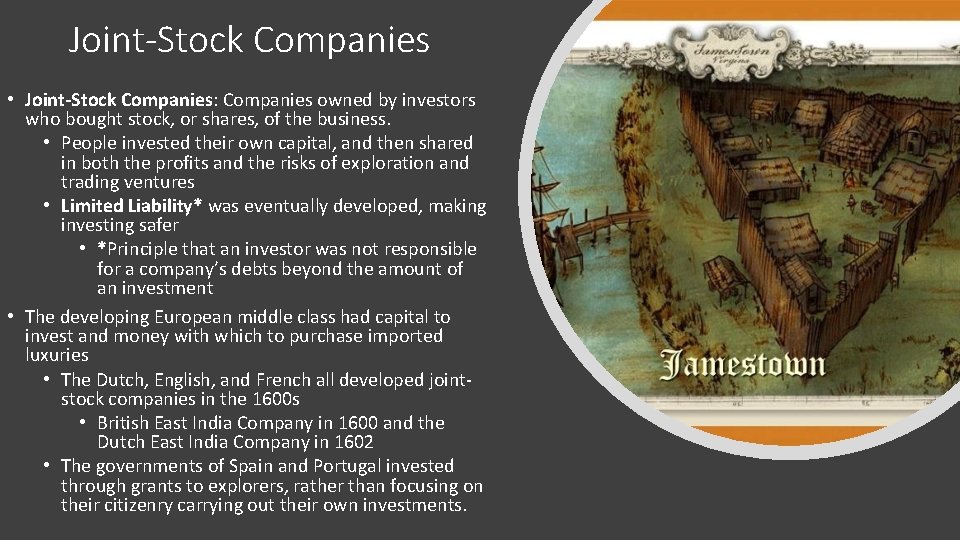
Joint-Stock Companies • Joint-Stock Companies: Companies owned by investors who bought stock, or shares, of the business. • People invested their own capital, and then shared in both the profits and the risks of exploration and trading ventures • Limited Liability* was eventually developed, making investing safer • *Principle that an investor was not responsible for a company’s debts beyond the amount of an investment • The developing European middle class had capital to invest and money with which to purchase imported luxuries • The Dutch, English, and French all developed jointstock companies in the 1600 s • British East India Company in 1600 and the Dutch East India Company in 1602 • The governments of Spain and Portugal invested through grants to explorers, rather than focusing on their citizenry carrying out their own investments.