
SCIENCE AN OPPORTUNITY TO CHANGE THE LEARNING LANDSCAPE
- Slides: 13
SCIENCE - AN OPPORTUNITY TO CHANGE THE LEARNING LANDSCAPE Jan Visser Learning Development Institute jvisser@learndev. org http: //www. learndev. org June 24, 1999 Learning Without Frontiers UNESCO j. visser@unesco. org http: //www. unesco. org/ education/lwf/ ICSU - Program for Capacity Building in Science Conference Budapest 1
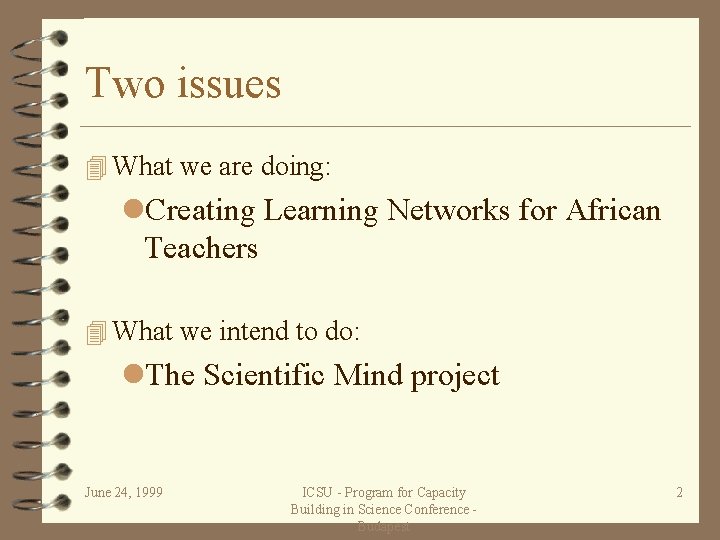
Two issues 4 What we are doing: l. Creating Learning Networks for African Teachers 4 What we intend to do: l. The Scientific Mind project June 24, 1999 ICSU - Program for Capacity Building in Science Conference Budapest 2
Overriding interest LEARNING June 24, 1999 ICSU - Program for Capacity Building in Science Conference Budapest 3
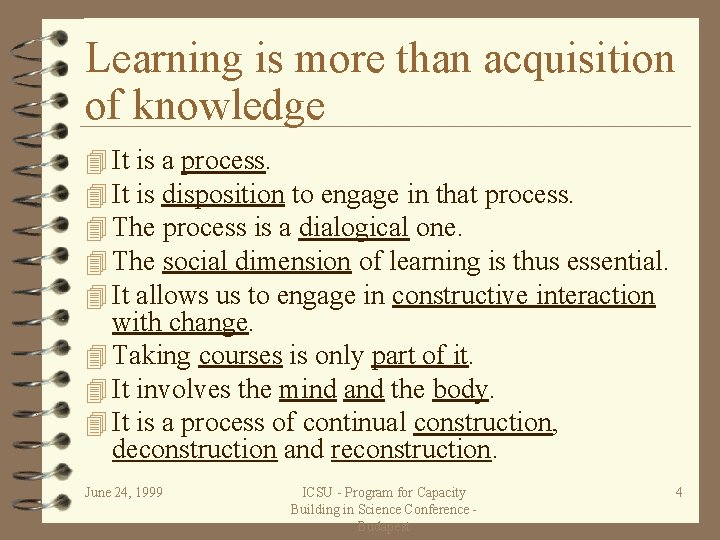
Learning is more than acquisition of knowledge 4 It is a process. 4 It is disposition to engage in that process. 4 The process is a dialogical one. 4 The social dimension of learning is thus essential. 4 It allows us to engage in constructive interaction with change. 4 Taking courses is only part of it. 4 It involves the mind and the body. 4 It is a process of continual construction, deconstruction and reconstruction. June 24, 1999 ICSU - Program for Capacity Building in Science Conference Budapest 4
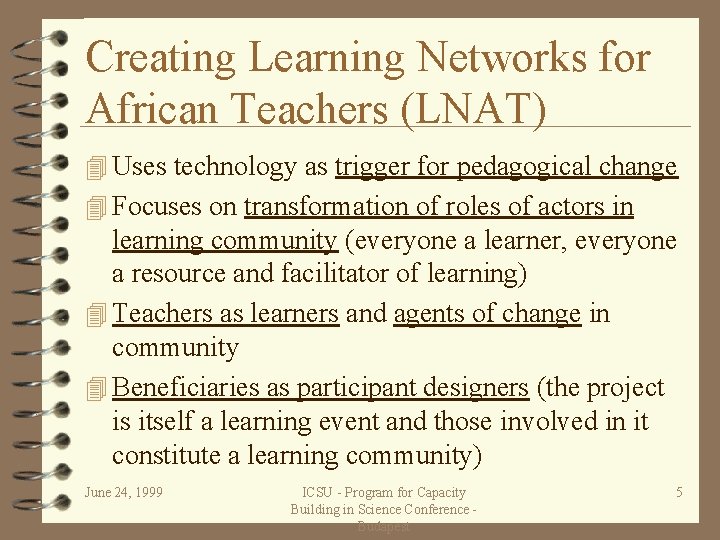
Creating Learning Networks for African Teachers (LNAT) 4 Uses technology as trigger for pedagogical change 4 Focuses on transformation of roles of actors in learning community (everyone a learner, everyone a resource and facilitator of learning) 4 Teachers as learners and agents of change in community 4 Beneficiaries as participant designers (the project is itself a learning event and those involved in it constitute a learning community) June 24, 1999 ICSU - Program for Capacity Building in Science Conference Budapest 5
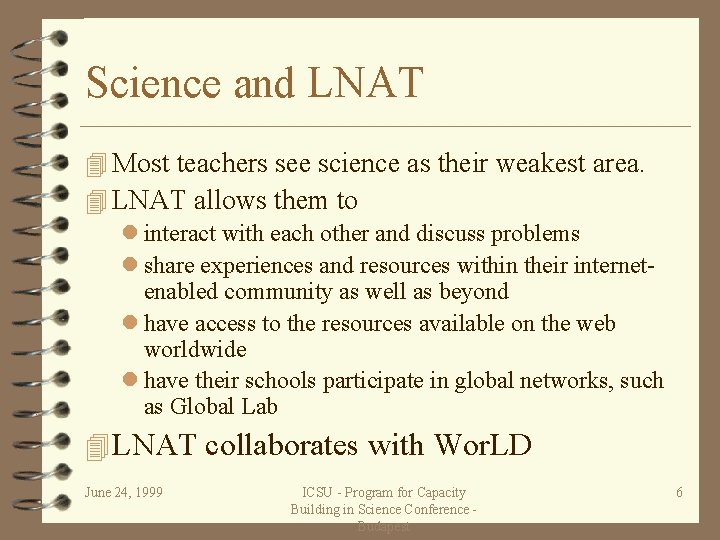
Science and LNAT 4 Most teachers see science as their weakest area. 4 LNAT allows them to l interact with each other and discuss problems l share experiences and resources within their internet- enabled community as well as beyond l have access to the resources available on the web worldwide l have their schools participate in global networks, such as Global Lab 4 LNAT collaborates with Wor. LD June 24, 1999 ICSU - Program for Capacity Building in Science Conference Budapest 6
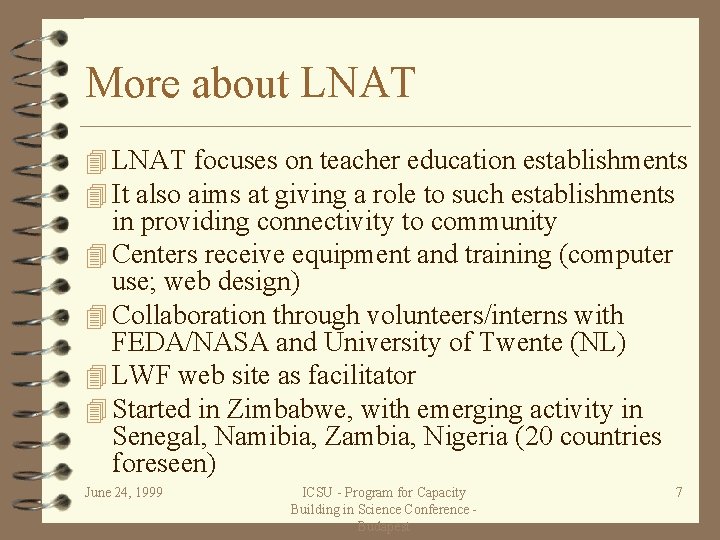
More about LNAT 4 LNAT focuses on teacher education establishments 4 It also aims at giving a role to such establishments in providing connectivity to community 4 Centers receive equipment and training (computer use; web design) 4 Collaboration through volunteers/interns with FEDA/NASA and University of Twente (NL) 4 LWF web site as facilitator 4 Started in Zimbabwe, with emerging activity in Senegal, Namibia, Zambia, Nigeria (20 countries foreseen) June 24, 1999 ICSU - Program for Capacity Building in Science Conference Budapest 7
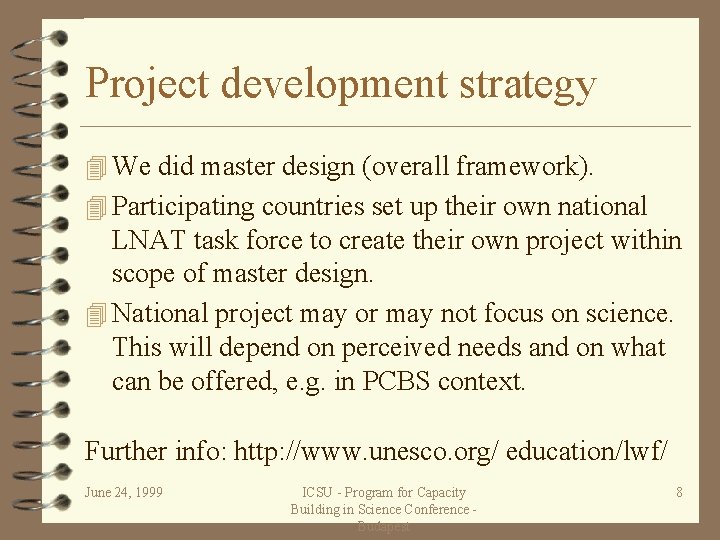
Project development strategy 4 We did master design (overall framework). 4 Participating countries set up their own national LNAT task force to create their own project within scope of master design. 4 National project may or may not focus on science. This will depend on perceived needs and on what can be offered, e. g. in PCBS context. Further info: http: //www. unesco. org/ education/lwf/ June 24, 1999 ICSU - Program for Capacity Building in Science Conference Budapest 8
The Scientific Mind (TSM) 4 Disposition to question the facts and critically challenge the 'givenness' of any a priori knowledge and authority. 4 Aesthetic awareness. 4 Moral conscience. Development of the true scientific spirit is important not only to create a scientifically literate population, but particularly also to create a citizenry that can creatively and constructively respond to the challenges of the world of the 21 st century. So many of these challenges being of a global nature, it is particularly important to stimulate the development of the scientific spirit in the context of global learning communities. Computer networking is a technology that has, if well designed and applied, important potential in this regard. June 24, 1999 ICSU - Program for Capacity Building in Science Conference Budapest 9
Thoughts about the scientific mind 4 The scientific mind involves the body as a whole. 4 It appeals to faculties across the intelligence spectrum. 4 Its pursuit should not be limited to scientific disciplines per se, but seek the unity of knowledge. 4 The scientific mind belongs to everyone. It relates to people's sense of freedom, responsibility, astonishment, recognition, gratitude. June 24, 1999 ICSU - Program for Capacity Building in Science Conference Budapest 10
Question 4 What conditions in the learning environment do best allow the scientific mind to develop and evolve? Question is relevant for: l rethinking school-based learning l considering the learning environment at large l looking at learning in the context of lifespan human development. June 24, 1999 ICSU - Program for Capacity Building in Science Conference Budapest 11
Aim of the project 4 Sort out what the scientific mind entails and do so in a way that goes beyond the limitations of individual disciplines (transdisciplinarity). 4 Find out what should be done to create conditions in the learning environment at large to foster in optimal ways the development of the scientific mind. 4 Put those conditions in place. Further info: http: //www. learndev. org June 24, 1999 ICSU - Program for Capacity Building in Science Conference Budapest 12
Use of these slides 4 Use of these slides In the interest of dialogue and the growth of understanding, use of these slides is permitted, provided that clear attribution be made to authorship (Jan Visser) and the Learning Development Institute (LDI) <http: //www. learndev. org>. June 24, 1999 ICSU - Program for Capacity Building in Science Conference Budapest 13