
Science 9 CHAPTER 3 Compounds A pure substance
Science 9 CHAPTER 3
Compounds �A pure substance made of two or more kinds of elements combined in fixed proportions. �Represented by a chemical formula. �Chemical bonds hold them together. �Are either ionic or covalent.
Covalent Compounds �Atoms combine by sharing electrons to form molecules. �Molecules: a group of atoms held together by sharing one or more pairs of electrons. �Examples include carbon dioxide and water. �Formed from non-metals only. �They do not conduct electricity. �May be a solid, liquid, or gas at room temperature
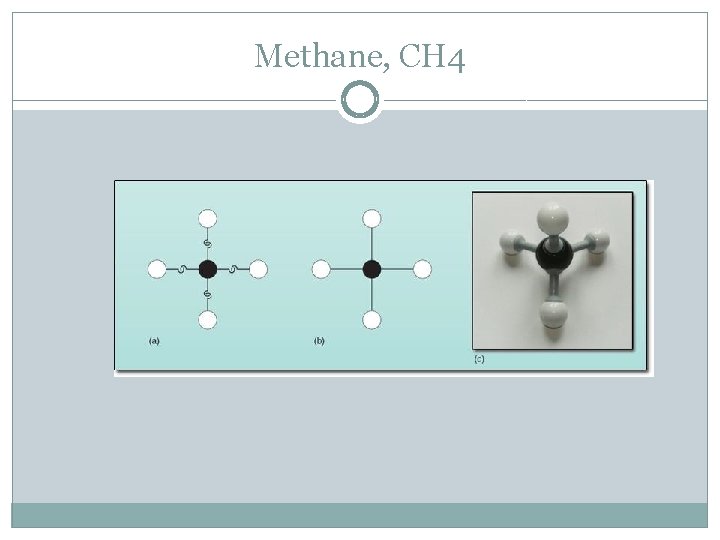
Methane, CH 4
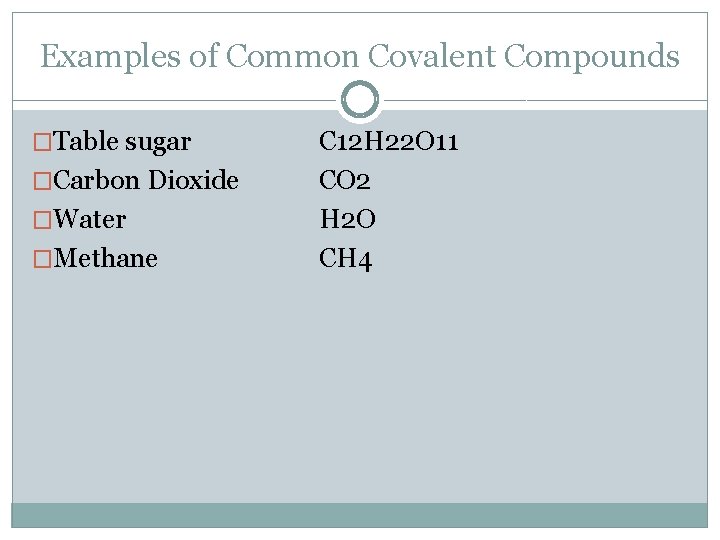
Examples of Common Covalent Compounds �Table sugar �Carbon Dioxide �Water �Methane C 12 H 22 O 11 CO 2 H 2 O CH 4
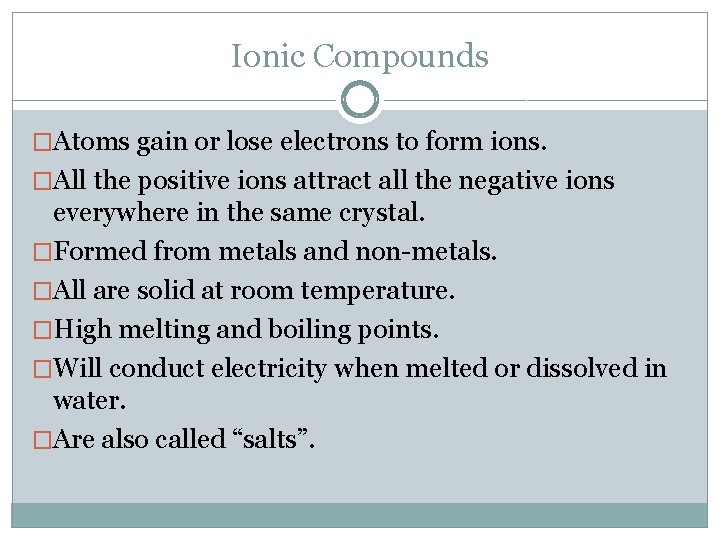
Ionic Compounds �Atoms gain or lose electrons to form ions. �All the positive ions attract all the negative ions everywhere in the same crystal. �Formed from metals and non-metals. �All are solid at room temperature. �High melting and boiling points. �Will conduct electricity when melted or dissolved in water. �Are also called “salts”.
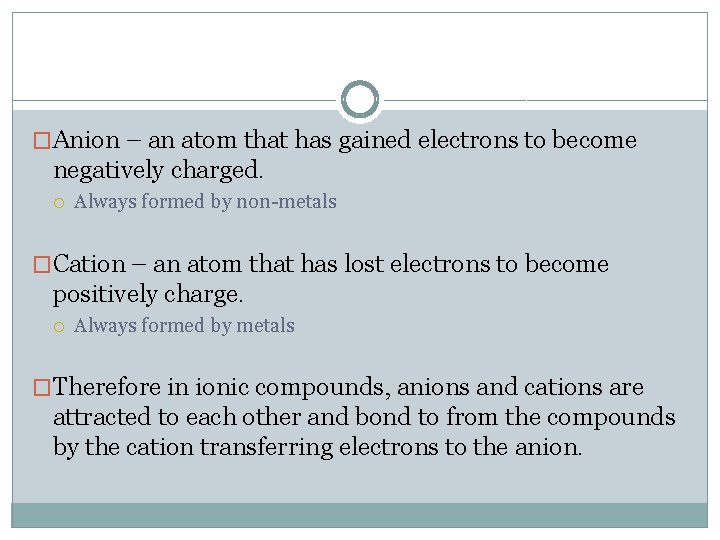
�Anion – an atom that has gained electrons to become negatively charged. Always formed by non-metals �Cation – an atom that has lost electrons to become positively charge. Always formed by metals �Therefore in ionic compounds, anions and cations are attracted to each other and bond to from the compounds by the cation transferring electrons to the anion.
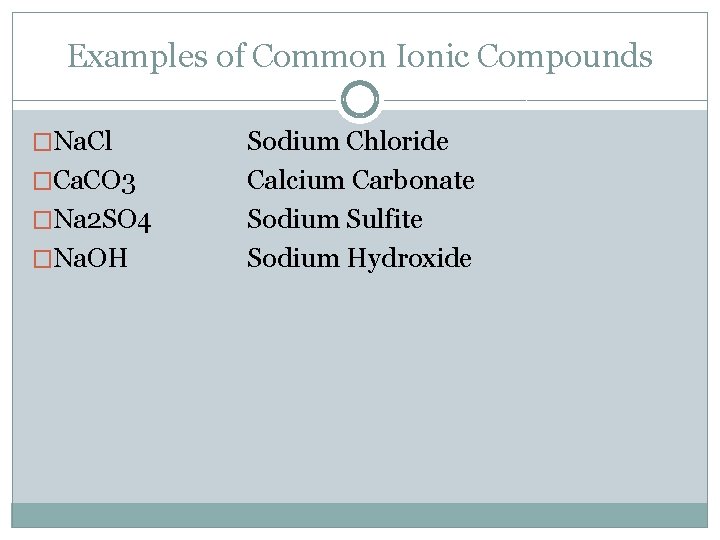
Examples of Common Ionic Compounds �Na. Cl �Ca. CO 3 �Na 2 SO 4 �Na. OH Sodium Chloride Calcium Carbonate Sodium Sulfite Sodium Hydroxide
Naming Compounds �Every compound has a. . . 1. Name: indicates the elements present in the compound (ionic only! In covalent compounds the name also indicates the ratio of each element present) 2. Formula: indicates the symbols and ratio of each element present in the compound.
Rules for Naming Ionic Compounds Name the metal 2. Name the non-metal using the root word and add the ending “ide” 1. Ex. Mg. Br 2 Magnesium bromide Ex. Li 3 N Lithium nitride

Practice Problems PAGE 82
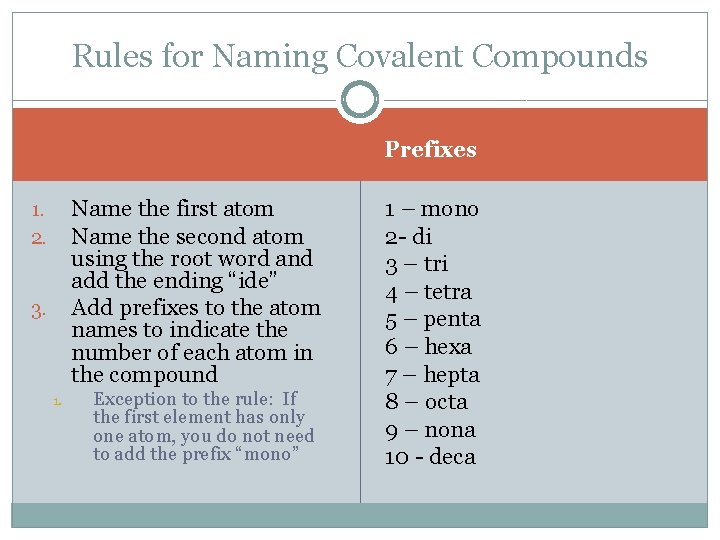
Rules for Naming Covalent Compounds Prefixes Name the first atom Name the second atom using the root word and add the ending “ide” Add prefixes to the atom names to indicate the number of each atom in the compound 1. 2. 3. 1. Exception to the rule: If the first element has only one atom, you do not need to add the prefix “mono” 1 – mono 2 - di 3 – tri 4 – tetra 5 – penta 6 – hexa 7 – hepta 8 – octa 9 – nona 10 - deca
�Ex: CO Carbon monoxide �Ex: Si. Cl 4 Silicon tetrachloride

Practice Problems PAGE 83
Physical and Chemical Changes
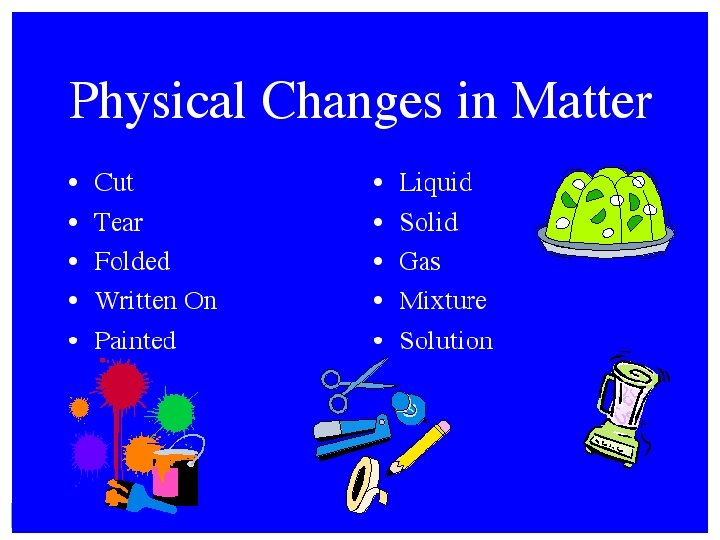
Physical Changes �the appearance of a substance may have changes but the bonds holding the atoms together in molecules and ions have not been broken and no new bonds have been made. Includes: �all changes in state (melting, evaporation, condensation, freezing) �Dissolving �Cutting TEND TO BE EASY TO REVERSE.
Chemical Changes �Produce new substances with new properties; may or may not be noticeable. �New bonds are formed while others are broken. �Chemical equations can be written for all chemical changes. �For example the composition of water. 2 H 2 + O 2 2 H 2 O • REACTANTS PRODUCTS
�In a chemical reaction the mass of the reactants = the mass of the products. The elements are conserved but not the compounds. �Ex. Corrosion, fruit ripening, combustion
Evidence of a Chemical Change 1. 2. 3. 4. 5. Color change Heat, light, sound produced or consumed Gas bubbles released A precipitate formed Difficult to reverse
Applications of Chemical Changes �Harnessing combustion �Combustion releases large amounts of energy which can be used to provide heat and light, electrical and mechanical energy. �Solving the corrosion problem (a process by which metals combine with oxygen; oxidation) �Using chemical change for traditional products (example: tanning hides, making dyes and medicines from plants, and preserving food)
Core Lab Activity 3 -3 C pg. 92 -3 OBSERVING CHANGES IN MATTER
CORE STSE : “PLASTICS AND MODERN LIFE”
- Slides: 24