
Science 7 Discovering Science 7 Unit 3 Mixtures




- Slides: 23
Science 7 Discovering Science 7 Unit 3: Mixtures and Solutions
Chapter 7: Matter can be classified as mixtures or pure substances
The Particles Theory • All matter is made up of particles. • These particles are constantly moving – they have energy. • There are spaces between these particles. • There attractive forces between the particles. • The particles of one substance differs from the particles of other substances.
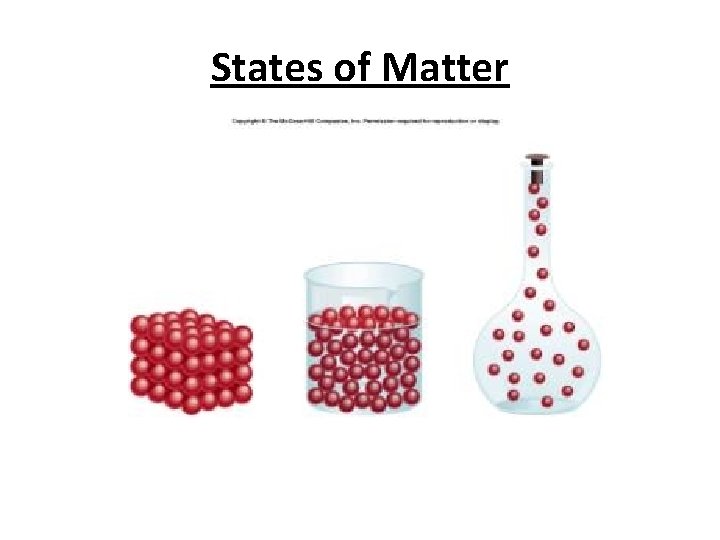
States of Matter
Matter Pure Substances Mixtures • A pure substance is matter that is the same throughout; having the same kind of particles. • Examples: Gold, copper water, iron, white sugar, . . . • The Period Table of Elements. • A mixture contains two or more different types of matter; having different particles. • Air (oxygen, carbon dioxide, nitrogen, etc. ), garden salad (lettuce, tomatoes, carrots, etc. ), Raisin bread (raisins, wheat, etc), . . .
Mixtures Heterogeneous Homogeneous • Mechanical mixtures • Easy to see the different parts • Composition of particles varies within the sample; more than one substance. • Composition of samples may vary. • Light will reflect perpendicular to the incident beam • Examples: stir fry, sandwich, Salsa, . . . • Solution • Hard to see the different particles; appears as one substance. • Composition of particles is the same within the sample. • Composition of samples is the same. • Light will pass through unaffected. • Examples: salt water, vinegar, clean air, . . .
Chapter 8: Some substances dissolve to form solutions faster and more easily than others
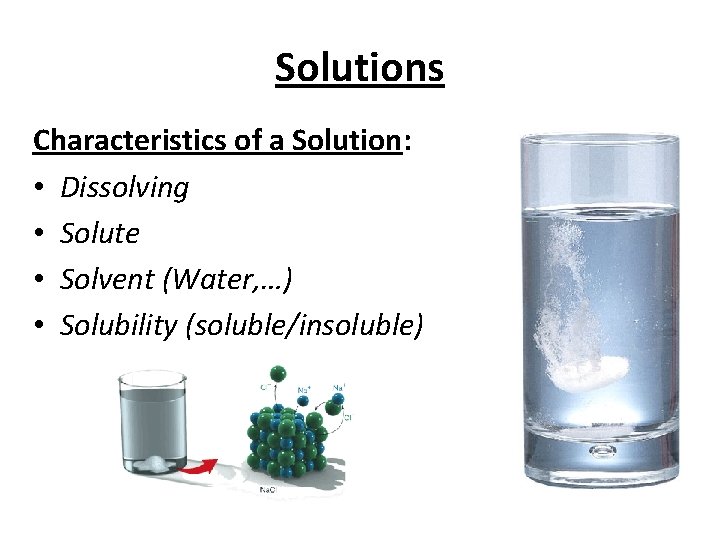
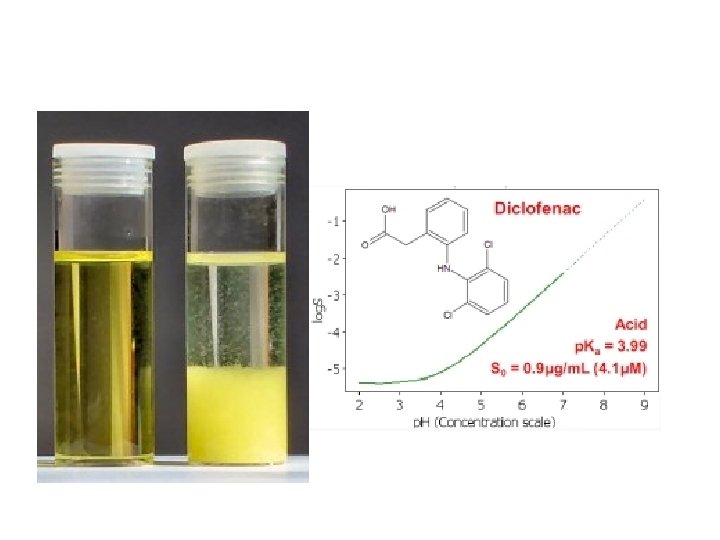
Solutions Characteristics of a Solution: • Dissolving • Solute • Solvent (Water, …) • Solubility (soluble/insoluble)
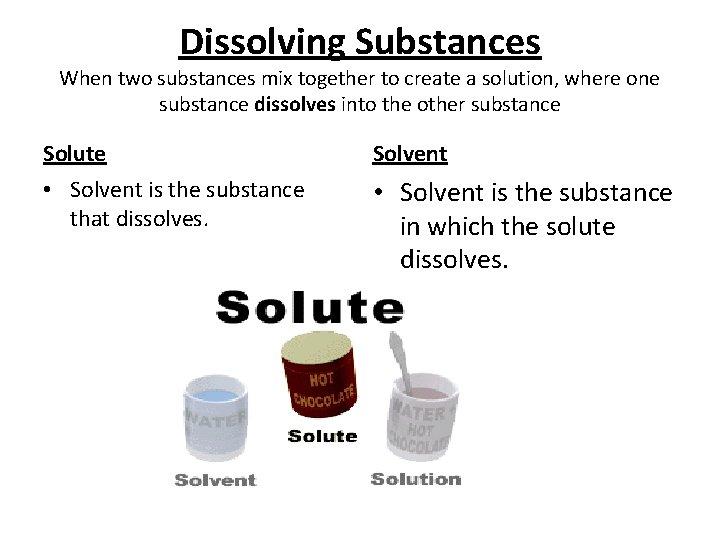
Dissolving Substances When two substances mix together to create a solution, where one substance dissolves into the other substance Solute Solvent • Solvent is the substance that dissolves. • Solvent is the substance in which the solute dissolves.
Working with Solutions “Soluble” vs. “Insoluble” Soluble Substances: • A substance that is “soluble” is able to dissolve in a certain solvent. • Example: Sugar (a solute) is able to dissolve in water. Water is considered the universal solvent.
Insoluble Substances: • A substance that is “insoluble” is unable to dissolve in a certain solvent. • Example: Sand is unable to dissolve in water.
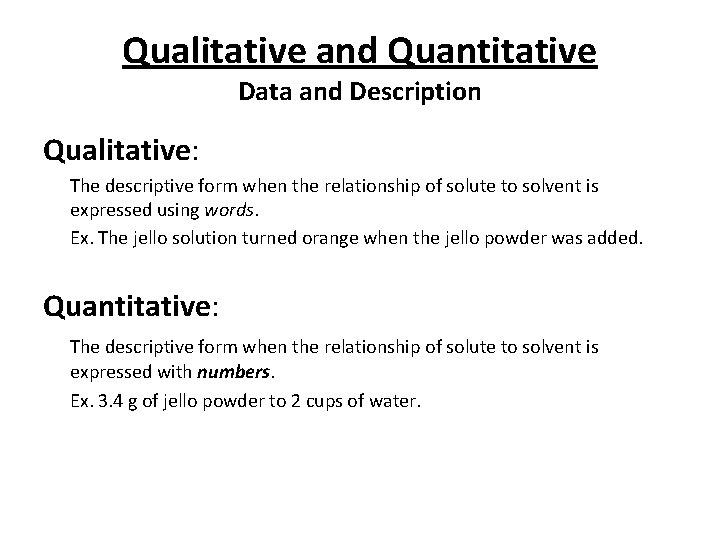
Qualitative and Quantitative Data and Description Qualitative: The descriptive form when the relationship of solute to solvent is expressed using words. Ex. The jello solution turned orange when the jello powder was added. Quantitative: The descriptive form when the relationship of solute to solvent is expressed with numbers. Ex. 3. 4 g of jello powder to 2 cups of water.
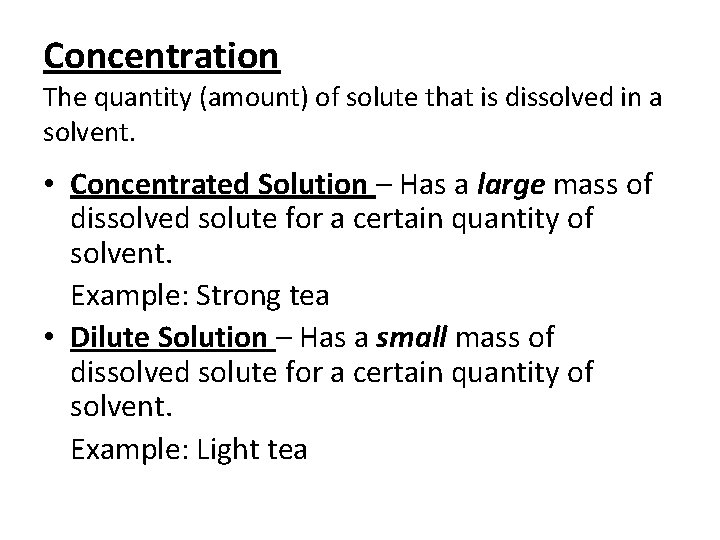
Concentration The quantity (amount) of solute that is dissolved in a solvent. • Concentrated Solution – Has a large mass of dissolved solute for a certain quantity of solvent. Example: Strong tea • Dilute Solution – Has a small mass of dissolved solute for a certain quantity of solvent. Example: Light tea
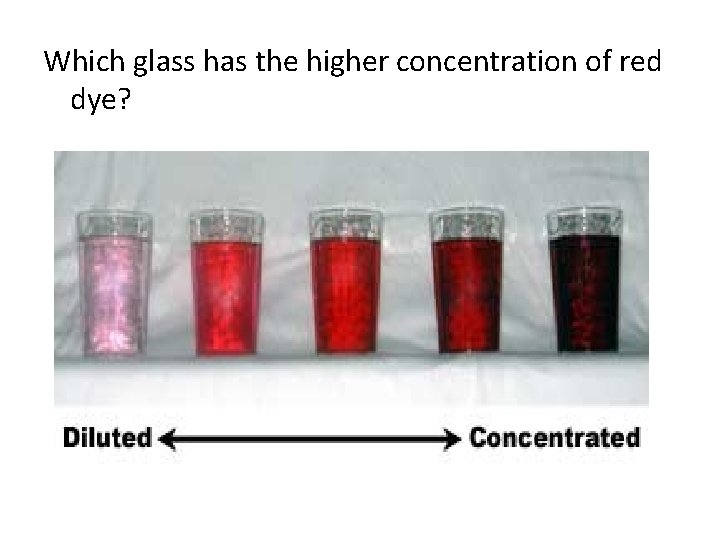
Which glass has the higher concentration of red dye?
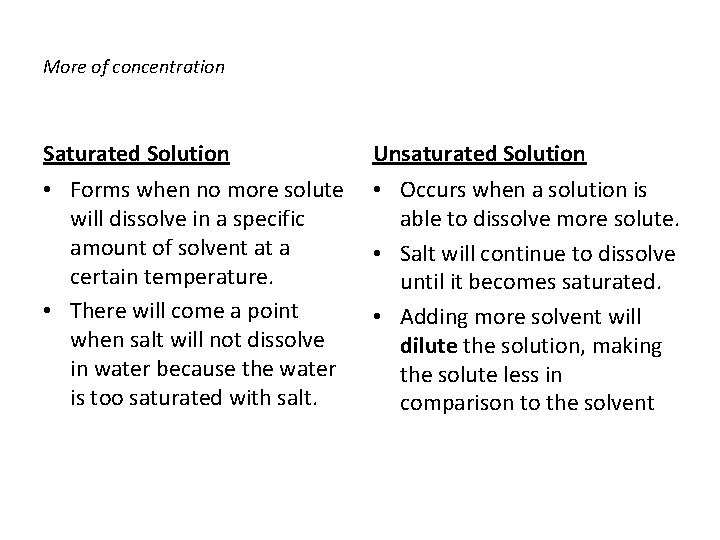
More of concentration Saturated Solution Unsaturated Solution • Forms when no more solute will dissolve in a specific amount of solvent at a certain temperature. • There will come a point when salt will not dissolve in water because the water is too saturated with salt. • Occurs when a solution is able to dissolve more solute. • Salt will continue to dissolve until it becomes saturated. • Adding more solvent will dilute the solution, making the solute less in comparison to the solvent
Solubility Factors which affect the solubility of solids and gas: • Stirring • Temperature • Pressure • Size of the particles of solute
Measuring Concentration • Percent by mass The simplest statement of the concentrations of the components of a mixture is in terms of their percentages by weight or volume. Mass percentage is calculated as the mass of a component divided by the total mass of the mixture, multiplied by 100%. Ex. Bleach is 5. 25% Na. OCl by mass, which means each 100 g of bleach contains 5. 25 g Na. OCl. • Parts per million Parts Per Million or ppm means out of a million. It describes the concentration of something in water or soil. One ppm is equivalent to one milligram of substance per liter of water (mg/l). Generally, used with low concentration. Ex. 0. 3 mg/l of salt
Chapter 9: Many useful products depend on technology for separating mixtures and solutions
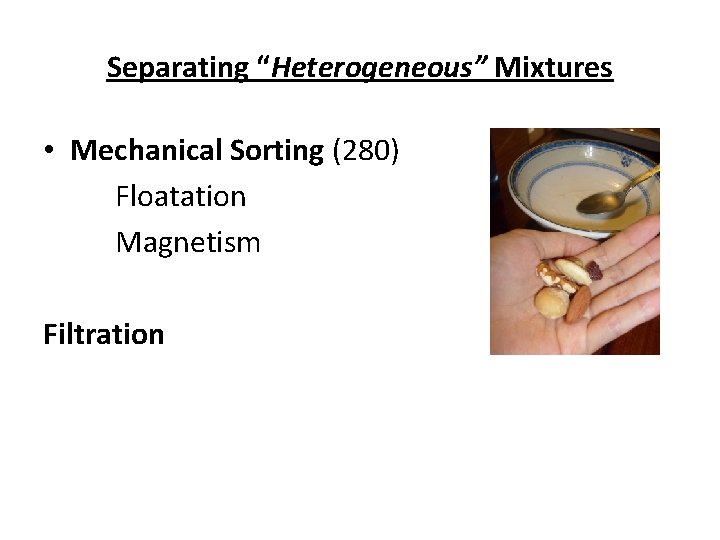
Separating “Heterogeneous” Mixtures • Mechanical Sorting (280) Floatation Magnetism Filtration
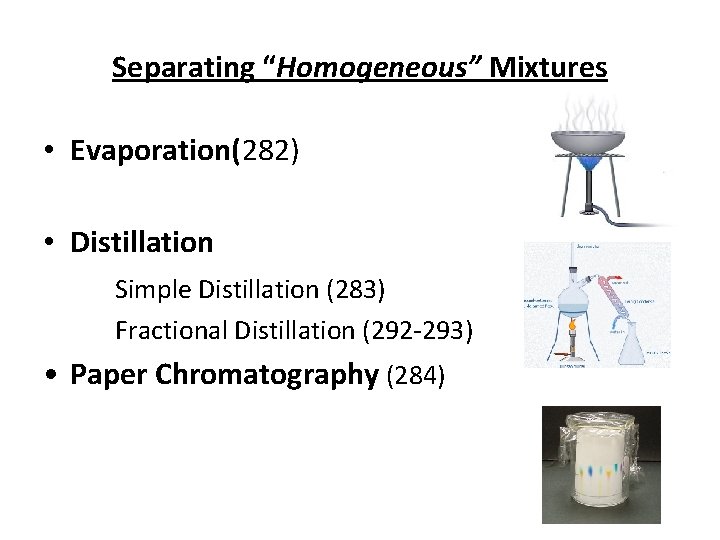
Separating “Homogeneous” Mixtures • Evaporation(282) • Distillation Simple Distillation (283) Fractional Distillation (292 -293) • Paper Chromatography (284)
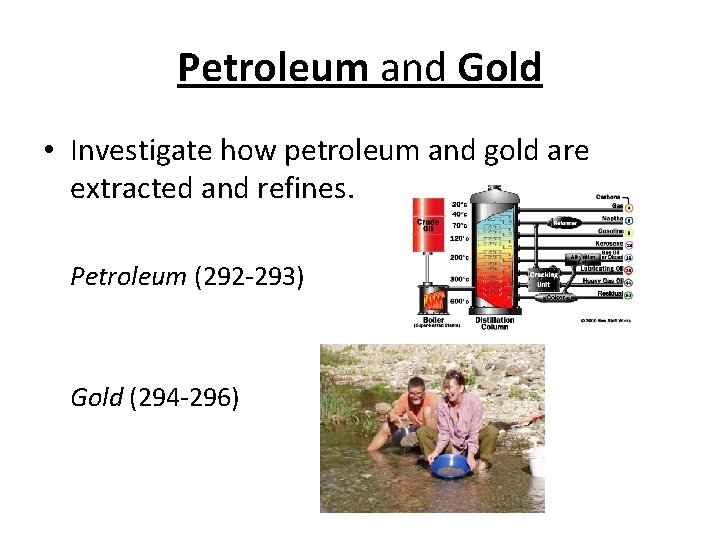
Petroleum and Gold • Investigate how petroleum and gold are extracted and refines. Petroleum (292 -293) Gold (294 -296)