
Science 421 Nature of Science September 2018 Scully
Science 421 Nature of Science September 2018 Scully
Why is Science Important? What is Science?
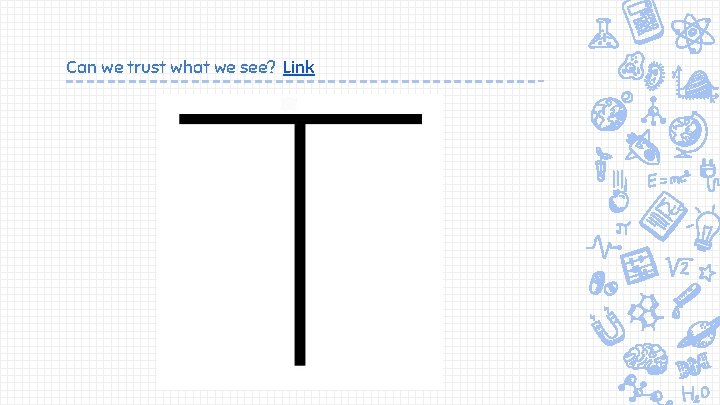
Can we trust what we see? Link
What is SCIENCE? Brainstorm with your neighbor about what it means to you.
https: //www. youtube. com/watch? v=Tmb 1 c 3 BGQu. M
What is SCIENCE? Do you want to add anything to the first list?
What IS science? ✓ Science is a way of knowing about the natural world. ✓ Science is an investigative process. ✓ Science involves forming new ideas about how things work (hypotheses) and then testing those ideas. ✓ Science uses evidence from tests to form explanations about what things are made of, how they work, and why they change (forming these explanations is called scientific reasoning). ✓ Science is reliable but explanations can change when new evidence is found.
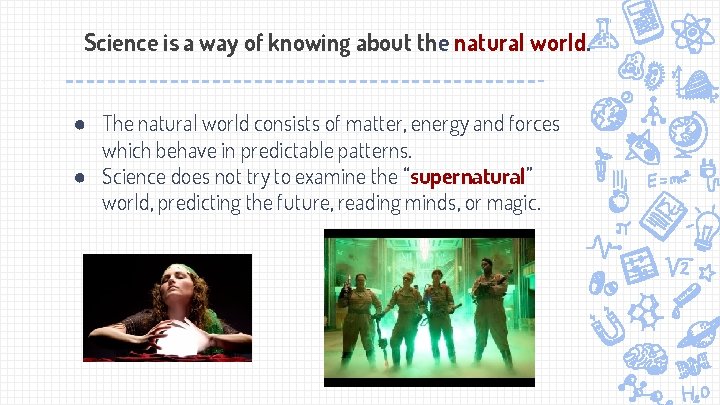
Science is a way of knowing about the natural world. ● The natural world consists of matter, energy and forces which behave in predictable patterns. ● Science does not try to examine the “supernatural” world, predicting the future, reading minds, or magic.
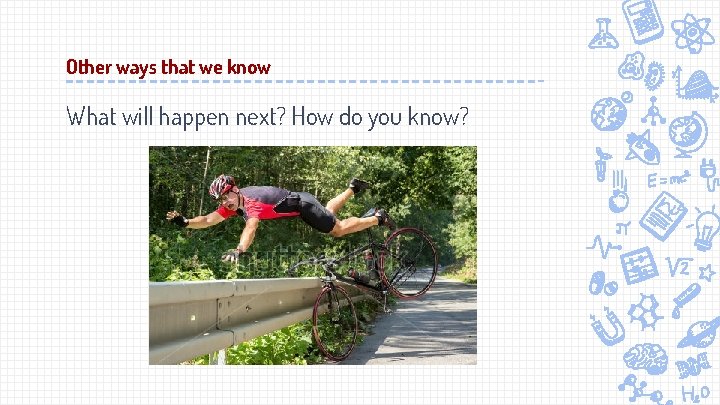
Other ways that we know What will happen next? How do you know?
Other ways that we know What is the answer? How do you know? 1 + 1 = ?
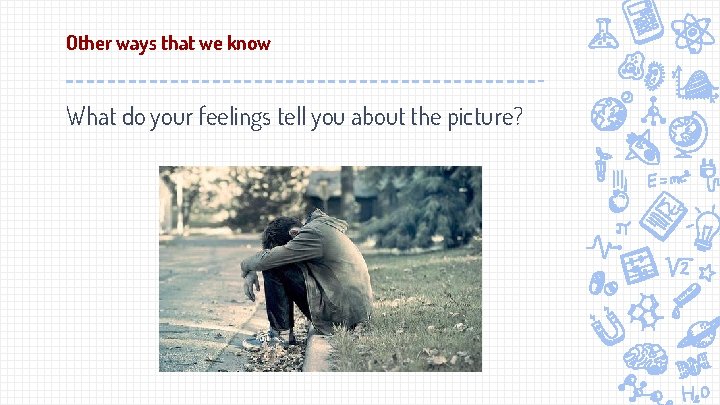
Other ways that we know What do your feelings tell you about the picture?

Science is limited to answering certain questions. SCIENCE CAN ANSWER ✓ testable questions about the natural world. Does the type of liquid affect how fast an ice cube melts? What is the effect of light on rate of seed germination? Do mint leaves repel ants? SCIENCE CAN NOT ANSWER ✘ questions relating to value Is saving a species more important than creating jobs? Is a cheetah more beautiful than a tiger? ✘ ethical questions Should we spray our lawns with pesticides?
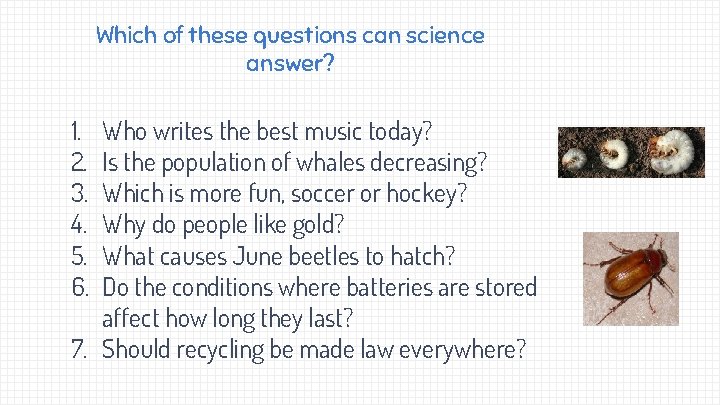
Which of these questions can science answer? 1. 2. 3. 4. 5. 6. Who writes the best music today? Is the population of whales decreasing? Which is more fun, soccer or hockey? Why do people like gold? What causes June beetles to hatch? Do the conditions where batteries are stored affect how long they last? 7. Should recycling be made law everywhere?
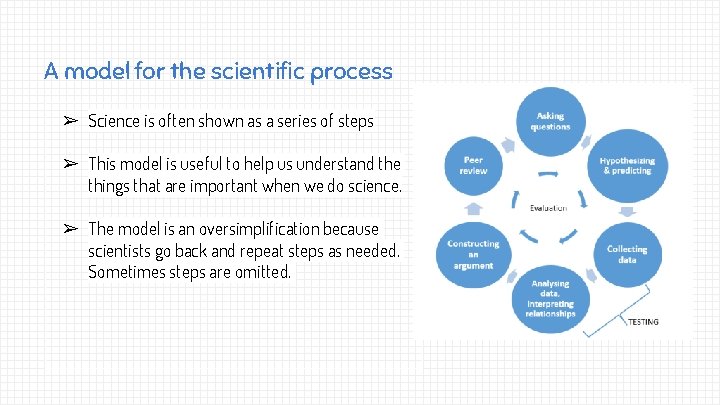
A model for the scientific process ➢ Science is often shown as a series of steps ➢ This model is useful to help us understand the things that are important when we do science. ➢ The model is an oversimplification because scientists go back and repeat steps as needed. Sometimes steps are omitted.
Summary Science is ✓ a useful and reliable way of knowing about the natural world ✓ one of the rules of the scientific way of knowing is that it is limited to answering questions that can be tested Doing science is: ✓ forming ideas ✓ testing ideas ✓ using evidence from tests to explain how things work
Activity Science Knowledge Survey *You will need a piece of paper and a pencil to complete this activity by yourself, or with a partner. *Use the knowledge you’ve learned about science to classify the statements.
Words of Science
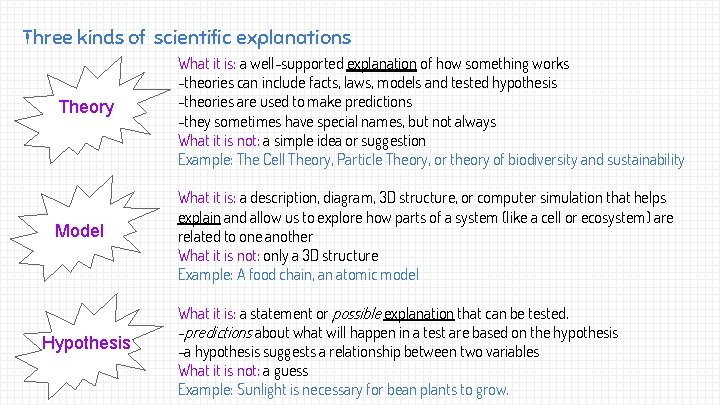
Three kinds of scientific explanations Theory What it is: a well-supported explanation of how something works -theories can include facts, laws, models and tested hypothesis -theories are used to make predictions -they sometimes have special names, but not always What it is not: a simple idea or suggestion Example: The Cell Theory, Particle Theory, or theory of biodiversity and sustainability Model What it is: a description, diagram, 3 D structure, or computer simulation that helps explain and allow us to explore how parts of a system (like a cell or ecosystem) are related to one another What it is not: only a 3 D structure Example: A food chain, an atomic model Hypothesis What it is: a statement or possible explanation that can be tested. -predictions about what will happen in a test are based on the hypothesis -a hypothesis suggests a relationship between two variables What it is not: a guess Example: Sunlight is necessary for bean plants to grow.
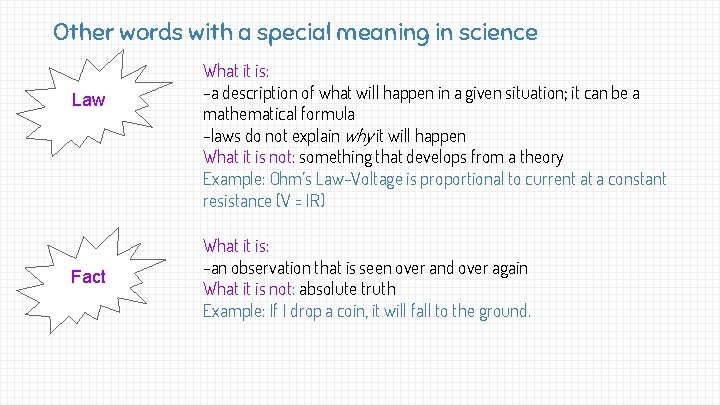
Other words with a special meaning in science Law Fact What it is: -a description of what will happen in a given situation; it can be a mathematical formula -laws do not explain why it will happen What it is not: something that develops from a theory Example: Ohm’s Law-Voltage is proportional to current at a constant resistance (V = IR) What it is: -an observation that is seen over and over again What it is not: absolute truth Example: If I drop a coin, it will fall to the ground.
Review Video
Practice - Fact, Law, Theory, or Hypothesis? 1. 2. 3. 4. 5. 6. 7. Astronomers suggest that the Universe began about 14 billion years ago. At that time, the entire Universe was inside a bubble that was thousands of times smaller than a pinhead. It was hotter and denser than anything we can imagine. Then it suddenly exploded. The Universe that we know was born. The Earth’s air contains oxygen E=mc 2 I think that my car stopped because it ran out of gas Physicists have found that an object at rest stays at rest or in motion stays in motion unless a force acts upon it, Since greenhouses are warm, maybe the glass holds in the heat. Heat is released when wood is burned.
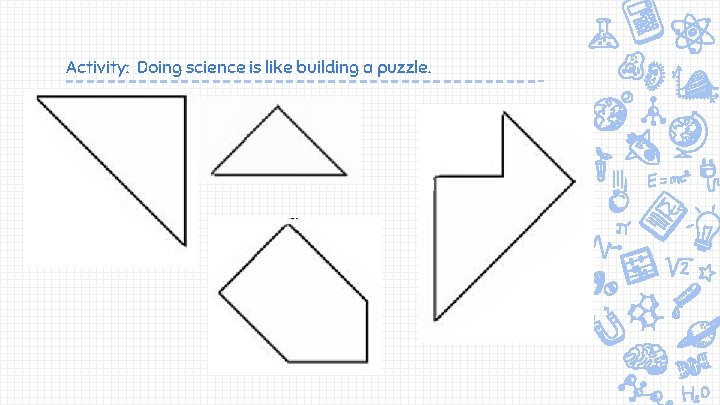
Activity: Doing science is like building a puzzle.
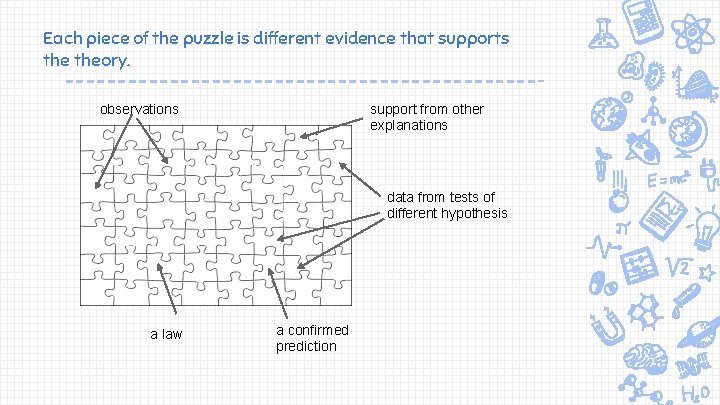
Each piece of the puzzle is different evidence that supports theory. observations support from other explanations data from tests of different hypothesis a law a confirmed prediction
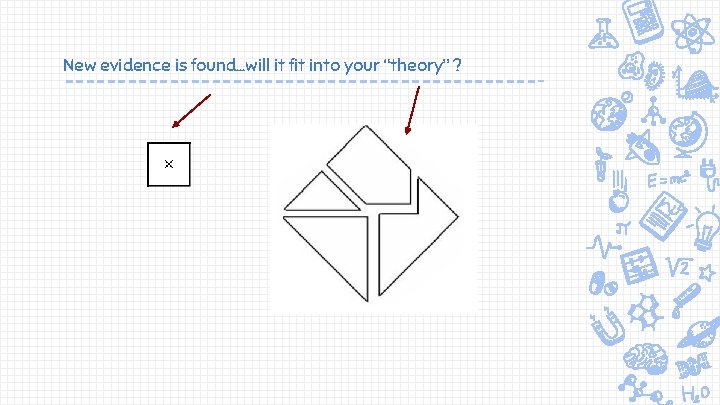
New evidence is found. . . will it fit into your “theory” ?
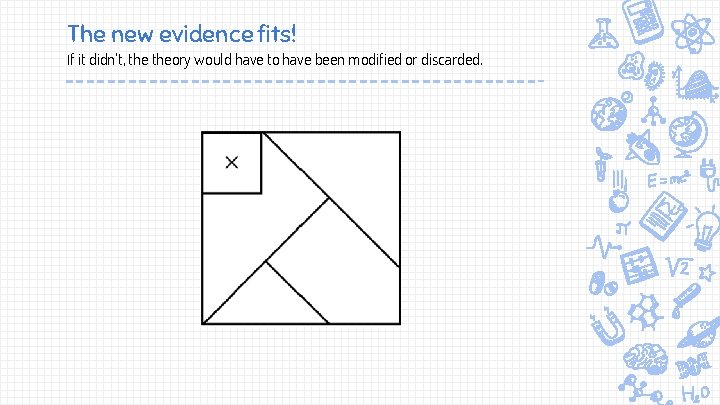
The new evidence fits! If it didn’t, theory would have to have been modified or discarded.
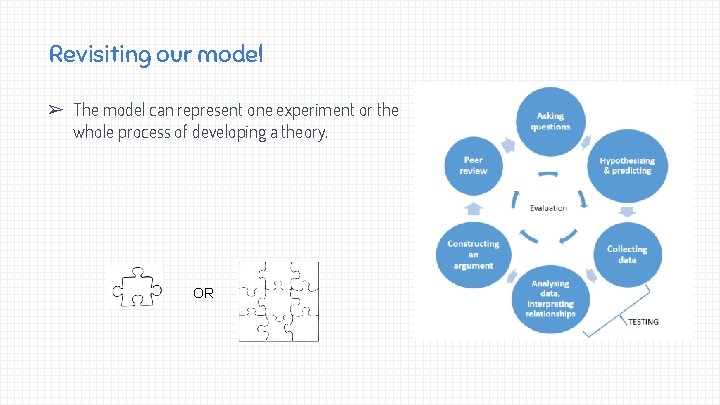
Revisiting our model ➢ The model can represent one experiment or the whole process of developing a theory. OR
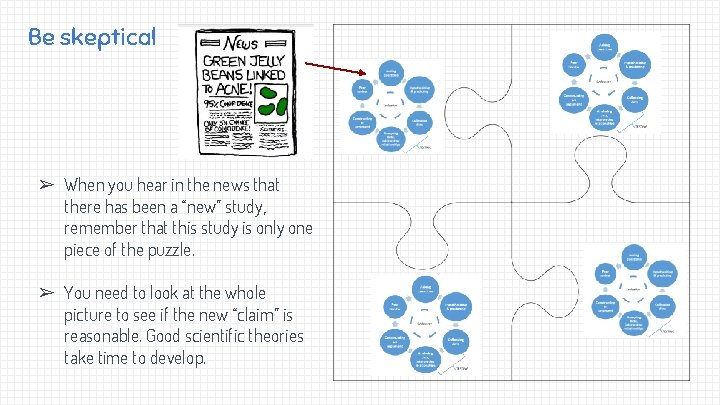
Be skeptical ➢ When you hear in the news that there has been a “new” study, remember that this study is only one piece of the puzzle. ➢ You need to look at the whole picture to see if the new “claim” is reasonable. Good scientific theories take time to develop.
How Does Science Work?
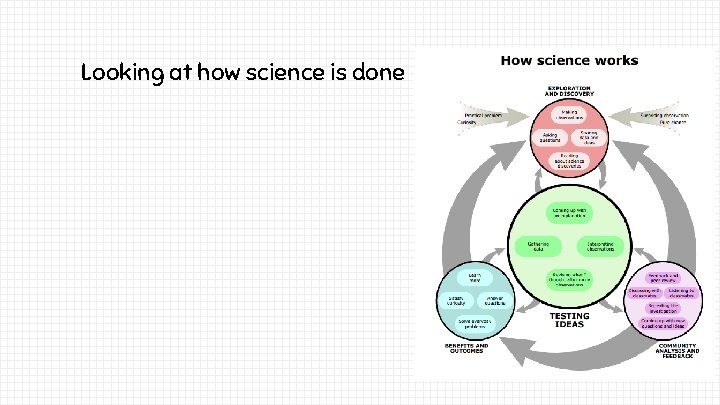
Looking at how science is done
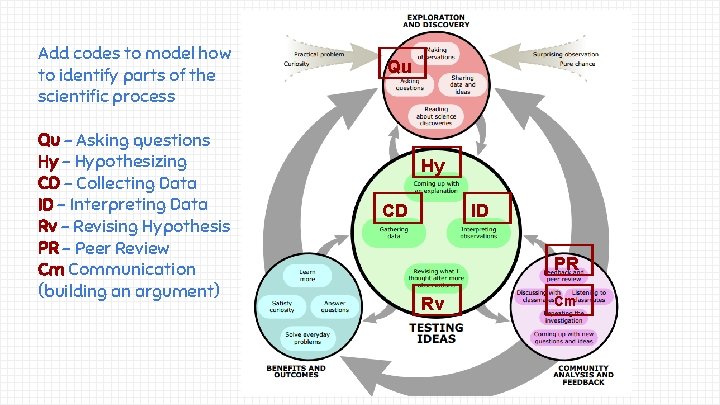
Add codes to model how to identify parts of the scientific process Qu - Asking questions Hy - Hypothesizing CD - Collecting Data ID - Interpreting Data Rv - Revising Hypothesis PR - Peer Review Cm Communication (building an argument) Qu Hy CD ID PR Rv Cm
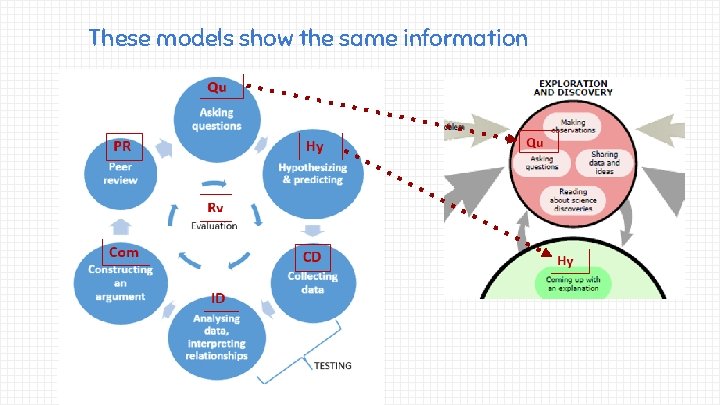
These models show the same information
Science involves forming new ideas and then testing those ideas. If an answer or idea can’t be tested, it isn’t science.
Testing is probably the most important feature of science! ● Testing ideas with evidence is at the heart of the process of science. ● Science accepts or rejects ideas based on the evidence.
Scientific Testing is: ★ fair ★ well-designed (variables are controlled) ★ based on unbiased data ★ honest ★ repeatable ★ accepted by the scientific community
In a Fair Test ● You must change only one factor at a time while keeping all other conditions the same. ● Scientists call the changing factors in an experiment variables.
Variables ● any factor that can be controlled, changed, or measured in an experiment ● an independent variable is the one condition that you change in an experiment ● A dependent variable is the variable that you measure or observe. ● A controlled variable is a variable that does not change during an experiment.
Variables Explained: What are variables? Test your Knowledge!
Relationships between variables:
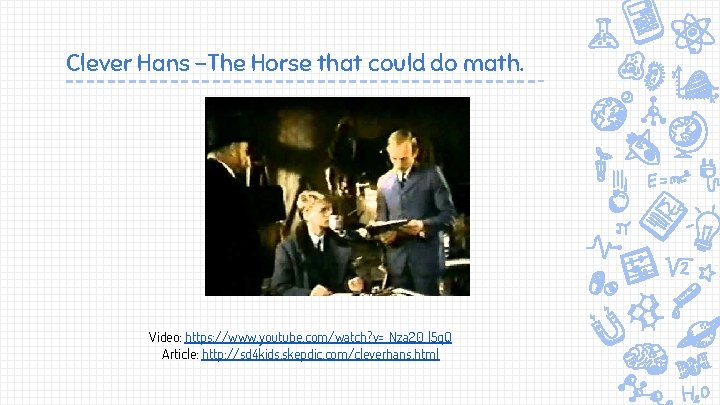
Bias ● Bias is prejudice in favor of or against one thing, person, or group compared with another, usually in a way considered to be unfair ● We all have bias, even scientists ● Bias leads to interpreting the test results in our favour; this is poor science ● Scientists design tests to help reduce or eliminate their bias
Clever Hans -The Horse that could do math. Video: https: //www. youtube. com/watch? v=_Nza 20_l 5 q. Q Article: http: //sd 4 kids. skepdic. com/cleverhans. html
Confirmation Bias ● When data is changed to support a certain bias ● When certain data is selected and other data is ignored. Working with other scientists and following the rules of science tends to reduce the influence of bias on their work. Peer review of scientific work can also expose biases.
Confirmation Bias is Science Read pages 70 -72 in the Science Surprises book. Answer the discussion questions (1 -9) below (also posted on google classroom). 1. What is “confirmation bias”? 2. Why do you suppose Blondlot announced his discovery of “N-rays” so quickly, without looking for weakness in that discovery first? 3. Explain why this “N-ray” discovery is a good example of “confirmation bias”. 4. Explain briefly how “N-ray” was shown to be a false phenomenon. 5. What did Benveniste report in the scientific journal Nature? 6. Why was Benveniste’s paper published even though his conclusions were illogical? 7. What was the flaw in Benveniste’s procedures? 8. Why do you suppose that the researchers involved in Benveniste’s work still perform this research on other homeopathic remedies? 9. What happens to scientists who refuse to acknowledge their confirmation bias?
Conflict of Interest: A special kind of Bias ● Some industries hire scientists to study their products. ● If the results of any study seem to only support the company that pays the scientist…. be suspicious! ● Scientists are supposed to reveal any conflict of interest in their reports ● Example: years ago, tobacco companies told consumers tobacco was safe. Independent science told us that is not safe.
Summary Good Science follows the rules of science Evidence supporting claim is: ★ from a fair test (can support an idea or prove it wrong) ★ from a well-designed test (e. g. , variables are controlled) ★ unbiased ★ honest reporting of data ★ repeatable ★ accepted by the scientific community Poor Science tries to follow the rules but fails Evidence supporting claim can be: ✘ from a poorly designed test (variables are not controlled) ✘ biased ✘ not honest ✘ unrepeatable
Activity: Good Science vs. Poor Science Read pages 38 -40 in Science Surprises. When you have finished the reading, turn to page 76. Read through the activity and do Parts A and B on your own. Please answer in complete sentences and submit your work to google classroom when you are done.
Science uses evidence from tests to form explanations about what things are made of, how they work, and why they change. Forming these explanations is called scientific reasoning.
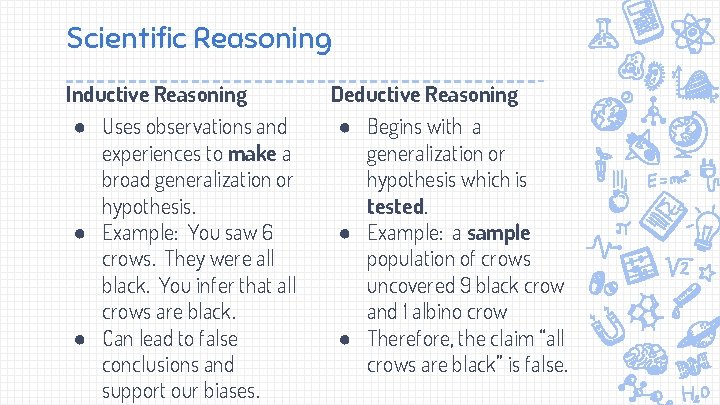
Scientific Reasoning Inductive Reasoning ● Uses observations and experiences to make a broad generalization or hypothesis. ● Example: You saw 6 crows. They were all black. You infer that all crows are black. ● Can lead to false conclusions and support our biases. Deductive Reasoning ● Begins with a generalization or hypothesis which is tested. ● Example: a sample population of crows uncovered 9 black crow and 1 albino crow ● Therefore, the claim “all crows are black” is false.
During the scientific process, deductive reasoning is used to reach a logical true conclusion. Inductive reasoning is also used to make a hypothesis. It is important to learn the meaning of each type of reasoning so that proper logic can be identified. Video: Inductive and Deductive Reasoning
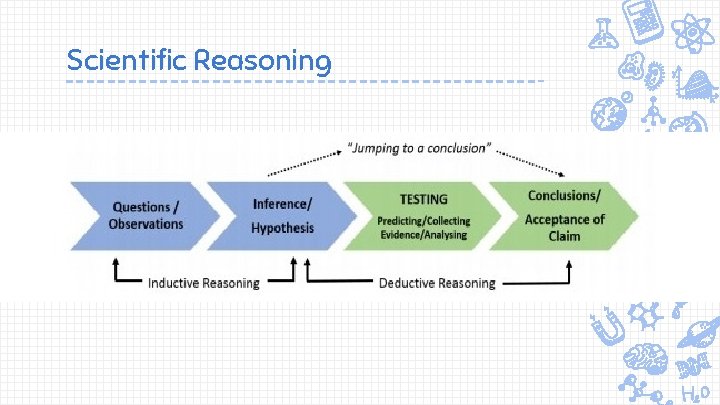
Scientific Reasoning
Not all reasoning is scientific nor should it be. Some reasoning passes itself off as scientific. This is pseudoscience.
Pseudoscience Any view, belief, or practice that claims to be scientific, but does not follow the rules of science. Pseudo is the Greek word meaning “false”. https: //www. youtube. com/watch? v=47 y. JJrauc 9 c
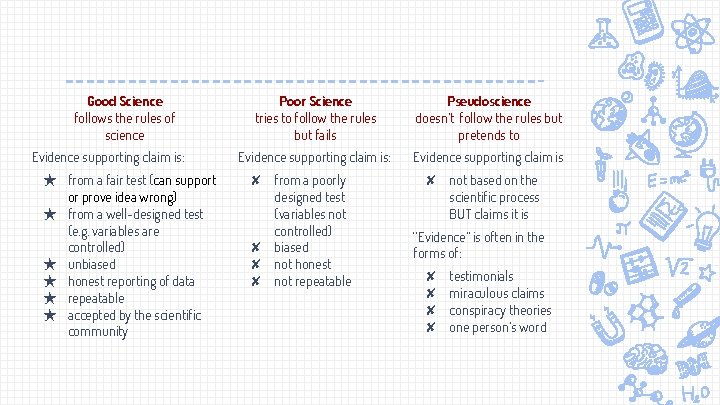
Good Science follows the rules of science Evidence supporting claim is: ★ from a fair test (can support or prove idea wrong) ★ from a well-designed test (e. g. variables are controlled) ★ unbiased ★ honest reporting of data ★ repeatable ★ accepted by the scientific community Poor Science tries to follow the rules but fails Pseudoscience doesn’t follow the rules but pretends to Evidence supporting claim is: Evidence supporting claim is ✘ from a poorly designed test (variables not controlled) ✘ biased ✘ not honest ✘ not repeatable ✘ not based on the scientific process BUT claims it is “Evidence” is often in the forms of: ✘ ✘ testimonials miraculous claims conspiracy theories one person’s word
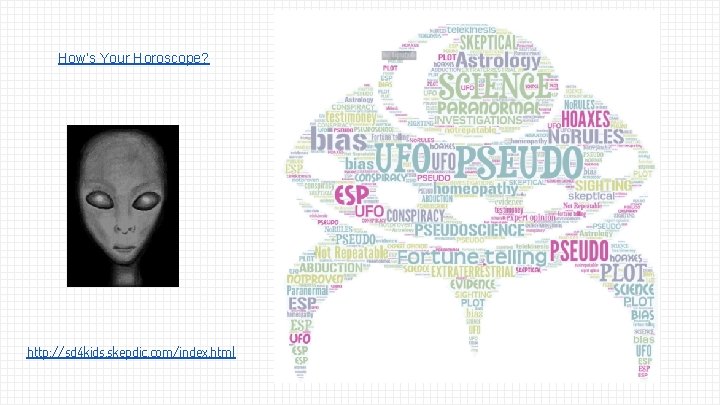
How’s Your Horoscope? http: //sd 4 kids. skepdic. com/index. html
Can you think of any examples of Pseudoscience that you have encountered in the media?
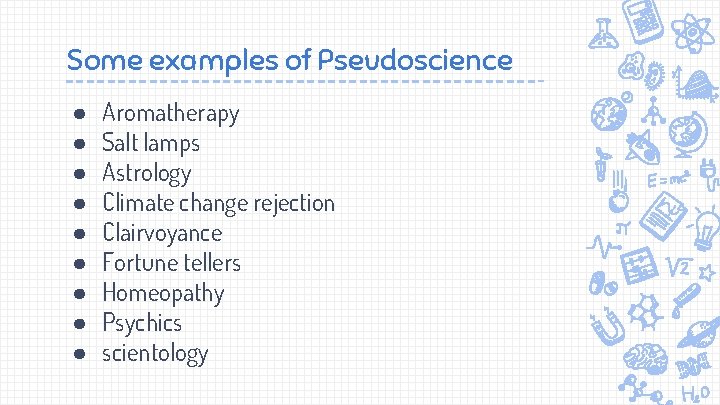
Some examples of Pseudoscience ● ● ● ● ● Aromatherapy Salt lamps Astrology Climate change rejection Clairvoyance Fortune tellers Homeopathy Psychics scientology
Why do people make these claims of pseudoscience?
Pseudoscience can be harmful. Using pseudoscience can lead to worse health or can cause death. Even if it’s not about health, it can be a waste of money. Naturopath Investigation
Critical Thinking and Skepticism
http: //www. flashlightcreative. net/swf/mindreader/
What were you thinking?
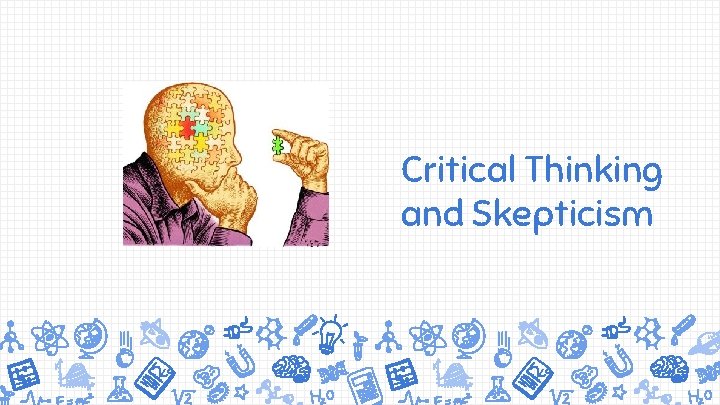
Why is Critical Thinking Important? Critical thinking requires you to use your ability to reason. It is about being an active learner rather than a passive recipient of information. Critical thinkers question ideas and assumptions rather than accepting them at face value. They will always seek to determine whether the ideas, arguments and findings represent the entire picture and are open to finding that they do not. Critical thinkers will identify, analyse and solve problems systematically rather than by intuition or instinct. https: //www. skillsyouneed. com/learn/critical-thinking. html
What is Skepticism? Skepticism is the process of applying reason and critical thinking to determine validity. It's the process of finding a supported conclusion, not the justification of a preconceived conclusion.
How Can We Tell if It’s Good Science or Not?
Be a Skeptic! You will encounter many claims on social media and on the internet. Some will be scientific; some not. Many of these claims may relate to your health and well being!
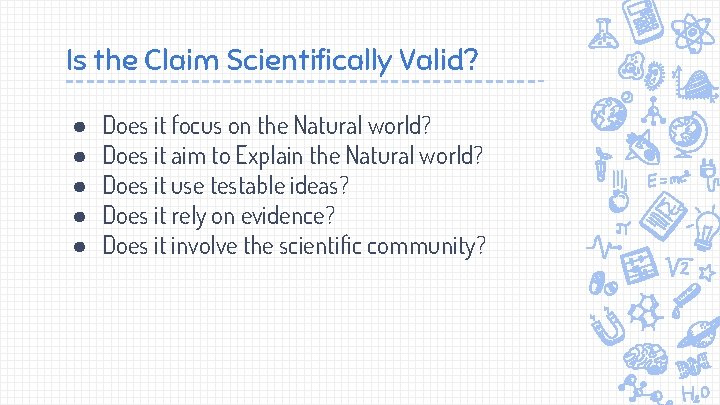
Is the Claim Scientifically Valid? ● ● ● Does it focus on the Natural world? Does it aim to Explain the Natural world? Does it use testable ideas? Does it rely on evidence? Does it involve the scientific community?
You want to use the internet to see if a health product does what it claims. How do you ensure that you get the most reliable information?
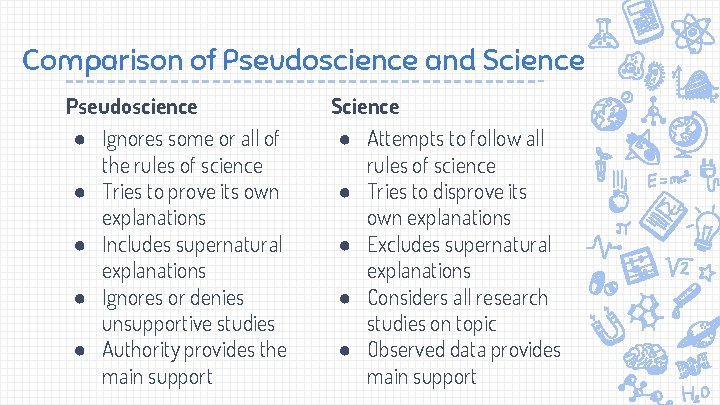
Comparison of Pseudoscience and Science Pseudoscience ● Ignores some or all of the rules of science ● Tries to prove its own explanations ● Includes supernatural explanations ● Ignores or denies unsupportive studies ● Authority provides the main support Science ● Attempts to follow all rules of science ● Tries to disprove its own explanations ● Excludes supernatural explanations ● Considers all research studies on topic ● Observed data provides main support
Claim: Vaccines cause Autism Video: Doctor Wakefield Speaks Out Think of the following questions while you watch the video: ● Do vaccines cause autism? ● Do you think people should have a choice to vaccinate or not vaccinate their children? ● What evidence did the scientific community have to support Dr. Wakefield’s claim? ● Was Dr. Wakefield’s claim Good science, Poor Science or Pseudoscience?
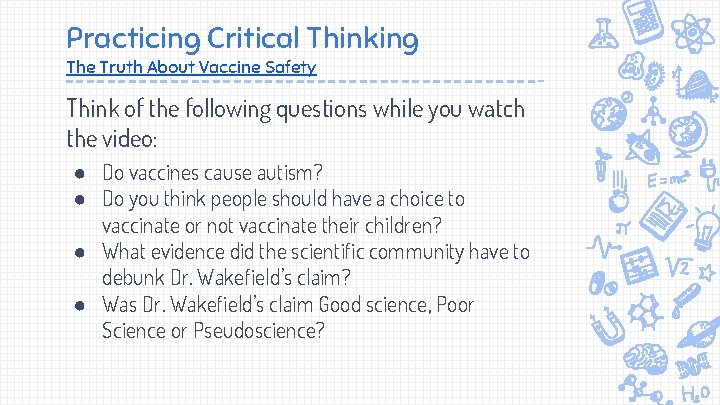
Practicing Critical Thinking The Truth About Vaccine Safety Think of the following questions while you watch the video: ● Do vaccines cause autism? ● Do you think people should have a choice to vaccinate or not vaccinate their children? ● What evidence did the scientific community have to debunk Dr. Wakefield’s claim? ● Was Dr. Wakefield’s claim Good science, Poor Science or Pseudoscience?
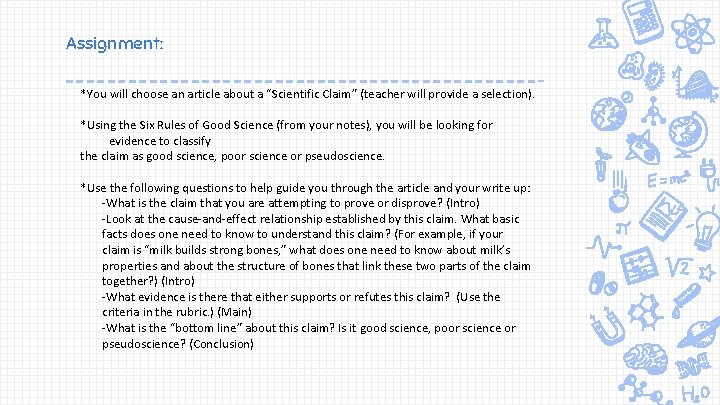
Assignment: *You will choose an article about a “Scientific Claim” (teacher will provide a selection). *Using the Six Rules of Good Science (from your notes), you will be looking for evidence to classify the claim as good science, poor science or pseudoscience. *Use the following questions to help guide you through the article and your write up: -What is the claim that you are attempting to prove or disprove? (Intro) -Look at the cause-and-effect relationship established by this claim. What basic facts does one need to know to understand this claim? (For example, if your claim is “milk builds strong bones, ” what does one need to know about milk’s properties and about the structure of bones that link these two parts of the claim together? ) (Intro) -What evidence is there that either supports or refutes this claim? (Use the criteria in the rubric. ) (Main) -What is the “bottom line” about this claim? Is it good science, poor science or pseudoscience? (Conclusion)
What influences our decisions?
Common Biases Causal illusion Confirmation Bias
Reflection: How has this unit changed the way you look at claims you read on the internet or other types of media? How has popular culture influenced the acceptance of pseudoscience claims? What are the consequences of this trend?
- Slides: 74