
Science 10 Unit Physics Motion Part 2 Objectives
Science 10 Unit: Physics Motion – Part 2
Objectives: By the end of the lesson you should be able to: n Describe and graph uniform motion n Create graphs using proper graphing techniques n Explain the difference between speed, velocity and average velocity n Calculate time, displacement and average velocity

Uniform Motion n Definition: when an object travels equal displacements in equal time intervals n I. E. objects do not speed up, slow down or change direction
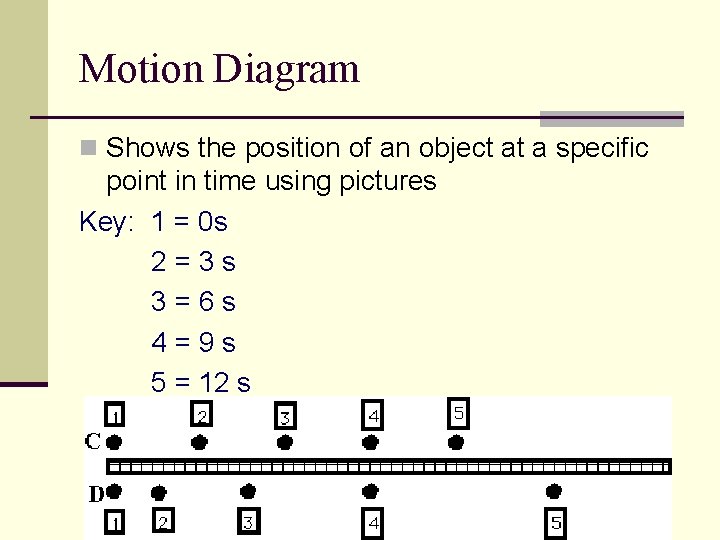
Motion Diagram n Shows the position of an object at a specific point in time using pictures Key: 1 = 0 s 2=3 s 3=6 s 4=9 s 5 = 12 s
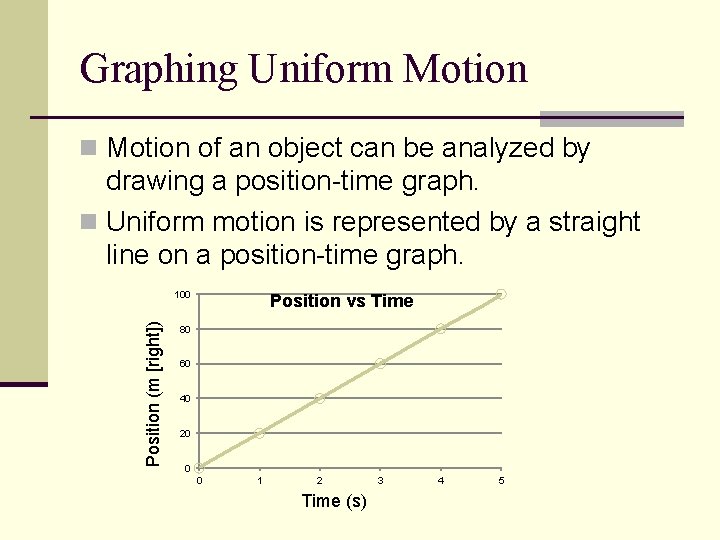
Graphing Uniform Motion n Motion of an object can be analyzed by drawing a position-time graph. n Uniform motion is represented by a straight line on a position-time graph. Position (m [right]) 100 Position vs Time 80 60 40 20 0 0 1 2 Time (s) 3 4 5
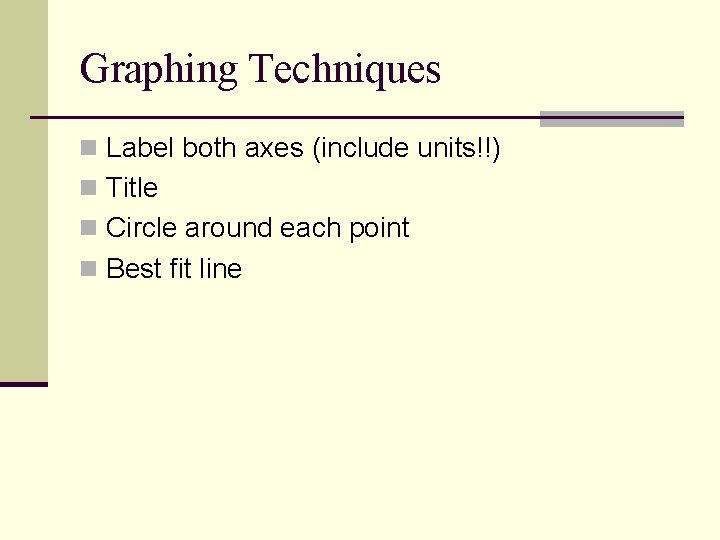
Graphing Techniques n Label both axes (include units!!) n Title n Circle around each point n Best fit line
![YOUR TURN! Draw Position – Time Graph Time (s) Position (cm) [Right] 0 0](http://slidetodoc.com/presentation_image/fef354c0bc400f5d97cfc1a206d45c53/image-7.jpg "YOUR TURN! Draw Position – Time Graph Time (s) Position (cm) [Right] 0 0")
YOUR TURN! Draw Position – Time Graph Time (s) Position (cm) [Right] 0 0 5 10 10 20 15 30 20 40 25 50
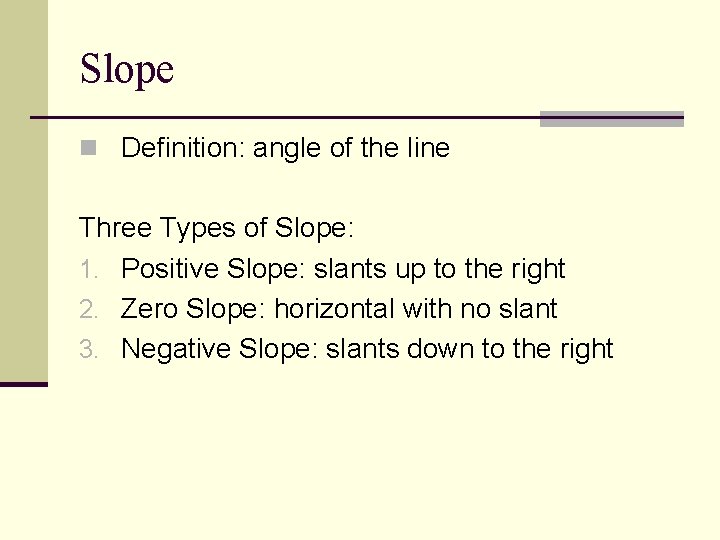
Slope n Definition: angle of the line Three Types of Slope: 1. Positive Slope: slants up to the right 2. Zero Slope: horizontal with no slant 3. Negative Slope: slants down to the right
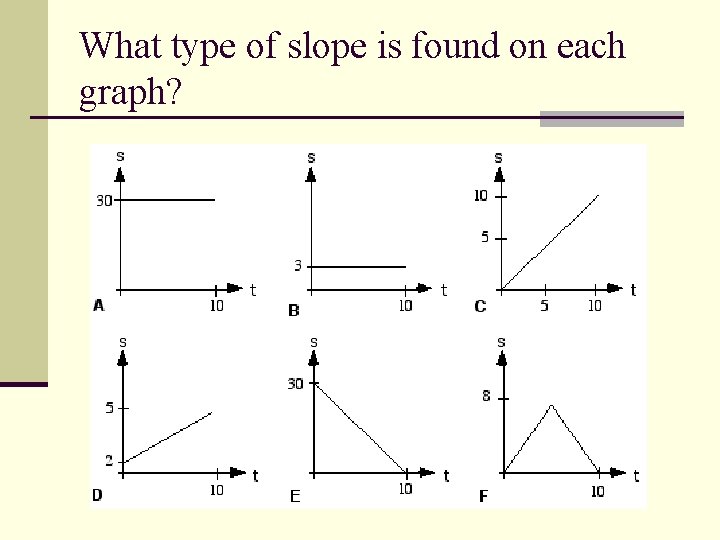
What type of slope is found on each graph?
Activities n Pg 352: 8 -1 b and 8 -1 c n Pg 355: 8 -1 d
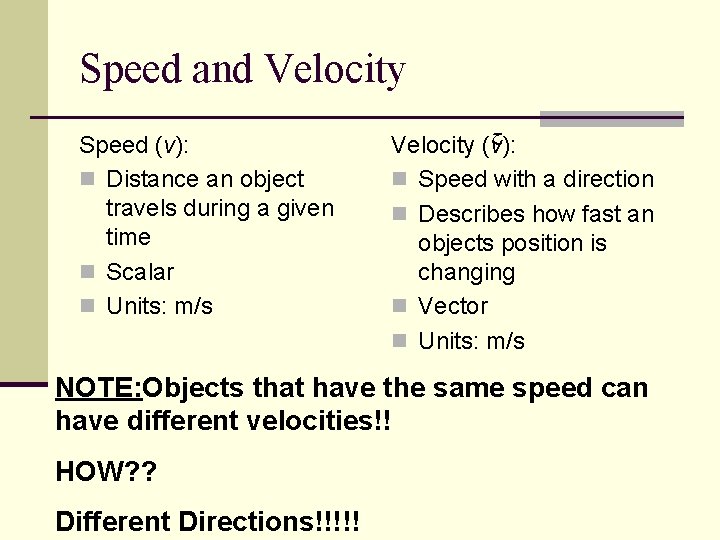
Speed and Velocity Speed (v): n Distance an object travels during a given time n Scalar n Units: m/s ﺡ Velocity (v): n Speed with a direction n Describes how fast an objects position is changing n Vector n Units: m/s NOTE: Objects that have the same speed can have different velocities!! HOW? ? Different Directions!!!!!
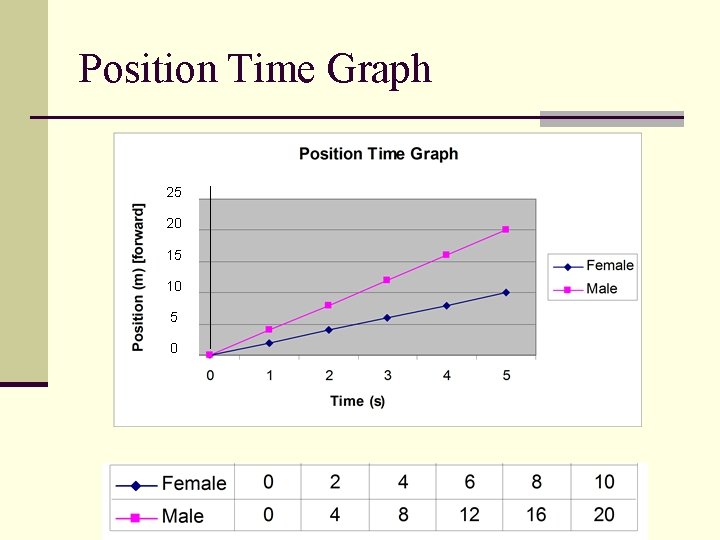
Position Time Graph 25 20 15 10 5 0
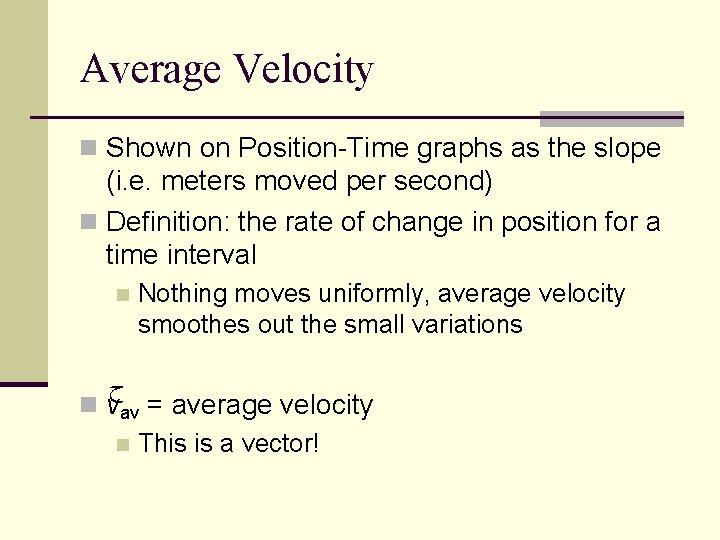
Average Velocity n Shown on Position-Time graphs as the slope (i. e. meters moved per second) n Definition: the rate of change in position for a time interval n Nothing moves uniformly, average velocity smoothes out the small variations ﺡ n vav = average velocity n This is a vector!
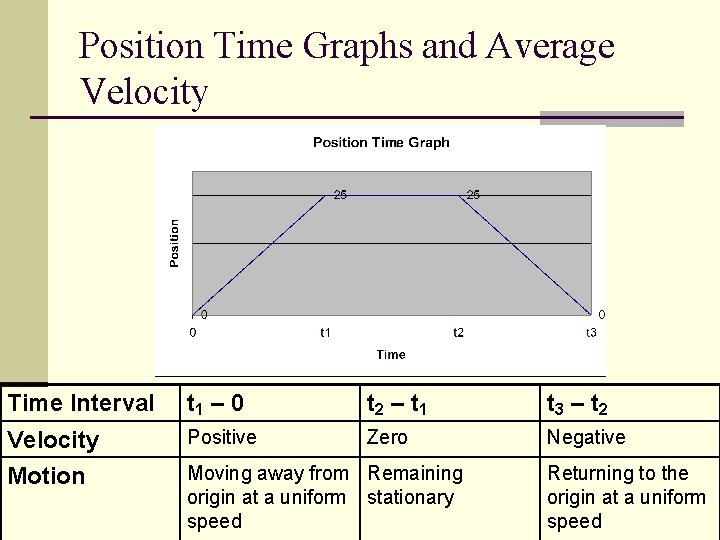
Position Time Graphs and Average Velocity Time Interval t 1 – 0 t 2 – t 1 t 3 – t 2 Velocity Motion Positive Zero Negative Moving away from Remaining origin at a uniform stationary speed Returning to the origin at a uniform speed
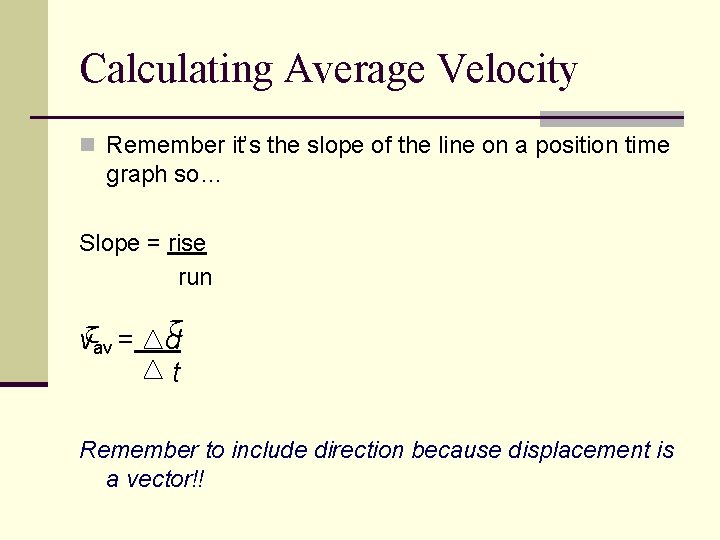
Calculating Average Velocity n Remember it’s the slope of the line on a position time graph so… Slope = rise run v ﺡ av = ﺡ d t Remember to include direction because displacement is a vector!!
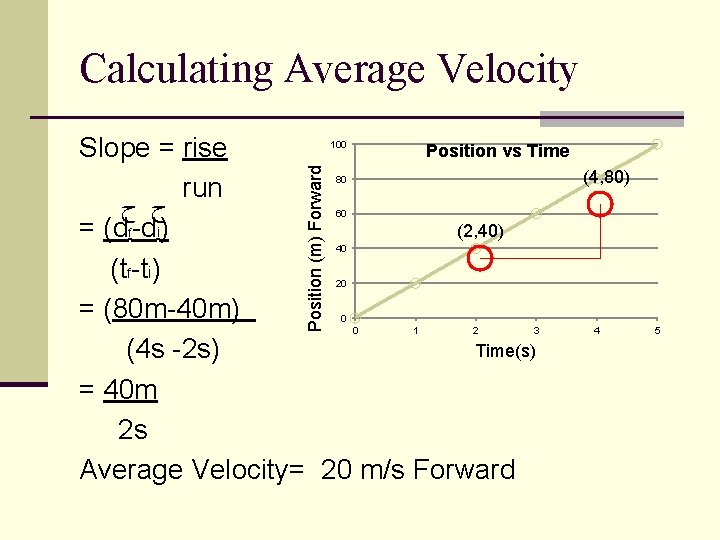
Calculating Average Velocity Position vs Time Slope = rise run ﺡ ﺡ (2, 40) = (df-di) (tf-ti) = (80 m-40 m) Time(s) (4 s -2 s) = 40 m 2 s Average Velocity= 20 m/s Forward Position (m) Forward 100 80 (4, 80) 60 40 20 0 0 1 2 3 4 5
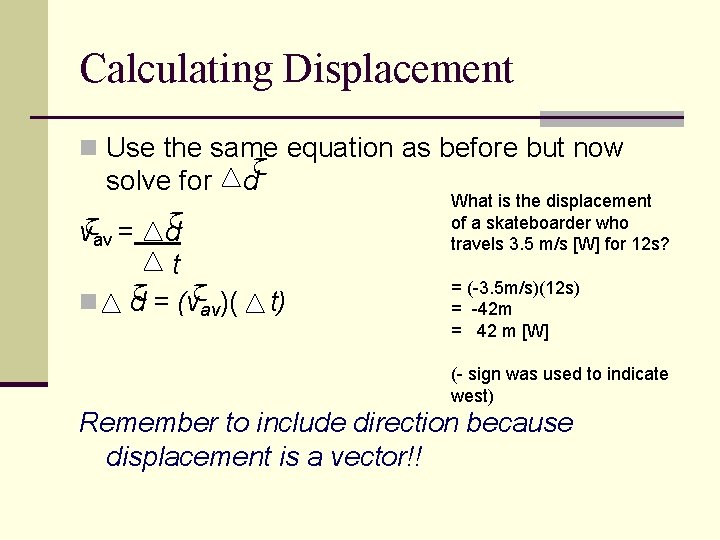
Calculating Displacement n Use the same ﺡ equation as before but now solve for d ﺡ ﺡ vav = d t ﺡ ﺡ n d = (vav)( t) What is the displacement of a skateboarder who travels 3. 5 m/s [W] for 12 s? = (-3. 5 m/s)(12 s) = -42 m = 42 m [W] (- sign was used to indicate west) Remember to include direction because displacement is a vector!!
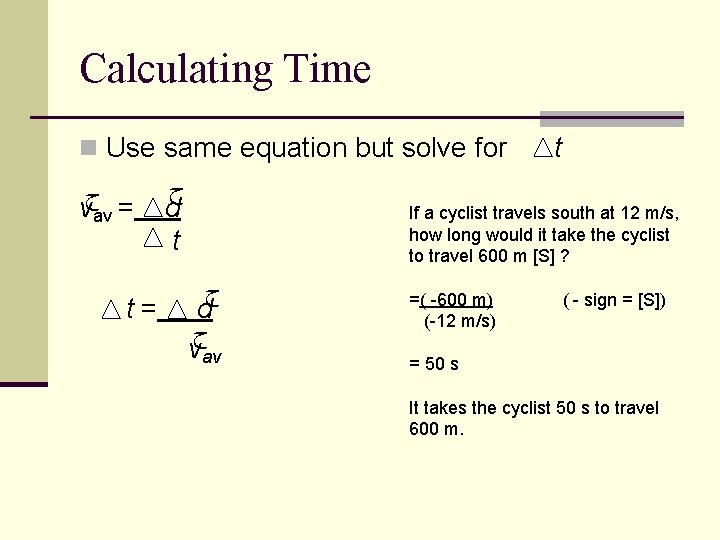
Calculating Time n Use same equation but solve for v ﺡ av = t= ﺡ d t t If a cyclist travels south at 12 m/s, how long would it take the cyclist to travel 600 m [S] ? ﺡ d ﺡ vav =( -600 m) (-12 m/s) ( - sign = [S]) = 50 s It takes the cyclist 50 s to travel 600 m.
Equations Made Easy! n Found in data book on pg. 4
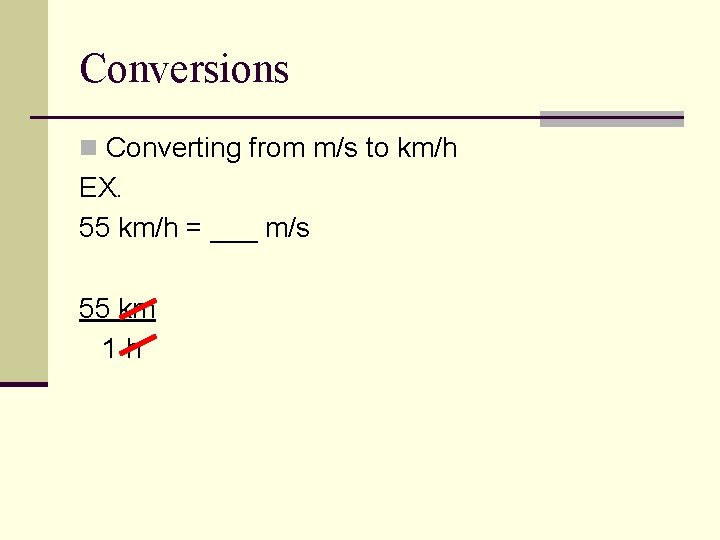
Conversions n Converting from m/s to km/h EX. 55 km/h = ___ m/s 55 km = 1000 m = 1 h = 15 m /s 1 h 1 km 3600 s
Your Turn! n pg 370: 8 -2 C n pg 375: Q 1 -17
- Slides: 21