
Sci 1600 Introduction to Physics Part 5 Electricity
- Slides: 47
Sci 1600 Introduction to Physics Part 5 Electricity and Magnetism Chapter 24 Magnetism © G. Dzyubenko 2016
This lecture will help you understand: l l l l Magnetic Force Magnetic Poles Magnetic Field Magnetic Domains Electric Currents and Magnetic Fields Magnetic Force on Moving Charged Particles Magnetic Force on Current Carrying Wires Earth’s Magnetic Field Ch 24: Magnetism 2
Magnetism The term magnetism comes from the name Magnesia, a coastal district of ancient Thessaly, Greece. l Unusual stones were found by the Greeks more than 2000 years ago. l These stones, called lodestones, had the intriguing property of attracting pieces of iron. l Magnets were first fashioned into compasses and used for navigation by the Chinese in the 12 th century. l Ch 24: Magnetism 3
Magnetic Force Magnetic force between a pair of magnets l Force of attraction or repulsion between a pair of magnets depends on which end of the magnet is held near the other. l Behavior similar to electrical forces. l Strength of interaction depends on the distance between the two magnets. Ch 24: Magnetism 4
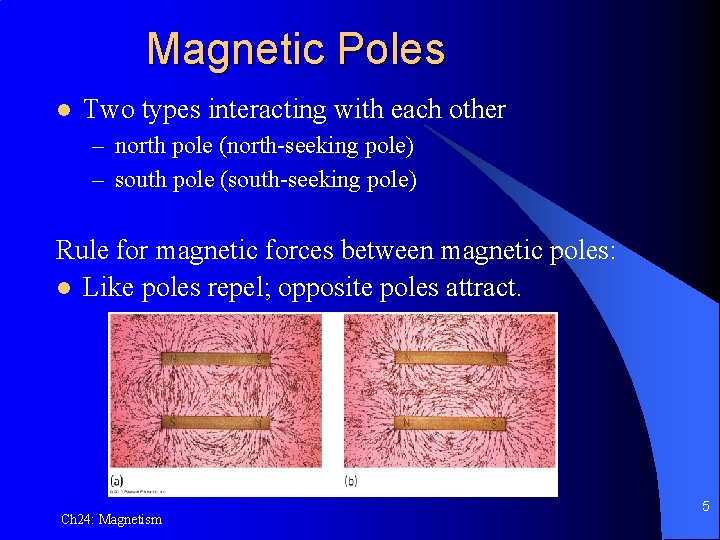
Magnetic Poles l Two types interacting with each other – north pole (north-seeking pole) – south pole (south-seeking pole) Rule for magnetic forces between magnetic poles: l Like poles repel; opposite poles attract. Ch 24: Magnetism 5
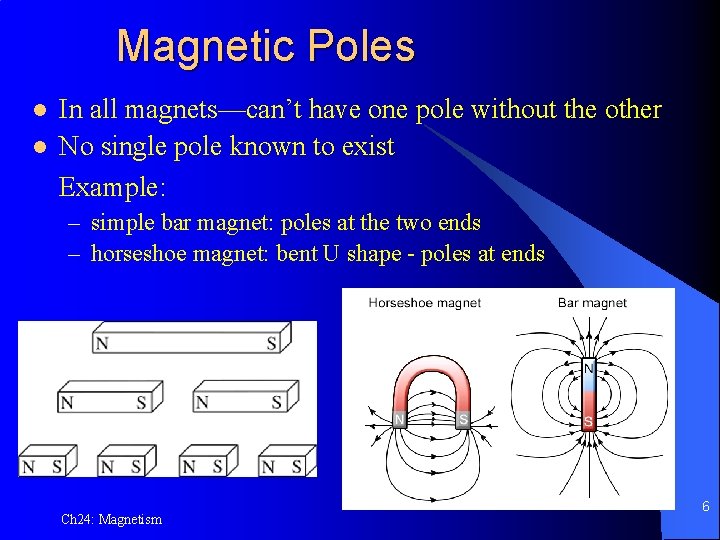
Magnetic Poles l l In all magnets—can’t have one pole without the other No single pole known to exist Example: – simple bar magnet: poles at the two ends – horseshoe magnet: bent U shape - poles at ends Ch 24: Magnetism 6
Magnetic Poles CHECK YOUR NEIGHBOR A weak and strong magnet repel each other. The greater repelling force is by the A. stronger magnet. B. weaker magnet. C. Both the same. D. None of the above. Ch 24: Magnetism 7
Magnetic Poles CHECK YOUR ANSWER A weak and strong magnet repel each other. The greater repelling force is by the A. B. C. D. stronger magnet. weaker magnet. Both the same. None of the above. Explanation: Remember Newton’s third law! Ch 24: Magnetism 8
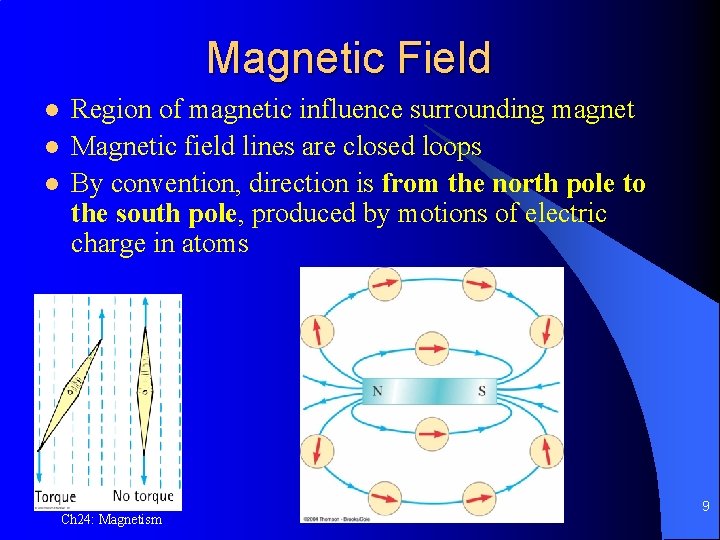
Magnetic Field l l l Region of magnetic influence surrounding magnet Magnetic field lines are closed loops By convention, direction is from the north pole to the south pole, produced by motions of electric charge in atoms Ch 24: Magnetism 9
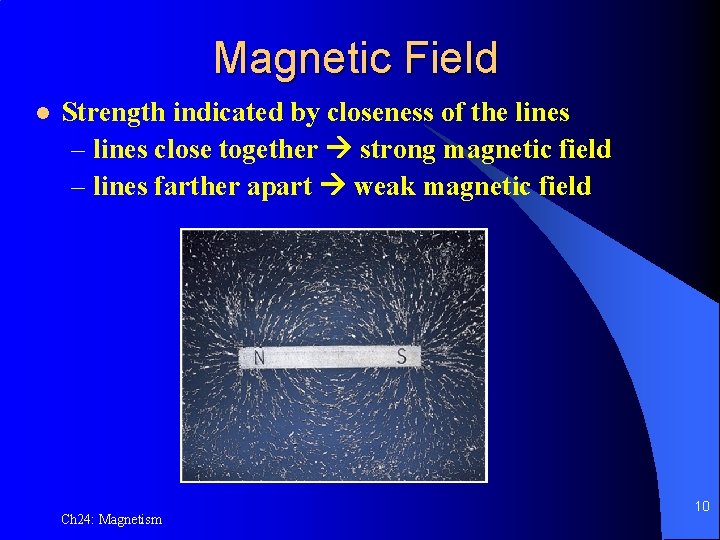
Magnetic Field l Strength indicated by closeness of the lines – lines close together strong magnetic field – lines farther apart weak magnetic field Ch 24: Magnetism 10
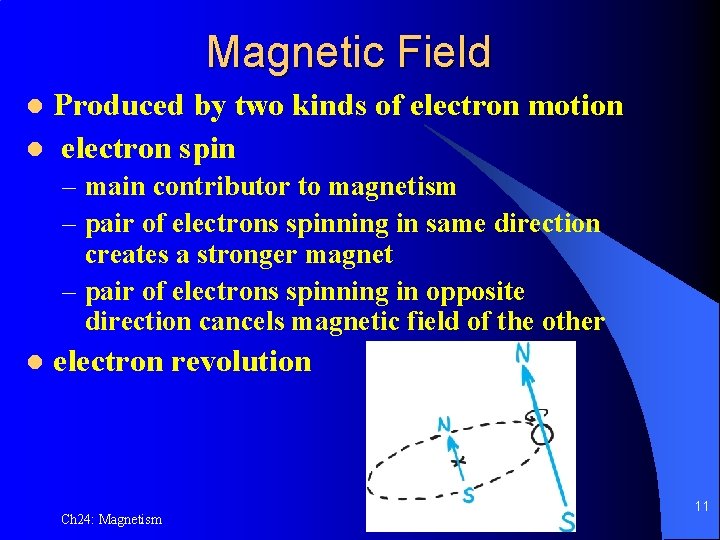
Magnetic Field Produced by two kinds of electron motion l electron spin l – main contributor to magnetism – pair of electrons spinning in same direction creates a stronger magnet – pair of electrons spinning in opposite direction cancels magnetic field of the other l electron revolution Ch 24: Magnetism 11
Magnetic Fields CHECK YOUR NEIGHBOR The source of all magnetism is A. electrons rotating around an atomic nucleus. B. electrons spinning around internal axes. C. either or both A and B. D. tiny bits of iron. Ch 24: Magnetism 12
Magnetic Fields CHECK YOUR ANSWER The source of all magnetism is A. B. C. D. electrons rotating around an atomic nucleus. electrons spinning around internal axes. either or both A and B. tiny bits of iron. Ch 24: Magnetism 13
Magnetic Fields CHECK YOUR NEIGHBOR Where magnetic field lines are more dense, the field there is A. B. C. D. weaker. stronger. Both A and B. Neither A nor B. Ch 24: Magnetism 14
Magnetic Fields CHECK YOUR ANSWER Where magnetic field lines are more dense, the field there is A. B. C. D. weaker. stronger. Both A and B. Neither A nor B. Ch 24: Magnetism 15
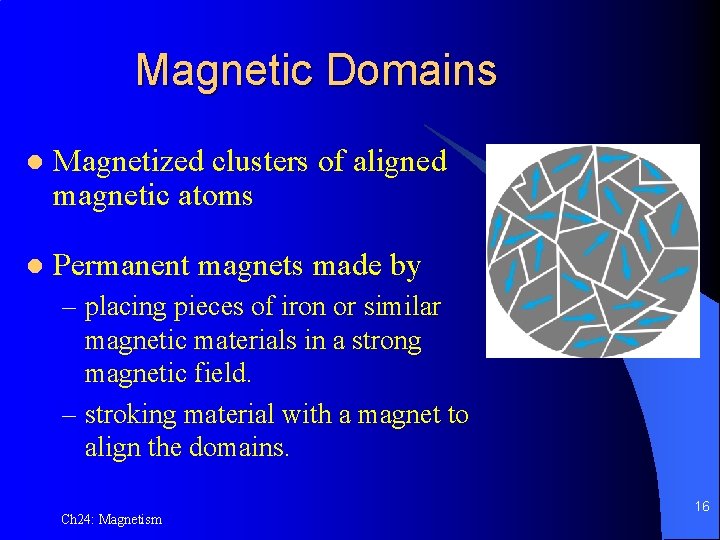
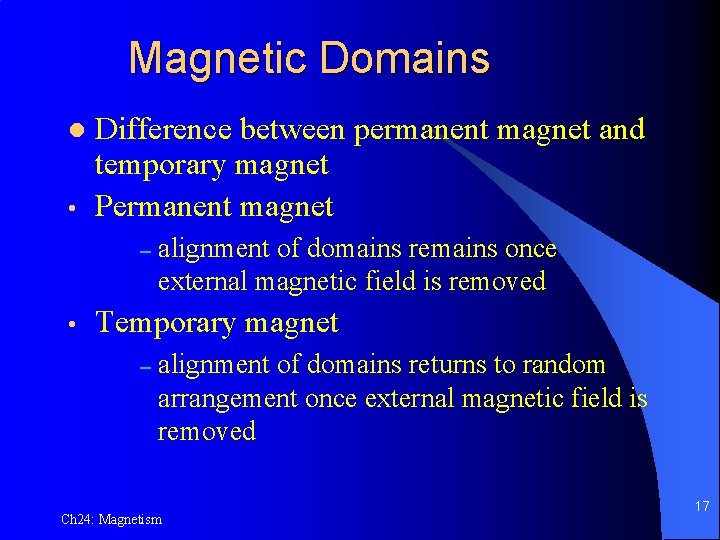
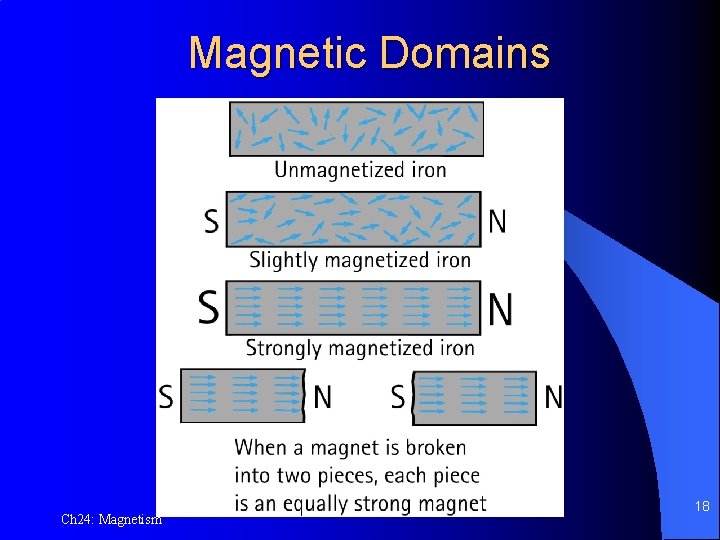
Magnetic Domains l Magnetized clusters of aligned magnetic atoms l Permanent magnets made by – placing pieces of iron or similar magnetic materials in a strong magnetic field. – stroking material with a magnet to align the domains. Ch 24: Magnetism 16
Magnetic Domains l • Difference between permanent magnet and temporary magnet Permanent magnet – • alignment of domains remains once external magnetic field is removed Temporary magnet – alignment of domains returns to random arrangement once external magnetic field is removed Ch 24: Magnetism 17
Magnetic Domains Ch 24: Magnetism 18
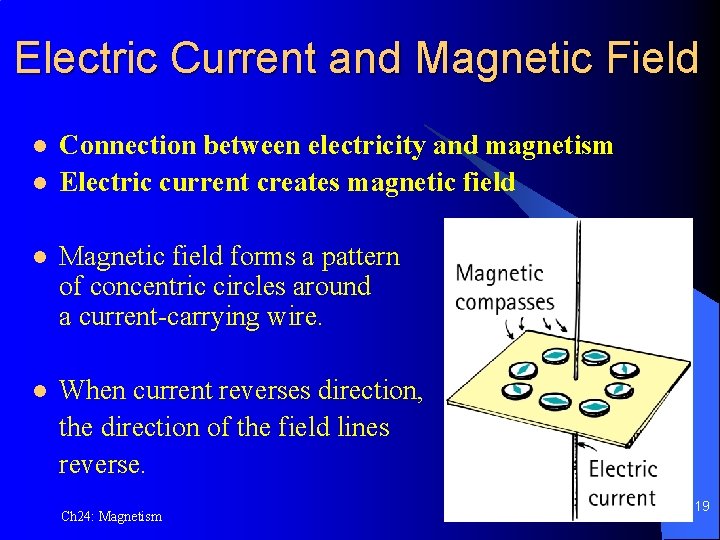
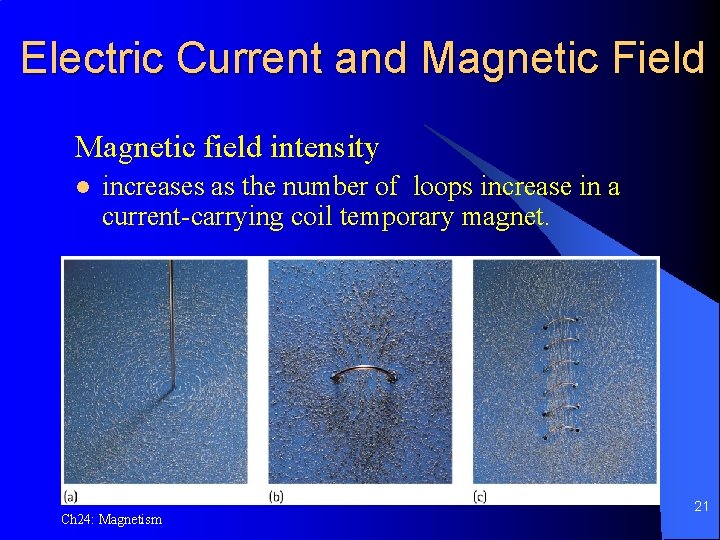
Electric Current and Magnetic Field l l Connection between electricity and magnetism Electric current creates magnetic field l Magnetic field forms a pattern of concentric circles around a current-carrying wire. l When current reverses direction, the direction of the field lines reverse. Ch 24: Magnetism 19
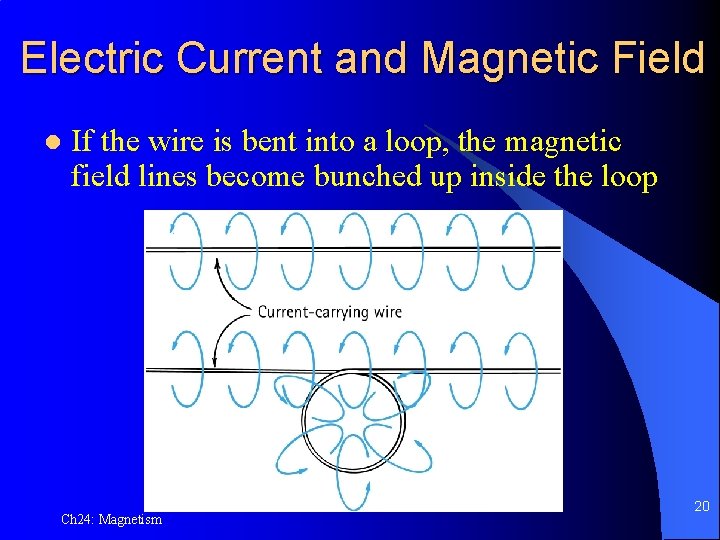
Electric Current and Magnetic Field l If the wire is bent into a loop, the magnetic field lines become bunched up inside the loop Ch 24: Magnetism 20
Electric Current and Magnetic Field Magnetic field intensity l increases as the number of loops increase in a current-carrying coil temporary magnet. Ch 24: Magnetism 21
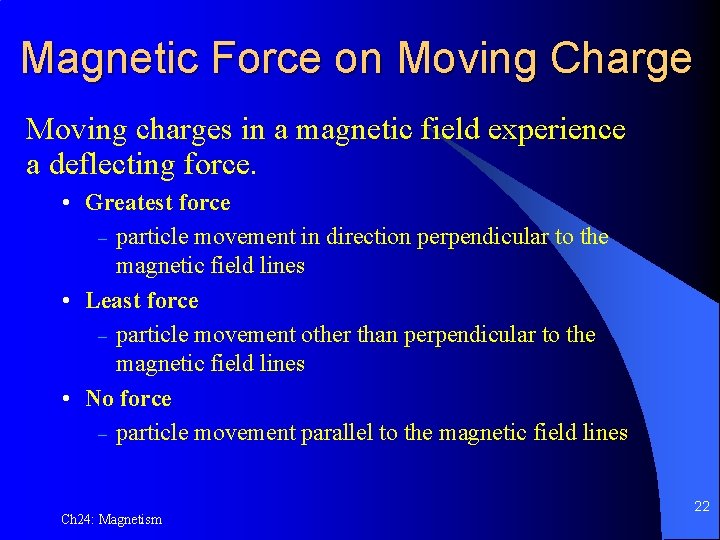
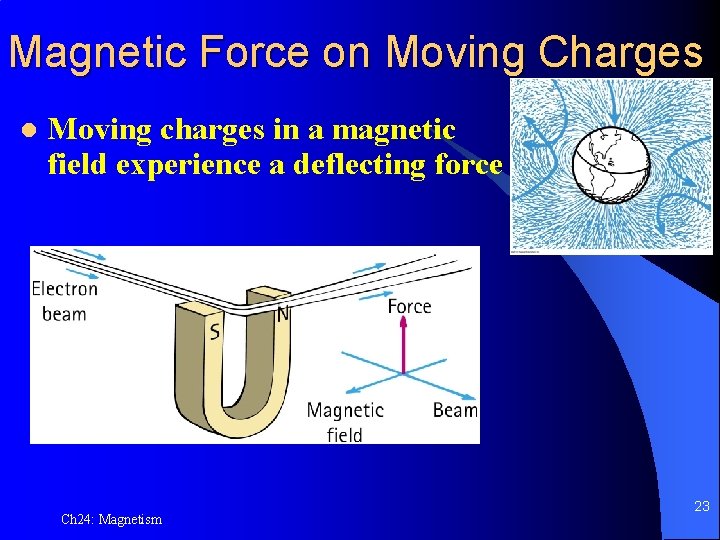
Magnetic Force on Moving Charge Moving charges in a magnetic field experience a deflecting force. • Greatest force – particle movement in direction perpendicular to the magnetic field lines • Least force – particle movement other than perpendicular to the magnetic field lines • No force – particle movement parallel to the magnetic field lines Ch 24: Magnetism 22
Magnetic Force on Moving Charges l Moving charges in a magnetic field experience a deflecting force Ch 24: Magnetism 23
Magnetic Force on Moving Charges CHECK YOUR NEIGHBOR The reason that an electron moving in a magnetic field doesn’t pick up speed is A. magnets only divert them. B. only electric fields can change the speed of a charged particle. C. the magnetic force is always perpendicular to its motion. D. All of the above. Ch 24: Magnetism 24
Magnetic Force on Moving Charges CHECK YOUR ANSWER The reason that an electron moving in a magnetic field doesn’t pick up speed is A. B. C. D. magnets only divert them. only electric fields can change the speed of a charged particle. the magnetic force is always perpendicular to its motion. All of the above. Explanation: Although all statements are true, the reason is given only by C. With no component of force in the direction of motion, speed doesn’t change. Ch 24: Magnetism 25
Magnetic Force on Moving Charges CHECK YOUR NEIGHBOR The magnetic force on a moving charged particle can change the particle’s A. B. C. D. speed. direction. Both A and B. Neither A nor B. Ch 24: Magnetism 26
Magnetic Force on Moving Charges CHECK YOUR ANSWER The magnetic force on a moving charged particle can change the particle’s A. B. C. D. speed. direction. Both A and B. Neither A nor B. Ch 24: Magnetism 27
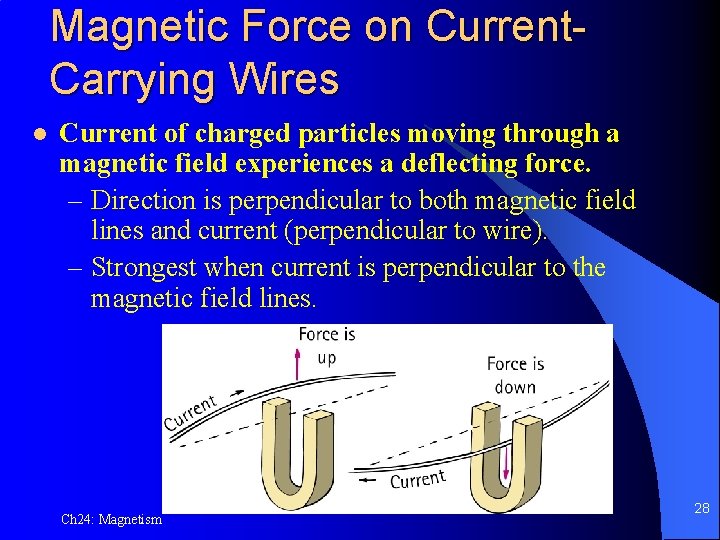
Magnetic Force on Current. Carrying Wires l Current of charged particles moving through a magnetic field experiences a deflecting force. – Direction is perpendicular to both magnetic field lines and current (perpendicular to wire). – Strongest when current is perpendicular to the magnetic field lines. Ch 24: Magnetism 28
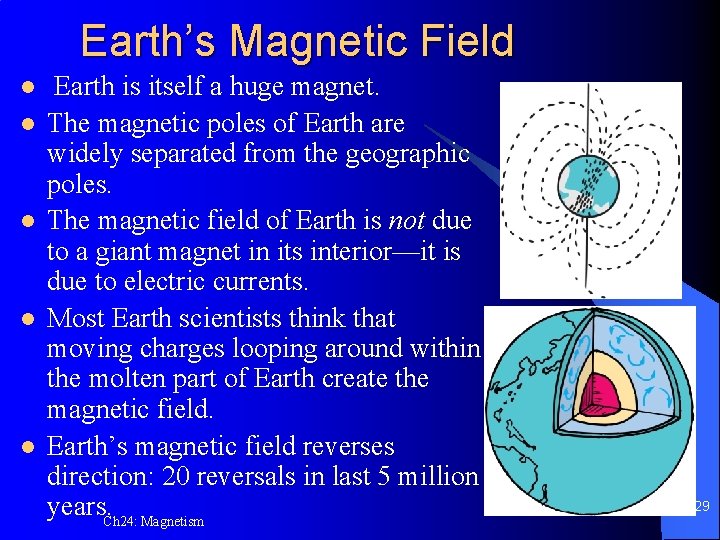
Earth’s Magnetic Field l l l Earth is itself a huge magnet. The magnetic poles of Earth are widely separated from the geographic poles. The magnetic field of Earth is not due to a giant magnet in its interior—it is due to electric currents. Most Earth scientists think that moving charges looping around within the molten part of Earth create the magnetic field. Earth’s magnetic field reverses direction: 20 reversals in last 5 million years. Ch 24: Magnetism 29
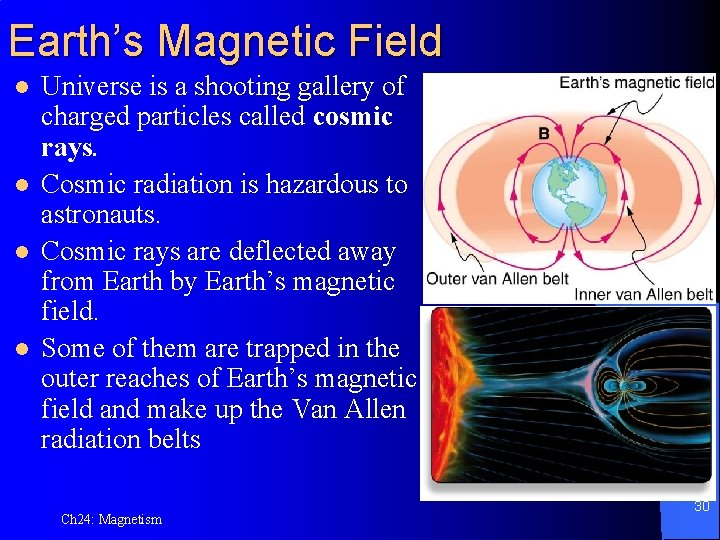
Earth’s Magnetic Field l l Universe is a shooting gallery of charged particles called cosmic rays. Cosmic radiation is hazardous to astronauts. Cosmic rays are deflected away from Earth by Earth’s magnetic field. Some of them are trapped in the outer reaches of Earth’s magnetic field and make up the Van Allen radiation belts Ch 24: Magnetism 30
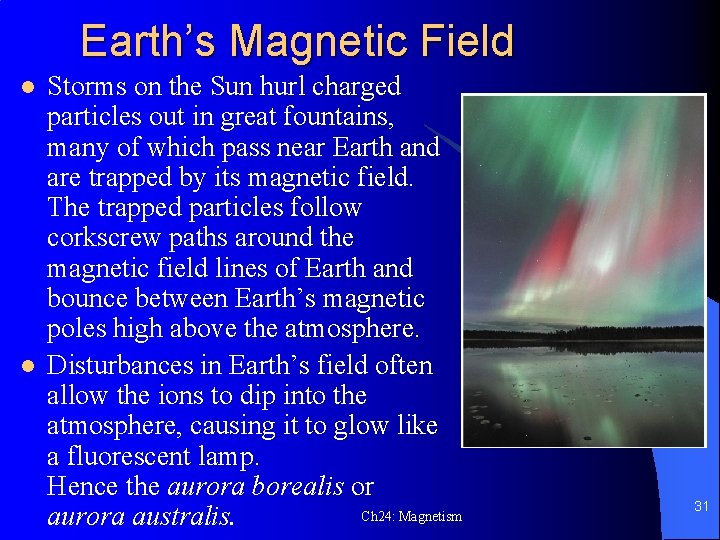
Earth’s Magnetic Field l l Storms on the Sun hurl charged particles out in great fountains, many of which pass near Earth and are trapped by its magnetic field. The trapped particles follow corkscrew paths around the magnetic field lines of Earth and bounce between Earth’s magnetic poles high above the atmosphere. Disturbances in Earth’s field often allow the ions to dip into the atmosphere, causing it to glow like a fluorescent lamp. Hence the aurora borealis or Ch 24: Magnetism aurora australis. 31
Sci 1600 Introduction to Physics Part 5 Electricity and Magnetism Chapter 25 Electromagnetic Induction © G. Dzyubenko 2016
This lecture will help you understand: Electromagnetic Induction l Faraday’s Law l Generators and Alternating Current l Ch 24: Magnetism 33
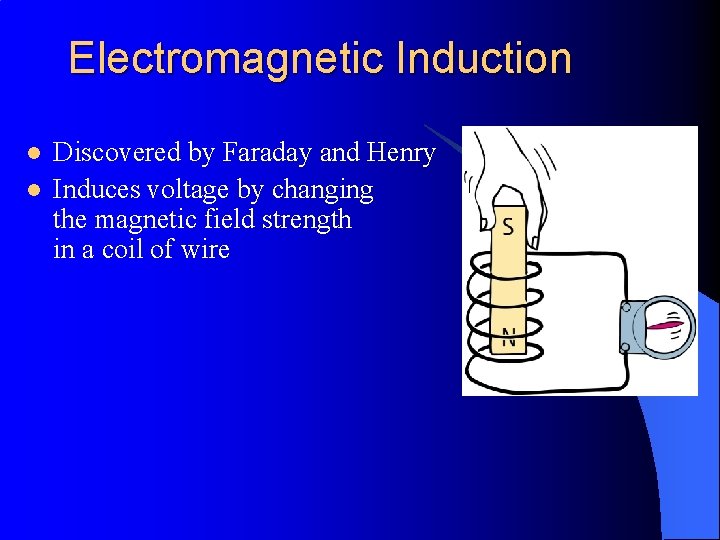
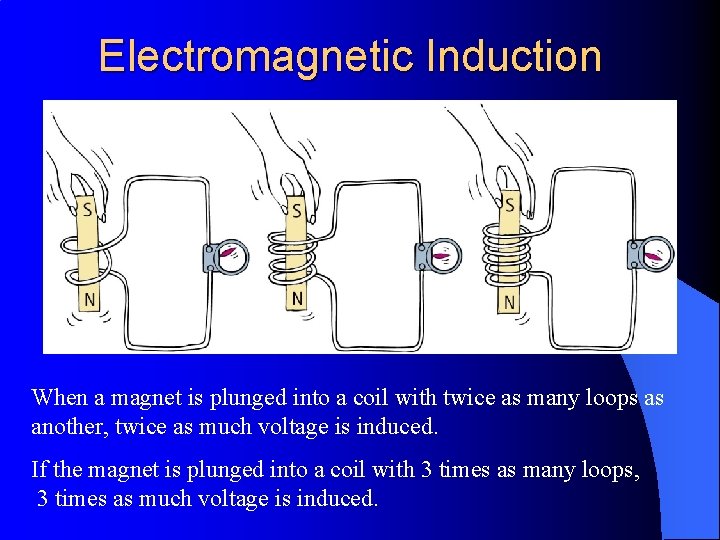
Electromagnetic Induction l l Discovered by Faraday and Henry Induces voltage by changing the magnetic field strength in a coil of wire
Electromagnetic Induction l Induced voltage can be increased by – increasing the number of loops of wire in a coil. – increasing the speed of the magnet entering and leaving the coil. l Slow motion produces hardly any voltage. l Rapid motion produces greater voltage.
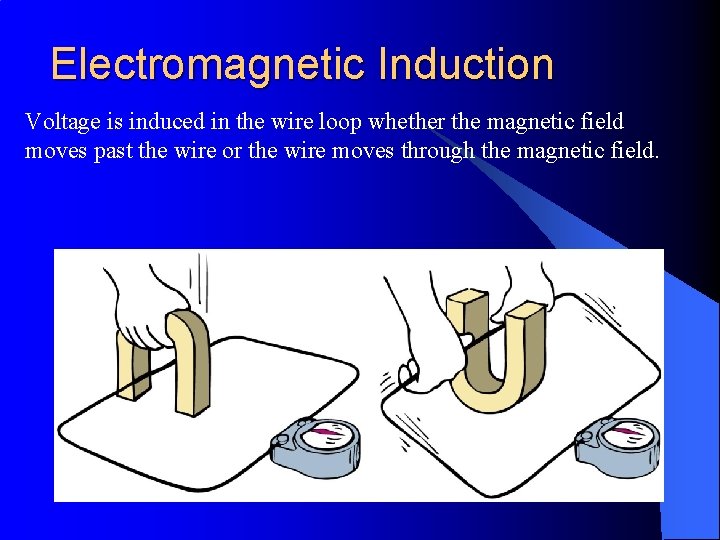
Electromagnetic Induction Voltage is induced in the wire loop whether the magnetic field moves past the wire or the wire moves through the magnetic field.
Electromagnetic Induction When a magnet is plunged into a coil with twice as many loops as another, twice as much voltage is induced. If the magnet is plunged into a coil with 3 times as many loops, 3 times as much voltage is induced.
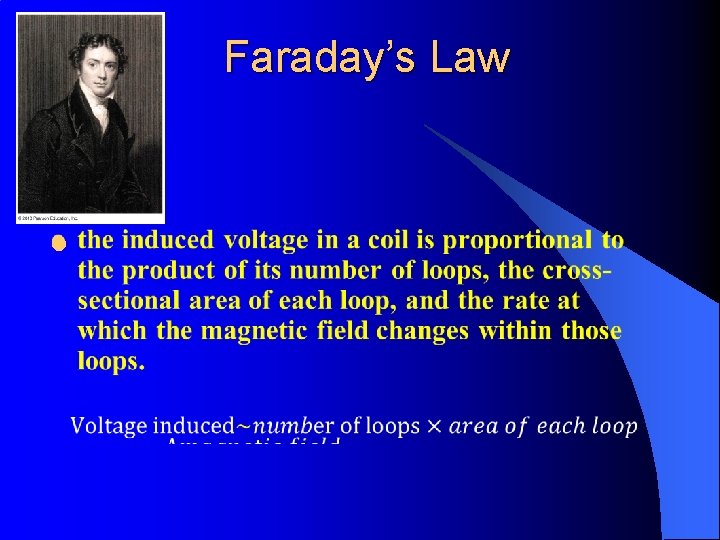
Faraday’s Law l
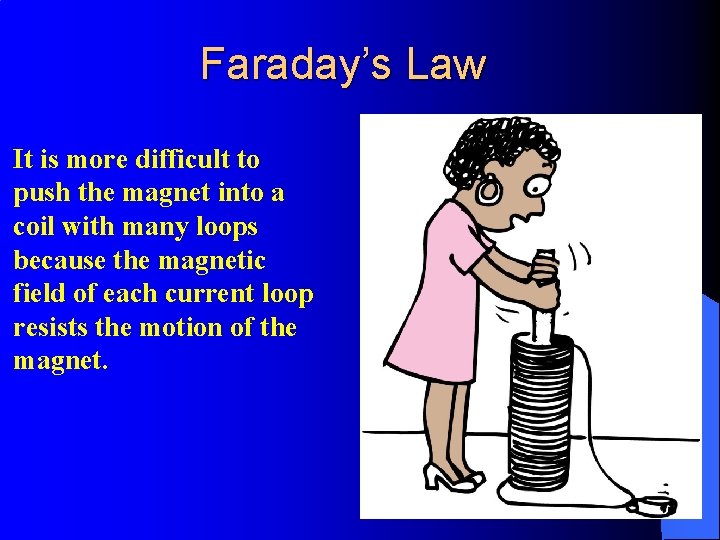
Faraday’s Law It is more difficult to push the magnet into a coil with many loops because the magnetic field of each current loop resists the motion of the magnet.
Faraday’s Law CHECK YOUR NEIGHBOR The resistance you feel when pushing a piece of iron into a coil involves A. B. C. D. repulsion by the magnetic field you produce. energy transfer between the iron and coil. Newton’s third law. resistance to domain alignment in the iron.
Faraday’s Law CHECK YOUR ANSWER The resistance you feel when pushing a piece of iron into a coil involves A. B. C. D. repulsion by the magnetic field you produce. energy transfer between the iron and coil. Newton’s third law. resistance to domain alignment in the iron.
Faraday’s Law Voltage induced in a wire requires changing magnetic field in the loop by • moving the loop near a magnet, • moving a magnet near a loop, • changing the current in a nearby loop. l
Faraday’s Law Application of Faraday’s law l l l Activation of traffic lights by a car moving over underground coils of wire Triggering security system at the airport by altering magnetic field in the coils as one walks through Scanning magnetic strips on back of credit cards Recording of sound on tape Electronic devices in computer hard drives, i. Pods
Faraday’s Law CHECK YOUR NEIGHBOR More voltage is induced when a magnet is thrust into a coil A. B. C. D. more quickly. more slowly. Both A and B. Neither A nor B.
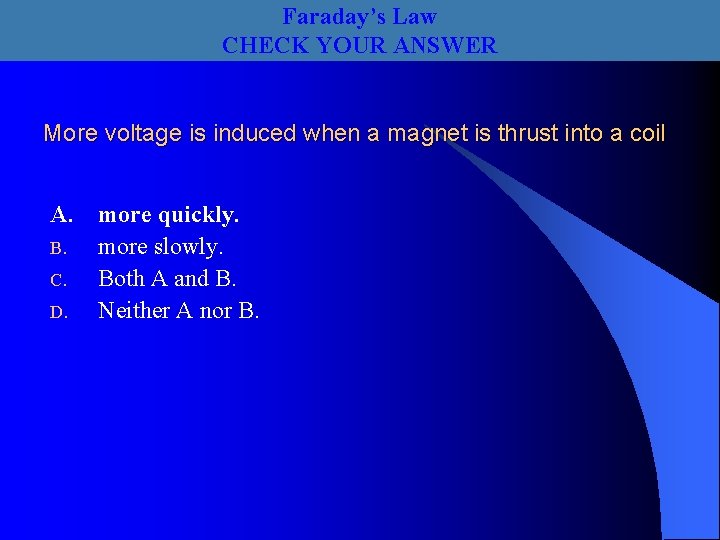
Faraday’s Law CHECK YOUR ANSWER More voltage is induced when a magnet is thrust into a coil A. B. C. D. more quickly. more slowly. Both A and B. Neither A nor B.
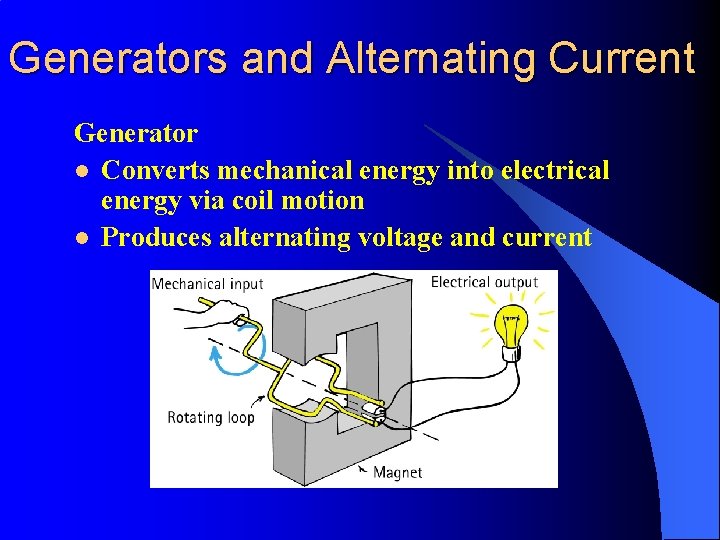
Generators and Alternating Current Generator l Converts mechanical energy into electrical energy via coil motion l Produces alternating voltage and current
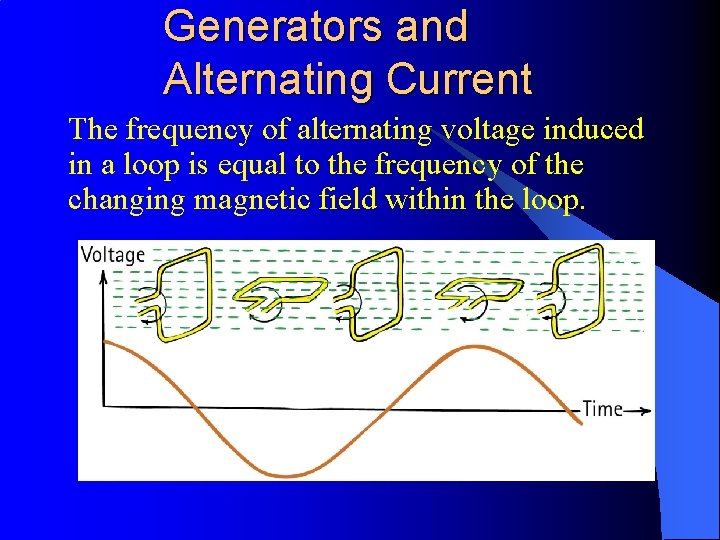
Generators and Alternating Current The frequency of alternating voltage induced in a loop is equal to the frequency of the changing magnetic field within the loop.