
Schrodinger TimeDependent Wave Equation It is a differential
- Slides: 19
Schrodinger Time-Dependent Wave Equation It is a differential equation for the de. Broglie waves associated with particles and describes the motion of particles.
• In 1926, Schrodinger presented his famous wave equation as a development of de Broglie ideas of the wave properties of matter. The Schrodinger equation is the fundamental equation of wave mechanics in the same sense as the Newton’s second law of motion of classical mechanics. • Schrödinger introduced a mathematical function ψ which is the variable quantity associated with the moving particle, and is a complex function of the space coordinates of the particle and the time. Ψ is called the ‘wave function’ as it characterizes the de Broglie waves associated with the particle. It is postulated that ψ has the form of the solution of the classical wave equation.
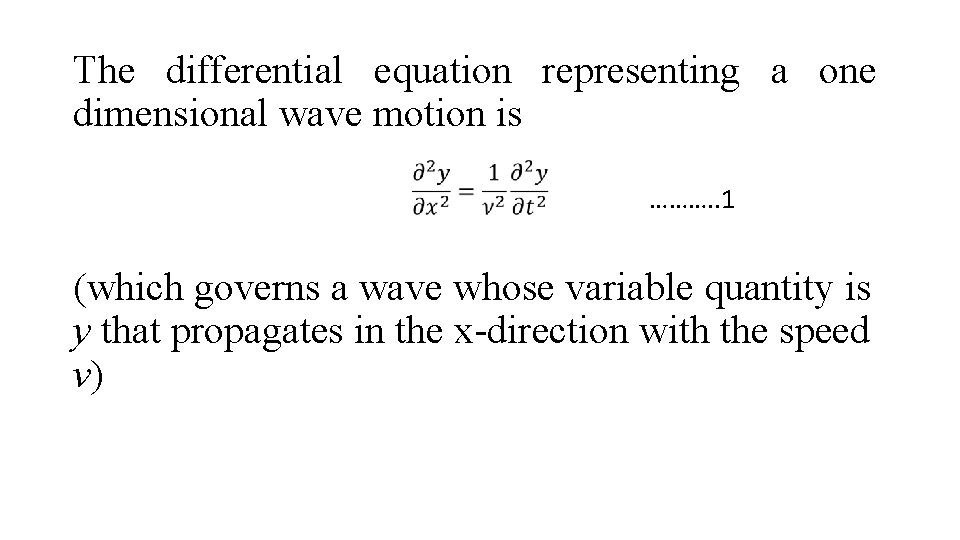
The differential equation representing a one dimensional wave motion is ………. . 1 (which governs a wave whose variable quantity is y that propagates in the x-direction with the speed v)
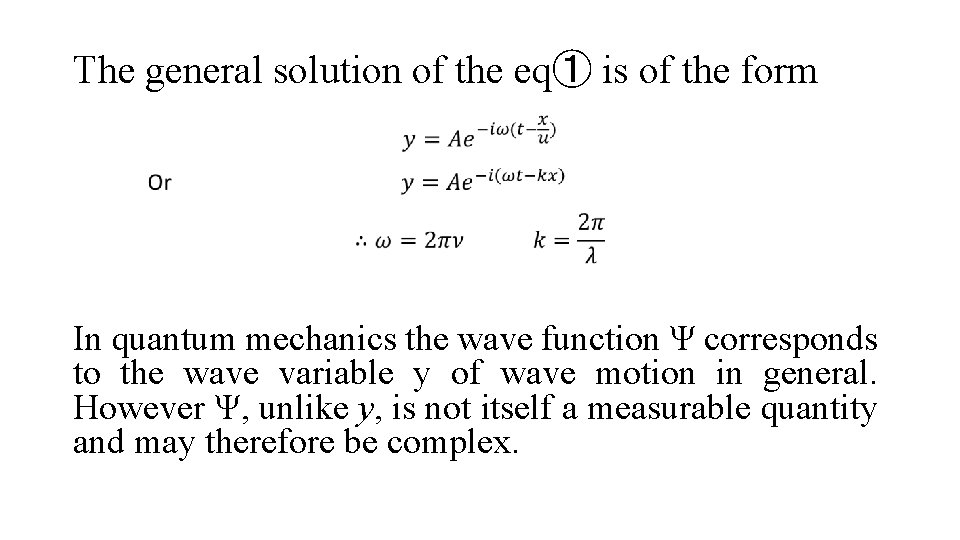
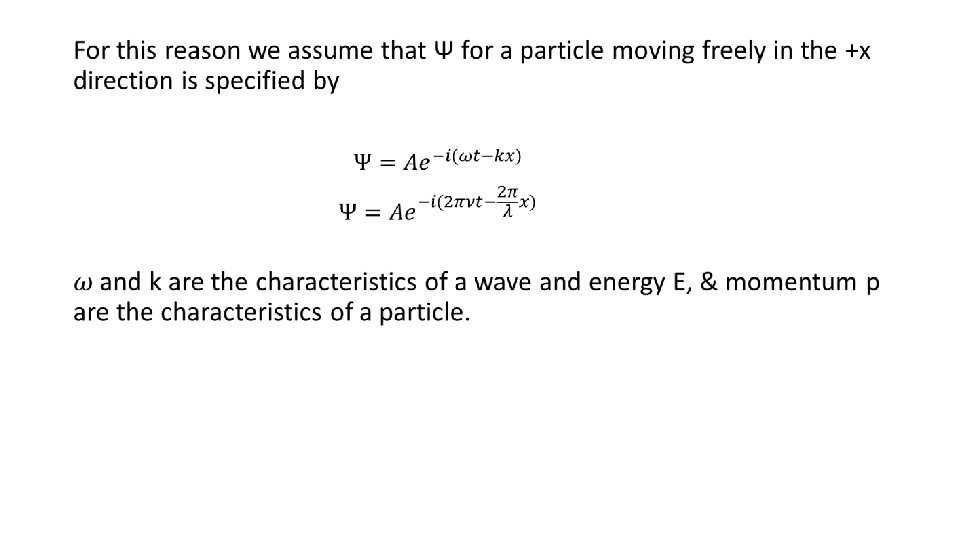
The general solution of the eq① is of the form In quantum mechanics the wave function Ψ corresponds to the wave variable y of wave motion in general. However Ψ, unlike y, is not itself a measurable quantity and may therefore be complex.
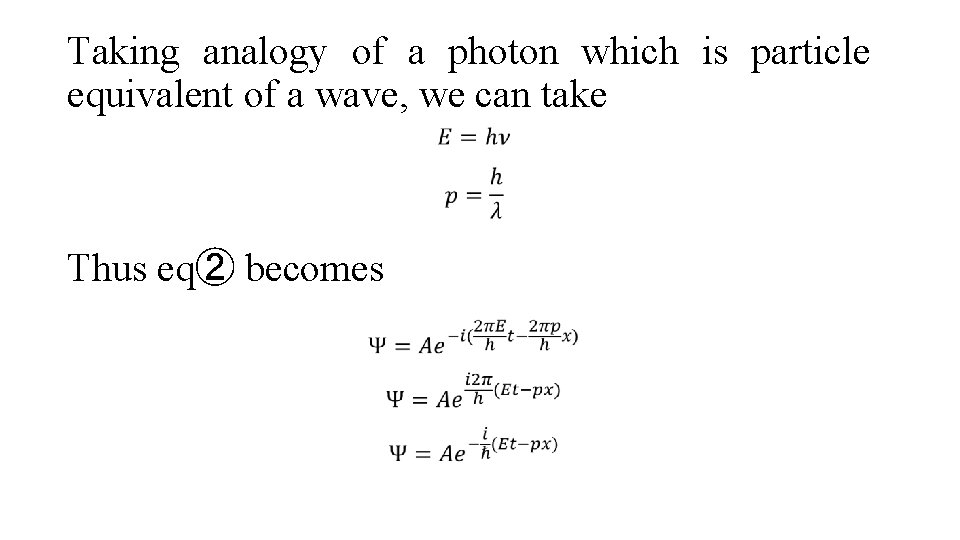
Taking analogy of a photon which is particle equivalent of a wave, we can take Thus eq② becomes
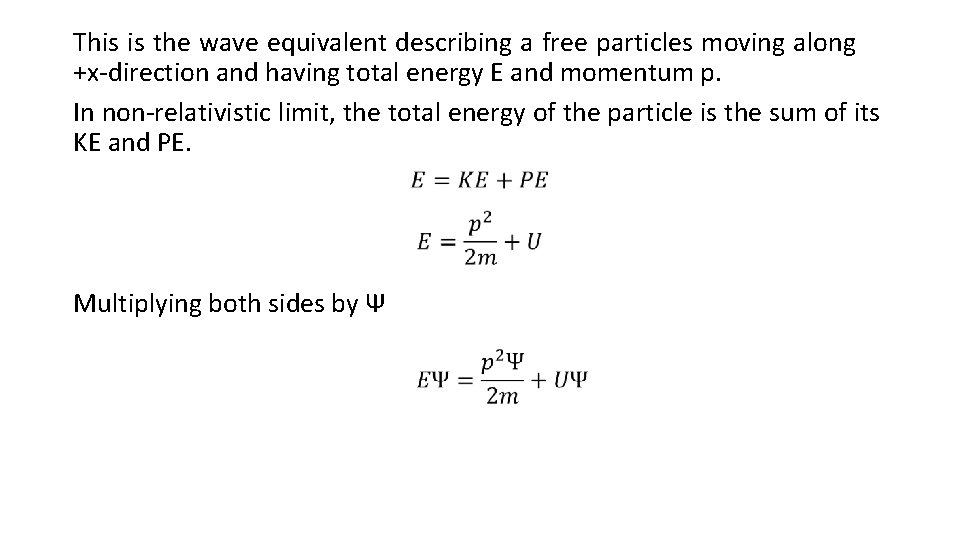
This is the wave equivalent describing a free particles moving along +x-direction and having total energy E and momentum p. In non-relativistic limit, the total energy of the particle is the sum of its KE and PE. Multiplying both sides by Ψ
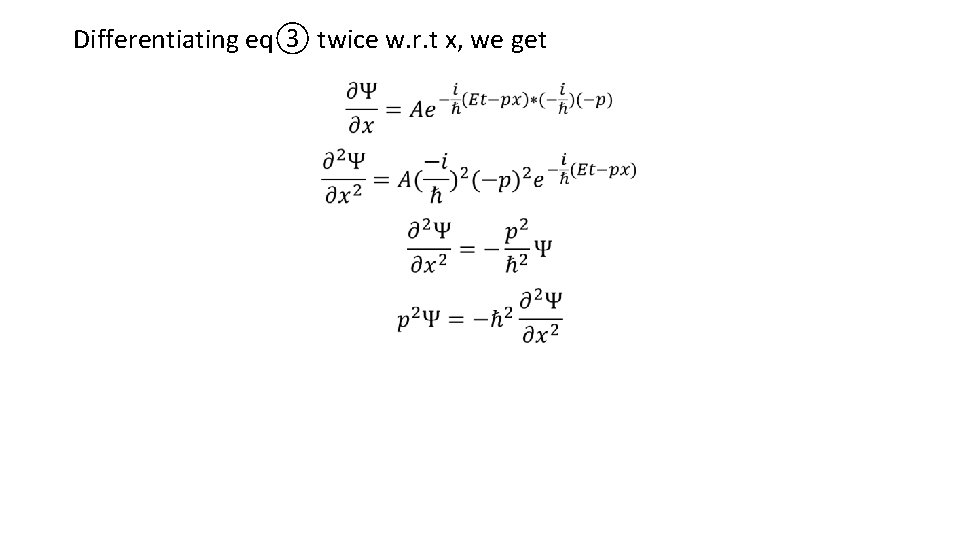
Differentiating eq③ twice w. r. t x, we get
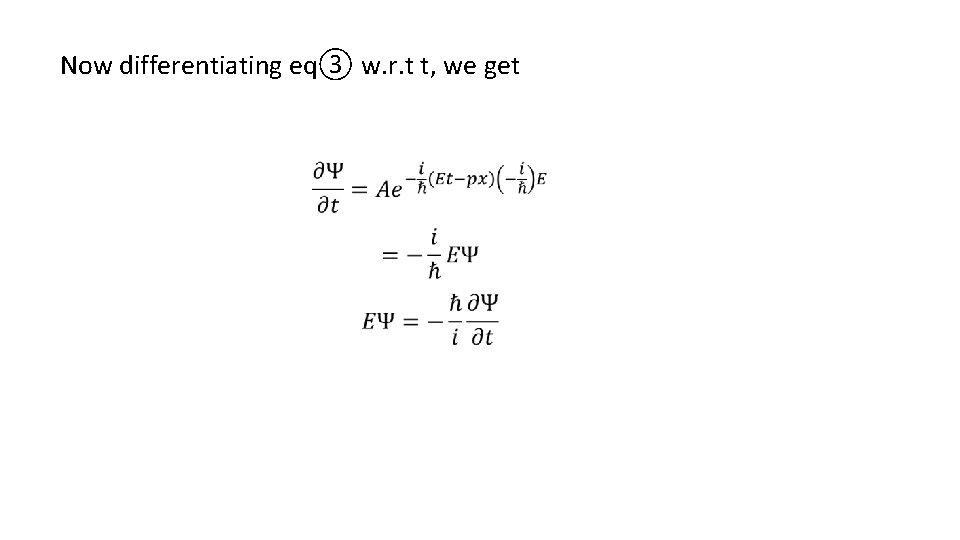
Now differentiating eq③ w. r. t t, we get
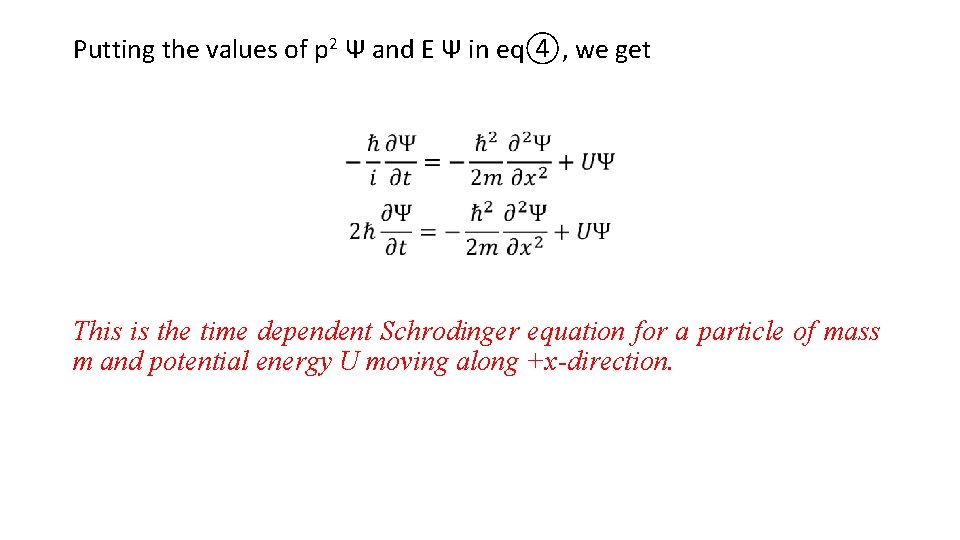
Putting the values of p 2 Ψ and E Ψ in eq④, we get This is the time dependent Schrodinger equation for a particle of mass m and potential energy U moving along +x-direction.
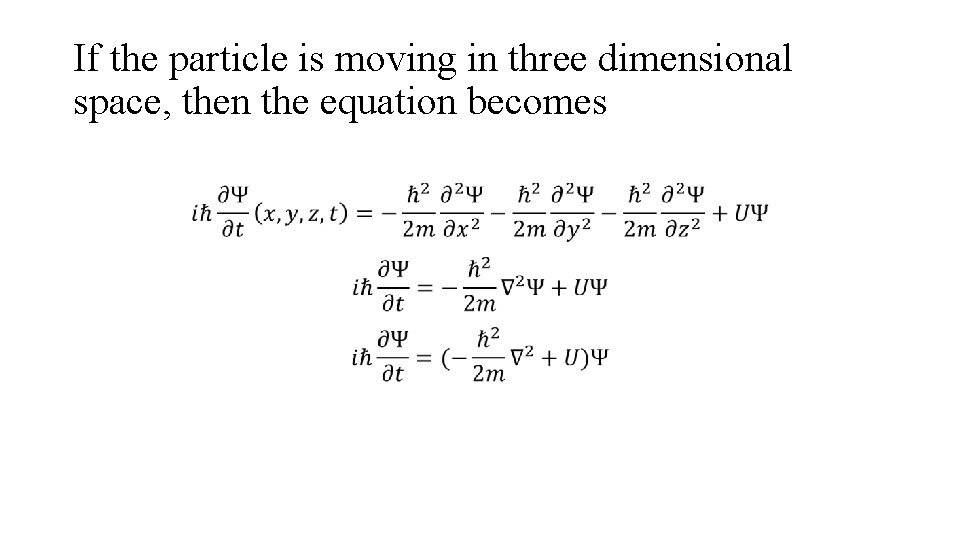
If the particle is moving in three dimensional space, then the equation becomes
Any condition imposed on the motion of particle will affect the potential energy U, which is a function of x & t. By knowing the exact form of U, the equation may be solved for Ψ. The time dependent Schrodinger equation is used to explain non-stationary phenomenon, such as electronic transition between two states of atom.
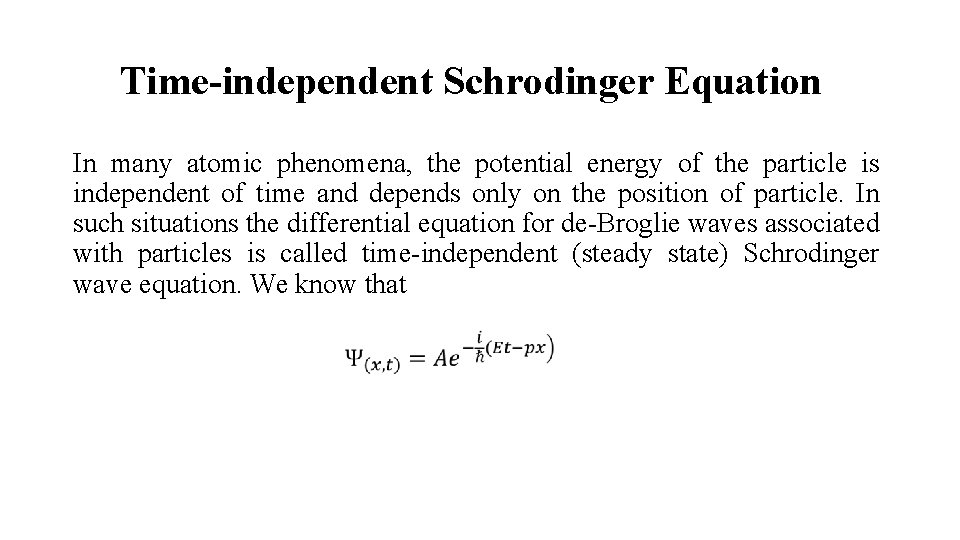
Time-independent Schrodinger Equation In many atomic phenomena, the potential energy of the particle is independent of time and depends only on the position of particle. In such situations the differential equation for de-Broglie waves associated with particles is called time-independent (steady state) Schrodinger wave equation. We know that
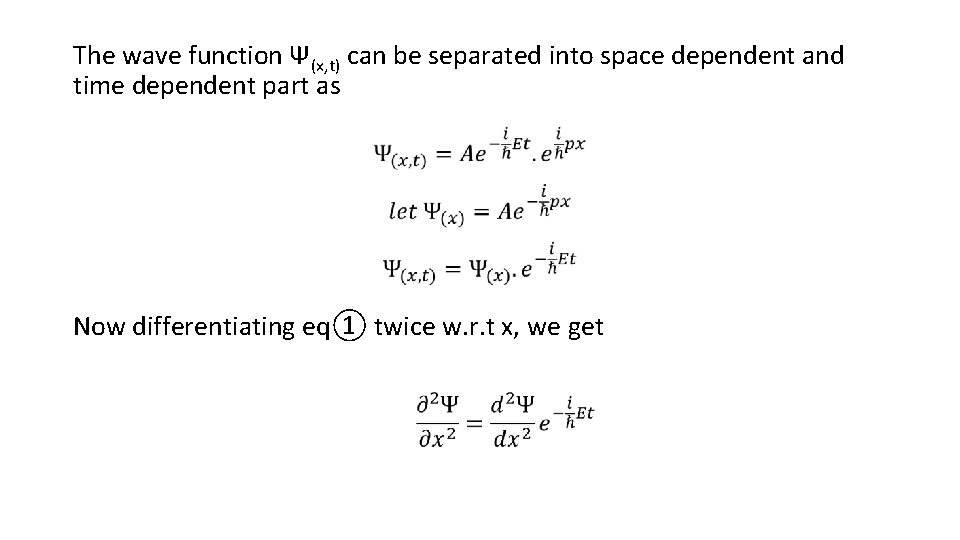
The wave function Ψ(x, t) can be separated into space dependent and time dependent part as Now differentiating eq① twice w. r. t x, we get
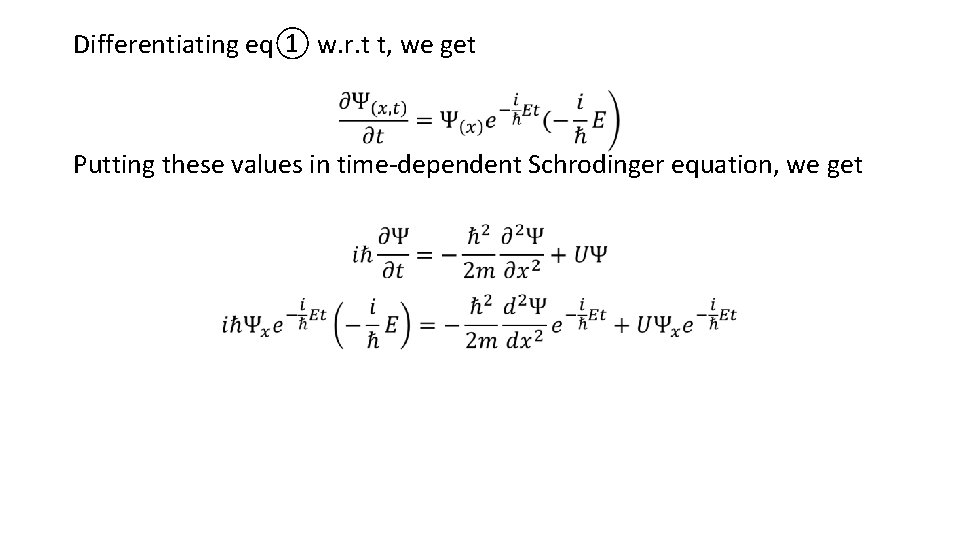
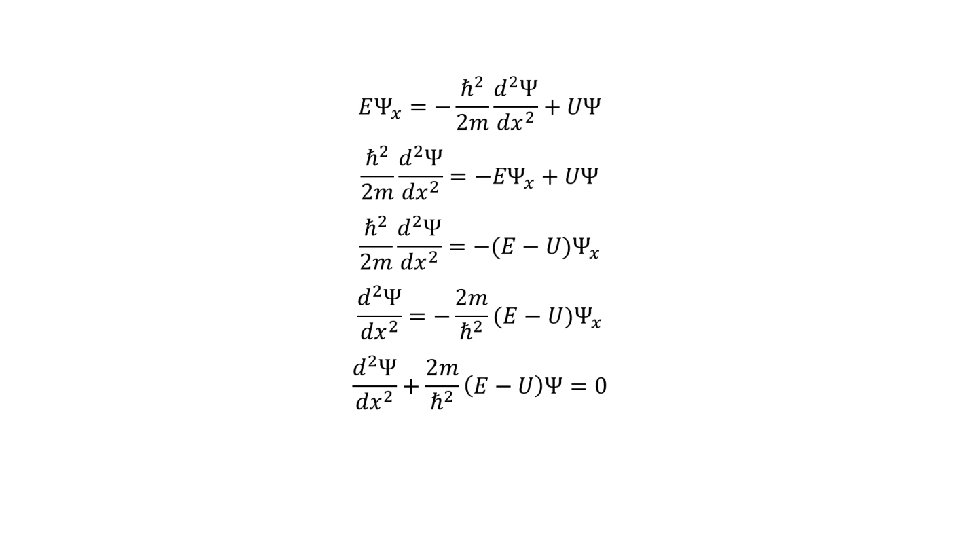
Differentiating eq① w. r. t t, we get Putting these values in time-dependent Schrodinger equation, we get
Physical interpretation of wave function Ψ • A satisfactory interpretation of the wave function Ψ associated with a moving particle was given by Max Born in 1926. He postulated that the square of the magnitude of the wave function, |Ψ|2 (or Ψ Ψ* if Ψ is complex) evaluated a particular point represents the probability of finding the particle at the point. |Ψ|2 is called the probability density and Ψ is the probability amplitude.
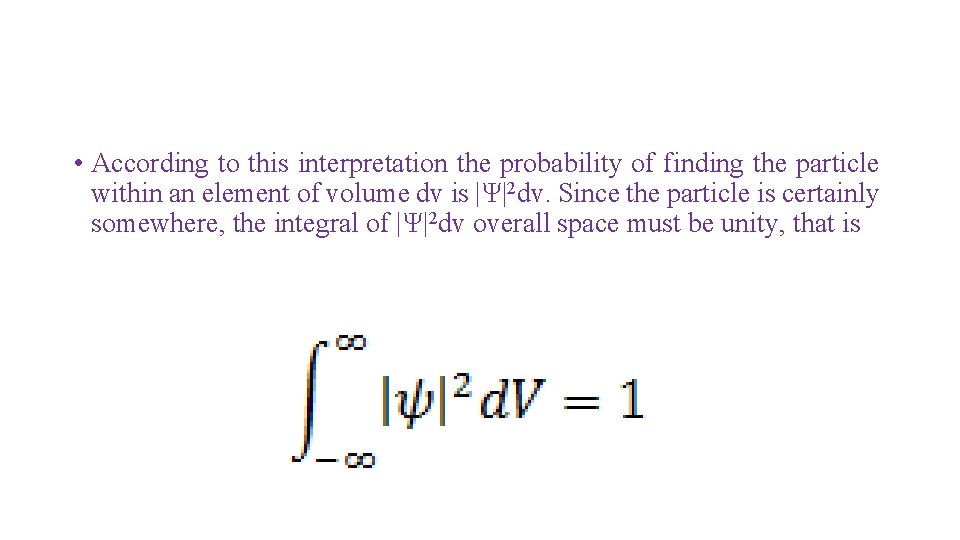
• According to this interpretation the probability of finding the particle within an element of volume dv is |Ψ|2 dv. Since the particle is certainly somewhere, the integral of |Ψ|2 dv overall space must be unity, that is
• A wave function that obeys this equation is said to be normalized. Every acceptable wave function must be normalized. Besides being normalized, an acceptable wave function Ψ must fulfill the following requirements: • It must be finite everywhere. • It must be single valued. • It must be continuous and have a continuous first derivative everywhere.