
Schrdinger Heisenberg Interaction Pictures Experiment measurable quantities variables
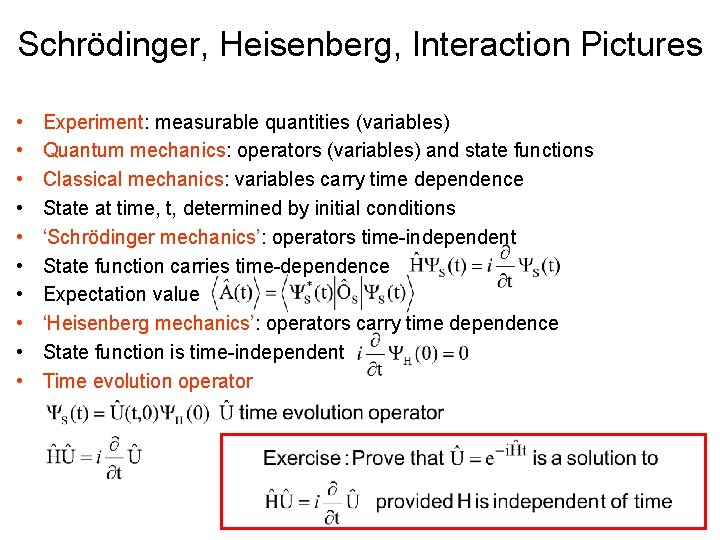
Schrödinger, Heisenberg, Interaction Pictures • • • Experiment: measurable quantities (variables) Quantum mechanics: operators (variables) and state functions Classical mechanics: variables carry time dependence State at time, t, determined by initial conditions ‘Schrödinger mechanics’: operators time-independent State function carries time-dependence Expectation value ‘Heisenberg mechanics’: operators carry time dependence State function is time-independent Time evolution operator
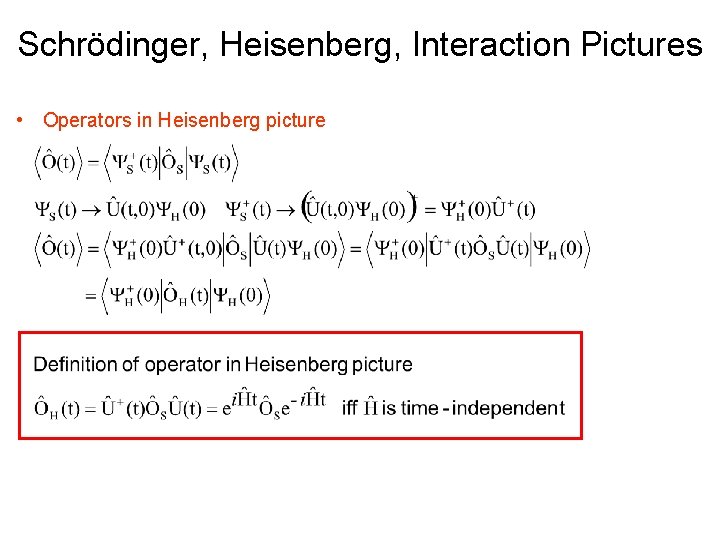
Schrödinger, Heisenberg, Interaction Pictures • Operators in Heisenberg picture
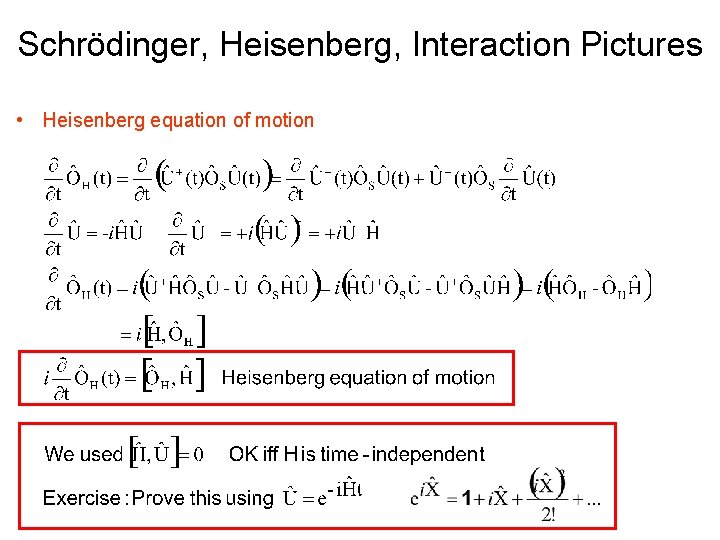
Schrödinger, Heisenberg, Interaction Pictures • Heisenberg equation of motion
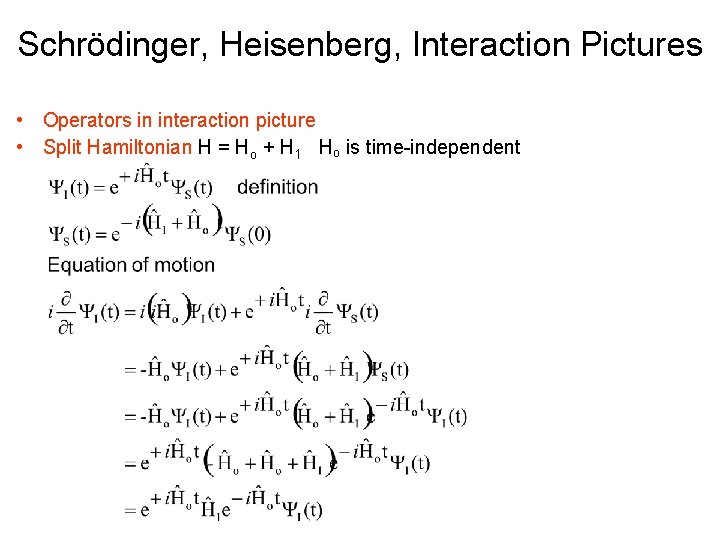
Schrödinger, Heisenberg, Interaction Pictures • Operators in interaction picture • Split Hamiltonian H = Ho + H 1 Ho is time-independent
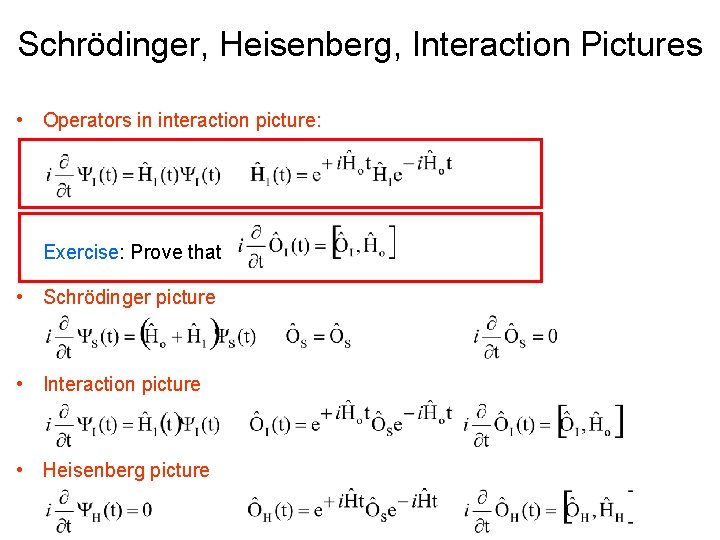
Schrödinger, Heisenberg, Interaction Pictures • Operators in interaction picture: Exercise: Prove that • Schrödinger picture • Interaction picture • Heisenberg picture
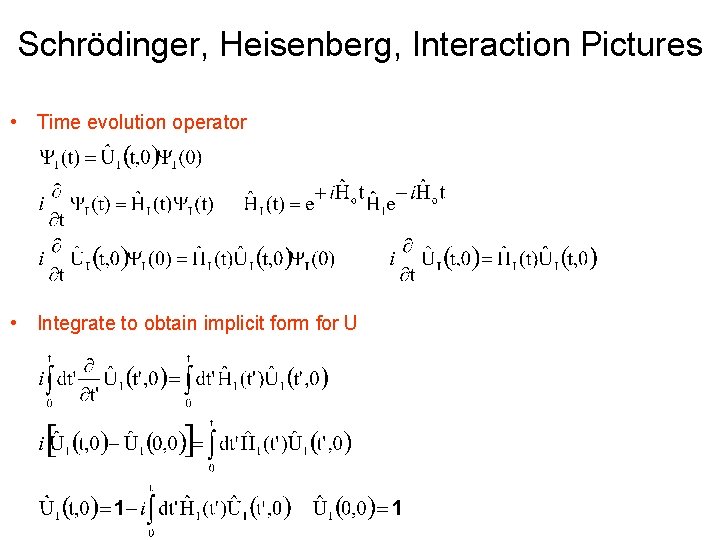
Schrödinger, Heisenberg, Interaction Pictures • Time evolution operator • Integrate to obtain implicit form for U
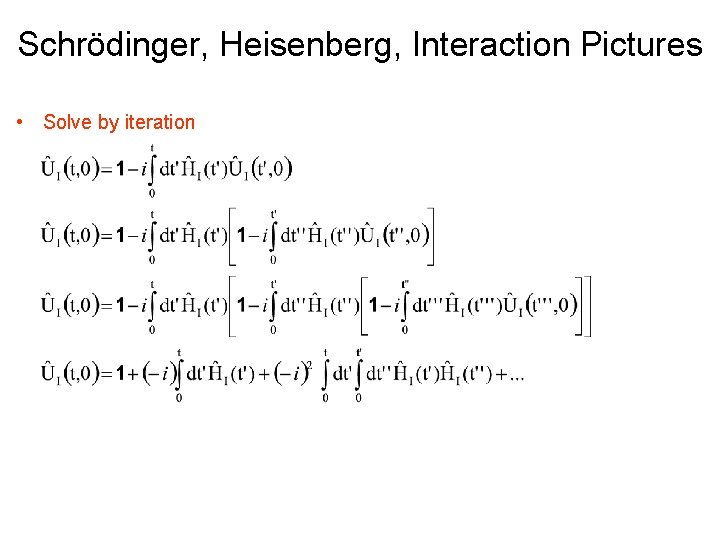
Schrödinger, Heisenberg, Interaction Pictures • Solve by iteration
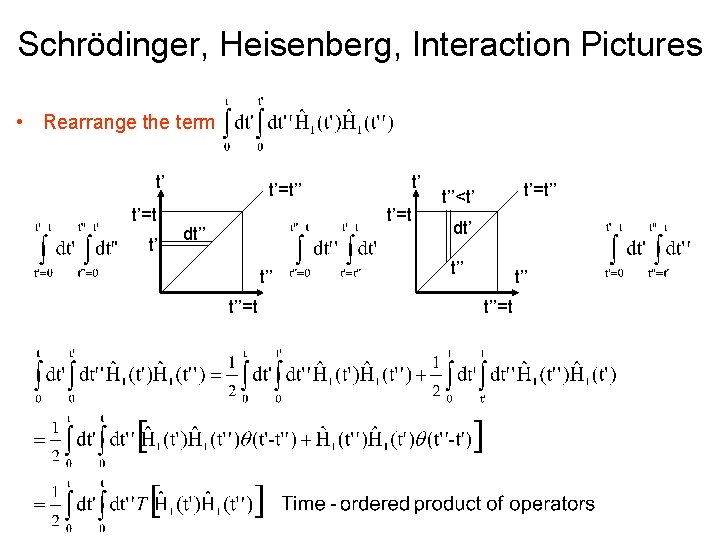
Schrödinger, Heisenberg, Interaction Pictures • Rearrange the term t’ t’=t’’ t’ t’=t dt’’ t’’=t t’=t’’ t’’<t’ dt’ t’’ t’’=t
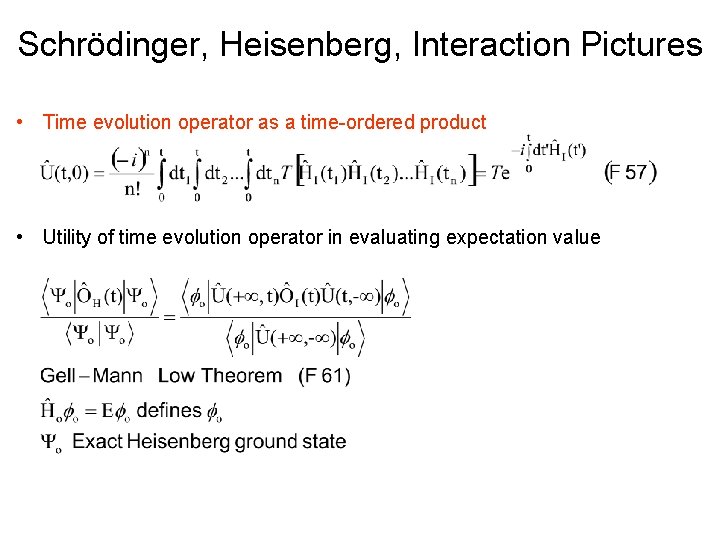
Schrödinger, Heisenberg, Interaction Pictures • Time evolution operator as a time-ordered product • Utility of time evolution operator in evaluating expectation value
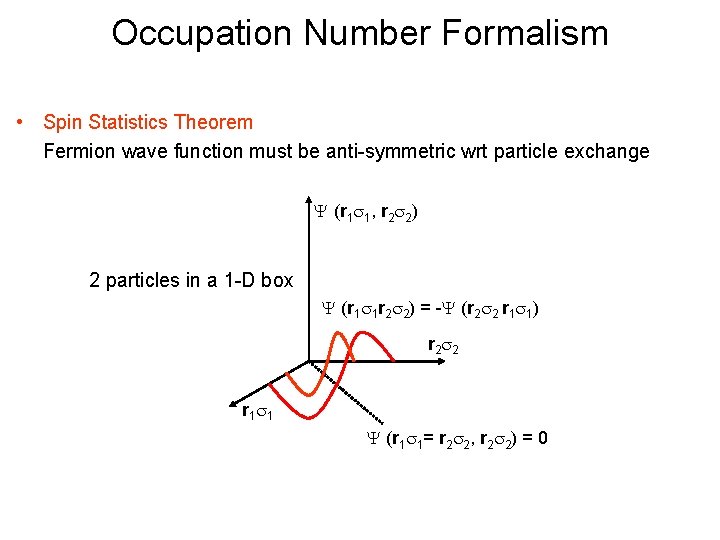
Occupation Number Formalism • Spin Statistics Theorem Fermion wave function must be anti-symmetric wrt particle exchange Y (r 1 s 1, r 2 s 2) 2 particles in a 1 -D box Y (r 1 s 1 r 2 s 2) = -Y (r 2 s 2 r 1 s 1) r 2 s 2 r 1 s 1 Y (r 1 s 1= r 2 s 2, r 2 s 2) = 0
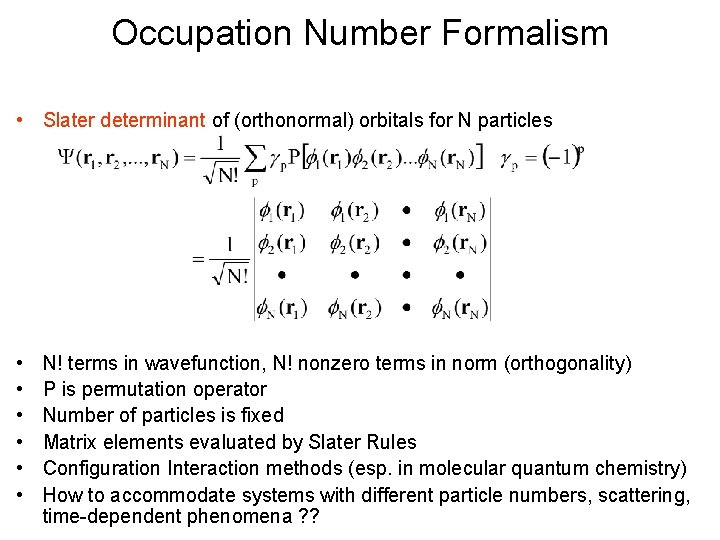
Occupation Number Formalism • Slater determinant of (orthonormal) orbitals for N particles • • • N! terms in wavefunction, N! nonzero terms in norm (orthogonality) P is permutation operator Number of particles is fixed Matrix elements evaluated by Slater Rules Configuration Interaction methods (esp. in molecular quantum chemistry) How to accommodate systems with different particle numbers, scattering, time-dependent phenomena ? ?
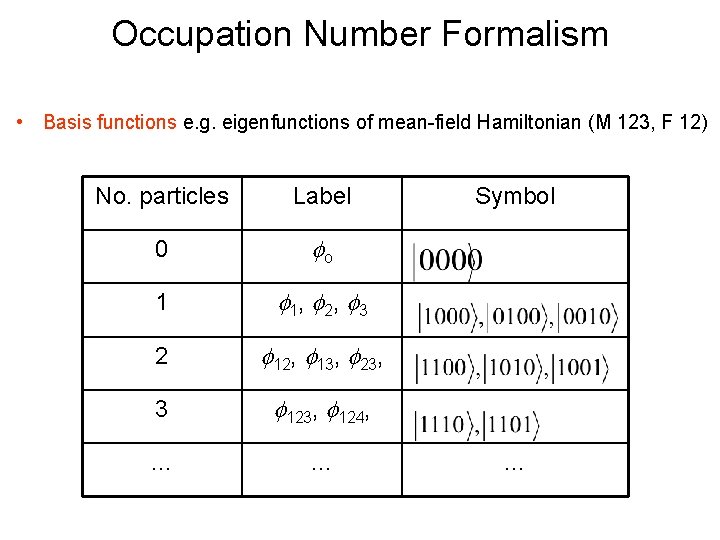
Occupation Number Formalism • Basis functions e. g. eigenfunctions of mean-field Hamiltonian (M 123, F 12) No. particles Label 0 fo 1 f 1, f 2, f 3 2 f 12, f 13, f 23, 3 f 123, f 124, … … Symbol …

Occupation Number Formalism • Fermion Creation and Annihilation Operators • Boson Creation and Annihilation Operators • Fermion example
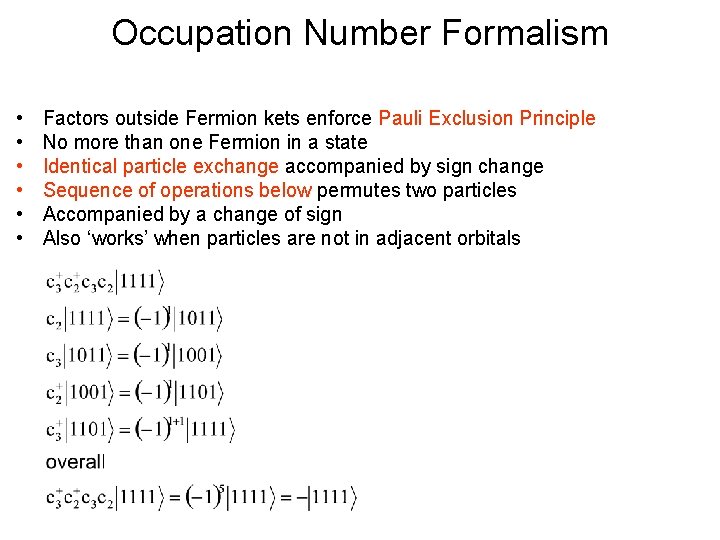
Occupation Number Formalism • • • Factors outside Fermion kets enforce Pauli Exclusion Principle No more than one Fermion in a state Identical particle exchange accompanied by sign change Sequence of operations below permutes two particles Accompanied by a change of sign Also ‘works’ when particles are not in adjacent orbitals
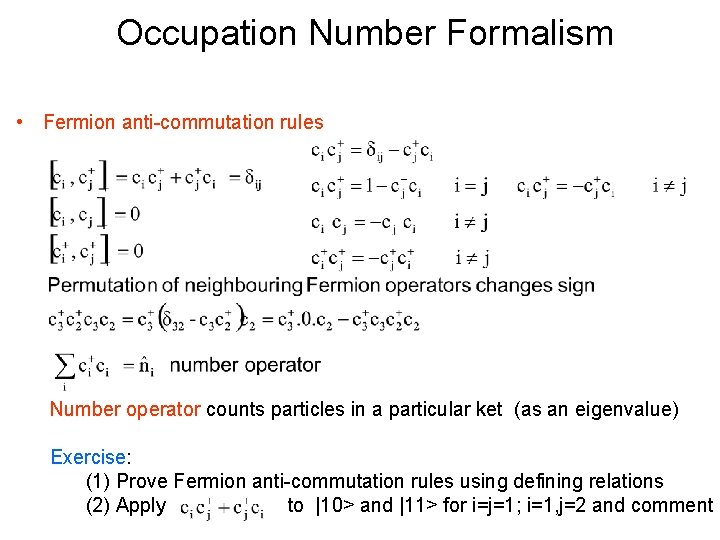
Occupation Number Formalism • Fermion anti-commutation rules Number operator counts particles in a particular ket (as an eigenvalue) Exercise: (1) Prove Fermion anti-commutation rules using defining relations (2) Apply to |10> and |11> for i=j=1; i=1, j=2 and comment
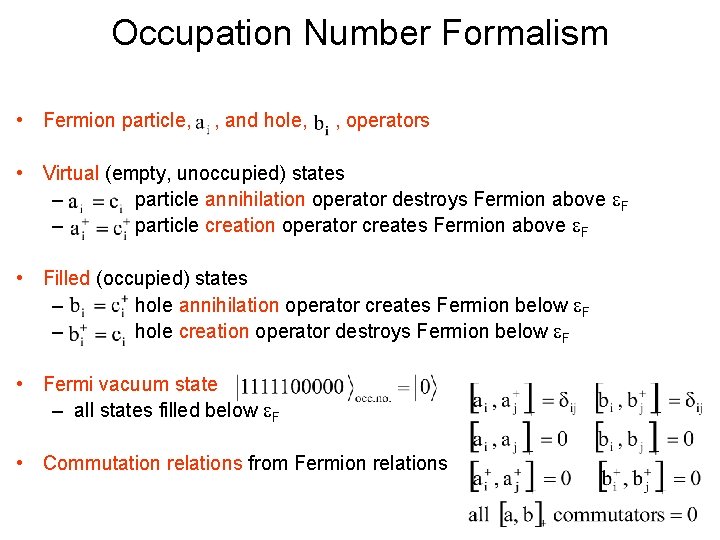
Occupation Number Formalism • Fermion particle, , and hole, , operators • Virtual (empty, unoccupied) states – particle annihilation operator destroys Fermion above e. F – particle creation operator creates Fermion above e. F • Filled (occupied) states – hole annihilation operator creates Fermion below e. F – hole creation operator destroys Fermion below e. F • Fermi vacuum state – all states filled below e. F • Commutation relations from Fermion relations
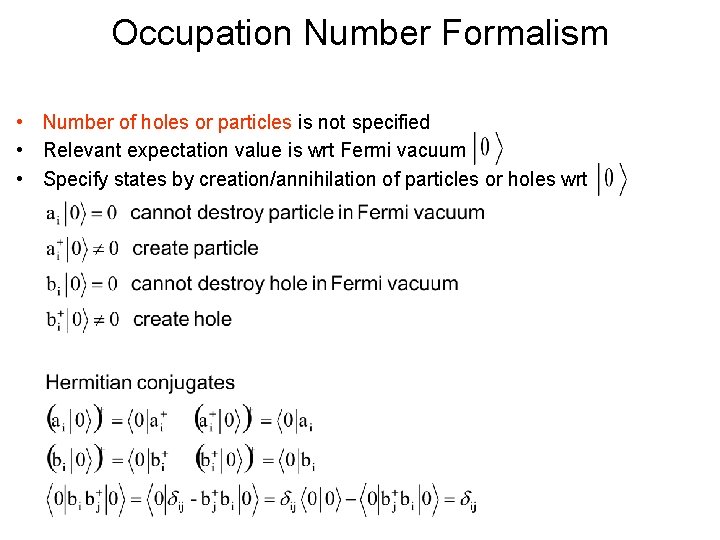
Occupation Number Formalism • Number of holes or particles is not specified • Relevant expectation value is wrt Fermi vacuum • Specify states by creation/annihilation of particles or holes wrt
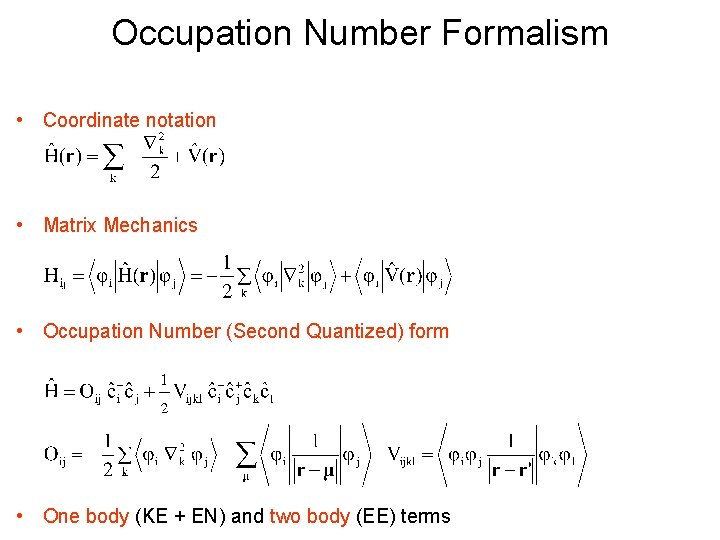
Occupation Number Formalism • Coordinate notation • Matrix Mechanics • Occupation Number (Second Quantized) form • One body (KE + EN) and two body (EE) terms
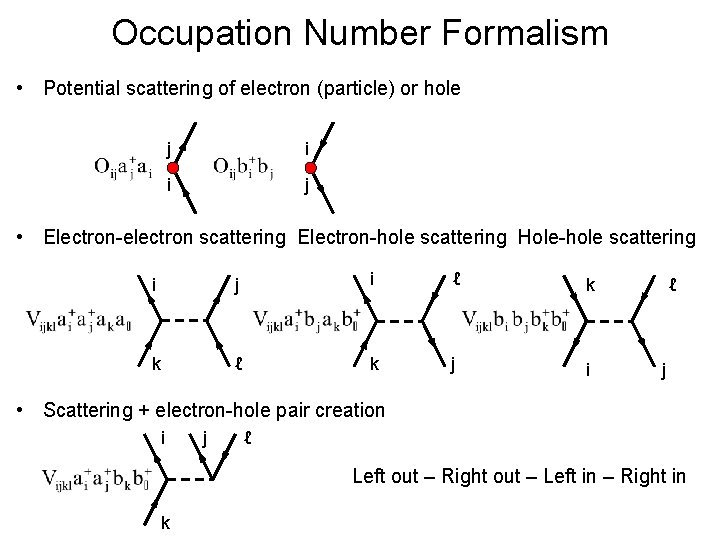
Occupation Number Formalism • Potential scattering of electron (particle) or hole j i i j • Electron-electron scattering Electron-hole scattering Hole-hole scattering i j i ℓ k k ℓ k j i ℓ j • Scattering + electron-hole pair creation i j ℓ Left out – Right out – Left in – Right in k
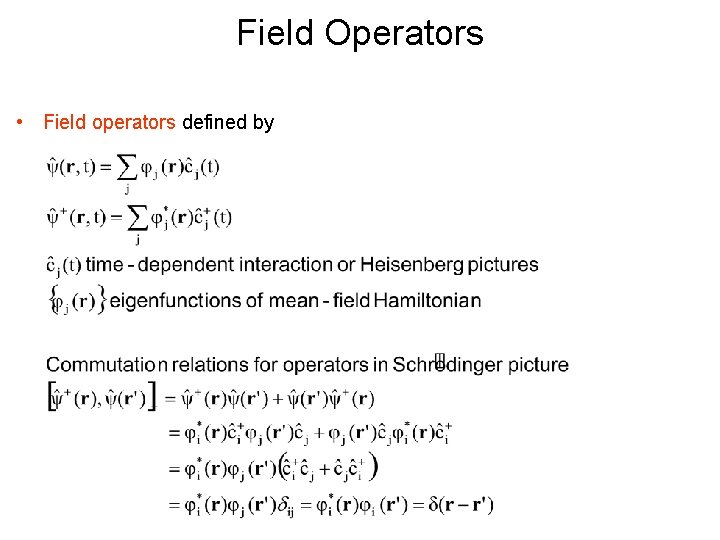
Field Operators • Field operators defined by
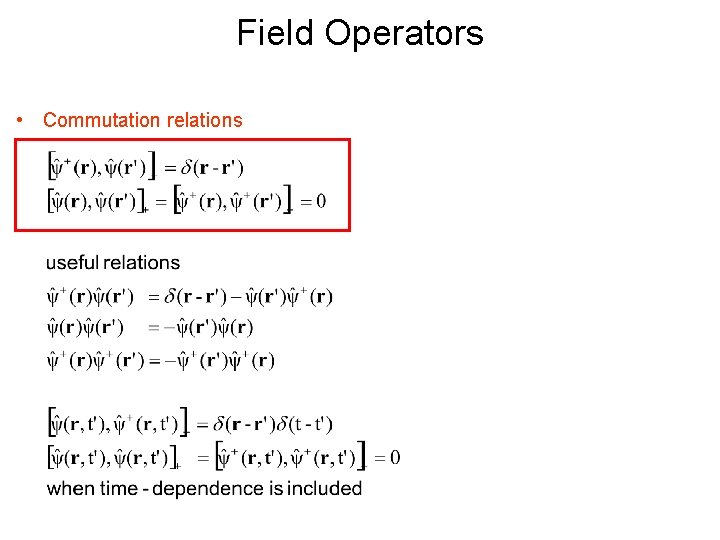
Field Operators • Commutation relations
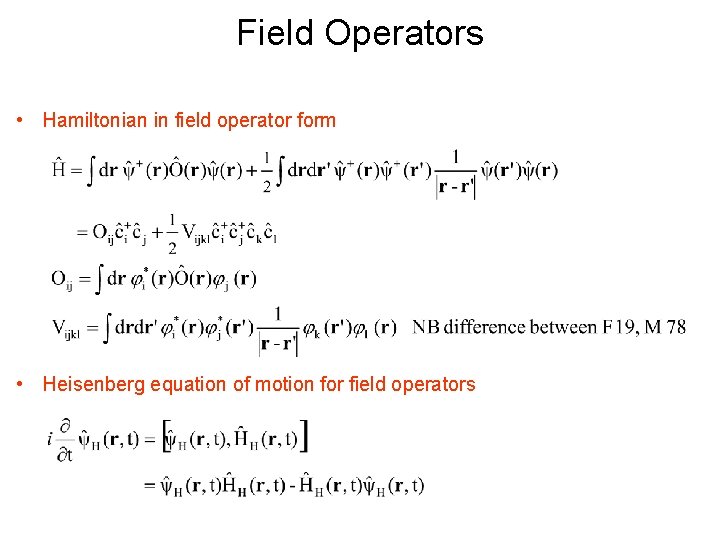
Field Operators • Hamiltonian in field operator form • Heisenberg equation of motion for field operators
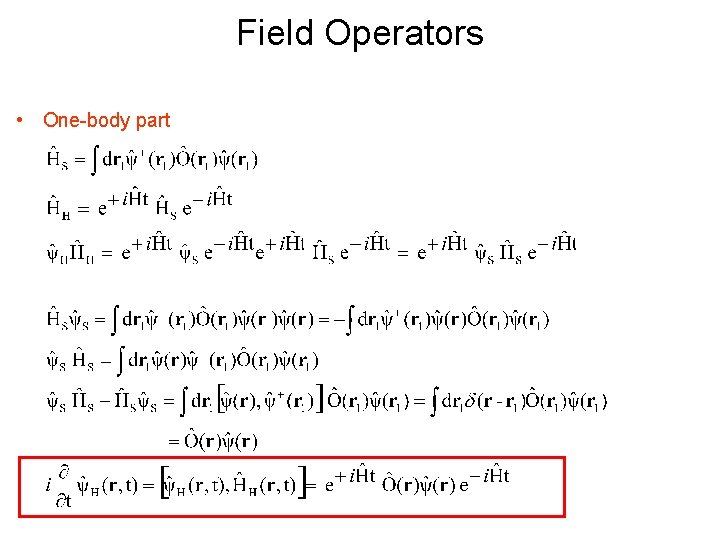
Field Operators • One-body part
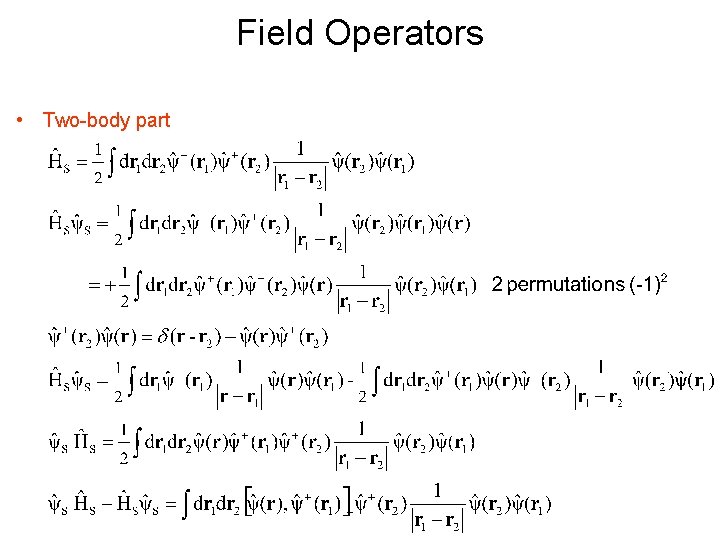
Field Operators • Two-body part
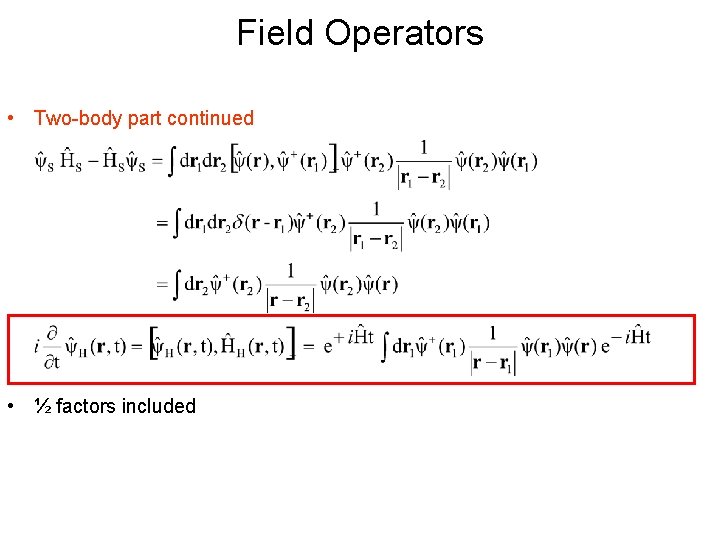
Field Operators • Two-body part continued • ½ factors included
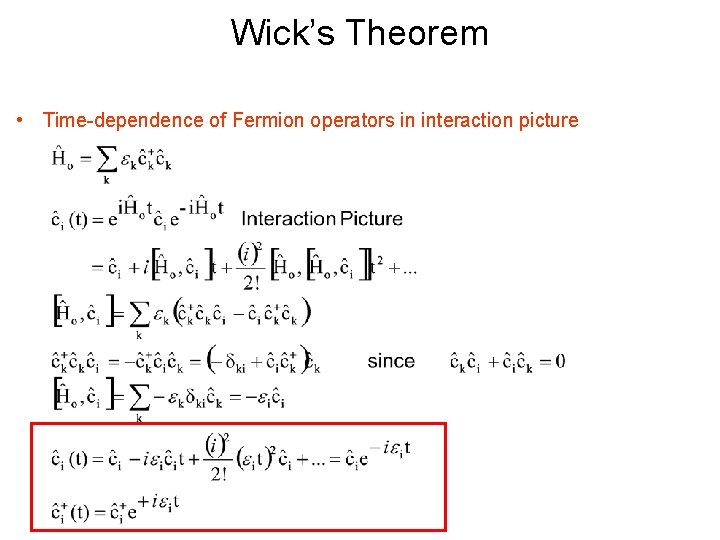
Wick’s Theorem • Time-dependence of Fermion operators in interaction picture
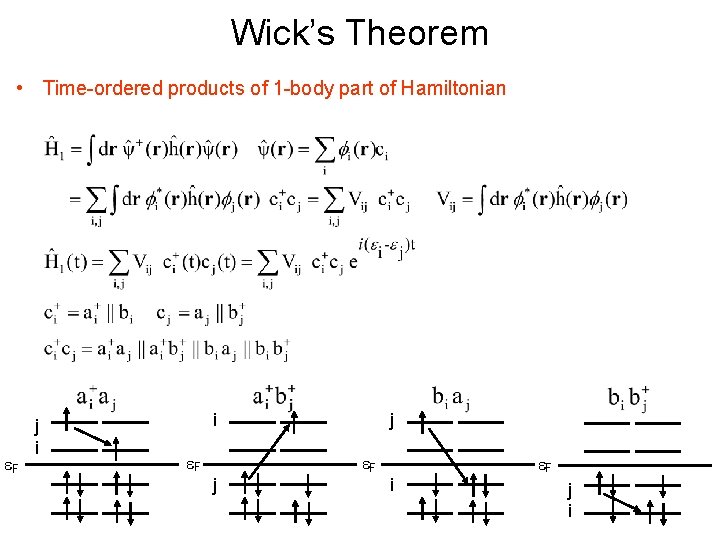
Wick’s Theorem • Time-ordered products of 1 -body part of Hamiltonian e. F j i i e. F j i
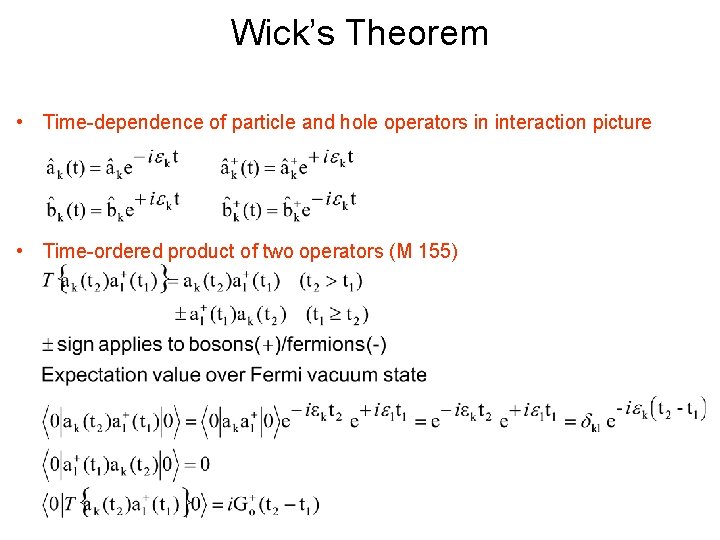
Wick’s Theorem • Time-dependence of particle and hole operators in interaction picture • Time-ordered product of two operators (M 155)
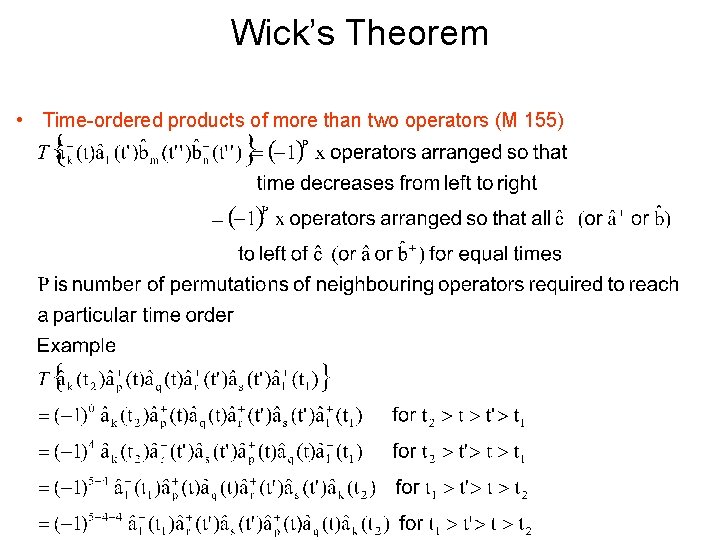
Wick’s Theorem • Time-ordered products of more than two operators (M 155)
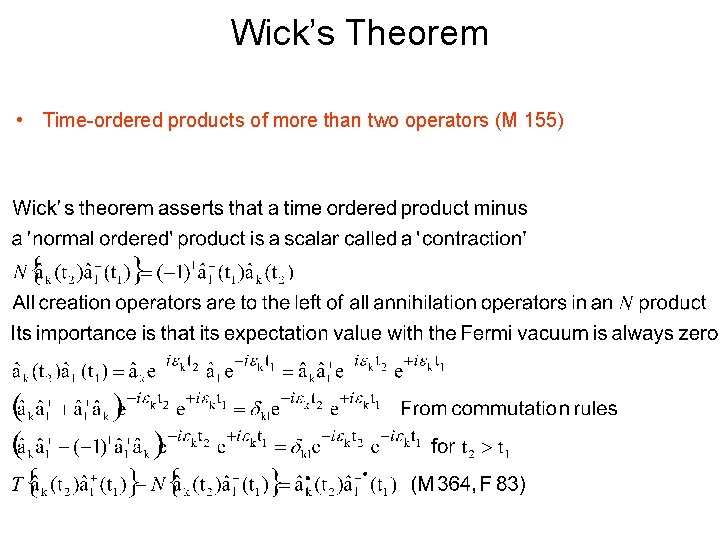
Wick’s Theorem • Time-ordered products of more than two operators (M 155)
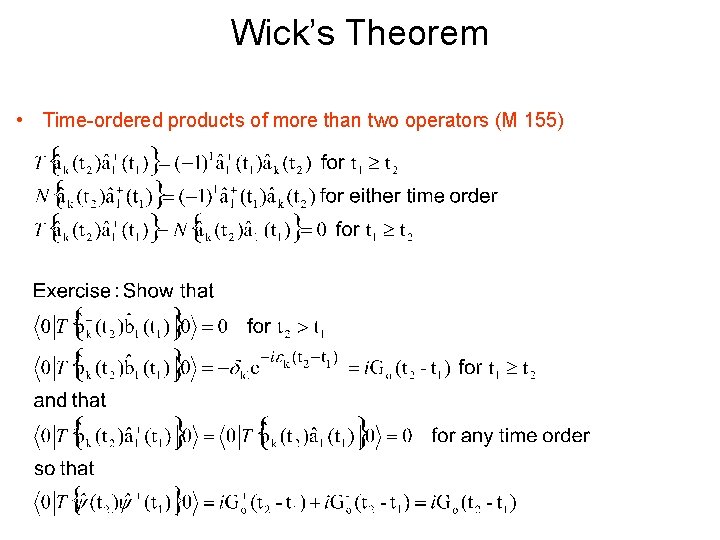
Wick’s Theorem • Time-ordered products of more than two operators (M 155)
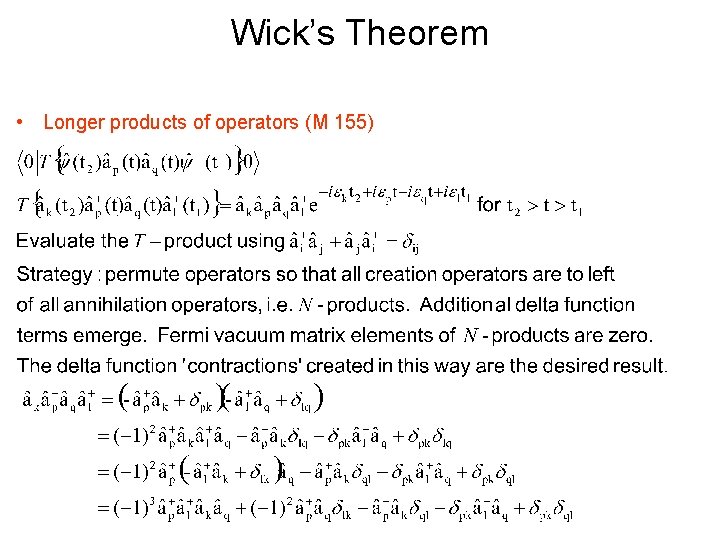
Wick’s Theorem • Longer products of operators (M 155)
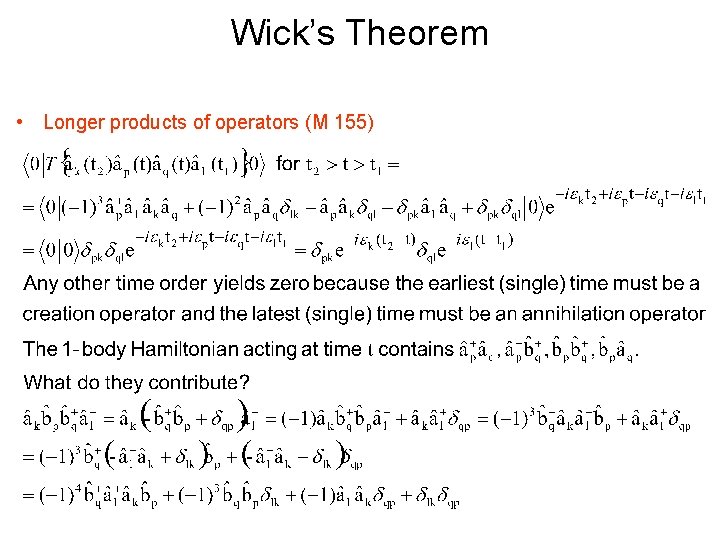
Wick’s Theorem • Longer products of operators (M 155)
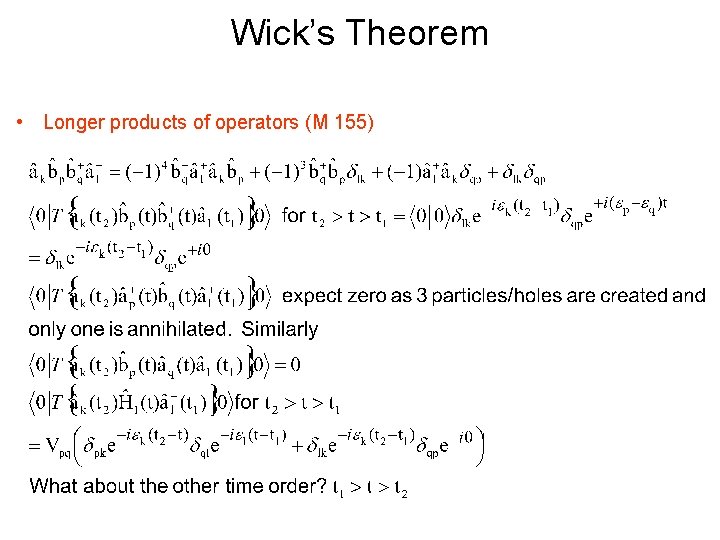
Wick’s Theorem • Longer products of operators (M 155)
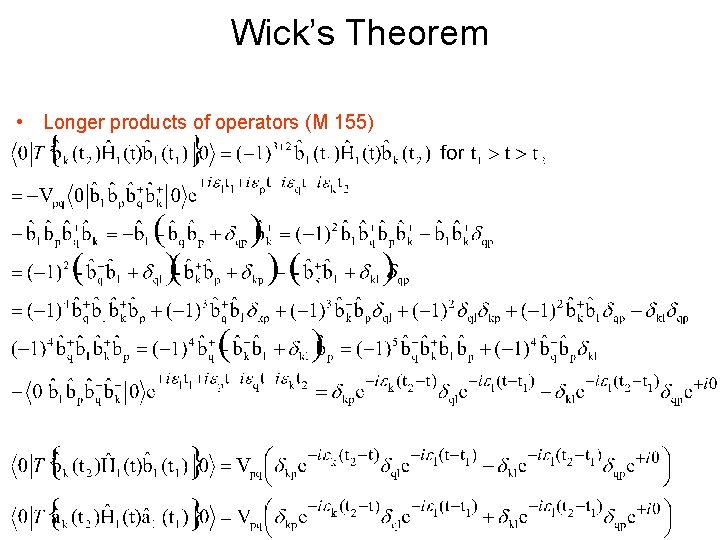
Wick’s Theorem • Longer products of operators (M 155)
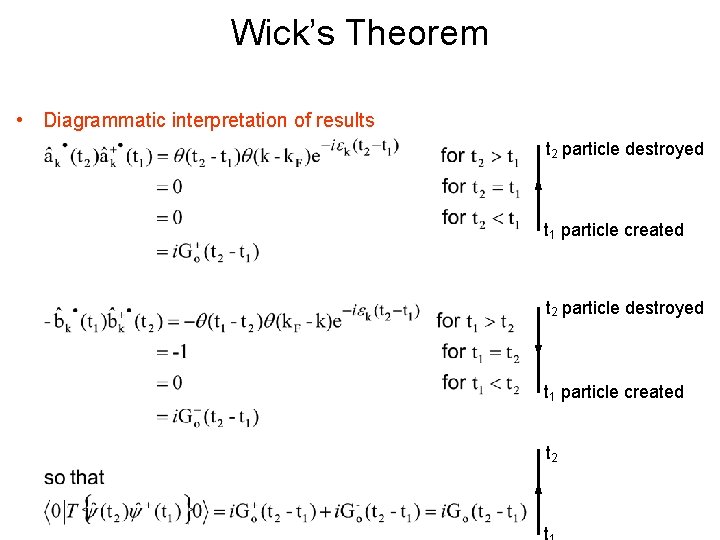
Wick’s Theorem • Diagrammatic interpretation of results t 2 particle destroyed t 1 particle created t 2
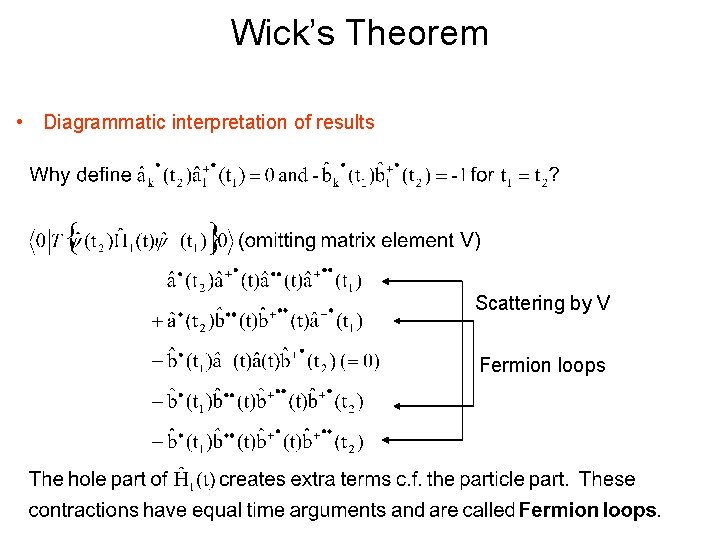
Wick’s Theorem • Diagrammatic interpretation of results Scattering by V Fermion loops
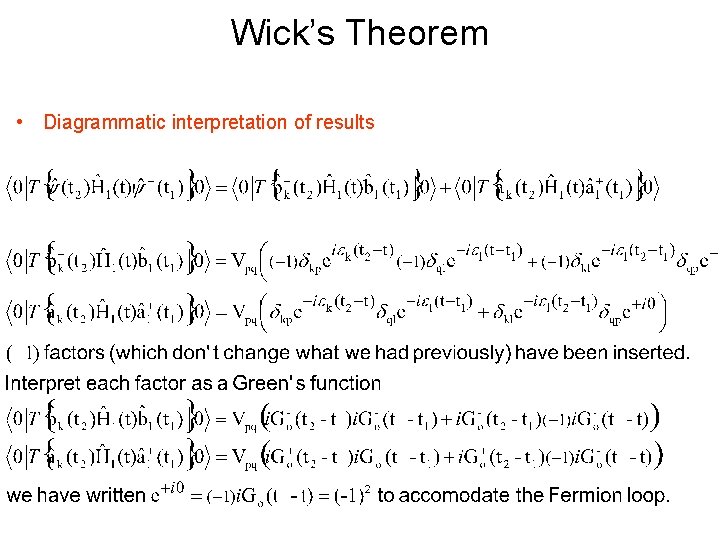
Wick’s Theorem • Diagrammatic interpretation of results
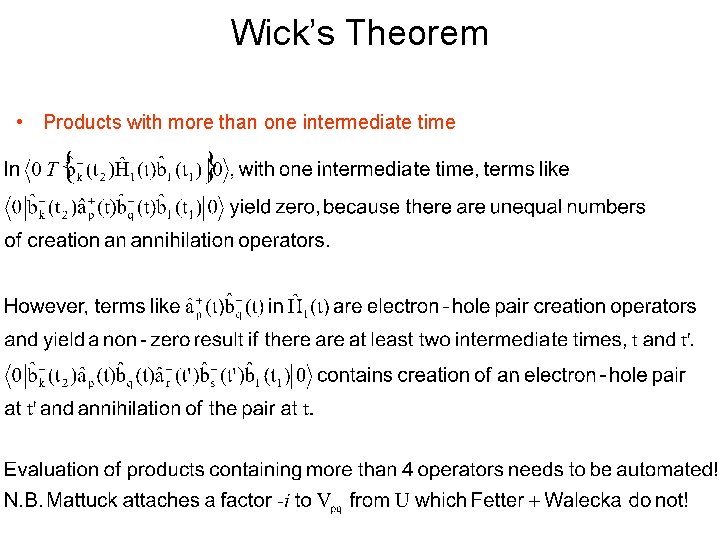
Wick’s Theorem • Products with more than one intermediate time
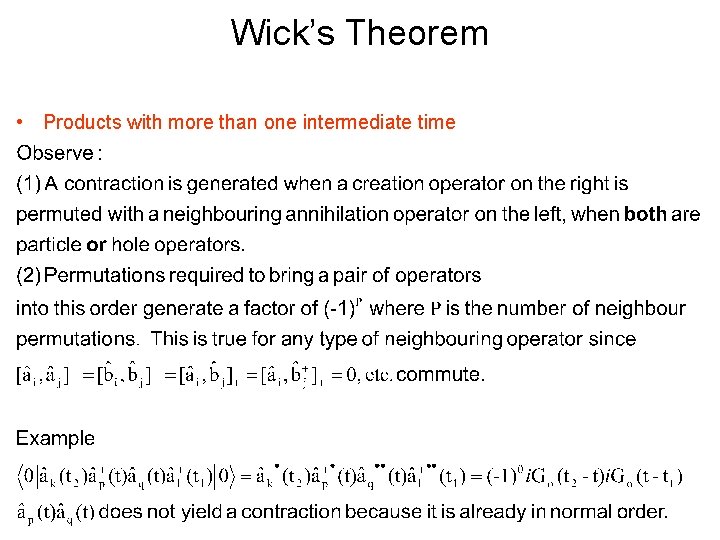
Wick’s Theorem • Products with more than one intermediate time
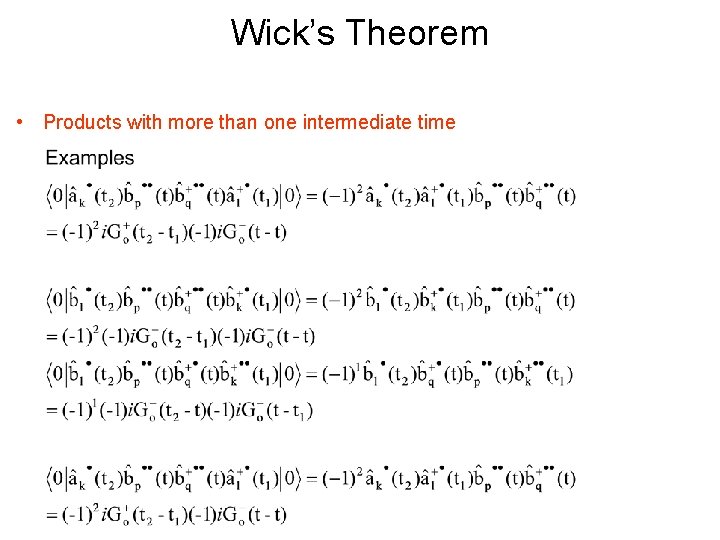
Wick’s Theorem • Products with more than one intermediate time

Wick’s Theorem • Normal ordered product of operators (M 364, F 83) • Contraction (contracted product) of operators
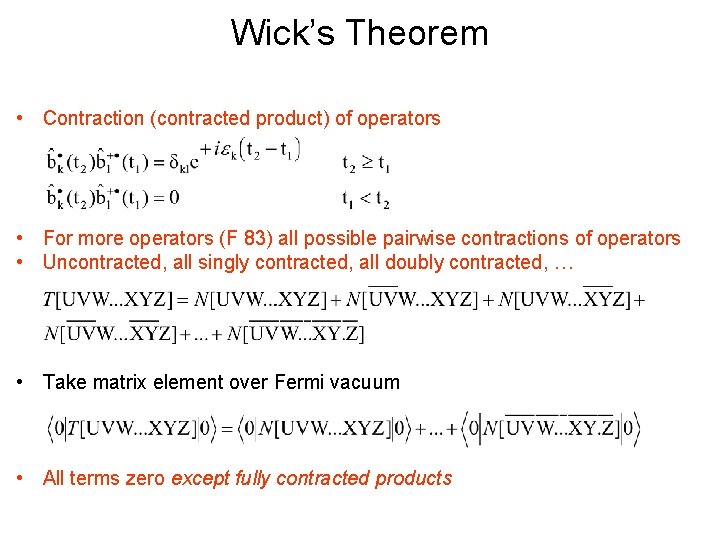
Wick’s Theorem • Contraction (contracted product) of operators • For more operators (F 83) all possible pairwise contractions of operators • Uncontracted, all singly contracted, all doubly contracted, … • Take matrix element over Fermi vacuum • All terms zero except fully contracted products
- Slides: 43