
Schottky barriers and Organic semiconductors Hubert Nguyen Physics
Schottky barriers and Organic semiconductors Hubert Nguyen Physics 211 A December 10, 2007
Overview • Electronic structure • Organic molecular beam deposition (OMBD) • Transport properties • Interface effects
Electronic structure I
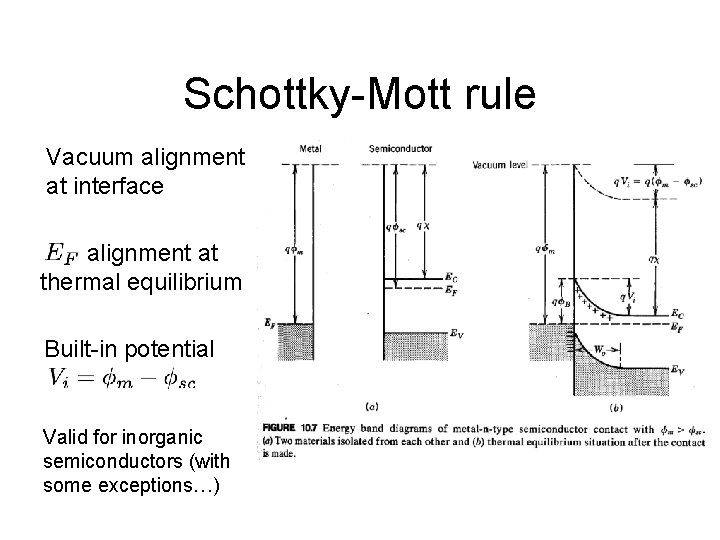
Schottky-Mott rule Vacuum alignment at interface alignment at thermal equilibrium Built-in potential Valid for inorganic semiconductors (with some exceptions…)
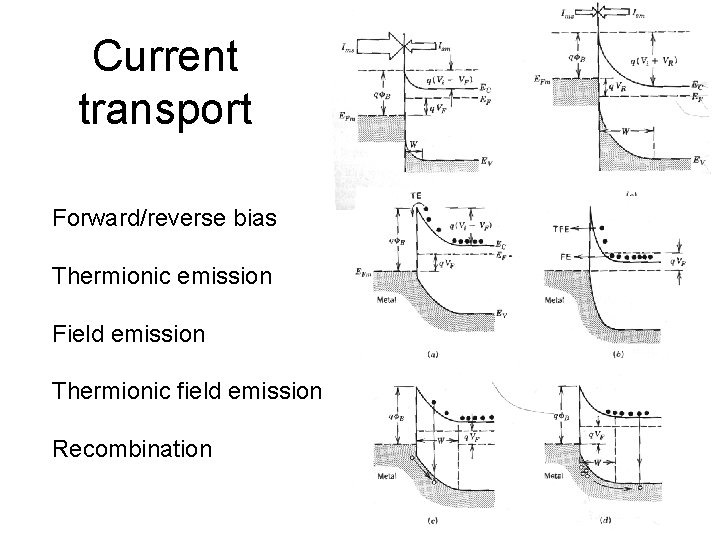
Current transport Forward/reverse bias Thermionic emission Field emission Thermionic field emission Recombination
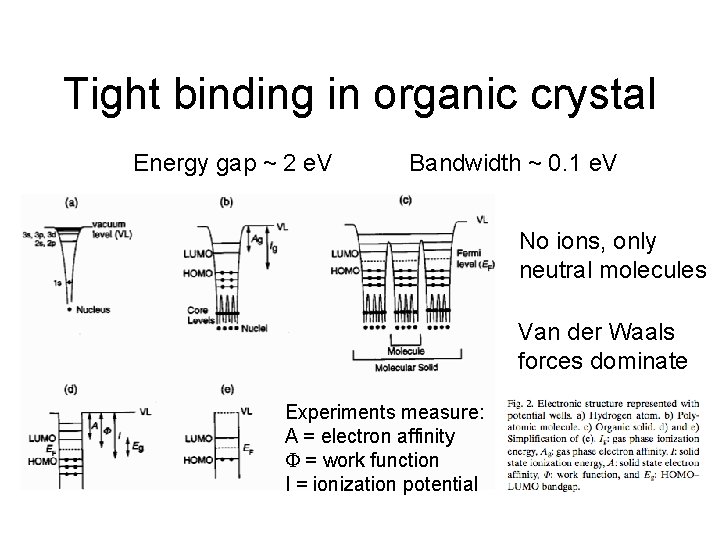
Tight binding in organic crystal Energy gap ~ 2 e. V Bandwidth ~ 0. 1 e. V No ions, only neutral molecules Van der Waals forces dominate Experiments measure: A = electron affinity = work function I = ionization potential
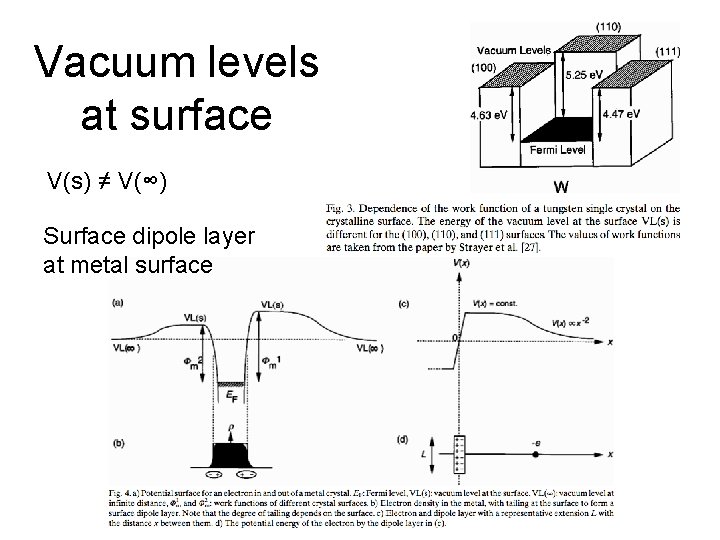
Vacuum levels at surface V(s) ≠ V(∞) Surface dipole layer at metal surface
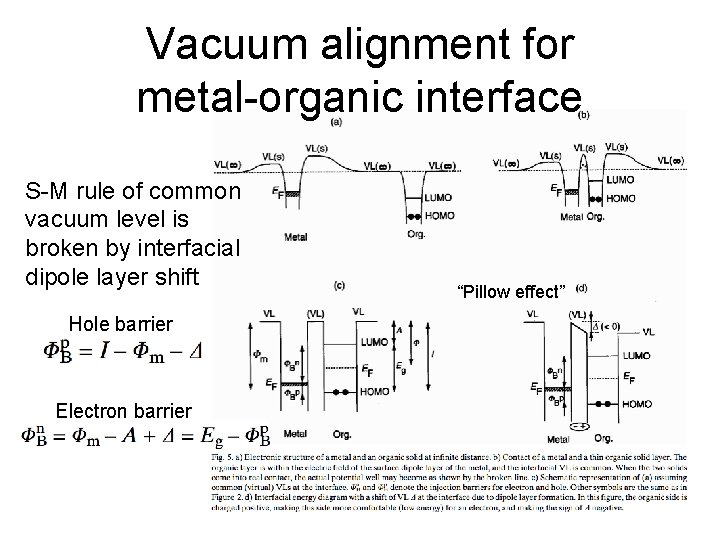
Vacuum alignment for metal-organic interface S-M rule of common vacuum level is broken by interfacial dipole layer shift Hole barrier Electron barrier “Pillow effect”
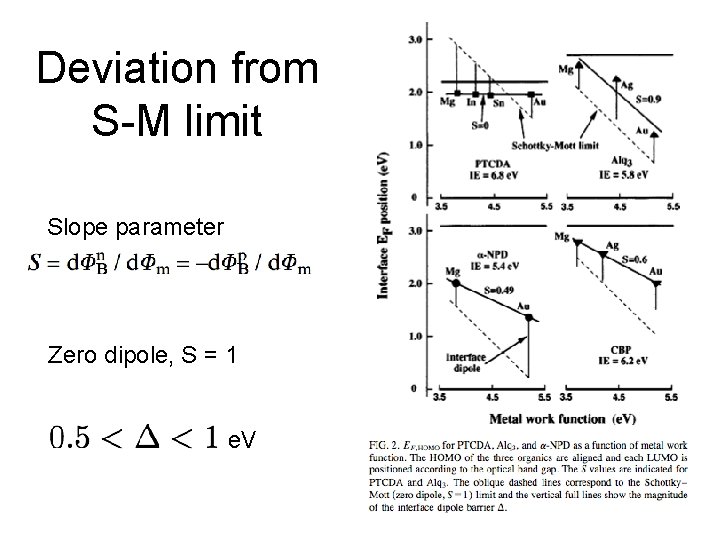
Deviation from S-M limit Slope parameter Zero dipole, S = 1 e. V
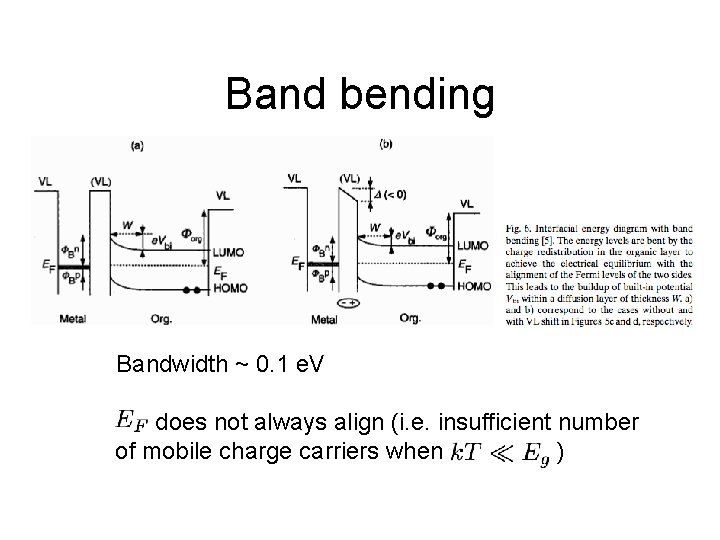
Band bending Bandwidth ~ 0. 1 e. V does not always align (i. e. insufficient number of mobile charge carriers when )
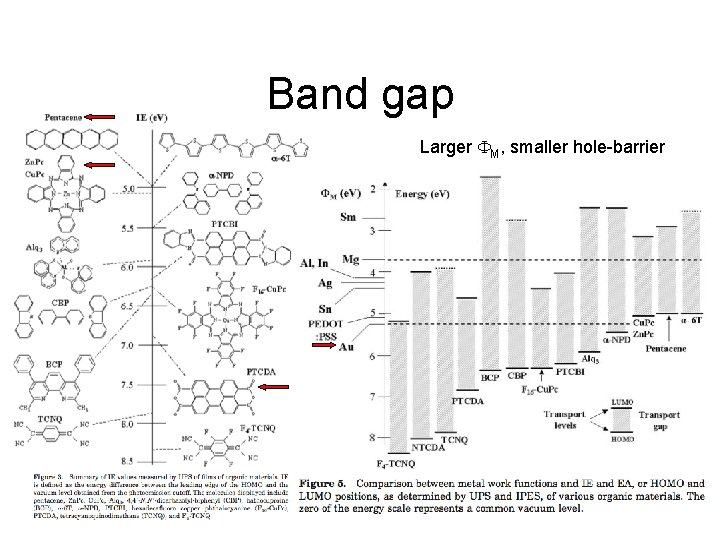
Band gap Larger M, smaller hole-barrier
Organic molecular beam deposition (OMBD) II
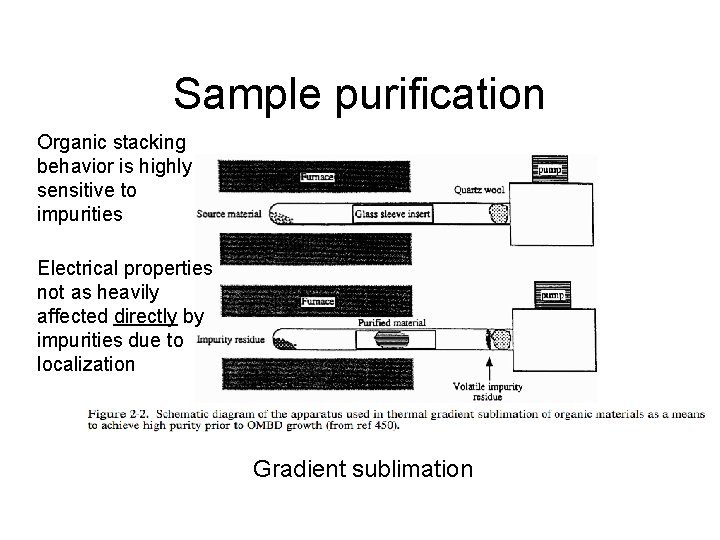
Sample purification Organic stacking behavior is highly sensitive to impurities Electrical properties not as heavily affected directly by impurities due to localization Gradient sublimation
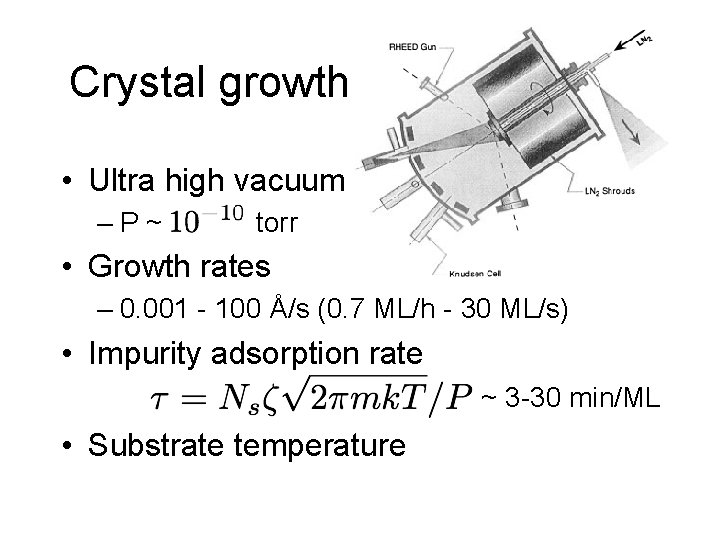
Crystal growth • Ultra high vacuum –P~ torr • Growth rates – 0. 001 - 100 Å/s (0. 7 ML/h - 30 ML/s) • Impurity adsorption rate ~ 3 -30 min/ML • Substrate temperature
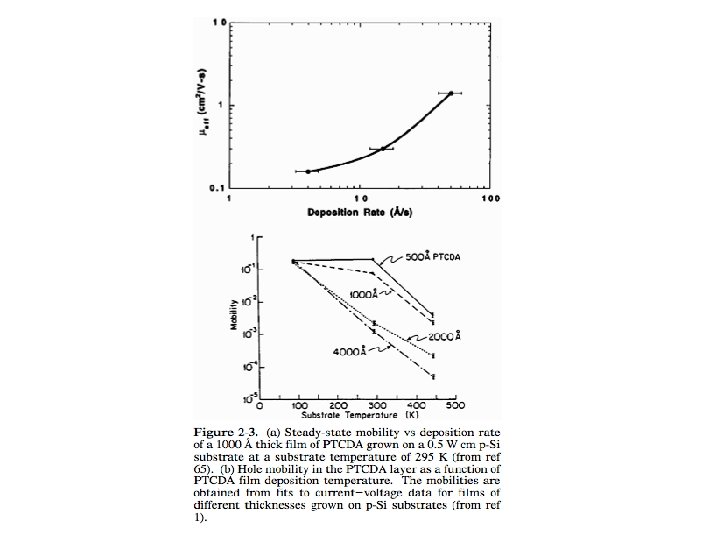
Depo rate
Growth modes • Inorganic – Strong interatomic covalent bonding (cohesion) • 100 - 5000 me. V/atom – Close lattice matching required • 1 -1 commensurate relationship • Organic – Weak van der Waals (vd. W) interaction • 1 -10 me. V/atom; but ~1000 me. V/molecule – Lattice matching requirement relaxed – Higher tolerance for interface-adlayer strain – Growth determined by substrate rather than bulk
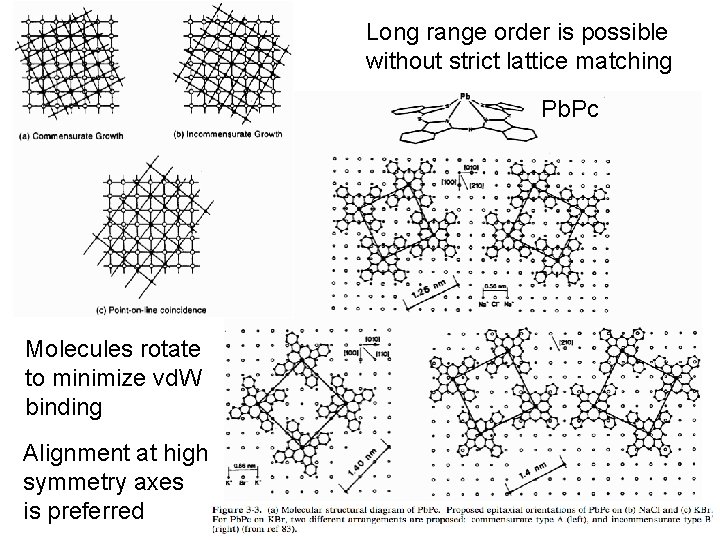
Long range order is possible without strict lattice matching Pb. Pc Molecules rotate to minimize vd. W binding Alignment at high symmetry axes is preferred
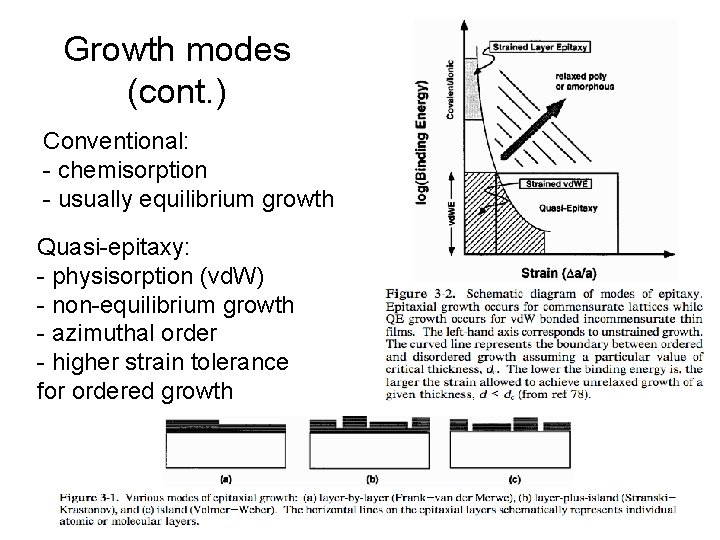
Growth modes (cont. ) Conventional: - chemisorption - usually equilibrium growth Quasi-epitaxy: - physisorption (vd. W) - non-equilibrium growth - azimuthal order - higher strain tolerance for ordered growth
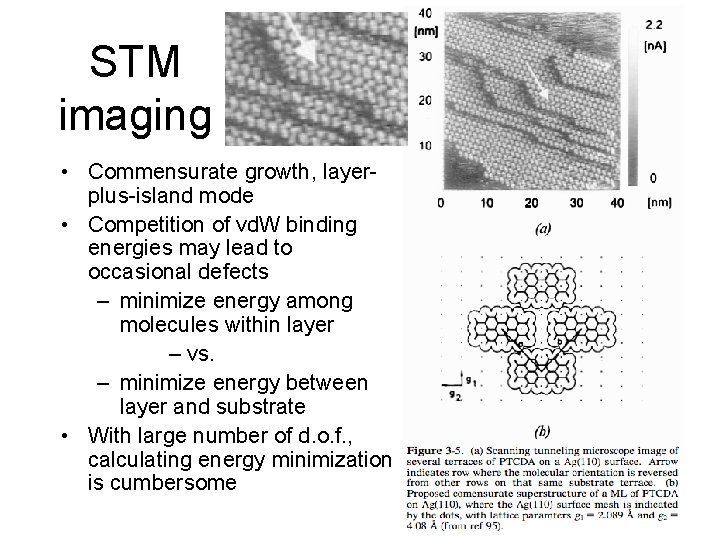
STM imaging • Commensurate growth, layerplus-island mode • Competition of vd. W binding energies may lead to occasional defects – minimize energy among molecules within layer – vs. – minimize energy between layer and substrate • With large number of d. o. f. , calculating energy minimization is cumbersome
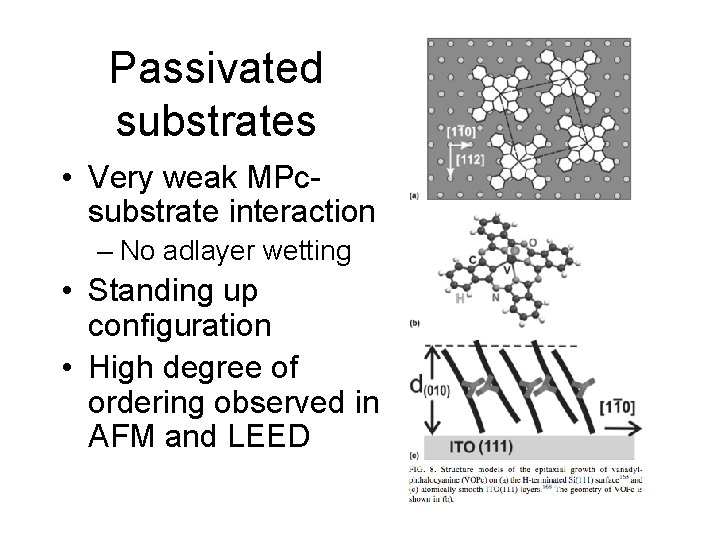
Passivated substrates • Very weak MPcsubstrate interaction – No adlayer wetting • Standing up configuration • High degree of ordering observed in AFM and LEED
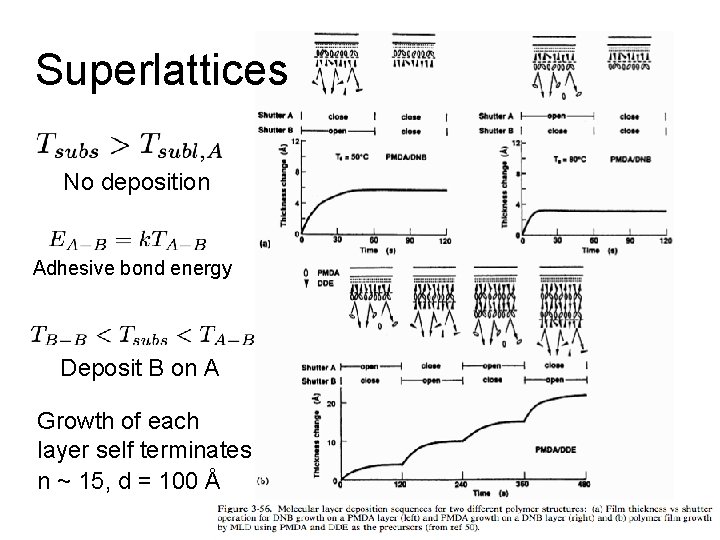
Superlattices No deposition Adhesive bond energy Deposit B on A Growth of each layer self terminates n ~ 15, d = 100 Å
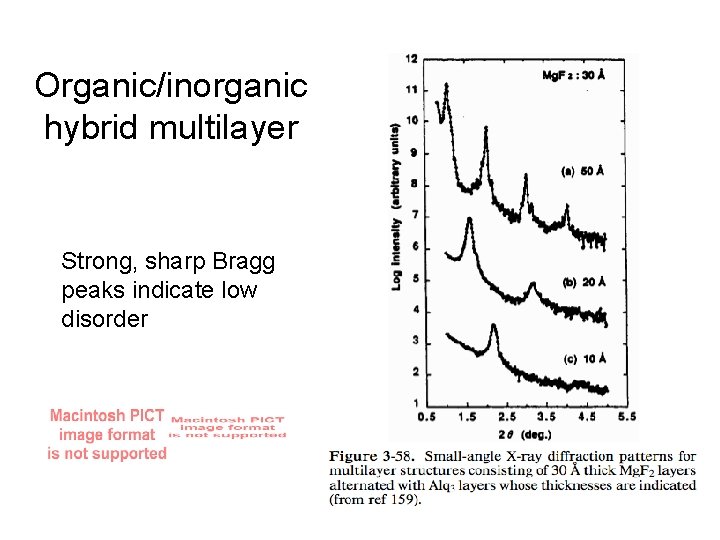
Organic/inorganic hybrid multilayer Strong, sharp Bragg peaks indicate low disorder
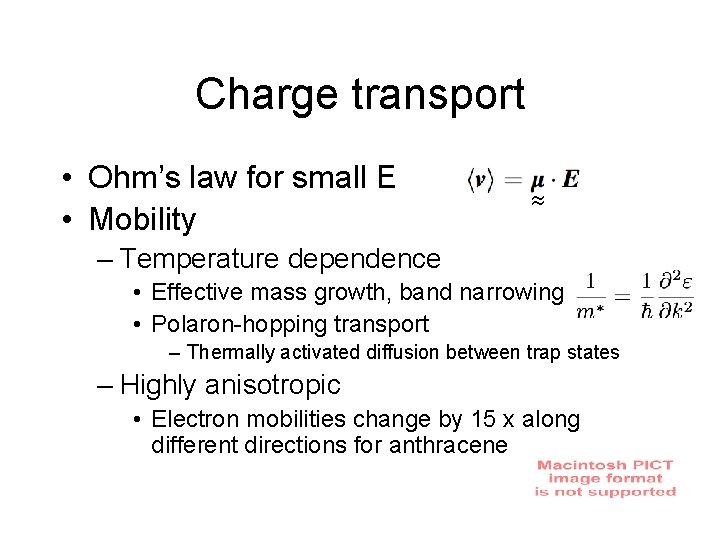
Charge transport • Ohm’s law for small E • Mobility – Temperature dependence • Effective mass growth, band narrowing • Polaron-hopping transport – Thermally activated diffusion between trap states – Highly anisotropic • Electron mobilities change by 15 x along different directions for anthracene
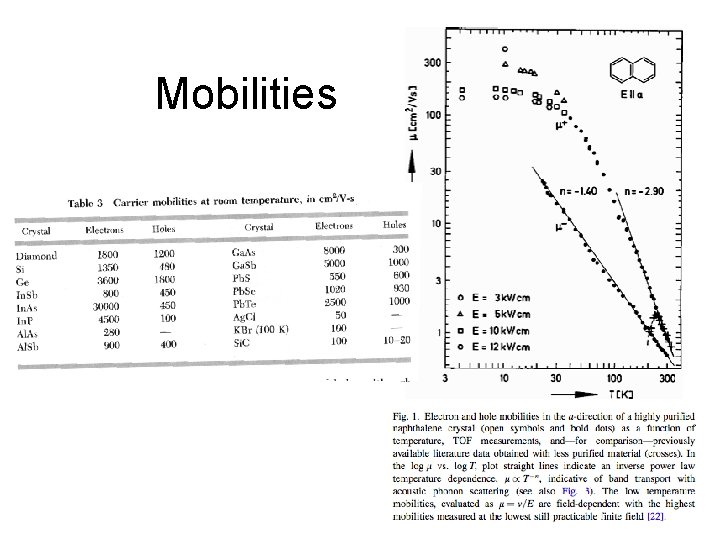
Mobilities
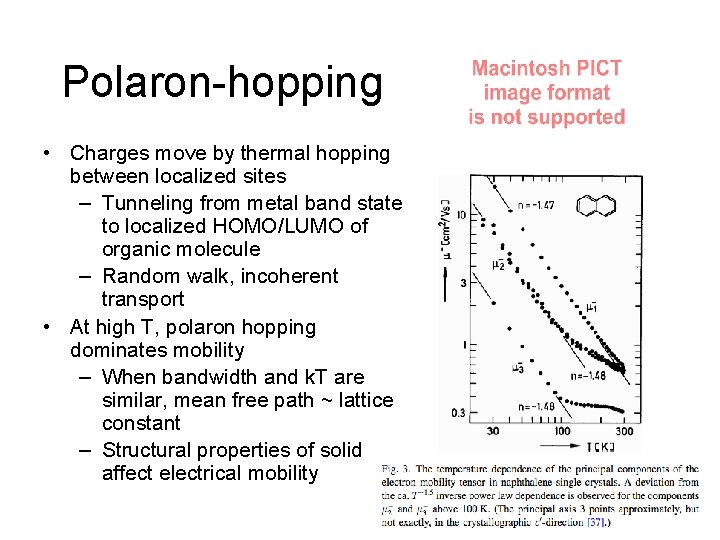
Polaron-hopping • Charges move by thermal hopping between localized sites – Tunneling from metal band state to localized HOMO/LUMO of organic molecule – Random walk, incoherent transport • At high T, polaron hopping dominates mobility – When bandwidth and k. T are similar, mean free path ~ lattice constant – Structural properties of solid affect electrical mobility
Conclusion • Organic semiconductors
- Slides: 26