
SchoolWide Positive Behavioral Interventions and Supports SWPBIS Northeast
School-Wide Positive Behavioral Interventions and Supports (SWPBIS) Northeast PBIS (NEPBIS) School-Wide Team Training Day 1 INSERT TRAINER NAMES with support from Brandi Simonsen, Jen Freeman, Susannah Everett, & George Sugai
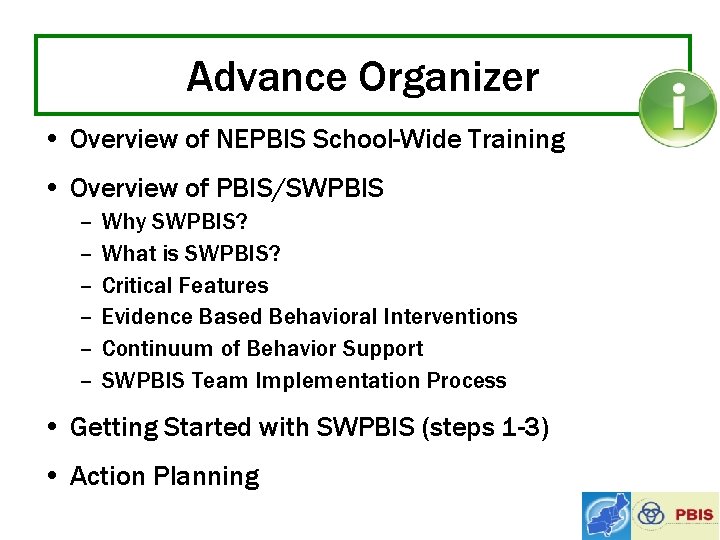
Advance Organizer • Overview of NEPBIS School-Wide Training • Overview of PBIS/SWPBIS – – – Why SWPBIS? What is SWPBIS? Critical Features Evidence Based Behavioral Interventions Continuum of Behavior Support SWPBIS Team Implementation Process • Getting Started with SWPBIS (steps 1 -3) • Action Planning
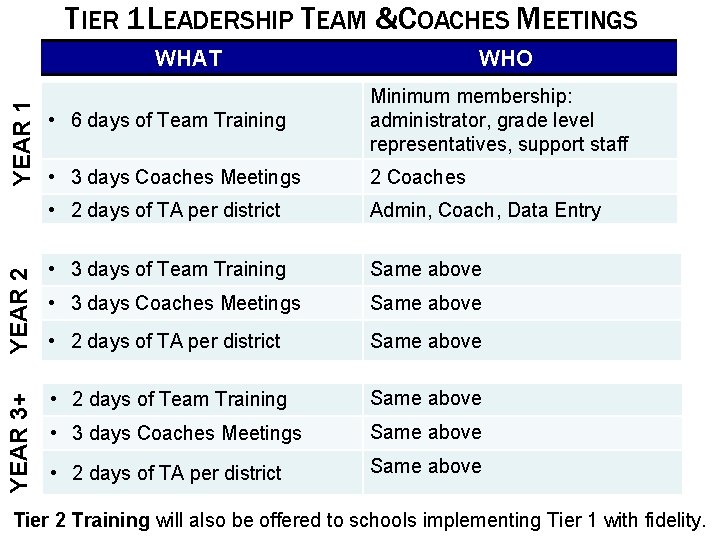
TIER 1 LEADERSHIP TEAM &COACHES MEETINGS • 3 days Coaches Meetings 2 Coaches • 2 days of TA per district Admin, Coach, Data Entry • 3 days of Team Training Same above • 3 days Coaches Meetings Same above • 2 days of TA per district Same above • 2 days of Team Training Same above • 3 days Coaches Meetings Same above • 2 days of TA per district Same above YEAR 1 • 6 days of Team Training Minimum membership: administrator, grade level representatives, support staff YEAR 2 WHO YEAR 3+ WHAT Tier 2 Training will also be offered to schools implementing Tier 1 with fidelity.
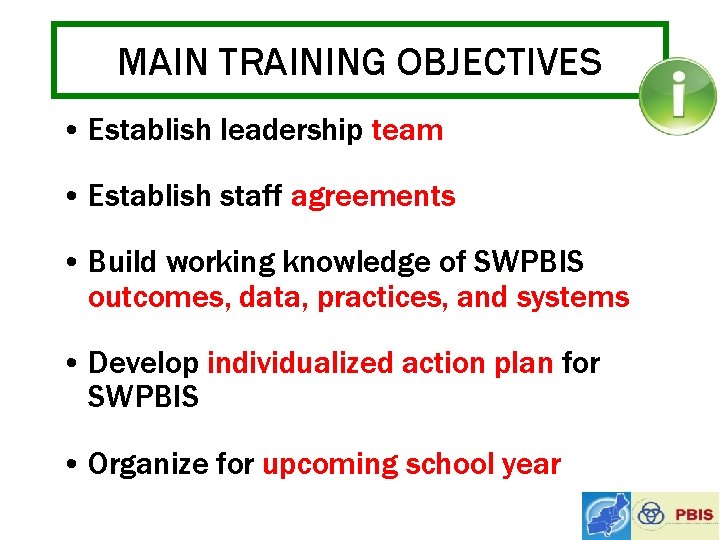
MAIN TRAINING OBJECTIVES • Establish leadership team • Establish staff agreements • Build working knowledge of SWPBIS outcomes, data, practices, and systems • Develop individualized action plan for SWPBIS • Organize for upcoming school year
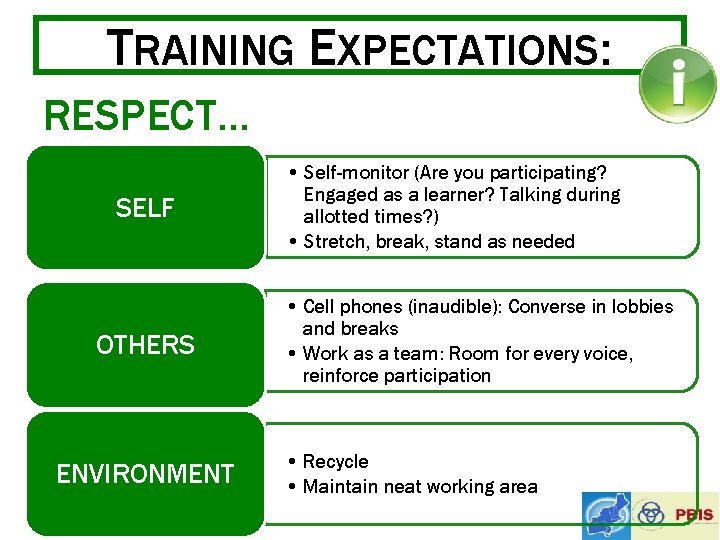
TRAINING EXPECTATIONS: RESPECT… SELF OTHERS ENVIRONMENT • Self-monitor (Are you participating? Engaged as a learner? Talking during allotted times? ) • Stretch, break, stand as needed • Cell phones (inaudible): Converse in lobbies and breaks • Work as a team: Room for every voice, reinforce participation • Recycle • Maintain neat working area
Tools! S I B P e d i d W n l a o o k Sch orkboo ces W pendi Ap

1. Overview of SWPBIS 2. Getting Started with SWPBIS 3. Non-classroom Settings 4. Classroom Settings 5. Building Behavioral Capacity
Tools! nepbis. org S I B P e d i d W n l a o o k Sch orkboo ces W pendi Ap
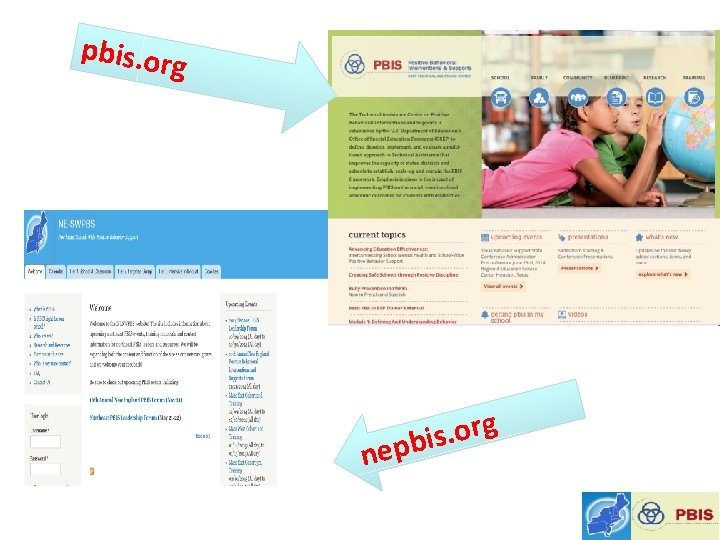
pbis. or g n g r o. s epbi
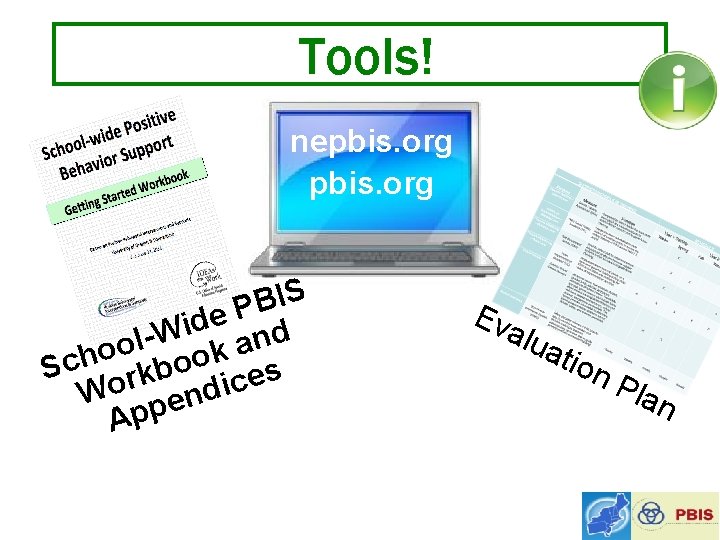
Tools! nepbis. org S I B P e d i d W n l a o o k Sch orkboo ces W pendi Ap Ev alu atio n P lan
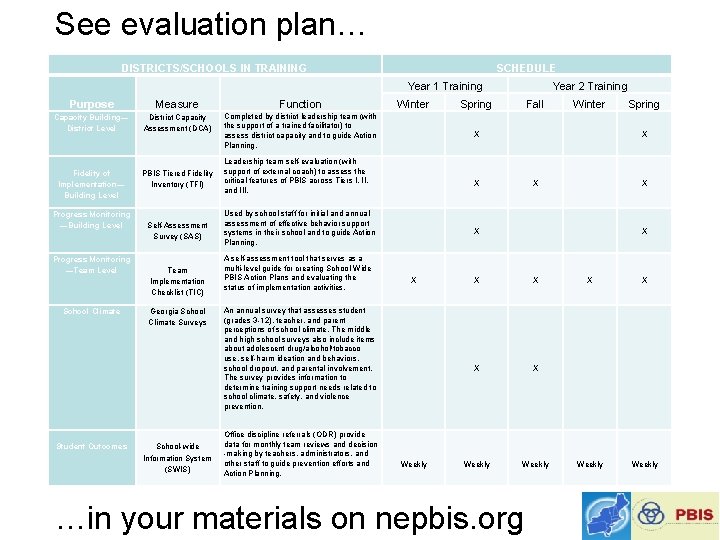
See evaluation plan… DISTRICTS/SCHOOLS IN TRAINING SCHEDULE Year 1 Training Year 2 Training Purpose Measure Function Winter Spring Fall Winter Spring Capacity Building— District Level District Capacity Assessment (DCA) Completed by district leadership team (with the support of a trained facilitator) to assess district capacity and to guide Action Planning. X X Fidelity of Implementation— Building Level PBIS Tiered Fidelity Inventory (TFI) Leadership team self-evaluation (with support of external coach) to assess the critical features of PBIS across Tiers I, II, and III. X X X Progress Monitoring —Building Level Self-Assessment Survey (SAS) Used by school staff for initial and annual assessment of effective behavior support systems in their school and to guide Action Planning. X X Progress Monitoring —Team Level Team Implementation Checklist (TIC) A self-assessment tool that serves as a multi-level guide for creating School-Wide PBIS Action Plans and evaluating the status of implementation activities. X X X Georgia School Climate Surveys An annual survey that assesses student (grades 3 -12), teacher, and parent perceptions of school climate. The middle and high school surveys also include items about adolescent drug/alcohol/tobacco use, self-harm ideation and behaviors, school dropout, and parental involvement. The survey provides information to determine training support needs related to school climate, safety, and violence prevention. X X Weekly Weekly School Climate Student Outcomes School-wide Information System (SWIS) Office discipline referrals (ODR) provide data for monthly team reviews and decision -making by teachers, administrators, and other staff to guide prevention efforts and Action Planning. …in your materials on nepbis. org
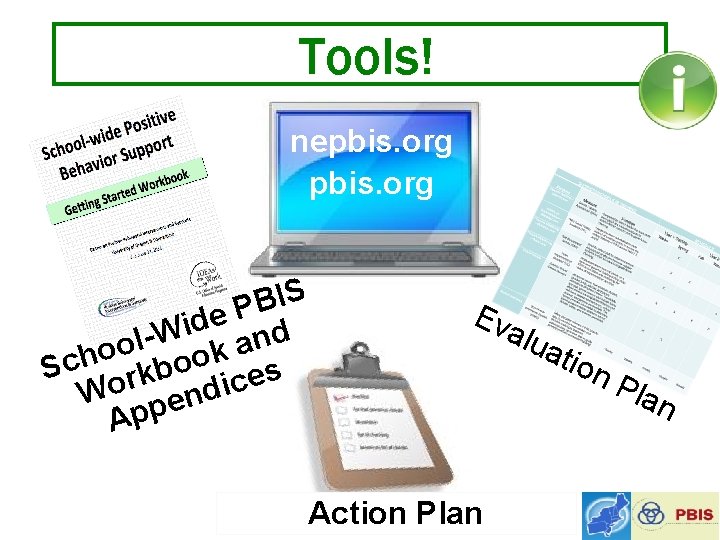
Tools! nepbis. org S I B P e d i d W n l a o o k Sch orkboo ces W pendi Ap Ev Action Plan alu atio n P lan
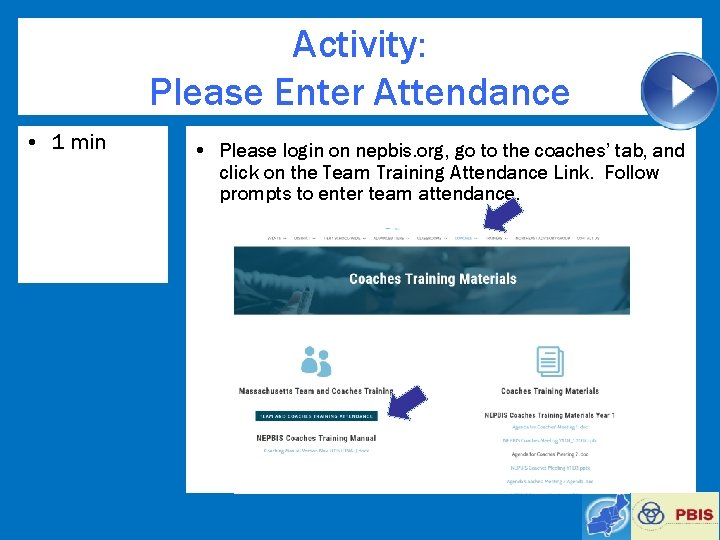
Activity: Please Enter Attendance • 1 min • Please login on nepbis. org, go to the coaches’ tab, and click on the Team Training Attendance Link. Follow prompts to enter team attendance.
Legend New Content Guidelines Training Organization Review +Ex -Ex Activity
Legend Section Header (I. A) Chapter Header (e. g. , I)
OVERVIEW OF SCHOOL-WIDE POSITIVE BEHAVIOR SUPPORTS (CHAPTER I)
Why SWPBIS? I. A
Why SWPBIS? “Get Tough” doesn’t work Context matters Schools are asked to do more with less SWPBIS works I. A. i
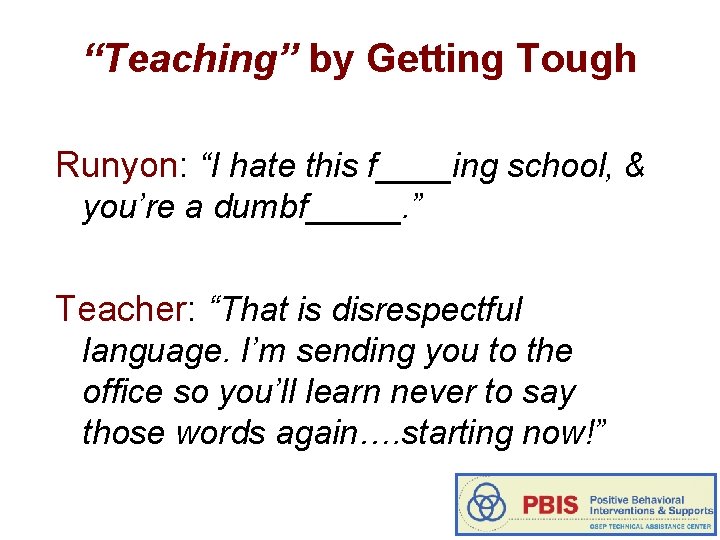
“Teaching” by Getting Tough Runyon: “I hate this f____ing school, & you’re a dumbf_____. ” Teacher: “That is disrespectful language. I’m sending you to the office so you’ll learn never to say those words again…. starting now!”
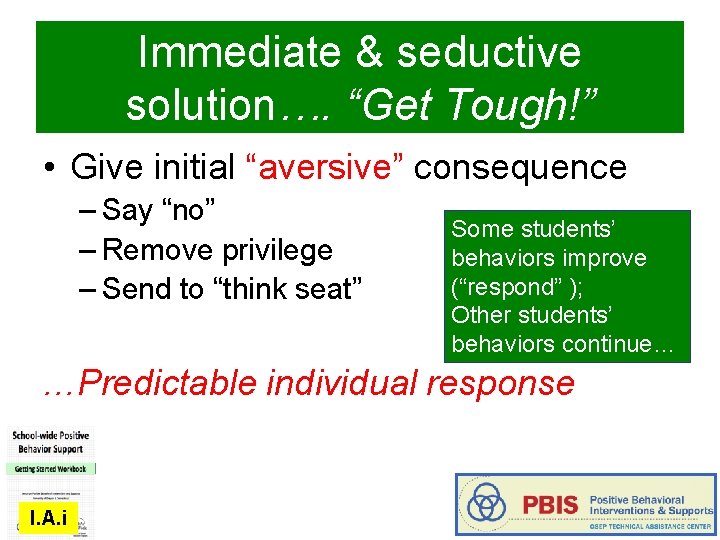
Immediate & seductive solution…. “Get Tough!” • Give initial “aversive” consequence – Say “no” – Remove privilege – Send to “think seat” Some students’ behaviors improve (“respond” ); Other students’ behaviors continue… . . . Predictable individual response I. A. i
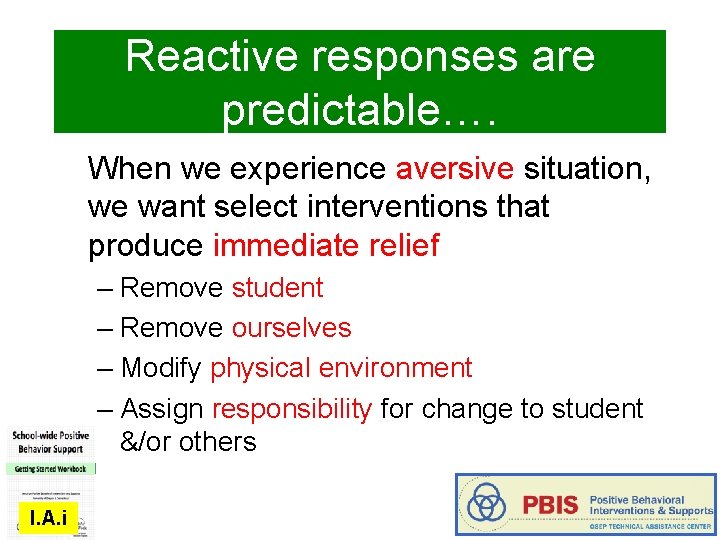
Reactive responses are predictable…. When we experience aversive situation, we want select interventions that produce immediate relief – Remove student – Remove ourselves – Modify physical environment – Assign responsibility for change to student &/or others I. A. i
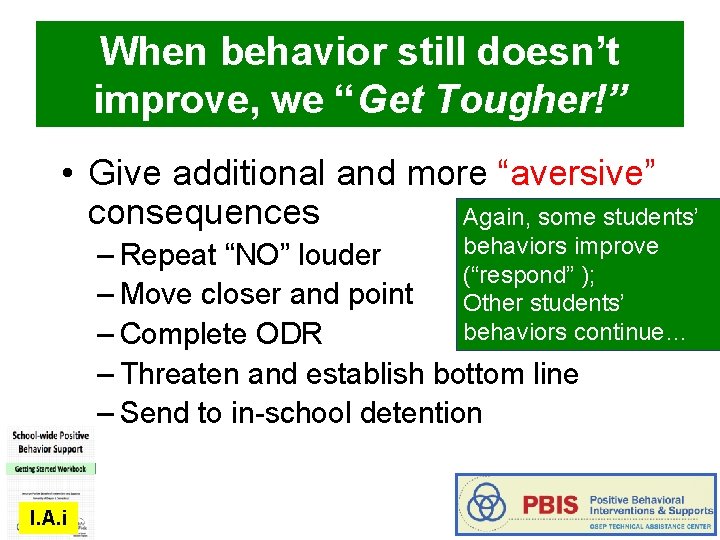
When behavior still doesn’t improve, we “Get Tougher!” • Give additional and more “aversive” consequences Again, some students’ behaviors improve – Repeat “NO” louder (“respond” ); – Move closer and point Other students’ behaviors continue… – Complete ODR – Threaten and establish bottom line – Send to in-school detention I. A. i
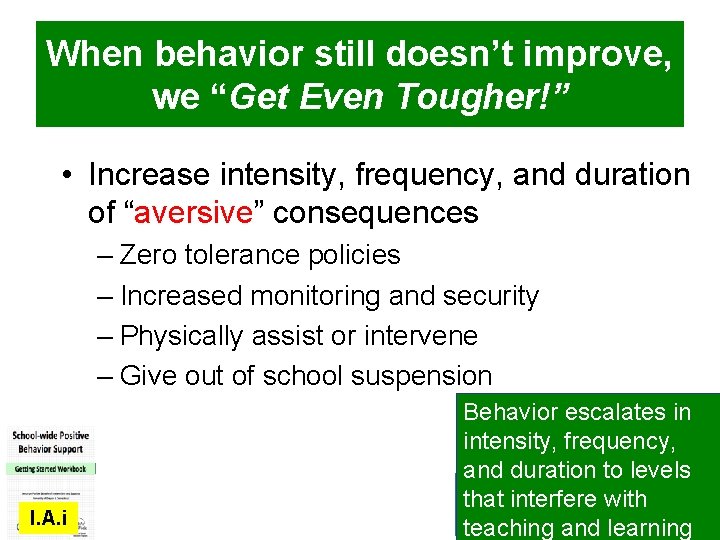
When behavior still doesn’t improve, we “Get Even Tougher!” • Increase intensity, frequency, and duration of “aversive” consequences – Zero tolerance policies – Increased monitoring and security – Physically assist or intervene – Give out of school suspension I. A. i Behavior escalates in intensity, frequency, and duration to levels that interfere with teaching and learning
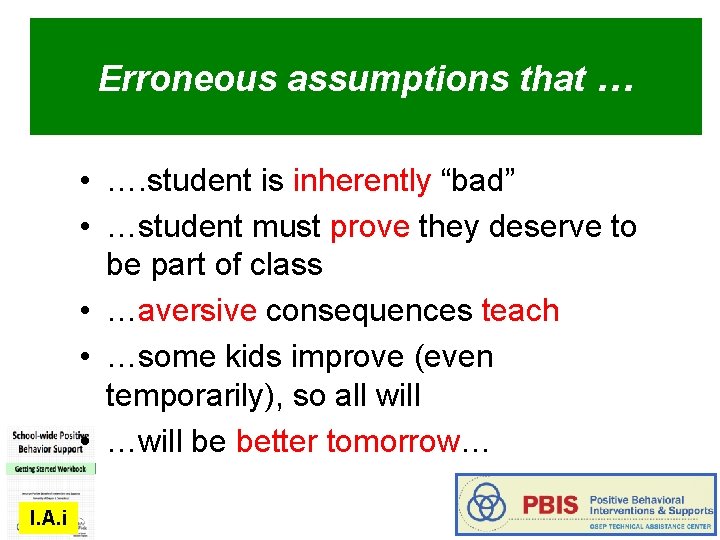
Erroneous assumptions that … • …. student is inherently “bad” • …student must prove they deserve to be part of class • …aversive consequences teach • …some kids improve (even temporarily), so all will • …will be better tomorrow… I. A. i
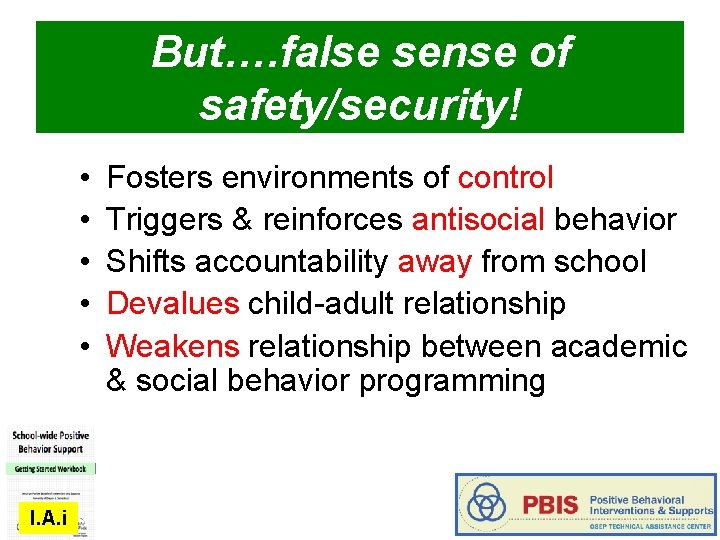
But…. false sense of safety/security! • • • I. A. i Fosters environments of control Triggers & reinforces antisocial behavior Shifts accountability away from school Devalues child-adult relationship Weakens relationship between academic & social behavior programming
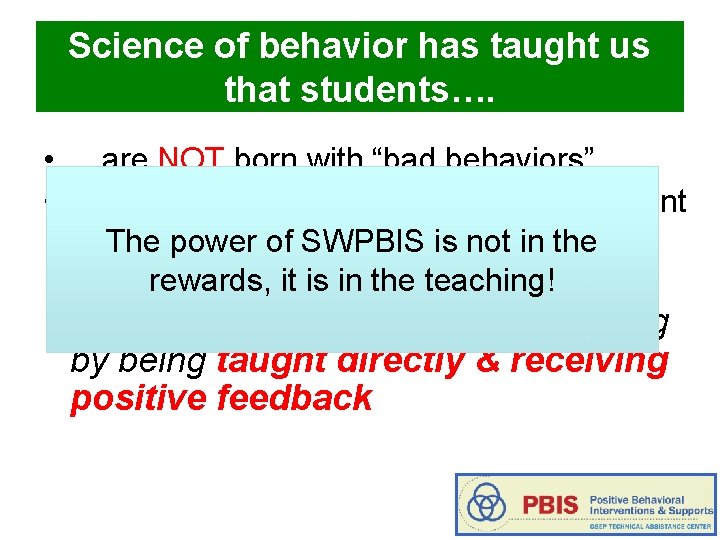
Science of behavior has taught us that students…. • …are NOT born with “bad behaviors” • …do NOT learn when presented contingent aversive consequences The power of SWPBIS is not in the rewards, it is in the teaching!. . . DO LEARN better ways of behaving by being taught directly & receiving positive feedback
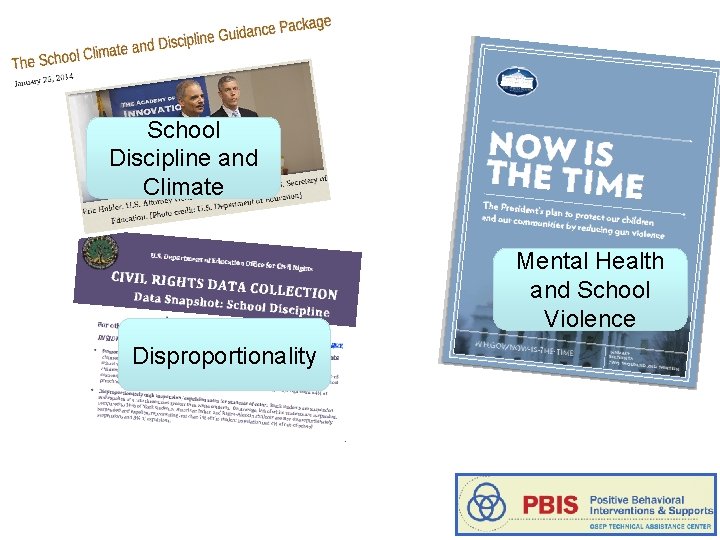
School Discipline and Climate Mental Health and School Violence Disproportionality
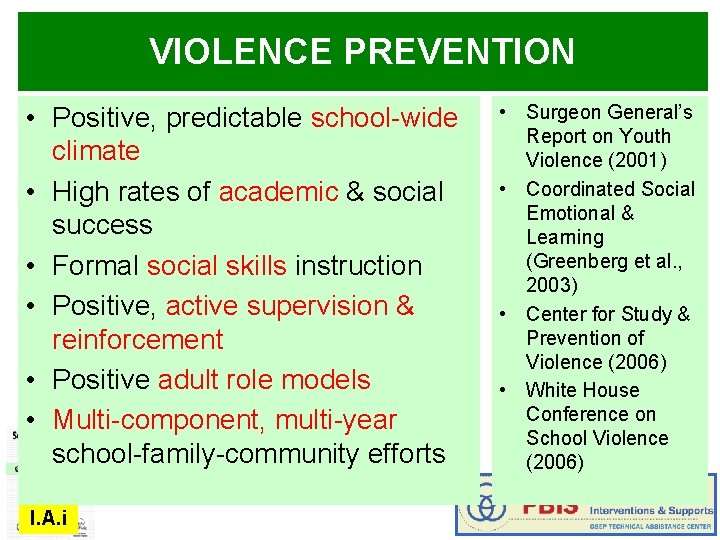
VIOLENCE PREVENTION • Positive, predictable school-wide climate • High rates of academic & social success • Formal social skills instruction • Positive, active supervision & reinforcement • Positive adult role models • Multi-component, multi-year school-family-community efforts I. A. i • Surgeon General’s Report on Youth Violence (2001) • Coordinated Social Emotional & Learning (Greenberg et al. , 2003) • Center for Study & Prevention of Violence (2006) • White House Conference on School Violence (2006)
Why SWPBIS? “Get Tough” doesn’t work Context matters Schools are asked to do more with less SWPBIS works I. A. ii
Context Matters! Examples: Individual Student vs. School-wide
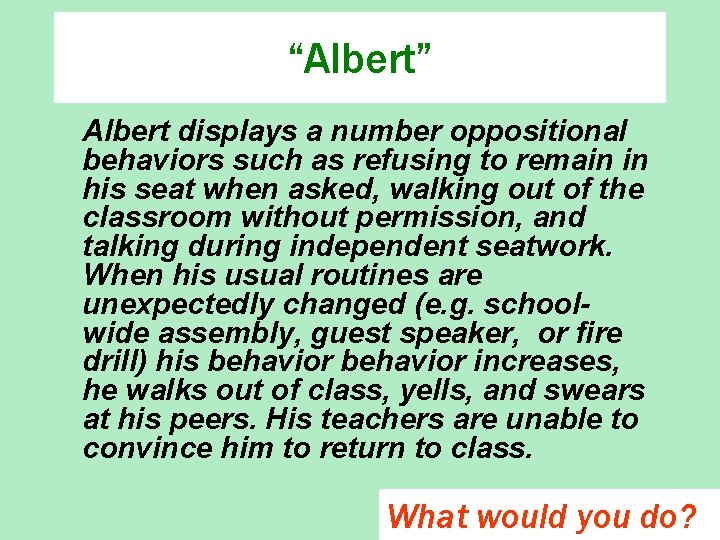
“Albert” Albert displays a number oppositional behaviors such as refusing to remain in his seat when asked, walking out of the classroom without permission, and talking during independent seatwork. When his usual routines are unexpectedly changed (e. g. schoolwide assembly, guest speaker, or fire drill) his behavior increases, he walks out of class, yells, and swears at his peers. His teachers are unable to convince him to return to class. What would you do?
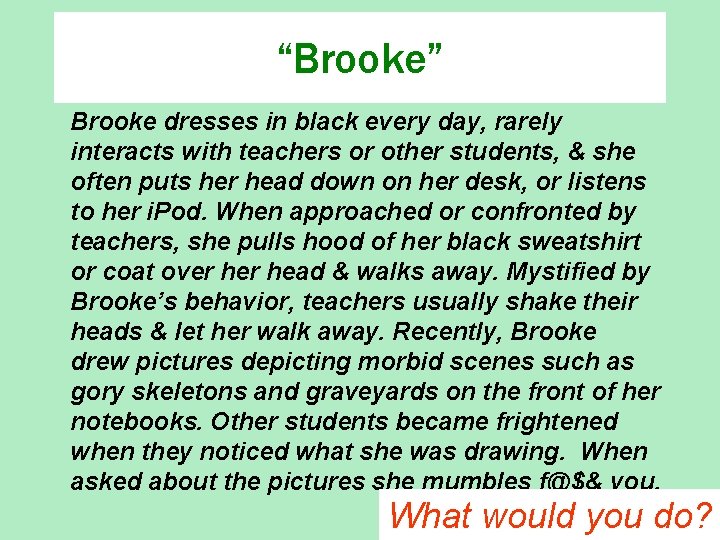
“Brooke” Brooke dresses in black every day, rarely interacts with teachers or other students, & she often puts her head down on her desk, or listens to her i. Pod. When approached or confronted by teachers, she pulls hood of her black sweatshirt or coat over head & walks away. Mystified by Brooke’s behavior, teachers usually shake their heads & let her walk away. Recently, Brooke drew pictures depicting morbid scenes such as gory skeletons and graveyards on the front of her notebooks. Other students became frightened when they noticed what she was drawing. When asked about the pictures she mumbles f@$& you. What would you do?
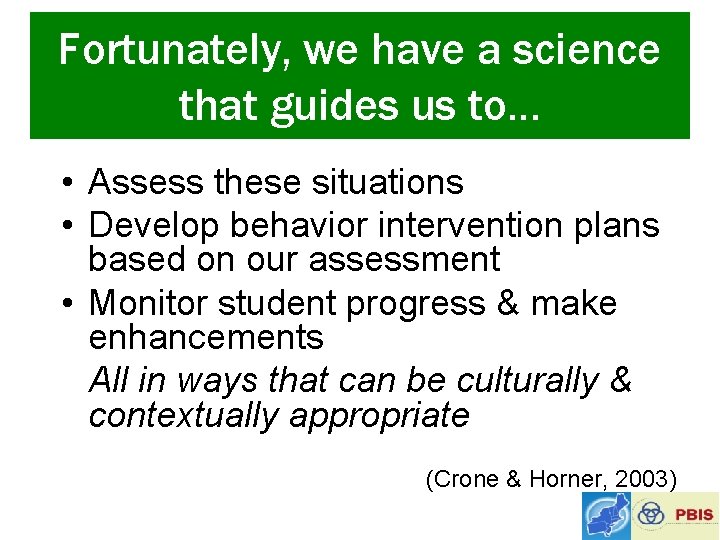
Fortunately, we have a science that guides us to… • Assess these situations • Develop behavior intervention plans based on our assessment • Monitor student progress & make enhancements All in ways that can be culturally & contextually appropriate (Crone & Horner, 2003)
However, context matters…. What factors influence our ability to implement what we know with accuracy, consistency, & durability for students like Albert and Brooke? I. A. ii
“ 159 Days!” Intermediate/senior high school with 880 students reported over 5, 100 office discipline referrals in one academic year. Nearly 2/3 of students have received at least one office discipline referral.
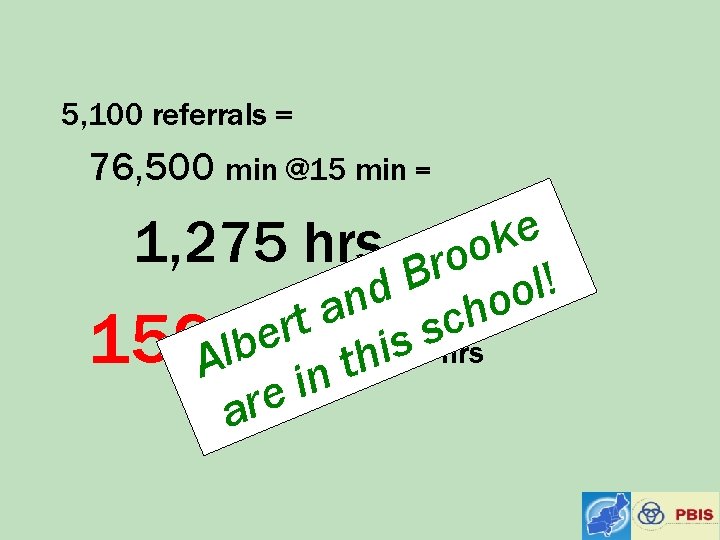
5, 100 referrals = 76, 500 min @15 min = e k 1, 275 hrs =Broo ! l d o n o a h t c r s e s b 159 Aldays @ 8 hrs i h t n i e r a
SWPBIS Message! Successful individual student behavior support is linked to host environments or school climates that are effective, efficient, relevant, & durable. (Zins & Ponti, 1990) I. A. ii
Why SWPBIS? “Get Tough” doesn’t work Context matters Schools are asked to do more with less SWPBIS works I. A. iii
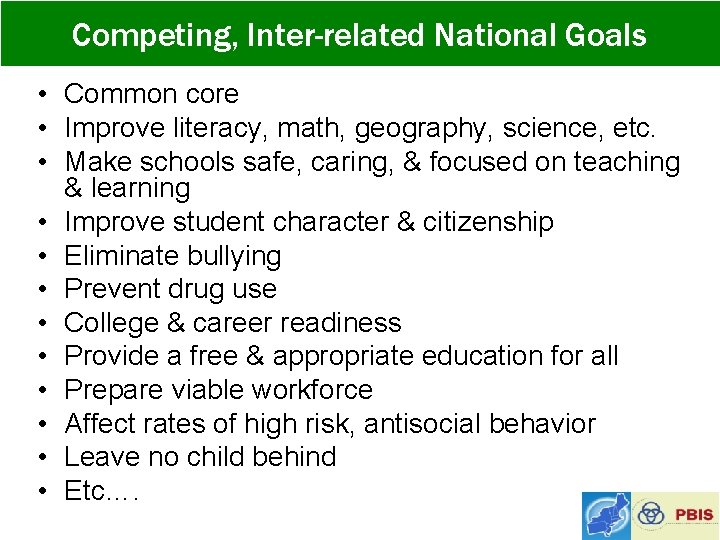
Competing, Inter-related National Goals • Common core • Improve literacy, math, geography, science, etc. • Make schools safe, caring, & focused on teaching & learning • Improve student character & citizenship • Eliminate bullying • Prevent drug use • College & career readiness • Provide a free & appropriate education for all • Prepare viable workforce • Affect rates of high risk, antisocial behavior • Leave no child behind • Etc….
Challenge
Why SWPBIS? “Get Tough” doesn’t work Context matters Schools are asked to do more with less SWPBIS works I. A. iv
And, when done well, SWPBIS makes things better for kids and adults!
Research Says… • Implementing Tier 1 SWPBS is associated with the following positive outcomes: – Increases in prosocial behavior – Increases in organizational health/climate – Increases in state-wide test scores (tentative) – Decreases in office discipline referrals – Decreases in suspensions – Decreases in reported bullying (e. g. , Bradshaw, Koth, Thornton, & Leaf, 2009; Bradshaw, Koth, Bevans, Ialongo, & Leaf, 2008; Bradshaw, Mitchell, & Leaf, 2010; Bradshaw, Waasdorp, & Leaf, 2012; Horner et al. , 2009; Waasdorp, Bradshaw, & Leaf, 2012 )a
Research Says… • Further, among schools implementing SWPBS, those that implement with fidelity experience greater – decreases in ODRs, – decreases in suspensions, and – increases in state-wide test scores in math over time. (Simonsen, Eber, Sugai, Black, Lewandowski, Simms, & Myers, 2012)
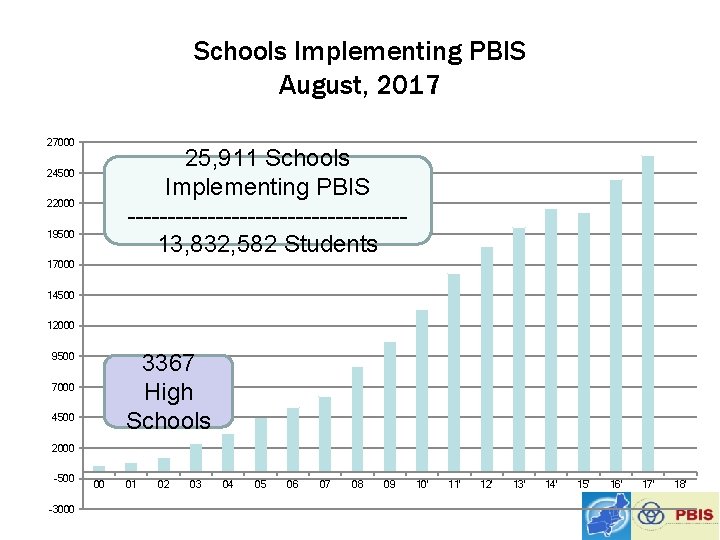
Schools Implementing PBIS August, 2017 27000 25, 911 Schools Implementing PBIS -----------------13, 832, 582 Students 24500 22000 19500 17000 14500 12000 3367 High Schools 9500 7000 4500 2000 -500 -3000 00 01 02 03 04 05 06 07 08 09 10' 11' 12' 13' 14' 15' 16' 17' 18'
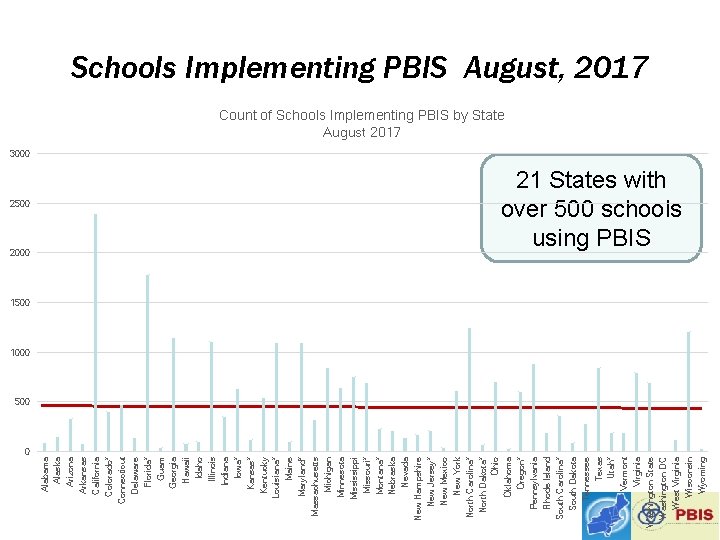
2500 2000 Alabama Alaska Arizona Arkansas California Colorado* Connecticut Delaware Florida* Guam Georgia Hawaii Idaho Illinois Indiana Iowa* Kansas* Kentucky Louisiana* Maine Maryland* Massachusetts Michigan Minnesota Mississippi Missouri* Montana* Nebraska Nevada New Hampshire New Jersey* New Mexico New York North Carolina* North Dakota* Ohio Oklahoma Oregon* Pennsylvania Rhode Island South Carolina* South Dakota Tennessee Texas Utah* Vermont Virginia Washington State Washington DC West Virginia Wisconsin Wyoming Schools Implementing PBIS August, 2017 Count of Schools Implementing PBIS by State August 2017 3000 21 States with over 500 schools using PBIS 1500 1000 500 0
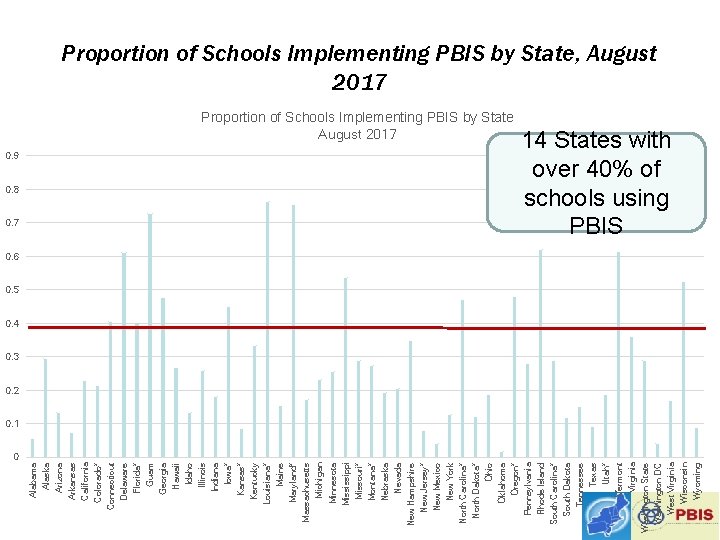
0. 9 0. 8 0. 7 Alabama Alaska Arizona Arkansas California Colorado* Connecticut Delaware Florida* Guam Georgia Hawaii Idaho Illinois Indiana Iowa* Kansas* Kentucky Louisiana* Maine Maryland* Massachusetts Michigan Minnesota Mississippi Missouri* Montana* Nebraska Nevada New Hampshire New Jersey* New Mexico New York North Carolina* North Dakota* Ohio Oklahoma Oregon* Pennsylvania Rhode Island South Carolina* South Dakota Tennessee Texas Utah* Vermont Virginia Washington State Washington DC West Virginia Wisconsin Wyoming Proportion of Schools Implementing PBIS by State, August 2017 Proportion of Schools Implementing PBIS by State August 2017 14 States with over 40% of schools using PBIS 0. 6 0. 5 0. 4 0. 3 0. 2 0. 1 0
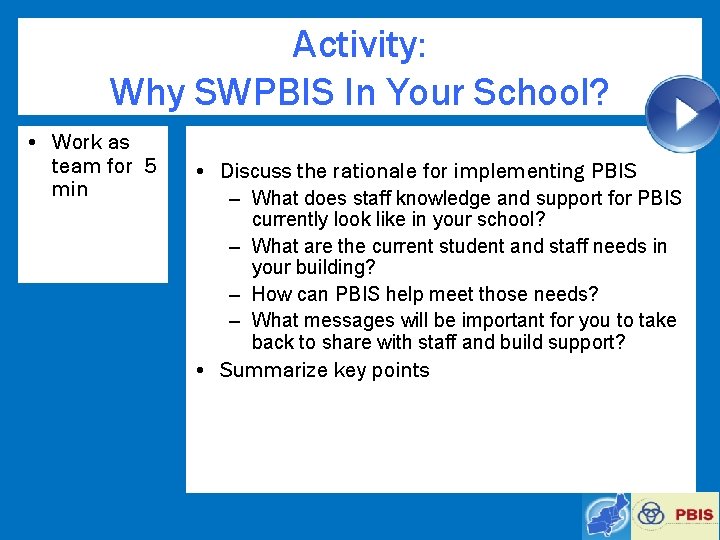
Activity: Why SWPBIS In Your School? • Work as team for 5 min • Discuss the rationale for implementing PBIS – What does staff knowledge and support for PBIS currently look like in your school? – What are the current student and staff needs in your building? – How can PBIS help meet those needs? – What messages will be important for you to take back to share with staff and build support? • Summarize key points
What is SWPBIS? I. B
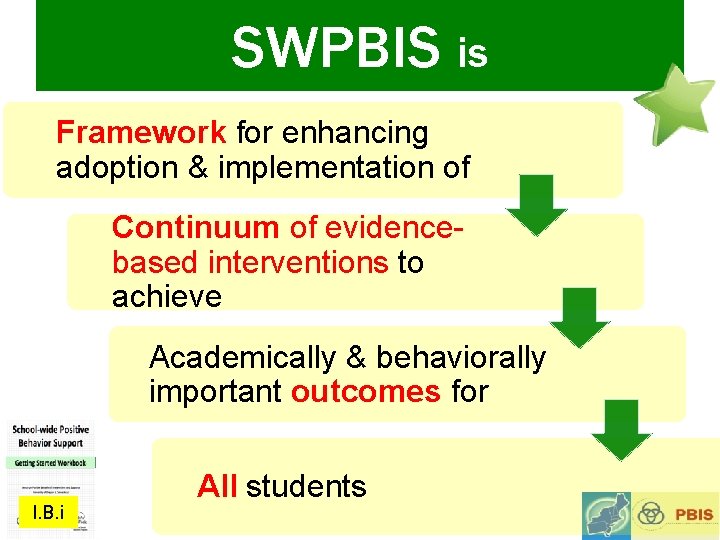
SWPBIS is Framework for enhancing adoption & implementation of Continuum of evidencebased interventions to achieve Academically & behaviorally important outcomes for I. B. i All students
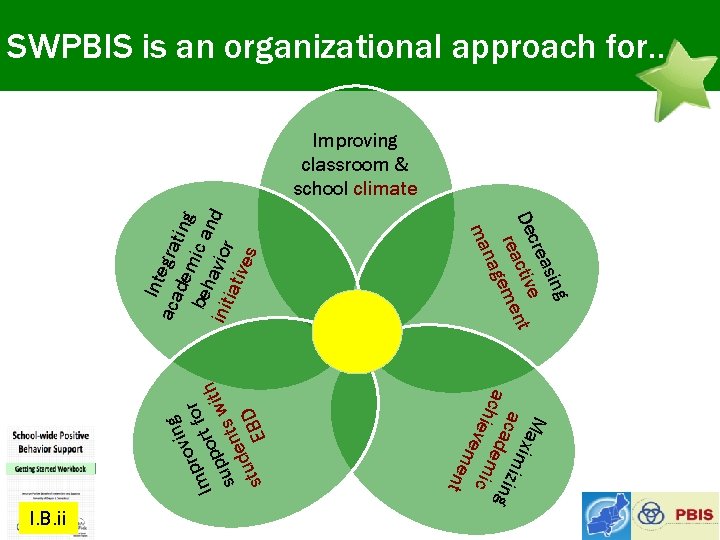
ng i v ro for p Im ort ith p sup nts w de D u t s EB Ma x ac imiz ach adem ing i e v em ic e nt I. B. ii ng asi cre De ctive nt rea eme nag ma Inte aca gra dem ting beh ic a init avior nd iati ves SWPBIS is an organizational approach for… Improving classroom & school climate
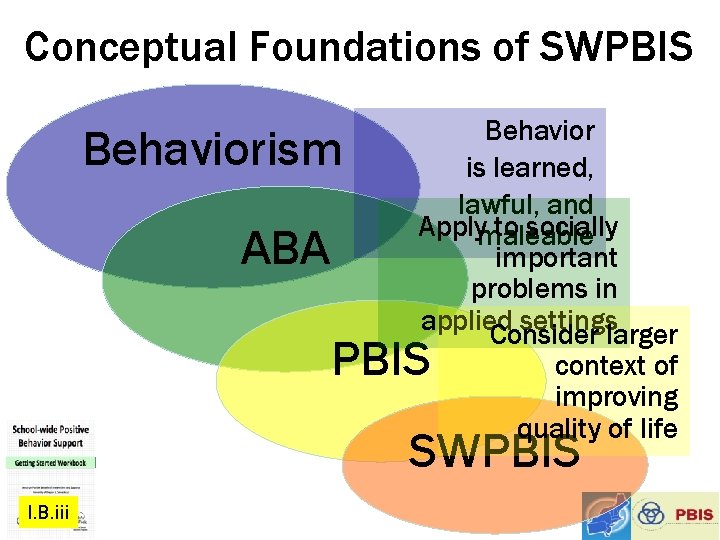
Conceptual Foundations of SWPBIS Behaviorism ABA Behavior is learned, lawful, and Applymaleable to socially important problems in applied settingslarger Consider PBIS context of improving quality of life SWPBIS I. B. iii
Revisiting SWPBIS Message! Successful individual student behavior support is linked to host environments or school climates that are effective, efficient, relevant, & durable. (Zins & Ponti, 1990) I. A
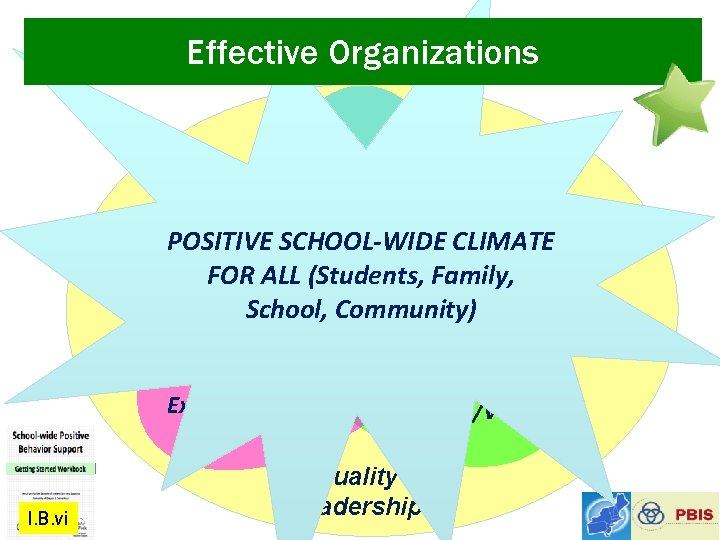
Effective Organizations Common Language POSITIVE SCHOOL-WIDE CLIMATE FOR ALL (Students, Family, School, Community) Common Experience I. B. vi Common Vision/Values Quality Leadership
What are the critical features of SWPBIS? I. C
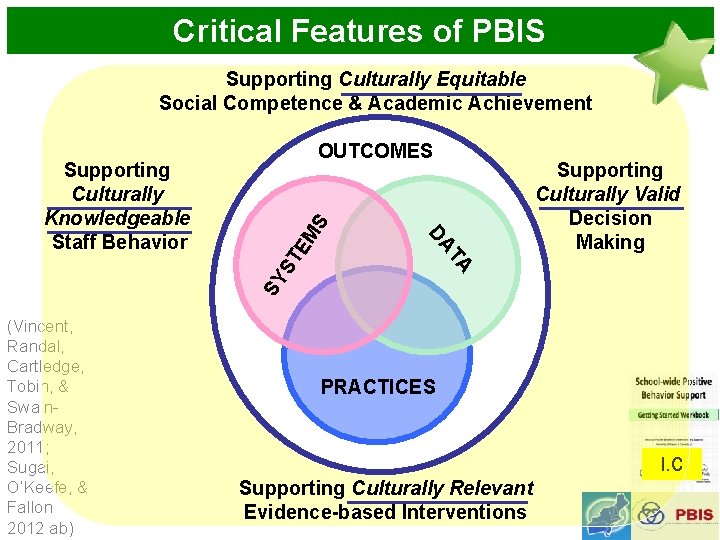
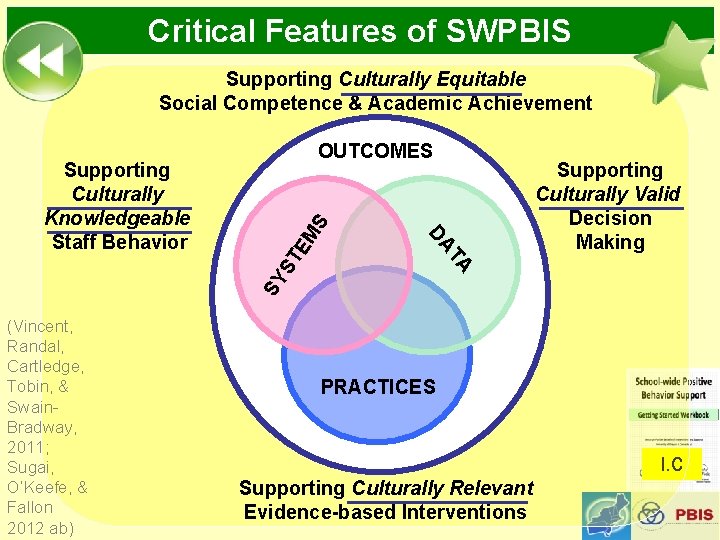
Critical Features of PBIS Supporting Culturally Equitable Social Competence & Academic Achievement SY ST EM S Supporting Culturally Valid Decision Making TA (Vincent, Randal, Cartledge, Tobin, & Swain. Bradway, 2011; Sugai, O’Keefe, & Fallon 2012 ab) DA Supporting Culturally Knowledgeable Staff Behavior OUTCOMES PRACTICES I. C Supporting Culturally Relevant Evidence-based Interventions
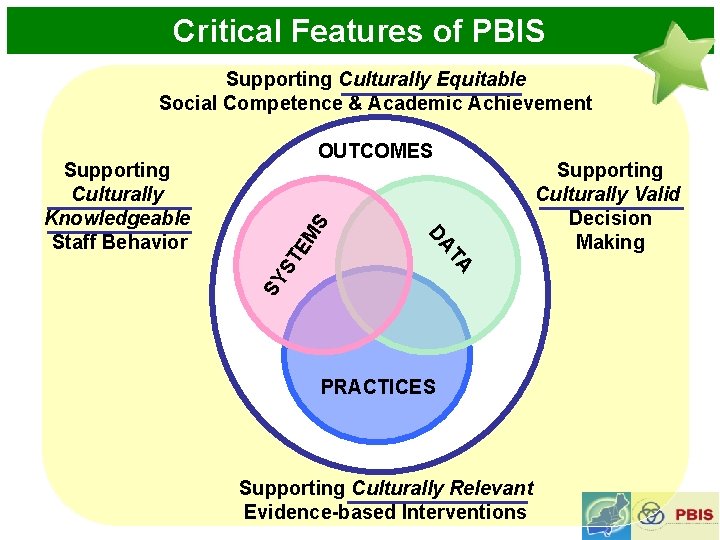
Critical Features of PBIS Supporting Culturally Equitable Social Competence & Academic Achievement OUTCOMES EM S ST SY TA DA Supporting Culturally Knowledgeable Staff Behavior PRACTICES Supporting Culturally Relevant Evidence-based Interventions Supporting Culturally Valid Decision Making
Focus on Outcomes How do we develop outcome statements? I. C. i OUTCOMES
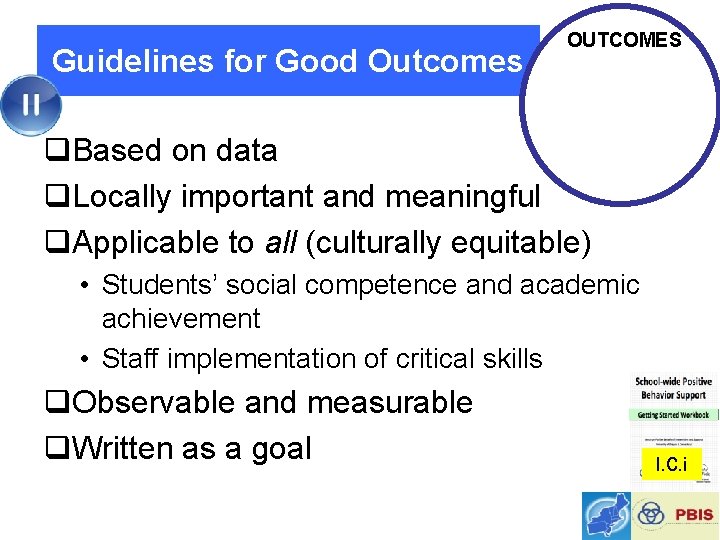
Guidelines for Good Outcomes OUTCOMES q. Based on data q. Locally important and meaningful q. Applicable to all (culturally equitable) • Students’ social competence and academic achievement • Staff implementation of critical skills q. Observable and measurable q. Written as a goal I. C. i
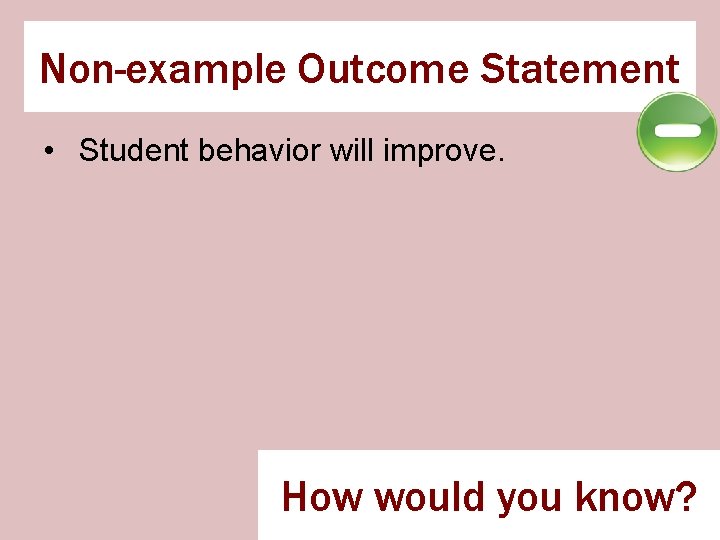
Non-example Outcome Statement • Student behavior will improve. How would you know?
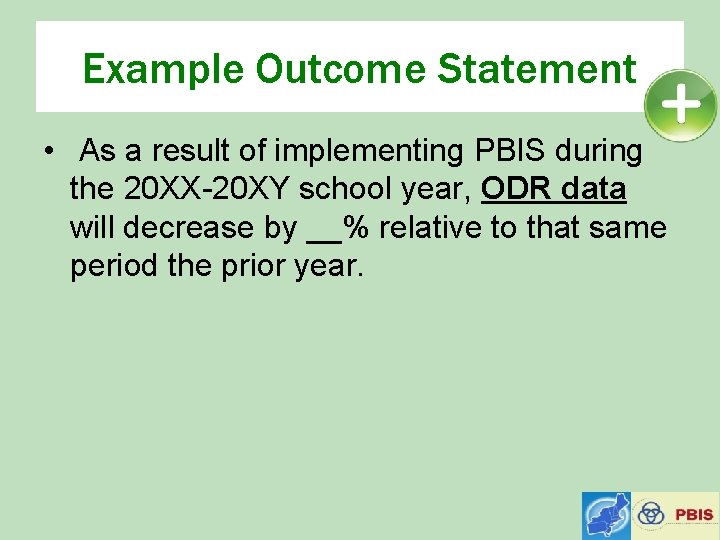
Example Outcome Statement • As a result of implementing PBIS during the 20 XX-20 XY school year, ODR data will decrease by __% relative to that same period the prior year.
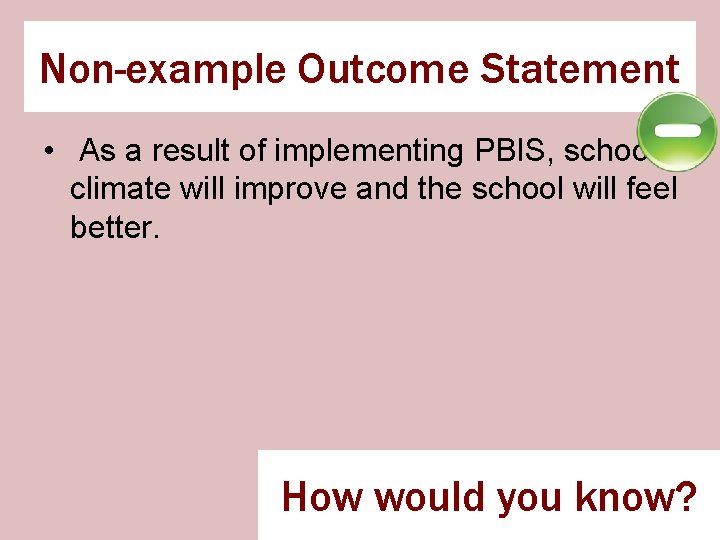
Non-example Outcome Statement • As a result of implementing PBIS, school climate will improve and the school will feel better. How would you know?
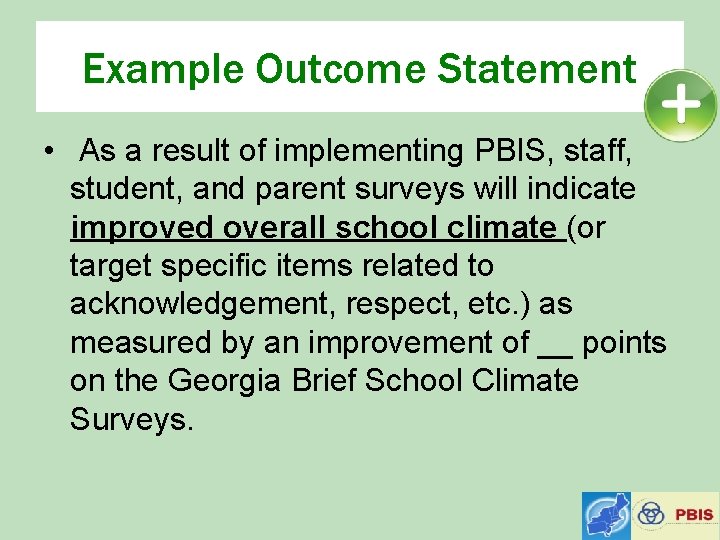
Example Outcome Statement • As a result of implementing PBIS, staff, student, and parent surveys will indicate improved overall school climate (or target specific items related to acknowledgement, respect, etc. ) as measured by an improvement of __ points on the Georgia Brief School Climate Surveys.
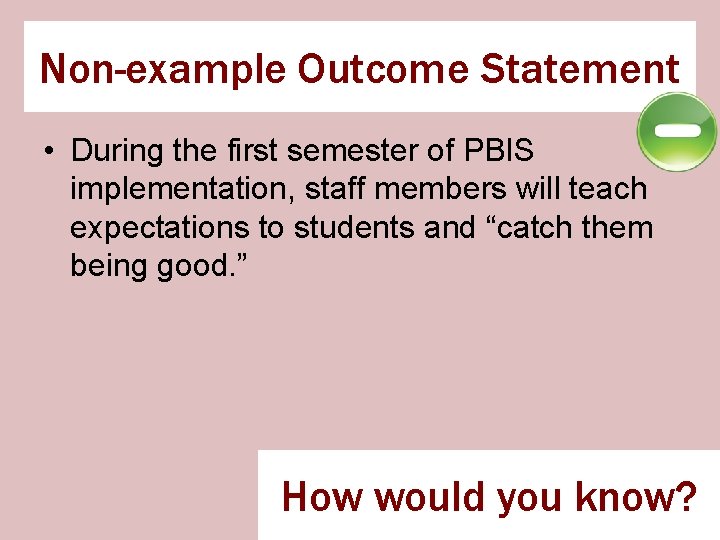
Non-example Outcome Statement • During the first semester of PBIS implementation, staff members will teach expectations to students and “catch them being good. ” How would you know?
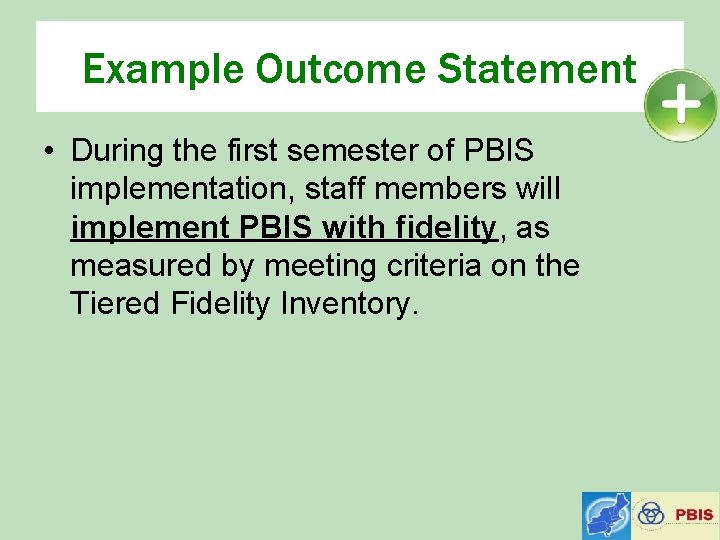
Example Outcome Statement • During the first semester of PBIS implementation, staff members will implement PBIS with fidelity, as measured by meeting criteria on the Tiered Fidelity Inventory.
Non-example Outcome Statement • During the first semester of PBIS implementation, staff members will be more positive toward students. How would you know?
Example Outcome Statement • During the first semester of PBIS implementation, 80% of staff members will meet or exceed a 4: 1 positive to negative ratio as measured by calculating a ratio of positive tickets/acknowledgements to office discipline referrals (ODRs) per staff.
Activity: Developing Outcomes • Work as team for 10 min • Begin to draft 1 -3 observable and measurable outcome statements for your school. – Consider at least one outcome statement focused on student behavior and one focused on adult behavior • Present 2 -3 “big ideas” from your group (1 min. reports)
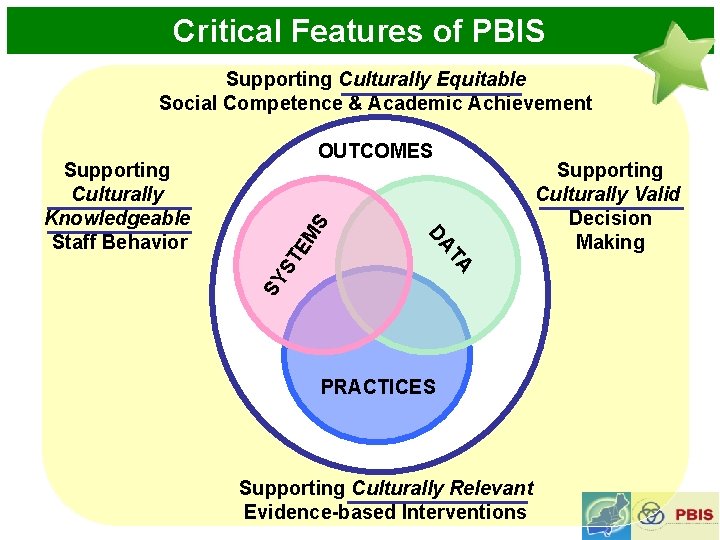
Critical Features of PBIS Supporting Culturally Equitable Social Competence & Academic Achievement OUTCOMES EM S ST SY TA DA Supporting Culturally Knowledgeable Staff Behavior PRACTICES Supporting Culturally Relevant Evidence-based Interventions Supporting Culturally Valid Decision Making
What is datadriven decision making? I. C. ii TA DA Focus on Data
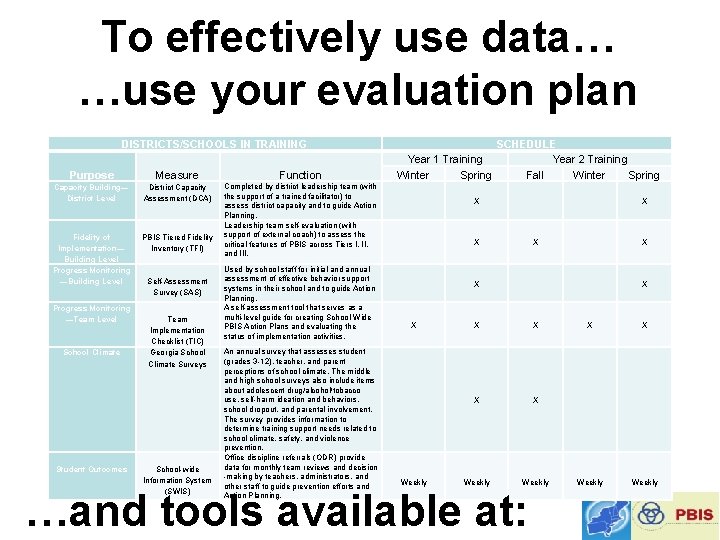
To effectively use data… …use your evaluation plan DISTRICTS/SCHOOLS IN TRAINING Purpose Measure Function Capacity Building— District Level District Capacity Assessment (DCA) Fidelity of Implementation— Building Level Progress Monitoring —Building Level PBIS Tiered Fidelity Inventory (TFI) Completed by district leadership team (with the support of a trained facilitator) to assess district capacity and to guide Action Planning. Leadership team self-evaluation (with support of external coach) to assess the critical features of PBIS across Tiers I, II, and III. Progress Monitoring —Team Level Team Implementation Checklist (TIC) Georgia School Climate Surveys School Climate Student Outcomes Self-Assessment Survey (SAS) School-wide Information System (SWIS) Used by school staff for initial and annual assessment of effective behavior support systems in their school and to guide Action Planning. A self-assessment tool that serves as a multi-level guide for creating School-Wide PBIS Action Plans and evaluating the status of implementation activities. An annual survey that assesses student (grades 3 -12), teacher, and parent perceptions of school climate. The middle and high school surveys also include items about adolescent drug/alcohol/tobacco use, self-harm ideation and behaviors, school dropout, and parental involvement. The survey provides information to determine training support needs related to school climate, safety, and violence prevention. Office discipline referrals (ODR) provide data for monthly team reviews and decision -making by teachers, administrators, and other staff to guide prevention efforts and Action Planning. Year 1 Training Winter Spring SCHEDULE Year 2 Training Fall Winter Spring X X X X X Weekly Weekly …and tools available at:
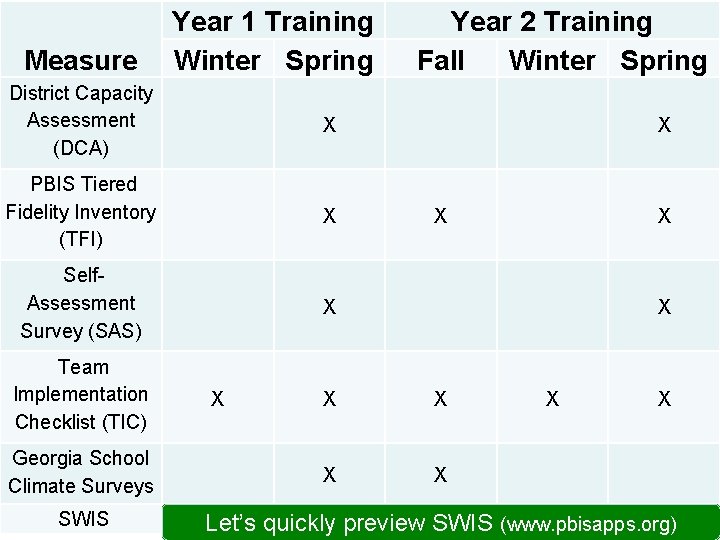
Measure Year 1 Training Winter Spring Year 2 Training Fall Winter Spring District Capacity Assessment (DCA) X X PBIS Tiered Fidelity Inventory (TFI) X X X Self. Assessment Survey (SAS) X X Team Implementation Checklist (TIC) X X X Georgia School Climate Surveys X X SWIS Weekly (www. pbisapps. org) Weekly Let’s quickly preview SWIS
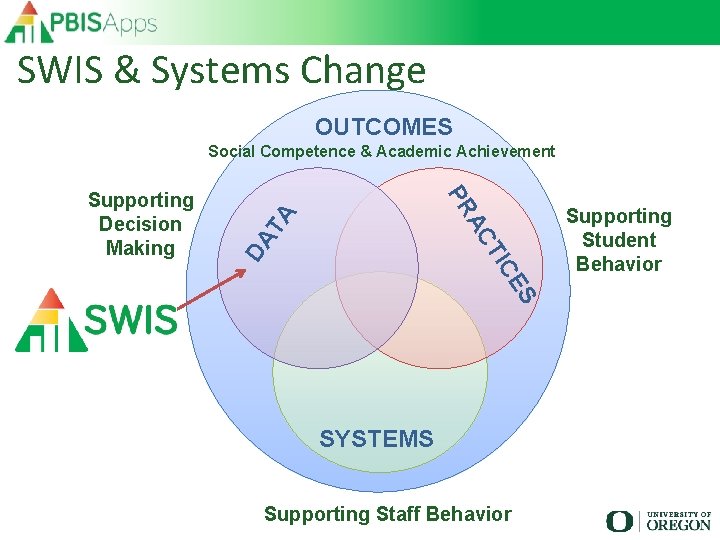
SWIS & Systems Change OUTCOMES Social Competence & Academic Achievement S CE TI DA T AC A PR Supporting Decision Making SYSTEMS Supporting Staff Behavior Supporting Student Behavior
What is the School-Wide Information System (SWIS)? • The School-Wide Information System (SWIS) is a web-based decision system used to improve behavior support in schools and other educational facilities by providing school personnel with accurate, timely, and practical information for making decisions about school environments.
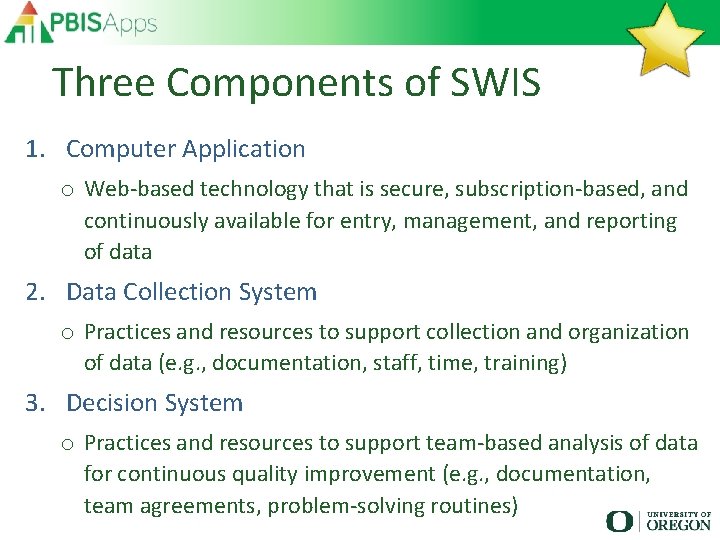
Three Components of SWIS 1. Computer Application o Web-based technology that is secure, subscription-based, and continuously available for entry, management, and reporting of data 2. Data Collection System o Practices and resources to support collection and organization of data (e. g. , documentation, staff, time, training) 3. Decision System o Practices and resources to support team-based analysis of data for continuous quality improvement (e. g. , documentation, team agreements, problem-solving routines)
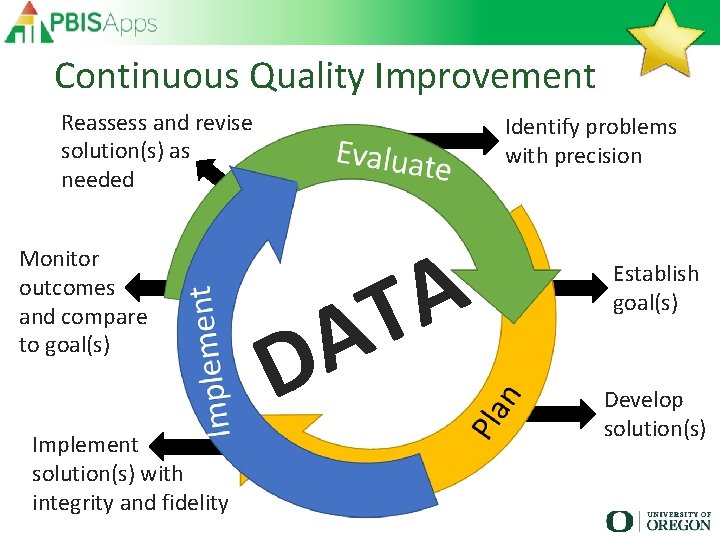
Continuous Quality Improvement Reassess and revise solution(s) as needed Monitor outcomes and compare to goal(s) Implement solution(s) with integrity and fidelity Identify problems with precision D A T A Establish goal(s) Develop solution(s)
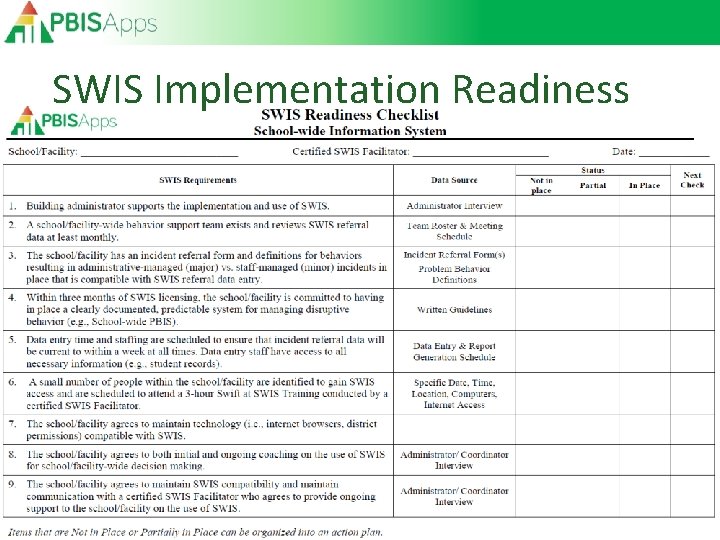
SWIS Implementation Readiness
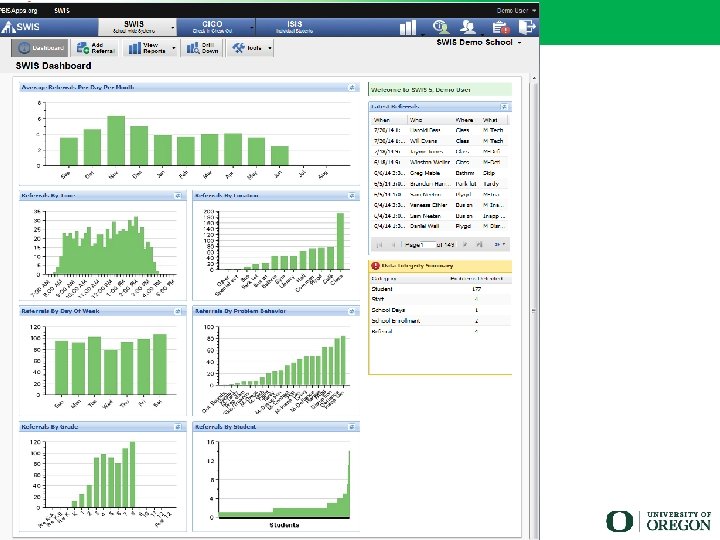
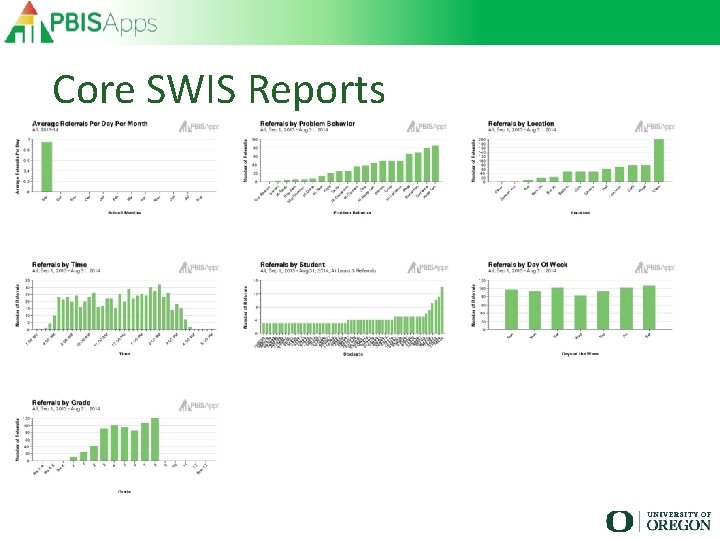
Core SWIS Reports
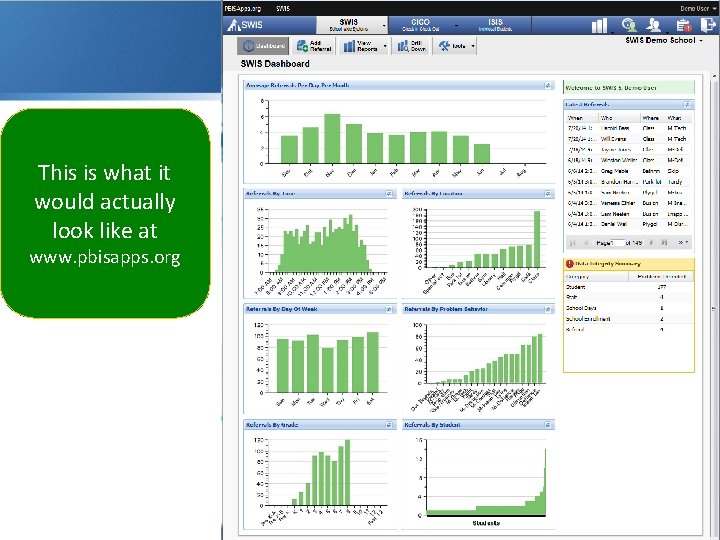
This is what it would actually look like at www. pbisapps. org
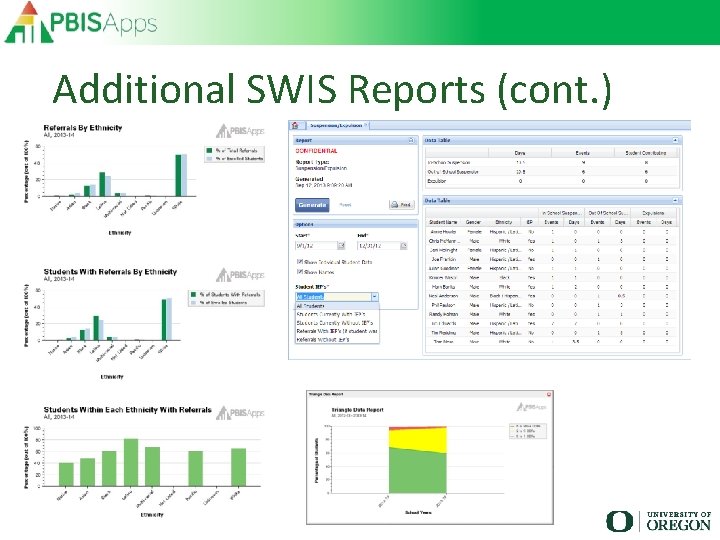
Additional SWIS Reports (cont. )
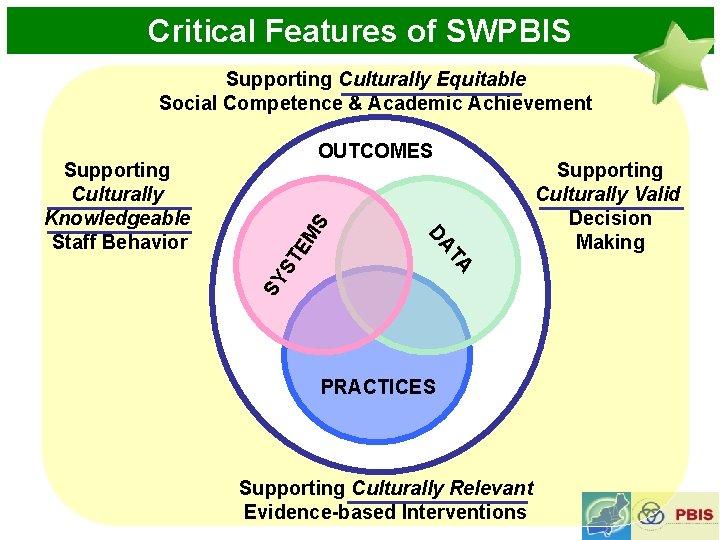
Critical Features of SWPBIS Supporting Culturally Equitable Social Competence & Academic Achievement OUTCOMES EM S ST SY TA DA Supporting Culturally Knowledgeable Staff Behavior PRACTICES Supporting Culturally Relevant Evidence-based Interventions Supporting Culturally Valid Decision Making
Focus on Practices PRACTICES What evidence -based interventions are included in SWPBIS? I. C. iii
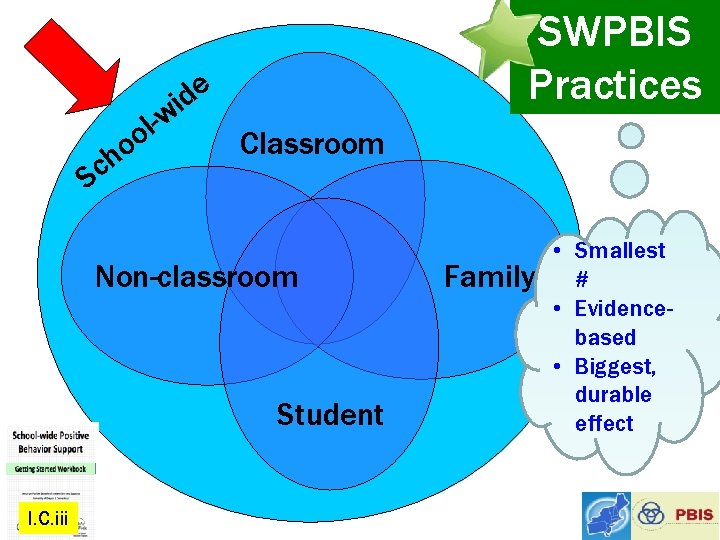
e d i w l- o o h Sc SWPBIS Practices Classroom Non-classroom Student I. C. iii Family • Smallest # • Evidencebased • Biggest, durable effect
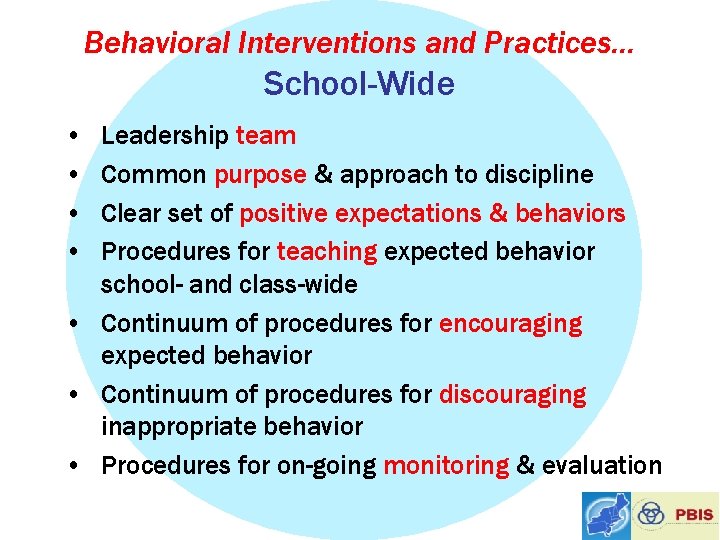
Behavioral Interventions and Practices… School-Wide • • Leadership team Common purpose & approach to discipline Clear set of positive expectations & behaviors Procedures for teaching expected behavior school- and class-wide • Continuum of procedures for encouraging expected behavior • Continuum of procedures for discouraging inappropriate behavior • Procedures for on-going monitoring & evaluation
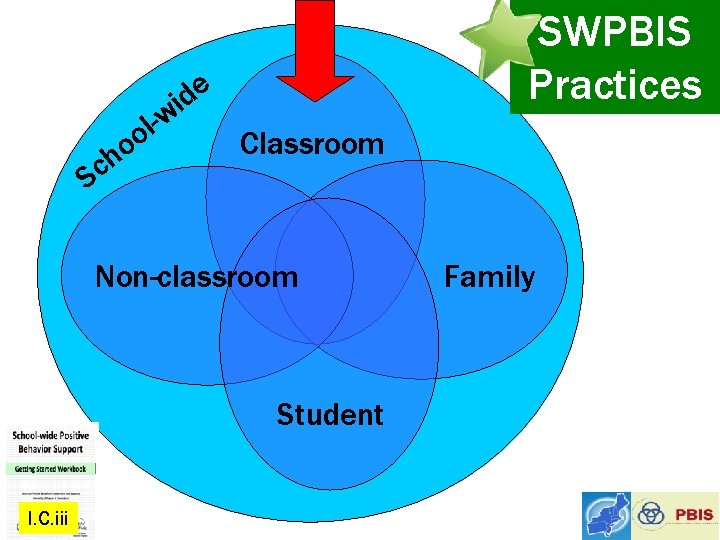
e d i w l- o o h Sc SWPBIS Practices Classroom Non-classroom Student I. C. iii Family
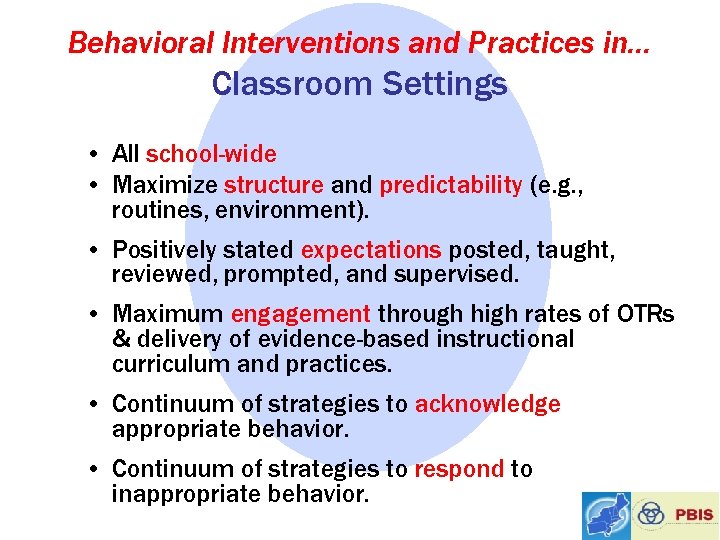
Behavioral Interventions and Practices in… Classroom Settings • All school-wide • Maximize structure and predictability (e. g. , routines, environment). • Positively stated expectations posted, taught, reviewed, prompted, and supervised. • Maximum engagement through high rates of OTRs & delivery of evidence-based instructional curriculum and practices. • Continuum of strategies to acknowledge appropriate behavior. • Continuum of strategies to respond to inappropriate behavior.
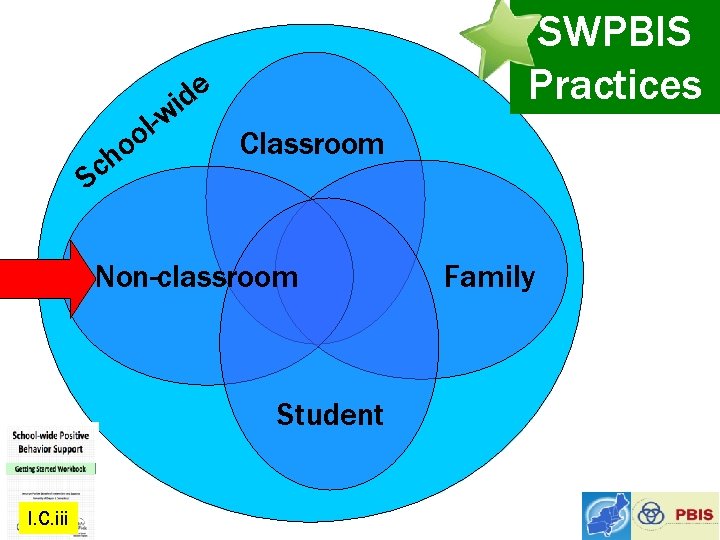
e d i w l- o o h Sc SWPBIS Practices Classroom Non-classroom Student I. C. iii Family
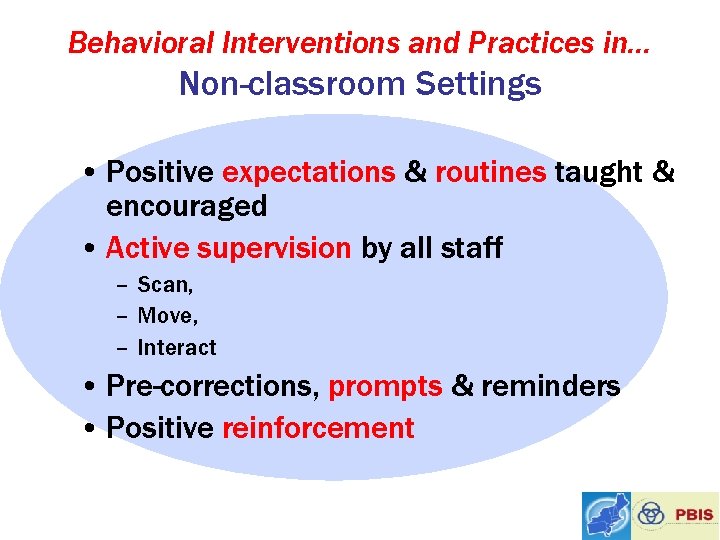
Behavioral Interventions and Practices in… Non-classroom Settings • Positive expectations & routines taught & encouraged • Active supervision by all staff – Scan, – Move, – Interact • Pre-corrections, prompts & reminders • Positive reinforcement
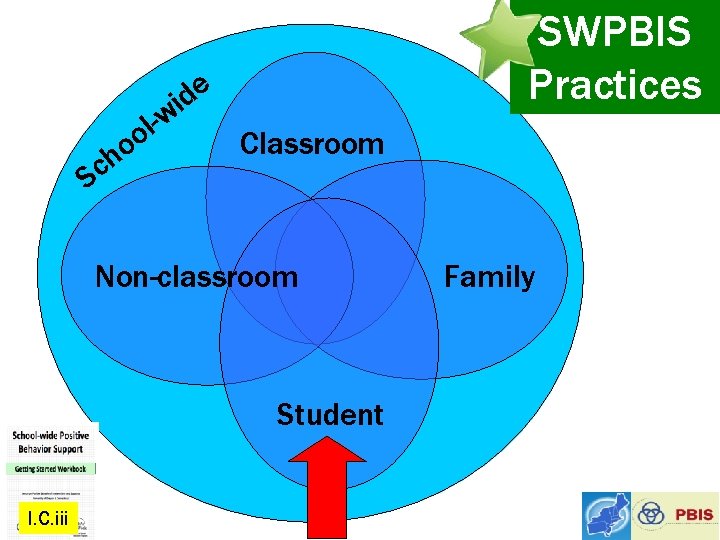
e d i w l- o o h Sc SWPBIS Practices Classroom Non-classroom Student I. C. iii Family
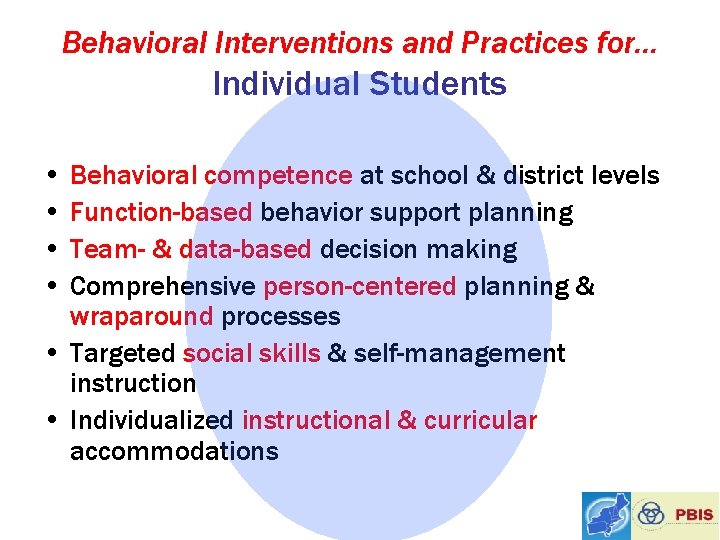
Behavioral Interventions and Practices for… Individual Students • Behavioral competence at school & district levels • Function-based behavior support planning • Team- & data-based decision making • Comprehensive person-centered planning & wraparound processes • Targeted social skills & self-management instruction • Individualized instructional & curricular accommodations
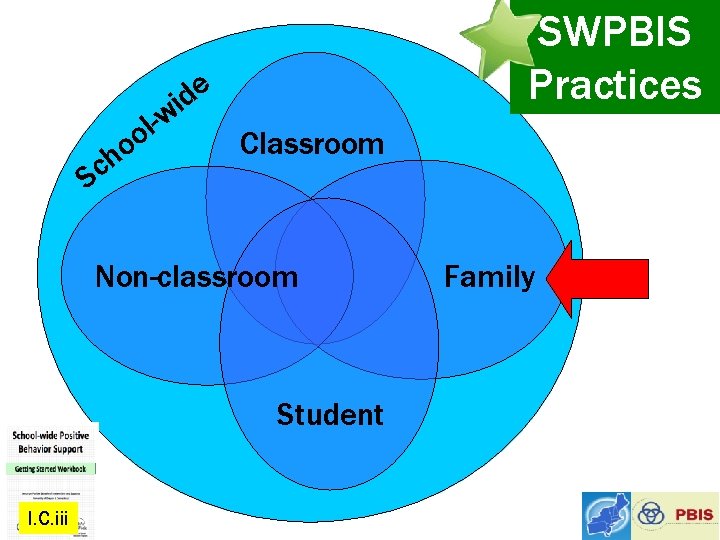
e d i w l- o o h Sc SWPBIS Practices Classroom Non-classroom Student I. C. iii Family
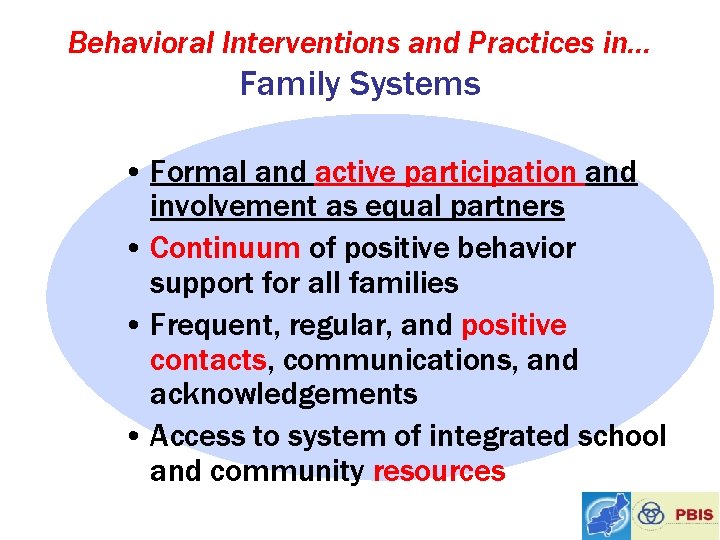
Behavioral Interventions and Practices in… Family Systems • Formal and active participation and involvement as equal partners • Continuum of positive behavior support for all families • Frequent, regular, and positive contacts, communications, and acknowledgements • Access to system of integrated school and community resources
Guidelines for Practices PRACTICES The selection and organization of these practices should: q Be developmentally, contextually, and culturally appropriate and adaptable q Be linked conceptually q Have data rules that guide timely decisions within and between practices and systems q Be empirically and educationally defendable q Be associated directly with the most important and documented school climate and behavior priorities of the school q Be monitored continuously for implementation fidelity and student benefit q Represent the core features that define the tiered prevention logic
PRACTICES What is the SWPBIS continuum of support? I. C. iii
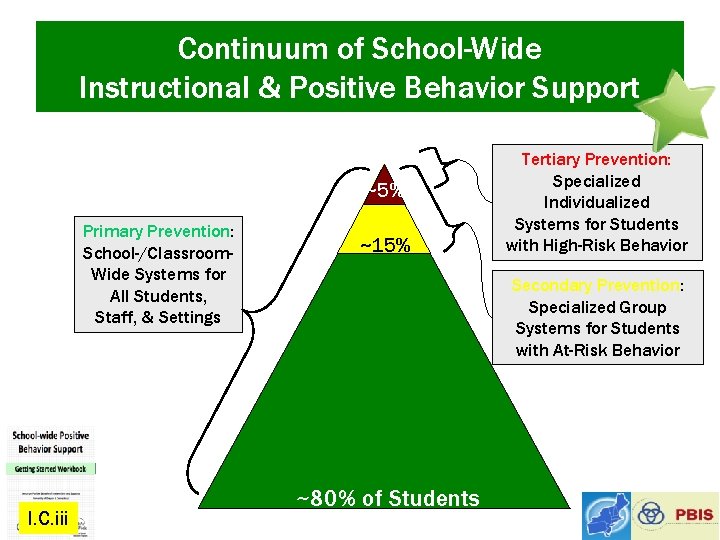
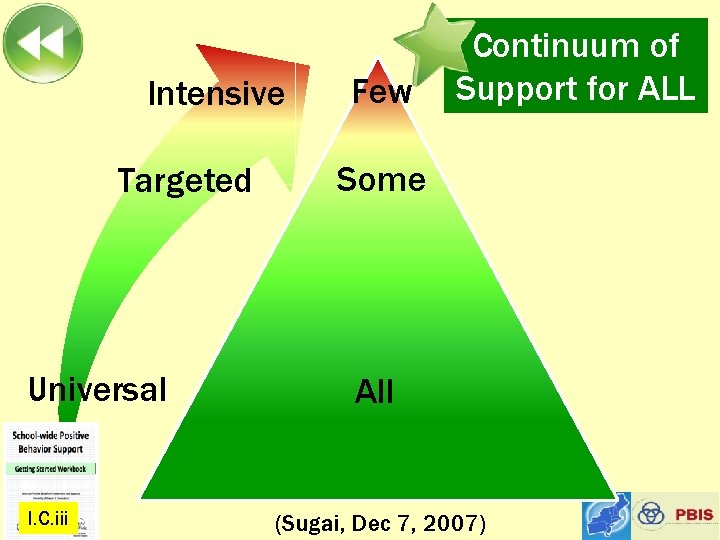
Continuum of School-Wide Instructional & Positive Behavior Support ~5% Primary Prevention: School-/Classroom. Wide Systems for All Students, Staff, & Settings I. C. iii ~15% Tertiary Prevention: Specialized Individualized Systems for Students with High-Risk Behavior Secondary Prevention: Specialized Group Systems for Students with At-Risk Behavior ~80% of Students
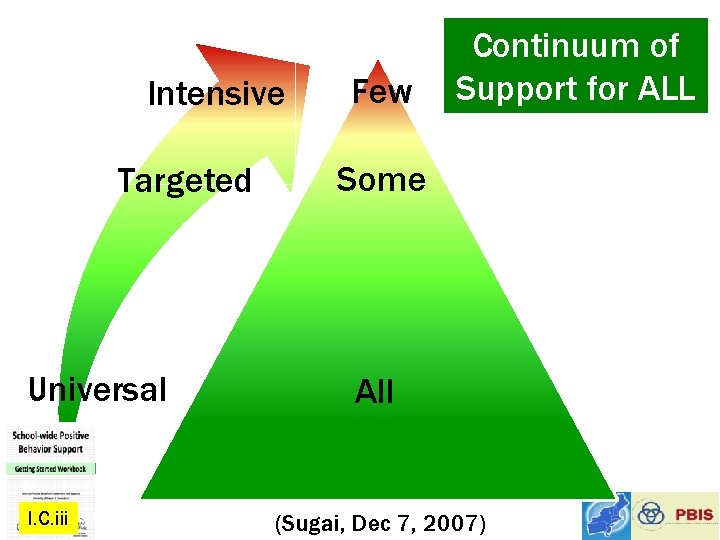
Intensive Targeted Universal I. C. iii Few Continuum of Support for ALL Some All (Sugai, Dec 7, 2007)
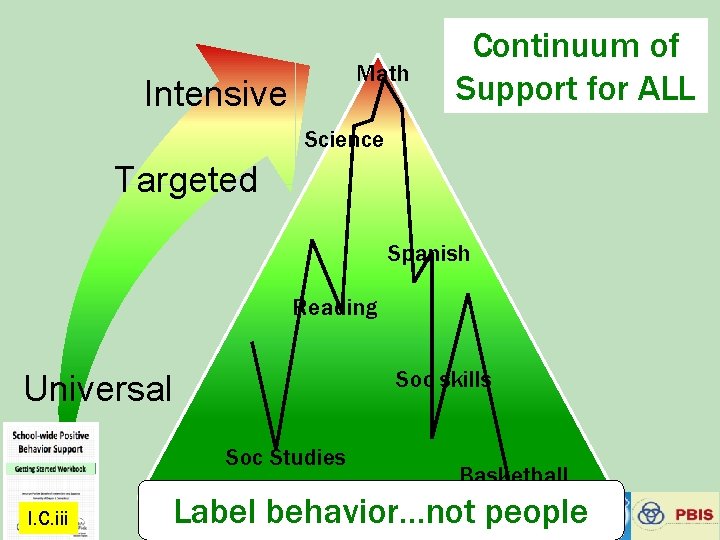
Math Intensive Continuum of Support for ALL Science Targeted Spanish Reading Soc skills Universal Soc Studies I. C. iii Basketball Label behavior…not people Dec 7, 2007
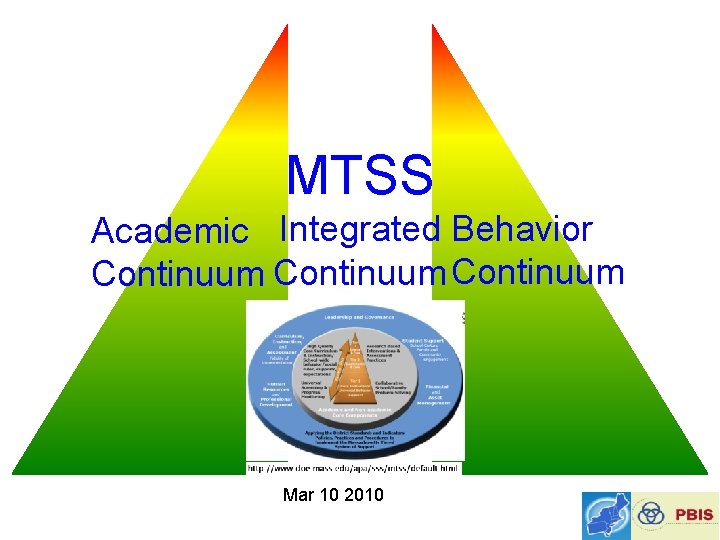
MTSS Academic Integrated Behavior Continuum Mar 10 2010
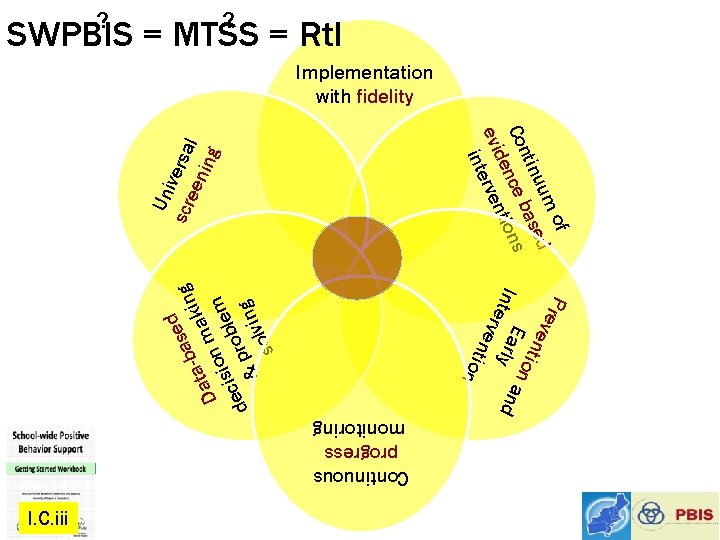
Pr e v en t i o n Int Early and e r ven t i o n d e s a ng b i k a t Da on ma em si l i b c ro g de p & lvin so Uni scr versa een l ing of um d tinu ase Con ce b ions t den evi rven inte I. C. iii ? SWPBIS = MTSS = Rt. I ? Implementation with fidelity Continuous progress monitoring
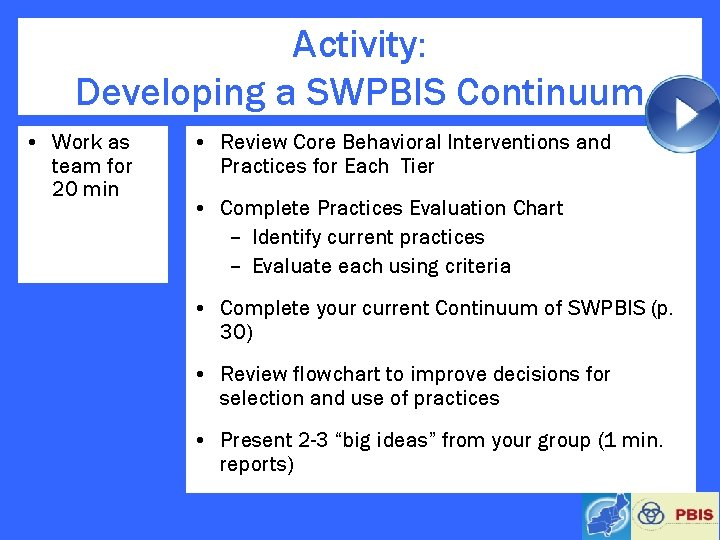
Activity: Developing a SWPBIS Continuum • Work as team for 20 min • Review Core Behavioral Interventions and Practices for Each Tier • Complete Practices Evaluation Chart – Identify current practices – Evaluate each using criteria • Complete your current Continuum of SWPBIS (p. 30) • Review flowchart to improve decisions for selection and use of practices • Present 2 -3 “big ideas” from your group (1 min. reports)
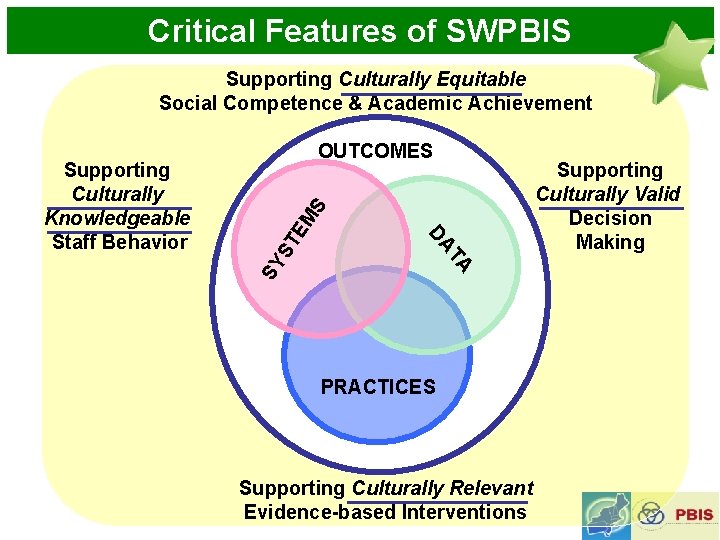
Critical Features of SWPBIS Supporting Culturally Equitable Social Competence & Academic Achievement EM S ST SY TA DA Supporting Culturally Knowledgeable Staff Behavior OUTCOMES PRACTICES Supporting Culturally Relevant Evidence-based Interventions Supporting Culturally Valid Decision Making
SY ST EM S Focus on Systems What are key systems features to support staff? I. C. iv
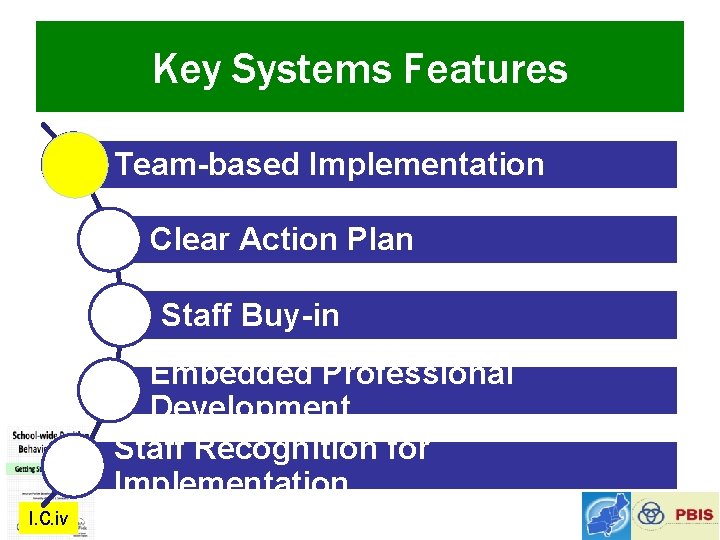
Key Systems Features Team-based Implementation Clear Action Plan Staff Buy-in Embedded Professional Development Staff Recognition for Implementation I. C. iv
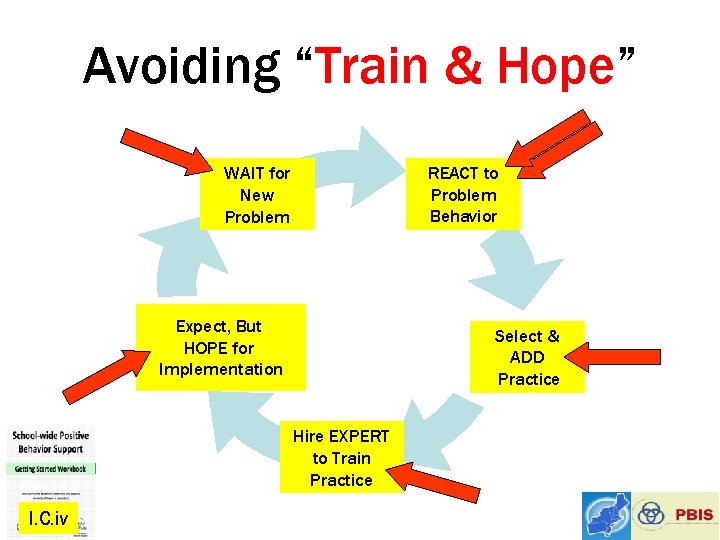
Avoiding “Train & Hope” REACT to Problem Behavior WAIT for New Problem Expect, But HOPE for Implementation Select & ADD Practice Hire EXPERT to Train Practice I. C. iv
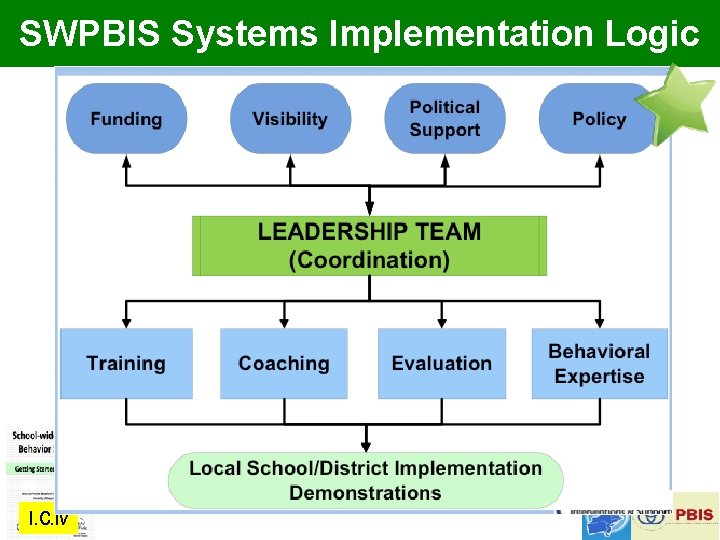
SWPBIS Systems Implementation Logic I. C. iv
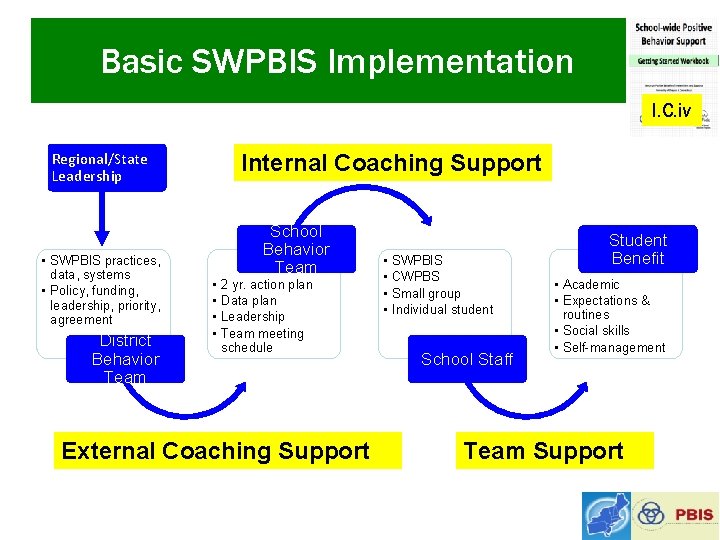
Basic SWPBIS Implementation I. C. iv Regional/State Leadership • SWPBIS practices, data, systems • Policy, funding, leadership, priority, agreement District Behavior Team Internal Coaching Support • • School Behavior Team 2 yr. action plan Data plan Leadership Team meeting schedule External Coaching Support • • SWPBIS CWPBS Small group Individual student School Staff Student Benefit • Academic • Expectations & routines • Social skills • Self-management Team Support
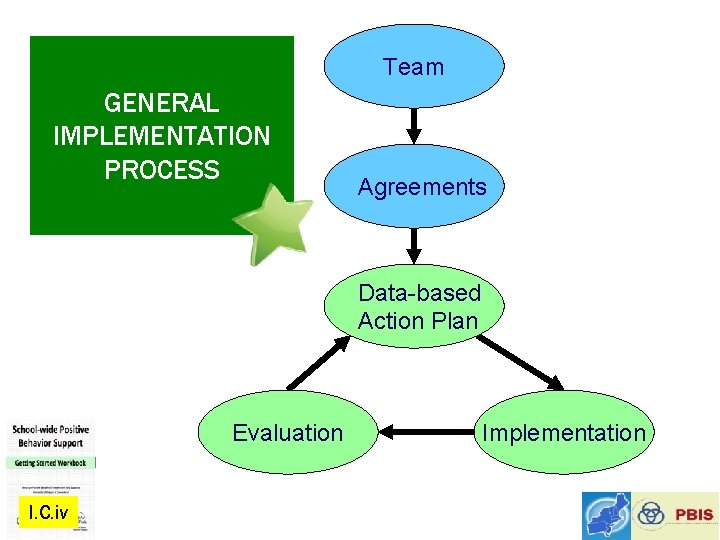
Team GENERAL IMPLEMENTATION PROCESS Agreements Data-based Action Plan Evaluation I. C. iv Implementation
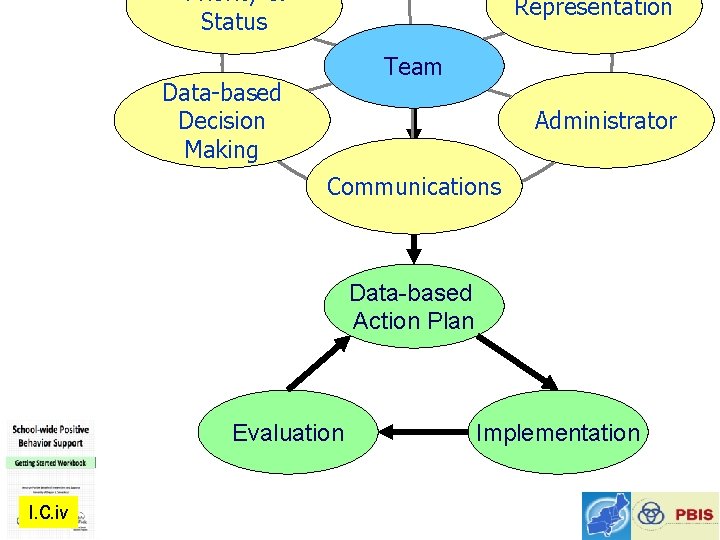
Priority & Status Representation Team Data-based Decision Making Administrator Agreements Communications Data-based Action Plan Evaluation I. C. iv Implementation
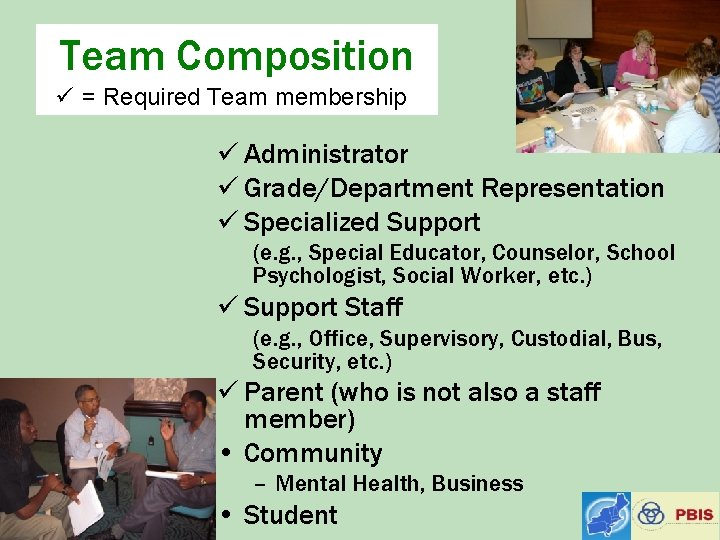
Team Composition ü = Required Team membership ü Administrator ü Grade/Department Representation ü Specialized Support (e. g. , Special Educator, Counselor, School Psychologist, Social Worker, etc. ) ü Support Staff (e. g. , Office, Supervisory, Custodial, Bus, Security, etc. ) ü Parent (who is not also a staff member) • Community – Mental Health, Business • Student
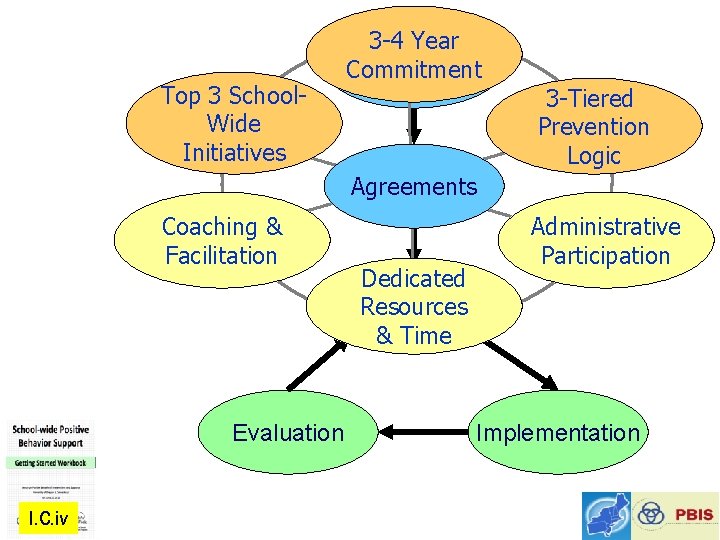
Top 3 School. Wide Initiatives 3 -4 Year Team Commitment 3 -Tiered Prevention Logic Agreements Coaching & Facilitation Evaluation I. C. iv Dedicated Data-based Resources Action Plan & Time Administrative Participation Implementation
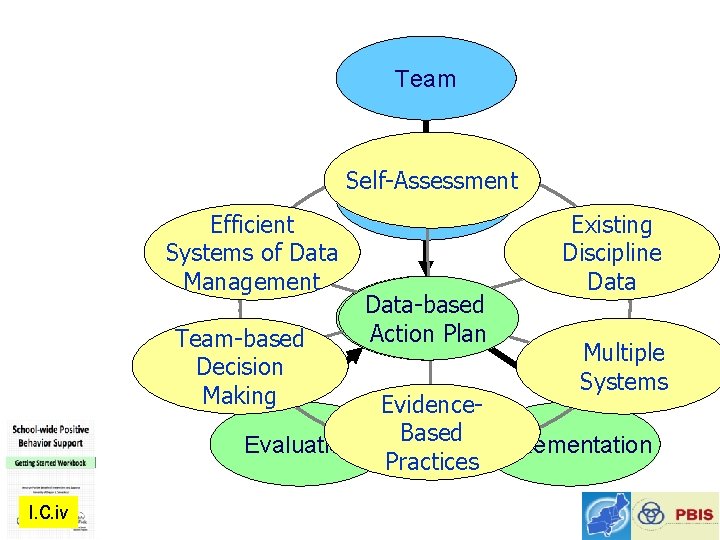
Team Efficient Systems of Data Management Self-Assessment Agreements Team-based Decision Making Evaluation I. C. iv Data-based Action Plan Existing Discipline Data Multiple Systems Evidence. Based Implementation Practices
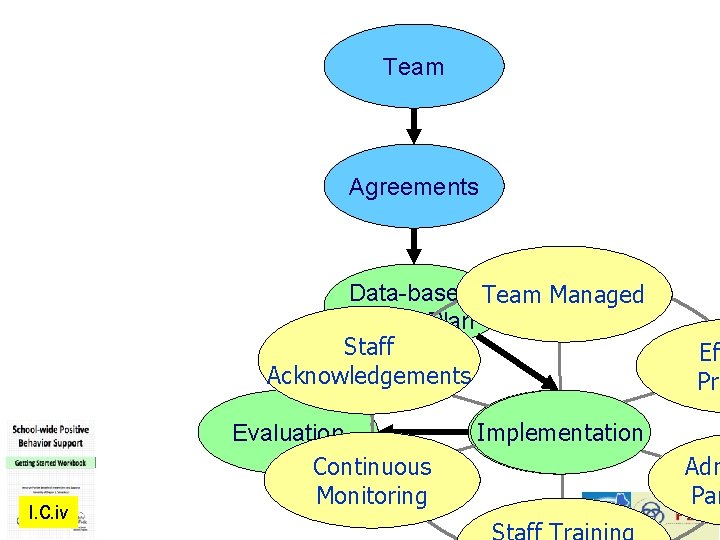
Team Agreements Data-based Team Managed Action Plan Staff Acknowledgements I. C. iv Evaluation Continuous Monitoring Eff Pra Implementation Adm Par
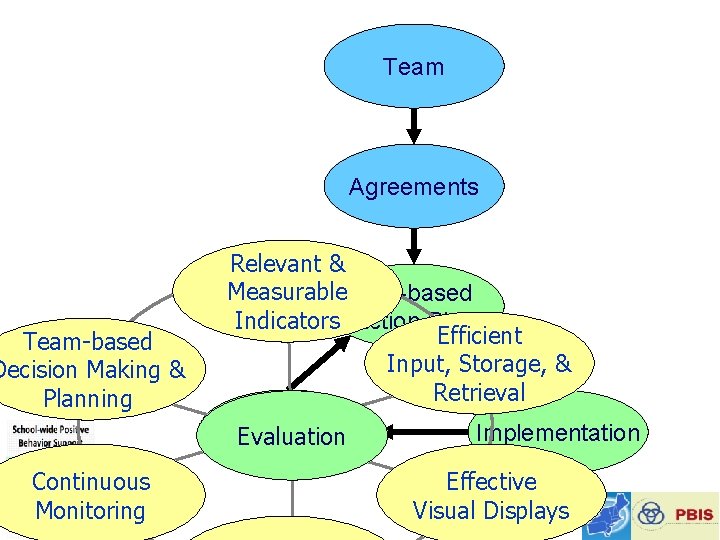
Team Agreements Team-based Decision Making & Planning Relevant & Measurable Data-based Indicators Action Plan Efficient Input, Storage, & Retrieval Evaluation Continuous Monitoring I. C. iv Implementation Effective Visual Displays
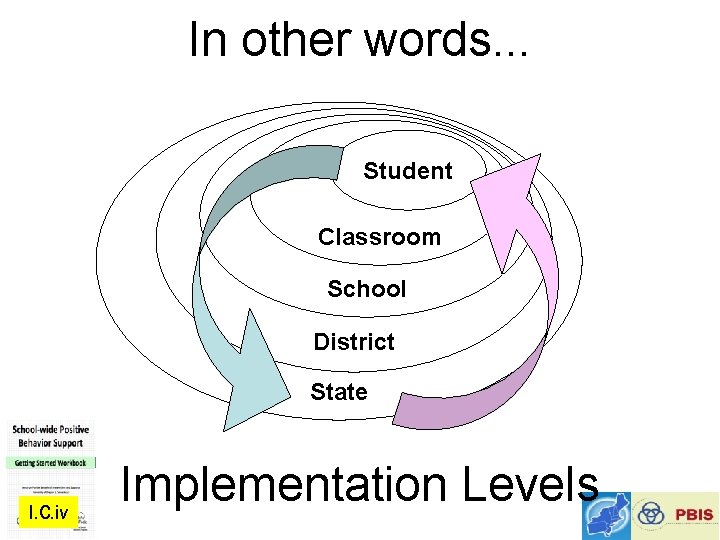
In other words. . . Student Classroom School District State I. C. iv Implementation Levels
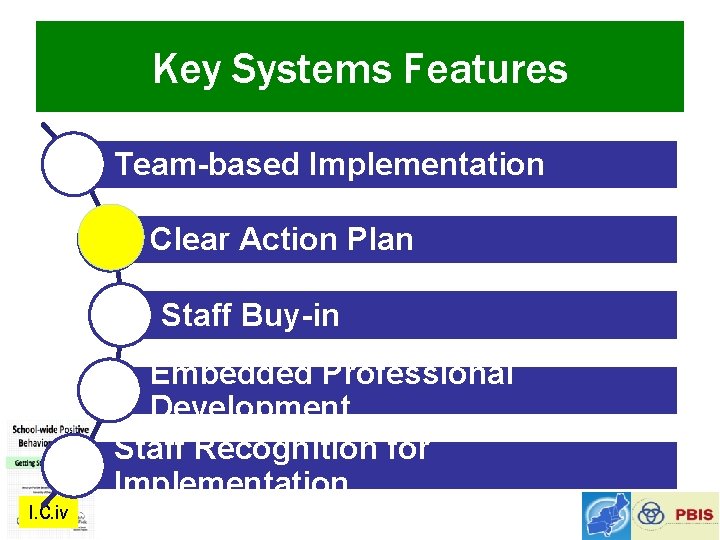
Key Systems Features Team-based Implementation Clear Action Plan Staff Buy-in Embedded Professional Development Staff Recognition for Implementation I. C. iv
Action Planning • Process of organizing and using resources to enable individuals to engage in activities designed to achieve specific and important outcomes
Activity: Preview Action Plan Template • Work as team for 5 min • Preview Action Plan process principles, facilitating questions, and example worksheets in workbook • Download suggested template on nepbis. org • Begin to complete individualize content (and format, if desired) for your team/school • Present 2 -3 “big ideas” from your group (1 min. reports)
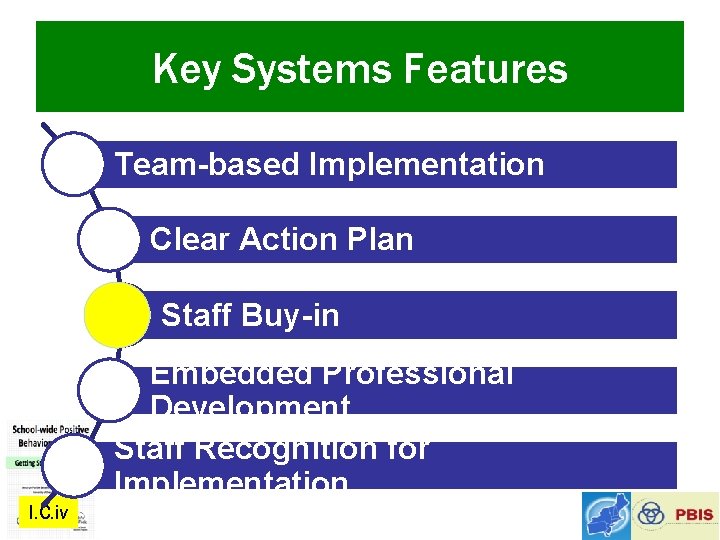
Key Systems Features Team-based Implementation Clear Action Plan Staff Buy-in Embedded Professional Development Staff Recognition for Implementation I. C. iv
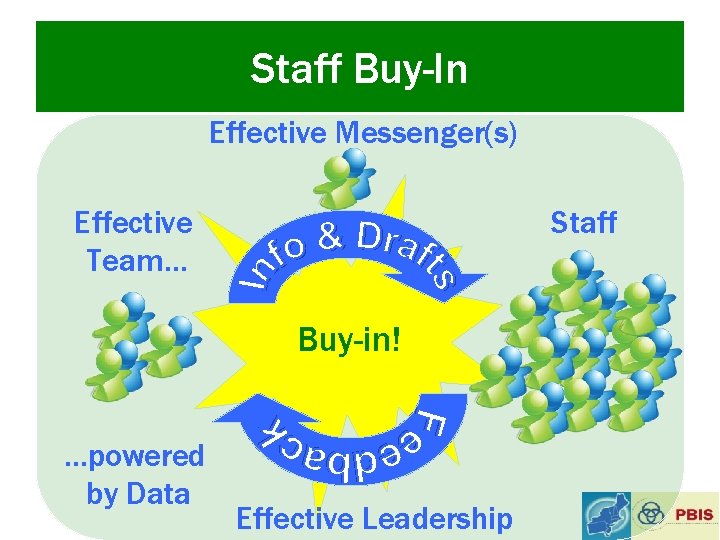
Staff Buy-In Effective Messenger(s) Effective Team… Staff Buy-in! …powered by Data Effective Leadership
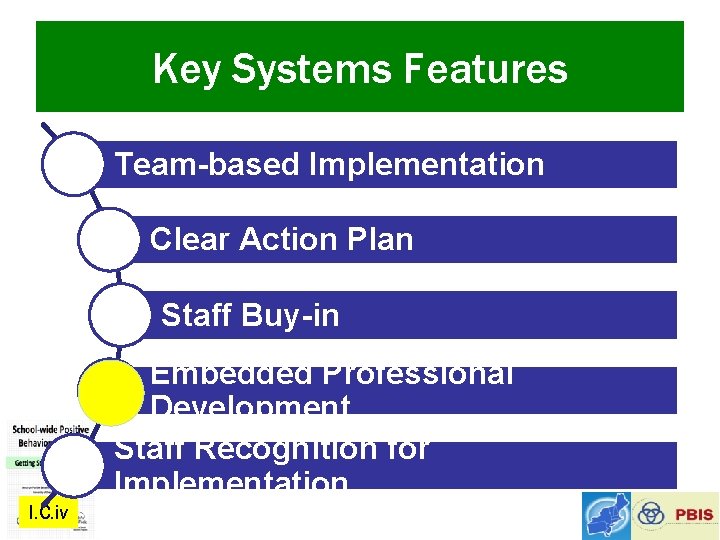
Key Systems Features Team-based Implementation Clear Action Plan Staff Buy-in Embedded Professional Development Staff Recognition for Implementation I. C. iv
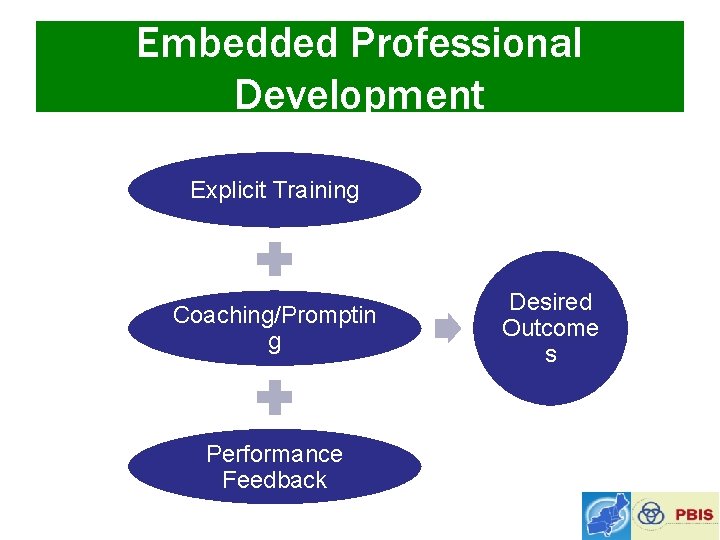
Embedded Professional Development Explicit Training Coaching/Promptin g Performance Feedback Desired Outcome s
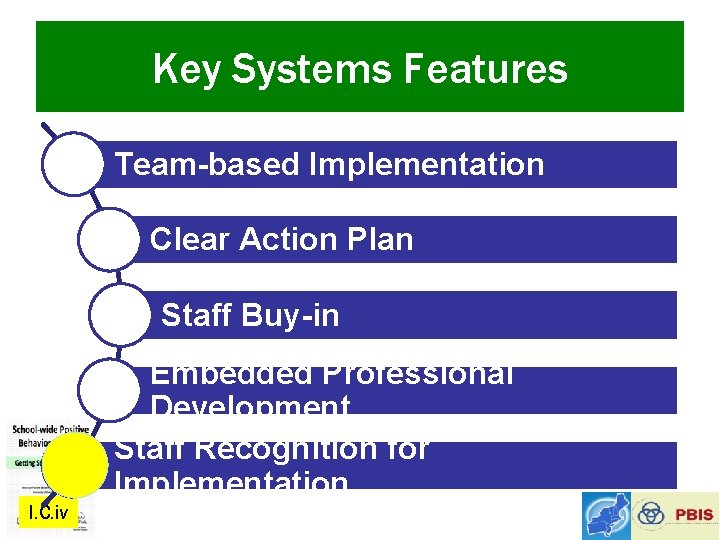
Key Systems Features Team-based Implementation Clear Action Plan Staff Buy-in Embedded Professional Development Staff Recognition for Implementation I. C. iv
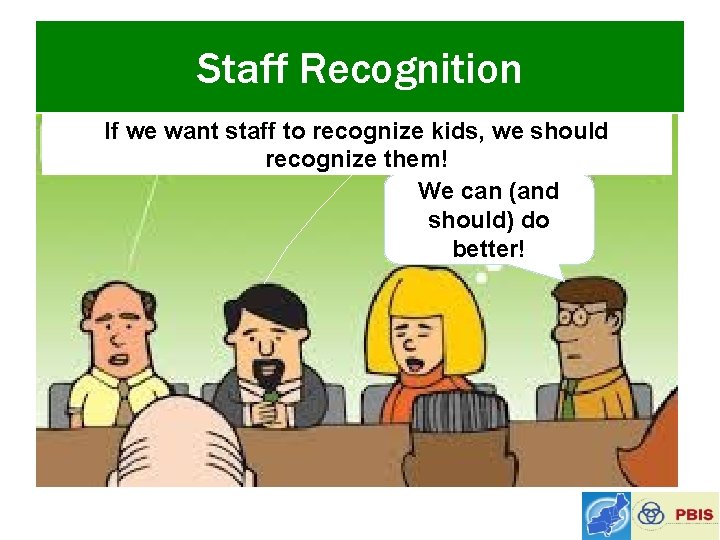
Staff Recognition If we want staff to recognize kids, we should recognize them! We can (and should) do better!
SY ST EM S Guidelines for Systems For each item in your action plan, ensure: q Agreement by >80% faculty and staff q Include procedures for informing others (e. g. families, community, district administrators, substitute teachers & staff) q Includes procedures for providing instruction to new faculty, staff, students, etc. q Schedule continuous evaluation of effectiveness, efficiency, and relevance q Include in school publications (e. g. , handbook, posters, newsletters, etc. ) I. C. iv
Cultural and Contextual Fit How do you ensure cultural and contextual fit? Culture & Context
Guidelines for Culture & Context For each item in your action plan, ensure: q Involve staff, students, & families in development q Contextually/culturally appropriate (e. g. , age, level, language) q Examine disaggregated data to ensure implementation of each feature works for all subgroups of students I. C. v
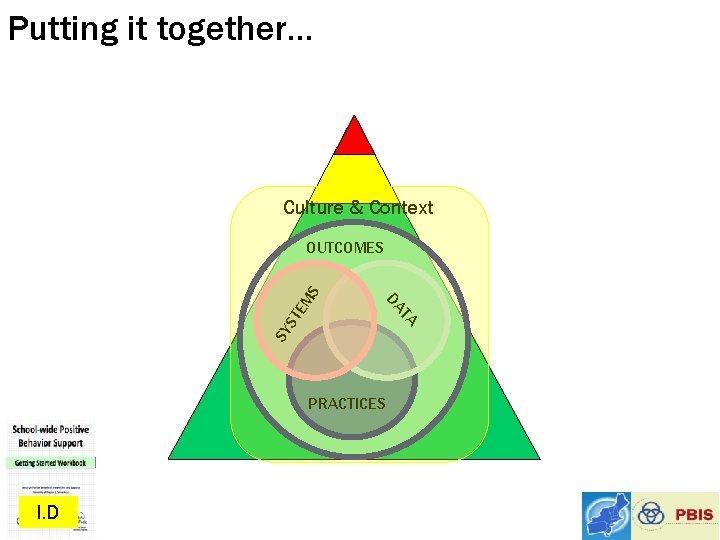
Putting it together… Culture & Context SY PRACTICES I. D TA DA ST EM S OUTCOMES
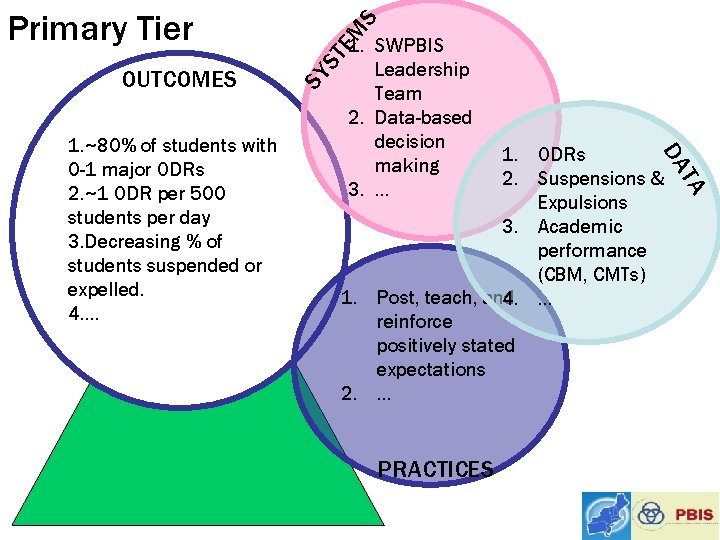
S EM 1. ODRs 2. Suspensions & Expulsions 3. Academic performance (CBM, CMTs) 1. Post, teach, and 4. … reinforce positively stated expectations 2. … PRACTICES TA 1. SWPBIS Leadership Team 2. Data-based decision making 3. … DA 1. ~80% of students with 0 -1 major ODRs 2. ~1 ODR per 500 students per day 3. Decreasing % of students suspended or expelled. 4. … ST OUTCOMES SY Primary Tier
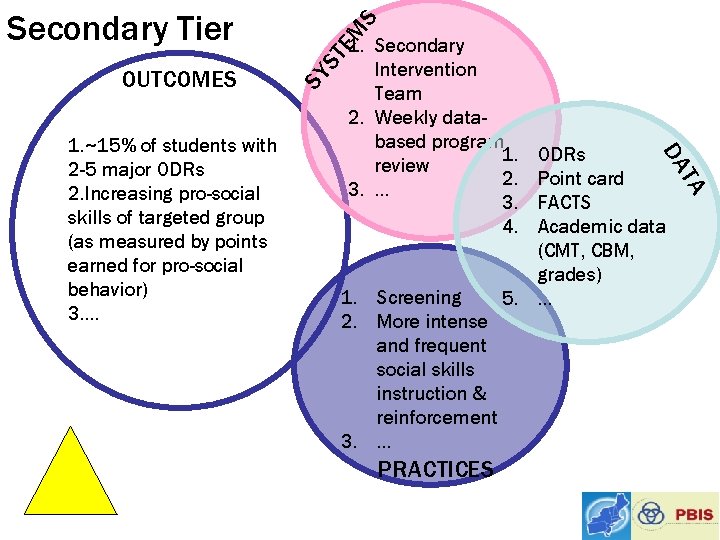
S EM 1. Screening 2. More intense and frequent social skills instruction & reinforcement 3. … PRACTICES ODRs Point card FACTS Academic data (CMT, CBM, grades) 5. … TA 1. Secondary Intervention Team 2. Weekly databased program 1. review 2. 3. … 3. 4. DA 1. ~15% of students with 2 -5 major ODRs 2. Increasing pro-social skills of targeted group (as measured by points earned for pro-social behavior) 3. … ST OUTCOMES SY Secondary Tier
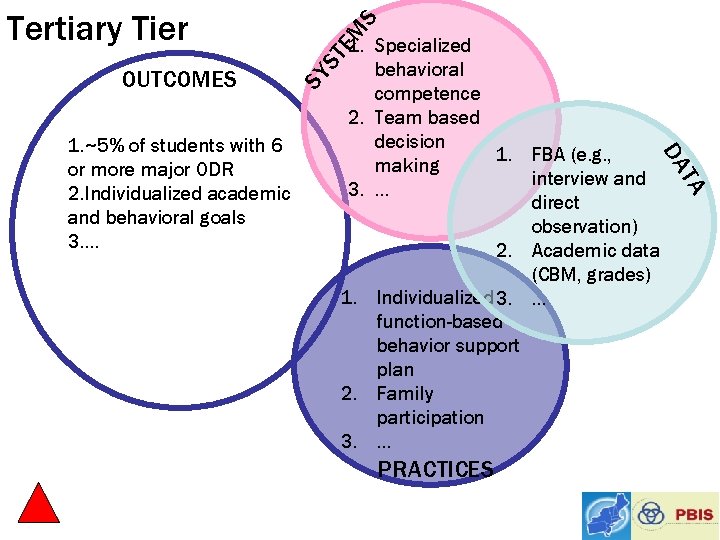
S EM PRACTICES TA DA 1. ~5% of students with 6 or more major ODR 2. Individualized academic and behavioral goals 3. … 1. Specialized behavioral competence 2. Team based decision 1. FBA (e. g. , making interview and 3. … direct observation) 2. Academic data (CBM, grades) 1. Individualized 3. … function-based behavior support plan 2. Family participation 3. … ST OUTCOMES SY Tertiary Tier
GETTING STARTED WITH SWPBIS (Chapter II)
What is the “Basic Logic” in one picture? II. A
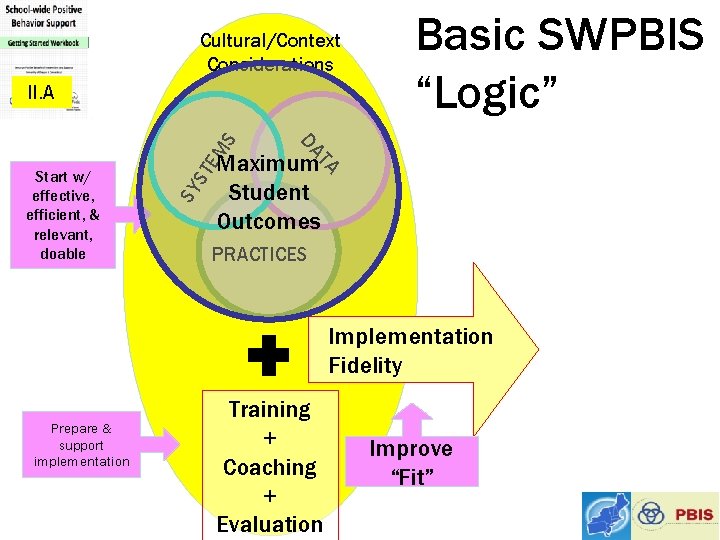
Cultural/Context Considerations EM ST SY Maximum Student Outcomes TA Start w/ effective, efficient, & relevant, doable DA S II. A Basic SWPBIS “Logic” PRACTICES Implementation Fidelity Prepare & support implementation Training + Coaching + Evaluation Improve “Fit”
Let’s get started! II. B
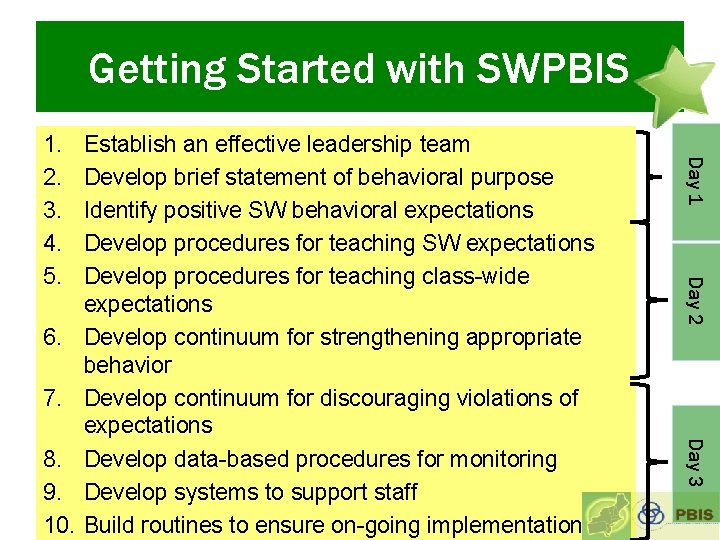
Getting Started with SWPBIS 7. Day 3 8. 9. 10. Day 2 6. Establish an effective leadership team Develop brief statement of behavioral purpose Identify positive SW behavioral expectations Develop procedures for teaching SW expectations Develop procedures for teaching class-wide expectations Develop continuum for strengthening appropriate behavior Develop continuum for discouraging violations of expectations Develop data-based procedures for monitoring Develop systems to support staff Build routines to ensure on-going implementation Day 1 1. 2. 3. 4. 5.
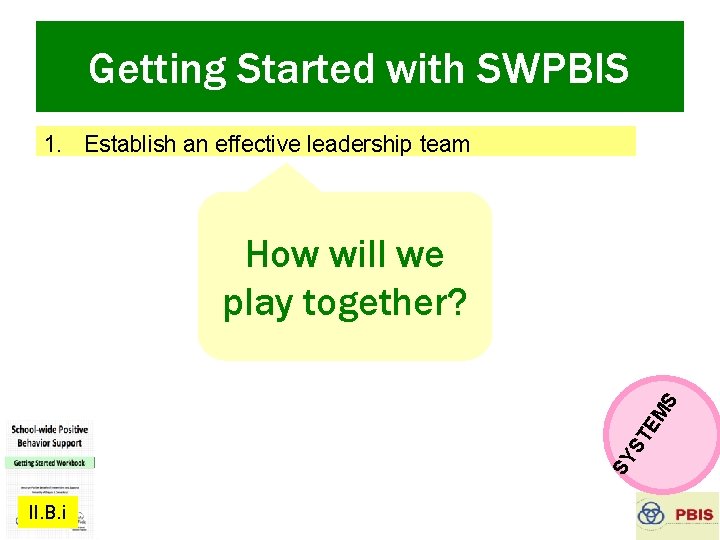
Getting Started with SWPBIS 8. 9. II. B. i 10. S EM 7. How will we play together? ST 6. Establish an effective leadership team Develop brief statement of behavioral purpose Identify positive SW behavioral expectations Develop procedures for teaching SW expectations Develop procedures for teaching class-wide expectations Develop continuum for strengthening appropriate behavior Develop continuum for discouraging violations of expectations Develop data-based procedures for monitoring Develop systems to support staff Build routines to ensure on-going implementation SY 1. 2. 3. 4. 5.
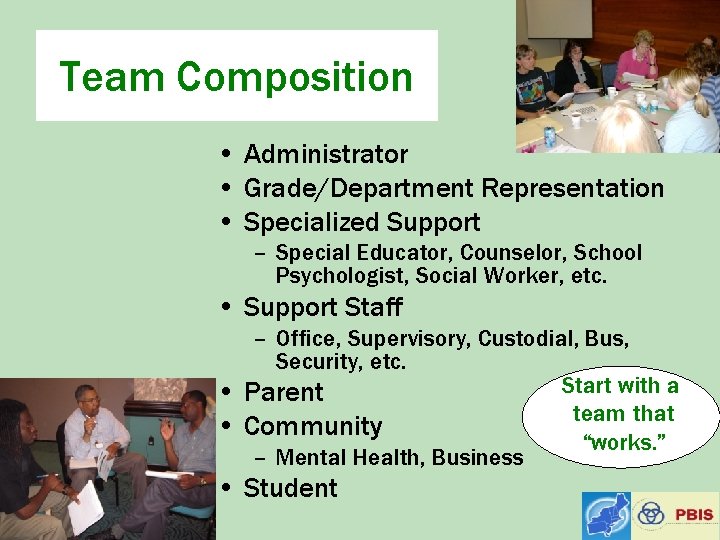
Team Composition • Administrator • Grade/Department Representation • Specialized Support – Special Educator, Counselor, School Psychologist, Social Worker, etc. • Support Staff – Office, Supervisory, Custodial, Bus, Security, etc. Start with a • Parent team that • Community “works. ” – Mental Health, Business • Student
EM S ST SY Guidelines for Team Composition q Representative of school/community demographics q 1 -2 individuals with behavior/classroom management competence q 1 -2 family members q Administrator as active member q Schedule for presenting to whole staff at least monthly q Schedule for meeting at least monthly q Integration with other behavior related initiatives and programs q Appropriate priority relative to school/district goals q Rules/agreements established q Schedule for annual self-assessments (see list)
Activity: Team Profile and Agreements • Work as team for 15 min • Complete Team Profile and Agreements • Review Conducting Leadership Meetings Worksheet • Establish Routines for Conducting Effective and Efficient Meetings • Add items to your Action Plan as necessary • Present 2 -3 “big ideas” from your group (1 min. reports)
Getting Started with SWPBIS 8. 9. II. B. i 10. S Working Smarter EM 7. What if the same people are on every team? ST 6. Establish an effective leadership team Develop brief statement of behavioral purpose Identify positive SW behavioral expectations Develop procedures for teaching SW expectations Develop procedures for teaching class-wide expectations Develop continuum for strengthening appropriate behavior Develop continuum for discouraging violations of expectations Develop data-based procedures for monitoring Develop systems to support staff Build routines to ensure on-going implementation SY 1. 2. 3. 4. 5.
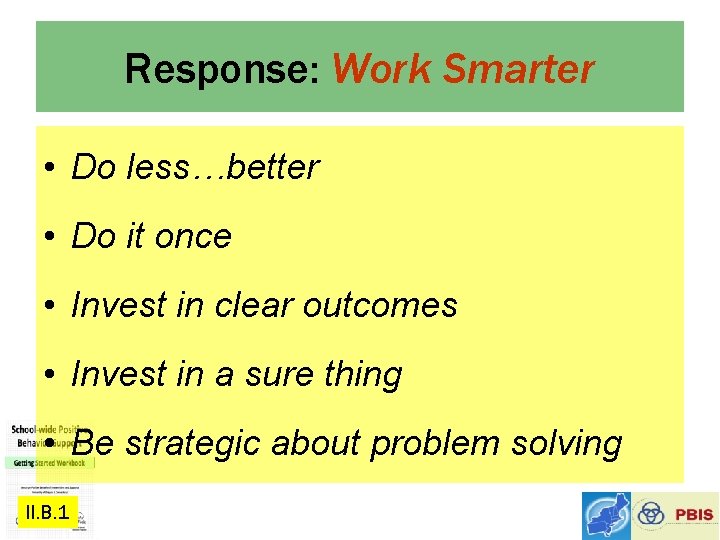
Response: Work Smarter • Do less…better • Do it once • Invest in clear outcomes • Invest in a sure thing • Be strategic about problem solving II. B. 1
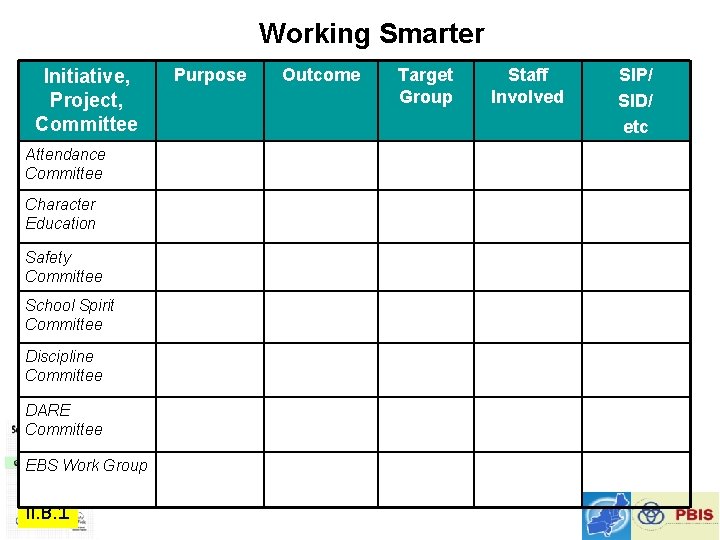
Working Smarter Initiative, Project, Committee Attendance Committee Character Education Safety Committee School Spirit Committee Discipline Committee DARE Committee EBS Work Group II. B. 1 Purpose Outcome Target Group Staff Involved SIP/ SID/ etc
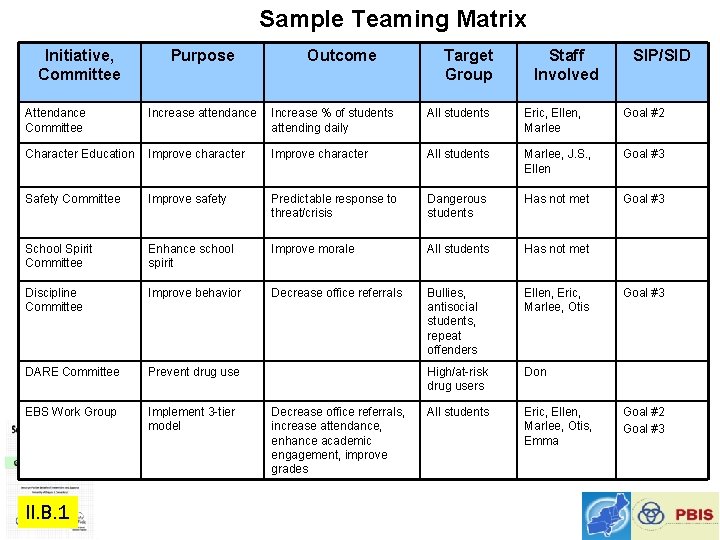
Sample Teaming Matrix Initiative, Committee Purpose Outcome Target Group Staff Involved SIP/SID Attendance Committee Increase attendance Increase % of students attending daily All students Eric, Ellen, Marlee Goal #2 Character Education Improve character All students Marlee, J. S. , Ellen Goal #3 Safety Committee Improve safety Predictable response to threat/crisis Dangerous students Has not met Goal #3 School Spirit Committee Enhance school spirit Improve morale All students Has not met Discipline Committee Improve behavior Decrease office referrals Bullies, antisocial students, repeat offenders Ellen, Eric, Marlee, Otis DARE Committee Prevent drug use High/at-risk drug users Don EBS Work Group Implement 3 -tier model All students Eric, Ellen, Marlee, Otis, Emma II. B. 1 Decrease office referrals, increase attendance, enhance academic engagement, improve grades Goal #3 Goal #2 Goal #3
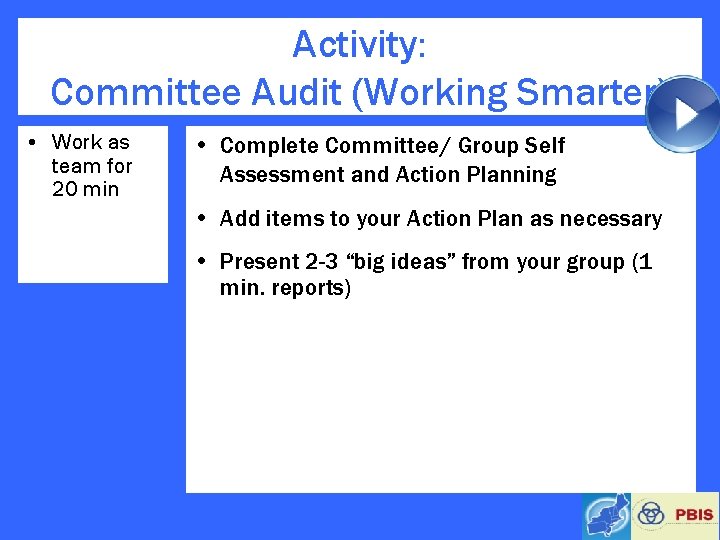
Activity: Committee Audit (Working Smarter) • Work as team for 20 min • Complete Committee/ Group Self Assessment and Action Planning • Add items to your Action Plan as necessary • Present 2 -3 “big ideas” from your group (1 min. reports)
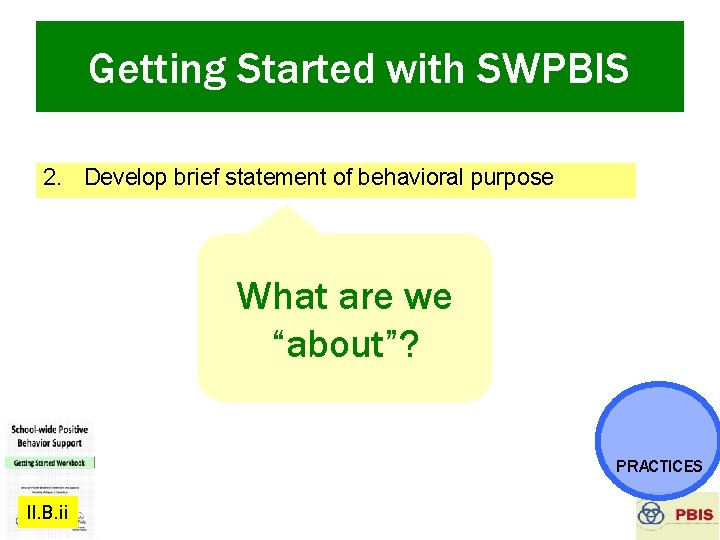
Getting Started with SWPBIS 1. 2. 3. 4. 5. 6. 7. 8. 9. II. B. ii 10. Establish an effective leadership team Develop brief statement of behavioral purpose Identify positive SW behavioral expectations Develop procedures for teaching SW expectations Develop procedures for teaching class-wide expectations Develop continuum for strengthening appropriate behavior Develop continuum for discouraging violations of expectations Develop data-based procedures for monitoring Develop systems to support staff Build routines to ensure on-going implementation What are we “about”? PRACTICES
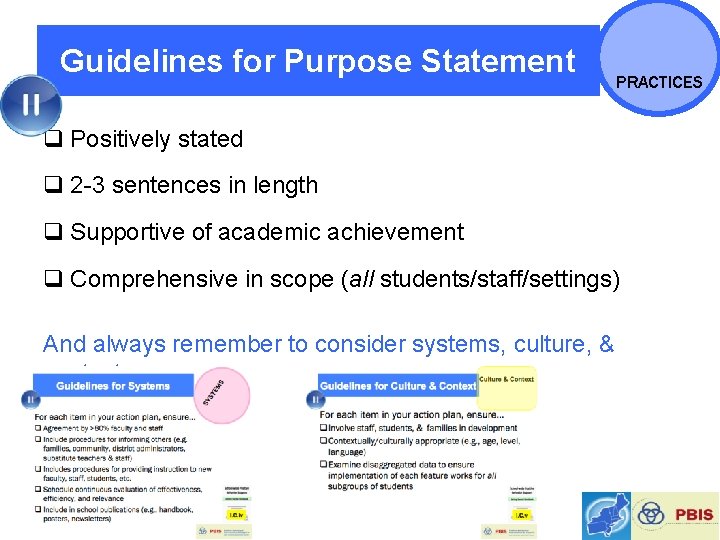
Guidelines for Purpose Statement PRACTICES q Positively stated q 2 -3 sentences in length q Supportive of academic achievement q Comprehensive in scope (all students/staff/settings) And always remember to consider systems, culture, & context:
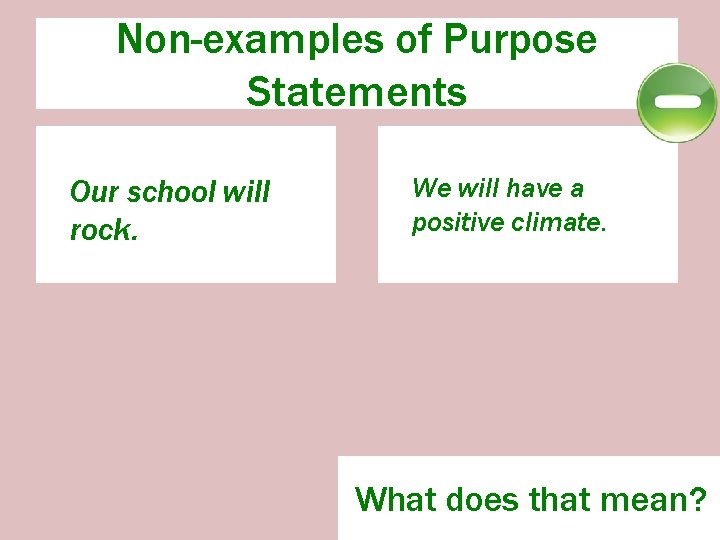
Non-examples of Purpose Statements Our school will rock. We will have a positive climate. What does that mean?
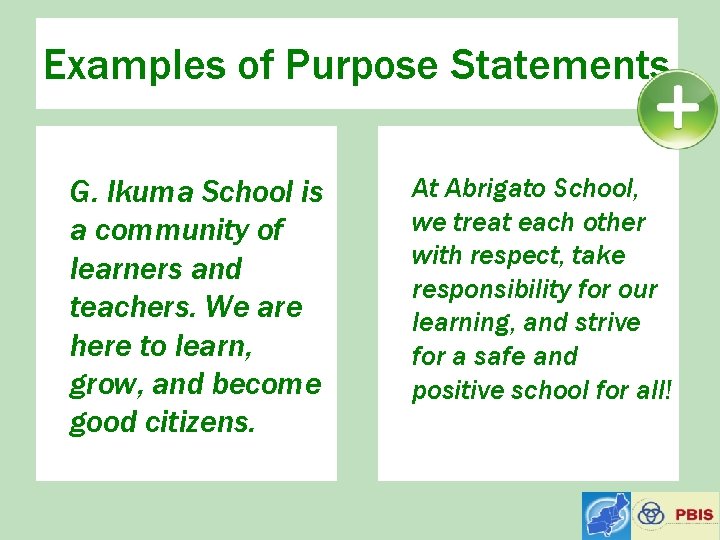
Examples of Purpose Statements G. Ikuma School is a community of learners and teachers. We are here to learn, grow, and become good citizens. At Abrigato School, we treat each other with respect, take responsibility for our learning, and strive for a safe and positive school for all!
Activity: Behavioral Purpose Statement • Work as team for 10 min • Draft School-Wide Behavioral Purpose Statement • Add items to your Action Plan as necessary • Present 2 -3 “big ideas” from your group (1 min. reports)
Getting Started with SWPBIS 1. 2. 3. 4. 5. Establish an effective leadership team Develop brief statement of behavioral purpose Identify positive SW behavioral expectations Develop procedures for teaching SW expectations Develop procedures for teaching class-wide expectations 6. Develop continuum for strengthening appropriate behavior 7. Develop continuum for discouraging violations of expectations 8. Develop data-based procedures for monitoring 9. Develop systems to support staff II. B. iii 10. Build routines to ensure on-going implementation What do we expect? PRACTICES
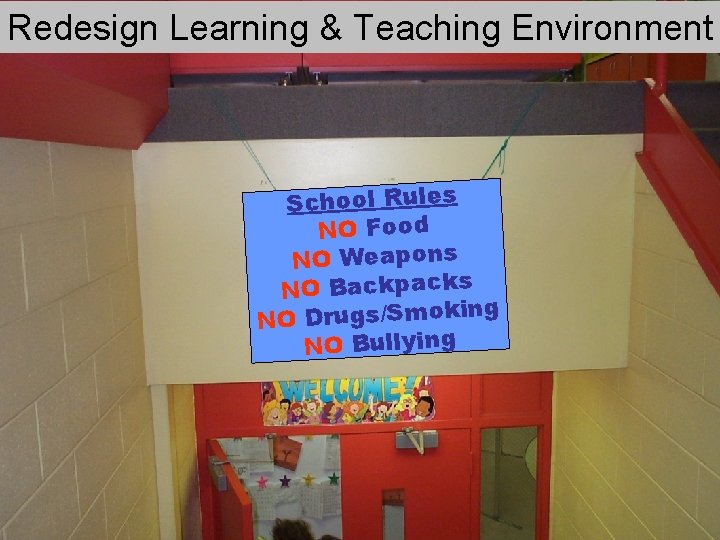
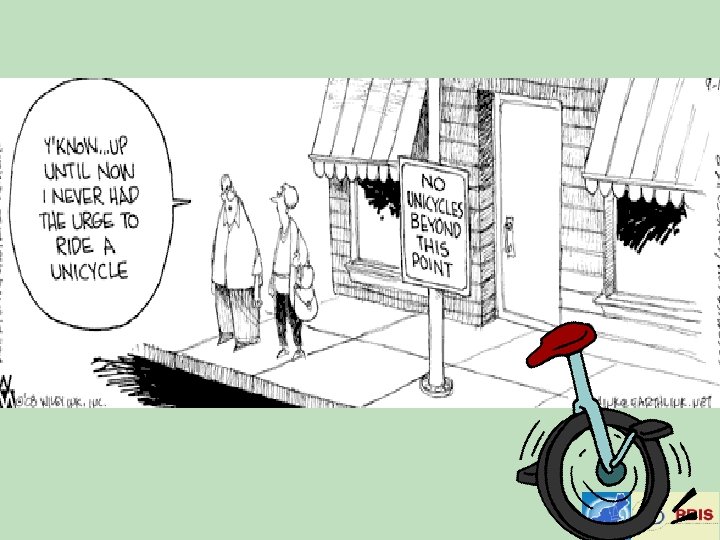
Redesign Learning & Teaching Environment School Rules NO Food NO Weapons NO Backpacks g NO Drugs/Smokin NO Bullying
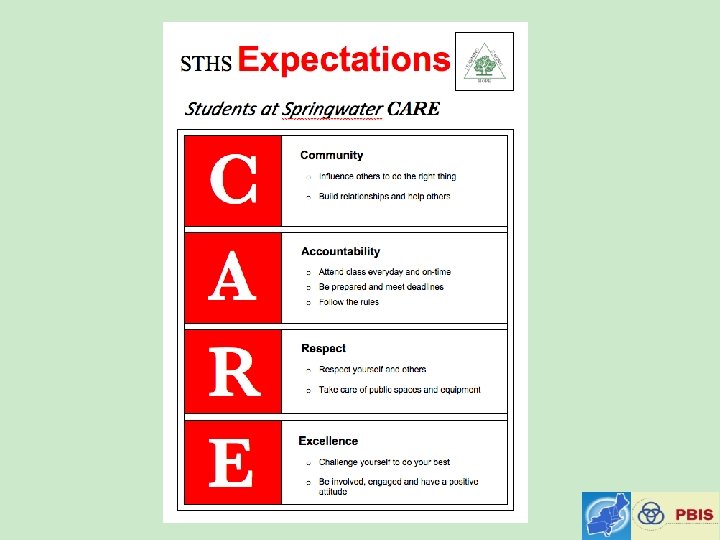
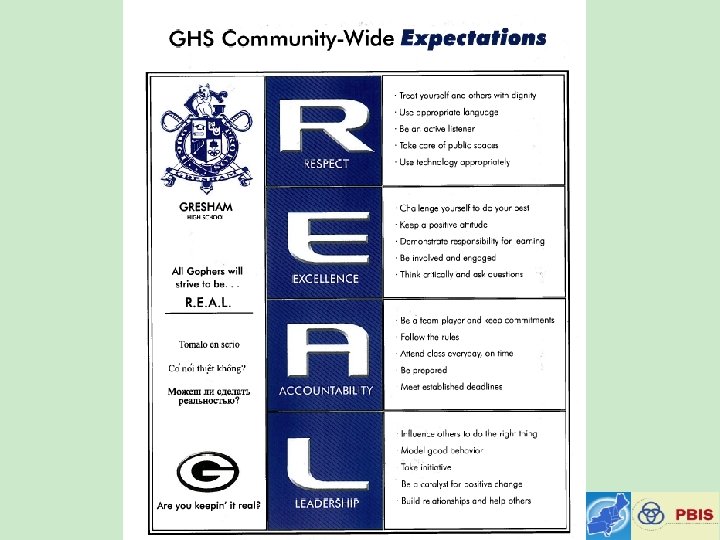
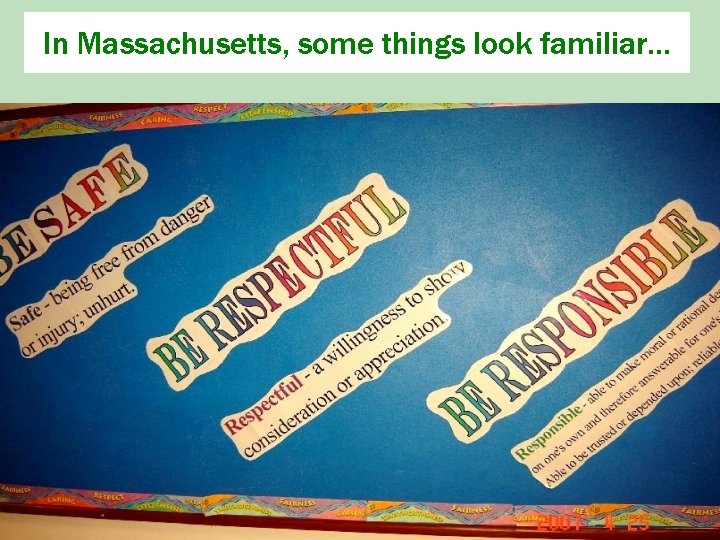
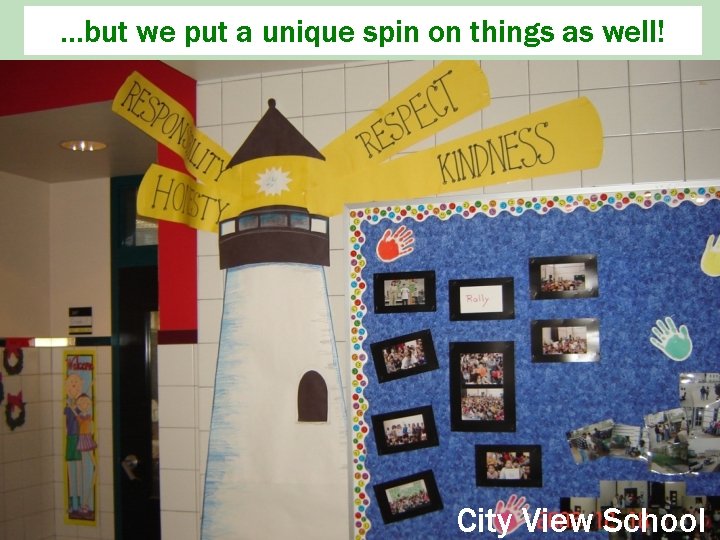
Guidelines for Expectations q Linked to social culture of school q Considerate of social skills that already exist q 3 -5 in number q 1 -3 words per expectation q Positively Stated II. B. iii PRACTICES
Guidelines for Expectations PRACTICES q Linked to social culture of school q Considerate of social skills that already exist q 3 -5 in number q 1 -3 words per expectation q Positively Stated q Supportive of academic achievement q Comprehensive in scope q Mutually exclusive (minimal overlap) And always remember to consider systems, culture, & context: II. B. iii
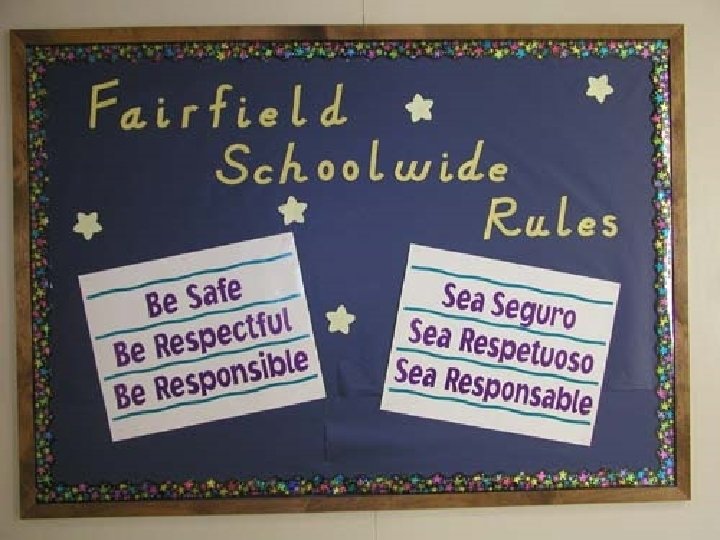
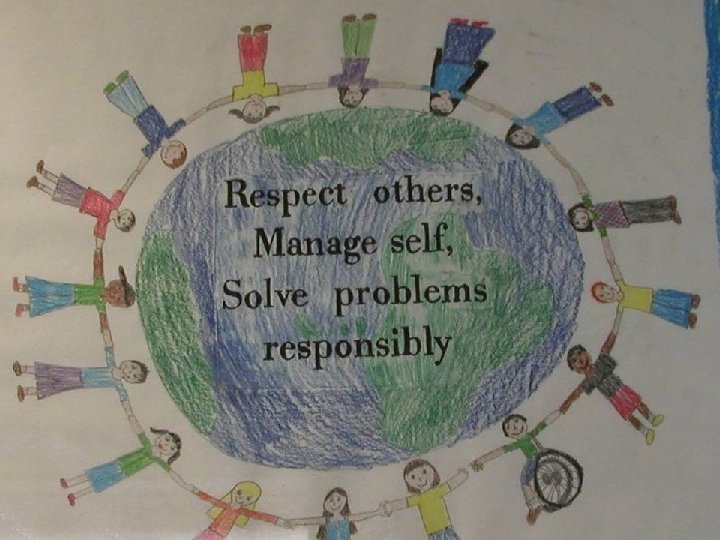
In Massachusetts, some things look familiar…
…but we put a unique spin on things as well! City View School
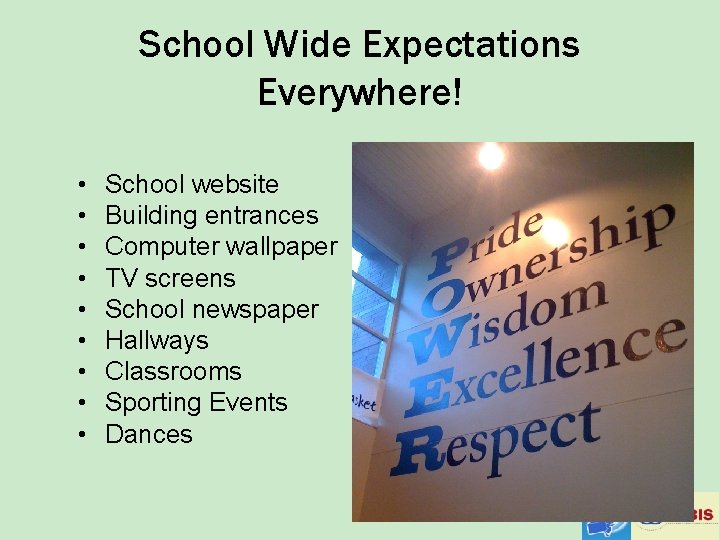
School Wide Expectations Everywhere! • • • School website Building entrances Computer wallpaper TV screens School newspaper Hallways Classrooms Sporting Events Dances
Activity: Behavioral Expectations • Work as team for 10 min • Draft School-Wide Behavior Expectations • Add items to your Action Plan as necessary • Present 2 -3 “big ideas” from your group (1 min. reports)
SWPBIS Action Planning
Activity: Action Planning • Work as team for 75 min • Return to your Action Plan • Update sections corresponding to: – Team profile and agreements – Committee Audit (working smarter matrix) – Getting started steps 1 -3 • In particular, make sure you’ve chosen a day, time, and setting for your regular SWPBIS team meetings! • Present 2 -3 “big ideas” from your group (1 min. reports) • Reminder: We will be collecting team action plans at the end of day 2 in order to provide specific feedback for your team.
Review of SWPBIS
SWPBIS Message! Successful individual student behavior support is linked to host environments or school climates that are effective, efficient, relevant, & durable. (Zins & Ponti, 1990) I. A. i
Critical Features of SWPBIS Supporting Culturally Equitable Social Competence & Academic Achievement OUTCOMES EM S SY ST Supporting Culturally Valid Decision Making TA DA Supporting Culturally Knowledgeable Staff Behavior (Vincent, Randal, Cartledge, Tobin, & Swain. Bradway, 2011; Sugai, O’Keefe, & Fallon 2012 ab) PRACTICES I. C Supporting Culturally Relevant Evidence-based Interventions
Intensive Targeted Universal I. C. iii Few Continuum of Support for ALL Some All (Sugai, Dec 7, 2007)
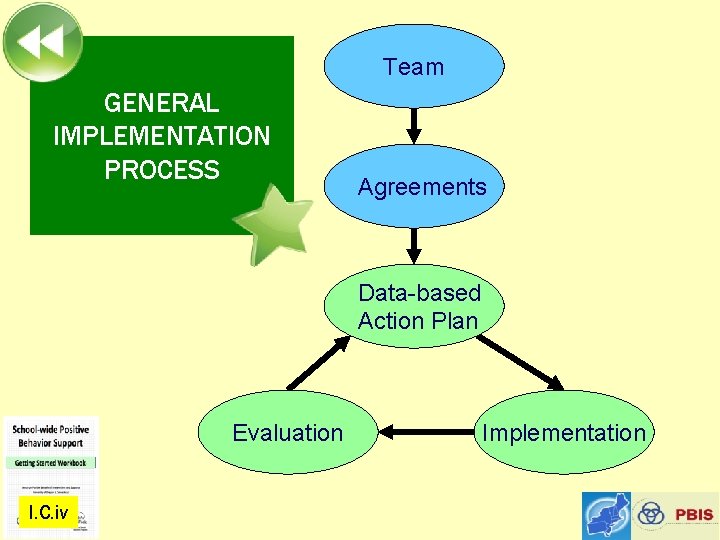
Team GENERAL IMPLEMENTATION PROCESS Agreements Data-based Action Plan Evaluation I. C. iv Implementation
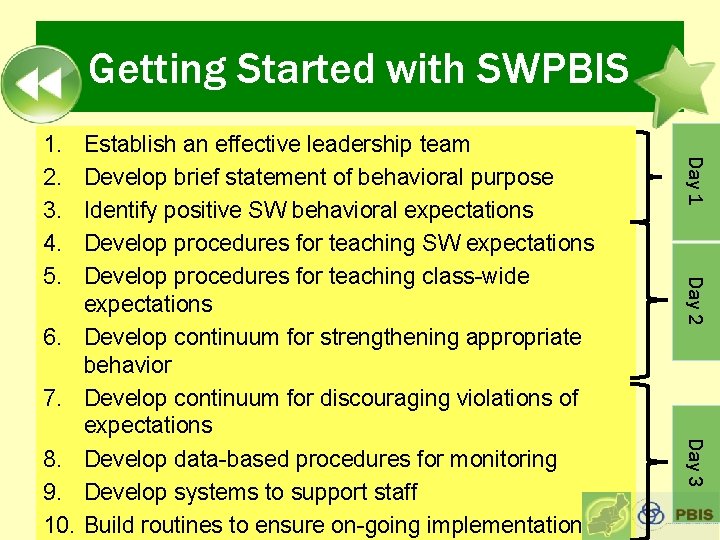
Getting Started with SWPBIS 7. Day 3 8. 9. 10. Day 2 6. Establish an effective leadership team Develop brief statement of behavioral purpose Identify positive SW behavioral expectations Develop procedures for teaching SW expectations Develop procedures for teaching class-wide expectations Develop continuum for strengthening appropriate behavior Develop continuum for discouraging violations of expectations Develop data-based procedures for monitoring Develop systems to support staff Build routines to ensure on-going implementation Day 1 1. 2. 3. 4. 5.
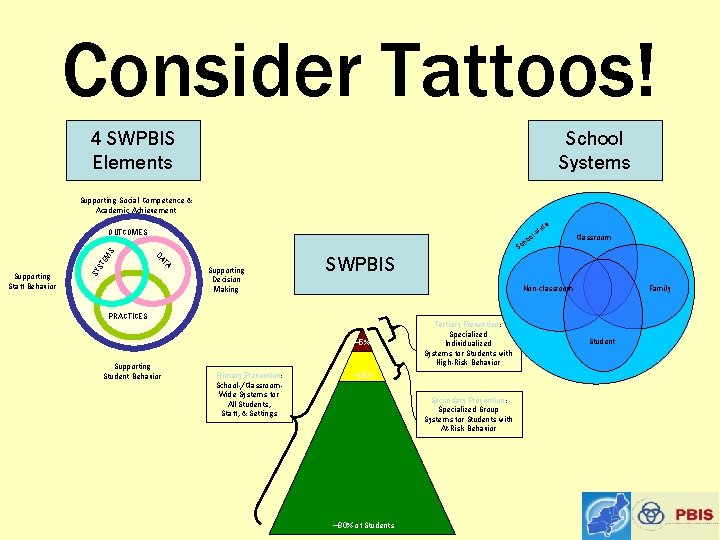
Consider Tattoos! 4 SWPBIS Elements School Systems Supporting Social Competence & Academic Achievement EM S Classroom S TA SY ST loo ch DA Supporting Staff Behavior de wi OUTCOMES Supporting Decision Making SWPBIS Non-classroom PRACTICES ~5% Supporting Student Behavior Primary Prevention: School-/Classroom. Wide Systems for All Students, Staff, & Settings Tertiary Prevention: Specialized Individualized Systems for Students with High-Risk Behavior ~15% Secondary Prevention: Specialized Group Systems for Students with At-Risk Behavior ~80% of Students Family Student
- Slides: 172