
Schoolwide PBIS Moreland SD Chris Borgmeier Ph D
School-wide PBIS Moreland SD Chris Borgmeier, Ph. D Portland State University cborgmei@pdx. edu
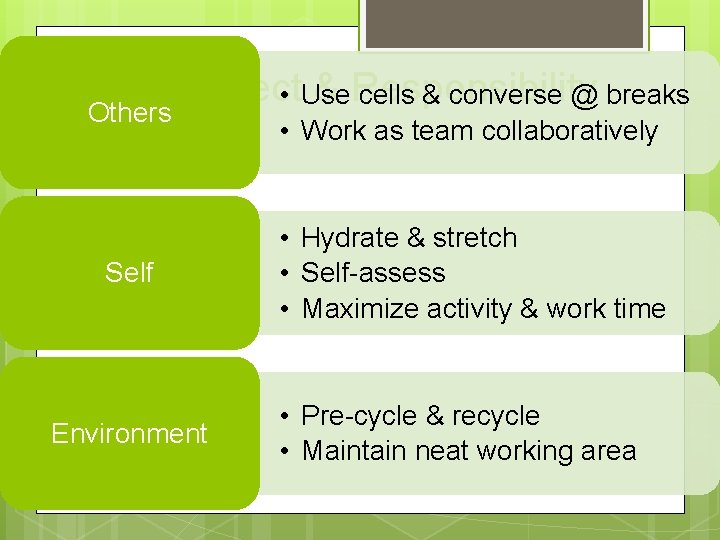
PBS – Respect & Responsibility • Use cells & converse @ breaks Others Self Environment • Work as team collaboratively • Hydrate & stretch • Self-assess • Maximize activity & work time • Pre-cycle & recycle • Maintain neat working area

Introductions & Team Reports Describe where you are at with implementation of SW-PBIS at your school: 2 Successes 1 -2 Challenges What would be helpful for your team today?
www. swpbis. pbworks. com Building & Maintaining a Strong Foundation Tier 1
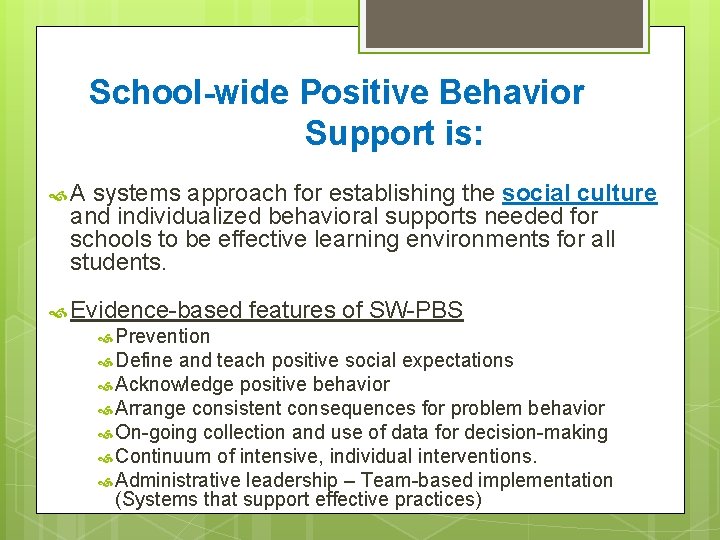
School-wide Positive Behavior Support is: A systems approach for establishing the social culture and individualized behavioral supports needed for schools to be effective learning environments for all students. Evidence-based features of SW-PBS Prevention Define and teach positive social expectations Acknowledge positive behavior Arrange consistent consequences for problem behavior On-going collection and use of data for decision-making Continuum of intensive, individual interventions. Administrative leadership – Team-based implementation (Systems that support effective practices)
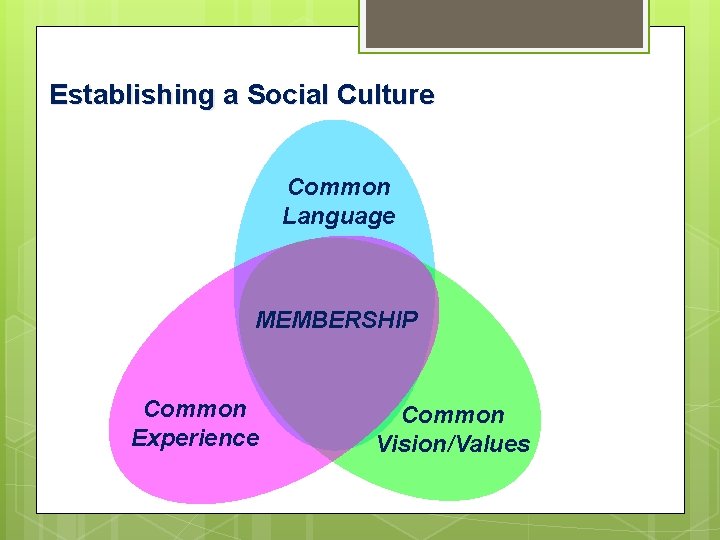
Establishing a Social Culture Common Language MEMBERSHIP Common Experience Common Vision/Values

OUTCOMES ST SY TA DA Supporting Staff Behavior EM S Elements of SW-PBIS Supporting Social Competence & Academic Achievement PRACTICES Supporting Student Behavior Supporting Decision Making
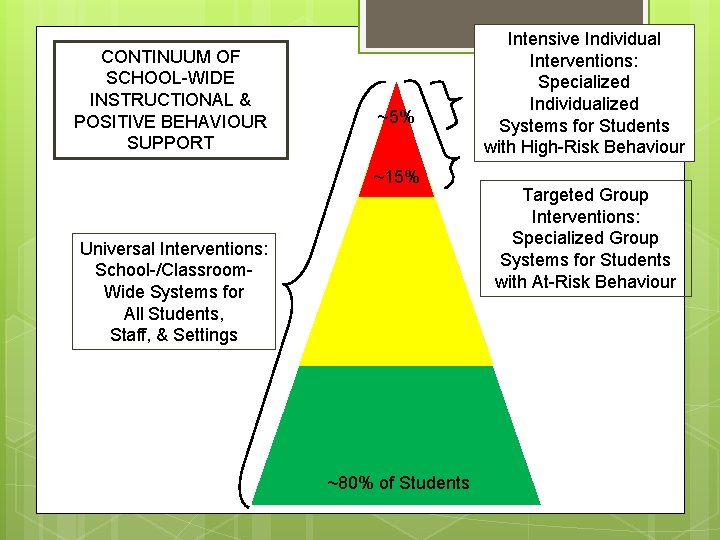
CONTINUUM OF SCHOOL-WIDE INSTRUCTIONAL & POSITIVE BEHAVIOUR SUPPORT ~5% ~15% Universal Interventions: School-/Classroom. Wide Systems for All Students, Staff, & Settings ~80% of Students Intensive Individual Interventions: Specialized Individualized Systems for Students with High-Risk Behaviour Targeted Group Interventions: Specialized Group Systems for Students with At-Risk Behaviour
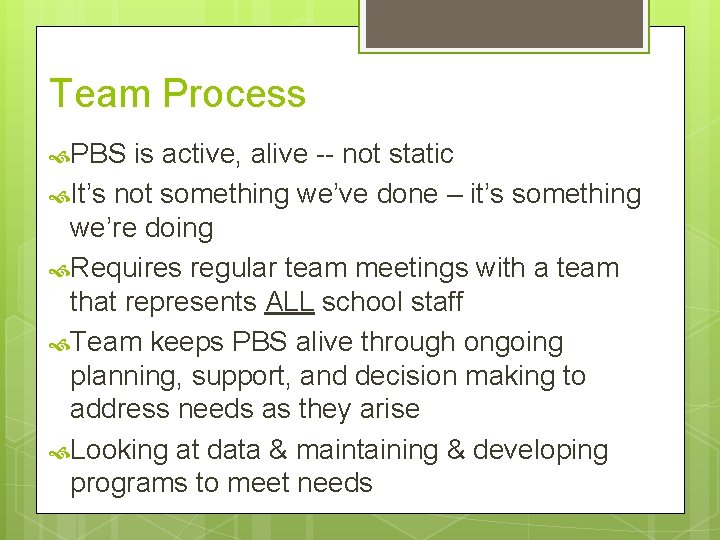
Team Process PBS is active, alive -- not static It’s not something we’ve done – it’s something we’re doing Requires regular team meetings with a team that represents ALL school staff Team keeps PBS alive through ongoing planning, support, and decision making to address needs as they arise Looking at data & maintaining & developing programs to meet needs
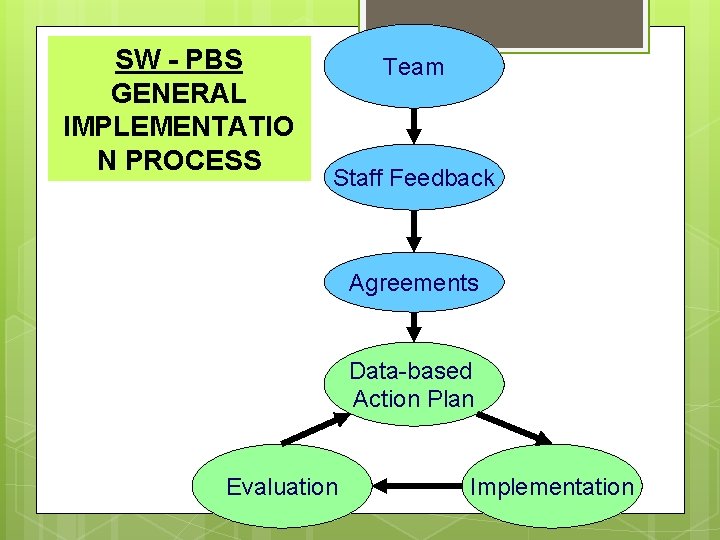
SW - PBS GENERAL IMPLEMENTATIO N PROCESS Team Staff Feedback Agreements Data-based Action Plan Evaluation Implementation
Responsibilities of Team Initially take the lead with development and implementation of SW PBS programs Seek feedback from staff throughout development After initial implementation Maintain SW PBS programs Monitor data and problem solve areas of concern Continued development of SW-PBS programs Plan for Tier 2 Prevention to support at-risk students
s e’ m Ti Up Team Discussion What are strengths & areas for improvement in your communication w/ staff re: SW-PBIS? How will your team continue to communicate & get feedback from your entire staff? Identify specific ideas & be ready to share Don’t forget about those staff members who don’t always come to staff meetings Instr’l Assistants, Supervisors, Office staff, custodians, etc.
Universal PBIS Systems The Basics 1. 2. 3. 4. 5. Define school-wide expectations Teach expectations and social-emotional competencies Monitor and acknowledge prosocial behavior Provide instructional consequences for problem behavior Collect information and use it for decision-making
Team Task: Complete TIC or BOQ & Develop an Action Plan TIC Be for Beginning Implementers prepared to share at least 2 action items identified through your TIC data
So What’s Next? Sustain & Build
Items perceived to be more important to sustainability than initial implementation Parents are actively involved in the SW-PBIS effort (e. g. as part of team at school or district) SW-PBIS is viewed as a part of systems already in use (as opposed to being an add-on) SW-PBIS has been integrated into new school or district initiatives A vast majority of school personnel (80% +) support SW-PBIS
Critical to Sustaining Hume & Mc. Intosh, 2011 The School team implementing SW-PBIS is well organized and operates efficiently School personnel perceive SW-PBIS as effective in helping them achieve desired outcomes SW-PBIS has been expanded to other areas (e. g. classrooms, buses, students w/ intensive needs, parenting workshops)

Predicting Sustained Implementation of SW-PBIS Mc. Intosh et al. , 2011 School Use team functioning of data for decision making District Supports = coaching, professional development, & connection to a community of practice
Sustaining Implementation The most critical item that contributed to sustainability “Data are used for problem solving, decision making and action planning (to make SW-PBIS more effective &/or efficient)” Hume & Mc. Intosh, 2011
Team Task - Sustainability What are steps your team needs to take to implement and sustain SW-PBIS with fidelity? Identify 2 -3 actions your team will take to promote sustained implementation… Be prepared to share with the other teams
Teaming & Data Based Decision Making Team Implemented Problem Solving (TIPS) Meeting Foundations Purpose of the team Define team agreements about meeting processes Define roles & responsibilities Facilitator, Minute Taker, Data Analyst, Time Keeper -- & Back-Ups for each role Use electronic meeting minutes Project minutes for Visual Guide
Teaming & Data Based Decision Making Effective Data System Precision Problem Statement Solving & Action Items
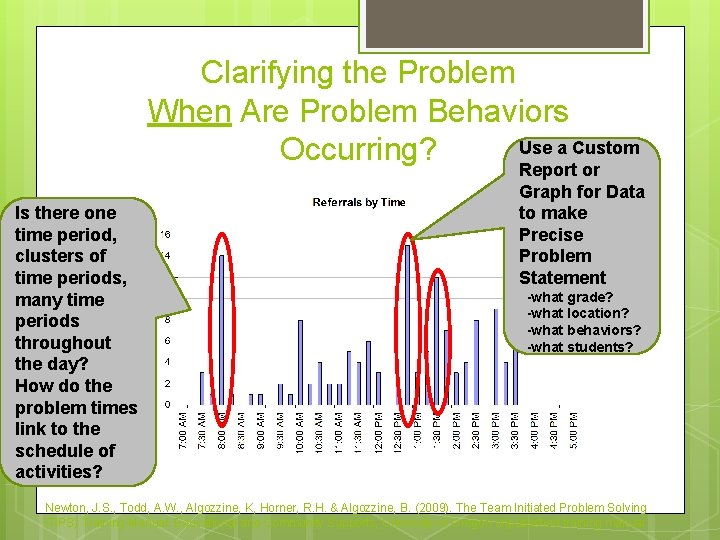
Clarifying the Problem When Are Problem Behaviors Use a Custom Occurring? Report or Is there one time period, clusters of time periods, many time periods throughout the day? How do the problem times link to the schedule of activities? Graph for Data to make Precise Problem Statement -what grade? -what location? -what behaviors? -what students? Newton, J. S. , Todd, A. W. , Algozzine, K, Horner, R. H. & Algozzine, B. (2009). The Team Initiated Problem Solving (TIPS) Training Manual. Educational and Community Supports, University of Oregon unpublished training manual.
Team Task Identify 3 ways you are currently using data for decision making in your PBIS team meetings. Discuss ways to improve your teams’ data based decision making. What does your team need to be successful with this? Be prepared to share

Expanding Implementation & Understanding of SW-PBIS
Equity & Culturally Responsive SW-PBIS
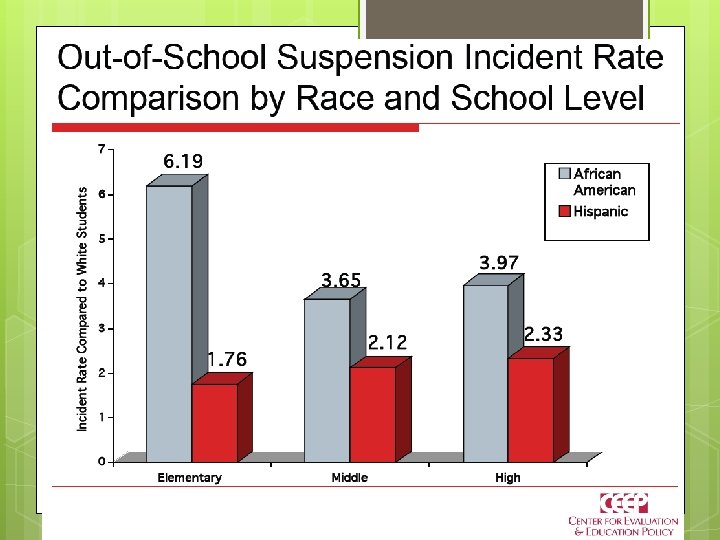
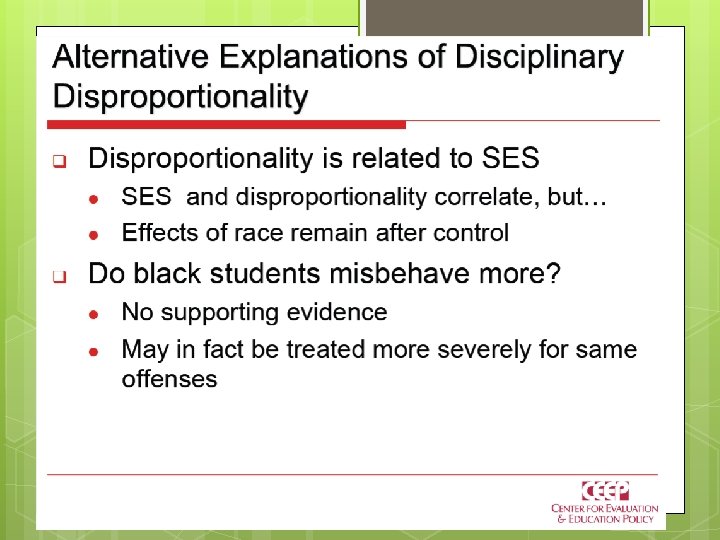
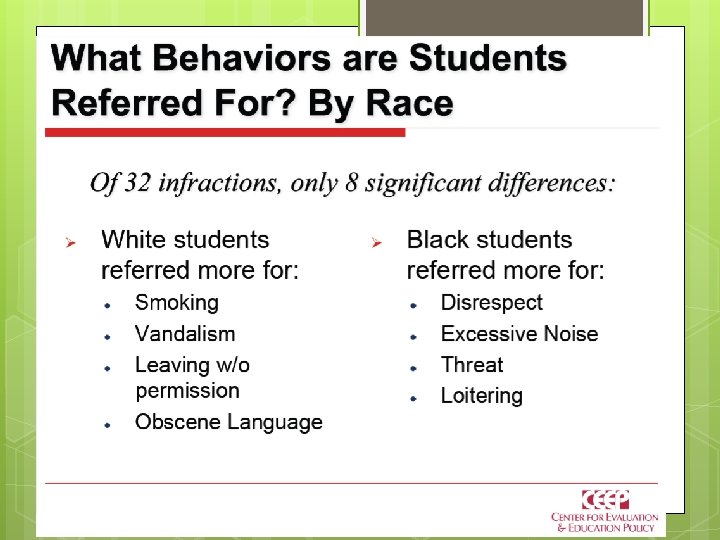
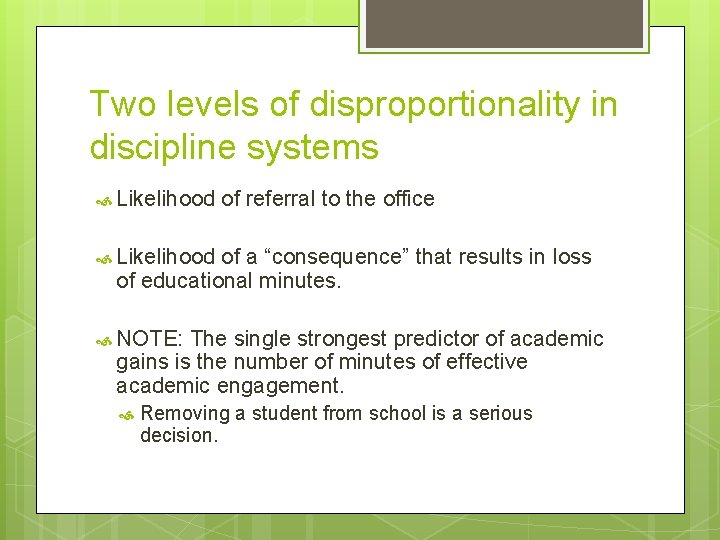
Two levels of disproportionality in discipline systems Likelihood of referral to the office Likelihood of a “consequence” that results in loss of educational minutes. NOTE: The single strongest predictor of academic gains is the number of minutes of effective academic engagement. Removing a student from school is a serious decision.
PBIS and Discipline Disproportionality If schools adopt school-wide PBIS do they demonstrate improved performance for children at risk for discipline disproportionality?
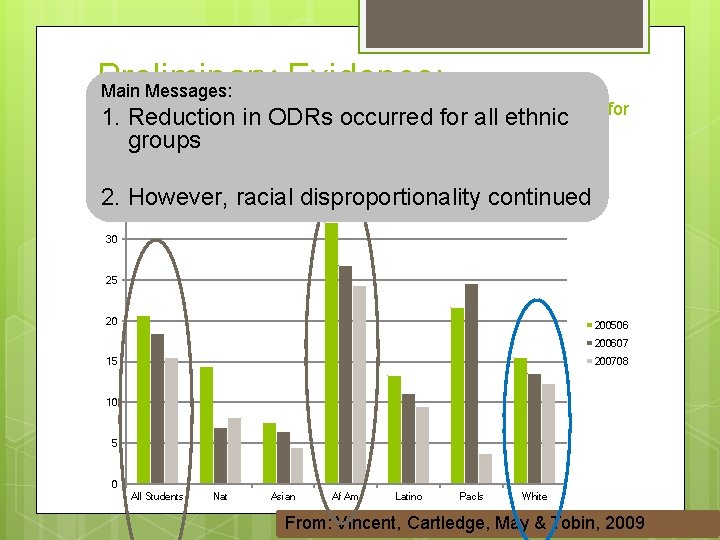
Preliminary Evidence: Main Messages: When PBIS is linked to reduction in ODRs does reduction occur for 1. Reduction in ODRs occurred for all ethnic students from all ethnic groups? groups Students with Major ODR/100 Students Enrolled n = 69 schools 35 However, racial disproportionality continued 2. 30 25 20 200506 200607 200708 15 10 5 0 All Students Nat Asian Af Am Latino Pac. Is White From: Vincent, Cartledge, May & Tobin, 2009
Equity & PBIS Develop School-wide Expectations that fit local context Challenge School faculty/staff is often not representative of the community How can we ensure that behavioral expectations are representative of the community?
Team Membership Invite members of the community that represent the diversity of the community to participate as PBIS team members or as a sub-team Identify customs representing the diverse membership of the community that can be actively built into PBIS implementation SW Rules & Language Behavioral Expectations Acknowledgment System, Assemblies & Celebrations Responses to problem behavior & Consequences
Representative Behavioral Expectations Actively seek feedback and participation from community members that represent the diversity within the community Provide an avenue for community members to provide feedback re: behavioral expectations and whether they represent the culture of community members Hold events to seek feedback from community members Send out expectations grids to seek feedback

SWIS – Ethnicity Report Disaggregate Discipline Data x Race The Ethnicity Report is the least used report Proportion within the of School. Referrals vs Enrollment By Ethnicity wide Information System (SWIS)
Examining Provide opportunities for teachers and administrators to examine their own potential biases related to research on disproportionality Know yourself Know your students Review your personal data Referrals Responses to problem behavior & likelihood to engage/escalate
Team Task Have you reviewed your discipline data with an eye toward equity &/or disproportionality? Is this an area of concern or emphasis for your school? If so, what actions might you take?
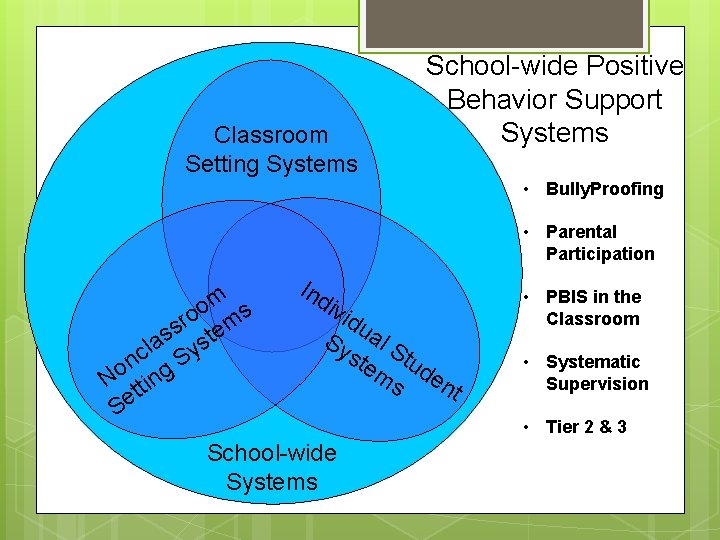
Classroom Setting Systems School-wide Positive Behavior Support Systems • Bully. Proofing • Parental Participation m o s o r m s te s a s l y c n g. S o N ttin Se Ind ivi du Sy al S ste tu ms den t School-wide Systems • PBIS in the Classroom • Systematic Supervision • Tier 2 & 3
Bully Proofing All “bully proofing” skills are more effective if the school has first established a set of POSITIVE school-wide behavioral expectations. Great care is needed to prevent a “bully-proofing” effort from becoming a “bully-training” program.
Bully Proofing Bullying behavior typically is rewarded (maintained) by the “victims” or “bystanders” Social attention Social recognition Social status Access to physical items/ preferred activities Bullying behavior is seldom maintained by adult attention
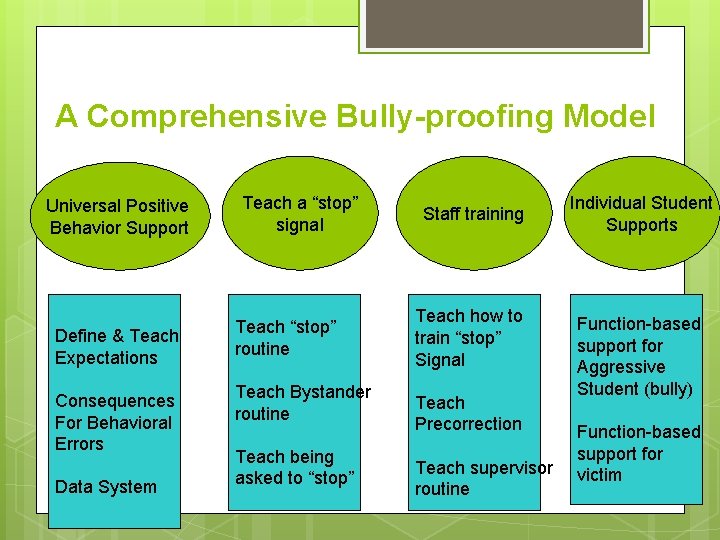
A Comprehensive Bully-proofing Model Universal Positive Behavior Support Teach a “stop” signal Define & Teach Expectations Teach “stop” routine Consequences For Behavioral Errors Teach Bystander routine Data System Teach being asked to “stop” Staff training Teach how to train “stop” Signal Teach Precorrection Teach supervisor routine Individual Student Supports Function-based support for Aggressive Student (bully) Function-based support for victim
Parental Involvement & Participation
Brainstorm for Parent Involvement & Introduction to PBS Send home information PBS in Parent/student handbook (see example) Website, newsletter Integrate Teach PBIS into “Back to School” night parents a PBS lesson & hand out tickets for good behavior, hold a drawing
Brainstorm for Parent Involvement & Introduction to PBS Involve Parents in PBIS on PBS team Actively solicit information re: behavioral expectations & acknowledgments from families in the community Use parent volunteers during PBS Kick-off in first week of school Make sure volunteering parents can use school acknowledgement system & know the rules
Extending SWPBIS into the Classroom
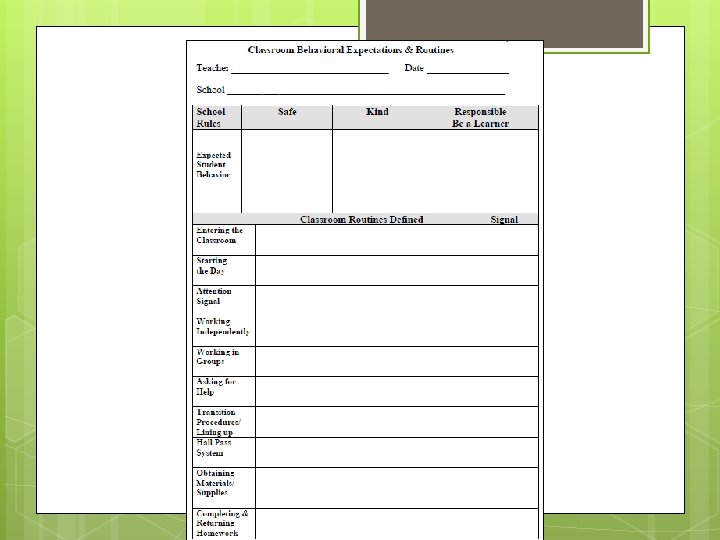
Classroom Setting Evidence Based Practices Classroom-wide positive expectations taught & encouraged Teaching classroom routines & cues taught & encouraged Ratio of 5 positive to 1 negative adult-student interaction Active supervision Redirections for minor, infrequent behavior errors Frequent precorrections for chronic errors Effective academic instruction & curriculum How can we implement systems that support staff to implement these practices consistently?
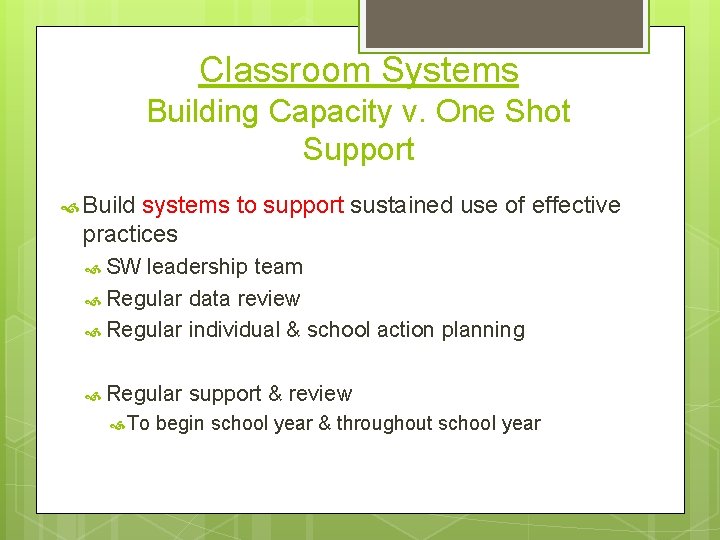
Classroom Systems Building Capacity v. One Shot Support Build systems to support sustained use of effective practices SW leadership team Regular data review Regular individual & school action planning Regular To support & review begin school year & throughout school year
Non-Classroom Settings & Systematic Supervision
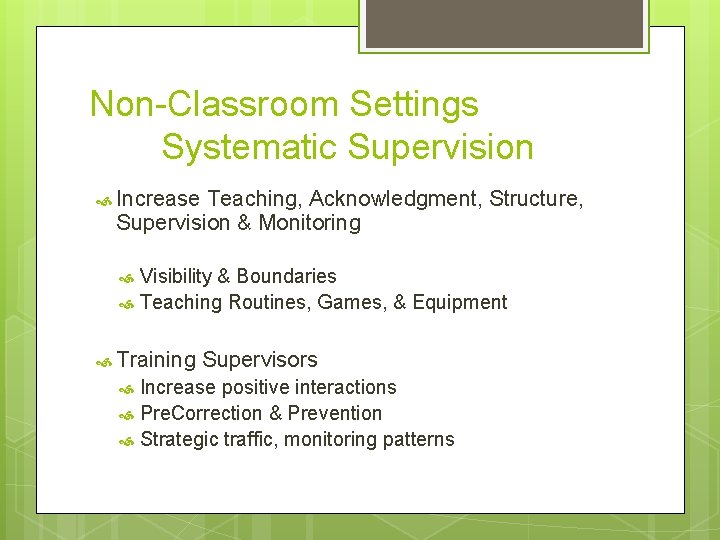
Non-Classroom Settings Systematic Supervision Increase Teaching, Acknowledgment, Structure, Supervision & Monitoring Visibility & Boundaries Teaching Routines, Games, & Equipment Training Supervisors Increase positive interactions Pre. Correction & Prevention Strategic traffic, monitoring patterns
Systematic Supervision www. irised. com
Team Task Review your Data: Determine next steps to take with SW-PBIS implementation Continue to improve implementation of critical features (TIC/SET results) Use data to identify areas of concern/need & focus on strategic supports Identify next steps in expanding (if this is appropriate right now) implementation Equity Parent participation Classroom Non-classroom Settings & Systematic Supervision
Next Step Tier 2 Intervention
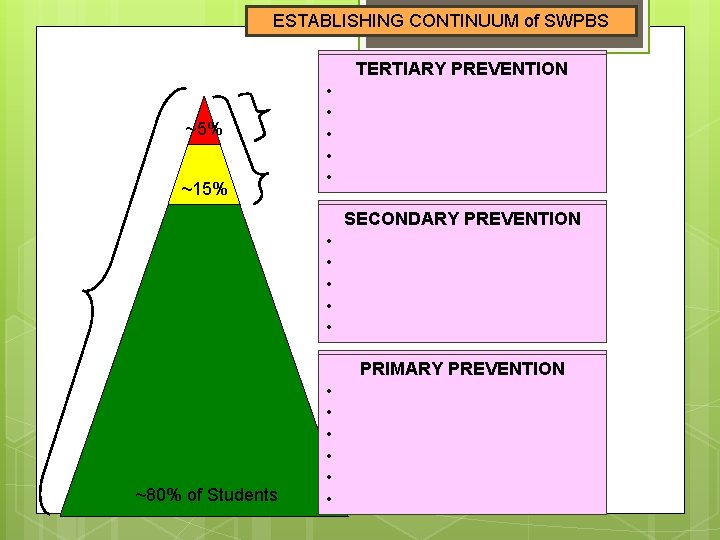
ESTABLISHING CONTINUUM of SWPBS ~5% ~15% TERTIARY PREVENTION • Function-based support • Wraparound • Person-centered planning • • SECONDARY PREVENTION • Check in/out • Targeted social skills instruction • Peer-based supports • Social skills club • ~80% of Students PRIMARY PREVENTION • Teach SW expectations • Proactive SW discipline • Positive reinforcement • Effective instruction • Parent engagement •
CICO Resources www. tier 2 pbis. pbworks. com
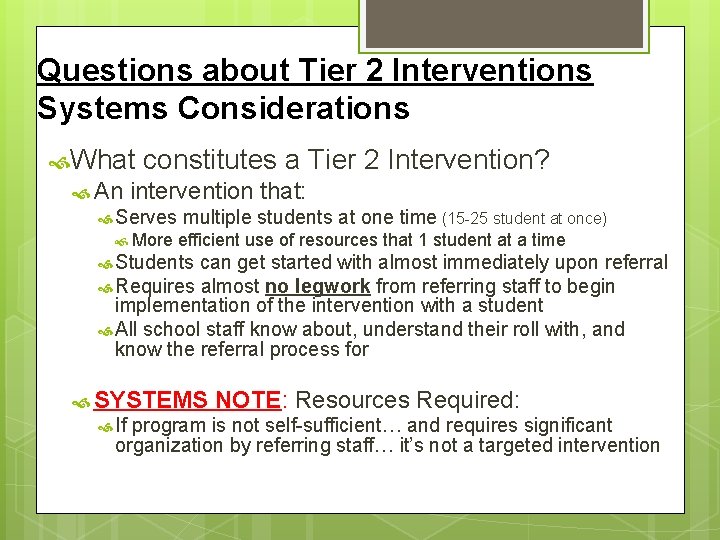
Questions about Tier 2 Interventions Systems Considerations What An constitutes a Tier 2 Intervention? intervention that: Serves More multiple students at one time (15 -25 student at once) efficient use of resources that 1 student at a time Students can get started with almost immediately upon referral Requires almost no legwork from referring staff to begin implementation of the intervention with a student All school staff know about, understand their roll with, and know the referral process for SYSTEMS If NOTE: Resources Required: program is not self-sufficient… and requires significant organization by referring staff… it’s not a targeted intervention
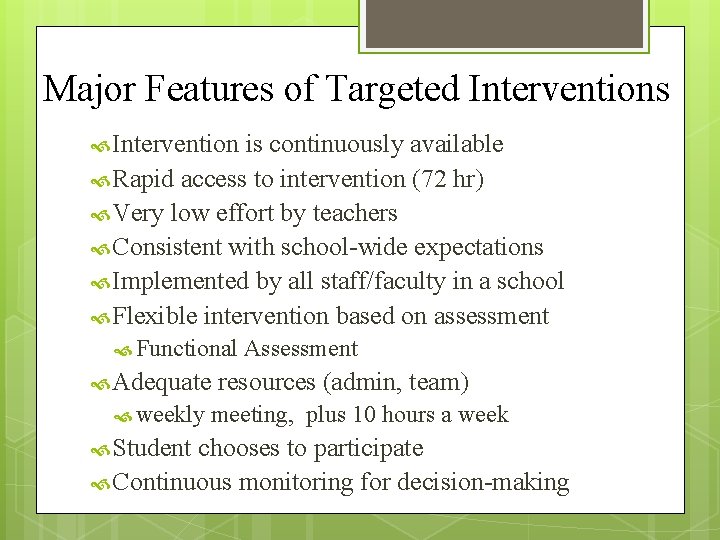
Major Features of Targeted Interventions Intervention is continuously available Rapid access to intervention (72 hr) Very low effort by teachers Consistent with school-wide expectations Implemented by all staff/faculty in a school Flexible intervention based on assessment Functional Adequate weekly Student Assessment resources (admin, team) meeting, plus 10 hours a week chooses to participate Continuous monitoring for decision-making
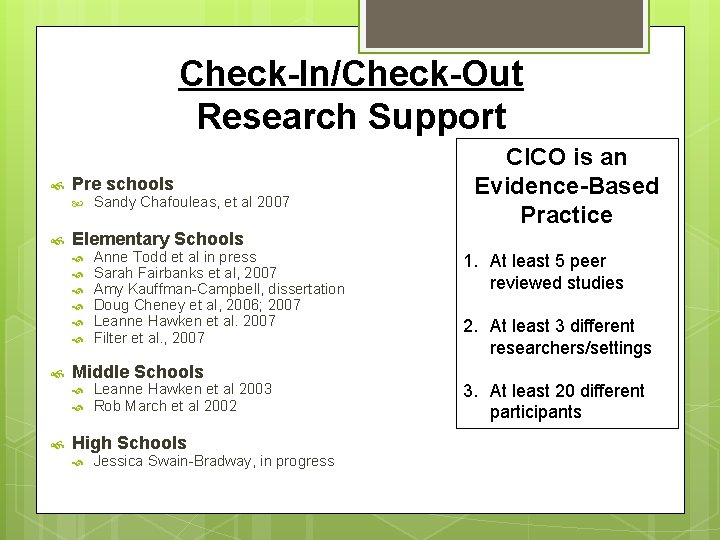
Check-In/Check-Out Research Support Pre schools Elementary Schools Anne Todd et al in press Sarah Fairbanks et al, 2007 Amy Kauffman-Campbell, dissertation Doug Cheney et al, 2006; 2007 Leanne Hawken et al. 2007 Filter et al. , 2007 Middle Schools Sandy Chafouleas, et al 2007 CICO is an Evidence-Based Practice Leanne Hawken et al 2003 Rob March et al 2002 High Schools Jessica Swain-Bradway, in progress 1. At least 5 peer reviewed studies 2. At least 3 different researchers/settings 3. At least 20 different participants
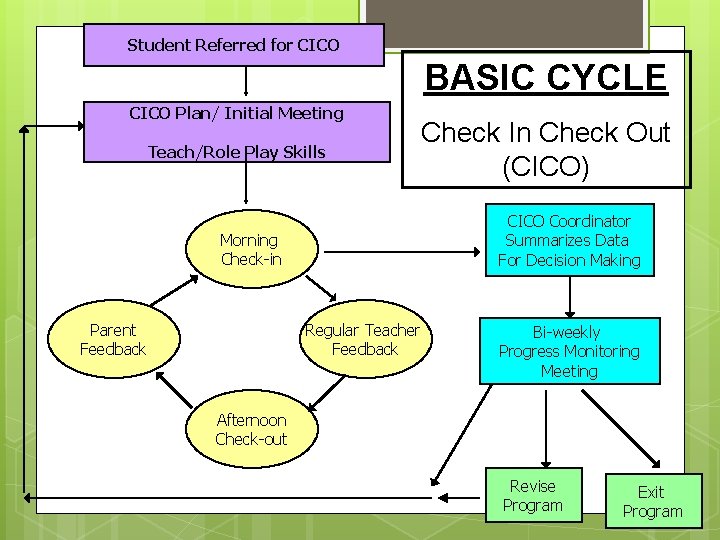
Student Referred for CICO BASIC CYCLE CICO Plan/ Initial Meeting Teach/Role Play Skills Check In Check Out (CICO) CICO Coordinator Summarizes Data For Decision Making Morning Check-in Parent Feedback Regular Teacher Feedback Bi-weekly Progress Monitoring Meeting Afternoon Check-out Revise Program Exit Program
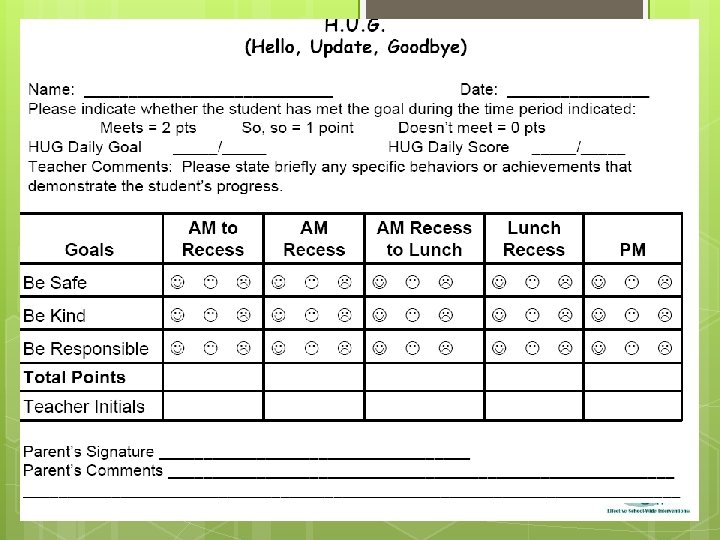
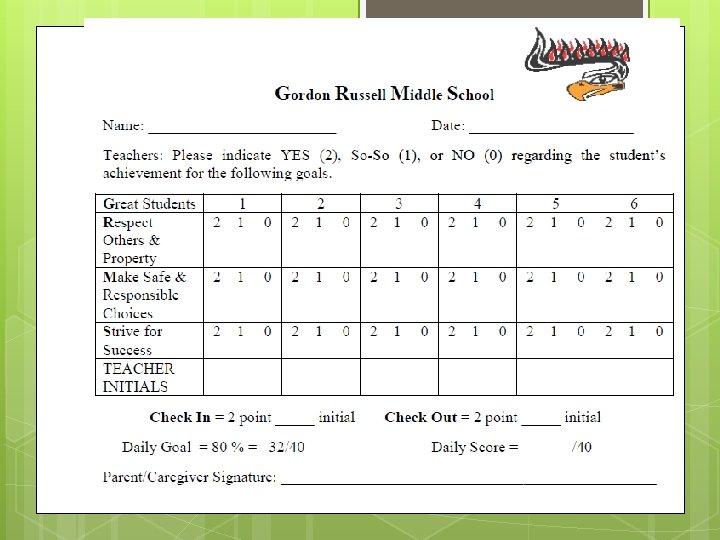
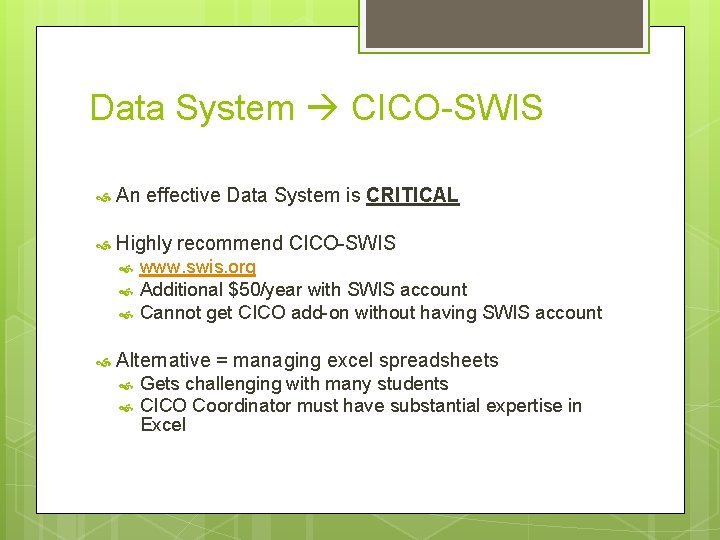
Data System CICO-SWIS An effective Data System is CRITICAL Highly recommend CICO-SWIS www. swis. org Additional $50/year with SWIS account Cannot get CICO add-on without having SWIS account Alternative = managing excel spreadsheets Gets challenging with many students CICO Coordinator must have substantial expertise in Excel
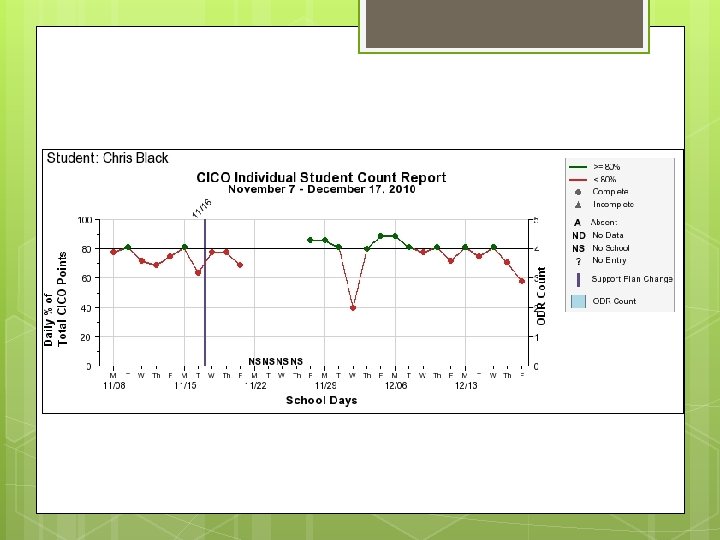
SWIS-CICO Report Daily Points Graph
Team Task Identify where your school is at with regard to Tier 2 & CICO What additional questions do you have? next steps do you want to take regarding CICO & Tier 2 interventions?
What happens after they are on CICO? ADVANCED IMPLEMENTERS
Team will use data to monitor student progress Some students will “graduate” from the program Some students will require the support on a continuing basis Some students will not respond to the program & need more or something different Set up processes for: Fading students off of the program Escalating intensity of intervention Maintain & monitor
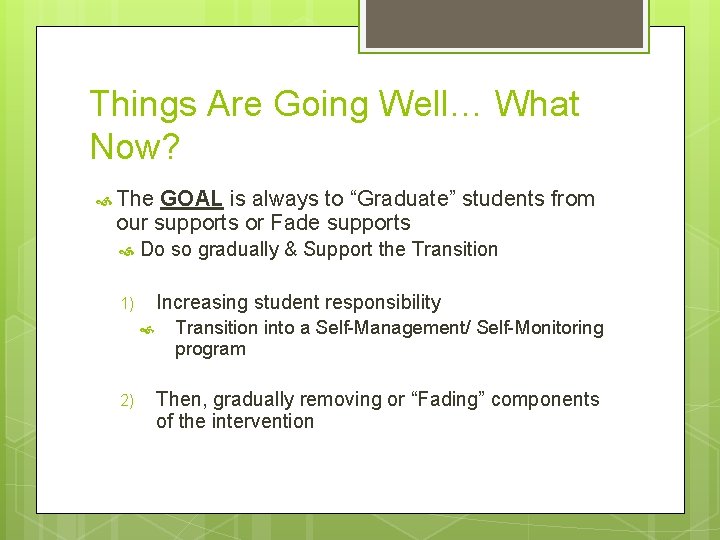
Things Are Going Well… What Now? The GOAL is always to “Graduate” students from our supports or Fade supports Do so gradually & Support the Transition Increasing student responsibility 1) 2) Transition into a Self-Management/ Self-Monitoring program Then, gradually removing or “Fading” components of the intervention
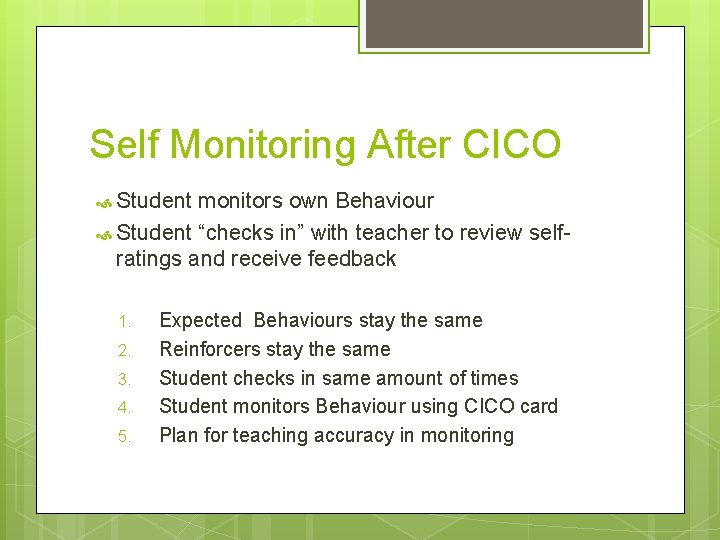
Self Monitoring After CICO Student monitors own Behaviour Student “checks in” with teacher to review selfratings and receive feedback 1. 2. 3. 4. 5. Expected Behaviours stay the same Reinforcers stay the same Student checks in same amount of times Student monitors Behaviour using CICO card Plan for teaching accuracy in monitoring
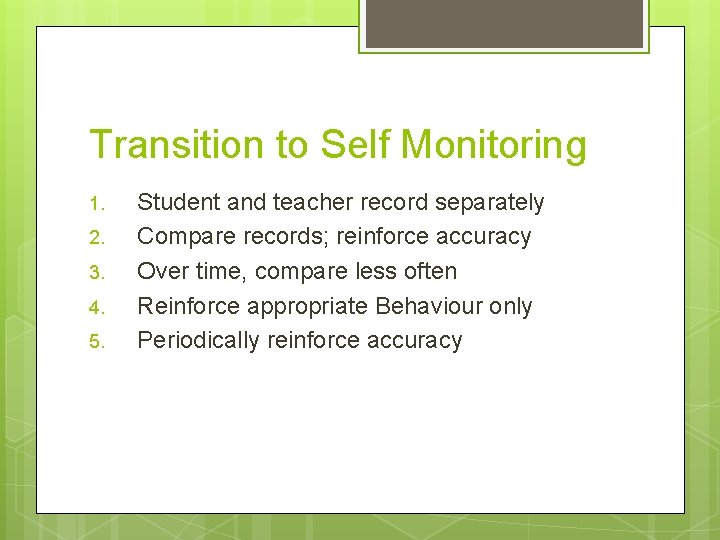
Transition to Self Monitoring 1. 2. 3. 4. 5. Student and teacher record separately Compare records; reinforce accuracy Over time, compare less often Reinforce appropriate Behaviour only Periodically reinforce accuracy
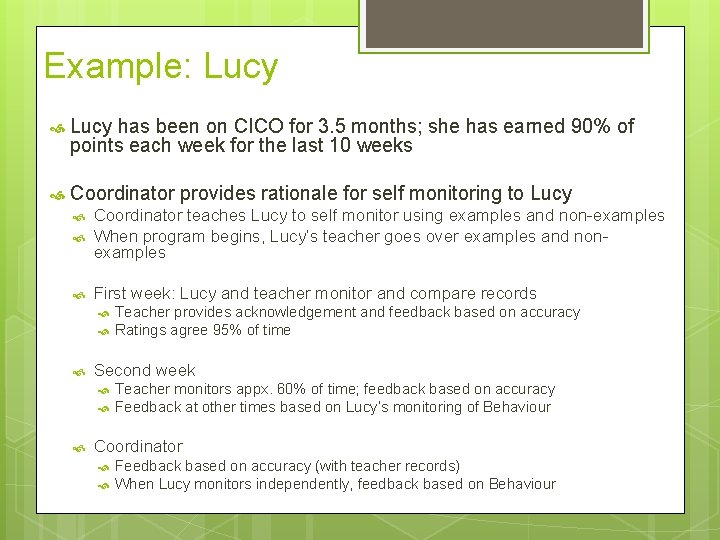
Example: Lucy has been on CICO for 3. 5 months; she has earned 90% of points each week for the last 10 weeks Coordinator provides rationale for self monitoring to Lucy Coordinator teaches Lucy to self monitor using examples and non-examples When program begins, Lucy’s teacher goes over examples and nonexamples First week: Lucy and teacher monitor and compare records Second week Teacher provides acknowledgement and feedback based on accuracy Ratings agree 95% of time Teacher monitors appx. 60% of time; feedback based on accuracy Feedback at other times based on Lucy’s monitoring of Behaviour Coordinator Feedback based on accuracy (with teacher records) When Lucy monitors independently, feedback based on Behaviour
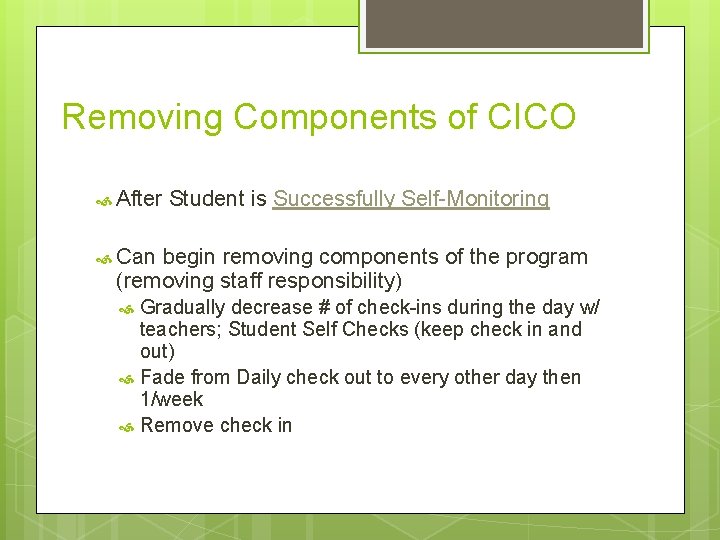
Removing Components of CICO After Student is Successfully Self-Monitoring Can begin removing components of the program (removing staff responsibility) Gradually decrease # of check-ins during the day w/ teachers; Student Self Checks (keep check in and out) Fade from Daily check out to every other day then 1/week Remove check in
After “Graduation” from CICO � Continue to monitor student Behaviour through discipline referrals & teacher report Celebrate continued success Some schools hold a monthly celebration for students who are maintaining success after Graduating from CICO Monthly “Alumni Club” Lunch
CICO: Fading Supports for Successful Students Transition to Self Management program Continued monitoring & celebrations for “Grads”
Team Task Identify ways to improve your CICO system for students who are successful & for fading students off of CICO
- Slides: 77