
Schoolteacher A Sociological Study By Dan Lortie Problem
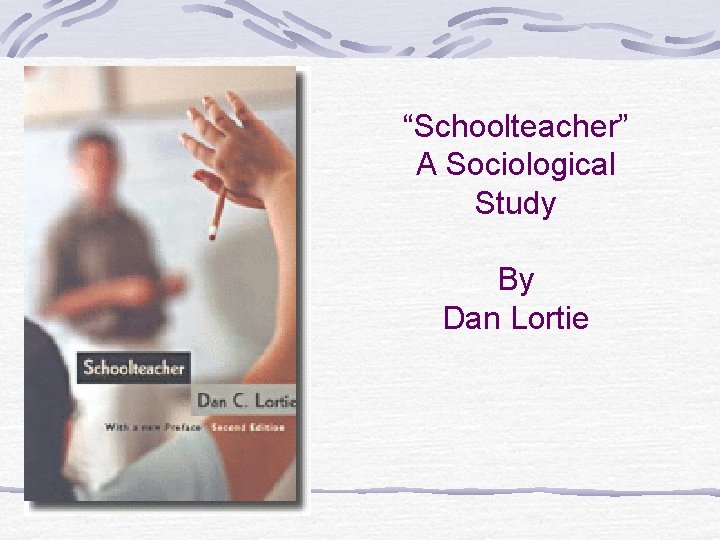
“Schoolteacher” A Sociological Study By Dan Lortie
Problem Sociological patterns have not been studied in the occupation of teaching(1975). How do patterns of the teaching profession relate to resistance to change in the field of education?

Variables Recruitment Stages of Socialization Distribution of Career Rewards Teacher Sentiments Self-Assessments Teacher Preferences with other adults

The Design Five Towns Survey Dade County Surveys conducted by the National Educational Association Data collection from other independent researchers

Results

Recruitment “resources consist of the properties which assist an occupation for competing for manpower and talent (26). ” In the case of becoming a teacher, operates without deliberate formulation or control and uses two types of resources: attractors and facilitators. Attractors – comparative benefits (5 themes): Interpersonal, Service, Continuation, Material, Time Compatibility
Recruitment (con’t) Facilitators – the sociological factors that broaden the pool of candidates for the occupation: highly accessible training, non-elitist admission, wide decision, subjective warrant, and other special facilitator. Attractors and Facilitators appear more potent for women
Stages of Formal Socialization What do teachers say about their shaping as members of the occupation? The Stages of Socialization Formal Schooling, Mediated Entry (Apprenticeship), and Learning while doing General schooling (K-12) serves as apprenticeship, but restrictions are present 42% of the Five Towns teachers compared their strategies to one of their former teachers Imagination, observation, and imitation
Stages of Formal Socialization The Stages of Socialization Student Teaching – many teachers consider this brief experience more valuable than their formal schooling-it directs the aspiring toward his or her actual goal to teach Experience – serves as the major means to learn how to teach Teachers are largely “Self-Made” and this creates many effects: constrains the status of the occupation, subjective cost imposed on teachers, occupational conservatism
Distribution of Career Rewards Teaching is essentially career-less It’s an “unstaged” career with little possibility of moving up the ladder The only place to move up is to administration and then you are no longer a teacher. Developed system of remuneration in the beginning. Pay incentives and benefits to attract new teacher No rewards for teachers already teaching Pay increases to teachers comes from seniority and course-taking, not effort or talent in a classroom
Distribution of Career Rewards (con’t) Effects of being “Career-less” and Remuneration Men and women see the job differently Men view teaching as a stepping stone to administration or to another career Women view the job as a career until they get married or if already married until husband can fully support family.
Distribution of Career Rewards (con’t) Men, single women, and married women differed in job satisfaction and engagement (time investment) Single women spent most amount of time on the job, but were the least satisfied Men spent the second most amount of time on the job and were the second most satisfied Married women spent the least amount of time on the job, and were the most satisfied.
Distribution of Career Rewards (con’t) Men, single women, and married women differed when asked the question, “Would they become teachers again? ” Men had the highest percentage that would not become a teacher again Single women had the next highest percentages that would not become a teacher again Married women had the least percentage that would not become teachers again
Teacher Sentiments What teachers want to accomplished Teaching morals Instilling love of schools and subject Reaching all students
Teacher Sentiments When asked about their good teachers Produced affection and respect from students Made students work hard “Effective in winning student compliance and discipline
Teacher Sentiments How teachers feel successful (Craft Pride) Reaching that one unreachable student Former student success in education or work Public events (plays, fairs, field trips, etc. ) Class improvement (PE skills, initial reading) Student voluntary contribution Community recognition
Teacher Sentiment Although most teachers goals were to reach the whole class they felt more pride when they reached that one special student, or when one student came back to thank them
Self-Assessments Attainment of Instructional Goals v. Maintaining an Appropriate Relationship with Students Difficulty in Self-Assessment Unlike typical/tangible fields with concrete examples of success teachers may not see hard evidence of success for years How do we assess attributes such as responsibility and citizenship? Attaining goals is also difficult because the students are obligated to go to school / students are not volunteers
Self Assessments (con’t) Maintaining an Appropriate Relationship 3 Special Issues in Relational Aspects 1. Lack of Volunteerism 2. Incomplete Socialization 3. The Grouped Context within which Instruction Occurs 2 Kinds of Leadership (Bales 1956) / (Lortie p. 152) Getting Tasks Accomplished by a Group v. Attending to Expressive Needs
Self-Assesments (con’t) “Strategy Counts for Less Than Chance when Mood is King” (p. 174) “Classroom Management” Not really management because teachers are significantly disadvantaged compared to managers in other fields less resources and autonomy Good Days v. Bad Days (distraction is the enemy) Teachers want to establish a monopoly over their student’s attention…they strive for a kind of privatization Teachers want to concentrate their efforts of the core aspects of teaching
Self-Assesments (con’t) “Strategy Counts for Less Than Chance when Mood is King” (p. 174) Teachers claims to want greater autonomy and more control over their students, but rarely assert this by challenging the basic order - Lortie assumes this may be due to lack of confidence in producing results
Teacher Preferences in Relationships with other Adults Parent: Differ in views about child and socialization Depend on for child’s participation in school Majority interaction with problems Colleagues: Sharing of ideas, joint teaching, comparisons Principal: Mediator Invincible or Popular General supervision over school affairs
Conclusions Through the sociological lens, the history of the occupation of teaching tilts toward continuity rather than discontinuity. Huge distinction between the sociological patterns between men and women. Teacher ethos
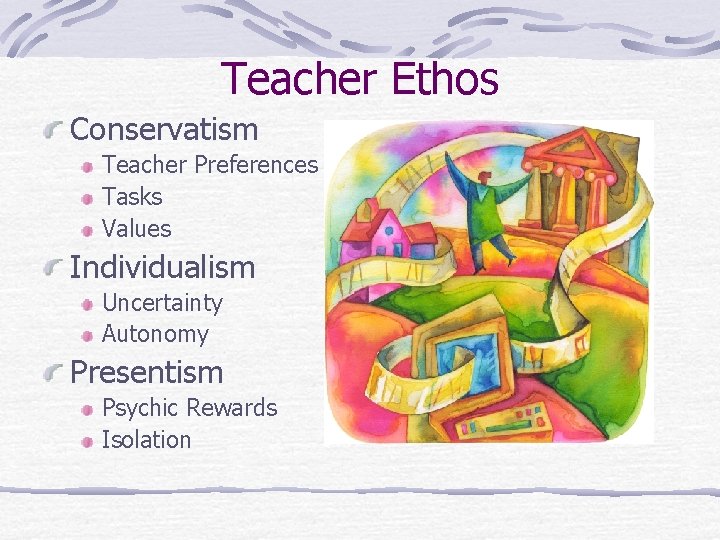
Teacher Ethos Conservatism Teacher Preferences Tasks Values Individualism Uncertainty Autonomy Presentism Psychic Rewards Isolation
Recommendations Greater adaptability Effective colleague relationships and responsibilities Sharing in issues of knowledge and expertise Increase technical expertise Professional values in occupation
- Slides: 25