
School Uniforms Do they affect students discipline in

- Slides: 10
School Uniforms: Do they affect students’ discipline in Calcasieu Parish? Presented By: Anthony James ELIT 600
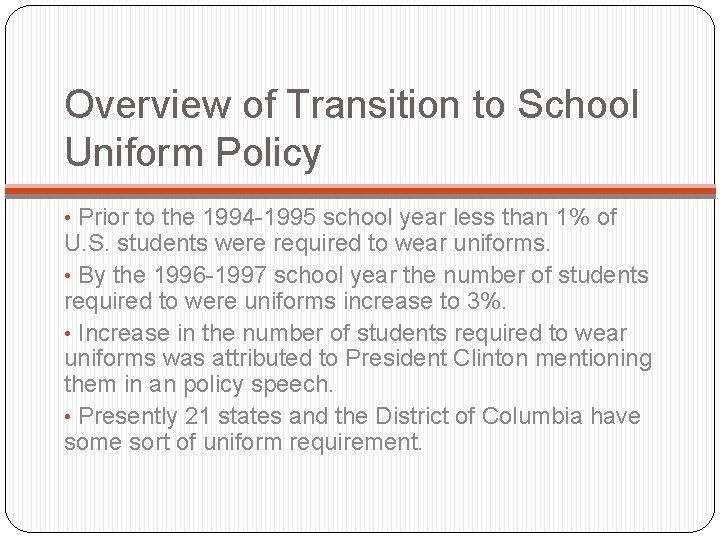
Overview of Transition to School Uniform Policy • Prior to the 1994 -1995 school year less than 1% of U. S. students were required to wear uniforms. • By the 1996 -1997 school year the number of students required to were uniforms increase to 3%. • Increase in the number of students required to wear uniforms was attributed to President Clinton mentioning them in an policy speech. • Presently 21 states and the District of Columbia have some sort of uniform requirement.
Questions to Consider • Why the transition? • What is the impact? • Should we rethink uniform requirements?
Statement of Purpose • Evaluate the affect that school uniforms have on students’ discipline in Calcasieu Parish.
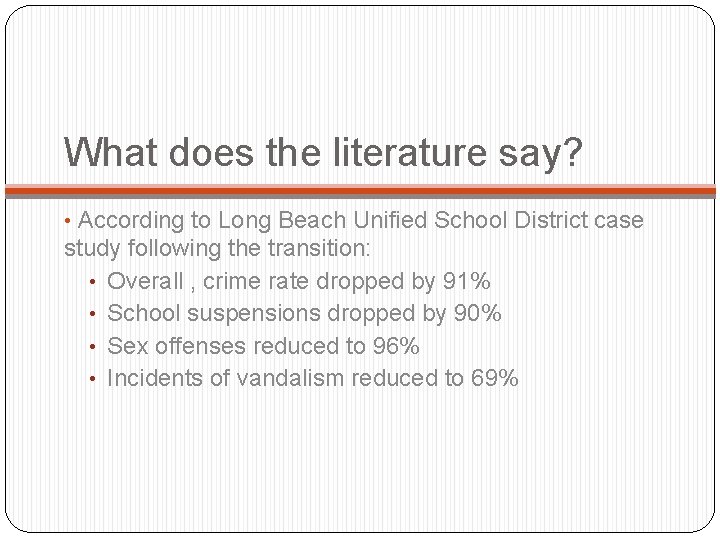
What does the literature say? • According to Long Beach Unified School District case study following the transition: • Overall , crime rate dropped by 91% • School suspensions dropped by 90% • Sex offenses reduced to 96% • Incidents of vandalism reduced to 69%
Research Question • Do school uniform positively affect students’ discipline in Calcasieu Parish?
Research Design • Conduct oral interviews with Calcasieu Parish high school principals to collect antidotal information. • Administer surveys to Calcasieu Parish high school principals. • Compare high school suspension rates pre and post implementation of school uniform policy in Calcasieu Parish high schools.
Sampling • 9 parish high schools • 9 high school principals
Data Collection Instruments • High school suspension records • Oral Interviews • Surveys
Work-plan • Forward to notice to high school principals informing them of study and inviting them to participate. • Schedule meetings with high school principals to conduct oral interviews and forward surveys. • Conduct interviews with high school principals. • Review suspension data. • Compile data from interviews, surveys and review of suspension rates. • Analyze data to uncover themes and trends. • Report findings.