
SCHOOL TRANSITION PRIMARY TO HIGH SCHOOL MODULE TWO
- Slides: 24
SCHOOL TRANSITION PRIMARY TO HIGH SCHOOL MODULE TWO
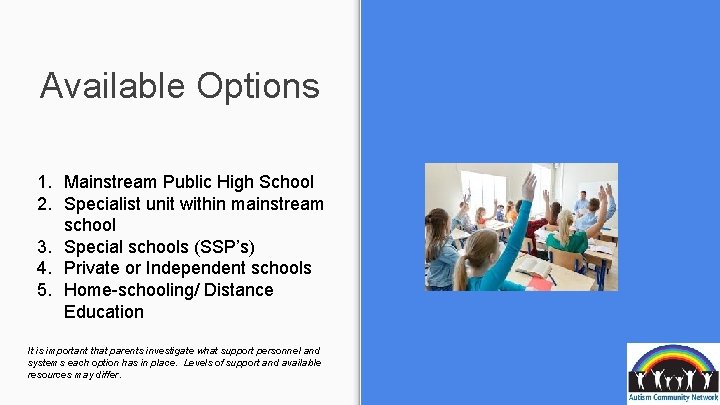
Available Options 1. Mainstream Public High School 2. Specialist unit within mainstream school 3. Special schools (SSP’s) 4. Private or Independent schools 5. Home-schooling/ Distance Education It is important that parents investigate what support personnel and systems each option has in place. Levels of support and available resources may differ.
Thinking about my child ● ● What are the educational goals that you have for your child? What do I want my child to achieve from high school? - academic pathway, socialisation, communication/ language development, career/ employment pathway? ● Remember it is you who is really interviewing the school to determine the best fit and whether the school can support your child achieve their educational goals. Consider: ● ● ● Who should I talk to (point of contact) to discuss my child’s high school education How will my/our preferred high school option approach and implement the necessary adjustments required to support the transition and educational goal achievement of my child What have been previous indicators of success? What available specialist services are there to support my child’s learning? What is the enrolment procedure?
Key People 1. 2. 3. 4. 5. 6. 7. 8. 9. Your Child You- The Parent/ Carer Other Family Members & Siblings Principal Diverse Learning Team/ Learning Support Coordinator Pastoral/ Wellbeing Coordinator Year Coordinator (responsible for all students in the year group) and acts as liaise between all your child’s teachers School Counsellor Existing Clinicians and External Service Providers
Timeline planning ● ● ● It is never too early to think and plan Public High Schools- Complete Expression of Interest form in March prior year- (link here) Catholic Schools- Two years prior (March. May) (link here) for Sydney Catholic Schools Independent Schools- Variable enrolment. Please contact the school directly. Independent Schools Australia (link here) Term 3 & 4 previous year- meeting & transition visits by request
Deciding the school shortlist ● ● ● ● ● Do your homework early- consider what schools are available to you Review each school’s website Request a prospectus (if available) Make an appointment- request a tour and time to discuss your child Adhere to the time allocated. Make another appointment if you need to Discuss school options with your child/ family members & siblings Discuss school options with your clinician/ case manager Discuss school experiences with other parents (remember just like your child is an individual, so too is the school experience of every family) Trust your instincts. You know your child best so make sure you feel the school you choose is the right fit for your child.
Questions to ask? ● ● ● Point of contact (Coordinator? ) for students with additional needs Support staff available (experience, availability, frequency) Level of support available to teaching staff to implement necessary adjustments for your child Transition program available/ evidence of previous success Size of school/ classes and structures for various subjects/ adjustments available to support your child including transition between classes, communication & organisation, social interaction, sensory processing Playground/ break time options and supervision Locker availability Framework to promote positive behaviour Opportunities for your child’s interests/ talents to be fostered Transport Enrolment process Remember that you can always make another appointment or speak to a staff member on the phone. Take the time to absorb the school environment and think about how you were welcomed and how well your questions were answered.
Documents to share with the school 1. Previous school reports 2. Up to date diagnostic reports/ clinician progress reports (this may take time so factor this in) 3. Planning Matrix 4. Achievements/ Photos 5. Sign a consent form so that schools can directly liaise between each other To set your child up for success at school, it is important that parents/ carers share information with relevant school personnel. This enables those who may be working with your child to get to know them, understand their preferences and needs and ultimately support them to experience success.
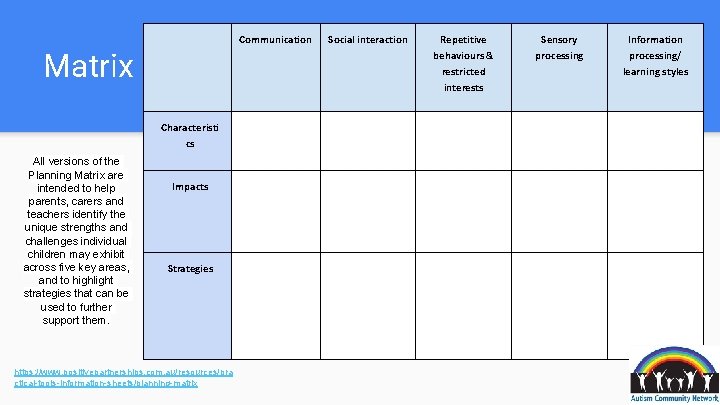
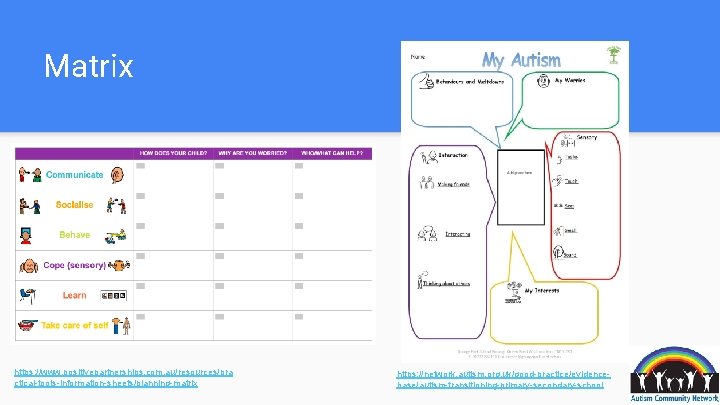
Communication Matrix Characteristi cs All versions of the Planning Matrix are intended to help parents, carers and teachers identify the unique strengths and challenges individual children may exhibit across five key areas, and to highlight strategies that can be used to further support them. Impacts Strategies https: //www. positivepartnerships. com. au/resources/pra ctical-tools-information-sheets/planning-matrix Social interaction Repetitive behaviours & restricted interests Sensory processing Information processing/ learning styles
Matrix https: //www. positivepartnerships. com. au/resources/pra ctical-tools-information-sheets/planning-matrix https: //network. autism. org. uk/good-practice/evidencebase/autism-transitioning-primary-secondary-school
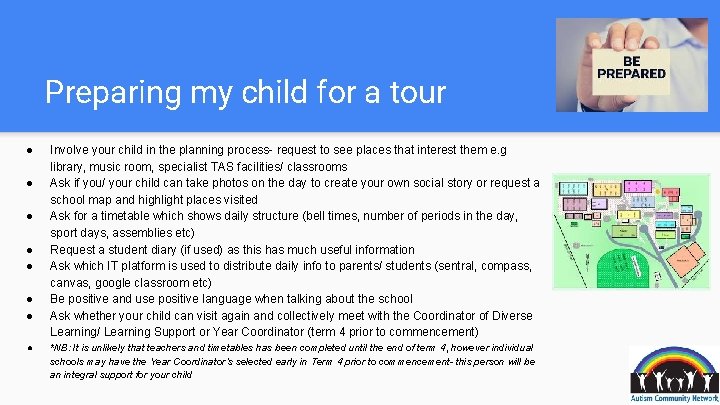
Preparing my child for a tour ● ● ● ● Involve your child in the planning process- request to see places that interest them e. g library, music room, specialist TAS facilities/ classrooms Ask if you/ your child can take photos on the day to create your own social story or request a school map and highlight places visited Ask for a timetable which shows daily structure (bell times, number of periods in the day, sport days, assemblies etc) Request a student diary (if used) as this has much useful information Ask which IT platform is used to distribute daily info to parents/ students (sentral, compass, canvas, google classroom etc) Be positive and use positive language when talking about the school Ask whether your child can visit again and collectively meet with the Coordinator of Diverse Learning/ Learning Support or Year Coordinator (term 4 prior to commencement) *NB: It is unlikely that teachers and timetables has been completed until the end of term 4, however individual schools may have the Year Coordinator’s selected early in Term 4 prior to commencement- this person will be an integral support for your child
Before starting school You and your child: ● Ask about a buddy or student support system ● Discuss prompts/ supports you use at home ● Discuss ways of communication- who is the point of contact The school should discuss with you: (joint collaboration) ● Transition plan ● Subjects your child will/can study ● How to plan for and facilitate transition between classes/ teachers ● Classroom environments- seating, noise, lighting, proximity to teacher, requesting help or a break ● Organisation of materials/ books/ locker use ● Access to playground environment & quiet spaces ● How to manage movements between classrooms/ PE/ assemblies etc ● Canteen/ buses/ excursions/ sports days etc ● Support person/teacher aide ● Communication supports- use of break card, question techniques if unsure, ‘go to’ person for child ● Plan for ‘what to do’ in case of your child feeling overwhelmed
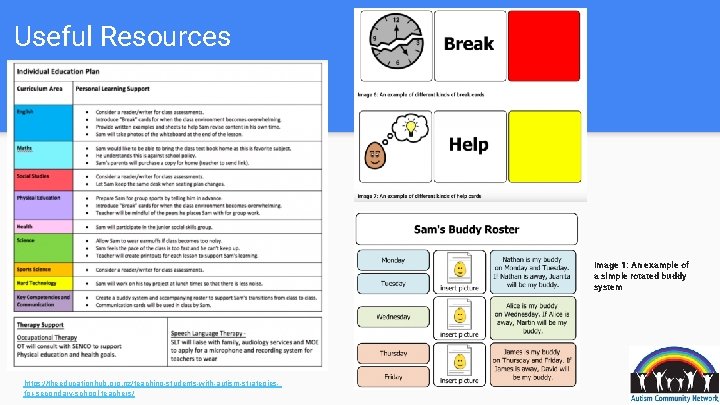
Useful Resources Image 1: An example of a simple rotated buddy system https: //theeducationhub. org. nz/teaching-students-with-autism-strategiesfor-secondary-school-teachers/
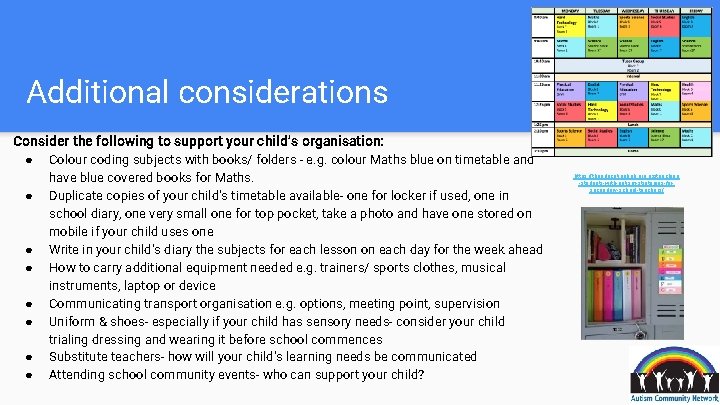
Additional considerations Consider the following to support your child’s organisation: ● ● ● ● Colour coding subjects with books/ folders - e. g. colour Maths blue on timetable and have blue covered books for Maths. Duplicate copies of your child’s timetable available- one for locker if used, one in school diary, one very small one for top pocket, take a photo and have one stored on mobile if your child uses one Write in your child’s diary the subjects for each lesson on each day for the week ahead How to carry additional equipment needed e. g. trainers/ sports clothes, musical instruments, laptop or device Communicating transport organisation e. g. options, meeting point, supervision Uniform & shoes- especially if your child has sensory needs- consider your child trialing dressing and wearing it before school commences Substitute teachers- how will your child’s learning needs be communicated Attending school community events- who can support your child? https: //theeducationhub. org. nz/teaching -students-with-autism-strategies-forsecondary-school-teachers/
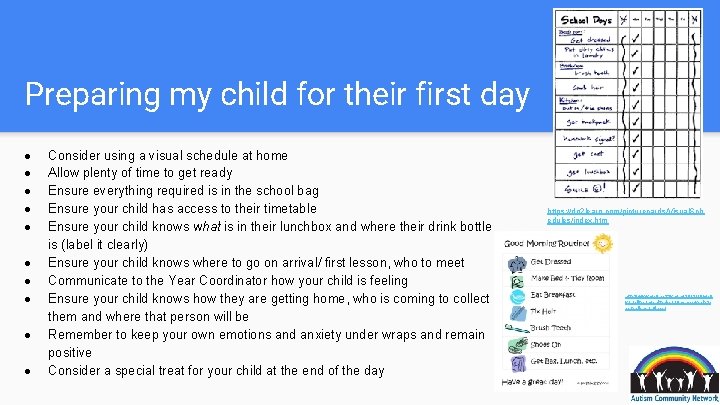
Preparing my child for their first day ● ● ● ● ● Consider using a visual schedule at home Allow plenty of time to get ready Ensure everything required is in the school bag Ensure your child has access to their timetable Ensure your child knows what is in their lunchbox and where their drink bottle is (label it clearly) Ensure your child knows where to go on arrival/ first lesson, who to meet Communicate to the Year Coordinator how your child is feeling Ensure your child knows how they are getting home, who is coming to collect them and where that person will be Remember to keep your own emotions and anxiety under wraps and remain positive Consider a special treat for your child at the end of the day https: //do 2 learn. com/picturecards/Visual. Sch edules/index. htm http: //www. getsnazzy. com/2012/10/getyour-life-organized-boot-camp-week-2 establish-routines/
Useful tips for parents/ carers ● ● ● ● Be kind to yourself Remember even the best planning isn’t always foolproof Work together with school personnel- positive communication fosters positive relationships When discussing issues always consider offering possible solutions Remember transitioning takes time, just like starting a new job Your child may be more emotional at the end of the school daysensory overload/ tiredness, feeling more safe/ comfortable at home Consider establishing after school routines in conjunction with night time routines, make it predictable
Useful Tips for Educators ● ● ● Liaise with the Year Coordinator/ Diverse Learning Team- whoever is the point of communication with the family- it’s a team approach and adjustments have been collaboratively discussed Provide a visual class structure- this may consist of written sequenced plan on board Provide structured learning and sequenced activities Use language that is clear and without idioms Have direct, explicit rules and expectations be consistent Prepare for transitions between activities/ classes by allowing plenty of time to pack up -often a child is very anxious about being on time to the next class Recognise the stress signals and adopt strategies quickly to reduce anxiety Consider careful classroom seating Consider use of break cards/ question cards Consider how technology is used in the class for communication, engagement, reinforcing concepts, rewards and deeper understanding & learning Communicate successes to the family- use the diary, email etc
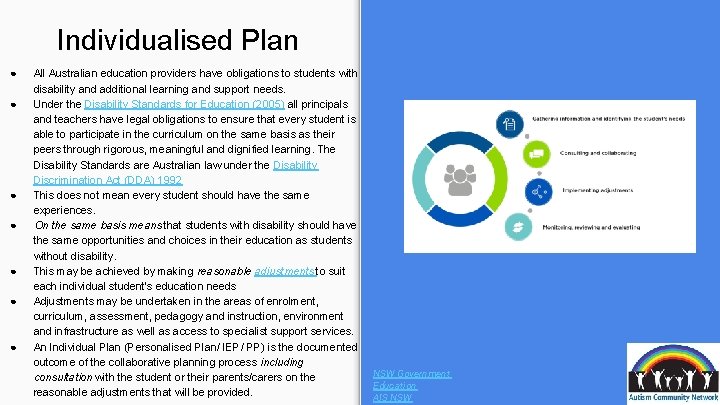
Individualised Plan ● ● ● ● All Australian education providers have obligations to students with disability and additional learning and support needs. Under the Disability Standards for Education (2005) all principals and teachers have legal obligations to ensure that every student is able to participate in the curriculum on the same basis as their peers through rigorous, meaningful and dignified learning. The Disability Standards are Australian law under the Disability Discrimination Act (DDA) 1992 This does not mean every student should have the same experiences. On the same basis means that students with disability should have the same opportunities and choices in their education as students without disability. This may be achieved by making reasonable adjustments to suit each individual student's education needs Adjustments may be undertaken in the areas of enrolment, curriculum, assessment, pedagogy and instruction, environment and infrastructure as well as access to specialist support services. An Individual Plan (Personalised Plan/ IEP/ PP) is the documented outcome of the collaborative planning process including consultation with the student or their parents/carers on the reasonable adjustments that will be provided. NSW Government Education AIS NSW
Supporting parents/ carers through their emotional journey Parents/ carers will feel a range of emotions at different stages, whether it is at your child’s diagnosis, or transitioning to another stage of your child’s development. Starting high school can be another emotional time. It is important that parents/ carers look after themselves as well, as often they place themselves much further down the priority list. Minimising stress is key. ● ● ● ● Stay organised- stress spirals when you feel things are out of your control. Have a visible weekly routine especially if trying to coordinate other children & activities Prioritise yourself. It’s difficult but important. Have activities that makes you and/or partner feel good. List these for all family members and plan for/ roster when they occur. It might be something simple as going for a walk by yourself. Engage support from family and friends- pick up/ drop offs/ after school care/ activities/ homework supervision of additional siblings. Communicate how they can assist you. Investigate respite services/ school holiday options Avoid comparisons with other children/ families- focus on positive experiences within your own family and positive self talk Join a local support group Relationships & stress Raising Children Network
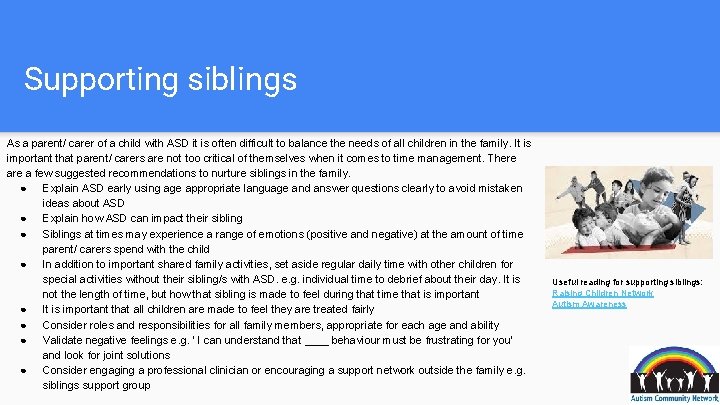
Supporting siblings As a parent/ carer of a child with ASD it is often difficult to balance the needs of all children in the family. It is important that parent/ carers are not too critical of themselves when it comes to time management. There a few suggested recommendations to nurture siblings in the family. ● Explain ASD early using age appropriate language and answer questions clearly to avoid mistaken ideas about ASD ● Explain how ASD can impact their sibling ● Siblings at times may experience a range of emotions (positive and negative) at the amount of time parent/ carers spend with the child ● In addition to important shared family activities, set aside regular daily time with other children for special activities without their sibling/s with ASD. e. g. individual time to debrief about their day. It is not the length of time, but how that sibling is made to feel during that time that is important ● It is important that all children are made to feel they are treated fairly ● Consider roles and responsibilities for all family members, appropriate for each age and ability ● Validate negative feelings e. g. ‘ I can understand that ____ behaviour must be frustrating for you’ and look for joint solutions ● Consider engaging a professional clinician or encouraging a support network outside the family e. g. siblings support group Useful reading for supporting siblings: Raising Children Network Autism Awareness
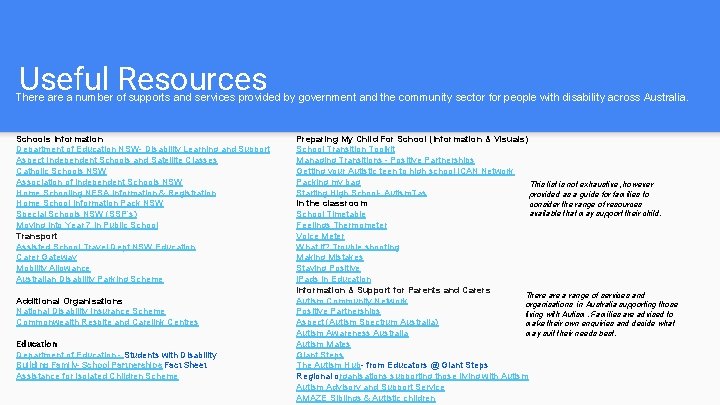
Useful Resources There a number of supports and services provided by government and the community sector for people with disability across Australia. Schools Information Department of Education NSW- Disability Learning and Support Aspect Independent Schools and Satellite Classes Catholic Schools NSW Association of Independent Schools NSW Home Schooling NESA Information & Registration Home School Information Pack NSW Special Schools NSW (SSP’s) Moving into Year 7 in Public School Transport Assisted School Travel Dept NSW Education Carer Gateway Mobility Allowance Australian Disability Parking Scheme Additional Organisations National Disability Insurance Scheme Commonwealth Respite and Carelink Centres Education Department of Education - Students with Disability Building Family- School Partnerships Fact Sheet Assistance for Isolated Children Scheme Preparing My Child For School (Information & Visuals) School Transition Toolkit Managing Transitions - Positive Partnerships Getting your Autistic teen to high school ICAN Network Packing my bag This list is not exhaustive, however Starting High School- Autism. Tas provided as a guide for families to In the classroom consider the range of resources available that may support their child. School Timetable Feelings Thermometer Voice Meter What if? Trouble shooting Making Mistakes Staying Positive i. Pads in Education Information & Support for Parents and Carers There a range of services and Autism Community Network organisations in Australia supporting those Positive Partnerships living with Autism. Families are advised to Aspect (Autism Spectrum Australia) make their own enquiries and decide what Autism Awareness Australia may suit their needs best. Autism Mates Giant Steps The Autism Hub- from Educators @ Giant Steps Regional organisations supporting those living with Autism Advisory and Support Service AMAZE Siblings & Autistic children
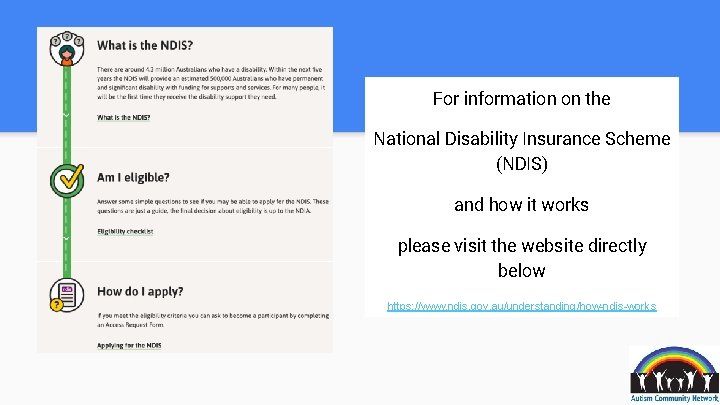
For information on the National Disability Insurance Scheme (NDIS) and how it works please visit the website directly below https: //www. ndis. gov. au/understanding/how-ndis-works
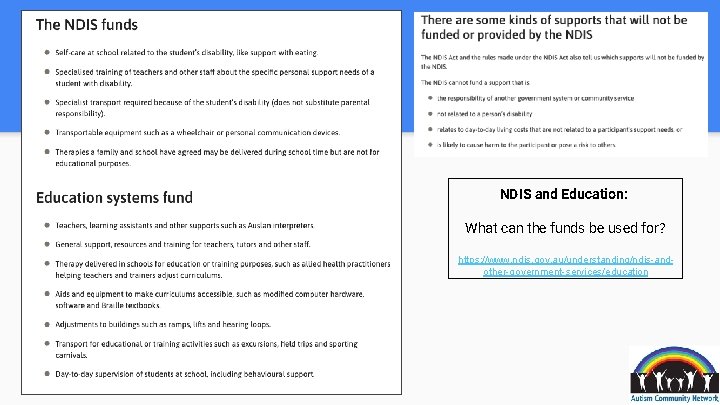
NDIS and Education: What can the funds be used for? https: //www. ndis. gov. au/understanding/ndis-andother-government-services/education
Presented on behalf of Autism Community Network a charity focused around building a strong community of support for those impacted by autism. https: //www. autismcommunity. org. au/