
School Therapy Dog Proposal Samantha Mc Atee M





- Slides: 27
School Therapy Dog Proposal Samantha Mc. Atee, M. S. Ed. Director of School Counseling
The Role and Purpose of a Certified Therapy Dog Team • Therapy Dogs certified with their owner/handlers as Certified Dog Teams provide emotional and physical support in the educational setting. These dogs model good behavior, tolerance, and acceptance. Certified Therapy Dog Teams work to support and positively influence student academic achievement and behavioral success. • Twin Lakes School Corporation would be the FIRST in White County to adopt a Certified Therapy Dog program.
Certified Therapy Dog-Definition Certified Therapy dogs are dogs trained and tested to provide therapeutic functions under the direction and control of a handler who works with the dog as a team. *Services are provided within educational and community-based instruction settings *Dogs have passed basic obedience courses and the AKC Canine Good Citizenship course *Dogs are used for Animal Assisted Activities (AAA) or Animal Assisted Therapy (AAT). AAA provides opportunities for animal interactions for motivational, educational and therapeutic activities that enhance the quality of the school day. This includes activities such as reading to the dog, petting to help relax the student or playing as an incentive for good behavior. AAT is an intervention in which the animal serves to help a student with their behavior and social skills. This includes learning self-regulation and empathy building. *Certified Therapy Dogs are owned and cared for by an employee of Twin Lakes School Corporation.
The Healing Power of Animals Research has shown that therapy dogs support psychological and academic growth while increasing social skills and self-esteem in children and adolescents. Therapy dogs have been trained to provide emotional support which positively impacts reading skills, emotional functioning and communication skills.
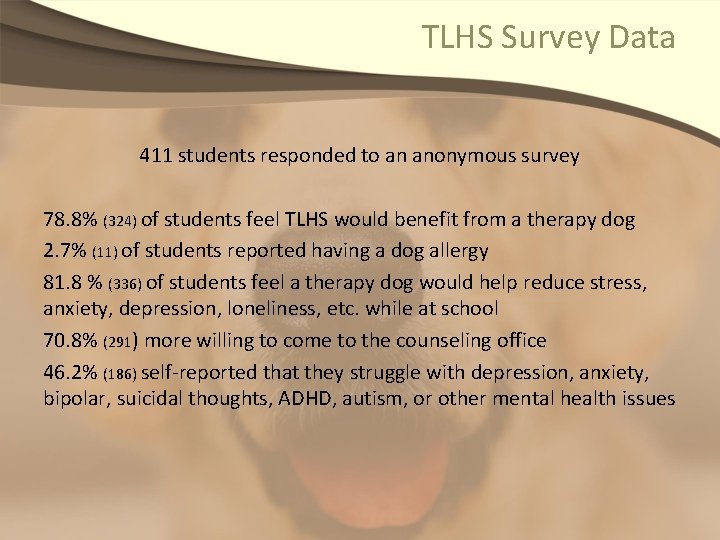
TLHS Survey Data 411 students responded to an anonymous survey 78. 8% (324) of students feel TLHS would benefit from a therapy dog 2. 7% (11) of students reported having a dog allergy 81. 8 % (336) of students feel a therapy dog would help reduce stress, anxiety, depression, loneliness, etc. while at school 70. 8% (291) more willing to come to the counseling office 46. 2% (186) self-reported that they struggle with depression, anxiety, bipolar, suicidal thoughts, ADHD, autism, or other mental health issues
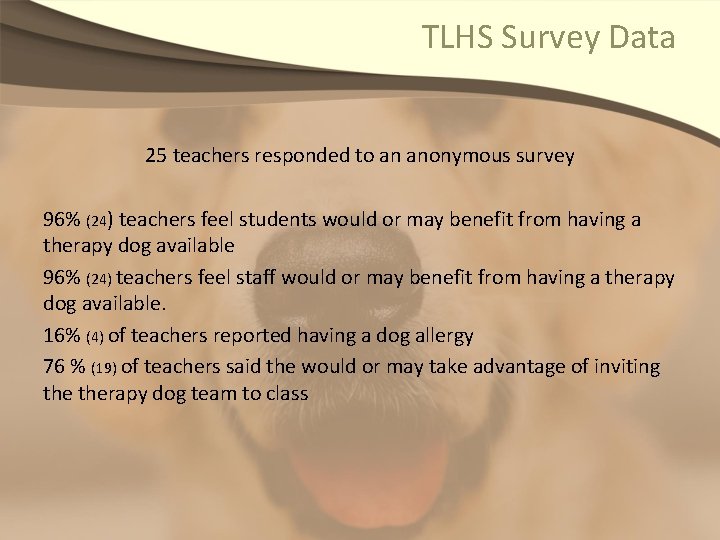
TLHS Survey Data 25 teachers responded to an anonymous survey 96% (24) teachers feel students would or may benefit from having a therapy dog available 96% (24) teachers feel staff would or may benefit from having a therapy dog available. 16% (4) of teachers reported having a dog allergy 76 % (19) of teachers said the would or may take advantage of inviting therapy dog team to class
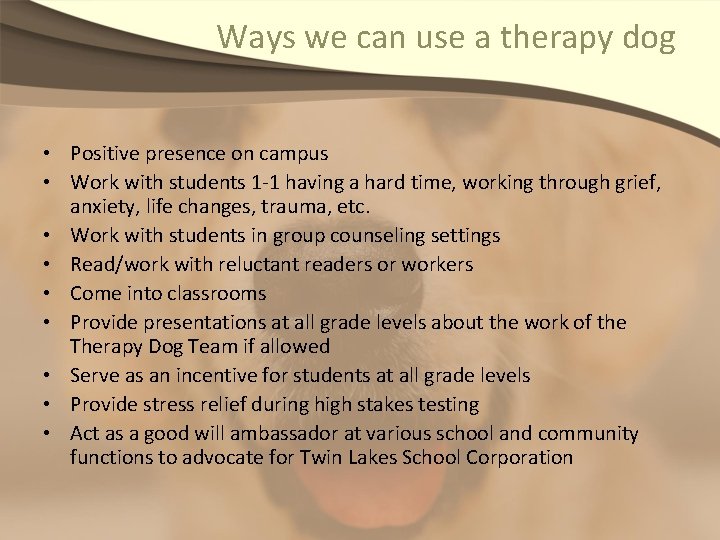
Ways we can use a therapy dog • Positive presence on campus • Work with students 1 -1 having a hard time, working through grief, anxiety, life changes, trauma, etc. • Work with students in group counseling settings • Read/work with reluctant readers or workers • Come into classrooms • Provide presentations at all grade levels about the work of the Therapy Dog Team if allowed • Serve as an incentive for students at all grade levels • Provide stress relief during high stakes testing • Act as a good will ambassador at various school and community functions to advocate for Twin Lakes School Corporation
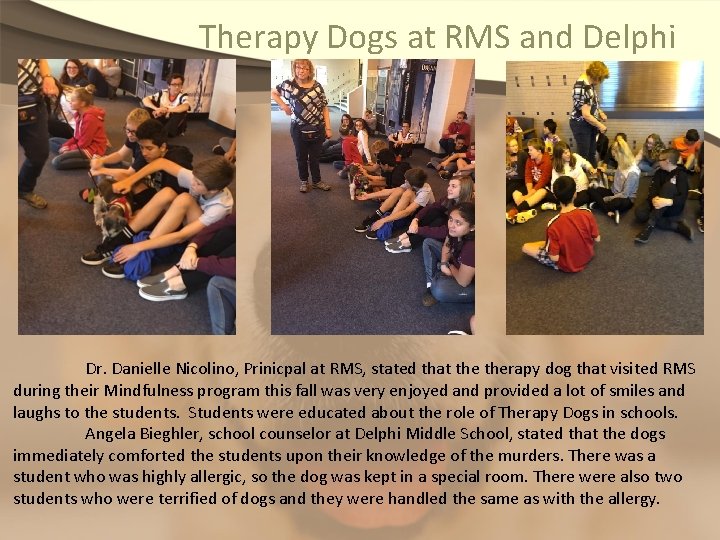
Therapy Dogs at RMS and Delphi Dr. Danielle Nicolino, Prinicpal at RMS, stated that therapy dog that visited RMS during their Mindfulness program this fall was very enjoyed and provided a lot of smiles and laughs to the students. Students were educated about the role of Therapy Dogs in schools. Angela Bieghler, school counselor at Delphi Middle School, stated that the dogs immediately comforted the students upon their knowledge of the murders. There was a student who was highly allergic, so the dog was kept in a special room. There were also two students who were terrified of dogs and they were handled the same as with the allergy.
Comprehensive Program Development • • Goals and Objectives- school wide, individual students Student Behavior Expectations-Approach, Ask, Pet, Goodbye Policies/Procedures-building wide, health screen, all families notified, leash protocols, hallway traffic, off-limit areas, injuries, incidents, lunch, lock downs, fire alarms, posted working dog sign, other dogs not allowed Administration approval-school board, principal Budget Planning- dog will be owned by me, all health care expenses will be my responsibility Insurance-Umbrella plan from homeowners insurance in place through Farm Bureau Insurance Intervention tools- leashes, harness, working vest, bed, signs, balls, treats, dander wipes, lint rollers
Comprehensive Program Records Management • • • Maintain therapy dog registry paperwork/testing Maintain vet records, training records, interaction hours District forms- school agreement, opt-out forms Intervention Data Program Evaluation Incident Records
Comprehensive Program Handler Considerations • • • Additional handlers model Ability to read and understand dog body language/stress signals Know how to facilitate interactions Can align interactions with student goals Professional development Can obtain insurance Network with other programs Comply with professional/humane ethics Maintains knowledge of relevant literature Shares best practices and resources with other professionals
Broad Scope of Impact : Goals To provide students with positive academic, emotional, and behavioral support To share relationship-building skills and trustworthiness To exemplify calming techniques and self-regulation To experience sharing, overcoming personal obstacles To help with test anxiety and stress To address respect for personal territory and boundaries To be a positive impact on self-esteem and confidence To teach assertiveness without anger, empathy, patience, and forgiveness To expand awareness of conflict resolution skills and how to have difficult conversations To encourage positive choices and decision-making skills To be a tool used in academic lessons
Intervention Examples Bridge to difficult conversations Focus on dog and then flow into conversation Recognition of changes in emotions Natural reaction to touch-soft fur, flop ears Notice feeling more calm/comfortable Physical greeting Dogs don’t “fake” greeting, truly glad to see you
Allergies are a common concern when implementing a therapy dog program in any public space, such as schools or hospitals. There are several steps to take to minimize or eliminate the impact on students and staff with allergies. *Regular baths (once per month) and brushing (daily) to minimize shedding and dander. *Wiped with anti-dander wipes every day when coming to school *Students will wash their hands after working with the dog and use a lint brush to remove animal hair from clothes, before returning to class. *My office will be vacuumed daily to remove animal hair and dander. *My office contains an air purifier with a HEPA filter that runs constantly.
Students can Opt-Out *Information will go out to families introducing therapy dog and the program. *All families will be provided with an “Opt-Out” permission form. This will allow students who have allergies or other issues surrounding dogs the opportunity to not be around the dog. *Students in my alphabet who “opt-out” will still be able to meet with me in an alternative office attached to the student services suite. *Opportunities for 1 -1 counseling and meetings will not be impaired do to opting-out.
Anticipated Program Costs • • • Umbrella Insurance Policy-$183 per year Nature’s Miracle Pet Wipes-$15. 42 (reduces dander/deodorizes) AKC Therapy Dog Title Application- $20 Therapy Dog Vest-$20 Training- Klondike Canine Academy, Lafayette – Puppy Pre-School (8 -16 weeks old) $132 – Canine Companion Course (4 mo+) $195 – Therapy Pet Workshop $104 Total: $649. 42 ($471 of total is only a one time cost)
West Lafayette School Corp Policy
WLSC cont’d
Niles High School Therapy Dog • LINK
Questions Let us be the trailblazers in White County and be the first school corporation to implement a School Therapy Dog program. Thank you very much for your time and consideration of this innovative approach to social, emotional, academic, and behavioral growth for our students!
Research Oxytocin Neuropeptide/hormone Social bonding/lactation Regulating stress and anxiety Dopamine Neuropeptide/hormone Key in reward-motivated behavior Positive Outlook Cortisol Steroid hormone Released in response to stress
Cortisol • Examining the effect of animal-assisted intervention on physiological stress biomarkers in hospitalized military veterans Significant decrease in heart rate and cortisol levels Decrease in blood pressure Increased relaxation Krause-Parello C. A. , Holman E. , (2015) Examining the effect of animal-assisted intervention of physiologic stress biomarkers in hospitalized military veterans: A landmark VA hospital based study
Oxytocin and the Human-Animal Bond Emotional bonding- In a 2003 study, both humans and dog oxytocin levels in the blood rose after five to 24 minutes of a petting session. Kuchinskas Susan, The Chemistry of Connection: How the Oxytocin Response Can Help You Find Trust, Intimacy, and Love p 65
Oxytocin in Relation to PTSD “In humans, a single administration of oxytocin increased trust and social approach behavior, and dampened stress reactivity and neural fear responses. ” Oxytocin can increase social bonding, trust, social interaction, recognition of facial expressions, and social support seeking behavior. Frijlng, Jessie; Van Zuiden, Mirjam; Nawijn, Laura; Kock, Saskia; Viltman, Dick; Oiff, Miaranda (2015) The effects of intranasal oxytocian in PTSD patients and trauma-exposed individuals: results of neuroimaging and clinical studies
Oxytocin’s Reflection in Therapy Dog work • Increase in trust through disclosure of emotional events Lane, A. , Luminet, O, Rime, B, Gross, JJ, de Timary P, Mikolajczak, M (2013). “Oxytocin increases willingness to socialy share one’s emotions”. International Journal of Psychology. 48 (4): 676 -81. • Find faces more trustworthy Theodoridou A, Rowe AC, Penton-Voak IS, Rogers PJ (June 2009). “Oxytocin and social perception: oxytocin increase perceived facial trustworthiness and attractiveness. ” Hormones and Behavior. 56 (1): 128 -32. • Reduces fear of social betrayal Baumgartner T, Heinrichs M, Vonlanthen A, Fischbacher U, Fehr E (May 2008). “Oxytocin shapes and neural circuitry of trusts and trust adaptation in humans”. Neuron. 58 (4): 639 -50.
Oxytocin Study with Canines • Mutual gazing has a profound effect on both dogs and their owners. Of the duos that have spent the greatest amount of time looking into each other’s eyes, both male and female dogs experienced a 130% rise in oxytocin levels, and both male and female owners a 300% increase. Grim, David: (2005) How Dogs Stole Our Hearts, Science Magazine