
School Survey on Crime and Safety SSOCS Chris

- Slides: 22
School Survey on Crime and Safety (SSOCS) Chris Chapman Association Commissioner – Sample Surveys Division Rachel Hansen Project Officer – School Crime Surveys National Center for Education Statistics School Security: Identifying and Addressing Sources of Inequity October 23 rd, 2018
This presentation is intended to promote ideas. The views expressed are part of ongoing research and do not necessarily reflect the position of the U. S. Department of Education
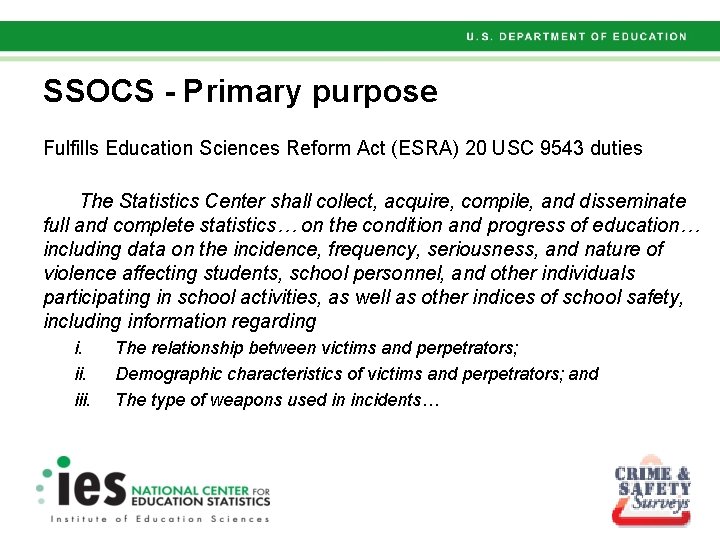
SSOCS - Primary purpose Fulfills Education Sciences Reform Act (ESRA) 20 USC 9543 duties The Statistics Center shall collect, acquire, compile, and disseminate full and complete statistics… on the condition and progress of education… including data on the incidence, frequency, seriousness, and nature of violence affecting students, school personnel, and other individuals participating in school activities, as well as other indices of school safety, including information regarding i. iii. The relationship between victims and perpetrators; Demographic characteristics of victims and perpetrators; and The type of weapons used in incidents…
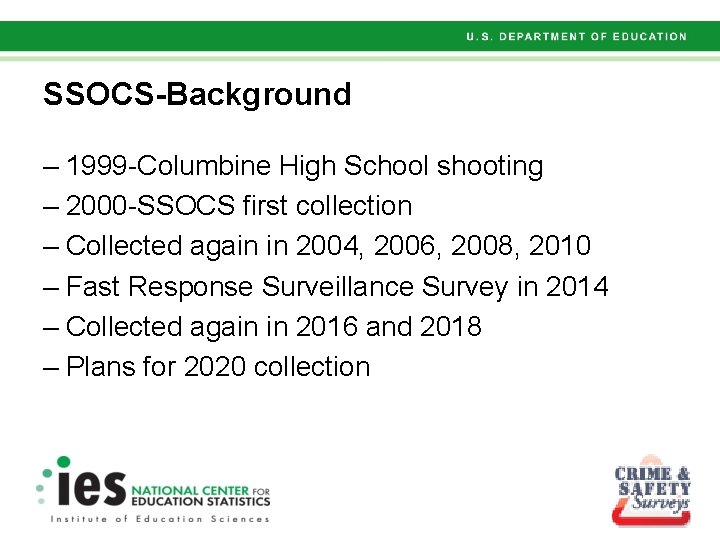
SSOCS-Background – 1999 -Columbine High School shooting – 2000 -SSOCS first collection – Collected again in 2004, 2006, 2008, 2010 – Fast Response Surveillance Survey in 2014 – Collected again in 2016 and 2018 – Plans for 2020 collection
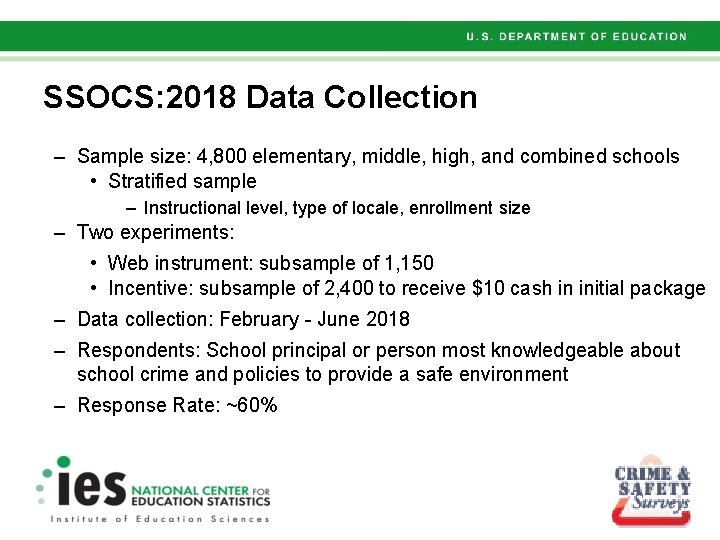
SSOCS: 2018 Data Collection – Sample size: 4, 800 elementary, middle, high, and combined schools • Stratified sample – Instructional level, type of locale, enrollment size – Two experiments: • Web instrument: subsample of 1, 150 • Incentive: subsample of 2, 400 to receive $10 cash in initial package – Data collection: February - June 2018 – Respondents: School principal or person most knowledgeable about school crime and policies to provide a safe environment – Response Rate: ~60%
SSOCS – Topics – School Practices and Programs – Parent and Community Involvement at School – School Security Staff – School Mental Health Services – Staff Training and Practices – Limitations on Crime Prevention – Frequency of Crime and Violence at School – Incidents – Disciplinary Problems and Actions
SSOCS Topics for the Conference The survey has a wealth of information Given the purpose of this conference, the presentation will provide more detailed information about security measures implemented by schools, security personnel in schools, and will be limited in focus to estimates by race/ethnicity. Similar information on other school characteristics is available, including percent free or reduced-price lunch and sex.
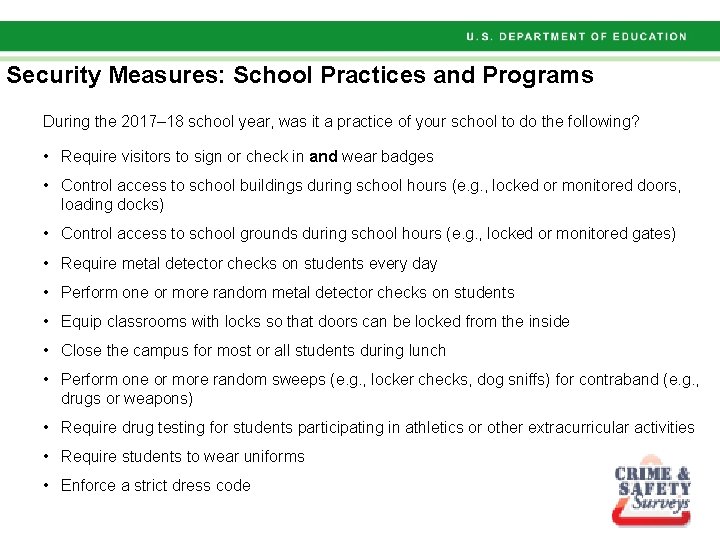
Security Measures: School Practices and Programs During the 2017– 18 school year, was it a practice of your school to do the following? • Require visitors to sign or check in and wear badges • Control access to school buildings during school hours (e. g. , locked or monitored doors, loading docks) • Control access to school grounds during school hours (e. g. , locked or monitored gates) • Require metal detector checks on students every day • Perform one or more random metal detector checks on students • Equip classrooms with locks so that doors can be locked from the inside • Close the campus for most or all students during lunch • Perform one or more random sweeps (e. g. , locker checks, dog sniffs) for contraband (e. g. , drugs or weapons) • Require drug testing for students participating in athletics or other extracurricular activities • Require students to wear uniforms • Enforce a strict dress code
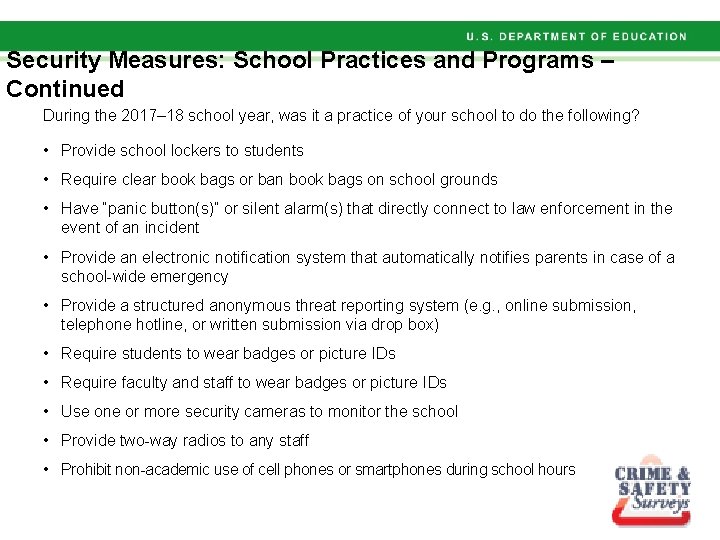
Security Measures: School Practices and Programs – Continued During the 2017– 18 school year, was it a practice of your school to do the following? • Provide school lockers to students • Require clear book bags or ban book bags on school grounds • Have “panic button(s)” or silent alarm(s) that directly connect to law enforcement in the event of an incident • Provide an electronic notification system that automatically notifies parents in case of a school-wide emergency • Provide a structured anonymous threat reporting system (e. g. , online submission, telephone hotline, or written submission via drop box) • Require students to wear badges or picture IDs • Require faculty and staff to wear badges or picture IDs • Use one or more security cameras to monitor the school • Provide two-way radios to any staff • Prohibit non-academic use of cell phones or smartphones during school hours
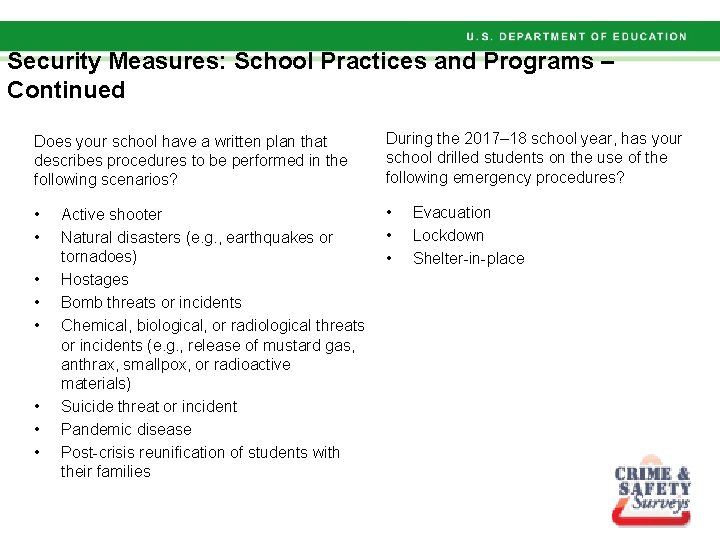
Security Measures: School Practices and Programs – Continued Does your school have a written plan that describes procedures to be performed in the following scenarios? During the 2017– 18 school year, has your school drilled students on the use of the following emergency procedures? • • • Active shooter Natural disasters (e. g. , earthquakes or tornadoes) Hostages Bomb threats or incidents Chemical, biological, or radiological threats or incidents (e. g. , release of mustard gas, anthrax, smallpox, or radioactive materials) Suicide threat or incident Pandemic disease Post-crisis reunification of students with their families Evacuation Lockdown Shelter-in-place
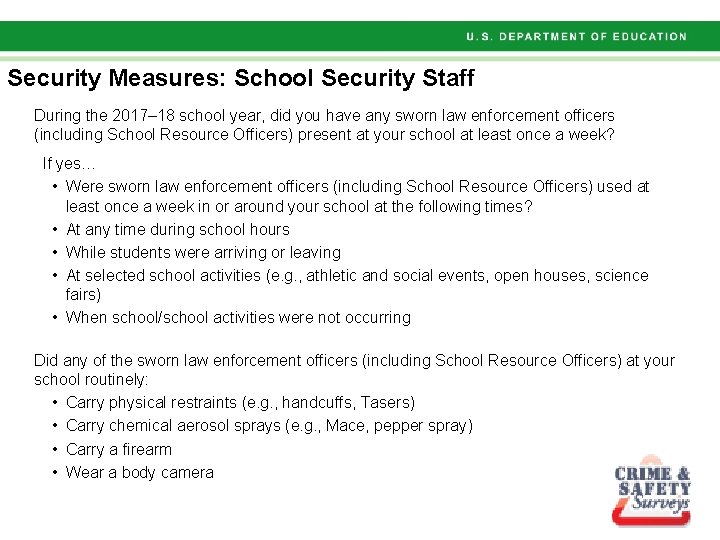
Security Measures: School Security Staff During the 2017– 18 school year, did you have any sworn law enforcement officers (including School Resource Officers) present at your school at least once a week? If yes… • Were sworn law enforcement officers (including School Resource Officers) used at least once a week in or around your school at the following times? • At any time during school hours • While students were arriving or leaving • At selected school activities (e. g. , athletic and social events, open houses, science fairs) • When school/school activities were not occurring Did any of the sworn law enforcement officers (including School Resource Officers) at your school routinely: • Carry physical restraints (e. g. , handcuffs, Tasers) • Carry chemical aerosol sprays (e. g. , Mace, pepper spray) • Carry a firearm • Wear a body camera
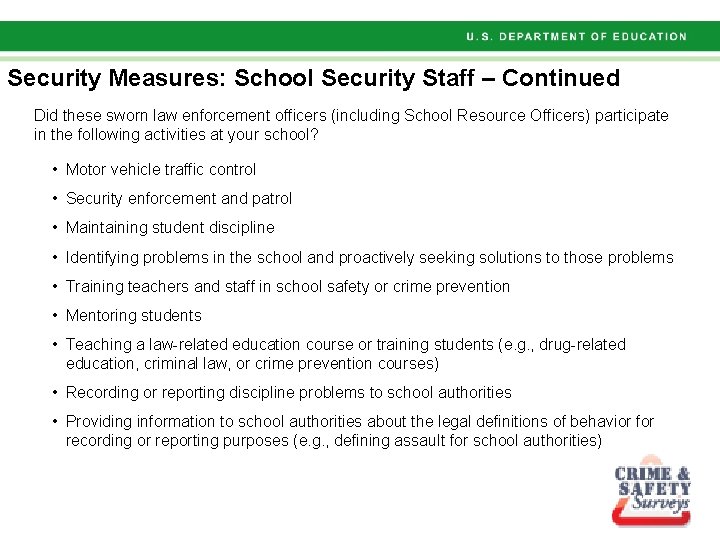
Security Measures: School Security Staff – Continued Did these sworn law enforcement officers (including School Resource Officers) participate in the following activities at your school? • Motor vehicle traffic control • Security enforcement and patrol • Maintaining student discipline • Identifying problems in the school and proactively seeking solutions to those problems • Training teachers and staff in school safety or crime prevention • Mentoring students • Teaching a law-related education course or training students (e. g. , drug-related education, criminal law, or crime prevention courses) • Recording or reporting discipline problems to school authorities • Providing information to school authorities about the legal definitions of behavior for recording or reporting purposes (e. g. , defining assault for school authorities)
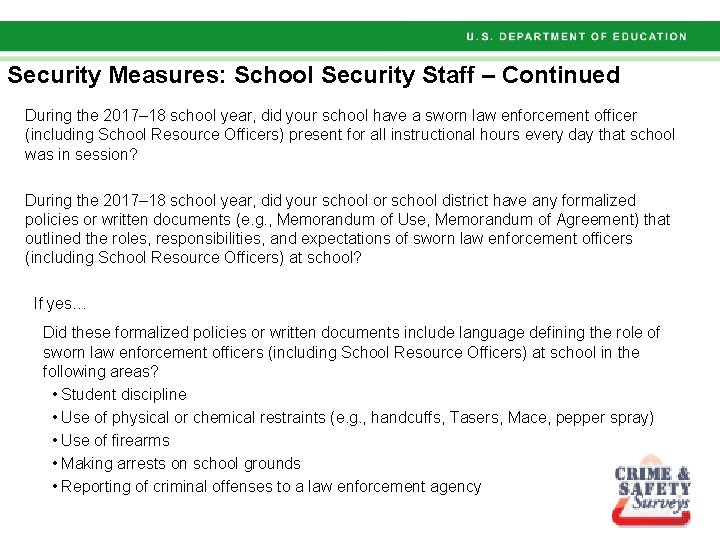
Security Measures: School Security Staff – Continued During the 2017– 18 school year, did your school have a sworn law enforcement officer (including School Resource Officers) present for all instructional hours every day that school was in session? During the 2017– 18 school year, did your school or school district have any formalized policies or written documents (e. g. , Memorandum of Use, Memorandum of Agreement) that outlined the roles, responsibilities, and expectations of sworn law enforcement officers (including School Resource Officers) at school? If yes… Did these formalized policies or written documents include language defining the role of sworn law enforcement officers (including School Resource Officers) at school in the following areas? • Student discipline • Use of physical or chemical restraints (e. g. , handcuffs, Tasers, Mace, pepper spray) • Use of firearms • Making arrests on school grounds • Reporting of criminal offenses to a law enforcement agency
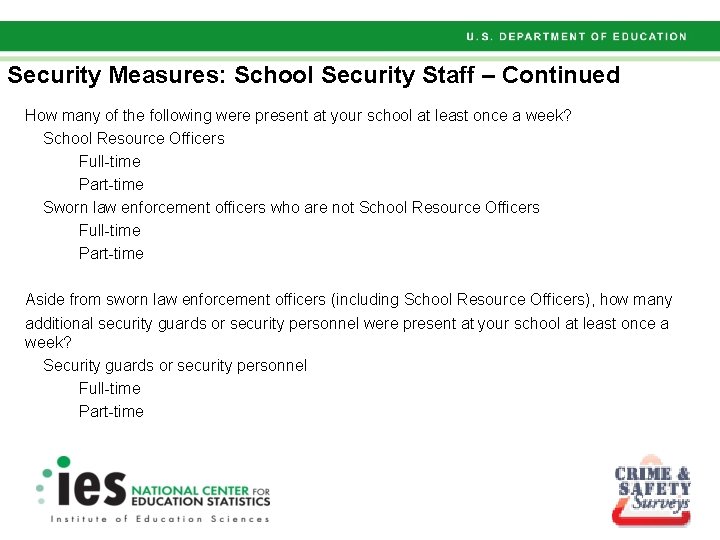
Security Measures: School Security Staff – Continued How many of the following were present at your school at least once a week? School Resource Officers Full-time Part-time Sworn law enforcement officers who are not School Resource Officers Full-time Part-time Aside from sworn law enforcement officers (including School Resource Officers), how many additional security guards or security personnel were present at your school at least once a week? Security guards or security personnel Full-time Part-time
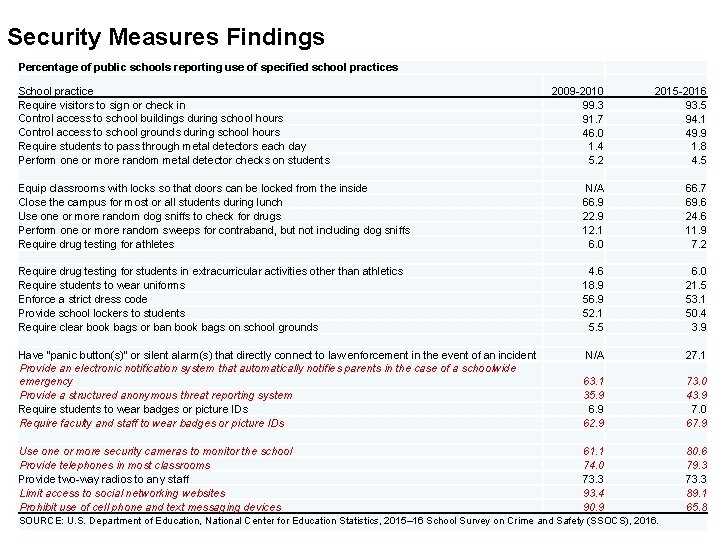
Security Measures Findings Percentage of public schools reporting use of specified school practices School practice Require visitors to sign or check in Control access to school buildings during school hours Control access to school grounds during school hours Require students to pass through metal detectors each day Perform one or more random metal detector checks on students 2009 -2010 99. 3 91. 7 46. 0 1. 4 5. 2 2015 -2016 93. 5 94. 1 49. 9 1. 8 4. 5 Equip classrooms with locks so that doors can be locked from the inside Close the campus for most or all students during lunch Use one or more random dog sniffs to check for drugs Perform one or more random sweeps for contraband, but not including dog sniffs Require drug testing for athletes N/A 66. 9 22. 9 12. 1 6. 0 66. 7 69. 6 24. 6 11. 9 7. 2 Require drug testing for students in extracurricular activities other than athletics Require students to wear uniforms Enforce a strict dress code Provide school lockers to students Require clear book bags or ban book bags on school grounds 4. 6 18. 9 56. 9 52. 1 5. 5 6. 0 21. 5 53. 1 50. 4 3. 9 Have "panic button(s)" or silent alarm(s) that directly connect to law enforcement in the event of an incident Provide an electronic notification system that automatically notifies parents in the case of a schoolwide emergency Provide a structured anonymous threat reporting system Require students to wear badges or picture IDs Require faculty and staff to wear badges or picture IDs N/A 27. 1 63. 1 35. 9 62. 9 73. 0 43. 9 7. 0 67. 9 Use one or more security cameras to monitor the school Provide telephones in most classrooms Provide two-way radios to any staff Limit access to social networking websites Prohibit use of cell phone and text messaging devices 61. 1 74. 0 73. 3 93. 4 90. 9 80. 6 79. 3 73. 3 89. 1 65. 8 SOURCE: U. S. Department of Education, National Center for Education Statistics, 2015– 16 School Survey on Crime and Safety (SSOCS), 2016.
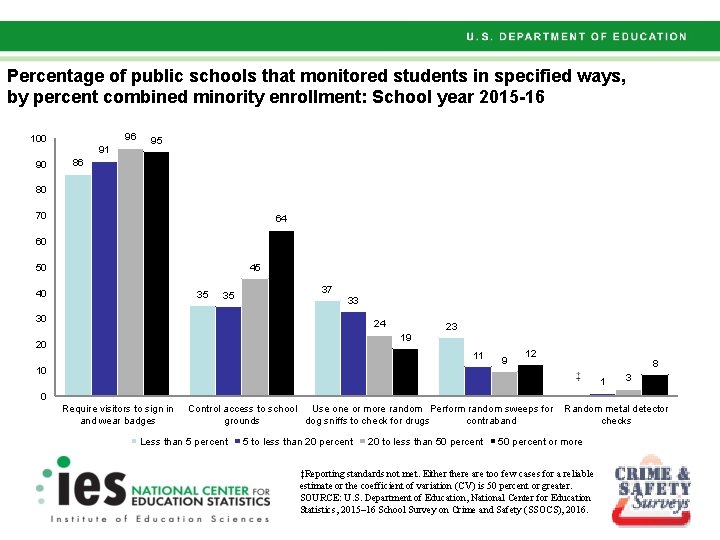
Percentage of public schools that monitored students in specified ways, by percent combined minority enrollment: School year 2015 -16 96 100 91 90 95 86 80 70 64 60 50 45 40 35 35 37 33 30 24 19 20 23 11 10 9 12 8 1 3 0 Require visitors to sign in and wear badges Control access to school Use one or more random Perform random sweeps for grounds dog sniffs to check for drugs contraband Less than 5 percent 5 to less than 20 percent 20 to less than 50 percent Random metal detector checks 50 percent or more ‡Reporting standards not met. Eithere are too few cases for a reliable estimate or the coefficient of variation (CV) is 50 percent or greater. SOURCE: U. S. Department of Education, National Center for Education Statistics, 2015– 16 School Survey on Crime and Safety (SSOCS), 2016.
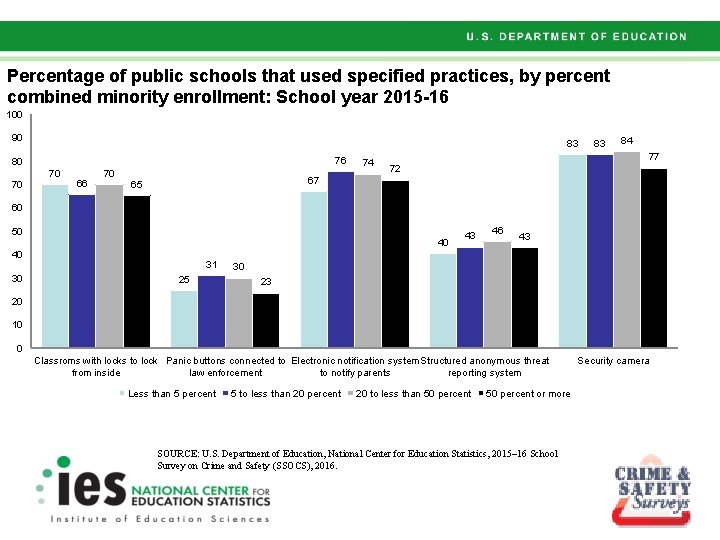
Percentage of public schools that used specified practices, by percent combined minority enrollment: School year 2015 -16 100 90 83 76 80 70 70 66 70 74 83 84 77 72 67 65 60 50 40 40 30 31 25 43 46 43 30 23 20 10 0 Classroms with locks to lock Panic buttons connected to Electronic notification system Structured anonymous threat from inside law enforcement to notify parents reporting system Less than 5 percent 5 to less than 20 percent 20 to less than 50 percent or more SOURCE: U. S. Department of Education, National Center for Education Statistics, 2015– 16 School Survey on Crime and Safety (SSOCS), 2016. Security camera
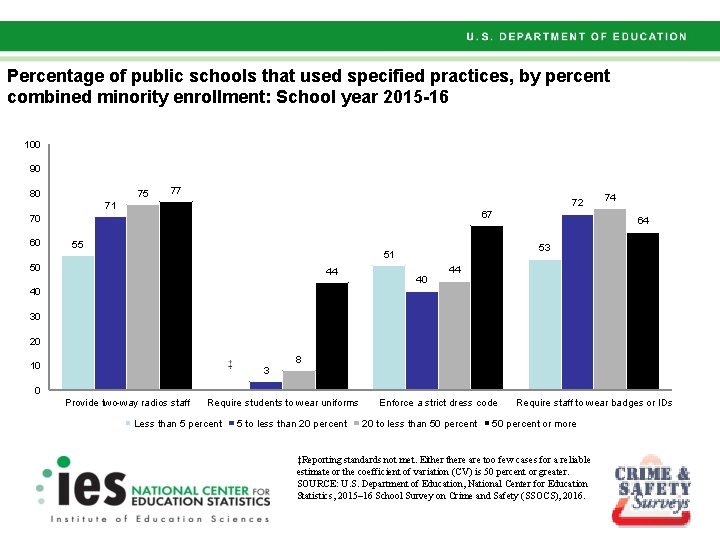
Percentage of public schools that used specified practices, by percent combined minority enrollment: School year 2015 -16 100 90 75 80 77 72 71 67 70 60 55 44 64 53 51 50 74 40 44 40 30 20 10 3 8 0 Provide two-way radios staff Require students to wear uniforms Less than 5 percent 5 to less than 20 percent Enforce a strict dress code 20 to less than 50 percent Require staff to wear badges or IDs 50 percent or more ‡Reporting standards not met. Eithere are too few cases for a reliable estimate or the coefficient of variation (CV) is 50 percent or greater. SOURCE: U. S. Department of Education, National Center for Education Statistics, 2015– 16 School Survey on Crime and Safety (SSOCS), 2016.
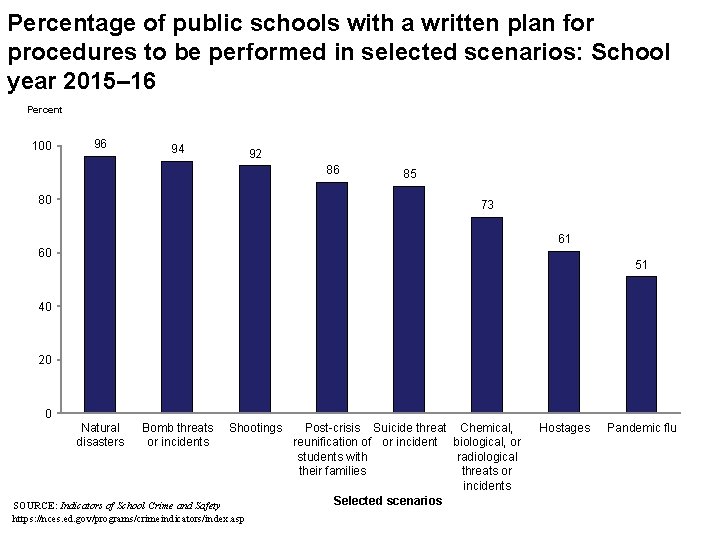
Percentage of public schools with a written plan for procedures to be performed in selected scenarios: School year 2015– 16 Percent 100 96 94 92 86 80 85 73 61 60 51 40 20 0 Natural disasters Bomb threats or incidents Shootings SOURCE: Indicators of School Crime and Safety https: //nces. ed. gov/programs/crimeindicators/index. asp Post-crisis Suicide threat Chemical, reunification of or incident biological, or students with radiological their families threats or incidents Selected scenarios Hostages Pandemic flu
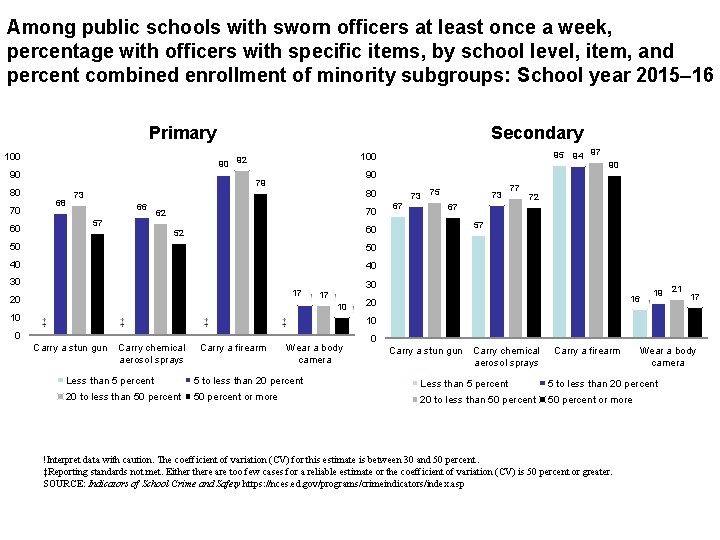
Among public schools with sworn officers at least once a week, percentage with officers with specific items, by school level, item, and percent combined enrollment of minority subgroups: School year 2015– 16 Primary 100 70 60 90 79 68 80 73 66 57 95 94 97 100 90 92 90 80 Secondary 70 62 67 73 75 73 50 50 40 40 30 17 20 72 67 57 60 52 77 90 30 17 10 10 16 20 19 21 17 10 0 Carry a stun gun Carry chemical aerosol sprays Carry a firearm Wear a body camera Less than 5 percent 5 to less than 20 percent 20 to less than 50 percent or more !Interpret data with caution. The coefficient of variation (CV) for this estimate is between 30 and 50 percent. ‡Reporting standards not met. Eithere are too few cases for a reliable estimate or the coefficient of variation (CV) is 50 percent or greater. SOURCE: Indicators of School Crime and Safety https: //nces. ed. gov/programs/crimeindicators/index. asp
Data Collection Issues – Response rate decline – Voluntary, sample survey – Rare events – Questionnaire length/burden
Thank you! Chris Chapman Chris. Chapman@ed. gov Rachel Hansen Rachel. Hansen@ed. gov https: //nces. ed. gov/surveys/ssocs/