
School Psychology in context Perception challenges and students
- Slides: 24
School Psychology in context: Perception, challenges, and students’ wellbeing in mainstream Kazakhstani secondary schools Carole Faucher, Daniel Torrano, Madina Tynybayeva, A. S. Cohen. Miller, and Kairat Kurakbayev Nazarbayev University Graduate School of Education Atlanta - CIES 2017
Understanding students’ wellbeing in Kazakhstan Join project between Nazarbayev University Graduate School of Education and The University of Cambridge Graduate School of Education This project is funded jointly by: Overarching research question: • How do schools define and contextualise the wellbeing of students throughout the academic year, especially in vulnerable populations or those under extreme academic stress?
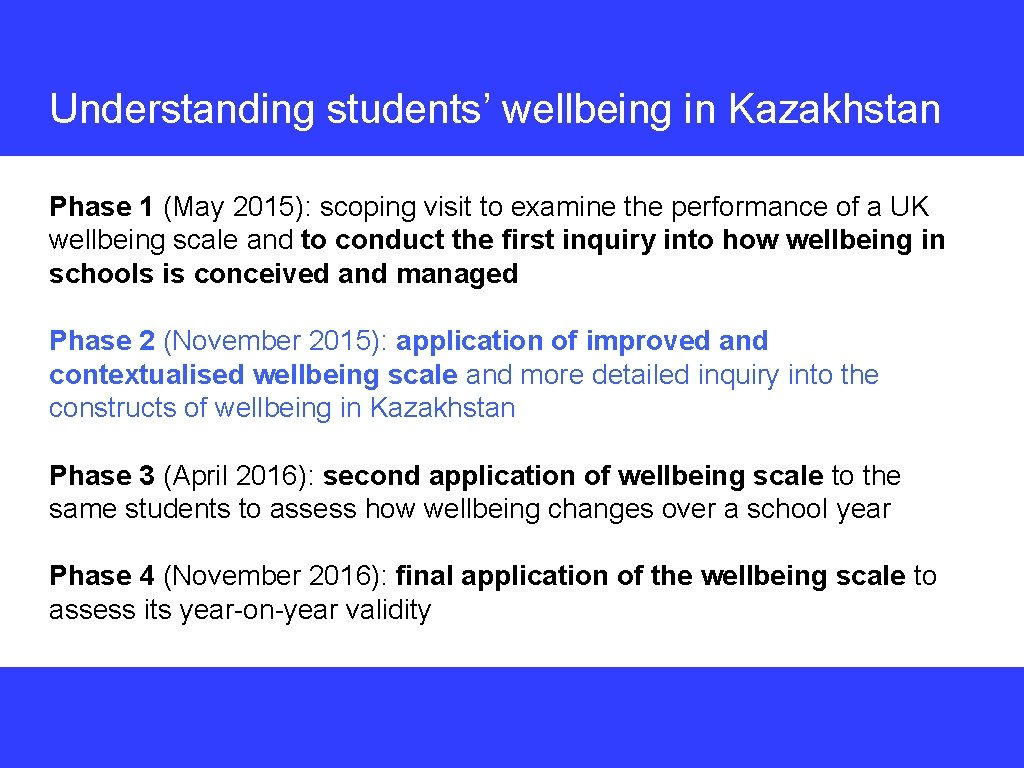
Understanding students’ wellbeing in Kazakhstan Phase 1 (May 2015): scoping visit to examine the performance of a UK wellbeing scale and to conduct the first inquiry into how wellbeing in schools is conceived and managed Phase 2 (November 2015): application of improved and contextualised wellbeing scale and more detailed inquiry into the constructs of wellbeing in Kazakhstan Phase 3 (April 2016): second application of wellbeing scale to the same students to assess how wellbeing changes over a school year Phase 4 (November 2016): final application of the wellbeing scale to assess its year-on-year validity
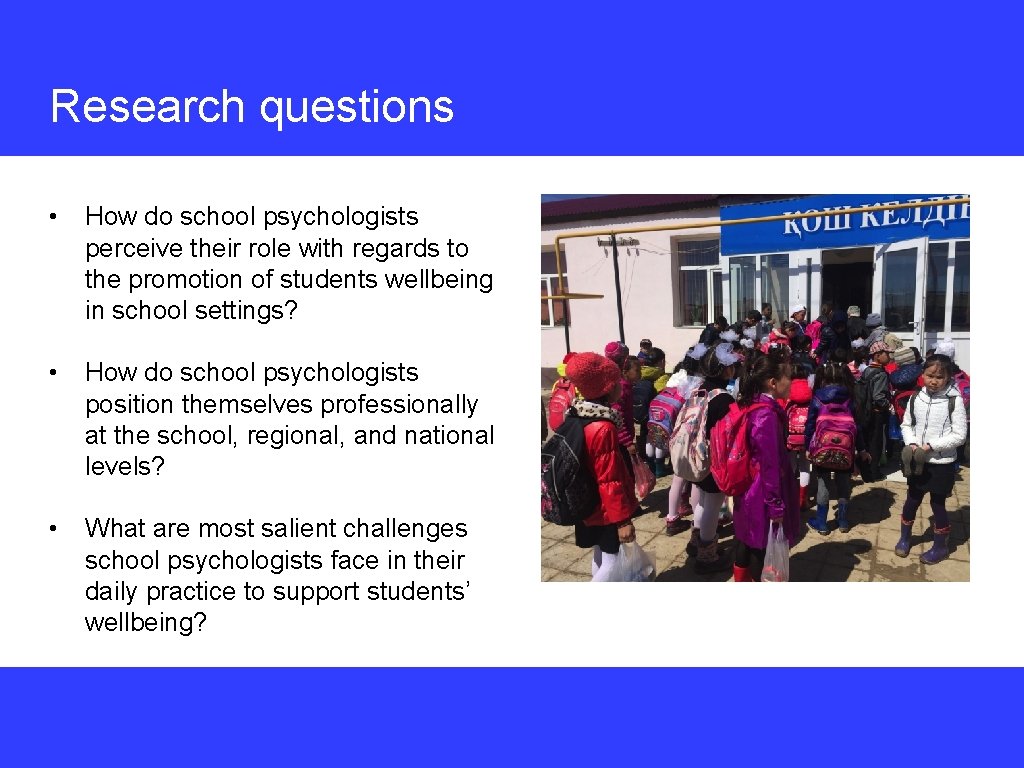
Research questions • How do school psychologists perceive their role with regards to the promotion of students wellbeing in school settings? • How do school psychologists position themselves professionally at the school, regional, and national levels? • What are most salient challenges school psychologists face in their daily practice to support students’ wellbeing?
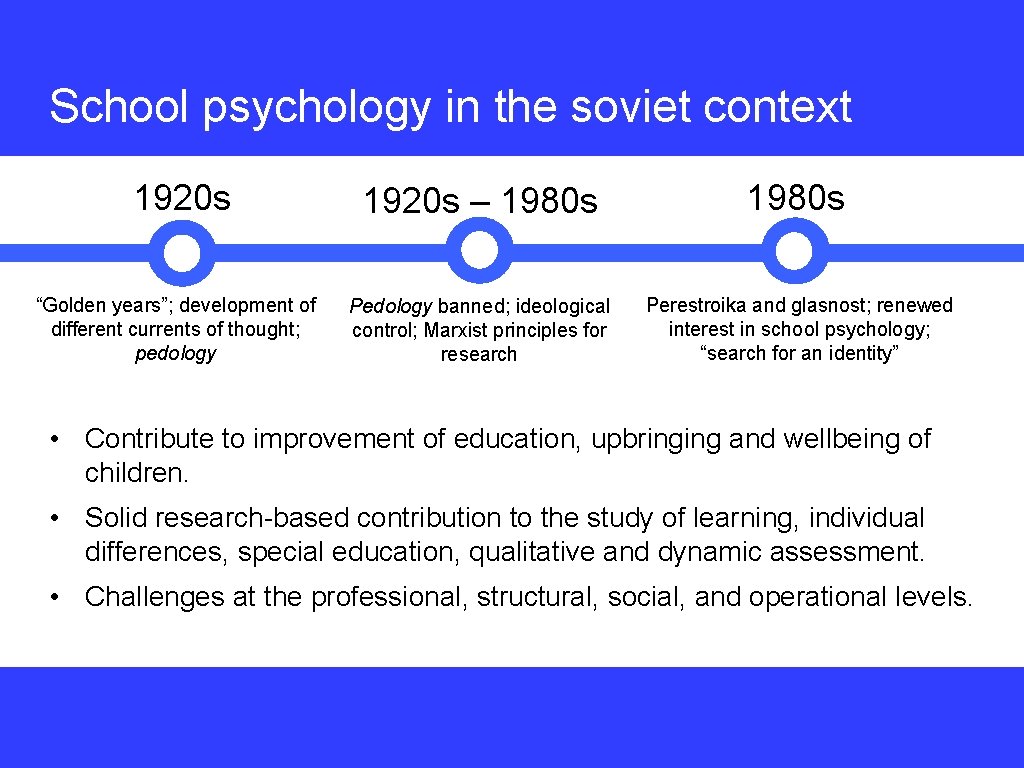
School psychology in the soviet context 1920 s “Golden years”; development of different currents of thought; pedology 1920 s – 1980 s Pedology banned; ideological control; Marxist principles for research Perestroika and glasnost; renewed interest in school psychology; “search for an identity” • Contribute to improvement of education, upbringing and wellbeing of children. • Solid research-based contribution to the study of learning, individual differences, special education, qualitative and dynamic assessment. • Challenges at the professional, structural, social, and operational levels.
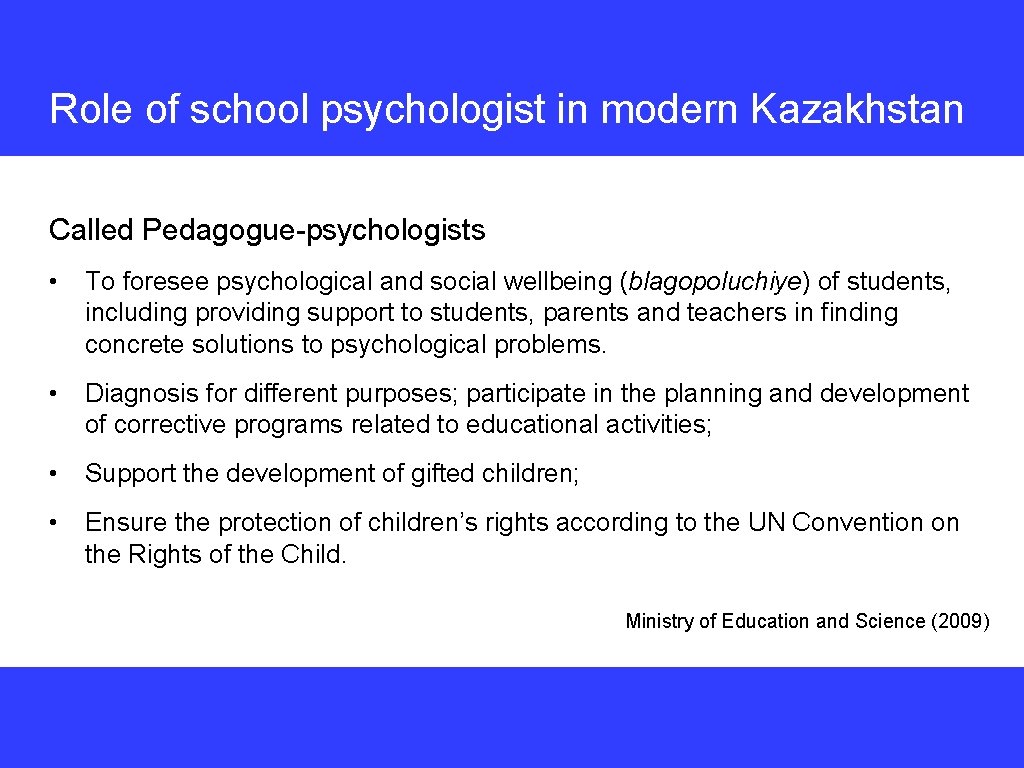
Role of school psychologist in modern Kazakhstan Called Pedagogue-psychologists • To foresee psychological and social wellbeing (blagopoluchiye) of students, including providing support to students, parents and teachers in finding concrete solutions to psychological problems. • Diagnosis for different purposes; participate in the planning and development of corrective programs related to educational activities; • Support the development of gifted children; • Ensure the protection of children’s rights according to the UN Convention on the Rights of the Child. Ministry of Education and Science (2009)
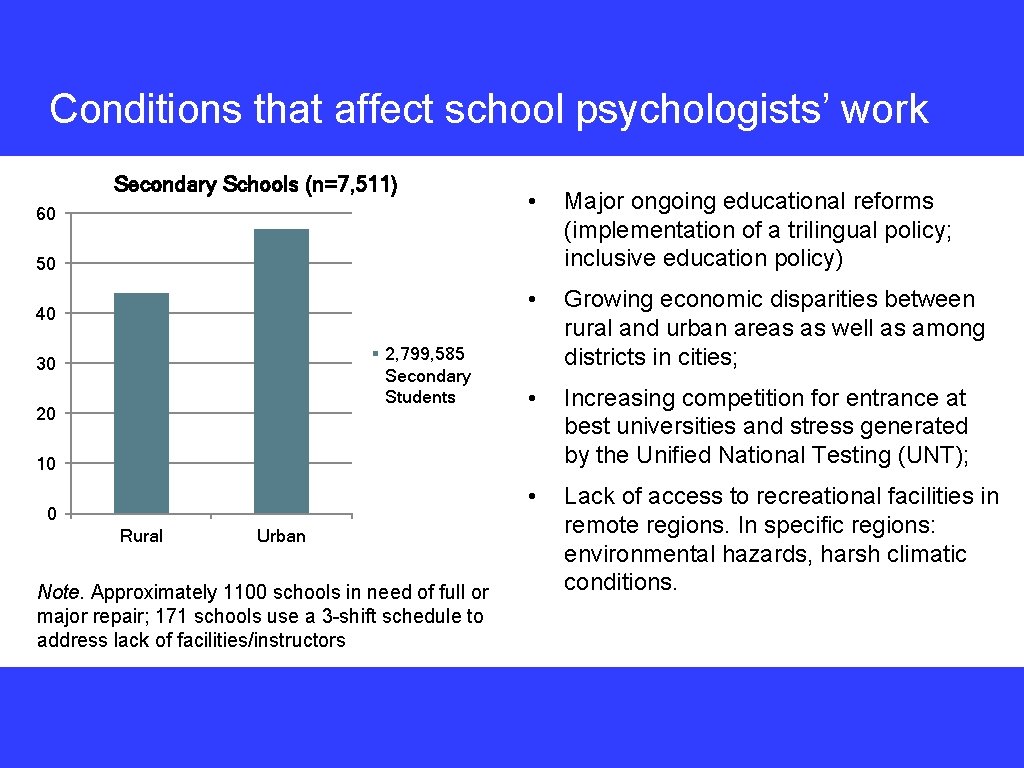
Conditions that affect school psychologists’ work Secondary Schools (n=7, 511) 60 • Major ongoing educational reforms (implementation of a trilingual policy; inclusive education policy) • Growing economic disparities between rural and urban areas as well as among districts in cities; • Increasing competition for entrance at best universities and stress generated by the Unified National Testing (UNT); • Lack of access to recreational facilities in remote regions. In specific regions: environmental hazards, harsh climatic conditions. 50 40 2, 799, 585 Secondary Students 30 20 10 0 Rural Urban Note. Approximately 1100 schools in need of full or major repair; 171 schools use a 3 -shift schedule to address lack of facilities/instructors
Scholarly significance • Adds empirical evidence to the professional characteristics, practices, and the general conditions under which school psychologists work in Kazakhstan; • Contributes to the formulation of culturally and contextually relevant framework to analyze the work of school psychologists; • Could inform development of site-specific models and promote young people’s wellbeing in Kazakhstan, Central Asia, and beyond. • Help to document the everyday life challenges of school psychologists as seen from their perspective;
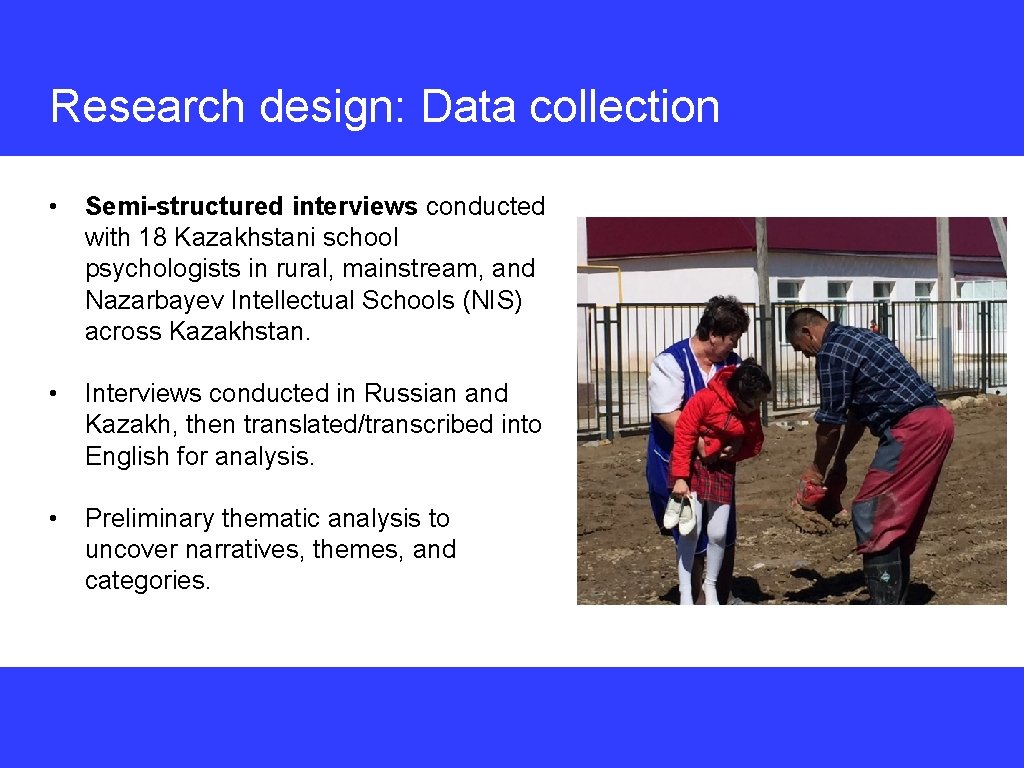
Research design: Data collection • Semi-structured interviews conducted with 18 Kazakhstani school psychologists in rural, mainstream, and Nazarbayev Intellectual Schools (NIS) across Kazakhstan. • Interviews conducted in Russian and Kazakh, then translated/transcribed into English for analysis. • Preliminary thematic analysis to uncover narratives, themes, and categories.
Perceived role Areas of work of school psychologists • Adjustment from primary to secondary school • Cognitive development (e. g. creativity) • Self-cognition (i. e. , moral & patriotic development) • Test preparation • Drug and alcohol prevention • Suicide prevention • Psychoeducational association
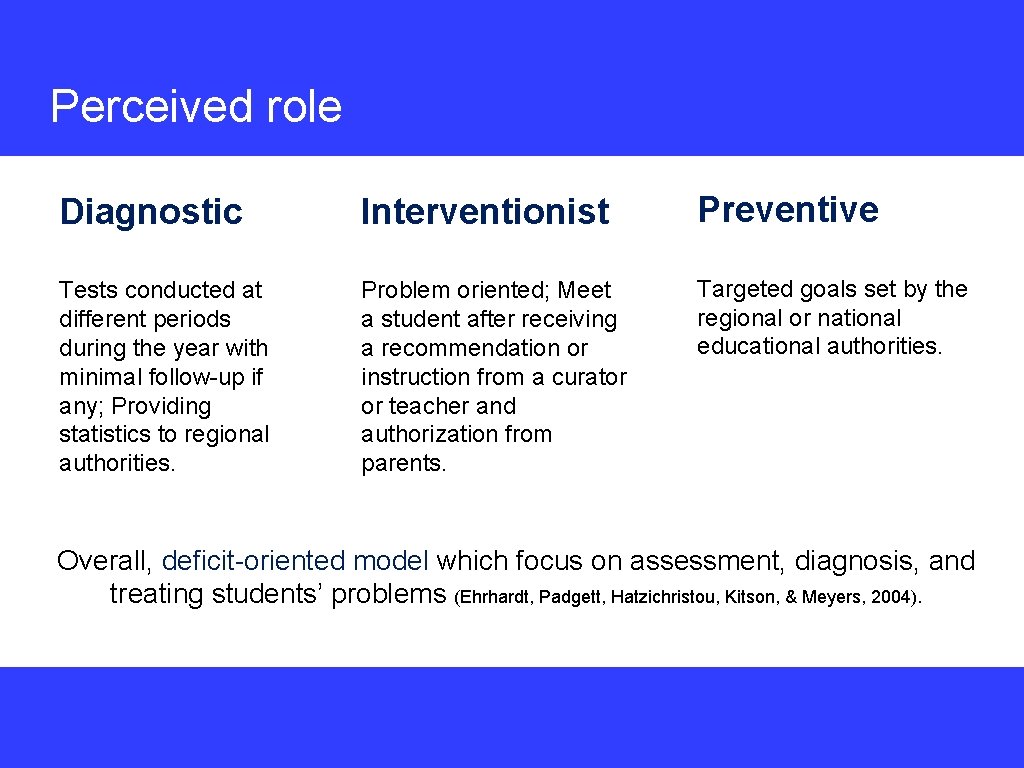
Perceived role Diagnostic Interventionist Preventive Tests conducted at different periods during the year with minimal follow-up if any; Providing statistics to regional authorities. Problem oriented; Meet a student after receiving a recommendation or instruction from a curator or teacher and authorization from parents. Targeted goals set by the regional or national educational authorities. Overall, deficit-oriented model which focus on assessment, diagnosis, and treating students’ problems (Ehrhardt, Padgett, Hatzichristou, Kitson, & Meyers, 2004).
Perceived role “We work in accordance with the work plan provided by the department of education. We file and report all cases. If there are some extraordinary cases, like autodestructive activity, the education department sends us specific emergency plans. The work plan we receive from the education department contains guidelines on the instruments that should be used for specific ages and grades: determination of readiness for school for junior grades, adaptation tests for middle grades because they have many more teachers and more demanding curriculum compared to the primary school, quality of education and stress level gauge tests for senior grades. We receive instructions from our superiors to use such and such books of such and such authors. We are expected to find the test ourselves – from books or Internet, wherever. Then we conduct tests, assess the results and report to our superiors. They just provide information on books by specific authors that we must use. We have to search for them and conduct the tests. ” (IVB, FGSP, 2 F, RLKL_Nurmukhamed GM 2)
Perceived role “On the whole, a psychologist has 5 areas of work related to school climate: ourselves, teachers, parents, principal and students. We make diagnosis; provide consultations and conduct corrective or intervention work. We don’t let a student leave without addressing his problem. We run the tests, make diagnosis of his issue, determine the solution, and conduct intervention activities and give advice. So we have a comprehensive, three-stage approach to problem issues. We also use special files to keep track of those who visit us. ” (IVB, FGSP, 2 F, RLKL_Nurmukhamed GM 2)
Positioning of school psychologists in school context • Located at the bottom of the school hierarchy, generally poor employment conditions, lowest salary • Role often misunderstood by other staff members • Lack of positive recognition • Coordination of the tasks with principals, curators and teachers is extremely important but not always present or sufficient • Sense of belonging to the school staff difficult to reach due to lack of recognition • Rarely get to know the students. Therefore, students tend to misunderstand even ignore the role of psychologist. • Strong commitment and dedication but lack of time and resources
Positioning of school psychologists in school context “There is a problem with the status of psychologists not only in our town, but in the country as well. Many people are not even aware of what the psychologist is. In some schools, if people do not teach some subject, it is considered that they don't do anything at all. Thus, the psychologists are sometimes compelled to take perform tasks that are beyond their actual duties. ” (IB, IISP, 1 F, KL_Malik_08_01_16)
Positioning of school psychologists in school context “We have had some round tables of psychologists organized by the department of education where we discussed advantages and disadvantages of available psychological instruments. However, this is not an association. At round tables they encourage us to exchange information, experience and good practice, including authority - recommended tests, their precision and reliability, and additional testing tools. We also have more specific workshops dedicated to specific focal points for a given academic term. At the end of each academic semester we give our feedback regarding the proposed instruments. ” (IVB, FGSP, 2 F, RLKL_Nurmukhamed
Positioning of school psychologists in school context “There is a problem with psychologists in Kazakhstan, because people do not take them seriously. When I came to this school, I found out that its psychologists were being replaced so many times that children didn't even understand the role of school psychologist. They used to the situation that a psychologist worked for half a year, and that’s it. But now I've been working here for three years, and I've managed to achieve good results. However, it was very tough for me to be adopted here. I've held many events in order to explain students who psychologists are and why they are needed. The students used to think that psychologists take tests and nothing ore. And now children come to me regularly to discuss their issues. They know that they can address and I will support them. ” (IB, IISP, 1 F, KL_Malik_08_01_16)
Positioning of school psychologists in regional and national structure • Support from regional authorities inconsistent, varies according to the region • Absence of association or of regular meetings • Expected to conduct tests and surveys to help build up statistics and as promoting preventive measure in relation to specific goals e. g. suicide, radicalization, level of anxiety before national testing • Minimal or non-existent logistic support • Lack of public awareness and sensibilization of their role with students, a situation that is leading to a continuing public stigma towards mental and emotional distress and problematic relations with parents • Lack of proper training
Positioning of school psychologists in regional and national structure “We prepare an annual report. We receive the requirements from the regional authority. We don’t know all the students, so the tutors or subject teachers ask me to work with one student or with the whole class. We make our planned work, but we also work upon a request. No, not the ministry, but the regional authority. They make a common plan, but it is not something fixed. We can modify it and add according to our preference. Some things are not suitable for gymnasium, but good for secondary school. So we remove one part and add another part. However, most of the things we do ourselves. It has been only 1 -2 years, since the regional authority decided to make a unified plan for everyone. ” (VA, IISP, 1 F, KL_Aimagambetova_Gulmira_29_02_16)
Positioning of school psychologists in regional and national structure “We receive instructions from our superiors to use such and such books of such and such authors. We are expected to find the test ourselves – from books or Internet, wherever. Then we conduct tests, assess the results and report to our superiors. They just provide information on books by specific authors that we must use. We have to search for them and conduct the tests. ” (IVB, FGSP, 2 F, RLKL_Nurmukhamed GM 2)
Major challenges in daily practice • Extremely poor employment condition and low prestige of the profession • Too many students per psychologist (although this is not a specific problem of Kazakhstan; there is a universal shortage of school psychologist around the world (see Jimerson, Cardenas, Skokut, Malone and Stewart, 2008) • No material, tools and instruments adapted to the regional and national cultural context (Varjas & al 2006) • No logistic support and minimal professional development offered - must find their own material through Internet • Tense relations with parents – must ask parental authorization before starting consultation with a student • Excessive time spent on assessment and diagnosis, as evidenced elsewhere (Curtis et al. , 2008; Jimerson et al. , 2007)
Most relevant preliminary findings • School psychologists from mainstream schools do not perceive their work as directly connected to students wellbeing; • The integration of the work of school psychologists, including sustain cooperation with other staff members, participation of psychologists in school meetings including parents and students’ gathering is paramount in developing a better awareness of students’ wellbeing; • Imperative need for culturally appropriate material in both Kazakh and Russian languages • Lack of nation wide association of school psychologists prevent practitioners to share common issues and move towards developing a sustainable approach that would be in line with the specific cultural and social environments.
Future developments New model to be implemented following the NIS approach: • Systematic integration of the school psychologist’s work in the overall structure • Working towards a holistic conceptualization of students’ wellbeing • Awareness work towards de-stigmatization of psychological and emotional issues among students • Providing access to professional development and problem sharing through nation wide meetings
School Psychology in context: Perception, challenges, and students’ wellbeing in mainstream Kazakhstani secondary schools Carole Faucher, Daniel Torrano, Madina Tynybayeva, Anna Cohen. Miller, and Kairat Kurakbayev Nazarbayev University Graduate School of Education