
School on Drafting Regulations Module 1 2 Overview
- Slides: 33
School on Drafting Regulations Module 1. 2 – Overview of IAEA safety standards IAEA - Department of Nuclear Safety & Security Division of Nuclear Installation Safety | Regulatory Activities Section IAEA International Atomic Energy Agency
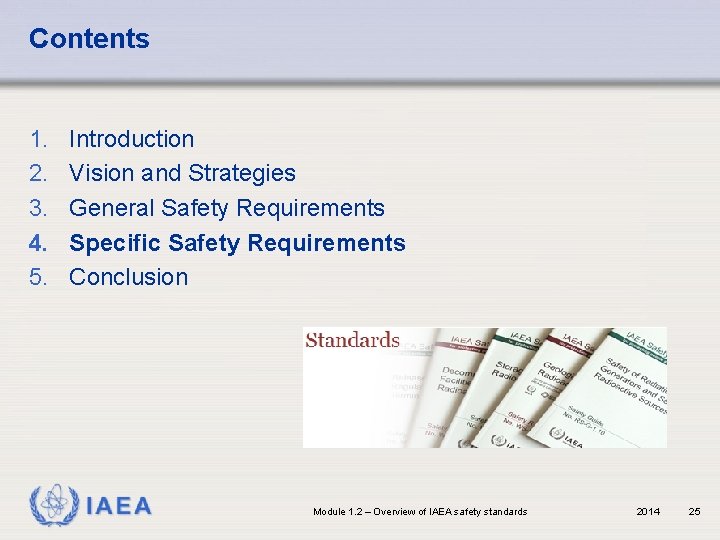
Contents 1. 2. 3. 4. 5. Introduction Vision and Strategies General Safety Standards Specific Safety Standards Conclusions IAEA Module 1. 2 – Overview of IAEA safety standards 2014 2
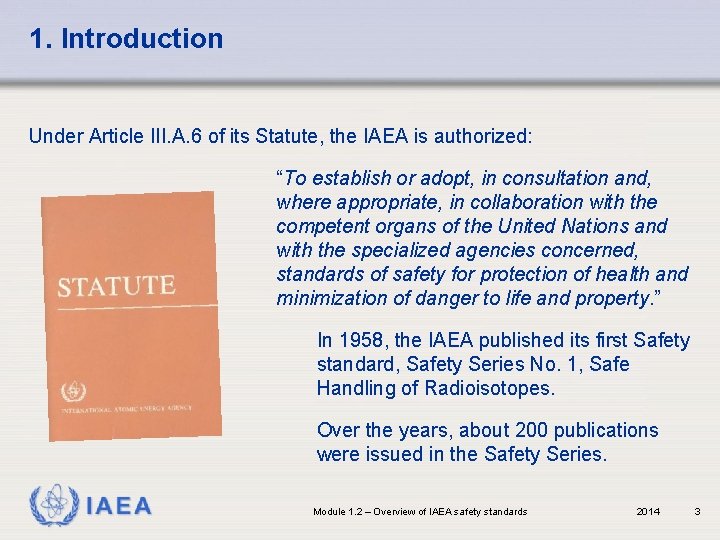
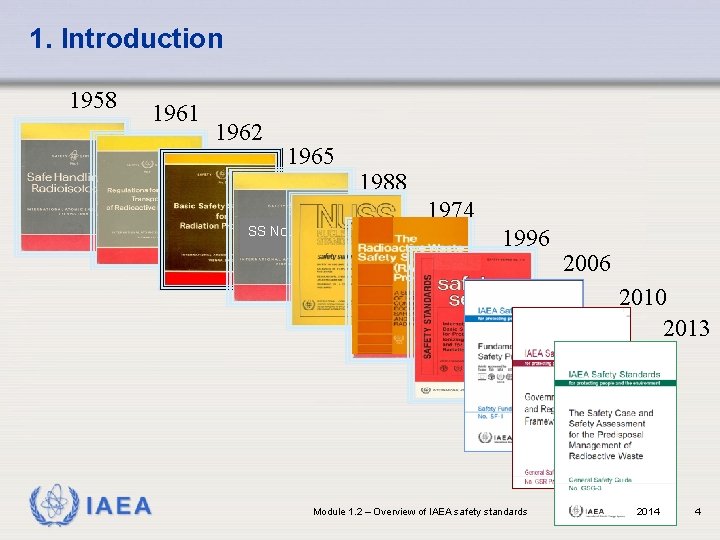
1. Introduction Under Article III. A. 6 of its Statute, the IAEA is authorized: “To establish or adopt, in consultation and, where appropriate, in collaboration with the competent organs of the United Nations and with the specialized agencies concerned, standards of safety for protection of health and minimization of danger to life and property. ” In 1958, the IAEA published its first Safety standard, Safety Series No. 1, Safe Handling of Radioisotopes. Over the years, about 200 publications were issued in the Safety Series. IAEA Module 1. 2 – Overview of IAEA safety standards 2014 3
1. Introduction 1958 1961 1962 1965 1988 1974 SS No. 15 1996 SS No. 15 IAEA Module 1. 2 – Overview of IAEA safety standards 2006 2010 2013 2014 4
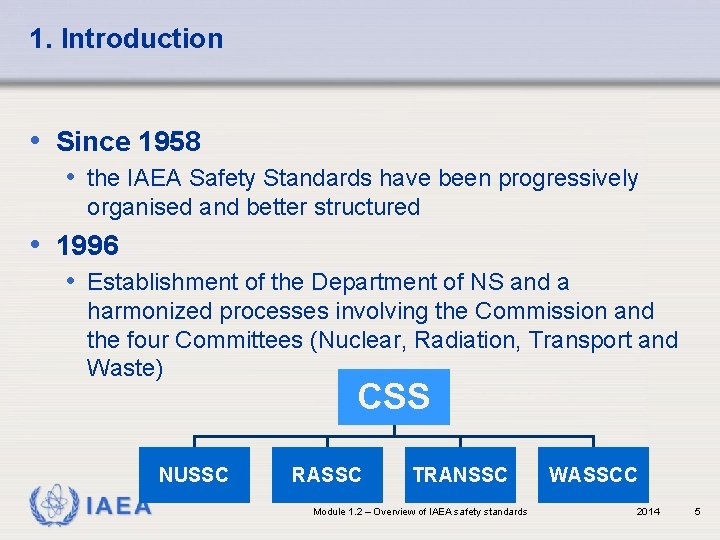
1. Introduction • Since 1958 • the IAEA Safety Standards have been progressively organised and better structured • 1996 • Establishment of the Department of NS and a harmonized processes involving the Commission and the four Committees (Nuclear, Radiation, Transport and Waste) CSS NUSSC IAEA RASSC TRANSSC Module 1. 2 – Overview of IAEA safety standards WASSCC 2014 5
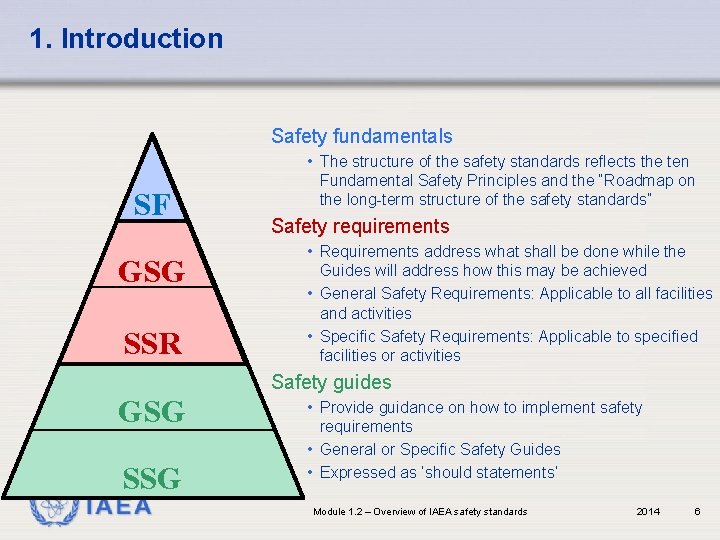
1. Introduction Safety fundamentals • The structure of the safety standards reflects the ten SF GSG SSR GSG SSG IAEA Fundamental Safety Principles and the “Roadmap on the long-term structure of the safety standards” Safety requirements • Requirements address what shall be done while the Guides will address how this may be achieved • General Safety Requirements: Applicable to all facilities and activities • Specific Safety Requirements: Applicable to specified facilities or activities Safety guides • Provide guidance on how to implement safety requirements • General or Specific Safety Guides • Expressed as ‘should statements’ Module 1. 2 – Overview of IAEA safety standards 2014 6
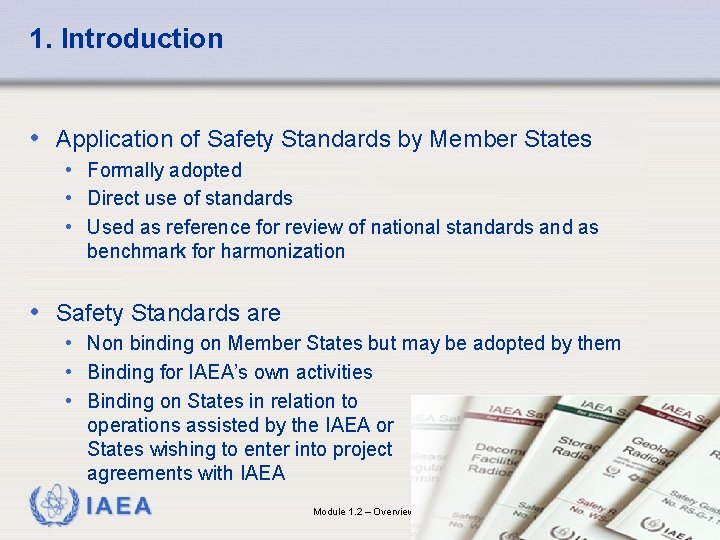
1. Introduction • Application of Safety Standards by Member States • Formally adopted • Direct use of standards • Used as reference for review of national standards and as benchmark for harmonization • Safety Standards are • Non binding on Member States but may be adopted by them • Binding for IAEA’s own activities • Binding on States in relation to operations assisted by the IAEA or States wishing to enter into project agreements with IAEA Module 1. 2 – Overview of IAEA safety standards 2014 7
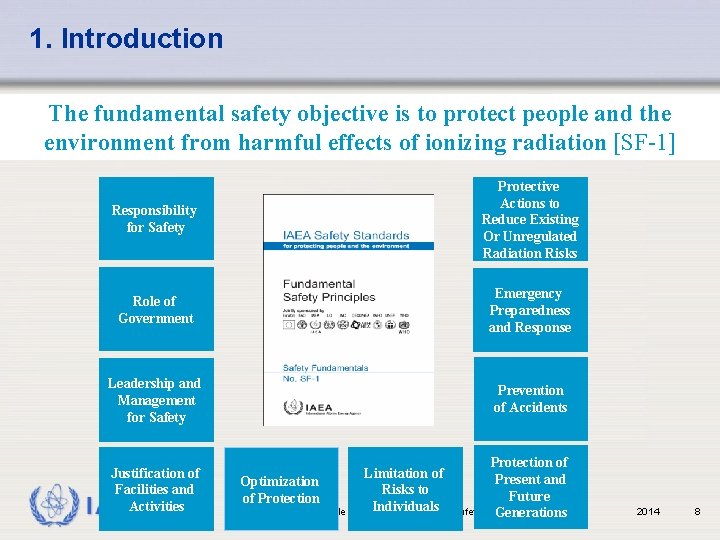
1. Introduction The fundamental safety objective is to protect people and the environment from harmful effects of ionizing radiation [SF-1] Responsibility for Safety Protective Actions to Reduce Existing Or Unregulated Radiation Risks Role of Government Emergency Preparedness and Response Leadership and Management for Safety Prevention of Accidents Justification of Facilities and IAEAActivities Protection of Limitation of Present and Optimization Risks to Future of Protection Module 1. 2 – Individuals Overview of IAEA safety standards Generations 2014 8
Contents 1. 2. 3. 4. 5. Introduction Vision and Strategy General Safety Requirements Specific Safety Requirements Conclusions IAEA Module 1. 2 – Overview of IAEA safety standards 2014 9
2. Vision and Strategy THE VISION - • An integrated, comprehensive and consistent set of upto-date, user friendly and fit-for-purpose IAEA safety standards of a high quality. • Using and applying the IAEA safety standards will provide for a worldwide harmonized high level of protection for people and the environment from harmful effects of ionizing radiation. IAEA Module 1. 2 – Overview of IAEA safety standards 2014 10
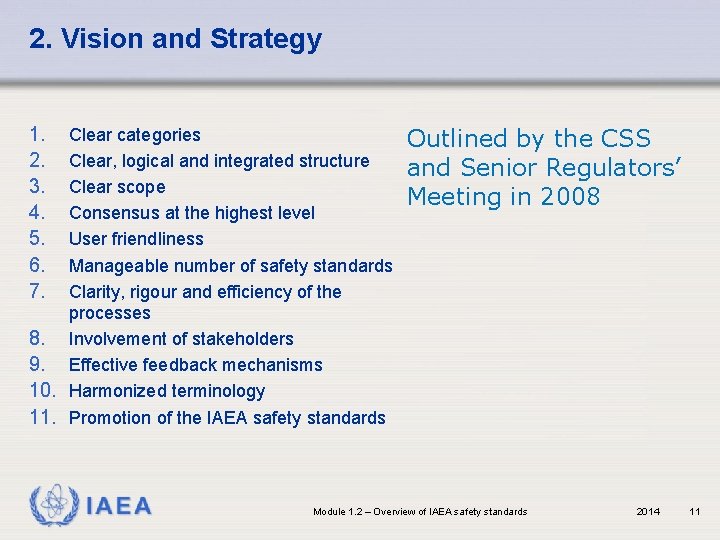
2. Vision and Strategy 1. 2. 3. 4. 5. 6. 7. Clear categories Clear, logical and integrated structure Clear scope Consensus at the highest level User friendliness Manageable number of safety standards Clarity, rigour and efficiency of the processes 8. Involvement of stakeholders 9. Effective feedback mechanisms 10. Harmonized terminology 11. Promotion of the IAEA safety standards IAEA Outlined by the CSS and Senior Regulators’ Meeting in 2008 Module 1. 2 – Overview of IAEA safety standards 2014 11
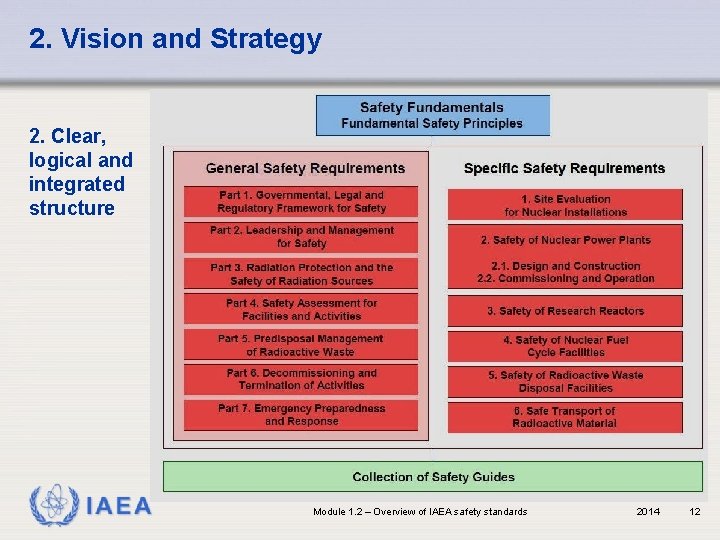
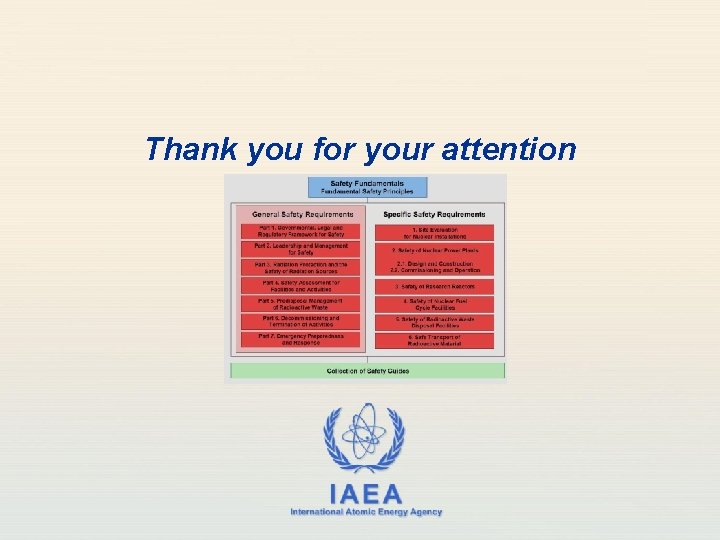
2. Vision and Strategy 2. Clear, logical and integrated structure IAEA Module 1. 2 – Overview of IAEA safety standards 2014 12
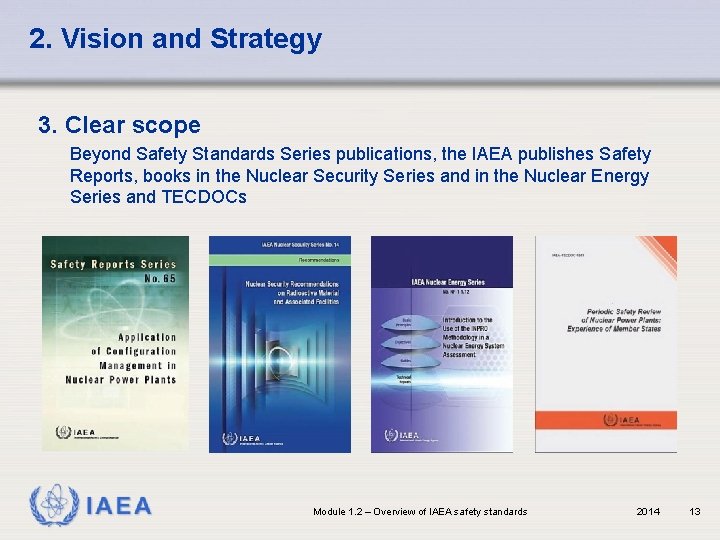
2. Vision and Strategy 3. Clear scope Beyond Safety Standards Series publications, the IAEA publishes Safety Reports, books in the Nuclear Security Series and in the Nuclear Energy Series and TECDOCs IAEA Module 1. 2 – Overview of IAEA safety standards 2014 13
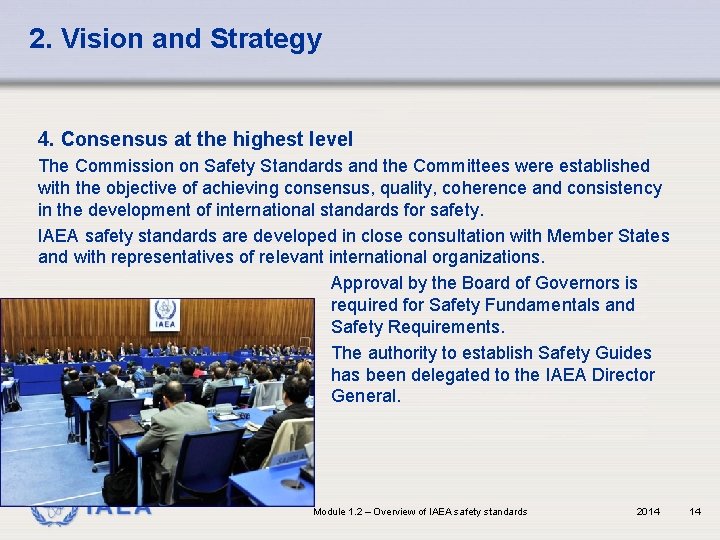
2. Vision and Strategy 4. Consensus at the highest level The Commission on Safety Standards and the Committees were established with the objective of achieving consensus, quality, coherence and consistency in the development of international standards for safety. IAEA safety standards are developed in close consultation with Member States and with representatives of relevant international organizations. Approval by the Board of Governors is required for Safety Fundamentals and Safety Requirements. The authority to establish Safety Guides has been delegated to the IAEA Director General. IAEA Module 1. 2 – Overview of IAEA safety standards 2014 14
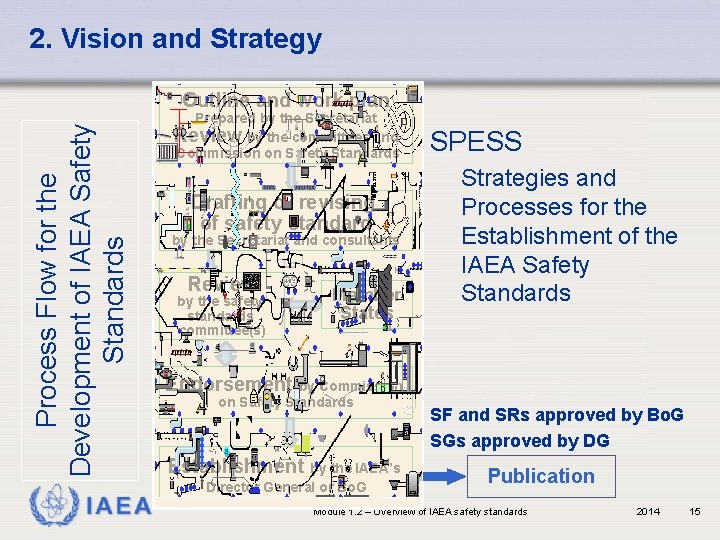
2. Vision and Strategy Process Flow for the Development of IAEA Safety Standards Outline and work plan IAEA Prepared by the Secretariat Review by the committees and Commission on Safety Standards Drafting or revising of safety standard by the Secretariat and consultants Review by the safety standards committee(s) Member States SPESS Strategies and Processes for the Establishment of the IAEA Safety Standards Endorsement by Commission on Safety Standards Establishment by the IAEA’s Director General or Bo. G SF and SRs approved by Bo. G SGs approved by DG Publication Module 1. 2 – Overview of IAEA safety standards 2014 15
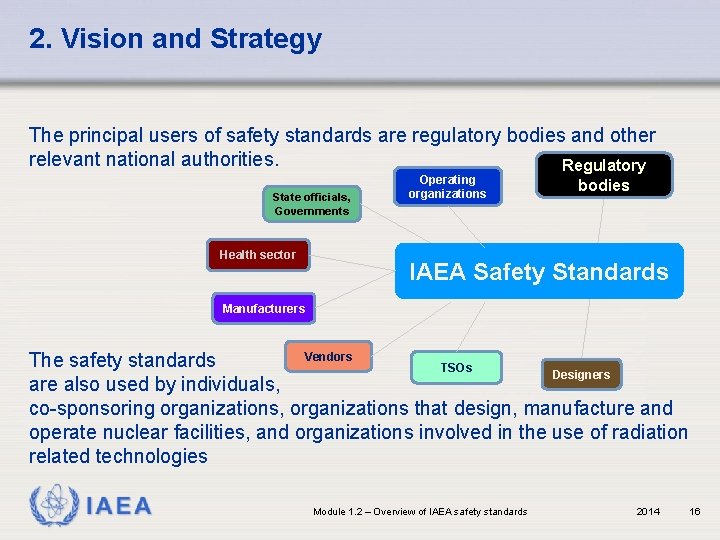
2. Vision and Strategy The principal users of safety standards are regulatory bodies and other relevant national authorities. Regulatory State officials, Governments Health sector Operating organizations bodies IAEA Safety Standards Manufacturers Vendors The safety standards TSOs Designers are also used by individuals, co-sponsoring organizations, organizations that design, manufacture and operate nuclear facilities, and organizations involved in the use of radiation related technologies IAEA Module 1. 2 – Overview of IAEA safety standards 2014 16
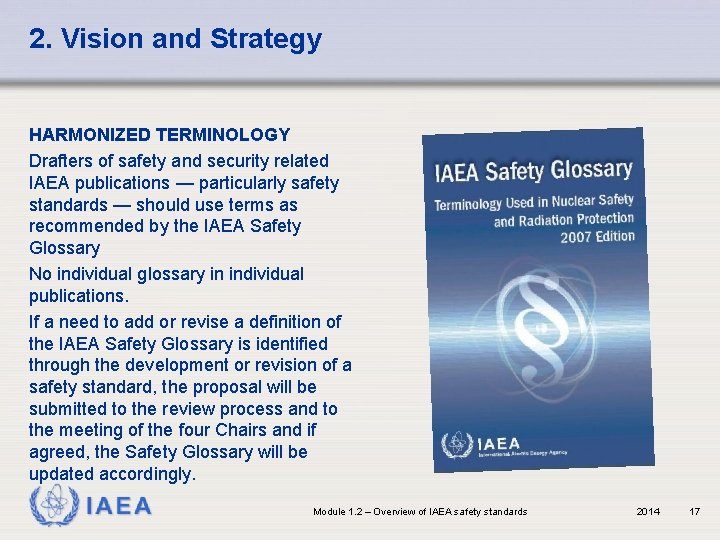
2. Vision and Strategy HARMONIZED TERMINOLOGY Drafters of safety and security related IAEA publications — particularly safety standards — should use terms as recommended by the IAEA Safety Glossary No individual glossary in individual publications. If a need to add or revise a definition of the IAEA Safety Glossary is identified through the development or revision of a safety standard, the proposal will be submitted to the review process and to the meeting of the four Chairs and if agreed, the Safety Glossary will be updated accordingly. IAEA Module 1. 2 – Overview of IAEA safety standards 2014 17
Contents 1. 2. 3. 4. 5. Introduction Vision and Strategies General Safety Requirements Specific Safety Requirements Conclusion IAEA Module 1. 2 – Overview of IAEA safety standards 2014 18
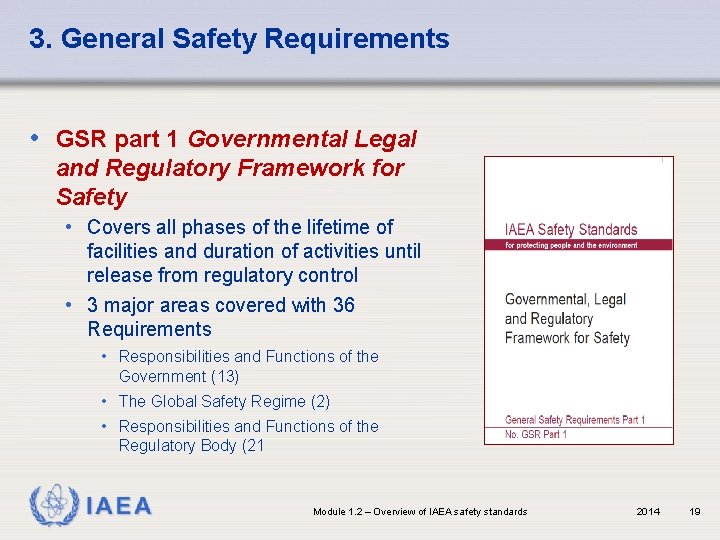
3. General Safety Requirements • GSR part 1 Governmental Legal and Regulatory Framework for Safety • Covers all phases of the lifetime of facilities and duration of activities until release from regulatory control • 3 major areas covered with 36 Requirements • Responsibilities and Functions of the Government (13) • The Global Safety Regime (2) • Responsibilities and Functions of the Regulatory Body (21 IAEA Module 1. 2 – Overview of IAEA safety standards 2014 19
3. General Safety Requirements GSR Part 1 - Responsibilities and Functions of the Government • • National policy and strategy for safety Establishment of a framework for safety Establishment of an independent regulatory body Prime responsibility for safety… GSR Part 1 - Global Safety Regime • • International obligations and arrangements for international cooperation Sharing of operating experience and regulatory experience GSR Part 1 - Responsibilities and functions of the Regulatory Body • • • Organization; resources; staffing; competence; management Independence in the performance of regulatory functions Management of adequate records relating to safety Stability and consistency of regulatory control Regulatory functions, etc. IAEA Module 1. 2 – Overview of IAEA safety standards 2014 20
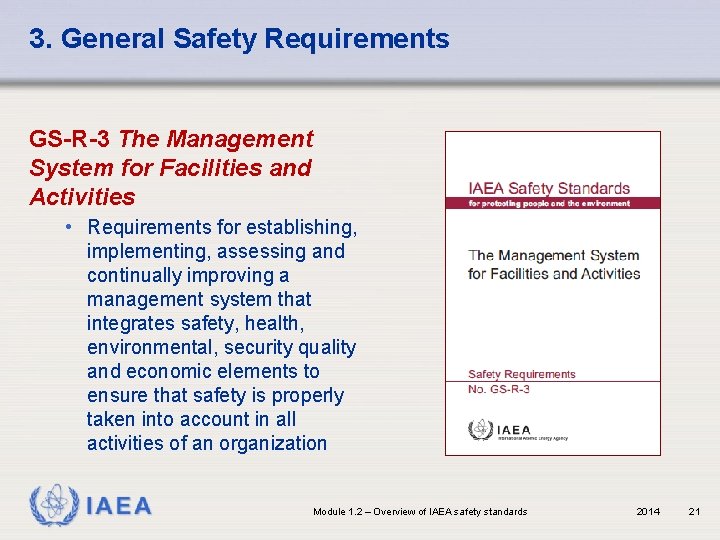
3. General Safety Requirements GS-R-3 The Management System for Facilities and Activities • Requirements for establishing, implementing, assessing and continually improving a management system that integrates safety, health, environmental, security quality and economic elements to ensure that safety is properly taken into account in all activities of an organization IAEA Module 1. 2 – Overview of IAEA safety standards 2014 21
3. General Safety Requirements GS-R-3 • Management system: General requirements for the management • • system, including those relating to safety culture, grading and documentation Management responsibility: Responsibilities of senior management for the development and implementation of a management system Resource management Process implementation: Processes of the organization � specification, development and management, including the generic processes of the management system Measurement, assessment and improvement: measuring, assessing and improving the management system IAEA Module 1. 2 – Overview of IAEA safety standards 2014 22
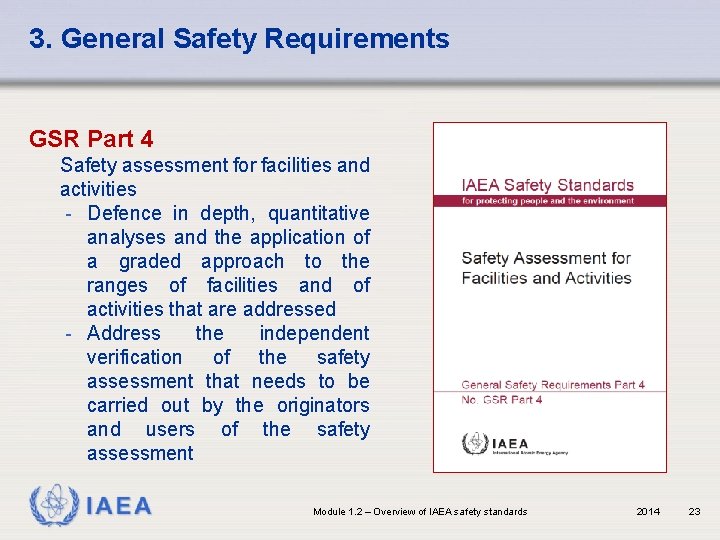
3. General Safety Requirements GSR Part 4 Safety assessment for facilities and activities - Defence in depth, quantitative analyses and the application of a graded approach to the ranges of facilities and of activities that are addressed - Address the independent verification of the safety assessment that needs to be carried out by the originators and users of the safety assessment IAEA Module 1. 2 – Overview of IAEA safety standards 2014 23
3. General Safety Requirements GSR Part 4 • BASIS FOR REQUIRING A SAFETY ASSESSMENT • Basis for requiring a safety assessment to be carried out, derived from SF-1 • GRADED APPROACH • to implementation of the requirements for safety assessment for different facilities and activities. • SAFETY ASSESSMENT • Overall requirements for a safety assessment and specific requirements that relate to the assessment of features relevant to safety • Requirements to address: defence in depth and safety margins, to perform safety analysis, to document the safety assessment and to carry out an independent verification • MANAGEMENT AND MAINTENANCE OF THE SAFETY ASSESSMENT IAEA Module 1. 2 – Overview of IAEA safety standards 2014 24
Contents 1. 2. 3. 4. 5. Introduction Vision and Strategies General Safety Requirements Specific Safety Requirements Conclusion IAEA Module 1. 2 – Overview of IAEA safety standards 2014 25
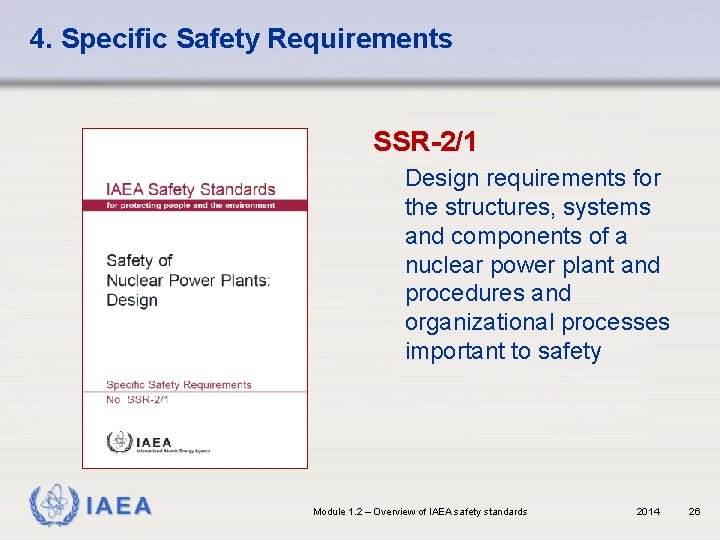
4. Specific Safety Requirements SSR-2/1 Design requirements for the structures, systems and components of a nuclear power plant and procedures and organizational processes important to safety IAEA Module 1. 2 – Overview of IAEA safety standards 2014 26
4. Specific Safety Requirements SSR-2/1 • Objective, safety principles and concepts that form the basis for deriving the safety function requirements as well as the safety design criteria. • Requirements to be satisfied by the designer in the management of safety in the design process. • Principal technical design criteria for safety, including for • the fundamental safety functions, • the application of defence in depth provision for construction, • interfaces of safety with nuclear security and with the State system of accounting for, and control of, nuclear material, • ensuring that radiation risks arising from the plant are maintained as low as reasonably achievable IAEA Module 1. 2 – Overview of IAEA safety standards 2014 27
4. Specific Safety Requirements SSR-2/1 • Requirements for: • General plant design that supplement the requirements for principal technical design criteria to ensure that safety objectives are met and the safety principles are applied. • General plant design apply to all items (i. e. structures, systems and components) important to safety. • the design of specific plant systems such as the reactor core, reactor coolant systems, containment system, and instrumentation and control systems. IAEA Module 1. 2 – Overview of IAEA safety standards 2014 28
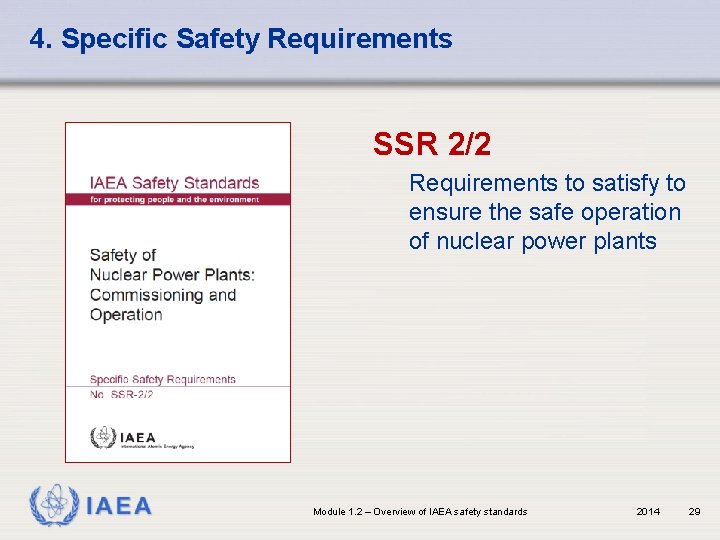
4. Specific Safety Requirements SSR 2/2 Requirements to satisfy to ensure the safe operation of nuclear power plants IAEA Module 1. 2 – Overview of IAEA safety standards 2014 29
4. Specific Safety Requirements SSR-2/2 • Safety objective and safety principles, which form the basis for requirements to be met in the operation of a NPP • Requirements to be applied for the management and organizational structure of the operating organization. • Requirements for • the management of operational safety • operational safety programmes. • plant commissioning. • plant operations • maintenance, testing, surveillance and inspection. • preparation for decommissioning IAEA Module 1. 2 – Overview of IAEA safety standards 2014 30
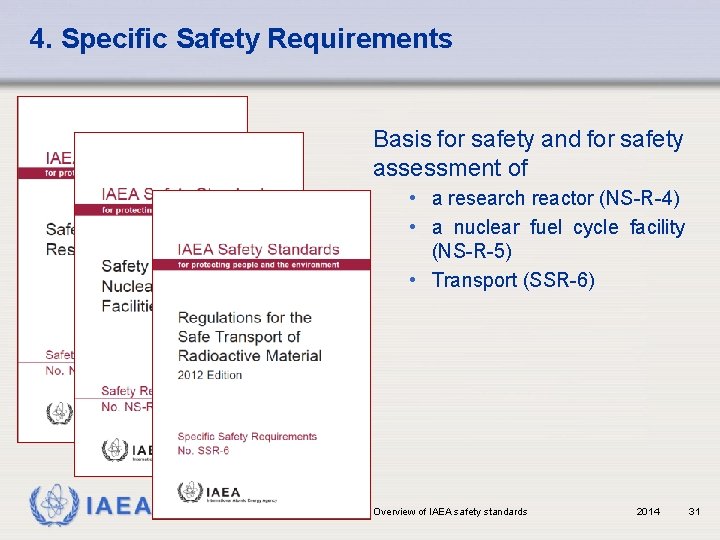
4. Specific Safety Requirements Basis for safety and for safety assessment of • a research reactor (NS-R-4) • a nuclear fuel cycle facility (NS-R-5) • Transport (SSR-6) IAEA Module 1. 2 – Overview of IAEA safety standards 2014 31
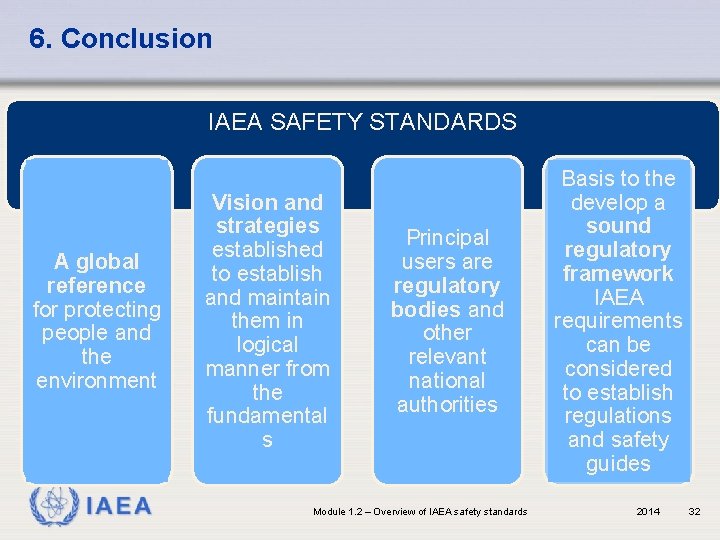
6. Conclusion IAEA SAFETY STANDARDS A global reference for protecting people and the environment IAEA Vision and strategies established to establish and maintain them in logical manner from the fundamental s Principal users are regulatory bodies and other relevant national authorities Module 1. 2 – Overview of IAEA safety standards Basis to the develop a sound regulatory framework IAEA requirements can be considered to establish regulations and safety guides 2014 32
Thank you for your attention IAEA International Atomic Energy Agency