
SCHOOL OF FOREST RESOURCES BUILDING Penn State University
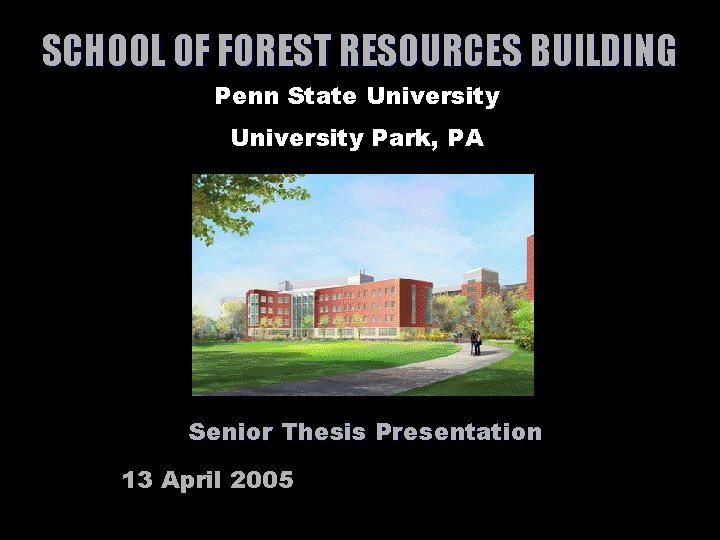
SCHOOL OF FOREST RESOURCES BUILDING Penn State University Park, PA Senior Thesis Presentation 13 April 2005
PRESENTATION AGENDA Background • Project Background LEED Design • LEED Certification for Laboratory Buildings VAV Systems • Variable Air Volume Systems for Laboratories VRML Models • Immersive Virtual Modeling for MEP Coordination Conclusion • Conclusions and Recommendations Brian Horn Construction Management Senior Thesis Presentation 13 April 2005
PROJECT BACKGROUND Background LEED Design PROJECT OVERVIEW • Size: 92, 000 SF • Laboratory Space: 28, 000 SF • Cost: $27, 000 VAV Systems VRML Models • Construction: August 2004 – December 2005 • Delivery Method: CM Agency • CM Agency: Gilbane Building Company Conclusion • Designed as LEED Certified Brian Horn Construction Management Senior Thesis Presentation 13 April 2005
PRESENTATION AGENDA Background • Project Background LEED Design • LEED Certification for Laboratory Buildings VAV Systems • Variable Air Volume Systems for Laboratories VRML Models • Immersive Virtual Modeling for MEP Coordination Conclusion • Conclusions and Recommendations Brian Horn Construction Management Senior Thesis Presentation 13 April 2005
LEED CERTIFICATION FOR LABS WHAT IS LEED? Background • Leadership in Energy and Environmental Design LEED Design • Established by the US Green Building Council (USGBC) VAV Systems • Voluntary, consensus based national standard for developing high performance, sustainable buildings VRML Models Conclusion • Four levels Certified: 26 -32 points Silver: 33 -38 points Gold: 39 -51 points Platinum: 52 -69 points Brian Horn Construction Management Senior Thesis Presentation 13 April 2005
LEED CERTIFICATION FOR LABS BENEFITS OF LEED Background • Decrease energy costs • Up to $6/SF for typical lab LEED Design VAV Systems VRML Models • Decrease water consumption • Up to 1, 000 gallons/year • Reduced equipment size • Improved indoor environmental quality • 20 – 26% improvement in learning / comprehension Conclusion • 1. 6 – 1. 9% improvement in classroom attendance • 2 – 4% improvement in employee productivity Brian Horn Construction Management Senior Thesis Presentation 13 April 2005
LEED CERTIFICATION FOR LABS Background LEED Design VAV Systems DIFFICULTIES FOR LABORATORY BUILDINGS • High demand for power and water • Air quality requirements VRML Models Conclusion Brian Horn Construction Management • 100% outdoor air • Minimum air flow rates • Air changes per hour • Maintain negative room pressure Senior Thesis Presentation 13 April 2005
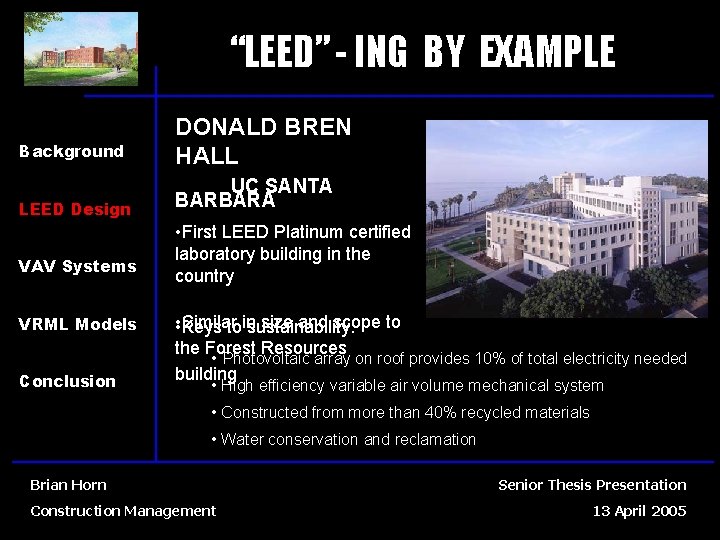
“LEED” - ING BY EXAMPLE Background LEED Design VAV Systems VRML Models Conclusion DONALD BREN HALL UC SANTA BARBARA • First LEED Platinum certified laboratory building in the country • • Similar size and scope to Keys toinsustainability: the Forest Resources • Photovoltaic array on roof provides 10% of total electricity needed building • High efficiency variable air volume mechanical system • Constructed from more than 40% recycled materials • Water conservation and reclamation Brian Horn Construction Management Senior Thesis Presentation 13 April 2005
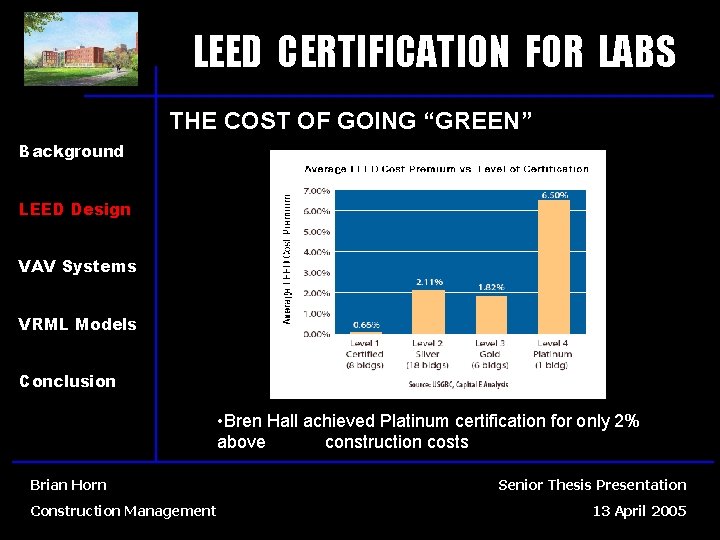
LEED CERTIFICATION FOR LABS THE COST OF GOING “GREEN” Background LEED Design VAV Systems VRML Models Conclusion • Bren Hall achieved Platinum certification for only 2% above construction costs Brian Horn Construction Management Senior Thesis Presentation 13 April 2005
LEED CERTIFICATION FOR LABS FOREST RESOURCES BUILDING Background • Designed for LEED Certification LEED Design VAV Systems VRML Models Conclusion • Could easily achieve Silver or even Gold certification • Main areas of focus: • Landscaping • Water conservation • Reduce total energy use Brian Horn Construction Management Senior Thesis Presentation 13 April 2005
PRESENTATION AGENDA Background • Project Background LEED Design • LEED Certification for Laboratory Buildings VAV Systems • Variable Air Volume Systems for Laboratories VRML Models • Immersive Virtual Modeling for MEP Coordination Conclusion • Conclusions and Recommendations Brian Horn Construction Management Senior Thesis Presentation 13 April 2005
VAV SYSTEMS FOR LABS Background LEED Design VAV Systems VRML Models WHAT IS VAV? • Variable Air Volume • System varies the amount of air supplied to specific areas of the building based on demand • Advantages • Reduced energy costs • Reduced equipment sizes • Disadvantages Conclusion Brian Horn Construction Management • Higher initial cost • Higher maintenance costs • More sensors and control wiring needed Senior Thesis Presentation 13 April 2005
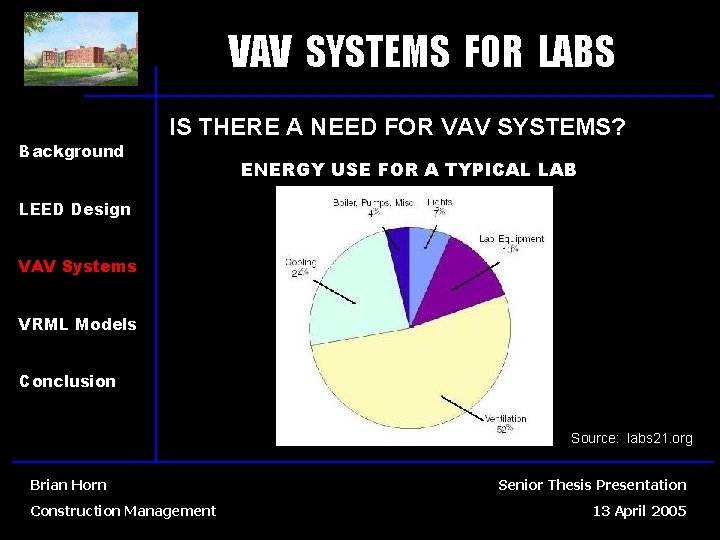
VAV SYSTEMS FOR LABS Background IS THERE A NEED FOR VAV SYSTEMS? ENERGY USE FOR A TYPICAL LAB LEED Design VAV Systems VRML Models Conclusion Source: labs 21. org Brian Horn Construction Management Senior Thesis Presentation 13 April 2005
VAV SYSTEMS FOR LABS Background LEED Design VAV FOR LABORATORIES • Must maintain room pressure • Laboratory fume hoods • Minimum air flow VAV Systems VRML Models • Sash position sensors • Maintain constant conditions for experiments • Override switch Conclusion Brian Horn Construction Management Senior Thesis Presentation 13 April 2005
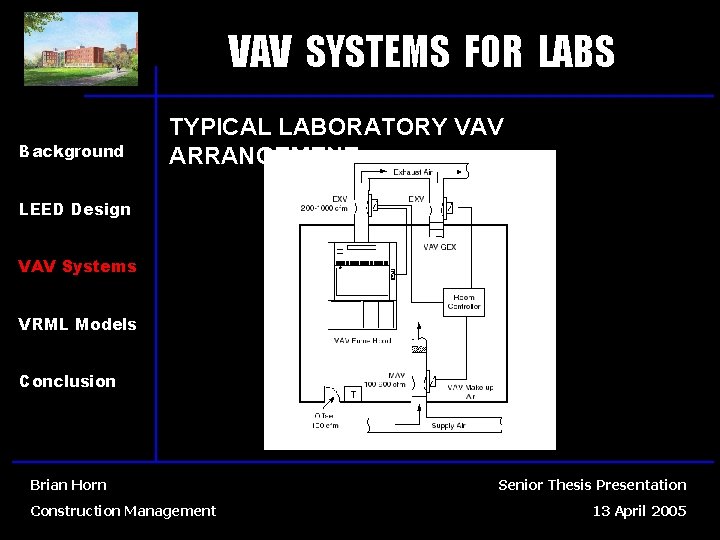
VAV SYSTEMS FOR LABS Background TYPICAL LABORATORY VAV ARRANGEMENT LEED Design VAV Systems VRML Models Conclusion Brian Horn Construction Management Senior Thesis Presentation 13 April 2005
VAV SYSTEMS FOR LABS Background IS A VAV SYSTEM COST EFFECTIVE? • Typical constant volume system $12 - $14 / SF of laboratory LEED Design • Typical VAV system VAV Systems VRML Models $15 - $17 / SF of laboratory • VAV system alone can save up to $2 / SF per year on energy costs Conclusion • Life cycle cost analysis shows VAV to be a better economic investment over life of building Brian Horn Construction Management Senior Thesis Presentation 13 April 2005
PRESENTATION AGENDA Background • Project Background LEED Design • LEED Certification for Laboratory Buildings VAV Systems • Variable Air Volume Systems for Laboratories VRML Models • Immersive Virtual Modeling for MEP Coordination Conclusion • Conclusions and Recommendations Brian Horn Construction Management Senior Thesis Presentation 13 April 2005
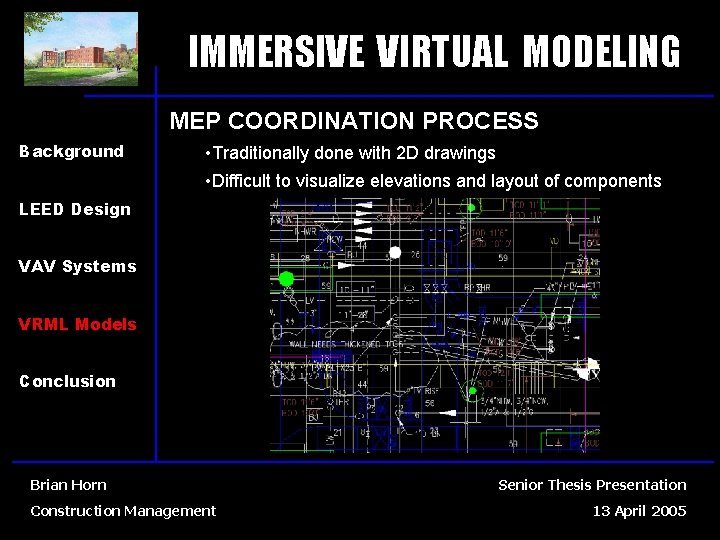
IMMERSIVE VIRTUAL MODELING MEP COORDINATION PROCESS Background • Traditionally done with 2 D drawings • Difficult to visualize elevations and layout of components LEED Design VAV Systems VRML Models Conclusion Brian Horn Construction Management Senior Thesis Presentation 13 April 2005
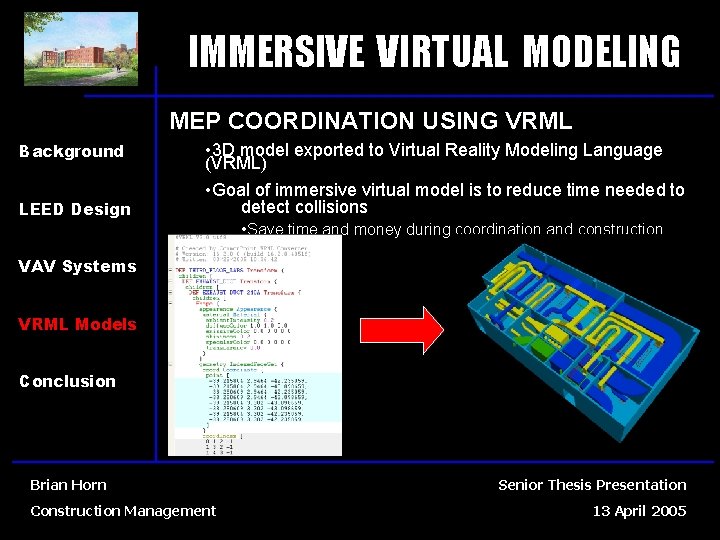
IMMERSIVE VIRTUAL MODELING MEP COORDINATION USING VRML Background LEED Design • 3 D model exported to Virtual Reality Modeling Language (VRML) • Goal of immersive virtual model is to reduce time needed to detect collisions • Save time and money during coordination and construction VAV Systems VRML Models Conclusion Brian Horn Construction Management Senior Thesis Presentation 13 April 2005
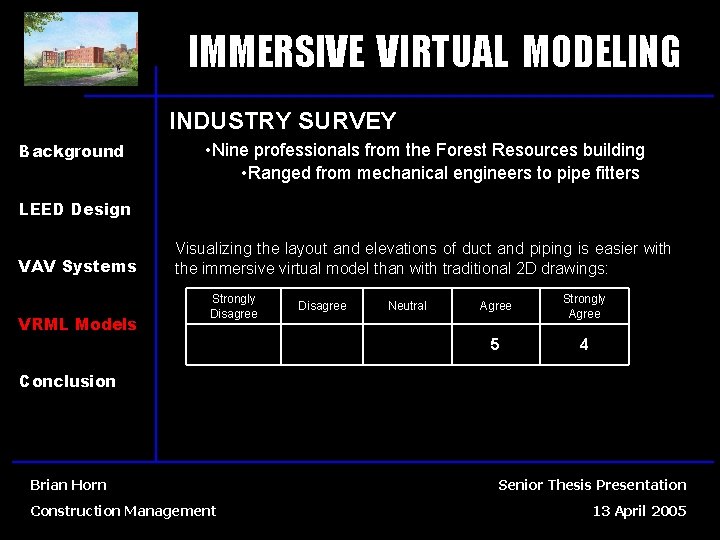
IMMERSIVE VIRTUAL MODELING INDUSTRY SURVEY Background • Nine professionals from the Forest Resources building • Ranged from mechanical engineers to pipe fitters LEED Design VAV Systems VRML Models Visualizing the layout and elevations of duct and piping is easier with the immersive virtual model than with traditional 2 D drawings: Strongly Disagree Neutral Agree Strongly Agree 5 4 Conclusion Brian Horn Construction Management Senior Thesis Presentation 13 April 2005
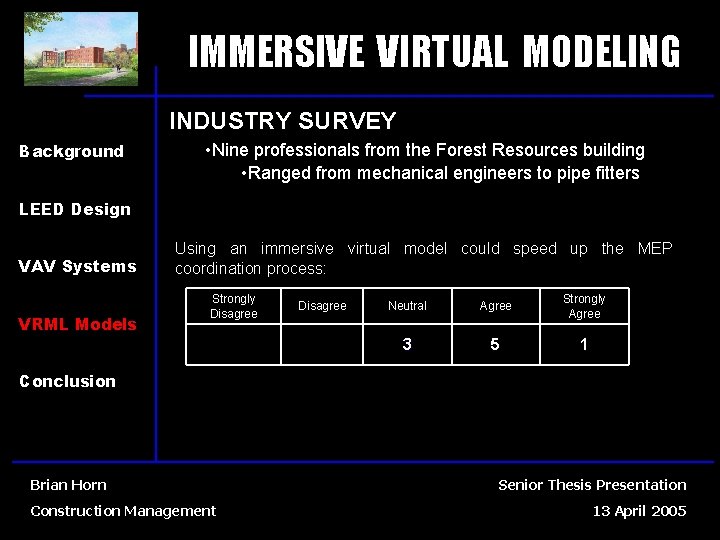
IMMERSIVE VIRTUAL MODELING INDUSTRY SURVEY Background • Nine professionals from the Forest Resources building • Ranged from mechanical engineers to pipe fitters LEED Design VAV Systems VRML Models Using an immersive virtual model could speed up the MEP coordination process: Strongly Disagree Neutral Agree Strongly Agree 3 5 1 Conclusion Brian Horn Construction Management Senior Thesis Presentation 13 April 2005
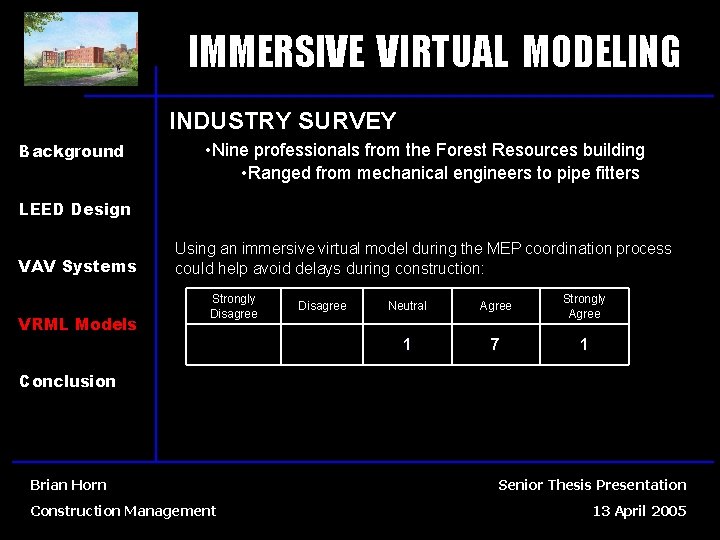
IMMERSIVE VIRTUAL MODELING INDUSTRY SURVEY Background • Nine professionals from the Forest Resources building • Ranged from mechanical engineers to pipe fitters LEED Design VAV Systems VRML Models Using an immersive virtual model during the MEP coordination process could help avoid delays during construction: Strongly Disagree Neutral Agree Strongly Agree 1 7 1 Conclusion Brian Horn Construction Management Senior Thesis Presentation 13 April 2005
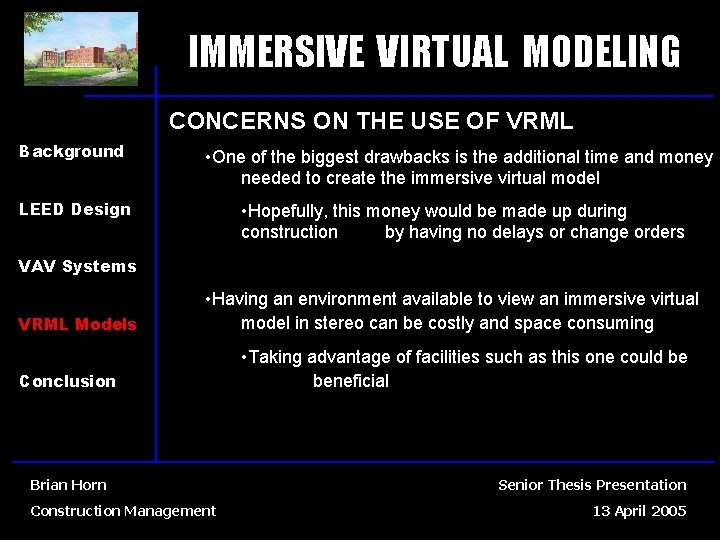
IMMERSIVE VIRTUAL MODELING CONCERNS ON THE USE OF VRML Background • One of the biggest drawbacks is the additional time and money needed to create the immersive virtual model LEED Design • Hopefully, this money would be made up during construction by having no delays or change orders VAV Systems VRML Models • Having an environment available to view an immersive virtual model in stereo can be costly and space consuming Conclusion Brian Horn Construction Management • Taking advantage of facilities such as this one could be beneficial Senior Thesis Presentation 13 April 2005
PRESENTATION AGENDA Background • Project Background LEED Design • LEED Certification for Laboratory Buildings VAV Systems • Variable Air Volume Systems for Laboratories VRML Models • Immersive Virtual Modeling for MEP Coordination Conclusion • Conclusions and Recommendations Brian Horn Construction Management Senior Thesis Presentation 13 April 2005
CONCLUSION • LEED Certification is a worthwhile and rewarding endeavor Background LEED Design VAV Systems VRML Models Conclusion • Main focus for Forest Resources building should be reduced energy use • Using a VAV system can greatly reduce energy consumption • Special attention should be given to laboratory requirements • Visualizing MEP coordination drawings can be greatly enhanced by immersive virtual models • Some barriers do exist that make the technology not quickly adopted into the construction industry • Immersive virtual models can be an economically rewarding investment Brian Horn Construction Management Senior Thesis Presentation 13 April 2005
QUESTIONS Background LEED Design VAV Systems VRML Models Conclusion Brian Horn Construction Management Senior Thesis Presentation 13 April 2005
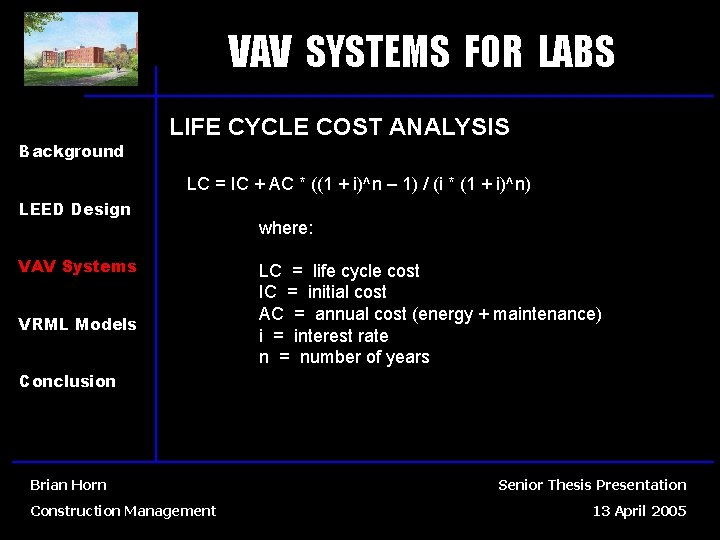
VAV SYSTEMS FOR LABS Background LIFE CYCLE COST ANALYSIS LC = IC + AC * ((1 + i)^n – 1) / (i * (1 + i)^n) LEED Design VAV Systems VRML Models where: LC = life cycle cost IC = initial cost AC = annual cost (energy + maintenance) i = interest rate n = number of years Conclusion Brian Horn Construction Management Senior Thesis Presentation 13 April 2005
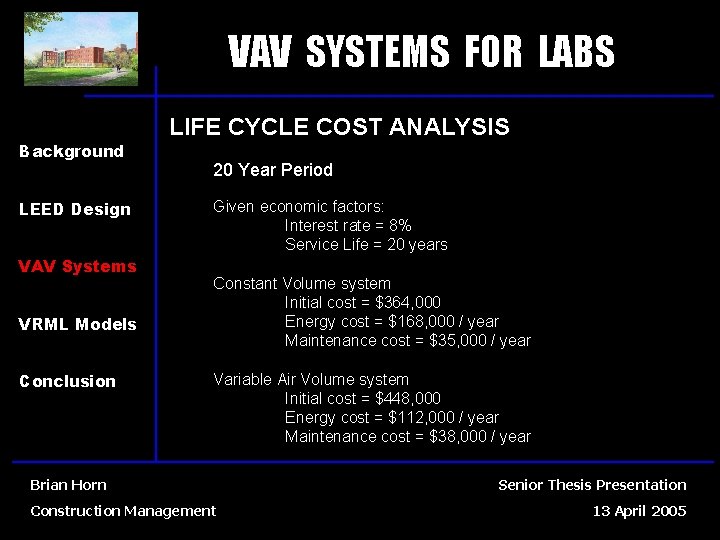
VAV SYSTEMS FOR LABS Background LEED Design VAV Systems VRML Models Conclusion LIFE CYCLE COST ANALYSIS 20 Year Period Given economic factors: Interest rate = 8% Service Life = 20 years Constant Volume system Initial cost = $364, 000 Energy cost = $168, 000 / year Maintenance cost = $35, 000 / year Variable Air Volume system Initial cost = $448, 000 Energy cost = $112, 000 / year Maintenance cost = $38, 000 / year Brian Horn Construction Management Senior Thesis Presentation 13 April 2005
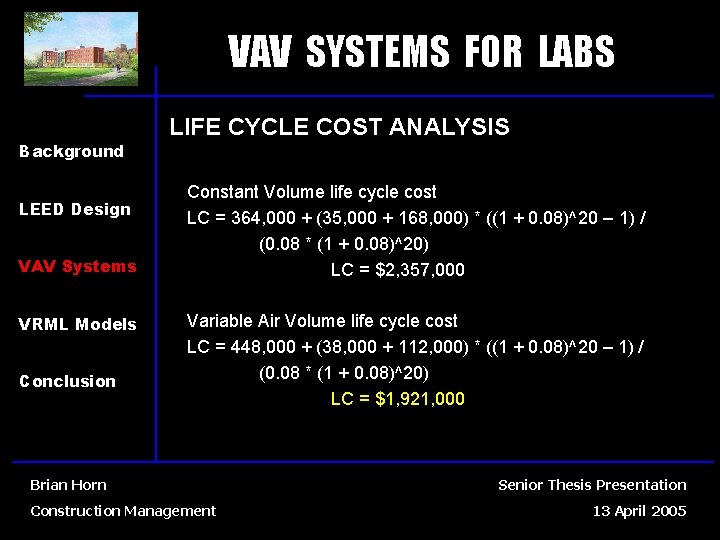
VAV SYSTEMS FOR LABS Background LEED Design VAV Systems VRML Models Conclusion LIFE CYCLE COST ANALYSIS Constant Volume life cycle cost LC = 364, 000 + (35, 000 + 168, 000) * ((1 + 0. 08)^20 – 1) / (0. 08 * (1 + 0. 08)^20) LC = $2, 357, 000 Variable Air Volume life cycle cost LC = 448, 000 + (38, 000 + 112, 000) * ((1 + 0. 08)^20 – 1) / (0. 08 * (1 + 0. 08)^20) LC = $1, 921, 000 Brian Horn Construction Management Senior Thesis Presentation 13 April 2005
- Slides: 29