
School of Environmental Engineering UNIVERSITI MALAYSIA PERLIS PRIMARY
- Slides: 31
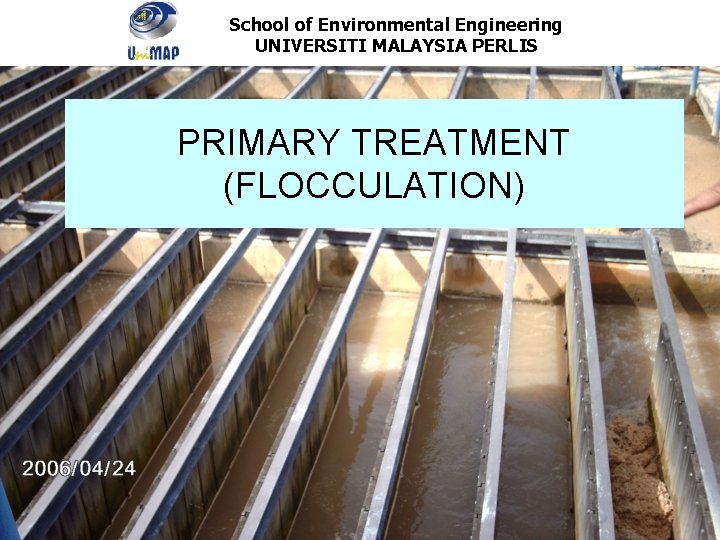
School of Environmental Engineering UNIVERSITI MALAYSIA PERLIS PRIMARY TREATMENT (FLOCCULATION)
School of Environmental Engineering UNIVERSITI MALAYSIA PERLIS OUTLINE • Flocculation – Types of flocculator – Design of flocculator
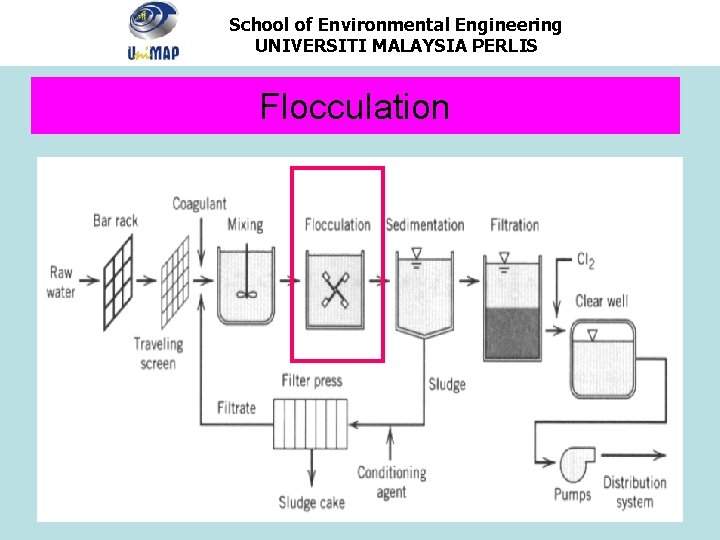
School of Environmental Engineering UNIVERSITI MALAYSIA PERLIS Flocculation
School of Environmental Engineering UNIVERSITI MALAYSIA PERLIS Flocculation Introduction: • Flocculation process is a physical process used to promote the growth of the floc under slow mixing conditions. • Objective: To provide for an increase in the number of contacts between coagulated particles in water by gentle and prolonged agitation. Slow Mix: • Flocculation requires slow and gentle agitation that will not create turbulence to break up the floc particles that already formed during coagulation process. Types of Flocculation; • Hydraulic method • Mechanical devices
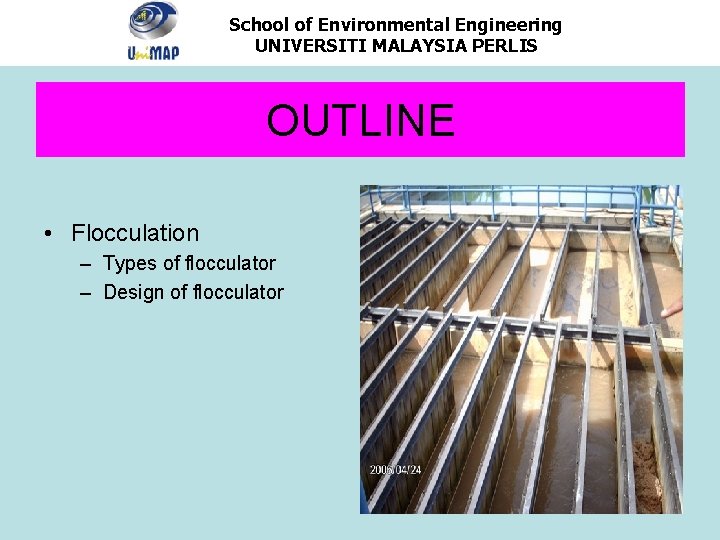
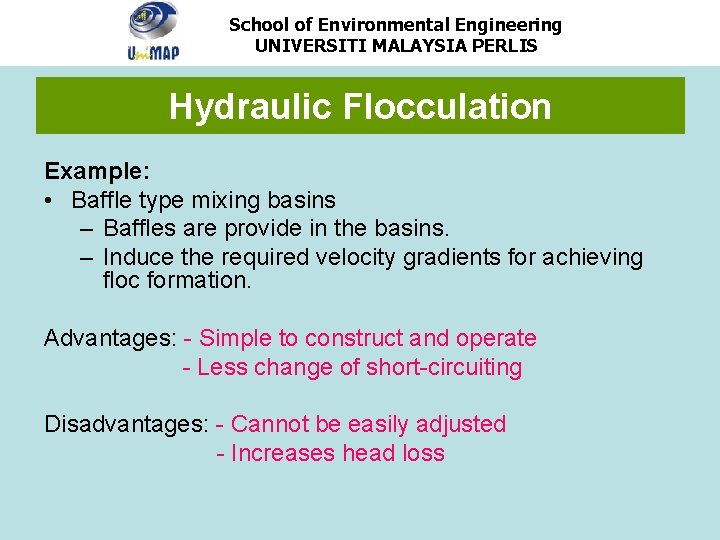
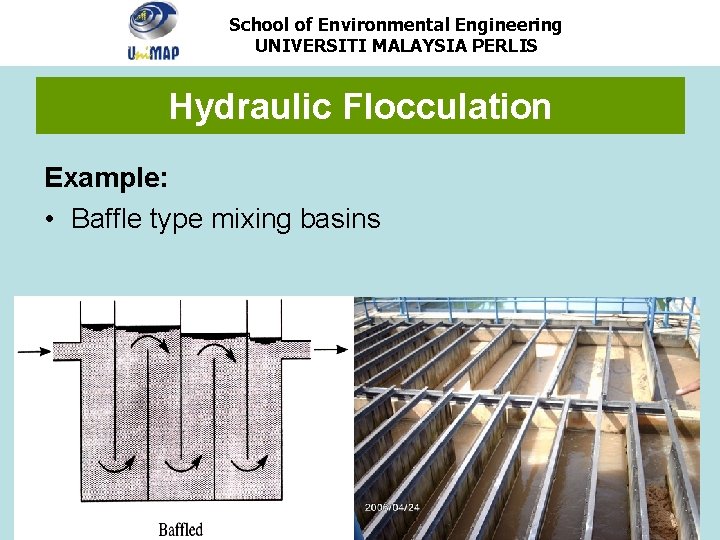
School of Environmental Engineering UNIVERSITI MALAYSIA PERLIS Hydraulic Flocculation Example: • Baffle type mixing basins – Baffles are provide in the basins. – Induce the required velocity gradients for achieving floc formation. Advantages: - Simple to construct and operate - Less change of short-circuiting Disadvantages: - Cannot be easily adjusted - Increases head loss
School of Environmental Engineering UNIVERSITI MALAYSIA PERLIS Hydraulic Flocculation Example: • Baffle type mixing basins
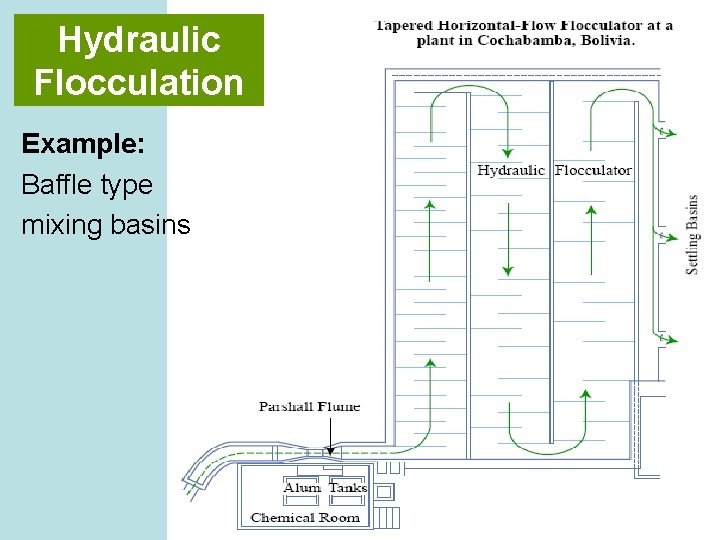
Hydraulic Flocculation Example: Baffle type mixing basins
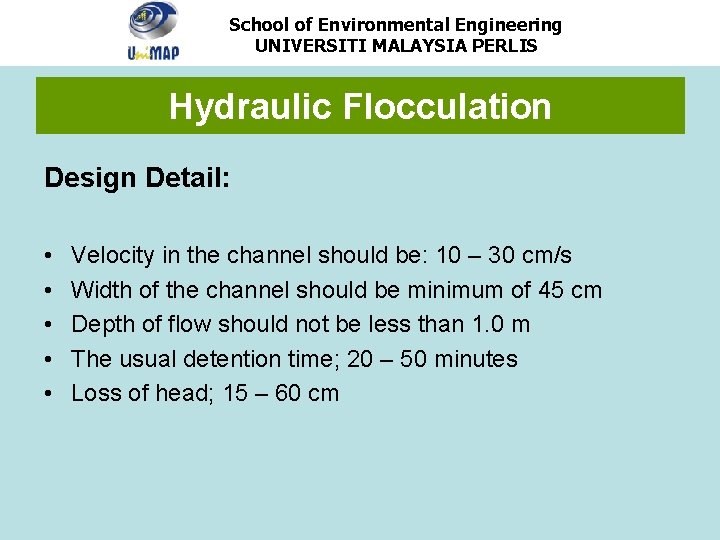
School of Environmental Engineering UNIVERSITI MALAYSIA PERLIS Hydraulic Flocculation Design Detail: • • • Velocity in the channel should be: 10 – 30 cm/s Width of the channel should be minimum of 45 cm Depth of flow should not be less than 1. 0 m The usual detention time; 20 – 50 minutes Loss of head; 15 – 60 cm
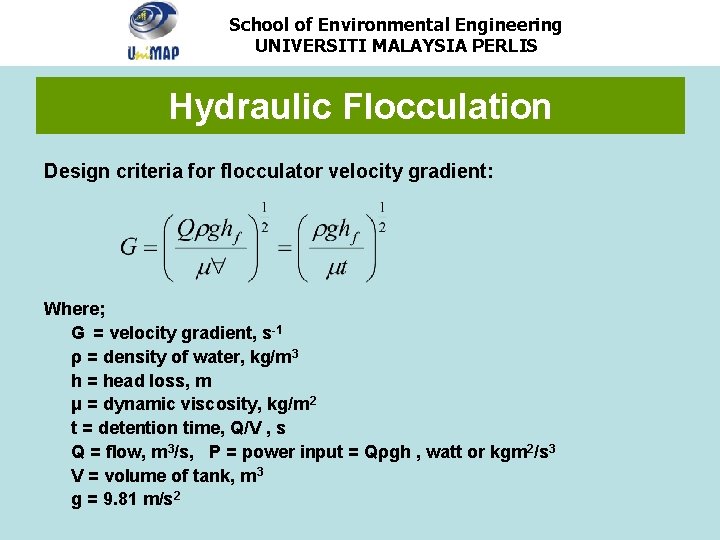
School of Environmental Engineering UNIVERSITI MALAYSIA PERLIS Hydraulic Flocculation Design criteria for flocculator velocity gradient: Where; G = velocity gradient, s-1 ρ = density of water, kg/m 3 h = head loss, m μ = dynamic viscosity, kg/m 2 t = detention time, Q/V , s Q = flow, m 3/s, P = power input = Qρgh , watt or kgm 2/s 3 V = volume of tank, m 3 g = 9. 81 m/s 2
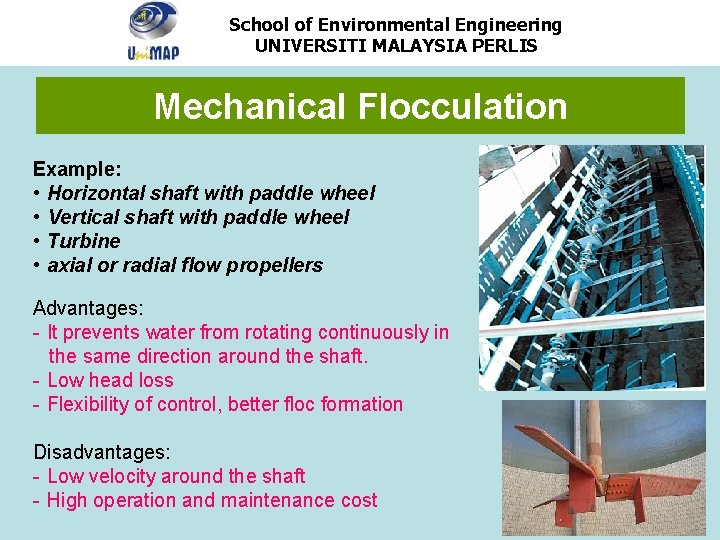
School of Environmental Engineering UNIVERSITI MALAYSIA PERLIS Mechanical Flocculation Example: • Horizontal shaft with paddle wheel • Vertical shaft with paddle wheel • Turbine • axial or radial flow propellers Advantages: - It prevents water from rotating continuously in the same direction around the shaft. - Low head loss - Flexibility of control, better floc formation Disadvantages: - Low velocity around the shaft - High operation and maintenance cost
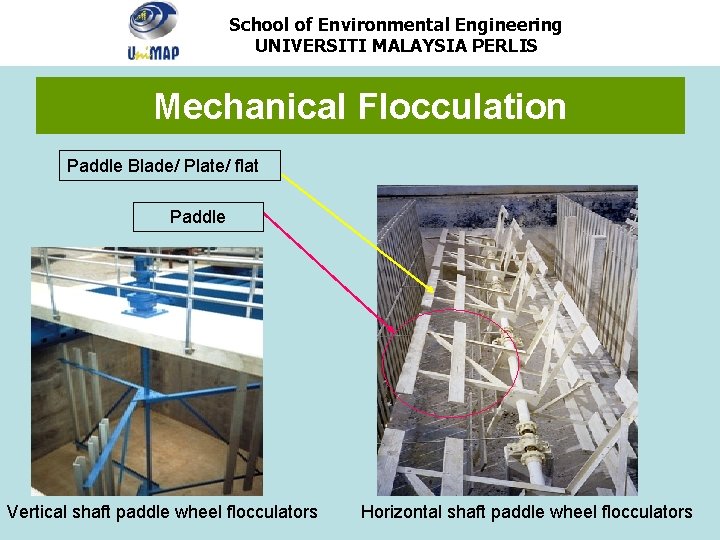
School of Environmental Engineering UNIVERSITI MALAYSIA PERLIS Mechanical Flocculation Paddle Blade/ Plate/ flat Paddle Vertical shaft paddle wheel flocculators Horizontal shaft paddle wheel flocculators
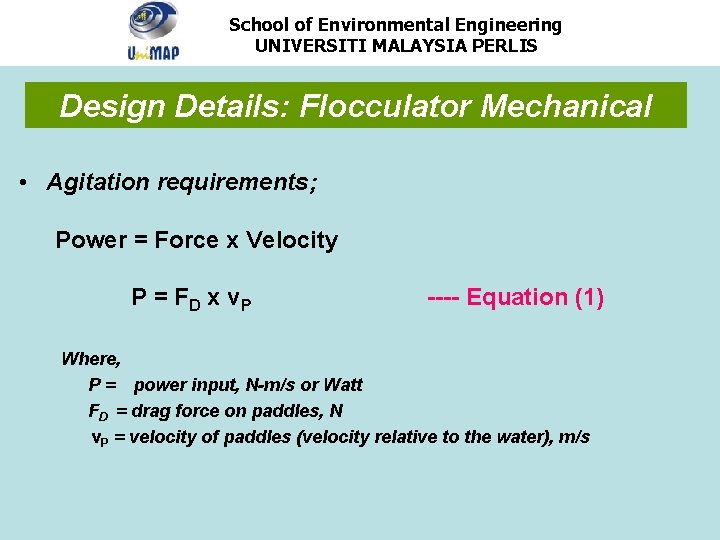
School of Environmental Engineering UNIVERSITI MALAYSIA PERLIS Design Details: Flocculator Mechanical • Agitation requirements; Power = Force x Velocity P = F D x v. P ---- Equation (1) Where, P = power input, N-m/s or Watt FD = drag force on paddles, N v. P = velocity of paddles (velocity relative to the water), m/s
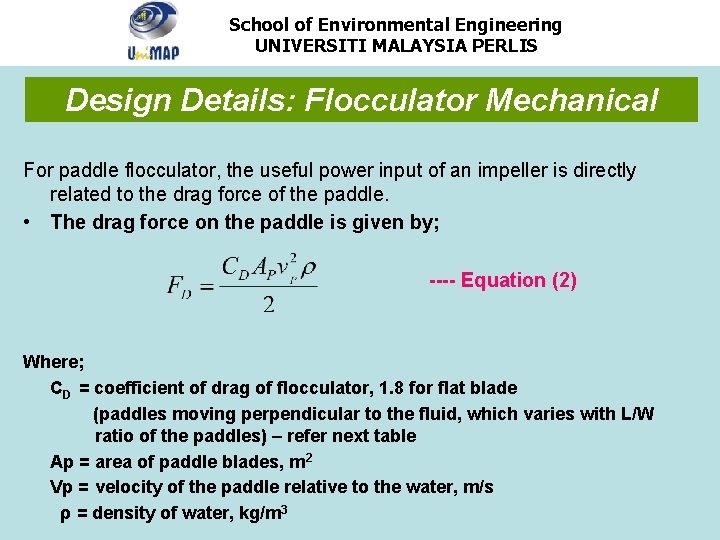
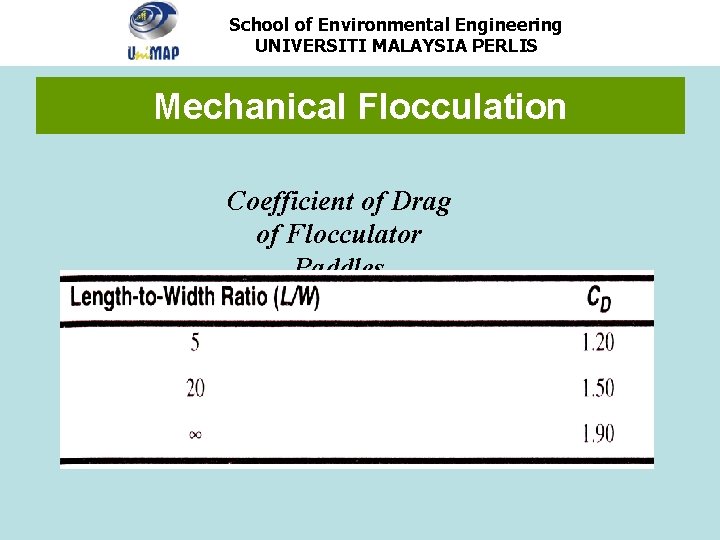
School of Environmental Engineering UNIVERSITI MALAYSIA PERLIS Design Details: Flocculator Mechanical For paddle flocculator, the useful power input of an impeller is directly related to the drag force of the paddle. • The drag force on the paddle is given by; ---- Equation (2) Where; CD = coefficient of drag of flocculator, 1. 8 for flat blade (paddles moving perpendicular to the fluid, which varies with L/W ratio of the paddles) – refer next table Ap = area of paddle blades, m 2 Vp = velocity of the paddle relative to the water, m/s ρ = density of water, kg/m 3
School of Environmental Engineering UNIVERSITI MALAYSIA PERLIS Mechanical Flocculation Coefficient of Drag of Flocculator Paddles
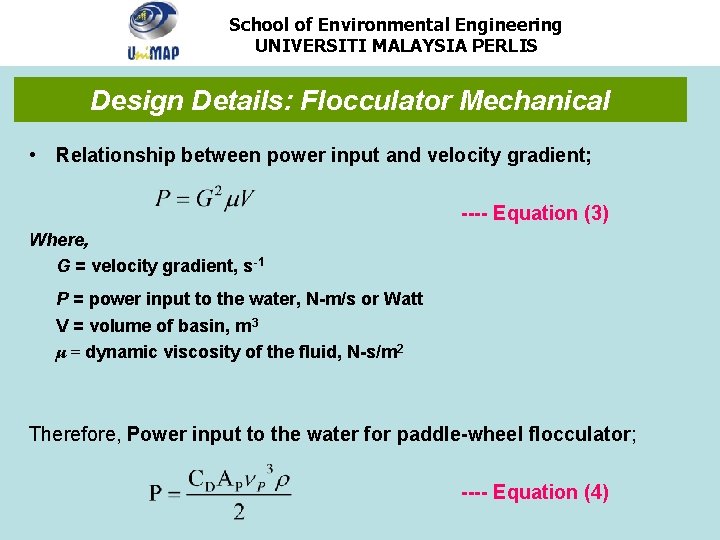
School of Environmental Engineering UNIVERSITI MALAYSIA PERLIS Design Details: Flocculator Mechanical • Relationship between power input and velocity gradient; ---- Equation (3) Where, G = velocity gradient, s-1 P = power input to the water, N-m/s or Watt V = volume of basin, m 3 μ = dynamic viscosity of the fluid, N-s/m 2 Therefore, Power input to the water for paddle-wheel flocculator; ---- Equation (4)
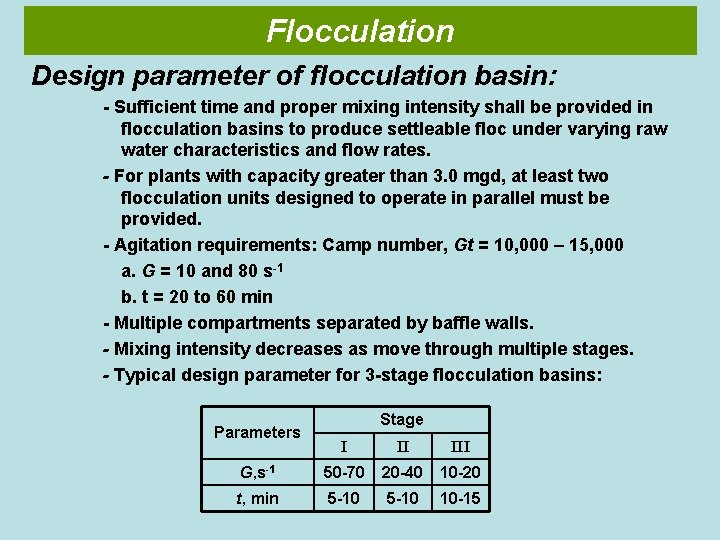
Flocculation Design parameter of flocculation basin: - Sufficient time and proper mixing intensity shall be provided in flocculation basins to produce settleable floc under varying raw water characteristics and flow rates. - For plants with capacity greater than 3. 0 mgd, at least two flocculation units designed to operate in parallel must be provided. - Agitation requirements: Camp number, Gt = 10, 000 – 15, 000 a. G = 10 and 80 s-1 b. t = 20 to 60 min - Multiple compartments separated by baffle walls. - Mixing intensity decreases as move through multiple stages. - Typical design parameter for 3 -stage flocculation basins: Parameters Stage I II III G, s-1 50 -70 20 -40 10 -20 t, min 5 -10 10 -15
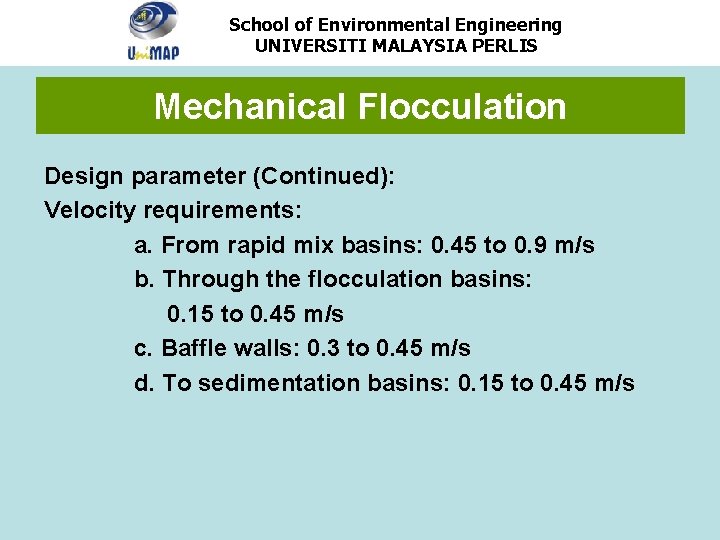
School of Environmental Engineering UNIVERSITI MALAYSIA PERLIS Mechanical Flocculation Design parameter (Continued): Velocity requirements: a. From rapid mix basins: 0. 45 to 0. 9 m/s b. Through the flocculation basins: 0. 15 to 0. 45 m/s c. Baffle walls: 0. 3 to 0. 45 m/s d. To sedimentation basins: 0. 15 to 0. 45 m/s
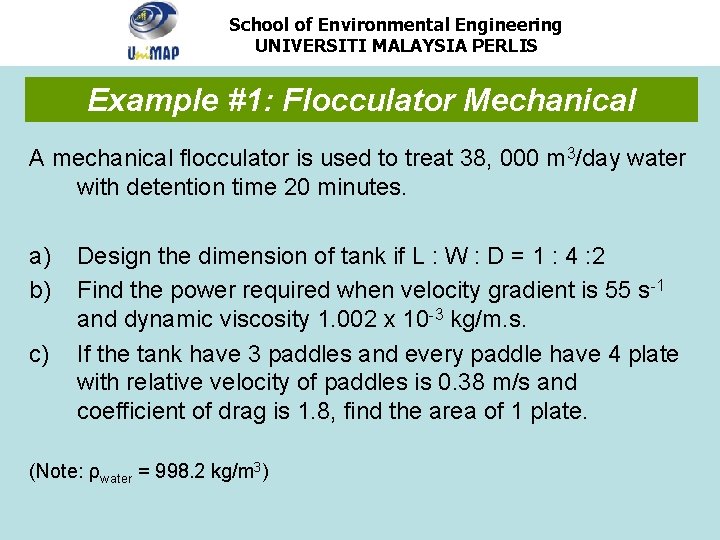
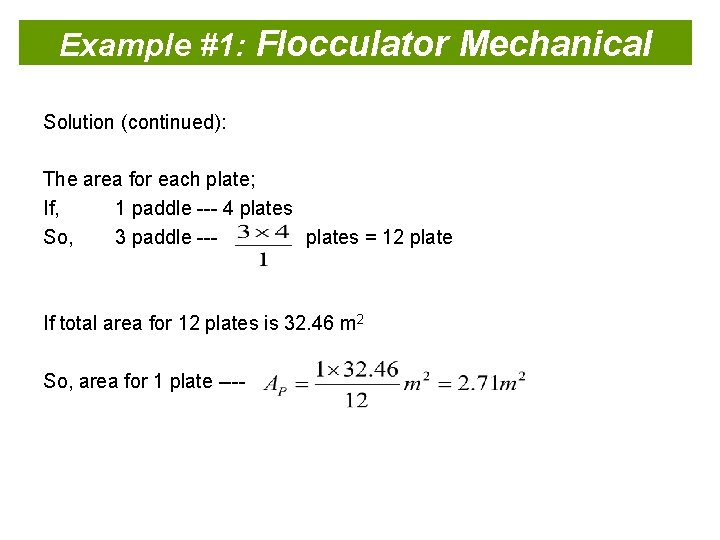
School of Environmental Engineering UNIVERSITI MALAYSIA PERLIS Example #1: Flocculator Mechanical A mechanical flocculator is used to treat 38, 000 m 3/day water with detention time 20 minutes. a) b) c) Design the dimension of tank if L : W : D = 1 : 4 : 2 Find the power required when velocity gradient is 55 s-1 and dynamic viscosity 1. 002 x 10 -3 kg/m. s. If the tank have 3 paddles and every paddle have 4 plate with relative velocity of paddles is 0. 38 m/s and coefficient of drag is 1. 8, find the area of 1 plate. (Note: ρwater = 998. 2 kg/m 3)
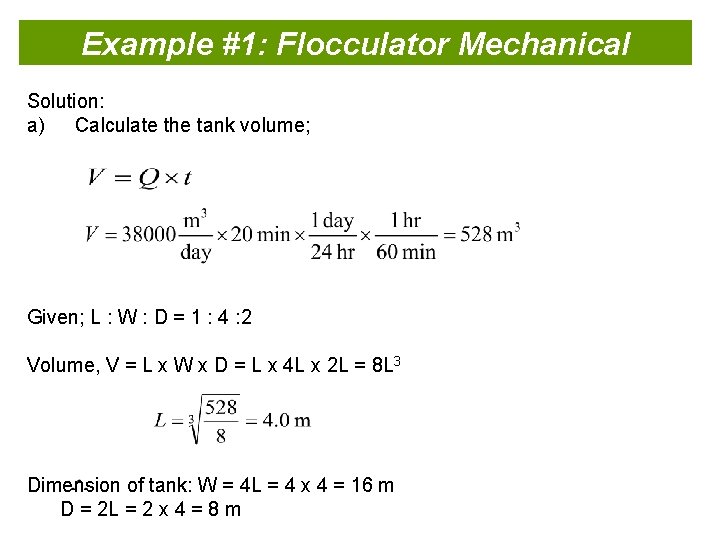
Example #1: Flocculator Mechanical Solution: a) Calculate the tank volume; Given; L : W : D = 1 : 4 : 2 Volume, V = L x W x D = L x 4 L x 2 L = 8 L 3 Dimension of tank: W = 4 L = 4 x 4 = 16 m D = 2 L = 2 x 4 = 8 m
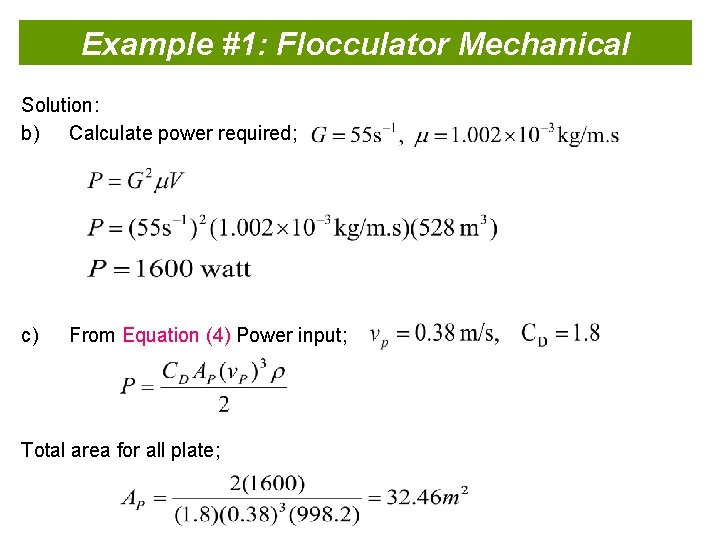
Example #1: Flocculator Mechanical Solution: b) Calculate power required; c) From Equation (4) Power input; Total area for all plate;
Example #1: Flocculator Mechanical Solution (continued): The area for each plate; If, 1 paddle --- 4 plates So, 3 paddle --plates = 12 plate If total area for 12 plates is 32. 46 m 2 So, area for 1 plate ----
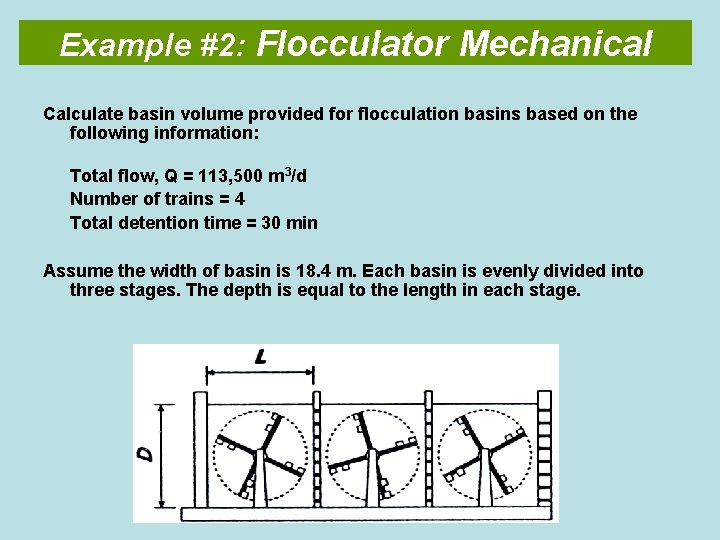
Example #2: Flocculator Mechanical Calculate basin volume provided for flocculation basins based on the following information: Total flow, Q = 113, 500 m 3/d Number of trains = 4 Total detention time = 30 min Assume the width of basin is 18. 4 m. Each basin is evenly divided into three stages. The depth is equal to the length in each stage.
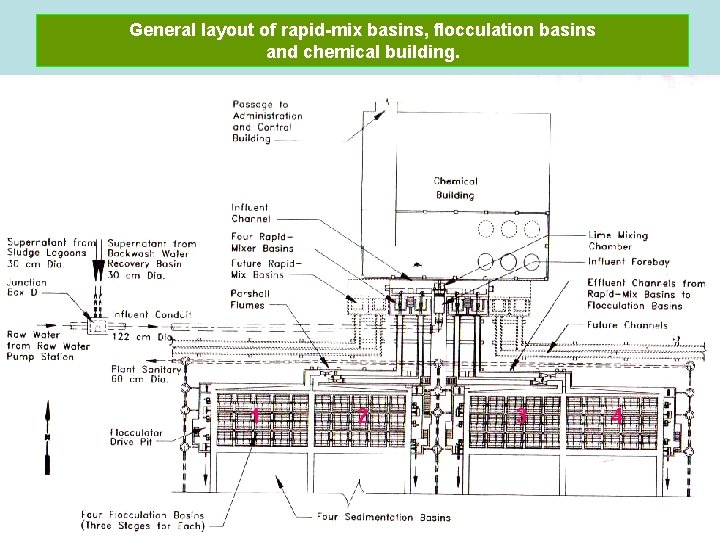
General layout of rapid-mix basins, flocculation basins and chemical building. 1 2 3 4
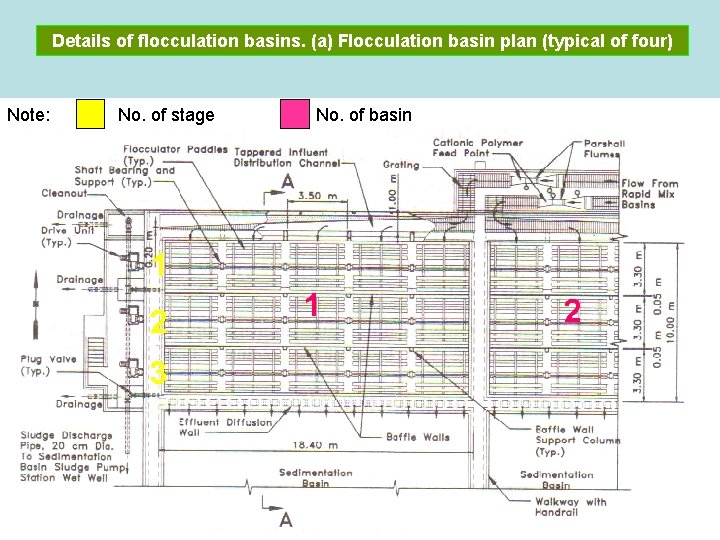
Details of flocculation basins. (a) Flocculation basin plan (typical of four) Note: No. of stage No. of basin 1 2 3 1 2
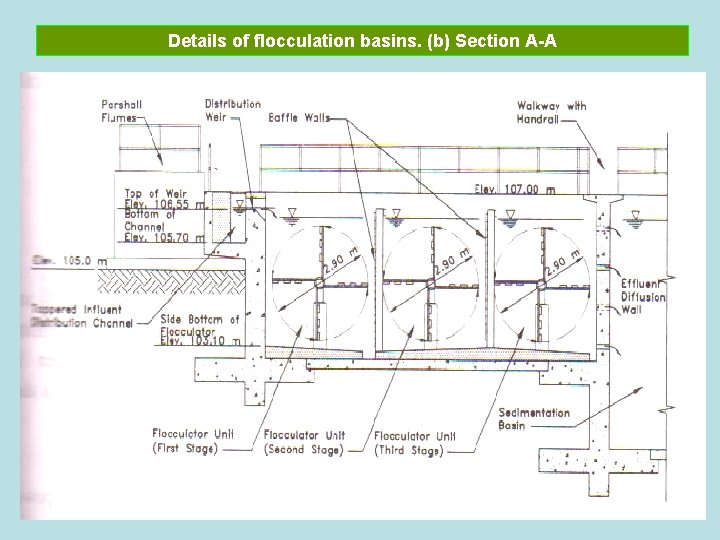
Details of flocculation basins. (b) Section A-A
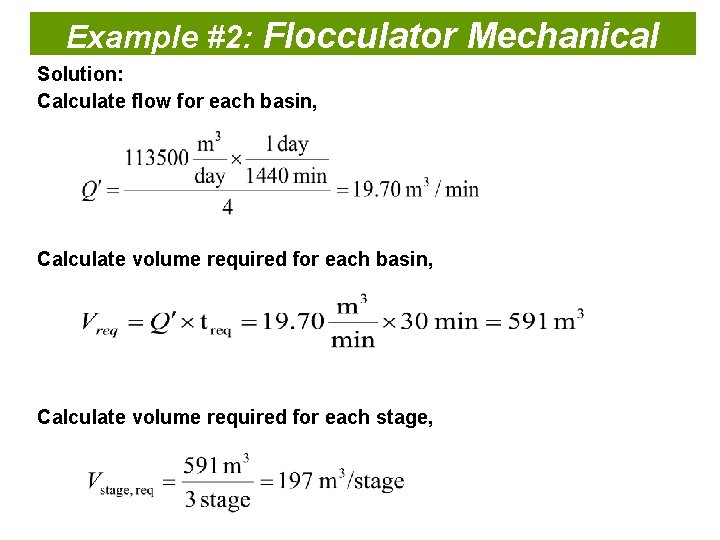
Example #2: Flocculator Mechanical Solution: Calculate flow for each basin, Calculate volume required for each stage,
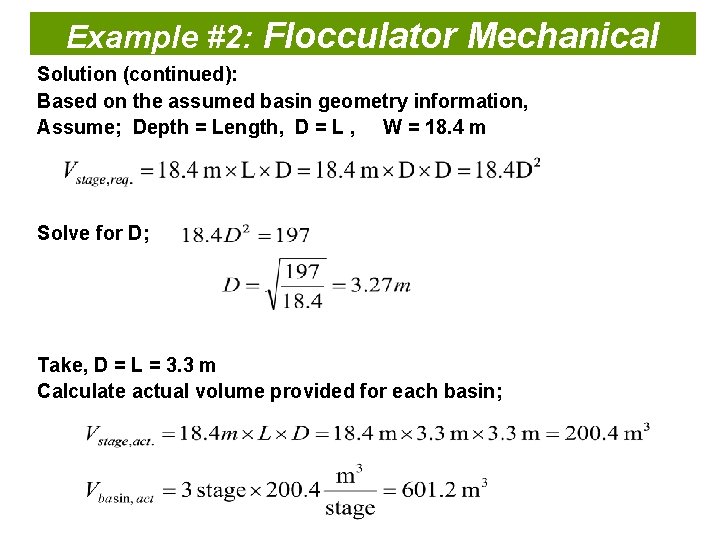
Example #2: Flocculator Mechanical Solution (continued): Based on the assumed basin geometry information, Assume; Depth = Length, D = L , W = 18. 4 m Solve for D; Take, D = L = 3. 3 m Calculate actual volume provided for each basin;
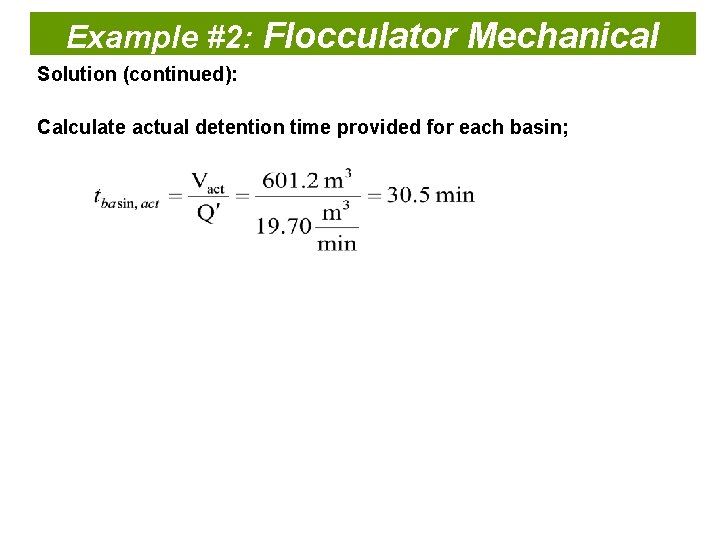
Example #2: Flocculator Mechanical Solution (continued): Calculate actual detention time provided for each basin;
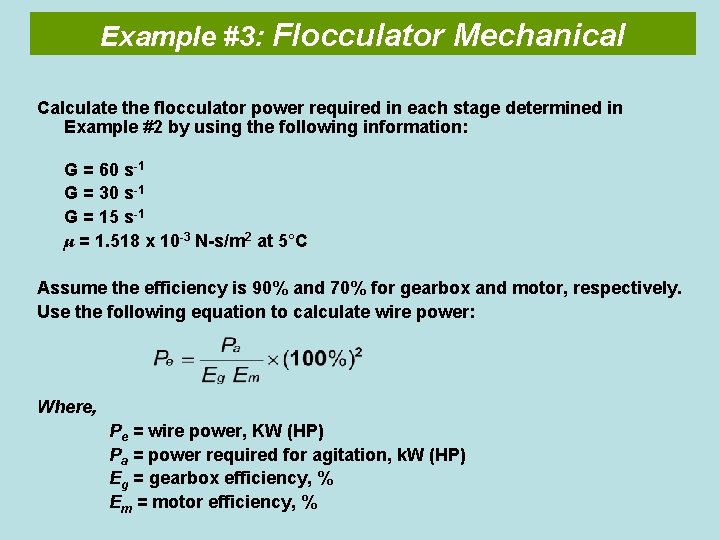
Example #3: Flocculator Mechanical Calculate the flocculator power required in each stage determined in Example #2 by using the following information: G = 60 s-1 G = 30 s-1 G = 15 s-1 μ = 1. 518 x 10 -3 N-s/m 2 at 5°C Assume the efficiency is 90% and 70% for gearbox and motor, respectively. Use the following equation to calculate wire power: Where, Pe = wire power, KW (HP) Pa = power required for agitation, k. W (HP) Eg = gearbox efficiency, % Em = motor efficiency, %
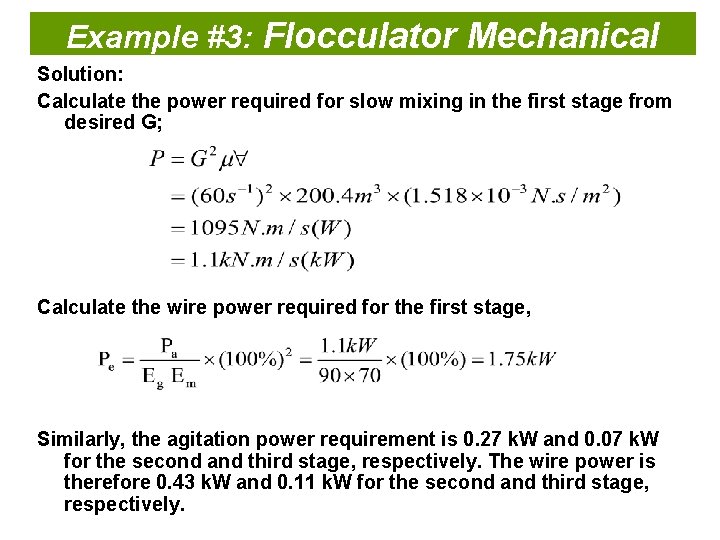
Example #3: Flocculator Mechanical Solution: Calculate the power required for slow mixing in the first stage from desired G; Calculate the wire power required for the first stage, Similarly, the agitation power requirement is 0. 27 k. W and 0. 07 k. W for the second and third stage, respectively. The wire power is therefore 0. 43 k. W and 0. 11 k. W for the second and third stage, respectively.
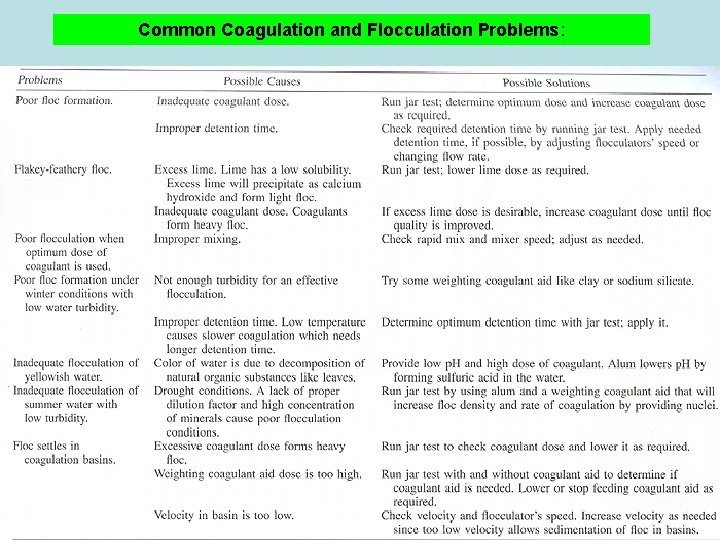
Common Coagulation and Flocculation Problems: