
School of Education University of Strathclyde Glasgow Scotland


- Slides: 29
School of Education, University of Strathclyde, Glasgow, Scotland • Largest provider of teachers in Scotland one of the largest in the UK, 1000 PGDE students, 900 UGs, Masters and PGR • We trace our origins to 1837 and the Glasgow Normal School, established by philanthropist David Stowe – one of the first teacher education institutions in the UK • The Glasgow Normal School became Jordanhill College of Education in the early 1900 s • The Scottish School of Physical Education (for men) was established in 1934, and merged with Dunfermline College (for women) in 1986 and based at the University of Edinburgh • We continue to off a PGDE course in Physical Education at Strathclyde
Teaching Games in School Physical Education: Towards a pedagogical model David Kirk Ph. D University of Strathclyde and University of Queensland Tsukuba Summer Institute 2017
Headline The research community concerned with the teaching of games in physical education is in turmoil due to conflict around the best way to teach and coach games
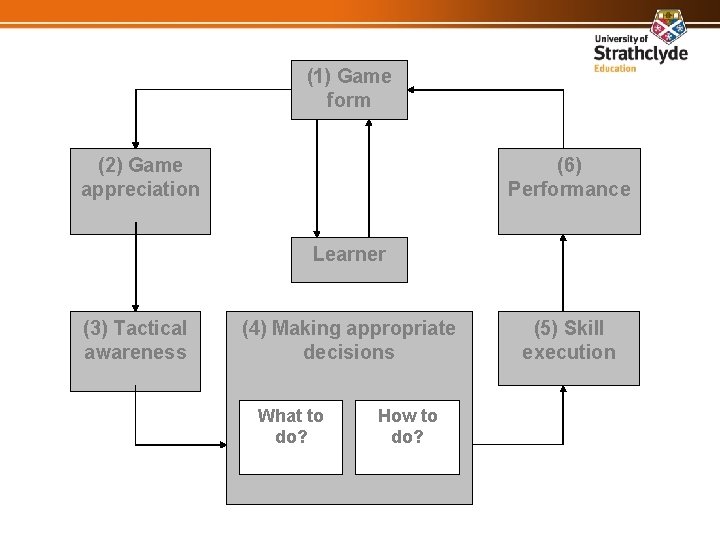
(1) Game form (2) Game appreciation (6) Performance Learner (3) Tactical awareness (4) Making appropriate decisions What to do? How to do? (5) Skill execution
Biography • I completed my Ph. D at Loughborough University between 198284, TII HRF based physical education, supervisor Len Almond • I contributed some papers to the Bulletin of Physical Education Kirk, D. (1983) A New Term for a Vacant Peg: Conceptualising Physical Performance in Sport. Bulletin of Physical Education 19 (3), pp. 38 -44. (Intelligent Performance) Kirk, D. (1983) Theoretical Guidelines for 'Teaching for Understanding'. Bulletin of Physical Education 9 (1), pp. 41 -45. Kirk, D. (1989) Teaching for Understanding: An Innovation in the Games Curriculum. ACHPER National Journal 126 (Summer), pp. 25 -27.
Chapters and conference papers Kirk, D. (2005) Model-based teaching and assessment in physical education: The Tactical Games model, pp. 128 -142 in Green, K. and Hardman, K. (Eds. ) Physical Education: Essential Issues London: Sage. Kirk, D. (2005) Future prospects for teaching games for understanding, pp. 213 -227 in Griffin, L. L & Butler, J. I. (Eds. ) Teaching Games for Understanding: Theory, Research and Practice Champaign: Human Kinetics. Kirk, D. , Brooker, R. and Braiuka, S. (2000) Teaching Games for Understanding: A situated perspective on student learning. Paper presented to the AERA Annual Meeting, New Orleans, April.
TGf. U papers Teaching games for understanding and situated learning: Rethinking the Bunker-Thorpe model D Kirk, A Mac. Phail (2002) Journal of Teaching in Physical Education 21 (2), 177 -192. Implementing a game sense approach to teaching junior high school basketball in a naturalistic setting R Brooker, D Kirk, S Braiuka, A Bransgrove (2000) European Physical Education Review 6 (1), 7 -26. Throwing and catching as relational skills in game play: Situated learning in a modified game unit A Mac. Phail, D Kirk, L Griffin (2008) Journal of Teaching in Physical Education 27 (1), 100 -115.
Founding Editor
Introduction • The research community concerned with the teaching of games in physical education is in turmoil due to a proliferation of approaches since publication of the original Teaching Games for Understanding (TGf. U) model over 30 years ago • What is missing from Stolz and Pills’ and others’ contributions to and accounts of the debate is an appreciation of the particular problem the originators of the TGf. U model were seeking to solve • The problem was what they perceived to be unsatisfactory practice in then current teaching of games, and their model was intended as a solution to this problem
Purpose • The purpose of this paper is to propose a pedagogical model for teaching games in school physical education as a solution to the original problem Bunker and Thorpe were seeking to solve, which I will argue remains in play today • In pursuit of this purpose, in the next section of the presentation I will elaborate on the nature of the problem of games teaching as I think Bunker and Thorpe understood it, and thus the nature of the solution they offered in the form of TGf. U
The problem of games teaching in secondary school physical education and TGf. U as a solution • Rod Thorpe said that he often saw the layup shot in Basketball practiced in physical education lessons and performed effectively, but then never saw the shot used in the game that followed • This is the nub of the problem, simply expressed, but its source is deeply rooted in the history of physical education in the UK and elsewhere, and in the nature of the school as an institution • Bunker and Thorpe (1982) in their original paper refer to the secondary school, and this is no accident. Why is this?
The problem of games teaching in secondary school physical education and TGf. U as a solution • David Munrow asked how a headteacher was to schedule different games and sports that required different durations and different facilities, such as court games, field games and outdoor activities • Instead of physical education lessons being timetabled in ways that suited the requirements of the activity – be it squash, soccer or canoeing – physical education was shoehorned into the existing academic timetable organised around periods of up to 50 minutes • Rather than fight this somewhat obvious restriction on their developing sport-based subject, physical educators instead embraced it
The problem of games teaching in secondary school physical education and TGf. U as a solution • Physical education was not so much sport-based as sportstechnique based • Given the constraints of the curriculum and other factors, lessons took the form of the practice of decontextualized sports techniques • The multi-activity curriculum became over time the dominant form of school physical education • This is the problem with games teaching that Bunker and Thorpe were seeking to resolve. • We might ask then, what kind of a solution to the problem of sports-technique based physical education was TGf. U?
A caveat: Skill in physical education • Rink (1993) developed a four-stage pedagogy around the development of skill within physical education lessons, of introduction, extension, refinement and application • Rink noted that a common failure of her approach was that teachers moved from introduction to application and missed the second and third stages, with the typical results that skills were rarely learned • The approach championed by Rink and others was not specifically a pedagogy for games playing, it was a general pedagogy for physical education writ large
The problem of games teaching in secondary school physical education and TGf. U as a solution • The TGf. U model was not a prescription for how to teach games since the model was never intended as a guide to what teachers might do to help children learn to play games • Bunker and Thorpe with Len Almond’s facilitation developed principles for teacher practice informed by this way of thinking, such as the extensive use of modified games shaped by exaggeration and representation • The ‘Iron Law’ of curriculum innovation and change, which states that ‘that the innovative idea will always and inevitably be transformed in the process of implementation’
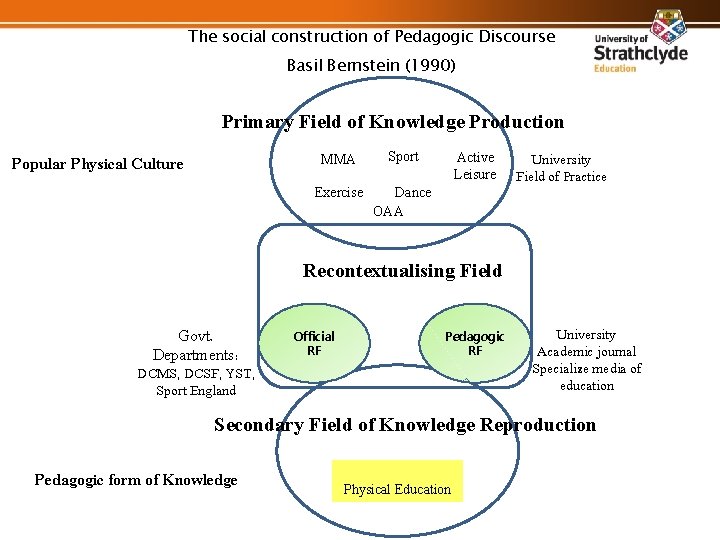
The social construction of Pedagogic Discourse Basil Bernstein (1990) Primary Field of Knowledge Production Popular Physical Culture MMA Sport Exercise Dance OAA Active Leisure University Field of Practice Recontextualising Field Govt. Departments: Official RF Pedagogic RF DCMS, DCSF, YST, Sport England University Academic journal Specialize media of education Secondary Field of Knowledge Reproduction Pedagogic form of Knowledge Physical Education
The argument so far • My argument thus far is that much of the turmoil in the research field of teaching games in school physical education stems from a lack of understanding of the problem Bunker and Thorpe perceived and sought to solve through TGf. U • What is required to move us beyond the current chaos in this field is the reorganisation of these elements in a way which more explicitly addresses the original problem TGf. U was intended to solve, but also recognises the need to manage the tension between prescription and adaptation
Pedagogical models in physical education • Pedagogical models have their own distinctive ‘practice architecture’ • There is an overarching idea that captures the main focus of the model • A pedagogical model identifies distinctive student learning outcomes or aspirations and shows how these might be best achieved through their tight alignment with teaching strategies and curriculum or subject matter • The model becomes the ‘organising centre’ (Metzler, 2005) for physical education programmes
Pedagogical models in physical education • Each pedagogical model is a design specification that can be used by teachers to create programmes for their schools that are suited to the specific circumstances of their local contexts • Each model prescribes some specific ‘non-negotiable’ features that make it distinctive, the critical elements • Without these non-negotiable features it could be argued that the stated learning outcomes are less likely to be achieved • In its original form TGf. U along with its many more recent variants lacks this practice architecture
The practice architecture of a prototype pedagogical model for teaching games in physical education • The use of particular ‘technical’ language (eg. The main idea), the requirement for specific social relations (eg. Studentcentredness) and the designation of particular physical spaces for teaching and learning (eg. Playing fields) taken together make particular pedagogical models possible • Within this concept of practice architecture, and as we just noted, all pedagogical models contain three key features, a main idea, critical elements and learning outcomes or aspirations
The practice architecture of a prototype pedagogical model for teaching games in physical education • The main idea for this pedagogical model for teaching games in schools is ‘The production of thinking players’. • The critical elements, the ‘non-negotiable’ aspects, of the prototype model are: student-centred pedagogy, the use of modified games, and the setting of problems to be solved • The learning outcomes can be specified in three broad contexts, at an individual level, in a small group context and in relation • The information generated by assessment is used to inform teacher judgment about what to do next, and to provide formative feedback to students so that they can improve to a whole (modified) game
Assessment • Currently, work is progressing with colleagues Carmen Barquero and José Luis Arias Estero from the Universidad Católica de Murcia to develop a tool which takes the individual, small group and whole game as three nested units of analysis • The instrument is comprised of four categories of criteria for game assessment: Contextual Criteria, Individual Criteria, Small Group Criteria and Team Criteria. There are 26 criteria over all, six or seven in each category • The instrument is currently undergoing expert validation prior to fieldwork testing
Is the proposed pedagogical model a solution to the Bunker-Thorpe problem? • At this stage the response can only be ‘possibly’ • A curriculum is merely a specification for practice that invites critical testing, rather than a prescription for what teachers must do • In this sense, pedagogical models are design specifications for practice, and the organising centres for physical education curricula • The model sketched here is a prototype until teachers and their pupils test it in practice
Is the proposed pedagogical model a solution to the Bunker-Thorpe problem? • The necessity of this approach is borne out by the Iron Law of curriculum innovation • Innovative ideas, such as a pedagogical model for teaching games, will always and inevitably be transformed in practice, to some degree, and so teachers and their pupils must make adaptations to suit their local context of implementation • This prototype pedagogical model for teaching games in schools has the potential to succeed where TGf. U has had limited success because it recognises and anticipates this reality of the curriculum as a specification to be tested in practice
Is the proposed pedagogical model a solution to the Bunker-Thorpe problem? • The critical elements are not diktats; they are, in Stenhouse’s terms, elements of the design specification that are ‘worth putting to the test of practice’ • The critical elements are ‘non-negotiable’ in so far as they must be present in some form in teachers’ practice • The pedagogical model does not dictate specific practices of student-centredness or specific modifications to games or specific problems to be solved • These specificities are for teachers and their pupils to determine
Is the proposed pedagogical model a solution to the Bunker-Thorpe problem? • Given the challenges I alluded to earlier that schools present, teachers and their pupils must have the spaces to test and adapt good pedagogical ideas in ways that suit their local conditions • They must be able to determine, too, the extent to which learning is taking place, and reasonable levels of game play for individuals and groups, through appropriate assessment practices.
Conclusion • My purpose in this paper has been to propose the development of a pedagogical model for teaching games in school physical education • The key feature of my argument is that this model must take into account the nature of the school as an institution, and physical education’s part in it • I argued that this was the problem Bunker and Thorpe originally attempted to solve, with TGf. U providing only partial success. • The model proposed here is then specific to the context of school physical education
Conclusion • The use of pedagogical models in physical education presupposes that teachers and their pupils have spaces for manoeuvre within their state or national curricula • Teacher need to have opportunities for career-long professional learning and the professional skills required to work in flexible partnerships • As long ago as 1975, Stenhouse was advocating for exactly this situation • Stenhouse was one of the early promoters of the concept of teacher-as-researcher, which grew into a now well-established movement for practitioner action research
Conclusion • Much is already known about how humans learn to play complex games and sports, certainly enough for teachers to set young people in their charge on learning journeys towards becoming good thinking players • The debate over the superiority of skill-based or TGf. U-inspired approaches to games has been a red herring and wasted effort • So too has been the more recent warring between rival supports of various TGf. U spin-offs • Our focus as a community of researchers should be on developing a robust pedagogical model for teaching games in school physical education, since such a model is at least ‘a provisional specification claiming no more than to be worth putting to the test of practice’.