
School of Education CDA Student Orientation Objectives Define
School of Education CDA Student Orientation
Objectives • • • Define CDA and Rasmussen Philosophy Age Group for CDA (assessment packet) Describe CDA Competency Standards Understand the Eligibility Requirements Identify the Six Stages of CDA Assessment Copyright Rasmussen, Inc. 2
Child Development Associate The Child Development Associate, or CDA, is a person who is able to meet the specific needs of children and who, with parents and other adults, works to nurture children’s physical, social, emotional, and intellectual growth in a child development framework. Copyright Rasmussen, Inc. 3
Why CDA? • • National Credential Independent Verification of Quality Validates your work and accomplishment Provides evidence of professional commitment to the field of ECE. Copyright Rasmussen, Inc. 4
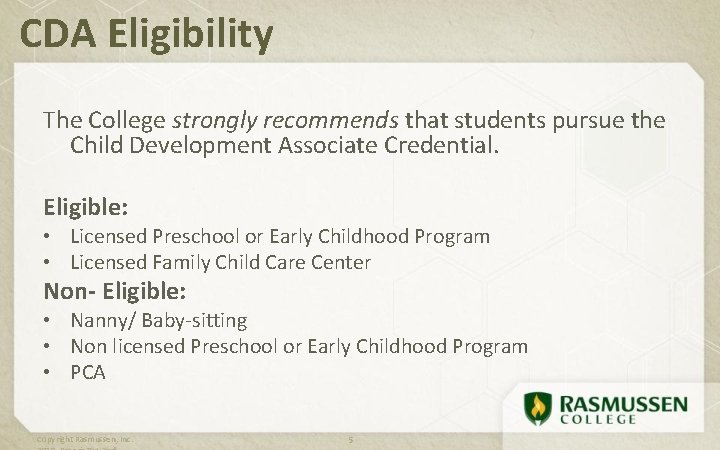
CDA Eligibility The College strongly recommends that students pursue the Child Development Associate Credential. Eligible: • Licensed Preschool or Early Childhood Program • Licensed Family Child Care Center Non- Eligible: • Nanny/ Baby-sitting • Non licensed Preschool or Early Childhood Program • PCA Copyright Rasmussen, Inc. 5
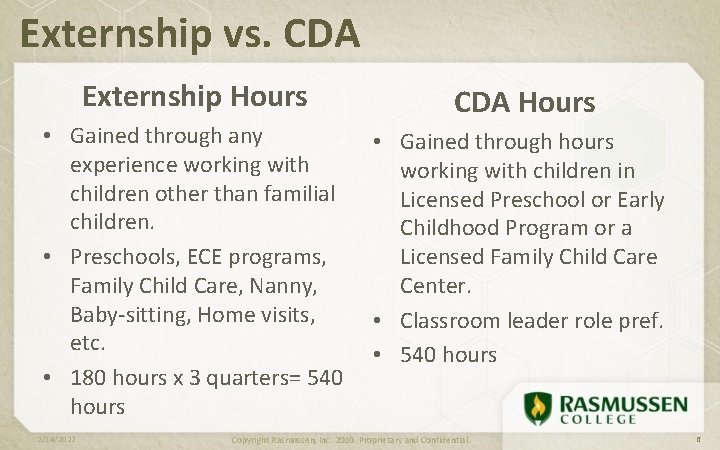
Externship vs. CDA Externship Hours • Gained through any experience working with children other than familial children. • Preschools, ECE programs, Family Child Care, Nanny, Baby-sitting, Home visits, etc. • 180 hours x 3 quarters= 540 hours 2/14/2022 CDA Hours • Gained through hours working with children in Licensed Preschool or Early Childhood Program or a Licensed Family Child Care Center. • Classroom leader role pref. • 540 hours Copyright Rasmussen, Inc. 2010. Proprietary and Confidential. 6
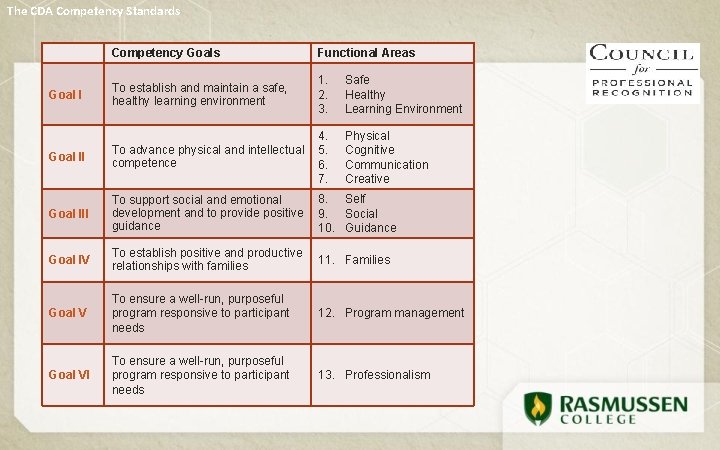
The CDA Competency Standards Competency Goals Functional Areas To establish and maintain a safe, healthy learning environment 1. 2. 3. Safe Healthy Learning Environment Goal II To advance physical and intellectual competence 4. 5. 6. 7. Physical Cognitive Communication Creative Goal III To support social and emotional development and to provide positive guidance 8. Self 9. Social 10. Guidance Goal IV To establish positive and productive relationships with families 11. Families Goal V To ensure a well-run, purposeful program responsive to participant needs 12. Program management Goal VI To ensure a well-run, purposeful program responsive to participant needs 13. Professionalism Goal I
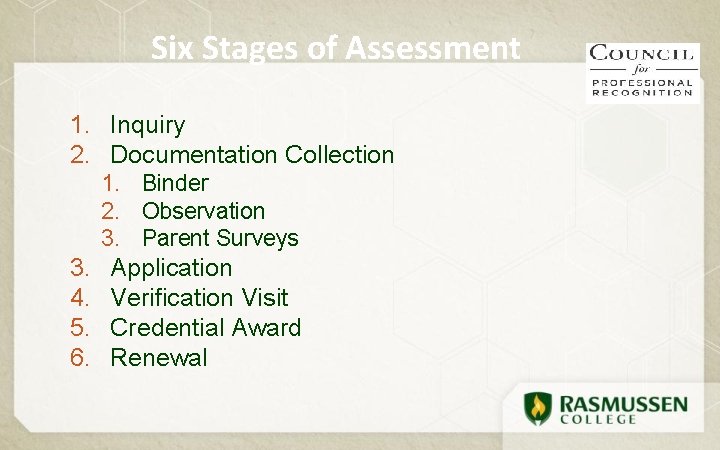
Six Stages of Assessment 1. Inquiry 2. Documentation Collection 1. Binder 2. Observation 3. Parent Surveys 3. 4. 5. 6. Application Verification Visit Credential Award Renewal
Inquiry: CDA Assessment Packet CDA assessment packet? • Selects either: Infant-Toddler, Preschool OR Family Child Care as the site where they will earn their required externship hours for the CDA Assessment. • One time only: Student requests the assessment packet based on student age group selection to be sent with their books. *Students who work in a family child care must secure an Advisor with Family Child Care experience and students outside the 60 mile radius. Copyright Rasmussen, Inc. 9
Inquiry: Setting: Age Categories § Center-based Preschool: 3 – 5 years old § Center-based Infant / Toddler: 0 – 36 months § Family Child Care: 0 – 5 years old
Documentation Collection Documentation Requirements § Professional Resource File ü Autobiography ü Statements of Competence ü Resource Collection § CDA Assessment Observation § Parent Opinion Questionnaires
Documentation Collection • Professional Resource File – Autobiography – Competency Statements 1 -6 – Resource Collection Items 1 -17 • Your collection of these Professional Resource File Items will occur over your course work as graded assignments. Most occur in Core ECE Courses: EC 100, EC 110 and EC 120. Copyright Rasmussen, Inc. 12
CDA Assessment Observation CDA Observation Instrument • Students must have mostly “ 3’s” to be ready to earn their CDA Credential. *Note: if outside the 60 mile radius student will need to find own CDA observer and this also, includes family child care settings. Copyright Rasmussen, Inc. 13
Supplemental Observation 1. Used when Formal Observation does not include all sub-age groups 2. Sub-age groups: § Young Infants 0 -8 months § Mobile Infants 9 -17 months § Toddlers 18 -36 months 3. Must be completed by same Advisor
Parent Opinion Surveys • • Distribute surveys to parents in your program Collect anonymously in a sealed envelope Goal to receive 75% of those distributed Sealed envelopes are then provided to validator at visit. Copyright Rasmussen, Inc. 15
Application • Process: – Application completed with Advisor and Supervisor – Within 30 days of completion of Certificate Req. – Copies of all college transcripts – Fee of $325. 00 paid by college – After receipt in D. C. - 4 -6 weeks Copyright Rasmussen, Inc. 16
Verification Visit • • Professional Resource File review Early Childhood Studies Exam Early Childhood Studies Interview Copies of Autobiography, Competency Statements, Observation, Parent Surveys go to Council. Copyright Rasmussen, Inc. 17
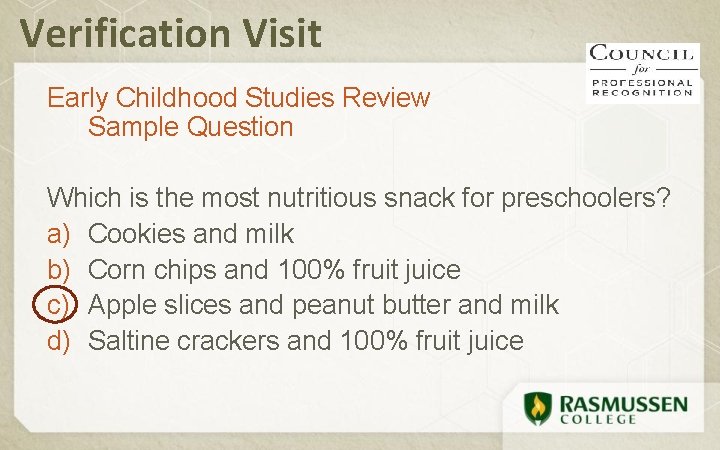
Verification Visit Early Childhood Studies Review Sample Question Which is the most nutritious snack for preschoolers? a) Cookies and milk b) Corn chips and 100% fruit juice c) Apple slices and peanut butter and milk d) Saltine crackers and 100% fruit juice
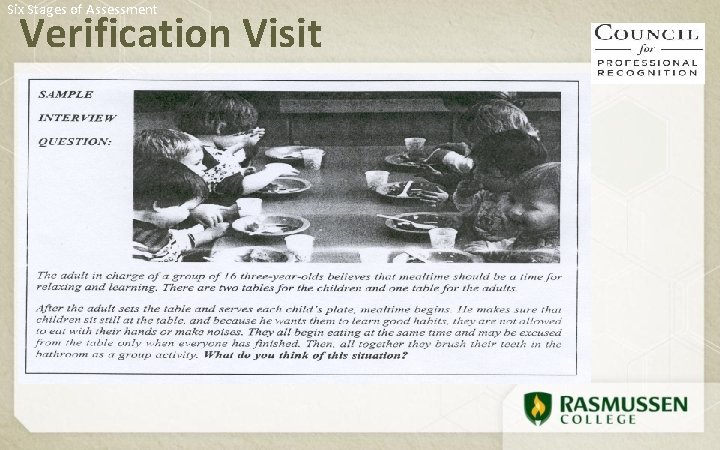
Six Stages of Assessment Verification Visit
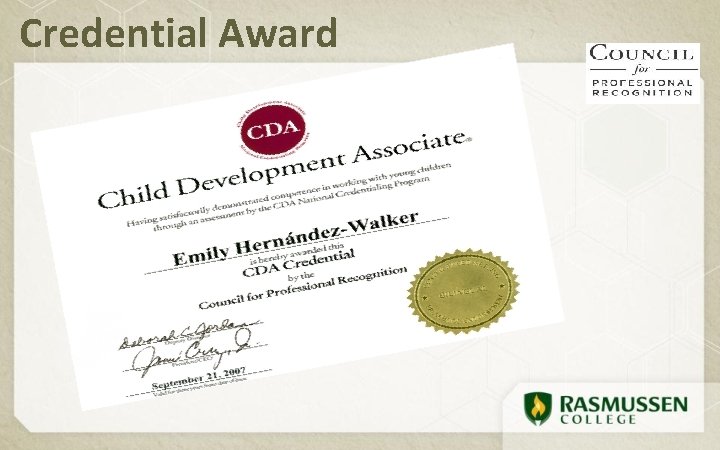
Credential Award
Credential Renewal – requirements § Current First Aid § 80 Hours of Experience With Children § 4. 5 CEUs or 3 College Credits § Letter of Recommendation § Membership
For Questions… Please contact your ECE Program Coordinator or Campus Advisor Copyright Rasmussen, Inc. 2011. Proprietary and Confidential.
- Slides: 22