
School of Computer and Communication Sciences September 15
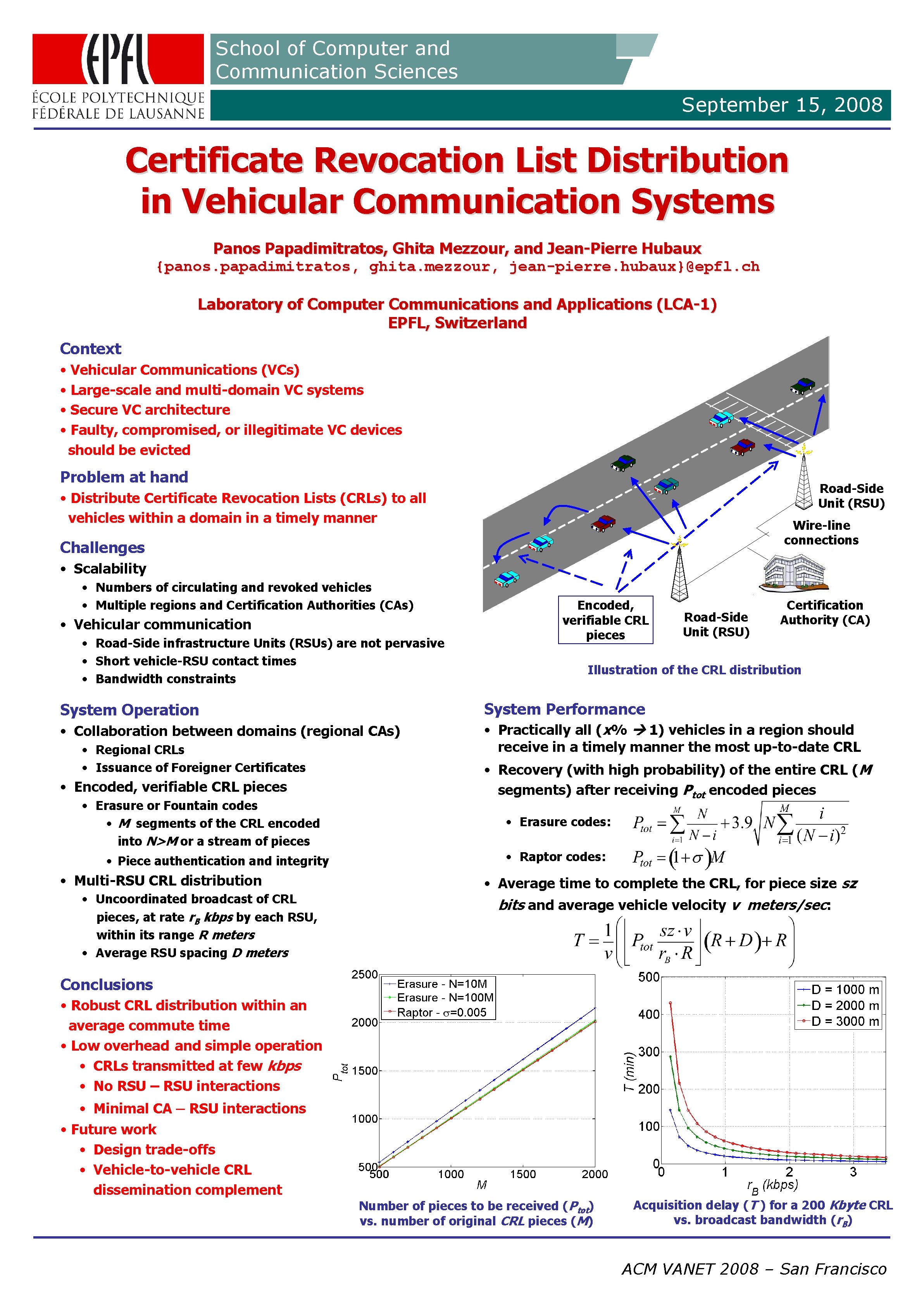
School of Computer and Communication Sciences September 15, 2008 Certificate Revocation List Distribution in Vehicular Communication Systems Panos Papadimitratos, Ghita Mezzour, and Jean-Pierre Hubaux {panos. papadimitratos, ghita. mezzour, jean-pierre. hubaux}@epfl. ch Laboratory of Computer Communications and Applications (LCA-1) EPFL, Switzerland Context • Vehicular Communications (VCs) • Large-scale and multi-domain VC systems • Secure VC architecture • Faulty, compromised, or illegitimate VC devices should be evicted Problem at hand Road-Side Unit (RSU) • Distribute Certificate Revocation Lists (CRLs) to all vehicles within a domain in a timely manner Wire-line connections Challenges • Scalability • Numbers of circulating and revoked vehicles • Multiple regions and Certification Authorities (CAs) • Vehicular communication • Road-Side infrastructure Units (RSUs) are not pervasive • Short vehicle-RSU contact times • Bandwidth constraints System Operation • Collaboration between domains (regional CAs) • Regional CRLs • Issuance of Foreigner Certificates • Encoded, verifiable CRL pieces • Erasure or Fountain codes • M segments of the CRL encoded into N>M or a stream of pieces • Piece authentication and integrity • Multi-RSU CRL distribution • Uncoordinated broadcast of CRL pieces, at rate r. B kbps by each RSU, within its range R meters • Average RSU spacing D meters Encoded, verifiable CRL pieces Road-Side Unit (RSU) Certification Authority (CA) Illustration of the CRL distribution System Performance • Practically all (x% 1) vehicles in a region should receive in a timely manner the most up-to-date CRL • Recovery (with high probability) of the entire CRL (M segments) after receiving Ptot encoded pieces • Erasure codes: • Raptor codes: • Average time to complete the CRL, for piece size sz bits and average vehicle velocity v meters/sec: Conclusions • Robust CRL distribution within an average commute time • Low overhead and simple operation • CRLs transmitted at few kbps • No RSU – RSU interactions • Minimal CA – RSU interactions • Future work • Design trade-offs • Vehicle-to-vehicle CRL dissemination complement Number of pieces to be received (Ptot) vs. number of original CRL pieces (M) Acquisition delay (T ) for a 200 Kbyte CRL vs. broadcast bandwidth (r. B) ACM VANET 2008 – San Francisco
- Slides: 1