
School of Bioresources and Technology King Mongkuts University
������� �� �������� School of Bioresources and Technology King Mongkut’s University of Technology Thonburi , Bangkok
Introduction Aromatic and medicinal plants are important for pharmaceutical, food and fragrance industries although they contain a small fraction of volatile oil. Essential oils are interested in aromatherapy for healing, cleansing, preservative, and mood-elevating attributes.
Essential oils refer to the subtle, aromatic and volatile liquids extracted from the flowers, seeds, leaves, stems, bark and roots of herbs, bushes, shrubs and trees. Chemically, in the essential oils that can derived to primarily composed of mono- and sesquiterpenes and aromatic etc.
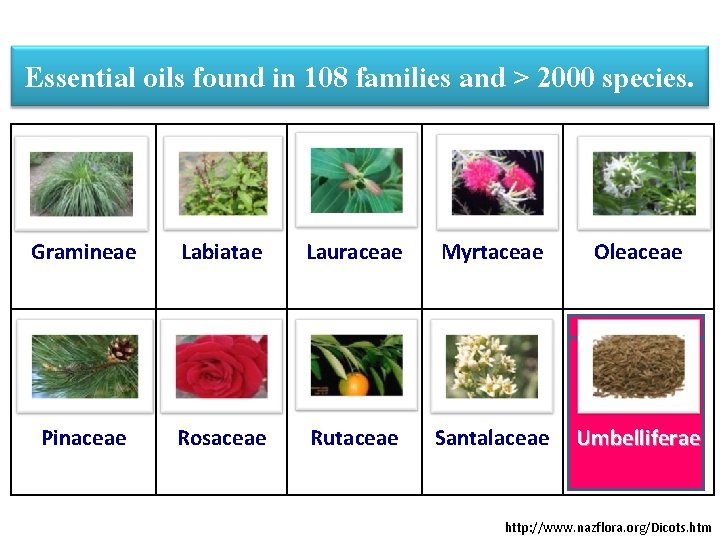
Essential oils found in 108 families and > 2000 species. Gramineae Labiatae Lauraceae Myrtaceae Oleaceae Pinaceae Rosaceae Rutaceae Santalaceae Umbelliferae http: //www. nazflora. org/Dicots. htm
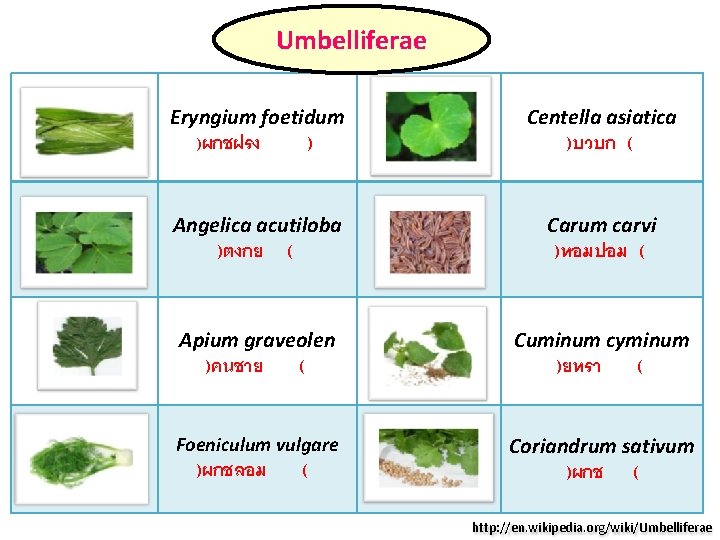
Umbelliferae Eryngium foetidum )ผกชฝรง ) Centella asiatica Angelica acutiloba Carum carvi Apium graveolen Cuminum cyminum Foeniculum vulgare Coriandrum sativum )ตงกย ( )คนชาย )ผกชลอม ( ( )บวบก ( )หอมปอม ( )ยหรา )ผกช ( ( http: //en. wikipedia. org/wiki/Umbelliferae
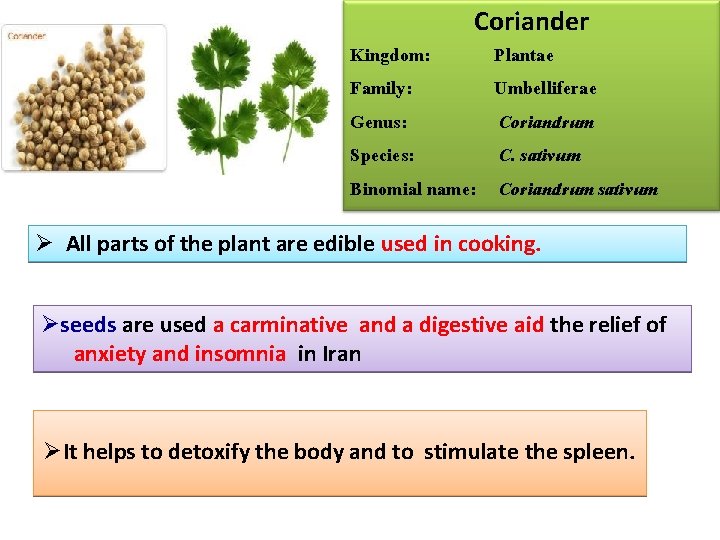
Coriander Kingdom: Plantae Family: Umbelliferae Genus: Coriandrum Species: C. sativum Binomial name: Coriandrum sativum Ø All parts of the plant are edible used in cooking. Øseeds are used a carminative and a digestive aid the relief of anxiety and insomnia in Iran ØIt helps to detoxify the body and to stimulate the spleen.
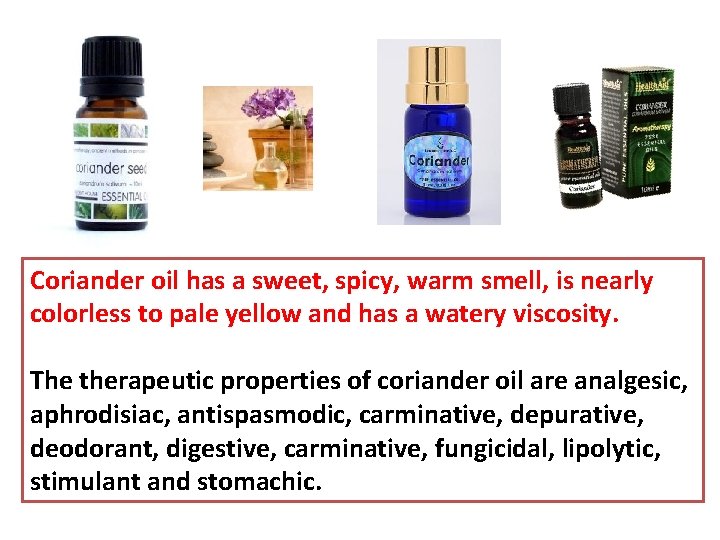
Coriander oil has a sweet, spicy, warm smell, is nearly colorless to pale yellow and has a watery viscosity. The therapeutic properties of coriander oil are analgesic, aphrodisiac, antispasmodic, carminative, depurative, deodorant, digestive, carminative, fungicidal, lipolytic, stimulant and stomachic.
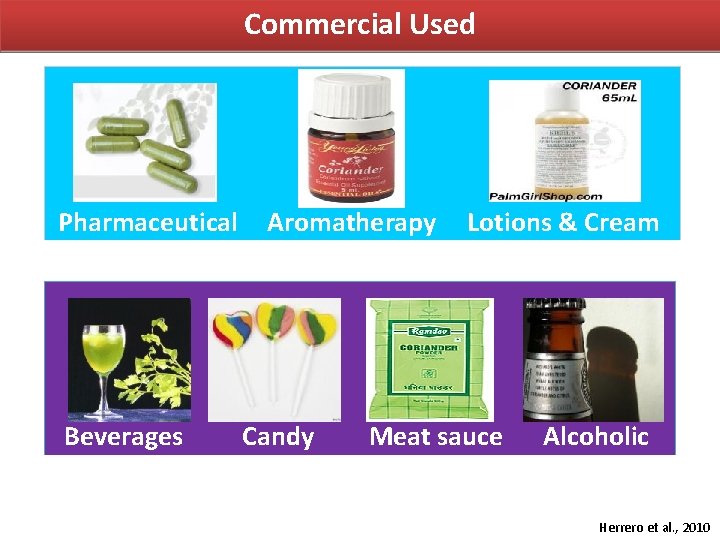
Commercial Used Pharmaceutical Beverages Aromatherapy Candy Lotions & Cream Meat sauce Alcoholic Herrero et al. , 2010
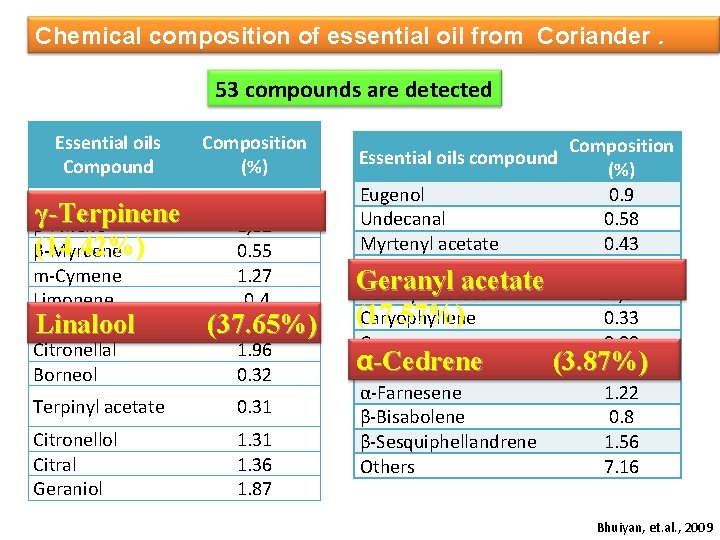
Chemical composition of essential oil from Coriander. 53 compounds are detected Essential oils Compound Composition (%) γ-Terpinene 14, 42 γ-Terpinene 1, 82 β-Pinene (14. 42%) β-Myrcene 0. 55 m-Cymene 1. 27 Limonene. 0. 4 Linalool 37, 65 Linalool (37. 65%) Citronellal 1. 96 Borneol 0. 32 Terpinyl acetate 0. 31 Citronellol Citral Geraniol 1. 31 1. 36 1. 87 Composition (%) Eugenol 0. 9 Undecanal 0. 58 Myrtenyl acetate 0. 43 Citronellyl acetate 1, 36 Geranyl acetate 17, 57 (17. 57%) Caryophyllene 0. 33 Curcumene 0. 98 αα-Cedrene (3. 87%) 3, 87 α-Farnesene 1. 22 β-Bisabolene 0. 8 β-Sesquiphellandrene 1. 56 Others 7. 16 Essential oils compound Bhuiyan, et. al. , 2009
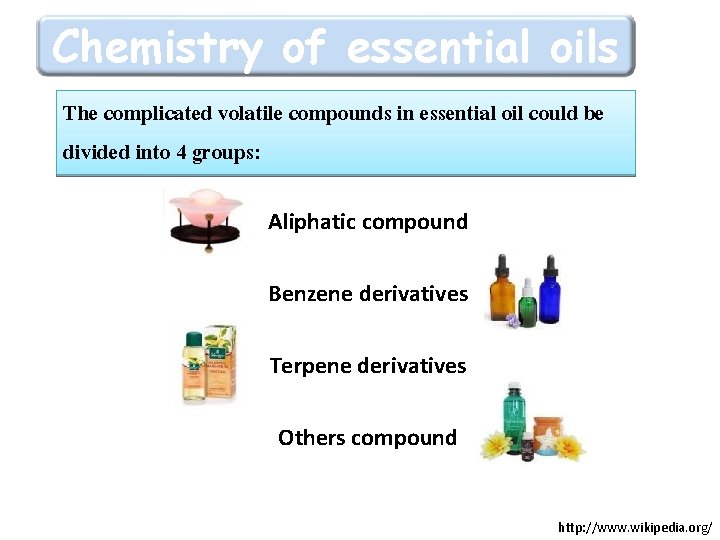
Chemistry of essential oils The complicated volatile compounds in essential oil could be divided into 4 groups: Aliphatic compound Benzene derivatives Terpene derivatives Others compound http: //www. wikipedia. org/
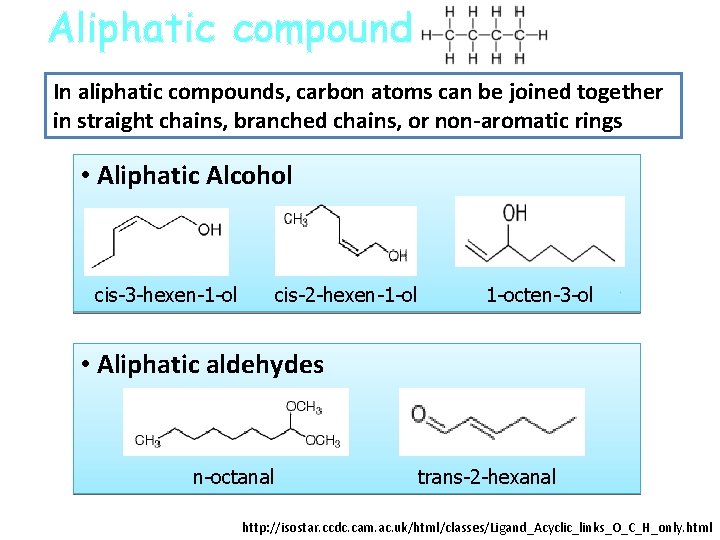
Aliphatic compound In aliphatic compounds, carbon atoms can be joined together in straight chains, branched chains, or non-aromatic rings • Aliphatic Alcohol cis-3 -hexen-1 -ol cis-2 -hexen-1 -ol 1 -octen-3 -ol • Aliphatic aldehydes n-octanal trans-2 -hexanal http: //isostar. ccdc. cam. ac. uk/html/classes/Ligand_Acyclic_links_O_C_H_only. html
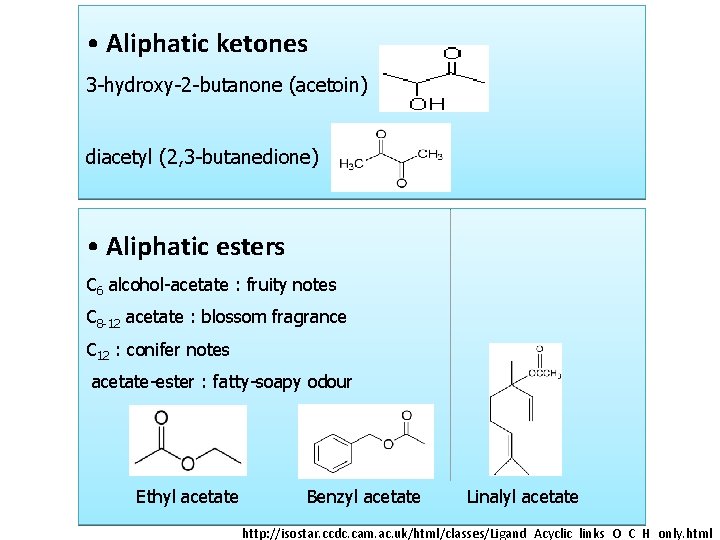
• Aliphatic ketones 3 -hydroxy-2 -butanone (acetoin) diacetyl (2, 3 -butanedione) • Aliphatic esters C 6 alcohol-acetate : fruity notes C 8 -12 acetate : blossom fragrance C 12 : conifer notes acetate-ester : fatty-soapy odour Ethyl acetate Benzyl acetate Linalyl acetate http: //isostar. ccdc. cam. ac. uk/html/classes/Ligand_Acyclic_links_O_C_H_only. html
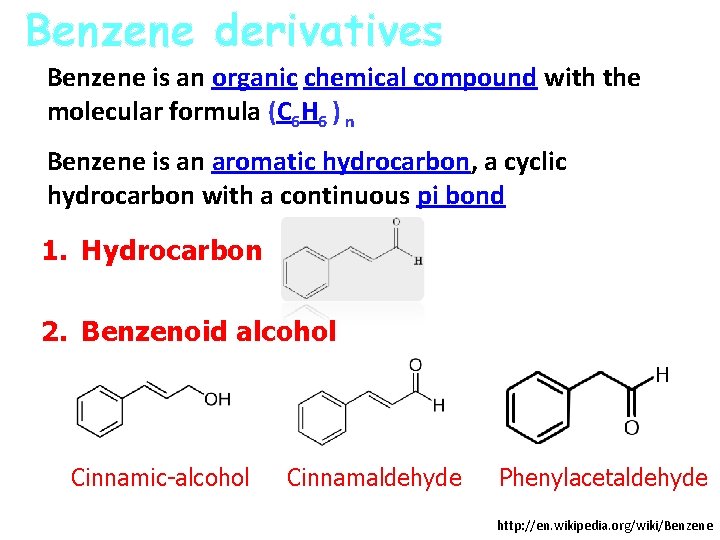
Benzene derivatives Benzene is an organic chemical compound with the molecular formula (C 6 H 6 ) n Benzene is an aromatic hydrocarbon, a cyclic hydrocarbon with a continuous pi bond 1. Hydrocarbon 2. Benzenoid alcohol Cinnamic-alcohol Cinnamaldehyde Phenylacetaldehyde http: //en. wikipedia. org/wiki/Benzene
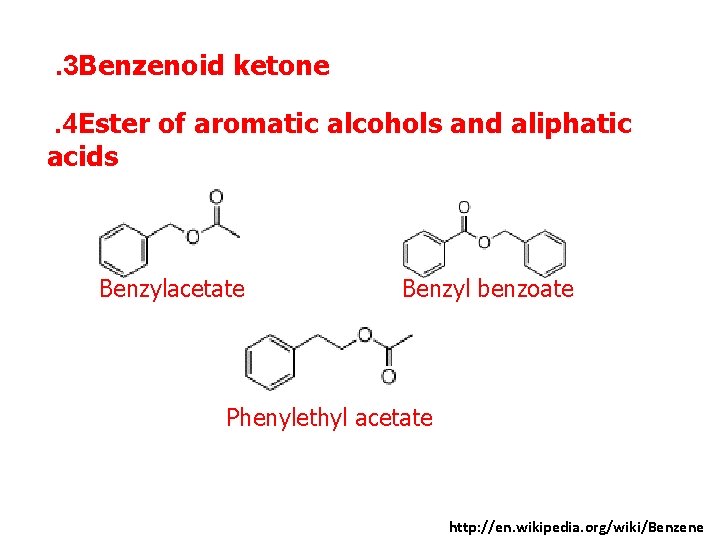
. 3 Benzenoid ketone. 4 Ester of aromatic alcohols and aliphatic acids Benzylacetate Benzyl benzoate Phenylethyl acetate http: //en. wikipedia. org/wiki/Benzene
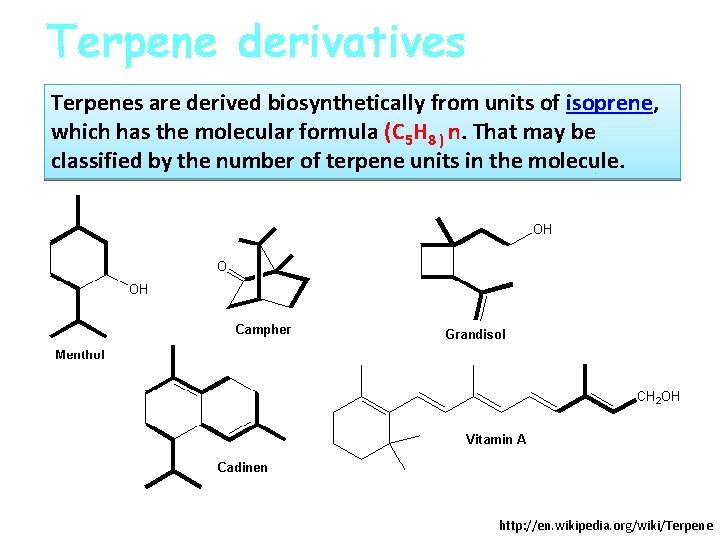
Terpene derivatives Terpenes are derived biosynthetically from units of isoprene, which has the molecular formula (C 5 H 8 ) n. That may be classified by the number of terpene units in the molecule. http: //en. wikipedia. org/wiki/Terpene
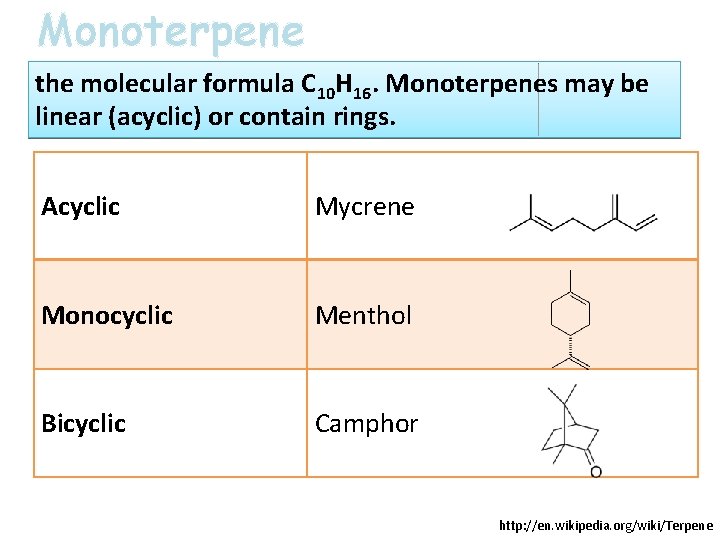
Monoterpene the molecular formula C 10 H 16. Monoterpenes may be linear (acyclic) or contain rings. Acyclic Mycrene Monocyclic Menthol Bicyclic Camphor http: //en. wikipedia. org/wiki/Terpene

Sesquiterpenes The molecular formula C 15 H 24. Like monoterpenes, sesquiterpenes may be acyclic or contain rings, including many unique combinations. Acyclic Monocyclic Bicyclic Tricyclic Farnesene Humulene Vetivazulene Longifolene http: //en. wikipedia. org/wiki/Terpene
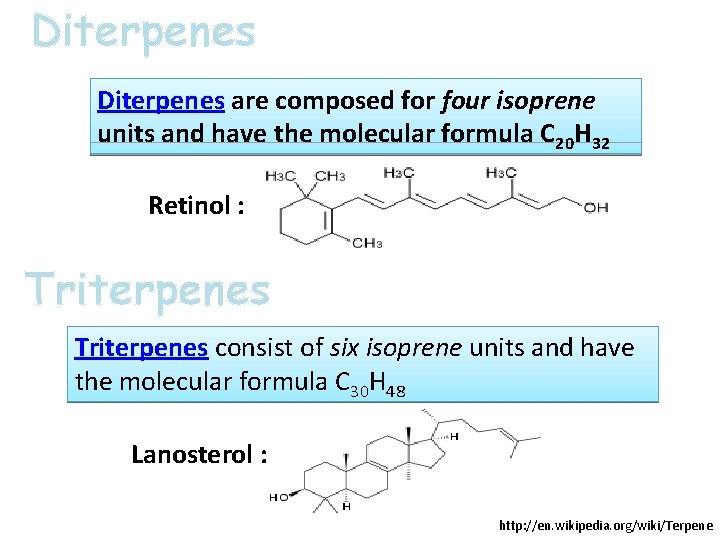
Diterpenes are composed for four isoprene units and have the molecular formula C 20 H 32 Retinol : Triterpenes consist of six isoprene units and have the molecular formula C 30 H 48 Lanosterol : http: //en. wikipedia. org/wiki/Terpene
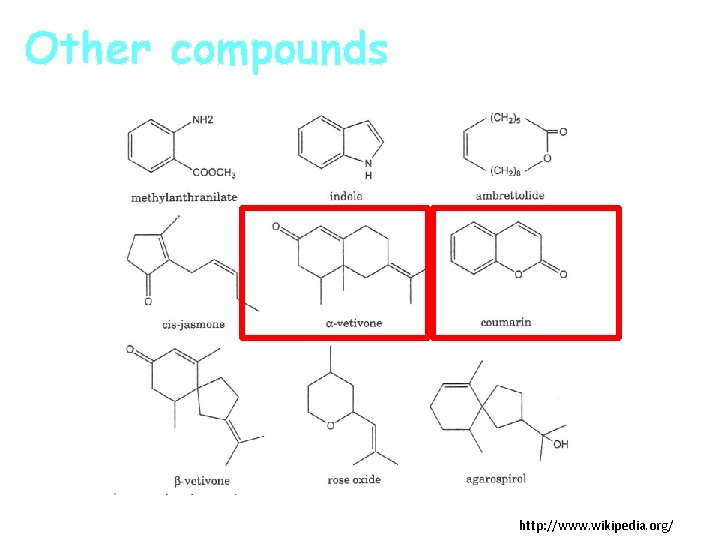
Other compounds http: //www. wikipedia. org/
The volatile oil composition may change from the natural odor depending on the extraction method (Anitescu et al, 1997).
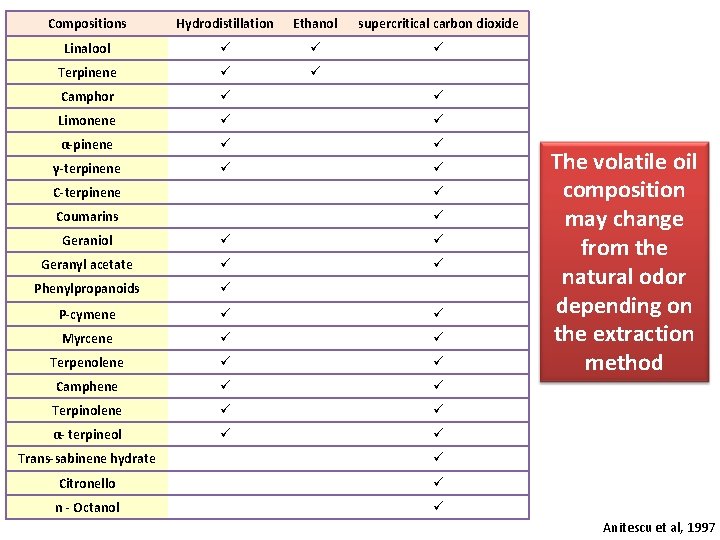
Compositions Hydrodistillation Ethanol supercritical carbon dioxide Linalool ü ü ü Terpinene ü ü Camphor ü ü Limonene ü ü α-pinene ü ü γ-terpinene ü ü C-terpinene ü Coumarins ü Geraniol ü ü Geranyl acetate ü ü Phenylpropanoids ü P-cymene ü ü Myrcene ü ü Terpenolene ü ü Camphene ü ü Terpinolene ü ü α- terpineol ü ü Trans-sabinene hydrate ü Citronello ü n - Octanol ü The volatile oil composition may change from the natural odor depending on the extraction method Anitescu et al, 1997
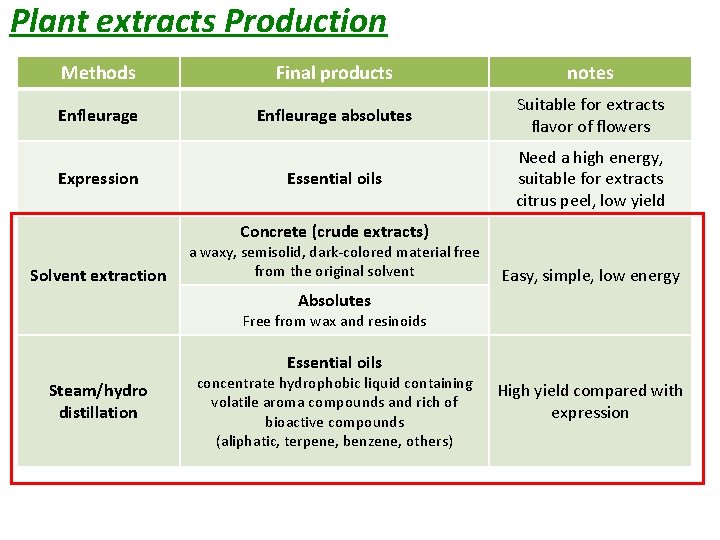
Plant extracts Production Methods Final products notes Enfleurage absolutes Suitable for extracts flavor of flowers Essential oils Need a high energy, suitable for extracts citrus peel, low yield Expression Concrete (crude extracts) Solvent extraction a waxy, semisolid, dark-colored material free from the original solvent Easy, simple, low energy Absolutes Free from wax and resinoids Essential oils Steam/hydro distillation concentrate hydrophobic liquid containing volatile aroma compounds and rich of bioactive compounds (aliphatic, terpene, benzene, others) High yield compared with expression
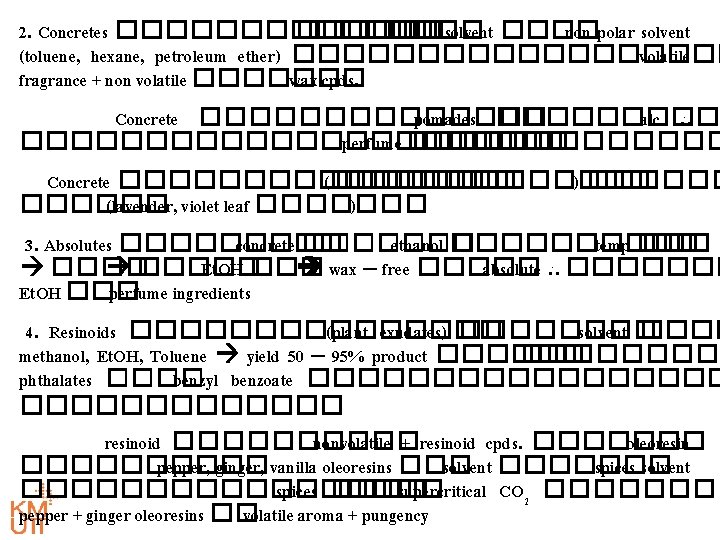
2. Concretes ������� solvent ���� non polar solvent (toluene, hexane, petroleum ether) ��������� volatile fragrance + non volatile ������� wax cpds. Concrete ������� pomades ����� alc. . . ����������� perfume ������� Concrete �������� (������� ) ������ (lavender, violet leaf ������� ) 3. Absolutes ����� concrete ������� ethanol ����� temp ����� Et. OH ��� wax – free ����� absolute. . . ������� Et. OH ��� perfume ingredients 4. Resinoids �������� (plant exudates) ���� solvent ���� methanol, Et. OH, Toluene yield 50 – 95% product ��������� phthalates ���� benzyl benzoate ��������� resinoid ����� nonvolatile + resinoid cpds. ������� oleoresin ����� pepper, ginger, vanilla oleoresins ��� solvent ������� spices solvent ��������� spices ���� supercritical CO 2 ���� pepper + ginger oleoresins �� volatile aroma + pungency
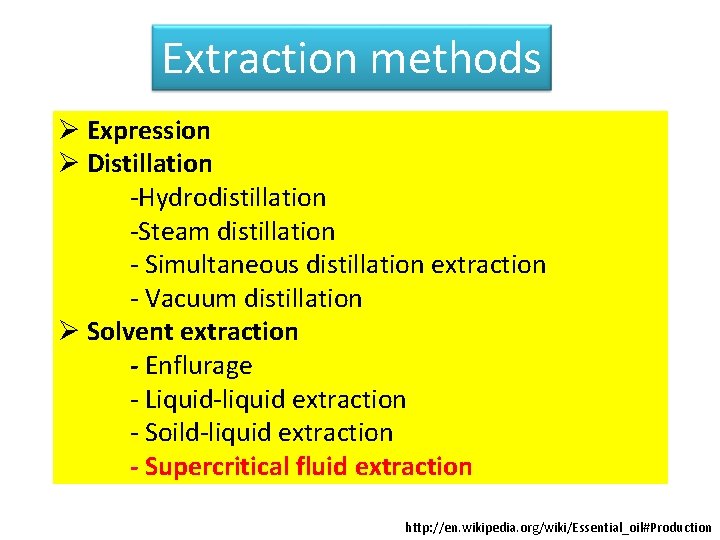
Extraction methods Ø Expression Ø Distillation -Hydrodistillation -Steam distillation - Simultaneous distillation extraction - Vacuum distillation Ø Solvent extraction - Enflurage - Liquid-liquid extraction - Soild-liquid extraction - Supercritical fluid extraction http: //en. wikipedia. org/wiki/Essential_oil#Production
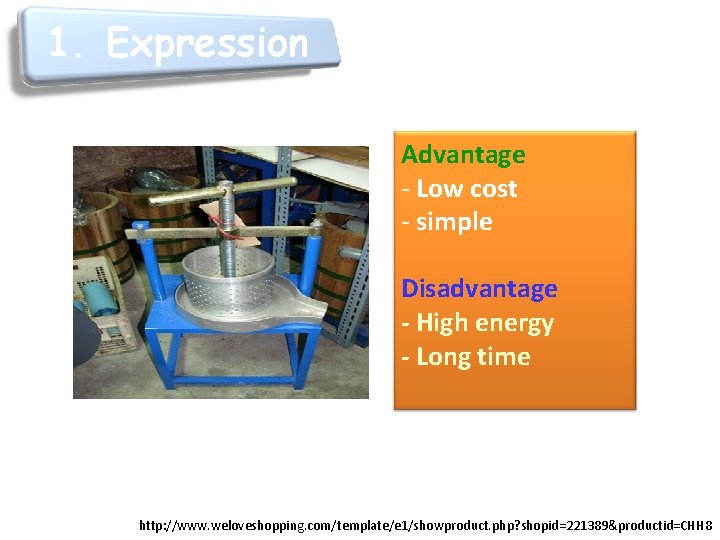
1. Expression Advantage - Low cost - simple Disadvantage - High energy - Long time http: //www. weloveshopping. com/template/e 1/showproduct. php? shopid=221389&productid=CHH 8
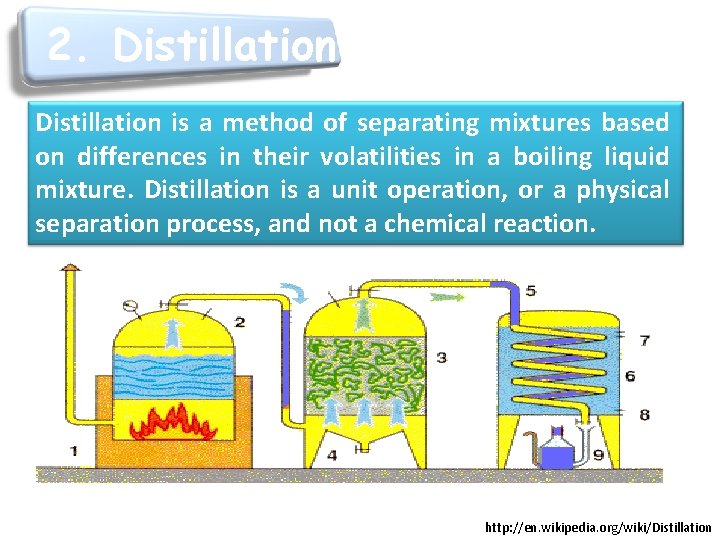
2. Distillation is a method of separating mixtures based on differences in their volatilities in a boiling liquid mixture. Distillation is a unit operation, or a physical separation process, and not a chemical reaction. http: //en. wikipedia. org/wiki/Distillation
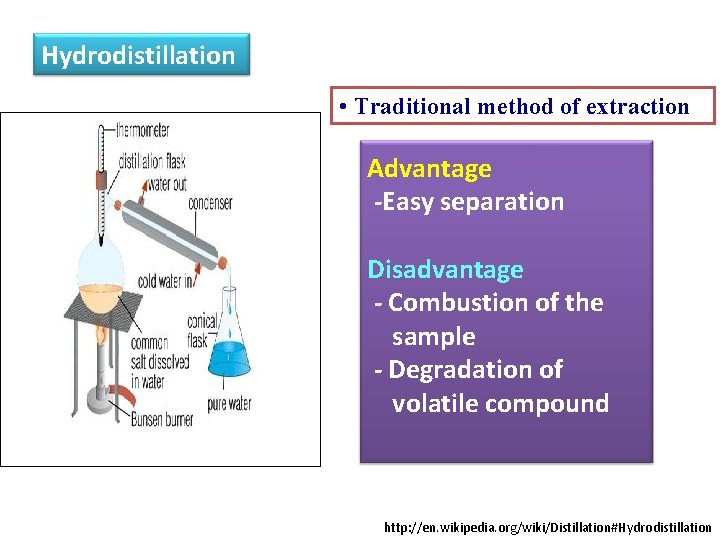
Hydrodistillation • Traditional method of extraction Advantage -Easy separation Disadvantage - Combustion of the sample - Degradation of volatile compound http: //en. wikipedia. org/wiki/Distillation#Hydrodistillation
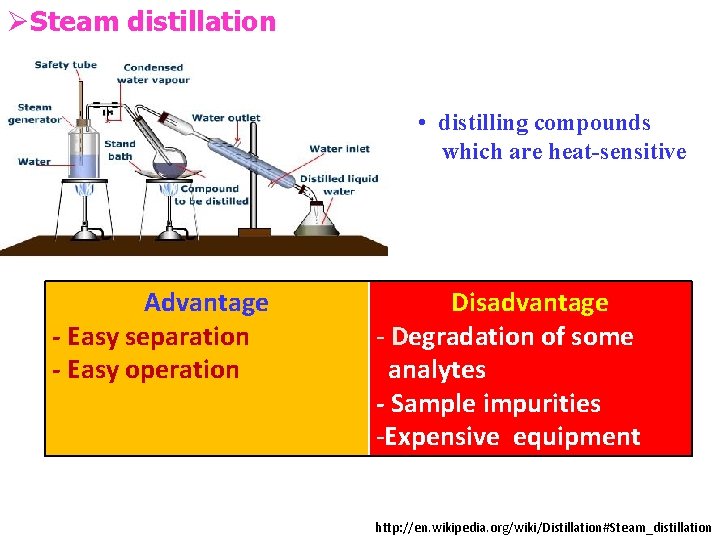
ØSteam distillation • distilling compounds which are heat-sensitive Advantage - Easy separation - Easy operation Disadvantage - Degradation of some analytes - Sample impurities -Expensive equipment http: //en. wikipedia. org/wiki/Distillation#Steam_distillation
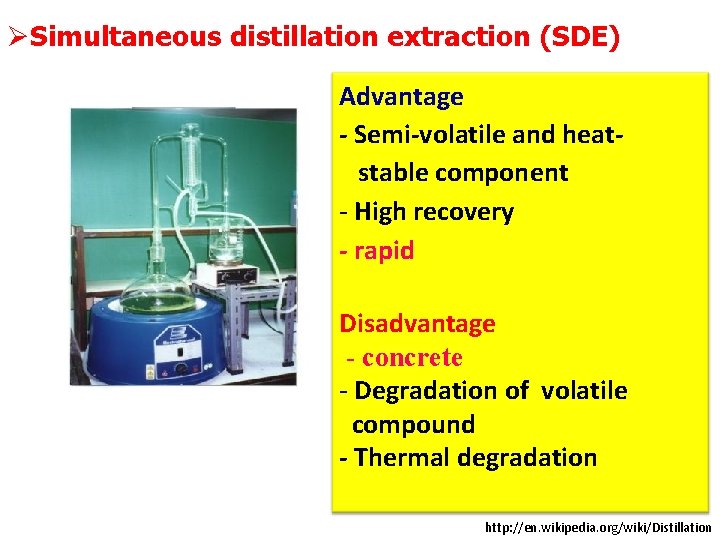
ØSimultaneous distillation extraction (SDE) Advantage - Semi-volatile and heatstable component - High recovery - rapid Disadvantage - concrete - Degradation of volatile compound - Thermal degradation http: //en. wikipedia. org/wiki/Distillation
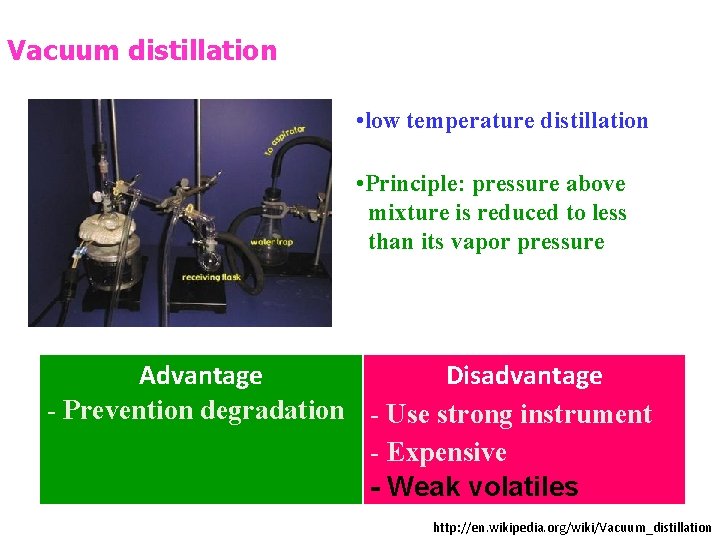
Vacuum distillation • low temperature distillation • Principle: pressure above mixture is reduced to less than its vapor pressure Advantage Disadvantage - Prevention degradation - Use strong instrument - Expensive - Weak volatiles http: //en. wikipedia. org/wiki/Vacuum_distillation
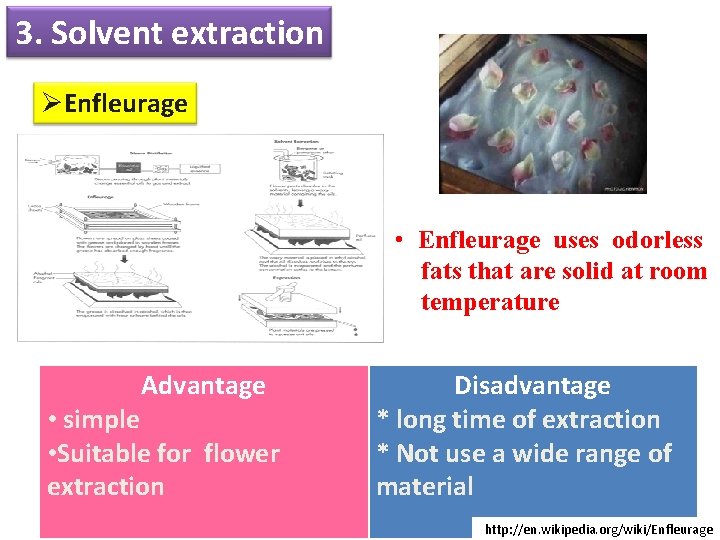
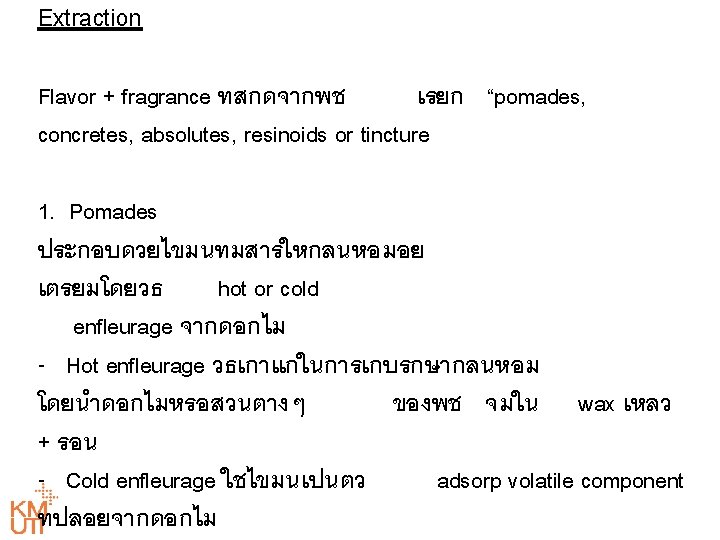
3. Solvent extraction ØEnfleurage • Enfleurage uses odorless fats that are solid at room temperature Advantage • simple • Suitable for flower extraction Disadvantage * long time of extraction * Not use a wide range of material http: //en. wikipedia. org/wiki/Enfleurage
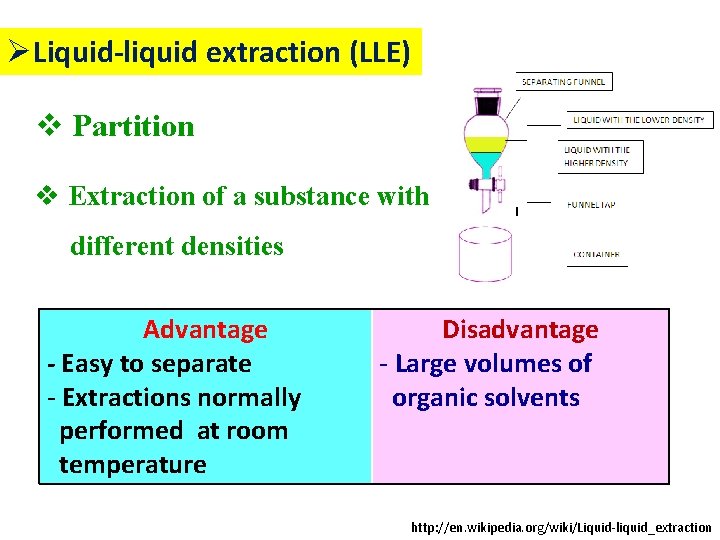
ØLiquid-liquid extraction (LLE) v Partition v Extraction of a substance with different densities Advantage - Easy to separate - Extractions normally performed at room temperature Disadvantage - Large volumes of organic solvents http: //en. wikipedia. org/wiki/Liquid-liquid_extraction
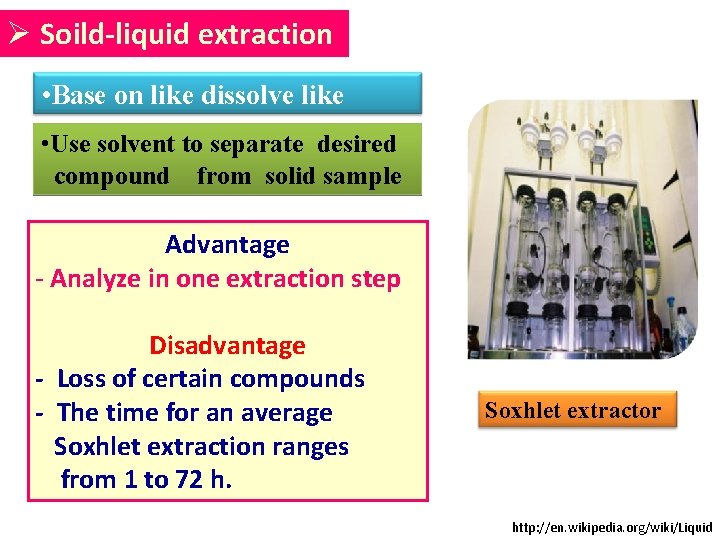
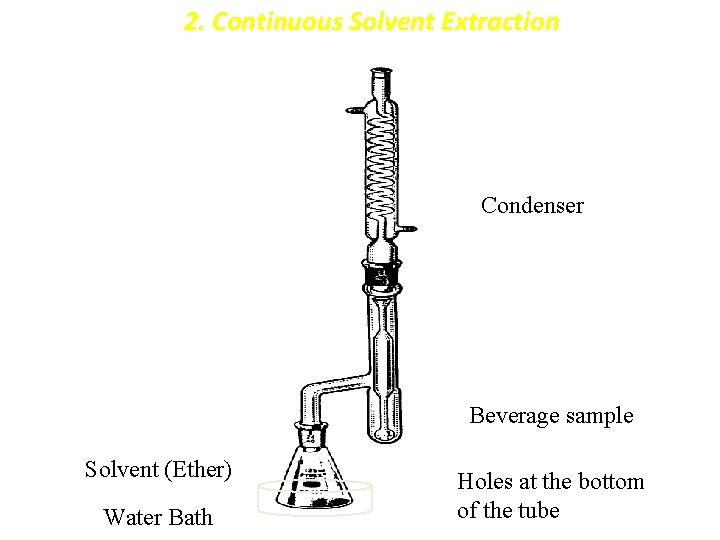
Ø Soild-liquid extraction • Base on like dissolve like • Use solvent to separate desired compound from solid sample Advantage - Analyze in one extraction step Disadvantage - Loss of certain compounds - The time for an average Soxhlet extraction ranges from 1 to 72 h. Soxhlet extractor http: //en. wikipedia. org/wiki/Liquid
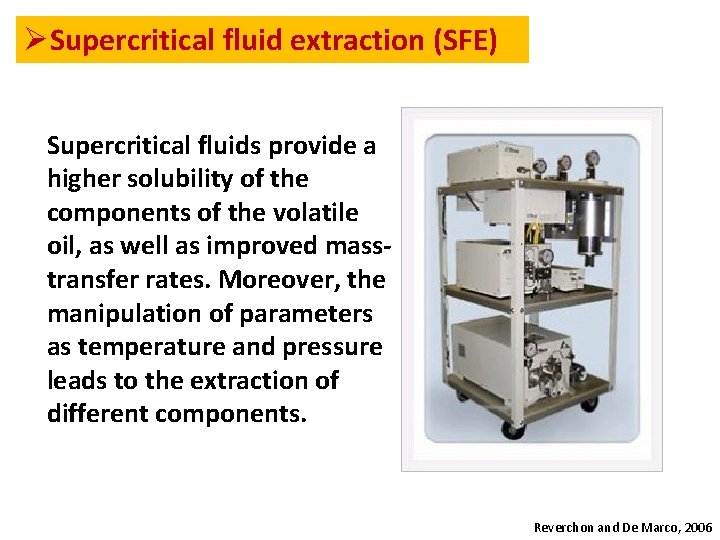
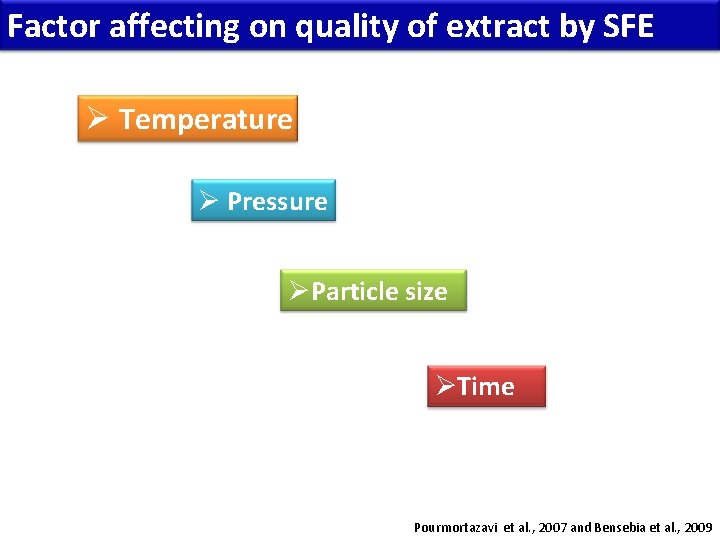
ØSupercritical fluid extraction (SFE) Supercritical fluids provide a higher solubility of the components of the volatile oil, as well as improved masstransfer rates. Moreover, the manipulation of parameters as temperature and pressure leads to the extraction of different components. Reverchon and De Marco, 2006
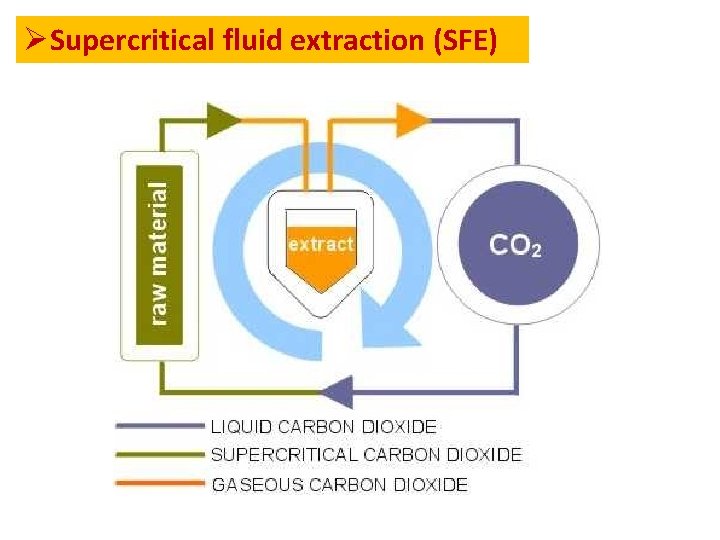
ØSupercritical fluid extraction (SFE)
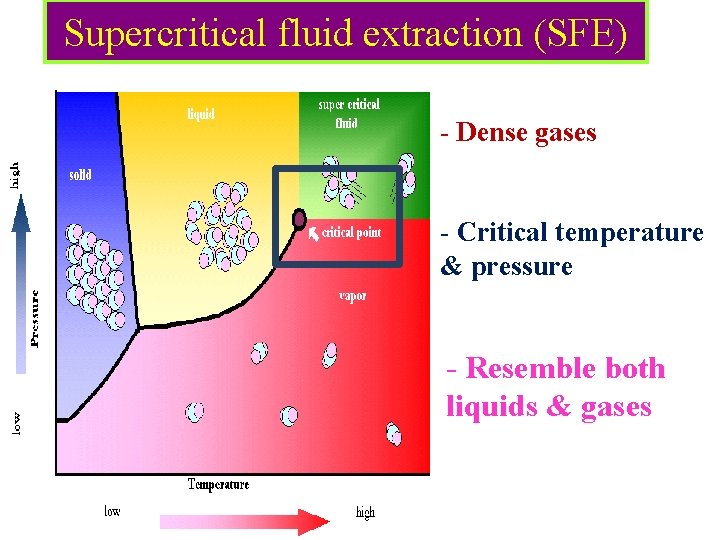
Supercritical fluid extraction (SFE) - Dense gases - Critical temperature & pressure - Resemble both liquids & gases
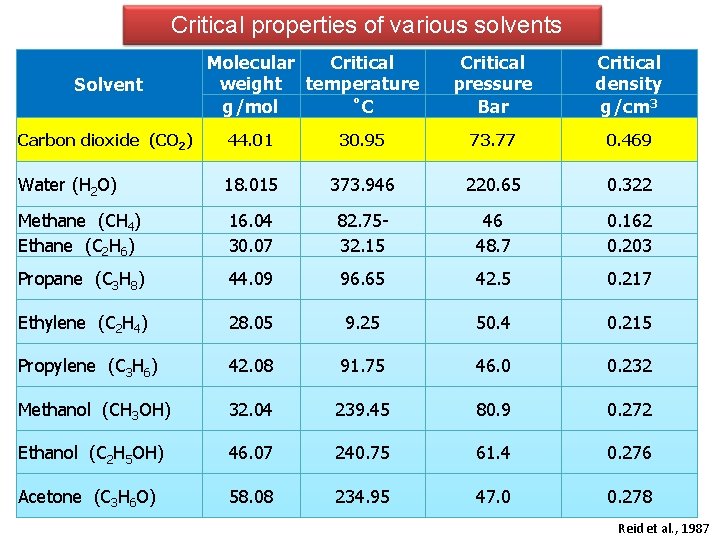
Critical properties of various solvents Solvent Molecular Critical weight temperature g/mol ˚C Critical pressure Bar Critical density g/cm 3 Carbon dioxide (CO 2) 44. 01 30. 95 73. 77 0. 469 Water (H 2 O) 18. 015 373. 946 220. 65 0. 322 Methane (CH 4) Ethane (C 2 H 6) 16. 04 30. 07 82. 7532. 15 46 48. 7 0. 162 0. 203 Propane (C 3 H 8) 44. 09 96. 65 42. 5 0. 217 Ethylene (C 2 H 4) 28. 05 9. 25 50. 4 0. 215 Propylene (C 3 H 6) 42. 08 91. 75 46. 0 0. 232 Methanol (CH 3 OH) 32. 04 239. 45 80. 9 0. 272 Ethanol (C 2 H 5 OH) 46. 07 240. 75 61. 4 0. 276 Acetone (C 3 H 6 O) 58. 08 234. 95 47. 0 0. 278 Reid et al. , 1987
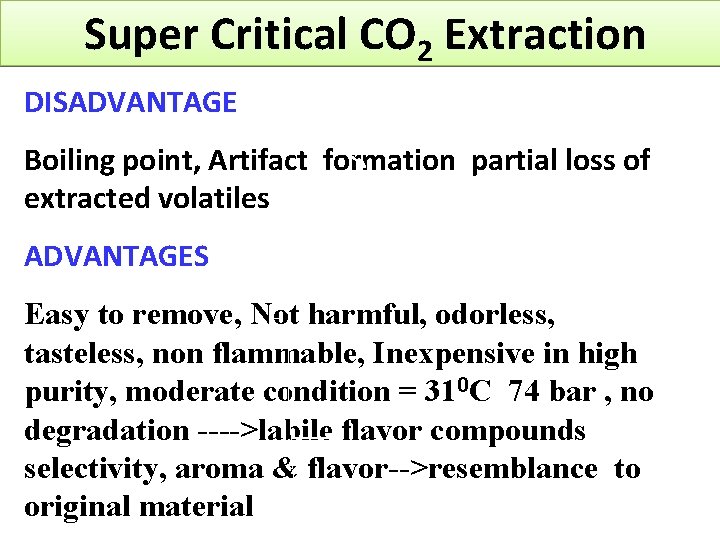
Super Critical CO 2 Extraction DISADVANTAGE Boiling point, Artifact formation partial loss of extracted volatiles ADVANTAGES Easy to remove, Not harmful, odorless, tasteless, non flammable, Inexpensive in high purity, moderate condition = 310 C 74 bar , no degradation ---->labile flavor compounds selectivity, aroma & flavor-->resemblance to original material
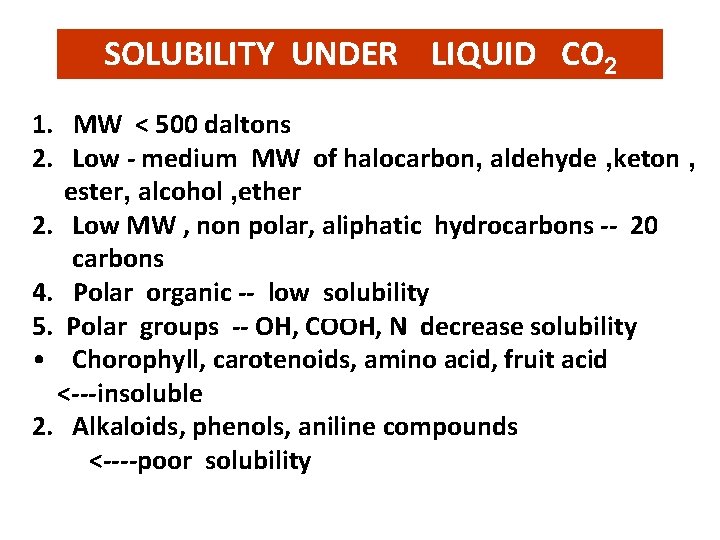
SOLUBILITY UNDER LIQUID CO 2 1. MW < 500 daltons 2. Low - medium MW of halocarbon, aldehyde , keton , ester, alcohol , ether 2. Low MW , non polar, aliphatic hydrocarbons -- 20 carbons 4. Polar organic -- low solubility 5. Polar groups -- OH, COOH, N decrease solubility • Chorophyll, carotenoids, amino acid, fruit acid <---insoluble 2. Alkaloids, phenols, aniline compounds <----poor solubility
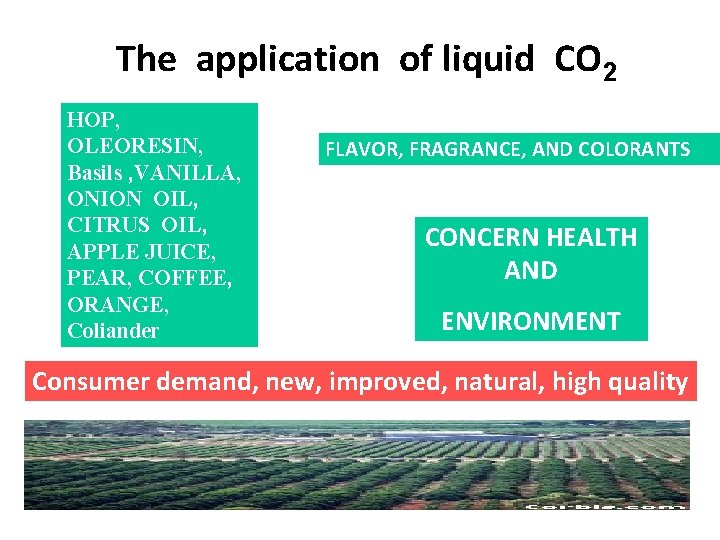
The application of liquid CO 2 HOP, OLEORESIN, Basils , VANILLA, ONION OIL, CITRUS OIL, APPLE JUICE, PEAR, COFFEE, ORANGE, Coliander FLAVOR, FRAGRANCE, AND COLORANTS CONCERN HEALTH AND ENVIRONMENT Consumer demand, new, improved, natural, high quality
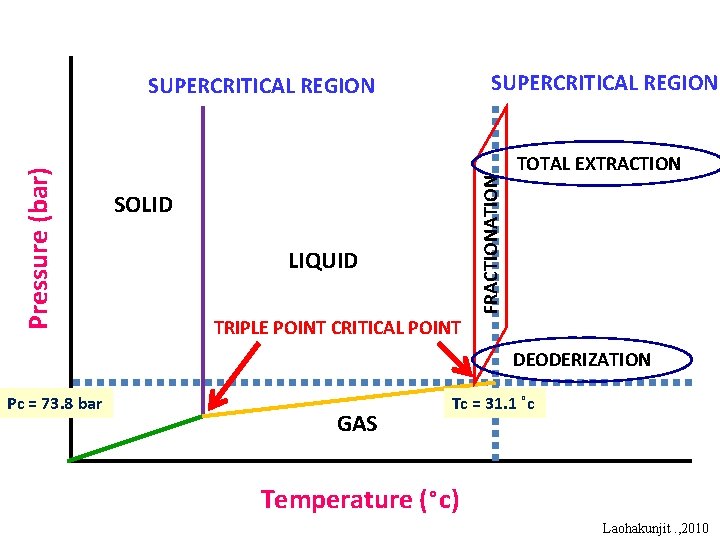
SUPERCRITICAL REGION FRACTIONATION Pressure (bar) SUPERCRITICAL REGION SOLID LIQUID TOTAL EXTRACTION TRIPLE POINT CRITICAL POINT DEODERIZATION Pc = 73. 8 bar GAS Tc = 31. 1 ˚c Temperature (˚c) Laohakunjit. , 2010
Factor affecting on quality of extract by SFE Ø Temperature Ø Pressure ØParticle size ØTime Pourmortazavi et al. , 2007 and Bensebia et al. , 2009
2. Continuous Solvent Extraction Condenser Beverage sample Solvent (Ether) Water Bath Holes at the bottom of the tube
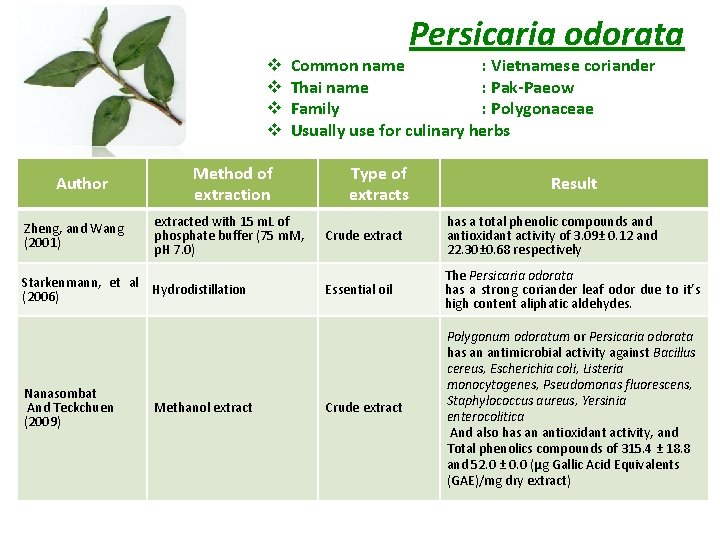
v v Author Zheng, and Wang (2001) Nanasombat And Teckchuen (2009) Common name : Vietnamese coriander Thai name : Pak-Paeow Family : Polygonaceae Usually use for culinary herbs Method of extraction extracted with 15 m. L of phosphate buffer (75 m. M, p. H 7. 0) Starkenmann, et al Hydrodistillation (2006) Methanol extract Persicaria odorata Type of extracts Result Crude extract has a total phenolic compounds and antioxidant activity of 3. 09± 0. 12 and 22. 30± 0. 68 respectively Essential oil The Persicaria odorata has a strong coriander leaf odor due to it’s high content aliphatic aldehydes. Crude extract Polygonum odoratum or Persicaria odorata has an antimicrobial activity against Bacillus cereus, Escherichia coli, Listeria monocytogenes, Pseudomonas fluorescens, Staphylococcus aureus, Yersinia enterocolitica And also has an antioxidant activity, and Total phenolics compounds of 315. 4 ± 18. 8 and 52. 0 ± 0. 0 (µg Gallic Acid Equivalents (GAE)/mg dry extract)
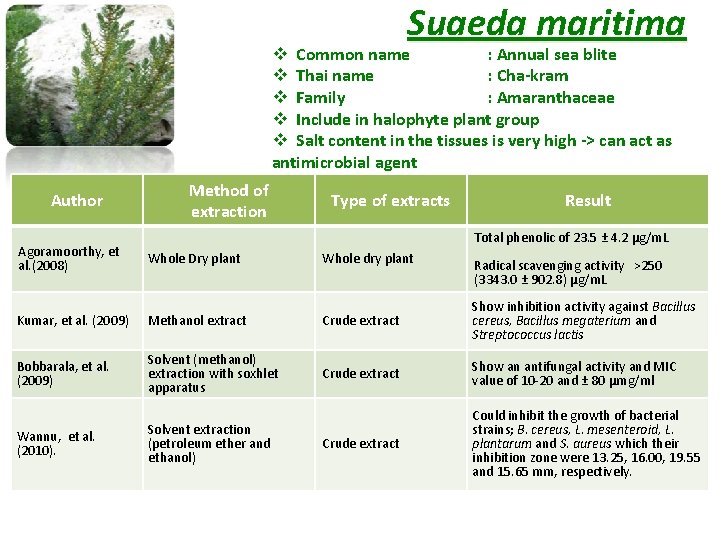
Suaeda maritima v Common name : Annual sea blite v Thai name : Cha-kram v Family : Amaranthaceae v Include in halophyte plant group v Salt content in the tissues is very high -> can act as antimicrobial agent Author Agoramoorthy, et al. (2008) Method of extraction Type of extracts Result Total phenolic of 23. 5 ± 4. 2 µg/m. L Whole Dry plant Whole dry plant Radical scavenging activity >250 (3343. 0 ± 902. 8) µg/m. L Kumar, et al. (2009) Methanol extract Crude extract Show inhibition activity against Bacillus cereus, Bacillus megaterium and Streptococcus lactis Bobbarala, et al. (2009) Solvent (methanol) extraction with soxhlet apparatus Crude extract Show an antifungal activity and MIC value of 10 -20 and ± 80 µmg/ml Wannu, et al. (2010). Solvent extraction (petroleum ether and ethanol) Crude extract Could inhibit the growth of bacterial strains; B. cereus, L. mesenteroid, L. plantarum and S. aureus which their inhibition zone were 13. 25, 16. 00, 19. 55 and 15. 65 mm, respectively.
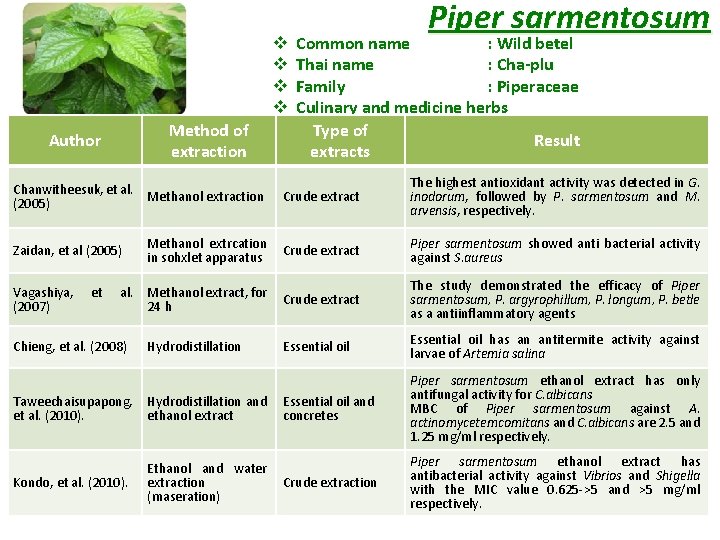
v v Method of extraction Author Piper sarmentosum Common name : Wild betel Thai name : Cha-plu Family : Piperaceae Culinary and medicine herbs Type of Result extracts Chanwitheesuk, et al. Methanol extraction (2005) Crude extract The highest antioxidant activity was detected in G. inodorum, followed by P. sarmentosum and M. arvensis, respectively. Methanol extrcation in sohxlet apparatus Crude extract Piper sarmentosum showed anti bacterial activity against S. aureus al. Methanol extract, for 24 h Crude extract The study demonstrated the efficacy of Piper sarmentosum, P. argyrophillum, P. longum, P. betle as a antiinflammatory agents Essential oil has an antitermite activity against larvae of Artemia salina Essential oil and concretes Piper sarmentosum ethanol extract has only antifungal activity for C. albicans MBC of Piper sarmentosum against A. actinomycetemcomitans and C. albicans are 2. 5 and 1. 25 mg/ml respectively. Crude extraction Piper sarmentosum ethanol extract has antibacterial activity against Vibrios and Shigella with the MIC value 0. 625 ->5 and >5 mg/ml respectively. Zaidan, et al (2005) Vagashiya, (2007) et Chieng, et al. (2008) Hydrodistillation Taweechaisupapong, et al. (2010). Hydrodistillation and ethanol extract Kondo, et al. (2010). Ethanol and water extraction (maseration)
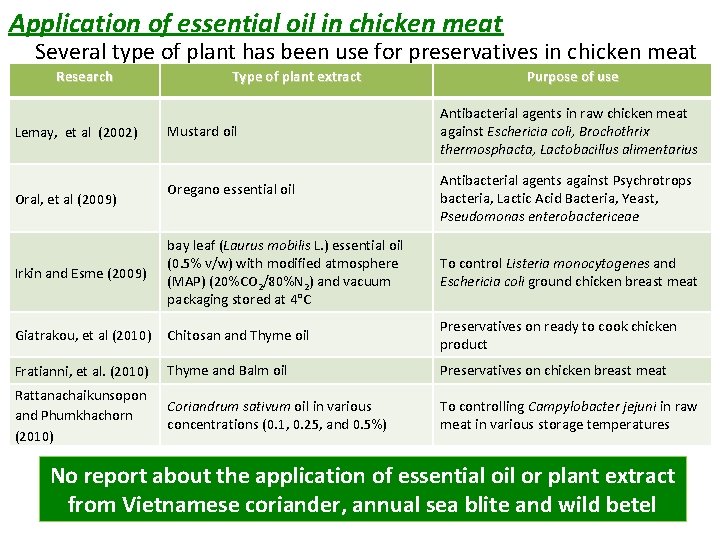
Application of essential oil in chicken meat Several type of plant has been use for preservatives in chicken meat Research Lemay, et al (2002) Oral, et al (2009) Type of plant extract Mustard oil Oregano essential oil Purpose of use Antibacterial agents in raw chicken meat against Eschericia coli, Brochothrix thermosphacta, Lactobacillus alimentarius Antibacterial agents against Psychrotrops bacteria, Lactic Acid Bacteria, Yeast, Pseudomonas enterobactericeae Irkin and Esme (2009) bay leaf (Laurus mobilis L. ) essential oil (0. 5% v/w) with modified atmosphere (MAP) (20%CO 2/80%N 2) and vacuum packaging stored at 4°C To control Listeria monocytogenes and Eschericia coli ground chicken breast meat Giatrakou, et al (2010) Chitosan and Thyme oil Preservatives on ready to cook chicken product Fratianni, et al. (2010) Thyme and Balm oil Preservatives on chicken breast meat Rattanachaikunsopon and Phumkhachorn (2010) Coriandrum sativum oil in various concentrations (0. 1, 0. 25, and 0. 5%) To controlling Campylobacter jejuni in raw meat in various storage temperatures No report about the application of essential oil or plant extract from Vietnamese coriander, annual sea blite and wild betel
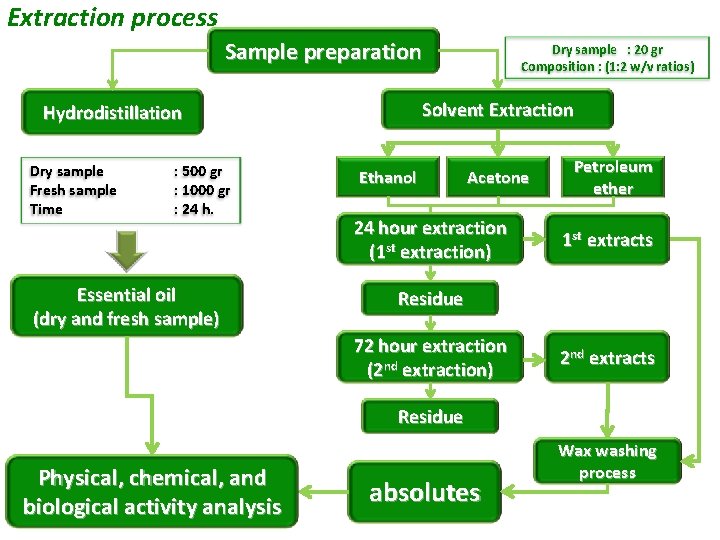
Extraction process Sample preparation Solvent Extraction Hydrodistillation Dry sample Fresh sample Time : 500 gr : 1000 gr : 24 h. Essential oil (dry and fresh sample) Dry sample : 20 gr Composition : (1: 2 w/v ratios) Ethanol Acetone 24 hour extraction (1 st extraction) Petroleum ether 1 st extracts Residue 72 hour extraction (2 nd extraction) 2 nd extracts Residue Physical, chemical, and biological activity analysis absolutes Wax washing process
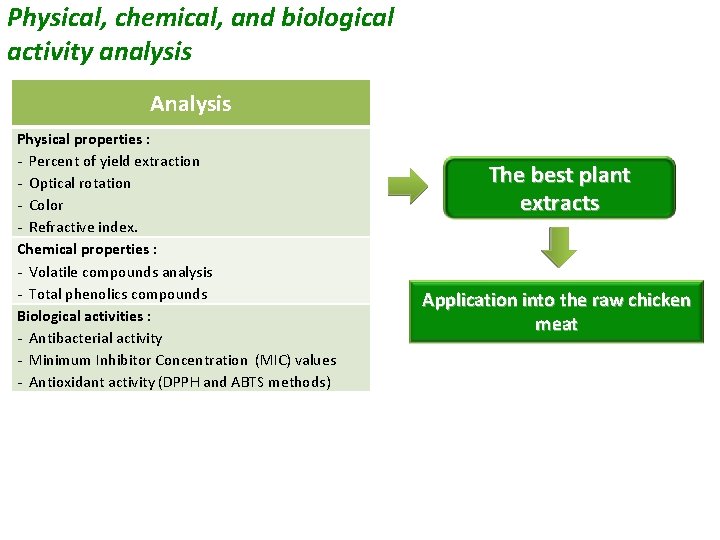
Physical, chemical, and biological activity analysis Analysis Physical properties : - Percent of yield extraction - Optical rotation - Color - Refractive index. Chemical properties : - Volatile compounds analysis - Total phenolics compounds Biological activities : - Antibacterial activity - Minimum Inhibitor Concentration (MIC) values - Antioxidant activity (DPPH and ABTS methods) The best plant extracts Application into the raw chicken meat
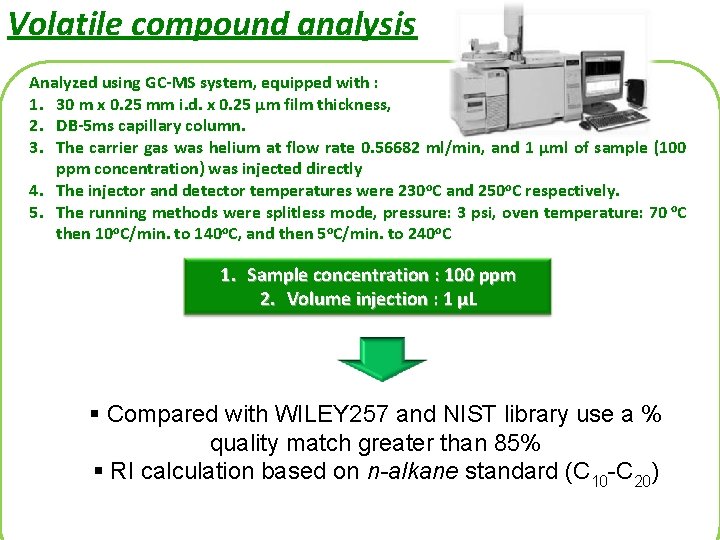
Volatile compound analysis Analyzed using GC-MS system, equipped with : 1. 30 m x 0. 25 mm i. d. x 0. 25 µm film thickness, 2. DB-5 ms capillary column. 3. The carrier gas was helium at flow rate 0. 56682 ml/min, and 1 µml of sample (100 ppm concentration) was injected directly 4. The injector and detector temperatures were 230 o. C and 250 o. C respectively. 5. The running methods were splitless mode, pressure: 3 psi, oven temperature: 70 o. C then 10 o. C/min. to 140 o. C, and then 5 o. C/min. to 240 o. C 1. Sample concentration : 100 ppm 2. Volume injection : 1 µL § Compared with WILEY 257 and NIST library use a % quality match greater than 85% § RI calculation based on n-alkane standard (C 10 -C 20)
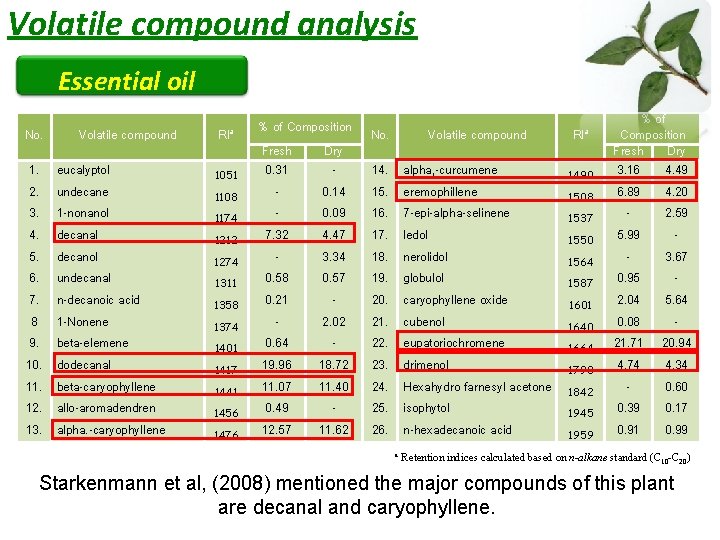
Volatile compound analysis Essential oil No. 1. 2. 3. 4. 5. 6. 7. 8 9. 10. 11. 12. 13. Volatile compound eucalyptol undecane 1 -nonanol decanal decanol undecanal n-decanoic acid 1 -Nonene beta-elemene dodecanal beta-caryophyllene allo-aromadendren alpha. -caryophyllene RIa 1051 1108 1174 1212 1274 1311 1358 1374 1401 1417 1441 1456 1476 % of Composition Fresh Dry 0. 31 0. 14 0. 09 7. 32 4. 47 3. 34 0. 58 0. 57 0. 21 2. 02 0. 64 19. 96 18. 72 11. 07 11. 40 0. 49 12. 57 11. 62 No. Volatile compound 14. 15. 16. 17. 18. 19. 20. 21. 22. 23. 24. 25. 26. alpha, -curcumene eremophillene 7 -epi-alpha-selinene ledol nerolidol globulol caryophyllene oxide cubenol eupatoriochromene drimenol Hexahydro farnesyl acetone isophytol n-hexadecanoic acid a RIa 1490 1508 1537 1550 1564 1587 1601 1640 1664 1790 1842 1945 1959 % of Composition Fresh Dry 3. 16 4. 49 6. 89 4. 20 2. 59 5. 99 3. 67 0. 95 2. 04 5. 64 0. 08 21. 71 20. 94 4. 74 4. 34 0. 60 0. 39 0. 17 0. 91 0. 99 Retention indices calculated based on n-alkane standard (C 10 -C 20) Starkenmann et al, (2008) mentioned the major compounds of this plant are decanal and caryophyllene.
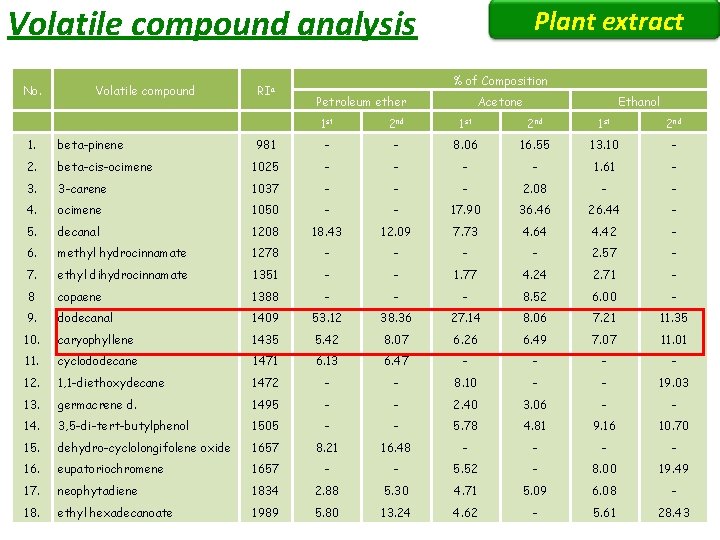
Volatile compound analysis No. Volatile compound RIa Plant extract % of Composition Petroleum ether Acetone Ethanol 1 st 2 nd 981 - - 8. 06 16. 55 13. 10 - 1. beta-pinene 2. beta-cis-ocimene 1025 - - 1. 61 - 3. 3 -carene 1037 - - - 2. 08 - - 4. ocimene 1050 - - 17. 90 36. 46 26. 44 - 5. decanal 1208 18. 43 12. 09 7. 73 4. 64 4. 42 - 6. methyl hydrocinnamate 1278 - - 2. 57 - 7. ethyl dihydrocinnamate 1351 - - 1. 77 4. 24 2. 71 - 8 copaene 1388 - - - 8. 52 6. 00 - 9. dodecanal 1409 53. 12 38. 36 27. 14 8. 06 7. 21 11. 35 10. caryophyllene 1435 5. 42 8. 07 6. 26 6. 49 7. 07 11. 01 11. cyclododecane 1471 6. 13 6. 47 - - 12. 1, 1 -diethoxydecane 1472 - - 8. 10 - - 19. 03 13. germacrene d. 1495 - - 2. 40 3. 06 - - 14. 3, 5 -di-tert-butylphenol 1505 - - 5. 78 4. 81 9. 16 10. 70 15. dehydro-cyclolongifolene oxide 1657 8. 21 16. 48 - - 16. eupatoriochromene 1657 - - 5. 52 - 8. 00 19. 49 17. neophytadiene 1834 2. 88 5. 30 4. 71 5. 09 6. 08 - 18. ethyl hexadecanoate 1989 5. 80 13. 24 4. 62 - 5. 61 28. 43
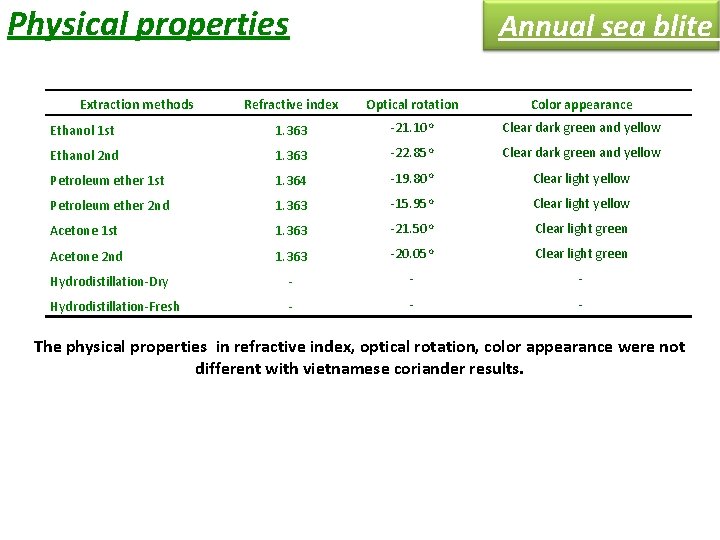
Physical properties Extraction methods Annual sea blite Refractive index Optical rotation Color appearance Ethanol 1 st 1. 363 -21. 10 o Clear dark green and yellow Ethanol 2 nd 1. 363 -22. 85 o Clear dark green and yellow Petroleum ether 1 st 1. 364 -19. 80 o Clear light yellow Petroleum ether 2 nd 1. 363 -15. 95 o Clear light yellow Acetone 1 st 1. 363 -21. 50 o Clear light green Acetone 2 nd 1. 363 -20. 05 o Clear light green Hydrodistillation-Dry - - - Hydrodistillation-Fresh - - - The physical properties in refractive index, optical rotation, color appearance were not different with vietnamese coriander results.
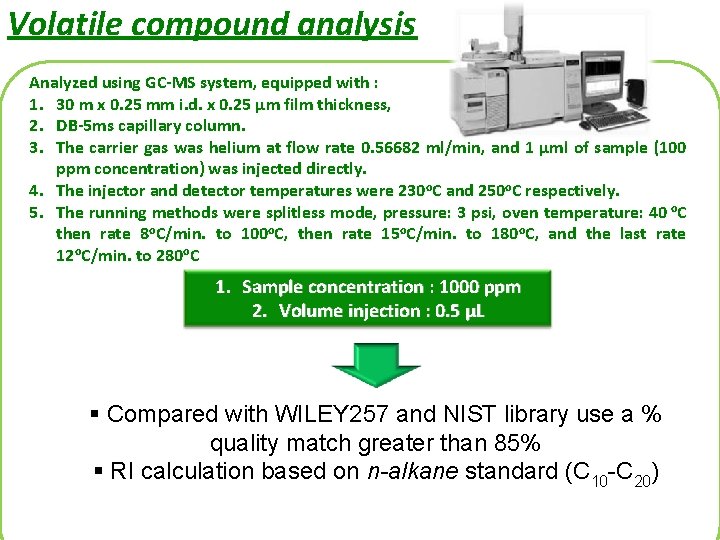
Volatile compound analysis Analyzed using GC-MS system, equipped with : 1. 30 m x 0. 25 mm i. d. x 0. 25 µm film thickness, 2. DB-5 ms capillary column. 3. The carrier gas was helium at flow rate 0. 56682 ml/min, and 1 µml of sample (100 ppm concentration) was injected directly. 4. The injector and detector temperatures were 230 o. C and 250 o. C respectively. 5. The running methods were splitless mode, pressure: 3 psi, oven temperature: 40 o. C then rate 8 o. C/min. to 100 o. C, then rate 15 o. C/min. to 180 o. C, and the last rate 12 o. C/min. to 280 o. C 1. Sample concentration : 1000 ppm 2. Volume injection : 0. 5 µL § Compared with WILEY 257 and NIST library use a % quality match greater than 85% § RI calculation based on n-alkane standard (C 10 -C 20)
The End Assoc. Prof. Dr. Natta Laohakunjit Assoc. Prof. Dr. Orapin Kerdchoechuen
- Slides: 56