
School Libraries Boost Student Achievement A strong library
School Libraries Boost Student Achievement! A strong library program improves student test scores! Support your STUDENTS learning by supporting your LIBRARY!

Building Partnerships for Learning The librarian is at once a: © • TEACHER • INSTRUCTIONAL PARTNER • INFORMATION SPECIALIST • PROGRAM ADMINISTRATOR
The mission of the library is to ensure that all students become skillful consumers and producers of information in a range of sources and formats to thrive personally and economically in the communication age. ³
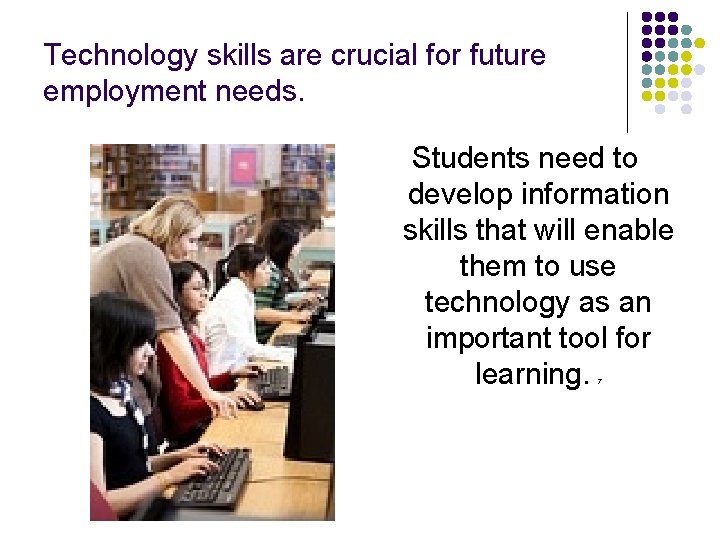
Technology skills are crucial for future employment needs. Students need to develop information skills that will enable them to use technology as an important tool for learning. 7

The School Library Supports Literacy and Math School librarians help schools meet reading and learning goals: They provide collaborative programs for reading instruction. They select resources that enhance leveled classroom collections. They provide imaginative materials that promote reading motivation. They encourage students to seek, access and use information. They provide for free voluntary reading and reading guidance. They provide reading advocacy by matching students to books in all formats. They share the findings of reading research with teachers. 6

School Libraries Work! © THE RESEARCH PROVES IT • In Alaska, students in secondary schools with full-time teacher-librarians were twice as likely to score average or above average on California Achievement Tests. 6 • 98. 2% of students in the Delaware study said they were helped by the school library in their learning process. 6 • Delaware students said they highly valued the librarian as teacher and made tangible links between the help provided through their library and their achievement. 6 • In Florida, FCAT scores were higher in schools with certified, university trained librarians. 6 • In Illinois, 11 th grade ACT scores are highest when there is a high degree of collaboration between the librarian and classroom teachers. 6 • Iowa reading test scores rise with the development of school library programs. 6 • The Michigan Educational Assessment Program reading test scores rise with the degree to which the school library programs are managed by qualified librarians. 6 • In Minnesota, twice as many schools with above average scores had full-time librarians. 6
Research shows that the relationship is causal-effective; library programs directly contribute to higher student achievement. n In Missouri, school library services exert a 10. 6% statistically significant impact on student achievement. 6 n School library programs in North Carolina schools have a significant impact on student achievement as measured by scores on standardized reading and English tests. 6 n In Ohio, 99. 4% of students believe school libraries and their services help them become better learners. 6 n 88. 5% of the Ohio students surveyed said the library helps them get better grades on projects and assignments. 6 n 74. 7% of Ohio students surveyed said the library helps with their homework. 6 n 92. 4% of Ohio students surveyed said computers in the library help improve their overall academic work. 6 n Teacher-librarians from Oregon high schools with the best Oregon statewide assessment reading/language scores are twice as likely as their colleagues from the lowest scoring schools to plan collaboratively with classroom teachers and their students are more than three times as likely to visit the library. 6 n In Wisconsin, certified librarians emerged as the most critical component of the library program and the impact on student academic performance. 6

PLEASE SUPPORT YOUR STUDENT’S LIBRARY PROGRAM Students need the guidance of a reading expert to encourage them to read more and to love reading. School librarians provide skillful guidance toward materials of interest and books appropriate to students reading level. More access to reading results in more reading. ¹

Saving funds by eliminating licensed school librarians and cutting the library program denies equal access for all students to the shared resources and information skills instruction crucial for students to learn and thrive in the 21 st century. ¹ As you make decisions, I urge you to recognize the importance school libraries play in graduating students who are skilled in the multiple literacies needed in the 21 st century. ¹
Bibliography 1 - American Association of School Librarians. . (n. d. ). AASL Crisis Toolkit. Retrieved Sep. 20, 2010, from http: //www. ala. org/ala/mgrps/divs/aaslissues/toolkits/crisis. cfm#crisisplanning 2 - Donham, J. (2007, October). Graduating students who are not only learned but also learners. Teacher Librarian, 35(1), 8 -12. 3 - American Association Of School Librarians. (1998). Information Power: Building Partnerships for Learning. Chicago, IL: American Library Association. 4 - (2010). Library Media Programs and Student Achievement, Research and Research-Based Practices for Library Media Specialists and Education Leaders. Retrieved 06. 21, 2010, from Cobb County Public Schools, Atlanta, GA. Web site: http: //www. cobbk 12. org/librarymedia/proof/research. pdf. 5 - Jericho Middle School Library Web Site. . (0 n. d. ). Mathematics. Retrieved Dec. 29, , from http: //www. jerichoschools. org/ms/library/math. html 6 - U. S. National Commission On Libraries and Information Science. Scholastic, Inc. (2008). School Libraries Work! Scholastic Library Publishing. Retrieved June 2, 2010, from www 2. scholastic. com/content/collateral_resources/pdf/s/slw 3_2008. pdf 7 - American Association Of School Librarians. (2009). Standards for the 21 st-century learner in action. Chicago, IL: American Association of School Librarians 8 - Loertscher, D. , & Todd, R. (2003). We boost achievement! Evidence based practice for school library media specialists. Salt Lake City, Utah: Hi Willow Research and Publishing.
- Slides: 10