
School Law Workshop January 28 2017 Abington Virginia
School Law Workshop January 28, 2017 Abington, Virginia M. David Alexander Virginia Tech
Endrew F. v. Douglas County School District RE-1 798 F. 3 d 1329 (C. A. 10) Colo. )) 2015 • Heard by Supreme Court Decision in June 2017 • Special Education • Main issue – Higher standard that Rowley • Procedural and Substantive Challenges 2
Endrew F. v. Douglas County School District RE-1 –Con’t • Procedural • A procedural failure must effectively deny the child FAPE and deprive educational benefits. • “Even assuming a procedural violation … did not result in denial of FAPE. ” • “District procedure could be more robust. ” 3
Endrew F. v. Douglas County School District RE-1 –Con’t • Substantive • Rowley “IEP” reasonably calculated to enable the child to receive educational benefits or “some educational benefit” • Parents wanted new standard “meaningful educational benefit”. • Rowley “Congress did not guarantee services sufficient to maximize each child’s potential. ” • • “ 4
Fry v. Napoleon Community Schools , 788 F. 3 d 622, ( C. A. 6( OH) 2014) • Special education • Decision in June • 8 year old special education service dog in school • Technical question • Sued on ADA and Rehabilitation Act • Must exhausted IDEA remedies before suing under ADA or Rehab. Act 5
Endrew F. v. Douglas County School District RE-1 –Con’t • Several circuits, 6 th, 5 th, 3 rd, have ruled for a higher standard “meaningful educational benefit”. • “meaningful educational benefit” v. “some educational benefit” • “The Act does not require that states do whatever is necessary to ensure that all students achieve a particular standardized level of ability and knowledge. ” • My Guess –Supreme Court-NO 6
Transgender • G. G. v. Gloucester County School Board , 2016 WL 1567467( C. A. 4 ( Va. ) 2016) • Department of Education Letter, January 7, 2015. Department’s Office of Civil Rights. • Deference to Letter defining discrimination under Title IX , “ A school generally must treat transgender student consistent with their gender identity “ • Gender Identity v. Genintalia 7
Transgender • GLOUCESTER COUNTY SCHOOL BOARD ( VA. ) v. G. G. , GRIMM. • 136 S. Ct. 2442 ( August 2016) • Grimm (student won at Fourth Circuit ) • Supreme Court issued stay 5 -3 vote • 5 Roberts, Thomas, Alito, Breyer, Kennedy • 3 Ginsburg Sotomayor, Kagan 8
Transgender • Cases based on Department of Education Title IX regulations Letter • Such as G. G. v. Gloucester County School Board 9
School Law Topics 1. 2. 3. 4. 5. 6. 7. 8. 9. Issues Technology and the Law Students and Social Media Sexting Cell Phones/Privacy/Search and Seizure Employees Social Media Teacher Free Expression Bullying Liability (Deliberate Indifference) Preventative Bullying Guidelines 10
School Law Topics (con’t) 10. 11. 12. 13. 14. 15. Liability Bullying Liability Search and Seizure Drug Testing Teachers School Resource Officers Religion 11
Technology and the Law • Recent Technology Cases • Supreme Court-Police Case • School Cases 12
Technology and the Law • City of Ontario, California v. Quon, 130 S. Ct. 1619 (S. Ct. 2010) The City of Ontario acquired alphanumeric pagers for text messaging and issued them to employees. There was a limit on the number of characters each pager was allowed under the city contract per month. The chief noticed that several employees exceeded the character limit. He requested the service provider send him two months of transcripts. The chief discovered that Officer Quon sent or received 456 messages for the month of August 2002 of which 57 were work related; several of the others were sexually explicit. The court held: (1) Quon had a reasonable privacy expectation; (2) petitioners’ review of the transcript constituted a Fourth Amendment search; and (3) the principles applicable to a government employer’s search of an employee’s physical office apply as well in the electronic sphere” 13
City of Ontario, California v. Quon, Technology (con’t) The Court ruled the chief had reasonable grounds to examine the officer’s text messages; therefore, there was no violation of the Fourth Amendment When addressing the privacy rights of those who Officer Quon sent or received messages, the court said, “[i}t is not necessary to resolve this question…” but added if it is reasonable to look at Officer Quon’s text, then it follows that it is reasonable to view the individual’s text who sent or received from Officer Quon 14
City of Ontario, California v. Quon, Technology (con’t) • The Court must proceed with care when considering the whole concept of privacy expectations in communications made on electronic equipment…. . The judiciary risks error by elaborating too fully on the Fourth Amendment implications of emerging technology before its role in society has become clear. …. . It is not so clear that courts at present are on so sure a ground. Prudence counsels caution before the facts in the instant case are used to establish far-reaching premises that define the existence, and extent, of privacy expectations enjoyed by employees when using employer-provided communication devices 15
Technology and the Law (con’t) • Statutes and court decisions provide guidance to school leaders, but they are lagging behind the rapid development of technology. This explosion of technology has impacted decisions regarding student disciplinary matters. Therefore, school leaders have been making discipline decisions about a new phenomenon without legal certainty. The administrator’s tool box only the tools that he/she possesses, which reside in court cases 16
Students and Social Media • The number of electronic outlets is continuing to grow, such as, internet forums, Facebook, weblogs, social blogs, microblogging, Wikis, podcasts, social bookmarking, twitter and others 17
Student Issues - Free Speech • Students usually claim that their free speech rights have been violated when issues of bullying, cyberbullying, My. Space , Facebook, Twitter, Blogs, etc. are litigated • Discipline for off campus behavior 18
Student Free Speech Cases- Supreme Court • Tinker v. Des Moines Students have First Amendment Rights, limiting material or substantial disruption or reasonably forecast disruption 19
Student Free Speech • Bethel v. Fraser Students lewd and indecent speech is not protected by the First amendment 20
Fraser’s Speech at School Assembly • I know a man who is firm - he’s firm in his pants, he’s firm in his shirt, his character is firm – but most of all, his belief in you, the students of Bethel, is firm • Jeff Kuhlman is a man who takes his point and pounds it in. If necessary, he’ll take an issue and nail it to the wall. He doesn’t attack things in spurts – he drives hard, pushing and pushing until finally – he succeeds • Jeff is a man who will go to the very end – even the climax, for each and every one of you • So vote for Jeff for A. S. B. vice-president – he’ll never come between you and the best our school can be 21
Student Issue Free Speech • Hazelwood v. Kuhlmeirer School may regulate the content of school news paper, “Legitimate Pedagogical Concern”, school board controls curriculum 22
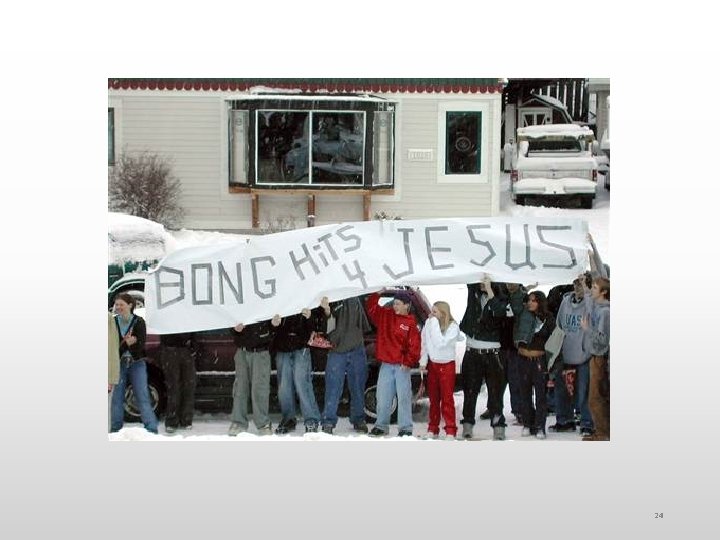
Student Issue Free Speech (con’t) • Morse v. Frederick Principal did not violate student’s free speech rights by confiscating banner “Bong hits for Jesus”, at off campus activity, promoting drugs 23
24
Student Issues Free Speech (con’t) Thus, because of Tinker, Bethel, and Hazelwood, Morse, freedom of expression in school can be described as follows: “First, ‘vulgar’ or plainly offensive speech ([Bethel]type speech) may be prohibited without showing…. disruption or substantial interference with the schoolwork. Second, schoolsponsored speech (Hazelwood-type speech) may be restricted when the limitation is reasonably related to legitimate educational concerns 25
Student Issues Free Speech (con’t) • Third, speech that is neither vulgar nor school-sponsored (Tinker-type) may only be prohibited if it causes a substantial and material disruption of the schools operation or a reasonable forecast of disruption. ” Fourth (Morsetype) may take action regarding activities that relate to drugs. 26
Student Issues Free Speech (con’t) 1. Tinker may apply to off campus 2. Rule: if there is a nexus between the outside activity and the school that materially and substantially disrupts then the student may be disciplined 3. Bethel applies to on campus only 4. Hazelwood – applies to the Curriculum 5. Morse – on campus drugs only 27
Material and Substantial Disruption • The Supreme Court has ruled that the school must be able to show that the students’ actions “materially or substantially” disrupted the school environment before taking an action against the students. To take an action school officials must have “something more than a mere desire to avoid the discomfort and unpleasantness that always accompany an unpopular viewpoint” 28
Material and Substantial Disruption (con’t) • The Court also stated that the student’s First Amendment rights ceased if school officials could show “facts which might reasonably have led [them] to forecast substantial disruption of or material interference with school activities” 29
Material and Substantial Disruption (con’t) • When determining whether substantial disruption has occurred the courts inquiry is highly fact intensive. “… [E]xisting case law has not provided clear guidelines as to when a substantial disruption is reasonably foreseeable. ” Hence, there is no magic number of students or classrooms that must be impacted 30
Material and Substantial Disruption (con’t) • Courts have considered several factors when determining whether the material and substantial disruption test has been met. The fact that students are merely discussing topics or situations is not sufficient to meet the substantial disruption standard. This does not provide evidence that “classroom activities were substantially disrupted” 31
Material and Substantial Disruption (con’t) • The court in Tinker concluded that the armbands “neither interrupted school activities nor sought to intrude in the school affairs or the lives of others. ” The armbands caused “… discussion outside the classroom, but no interference with work and no disorder” occurred; thus mere discussing of a situation is insufficient to meet the Tinker standard 32
Material and Substantial Disruption (con’t) 1. True threat, Not protected by the constitution a)Posted message about another student wanted to rip student’s heart out and pound head with ice pick. D. C. v. R. R. (California 2010) 33
Tinker Cited (Upheld school) J. S. v. Bethlehem Student web site created at home “Why an algebra teacher should die” requested money to hire “hit man” 34
Cases that Upheld School Wisniewski v. Board of Education Student web site created at home, showed bullet fire through teachers head, also stated “Kill Mr. Vander. Molen”. Not protected by the First Amendment 35
Cases that Upheld School Doninger v. Niehoff Website said that school activity had been cancelled “due to douchbags in central office”. Encouraging individuals to call and email school and central office, because it would “piss” them off. Creating foreseeable disruption 36
Kowalski v. Berkeley Co. Schools (W. VA. ) 2011 Case Cyberbullying (Upheld School) Senior created and posted My. Space web pages called” S. A. S. H. ”, “student against sluts and herpes”, “No No herpes, we don’t want no herpes” Another student responded on webpage saying “students against Shays’ herpes’ referring to a student Shay N. Another student stated “Shay has herpes” 37
Kowalski v. Berkeley Co. Schools (con’t) • Court ruled that school did not violate students rights by suspending her for creating and posting webpage. Applied Tinker disruption test, Cyber bullying, Tinker Case • In 4 th Circuit (Virginia) 38
Layschock v. Hermitage School District, 2011, (vote 14 -0)(3 rd Circuit)…Upheld student Justin Layschock was a seventeen-year old senior. While Justin was at his grandmother's house during non-school hours; he used her computer to create what he would later refer to as a “parody profile” of his Principal 39
Layschock v. Hermitage School District (con’t) • The only school resource that was involved in creating the profile was a photograph of the Principal copied from the School District's website. Justin created the profile on “My. Space. ” Justin created the profile by giving bogus answers to survey. All of Justin's answers were based on a theme of “big, ” because the Principal was a large man. For example, Justin answered “tell me about yourself” questions as follows: 40
Layschock v. Hermitage School District (con’t) For example, Justin answered “tell me about yourself” questions as follows: 1. 2. 3. 4. 5. Birthday? too drunk to remember Are you a health freak? big steroid freak? In the past month have you smoked? big blunt? In the past month have you been on pills> big pills In the past month, have you gone Skinny Dipping? big lake, not big dick? 6. In the past month have you Stolen Anything? big keg 41
Layschock v. Hermitage school District (con’t) 1. 2. 3. 4. 5. Ever been drunk? big number of times Ever been called a Tease? big whore Ever been beaten up? big fag Ever Shoplifted? big bag of Kmart Number of Drugs I have taken? big Under “Interests, ” Justin listed: “Transgender, Appreciators of Alcoholic Beverages. ” Justin also listed “Steroids International” as a club the principal belonged to Principal believed all of the profiles were “degrading, ” “demeaning, ” “demoralizing, ” and “shocking” 42
Layschock v. Hermitage School District, 2011 Decision 1. Student entering school website to take principal’s photo was not sufficient Nexus 2. What school considered lewd and offensive (Bethel does not allow school district to punish Justin for expressive conduct outside of school) 3. School did not dispute that Tinker did not apply because it was not disruptive 4. Court ruled school violated student free speech 43
J. S. v. Blue Mountain School District, 2011 An eighth-grade honor student at Blue Mountain Middle school, was upset with her principal for disciplining her for dress-code violations. She created a My. Space page in retaliations depicting her portrayal of a bisexual Alabama Middle School Principal. J. S. accused her principal of “having sex in his office”, “hitting on students and their parents”, and being a “sex addict, fuc…. in his office” 44
J. S. v. Blue Mountain School District, 2011 (con’t) • …. she called him a “dick head”, stated that he was “put on this world with a small dick”, and called him a “fagass”. She stated that his wife “looks like a man” and that his son “looks like a gorilla”. She stated that the principal enjoyed “riding the fraintrain”, a reference to his wife Debra Frain, who worked at the school as a guidance counselor- and that “it’s a slow ride but you’ll get there eventually. ” Created at home on the weekend. Student wrote letters to the wife apologizing. The student said it was a joke between her and her friends 45
J. S. v. Blue Mountain School District, 2011 Court Ruled 1. School could not forecast substantial disruption 2. School could not punish student for use of profane language outside of school, non school hours 3. Was not “materially or substantially” disruptive 46
Sexting 47
Sexting 1. VA Attorney General opinion (11/24/2010) a) “ In my opinion searches and seizures of student cellular phones and laptops are permitted when there is reasonable suspicion…” b) Sexual material for minor (under 18), child pornography, promptly contact law enforcement. 2. “Virginia Guidelines For No Prevention of Sexual Misconduct and Abuse in Virginia Public Schools” 48
Sexting (con’t) 3. VDOE reports 46 educators or school employers were arrested in past 3 years because of misconduct with students or other minors 4. Of the 169 actions taken by the Board of Education against licenses since 2000, 120 were in response to sexual misconduct involving minors. In many of these cases, school divisions filed petitions only after receiving an inquiry from VDOE about a case in which a license holder had been convicted and no licensure action had been initiated by the division 5. Cell Phones 49
Sexting (con’t) 6. Miller v. Mitchell – School officials discovered nude, semi-nude photographs on students cell phones 7. District Attorney determined inappropriate and proceeded to prosecute 13 year old girls 8. Either take education class or be prosecuted 9. Parent sued court rules for parents compelled or forced speech unconstitutional 50
Sexting (con’t) 10. 11. 12. 13. Nude pictures of student, neck down Student was harassed because of pictures Ask SRO – told Logan v. Sycamore Sch. Bd. Case Student to submit to television interview on “sexting” – made harassment worse 14. SRO said he could do nothing 15. Student committed suicide 16. SRO and school held liable 51
Cell Phones/Privacy/Search and Seizure 52
Cell Phone Search Riley v. California, June 2014 , S. Ct. • The Supreme Court ruled that police generally may not search a cell phone upon arresting an individual • “Our answer to the question of what police must do before searching a cell phone seized incident to an arrest is accordingly simple – get a warrant” 53
School Cell Phone Cases 1. Klump v. Nazareth Area School District • Student was using cell phone against school rules • Administrator texted individuals on phone contact list. Pretends to be student • Court rule unconstitutional 2. J. W. v. Desoto County School District • Open cell phone reviewed personal pictures • School had cell phone rule, no cell phones • Court ruled search reasonable since he was breaking school rule (criticized in G. C. ) 3. G. C. v. Owensboro Public Schools (school cell phone) • School officials lacked reasonable grounds to search Student’s cell phone 54
Gallimore v. Henrico Co. Sch. Bd. (2015) • Report student had marijuana, administrator search backpack, shoes, pockets, sandwich wrapper and Vaseline jar – All reasonable • Administrator searched cell phone – unreasonable – cell phone could not have contained marijuana 55
Employees Social Media 56
Employees Social Media • A 26 year old teacher in Broward, Florida was fired when the principal learned that she, using an alter ego, was posing for bikiniphotos for XXXTransvision Radio Magazine and Miami parties. com. The unapologetic teacher posted: “I’m too sexy for my job … lol …” She also was quoted in the press as saying, “Lots of teachers get fired or asked to resign for the same things I did. ” (Footnote: The Inquistr/Inquistr. ltd, May 10, 2013) 57
Employees Social Media (con’t) • A Chesterfield County School’s (VA) art teacher was fired after a You. Tube video surfaced. The “You. Tube video show[ed] [the teacher] with a fake nose and glasses, a towel on his head and black thong. …[p]racticing his private abstract artwork, much of which is produced when he smears his posterior and genitals with paint and presses them against a canvas. The video was widely dispersed among students. ” (http: //malottblogsspot. com) The pictures sold for $400 to $900 per picture. The School Board voted unanimously to dismiss him, whereupon he filed suit claiming violations of his First Amendment rights. The Board agreed to a $65, 000 settlement. (The Tuscaloosa News, May 8, 2008) 58
Employees Social Media (con’t) • The Attorney General of Tennessee reports that there has been an increase in the number of teachers who have lost their teaching licenses because of inappropriate relationships with students. The AG states, “Technology is making it easier to engage in inappropriate communications with students … it’s easier to say something in a text message than in person. ” In 2010, 27 teachers lost their licenses because of inappropriate actions such as sexting. This compares to 11 in 2009 (http: //www. tennessean. com) 59
Teachers Free Speech 60
Teachers Free Speech • Teachers like students claim free speech when they are being dismissed or disciplined for Social Media postings • The U. S. Supreme Court has decided four cases involving public employees where the primary legal issue was free speech these were: Pickering v. Board of Education of Township High School District (1968) , Mt. Healthy City School District Board of Education v. Doyle, (1977), Connick v. Myers, (1983), Garcetti v. Ceballos, (2006). Only Pickering and Mt. Healthy were teacher cases, but all dealt with public employees and are therefore relevant 61
Teacher Free Speech (con’t) 1) Pickering v. Board of Education (may speak out on matter of public concern, must be speaking as a citizen) 2) Mt. Healthy v. Doyle, mixed motive test, constitutional right and non-constitutional right 3) Connick v. Myers applied mixed motive test 4) Garcetti v. Cebollas – statements made by public employee pursuant to their official duties, not protected by First Amendment It is the educational institution that has a right to academic freedom, not the individual teacher. Evans. Marshal v Board of Education, Urofsky v. Gilmore (Virginia Case) 62
Land v. L’Anse Creuse Public School Board of Education. (Teacher not dismissed) • A school board terminated a tenured middle school teacher after students gained access to photographs of the teacher at a summer party. The photos showed the teacher engaged in a simulated act of fellafio with a male mannequin at a bachelor/ bachelorette party. The photos were taken approximately 2 years before they surfaced, and were taken without the teacher’s knowledge and posted without her consent. The photos were subsequently removed • The court found for the teacher and ruled the event had happened two years prior at a public event, was not an illegal act, did not involve students or any school personnel 63
Rubino v. City of New York (Teacher not dismissed) • • • A New York City student drowned on a school sponsored field trip. A tenured teacher at another New York City school posted on Facebook, “After today, I am thinking the beach sounds like a wonderful idea for my 5 th graders! I HATE THEIR GUTS! They are devils [sic] spawn. ” A friend replied, “oh you would let little Kwame float away. ” The teacher responded, “Yes, I wld [sic] not throw a life jacket in for a million!!” The teacher was recommended for termination. “[The] Facebook postings do not constitute protected speech insofar as [it]…. was decided that [the teacher] posted the comments as a teacher and that the comments did not pertain to a matter of public concern. ” 64
Rubino v. City of New York (con’t) • Even though no First Amendment right was involved the court ruled that the teacher’s dismissal was “shocking to one’s fairness” • “[The] Facebook postings do not constitute protected speech insofar as [it]…. was decided that [the teacher] posted the comments as a teacher and that the comments did not pertain to a matter of public concern” • Even though no First Amendment right was involved the court ruled that the teacher’s dismissal was “shocking to one’s fairness” 65
In re O’Brien (Teacher dismissed) • A teacher, posted two statements on Facebook. The first “I’m not a teacher – I’m a warden for the future criminals”, and “They had a scared straight program in school – why couldn’t [I] bring [first] graders. ” A “Scared Straight” for sixth graders and older students was conducted at the school; O’Brien had briefly attended the program • After the Facebook posting the principal received parental complaints about the postings; then major news organizations descended upon the school. At a Home-School Council meeting that evening, the majority of the agenda was devoted to the Facebook postings 66
In re O’Brien (con’t) (Teacher dismissed) • O’Brien was recommended for dismissal based on “conduct unbecoming a teacher”. O’Brien posted on Facebook out of frustration, because she had recently been hit by a student, had students hitting each other, and items stolen in her classroom. She also apologized for the postings • O’Brien filed suit claiming her Facebook postings were protected by the First Amendment. The court ruled that O’Brien was not speaking as a citizen on a matter of public concern, which is constitutionally protected, but, even if her speech were a matter of public concern and therefore protected , she still would have been dismissed because of the disruption caused by the postings 67
San Diego Unified School District v. Commission of Professional Competence, (Teacher dismissed) • San Diego Unified School District v. Comm. on Prof. Competence – Teacher dismissed for posting on Craigslist graphic photos of his genitalia and anus, while soliciting sex 68
Teacher or Student (Teacher dismissed) 1. Snyder v. Millersville University – student teacher dismissed from student teaching, for posting criticism of cooperating teacher, and pictures of her as “drunken pirate”. Had been told not to post improper material 2. Spanierman v. Hughes – told to use only school email with students. Had my space account that student had access, also inappropriate exchange with students. Had been warned 69
Bullying Liability (Deliberate Indifference) 70
Liability Two types of liability 1) State Torts –Varies from state to state (State Court) a) Negligence b) Strict Liability (no school cases) c) Intentional torts (defamation, corporal punishment, etc. ) 2) Constitutional Torts (Federal Court) a) 42 USC section 1983 b) Violation of U. S. Constitution or Federal Statute 71
Commonwealth of Virginia - Negligence 1) Teachers Immuned from Negligence a) Common Case Law b) Code of Virginia 8. 01 -220. 1: 2 c) Paul D. Coverdell Act of 2001 (ESSA) 2) Administrators Immuned from Negligence a) Common Case Law b) Paul D. Coverdell Act of 2001 (ESSA) Administrators NOT Immuned under Code of Virginia, 8. 01 -220. 1: 2 Burns v. Gagon, 727 S. E. 2 d 634 (S. Ct. Va. 2012) 72
Virginia Tort Cases - Common or Case Law Lentz v. Morris, 372 S. E. 2 d 608, (1988) Immuned 1) Immunity for teachers (ordinary negligence, does not cover gross negligence) Banks v. Sellers, 294 S. E. 2 d 862, (1982) Immuned 1) Division Superintendents 2) High School Principals 73
Code of Virginia § 8. 01 -220. 1: 2 Civil immunity for teachers under certain circumstances (passed in 2007) A. Any teacher employed by a local school board in the Commonwealth shall not be liable for any civil damages for any acts or omissions resulting from the supervision, care or discipline of students when such acts or omissions are within such teacher’s scope of employment and are taken in good faith in the course of supervisions, care or discipline of students, unless such acts or omissions were the result of gross negligence or willful misconduct B. No school employee or school volunteer shall be liable for any civil damages arising from the prompt good faith reporting of alleged acts of bullying or crimes against others to the appropriate school official in compliance with specified procedures C. This section shall not be construed to limit, withdraw or overturn any defense or immunity already existing in statutory or common law or to affect any claim occurring prior to the effective date of this law, or to prohibit any person subject to bullying or a criminal act from seeking redress under other provision of law 74
Paul D. Coverdell Teacher Protection Act of 2001 (Part of ESSA) • The purpose of this subpart is to provide teachers, principals, and other school professionals the tools they need to undertake reasonable actions to maintain order, discipline, and an appropriate educational environment 75
Federal Courts Liability Constitutional Tort- 42 U. S. C. section 1983 • Every person (Individual and School Board) who, under color of any statute, ordinance, regulation, custom, or usage, of any state …subjects, or causes to be subjected any citizen of the United States …to the deprivation of any rights , privileges or immunities secured by the Constitution and laws, shall be liable to the party injured in an action at law , suit in equity (Called MONEY) , or other proper proceedings 76
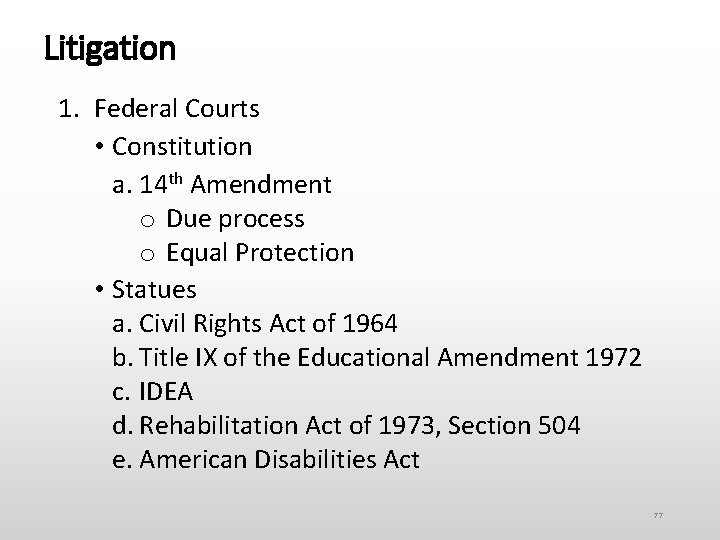
Litigation 1. Federal Courts • Constitution a. 14 th Amendment o Due process o Equal Protection • Statues a. Civil Rights Act of 1964 b. Title IX of the Educational Amendment 1972 c. IDEA d. Rehabilitation Act of 1973, Section 504 e. American Disabilities Act 77
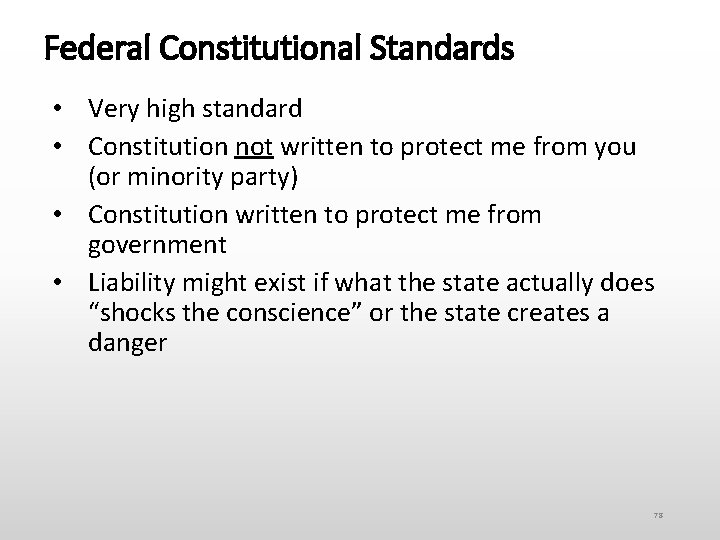
Federal Constitutional Standards • Very high standard • Constitution not written to protect me from you (or minority party) • Constitution written to protect me from government • Liability might exist if what the state actually does “shocks the conscience” or the state creates a danger 78
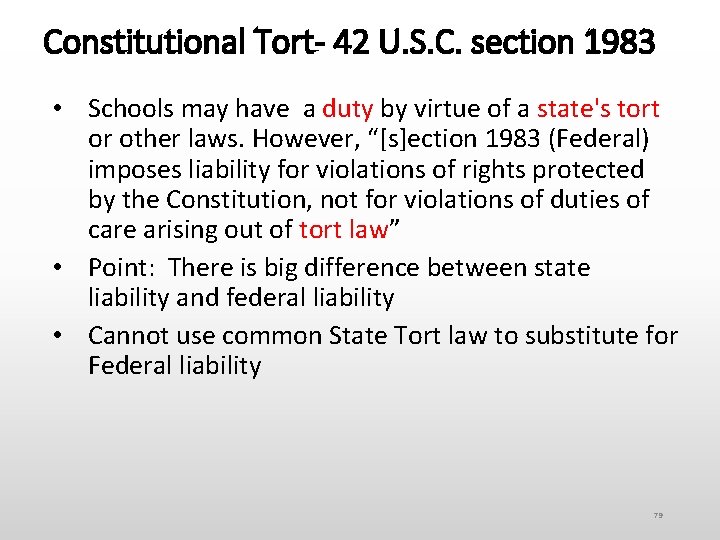
Constitutional Tort- 42 U. S. C. section 1983 • Schools may have a duty by virtue of a state's tort or other laws. However, “[s]ection 1983 (Federal) imposes liability for violations of rights protected by the Constitution, not for violations of duties of care arising out of tort law” • Point: There is big difference between state liability and federal liability • Cannot use common State Tort law to substitute for Federal liability 79
Preventative Bullying Guidelines 80
What the School Leader Can Do: Preventing and Responding to Harassment and Bullying 1. The Preventative Actions a. Adopt policies that prohibit bullying and harassment b. Implement programs that promote tolerance and acceptance of all students 81
What the School Leader Can Do: Preventing and Responding to Harassment and Bullying (con’t) 2. The Protective Actions a. Take immediate action to protect students who may be harassed or bullied b. Implement procedures to protect those who are bullied or harassed and those who might report harassment c. Have procedures for investigating and reporting inappropriate actions by anyone 82
What the School Leader Can Do: Preventing and Responding to Harassment and Bullying (con’t) 3. Punitive Action Against Wrongdoers a. Investigate, collect facts and immediately discipline individuals committing acts of harassment or bullying b. Punish not only the primary bullier but those who have been involved, such as co-conspirators or individuals who participated in bullying or harassment 83
What the School Leader Can Do: Preventing and Responding to Harassment and Bullying (con’t) 4. Public Action a. Release statement by the school officials and School Board to the public that those types of behaviors will not be tolerated b. Have press releases and transparency on your action against those individuals 84
Liability 85
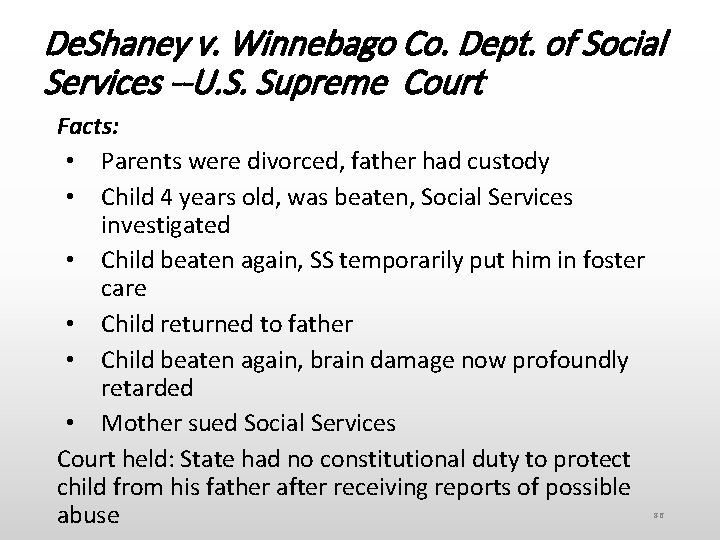
De. Shaney v. Winnebago Co. Dept. of Social Services --U. S. Supreme Court Facts: • Parents were divorced, father had custody • Child 4 years old, was beaten, Social Services investigated • Child beaten again, SS temporarily put him in foster care • Child returned to father • Child beaten again, brain damage now profoundly retarded • Mother sued Social Services Court held: State had no constitutional duty to protect child from his father after receiving reports of possible abuse 86
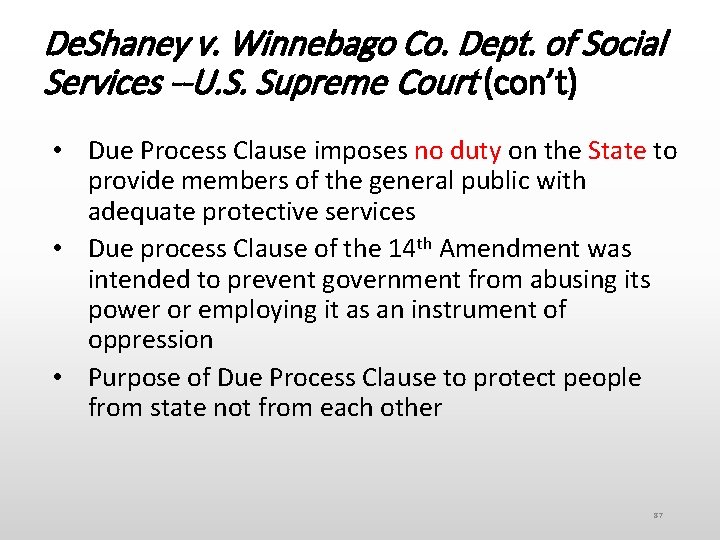
De. Shaney v. Winnebago Co. Dept. of Social Services --U. S. Supreme Court (con’t) • Due Process Clause imposes no duty on the State to provide members of the general public with adequate protective services • Due process Clause of the 14 th Amendment was intended to prevent government from abusing its power or employing it as an instrument of oppression • Purpose of Due Process Clause to protect people from state not from each other 87
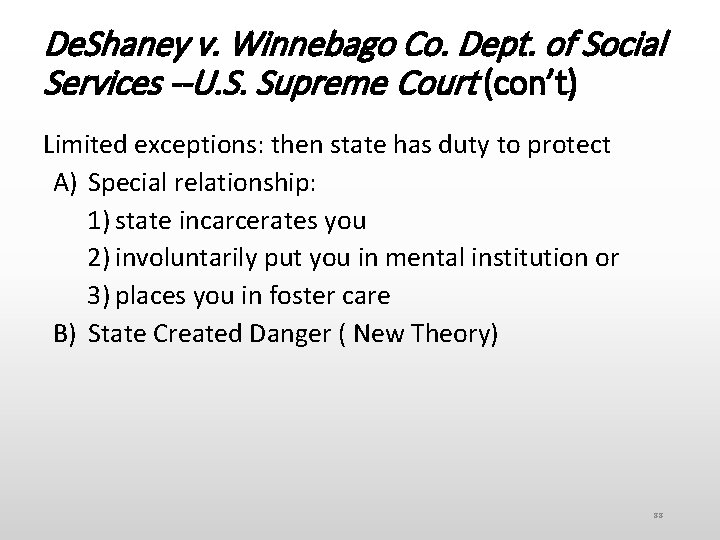
De. Shaney v. Winnebago Co. Dept. of Social Services --U. S. Supreme Court (con’t) Limited exceptions: then state has duty to protect A) Special relationship: 1) state incarcerates you 2) involuntarily put you in mental institution or 3) places you in foster care B) State Created Danger ( New Theory) 88
De. Shaney v. Winnebago Co. Dept. of Social Services --U. S. Supreme Court (con’t) • But nothing in the language of the Due Process Clause itself requires the State to protect the life, liberty, and property of its citizens against invasion by private actors. The Clause is phrased as a limitation on the State's power to act, not as a guarantee of certain minimal levels of safety and security. It forbids the State itself to deprive individuals of life, liberty, or property without “due process of law, ” but its language cannot fairly be extended to impose an affirmative obligation on the State to ensure that those interests do not come to harm through other means. Nor does history support such an expansive reading of the constitutional text • (quote Supreme Court) 89
Doe v. Covington County School District (5 th Cir. 2012) Federal liability – The en banc (all judges) court is called upon to decide whether a public school student has stated a constitutional claim against her school for its failure to protect her from harm inflicted by a private actor Facts: • Nine year old Jane Doe • School had check-out policy • Guardian filled out “ Permission to Check- out- Form” • Policy did not require check-out identification • Man not on form checked Jane Doe out of School 6 times over 7 months • Check-her out 5 times as father, 1 time mother • Took her to his apt. and molested her then returned her to school 90
Doe v. Covington County School District (con’t) • We now hold that student did not have a De. Shaney special relationship with the school , and her school therefore had no Constitutional Duty to Protect her from harm inflicted by private actor 91
Stevenson v. Martin County Board of Education (4 th Circuit, N. C. ) Facts: • 10 year old, sixth grade student • Second day of school student robbed and assaulted • Another student threw book at student, student suspended • Later fight between plaintiff and another student, both suspended • Father complained to Principal, said his son was being threatened • Next month harassment continued, kicked, punched in chest • First period Art class, another student started hitting student • Student ask teacher for help • Teacher said, “ nothing I can do” and “ you probably deserved it” • Students in class suspended, not plaintiff 92
Stevenson v. Martin County Board of Education (con’t) Father sued saying his child was deprived of a liberty interest in bodily integrity Court ruled: • No special relationship cited De. Shaney as controlling • School officials were not constitutionally liable for failing to prevent physical assaults • Father also filed state claims of negligence, assault, negligent infliction of emotional distress and violations of North Carolina Constitution. Federal Court said these need to be resolved in state court 93
Bullying Liability 94
Bullying Liability • Cases a) Equal protection b) Title IX –Education Amendments 1972 , Sex c) IDEA Disabilities d) Religion • Common Factor School Acted with Deliberate Indifference 95
Court Bullying “Nearly every state has enacted anti-bullying laws…experimenting with their own solutions to the problems of bullying. There is no institutional need to send judges off on [a] mission-almost-impossible to prevent and cure the effects of school bullying when legislators are able to amass the stuff of actual experience and cull conclusions from it… To suddenly constitutionalize this area would short-circuit what looks to be a prompt and considered legislative response. If the people of Pennsylvania, Delaware, 96
Court Bullying (con’t) New Jersey [or any state] wants[s] to expose their schools to great liability for inaction, or if they desire different solutions to the problem that all on this court agree bullying to be, it is their prerogative to do so. ” (Footnote: Marrow v. Balanski, 719 F. 3 d 160 at 183) * As of March 2015, with Montana, all states have bullying laws 97
Nabozny v. Podlesny 92 F. 3 d 446, (C. A. 7 th Circuit) 1996 Equal Protection Student openly gay Student called him names Ask administrators for help Student muck raped him and urinated on him in bathroom • Principal said, “go home and change your clothes and if you are going to be gay then you should expect this • Nabozny showed that when boy struck girlfriend he was expelled • Court rendered damages against school for “deliberate indifference” • • 98
Example of Laws-Liability --Title IX Education Amendments of 1972 • Sex Discrimination (Federal Law) • Employee-Employee, Employee-Student, Student (Peer-to-Peer) • Can be liable if school officials act with “deliberate indifference” • Even if school officials were ineffective they did not act with deliberate indifference. (Do something, document) • Baynard v. Malone, 268 F. 3 d 228 (4 th Cir. 2010), Principal liable for deliberate indifference in sexual harassment case. Virginia Case, $ 300 K 99
T. K. and S. K. v. New York City Department of Education Disabilities • 12 year old special education student, autistic • Three types of bullying 1) Physical 2) Verbal 3) Psychological • Cyber bullying differs from traditional bullying • Bullying created hostile environment • Parents complained about bullying • Principal refused to discuss in IEP meeting 100
T. K. and S. K. v. New York City Department of Education (con’t) • “No one gains from ignoring school bullying- not even the bullies themselves” • Teacher aids reported student was ostracized and subjected to ridicule • Student intentionally stayed away, and push student away for fun, tripped and when she fell teacher got upset with her • Court ruled that school had acted “deliberately indifferent” Title IX standard for sexual harassment, sever, pervasive and objectively offensive altered education 101
P. W. and D. W. Guardian, of H. W. v. Fairport Central School District. 927 F. Supp. 2 D 76 (W. D. N. Y. 2013) Gender • Peer-to-peer bullying • Jammed lacrosse stick in to his buttock • Squeezed nipple, on tape of incident. Asst. Prin looked at tape something happened, did nothing • Name calling • Over a period of years • Violation of Title IX • Court rendered damages against school for “deliberate indifference” 102
G. D. S. v. Northport-East Northport Union Free School District. 915 f. Supp. 2 D (E. D. N. Y. 2012) Religion • Anti-Semitic comments: “Hitler is a good person”; “what is the difference between a Jew and pizza? A pizza doesn’t scream when it goes in the oven” • Parent met with administrators • Administration and teachers saw bullying • Court rendered damages against school for “deliberate indifference” 103
Zeno v. Pine Plains, Central School District. 702 F. 3 d 655 (C. A. 2 (NY) 2012) Skin Color • Harassment “nigger” • “We don’t want your kind here” • “Go back where you came from” • “You fxxxing, nigger” • Student displaced no use • Million dollar judgment under Title VI of the Civil Right Act • Court rendered damages against school for “deliberate indifference” 104
Search and Seizures 105
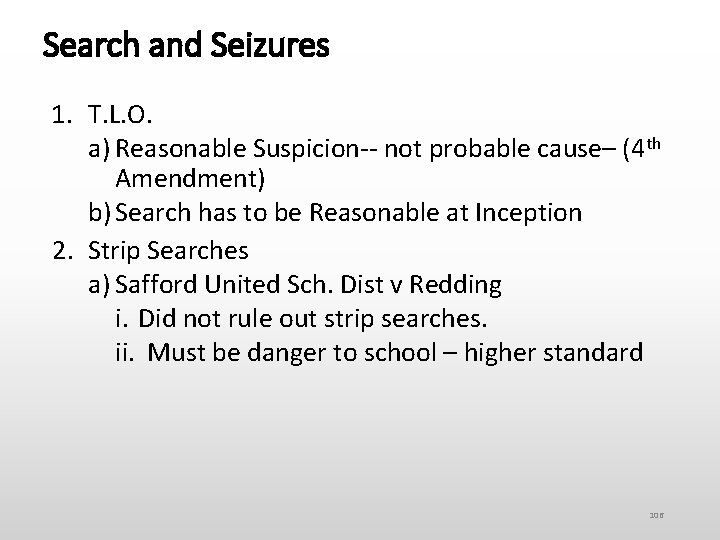
Search and Seizures 1. T. L. O. a) Reasonable Suspicion-- not probable cause– (4 th Amendment) b) Search has to be Reasonable at Inception 2. Strip Searches a) Safford United Sch. Dist v Redding i. Did not rule out strip searches. ii. Must be danger to school – higher standard 106
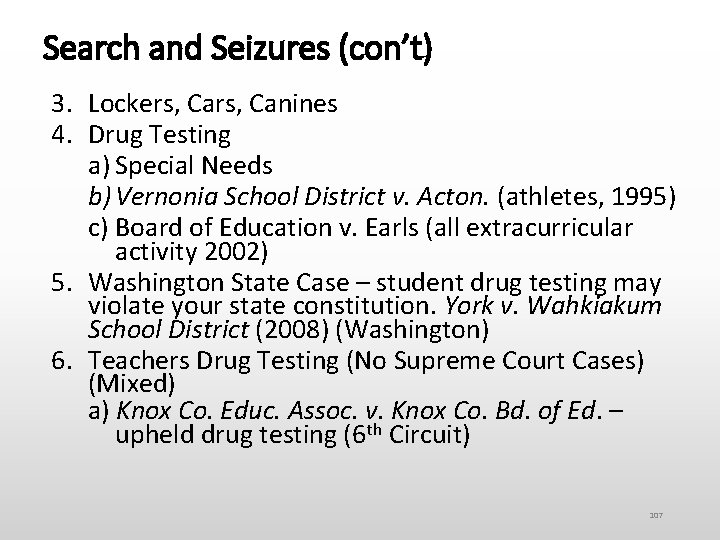
Search and Seizures (con’t) 3. Lockers, Canines 4. Drug Testing a) Special Needs b) Vernonia School District v. Acton. (athletes, 1995) c) Board of Education v. Earls (all extracurricular activity 2002) 5. Washington State Case – student drug testing may violate your state constitution. York v. Wahkiakum School District (2008) (Washington) 6. Teachers Drug Testing (No Supreme Court Cases) (Mixed) a) Knox Co. Educ. Assoc. v. Knox Co. Bd. of Ed. – upheld drug testing (6 th Circuit) 107
Drug Testing Teachers 108
Drug Testing • American Federation of Teachers v. Kanawha Co. Bd. of Ed. (No special needs, for safety, violates constitution) • Smith Co. Ed. Assoc. v. Smith Co. Bd. of Ed. (violate teachers rights) • Jones v. Graham (violate the North Carolina Constitution) 109
School Resource Officer 110
School Resource Officer • Triad Model (Law enforcement, Teacher, Counselor) • School to prison pipeline • 24 states have statues • Taser, Handcuffs • School District Police Department • New York 5000 Officers, 6 th largest in U. S. • Search and Seizure • Miranda 111

Religion 112
Religion 1. Both Student and Teachers 2. Equal Access Act, Clubs 3. Forum Analysis, passing out religious literature: Free Speech v. Establishment Clause 4. Prayer, Graduation, Football Game 5. Ten Commandments 113
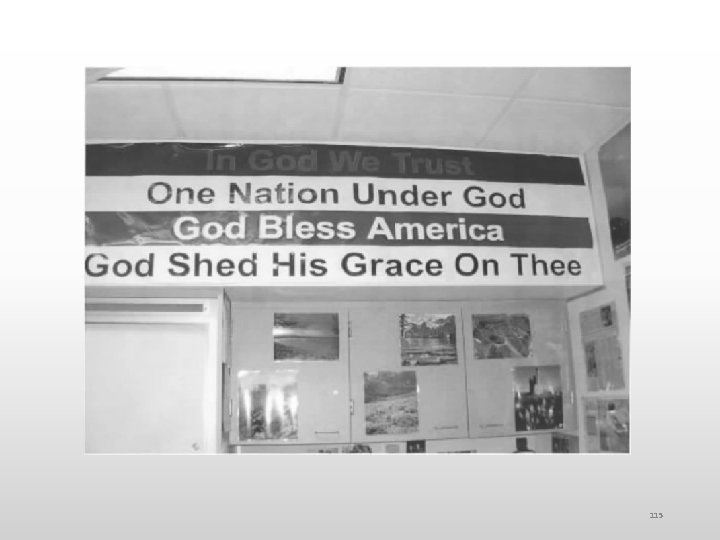
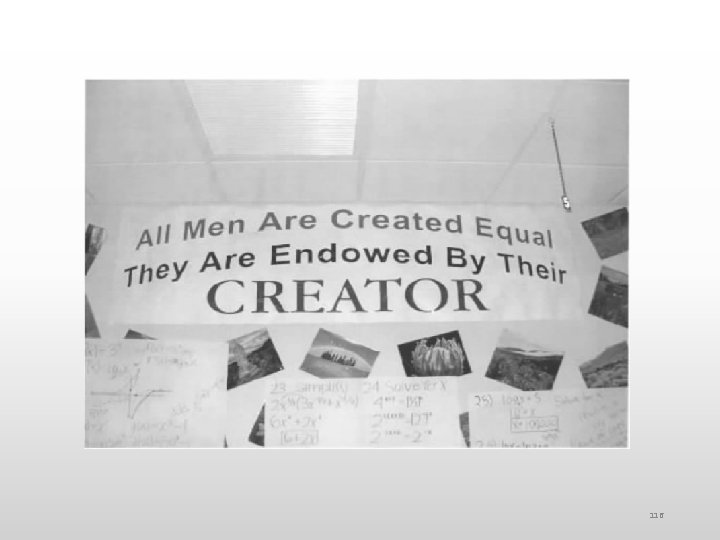
Teachers • Johnson v. Poway Unified School District (2011) did not violate Teachers First Amendment right to Free speech very similar to Lee v. York Co Sch. Division (2007) Remove materials from classroom. Not matter of public concern (Pickering – Connick ) also curriculum (Hazelwood) 114
115
116
- Slides: 116