
School Innovation and New School Models In the
- Slides: 28
School Innovation and New School Models
In the midst of the pandemic, how are leaders from all types of schools thinking differently about education? What opportunities are there for independent schools to rethink and innovate? 2
Innovation
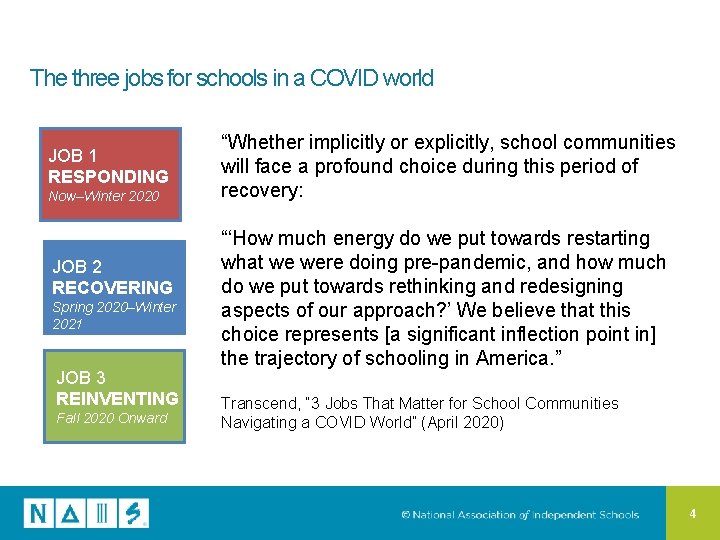
The three jobs for schools in a COVID world JOB 1 RESPONDING Now–Winter 2020 JOB 2 RECOVERING Spring 2020–Winter 2021 JOB 3 REINVENTING Fall 2020 Onward “Whether implicitly or explicitly, school communities will face a profound choice during this period of recovery: “‘How much energy do we put towards restarting what we were doing pre-pandemic, and how much do we put towards rethinking and redesigning aspects of our approach? ’ We believe that this choice represents [a significant inflection point in] the trajectory of schooling in America. ” Transcend, “ 3 Jobs That Matter for School Communities Navigating a COVID World” (April 2020) 4
The choice to reinvent School communities using the critical period of recovery to rethink and reimagine will need to take these steps: • “Bringing together a diverse ‘recovery coalition’ so key stakeholders are involved and invested…. • “Taking stock of what happened and the consequences of choices made…. • “Tending to trauma and loss” so the school community can be a welcoming and healing space. • “Prioritizing key design choices that will have the greatest impact—now and over time…. • “Planning for implementation and iteration” by finding, borrowing, and adapting solutions from other places and setting up structures to continually assess and adjust over time. “The choice to reinvent doesn’t mean having all the answers or even prioritizing drastic shifts immediately. ” It means taking on pressing challenges with an orientation of rethinking old ways to find practical solutions for today and committing to a path of bold, equitable innovation over time. Transcend, “ 3 Jobs That Matter for School Communities Navigating a COVID World” (April 2020) 5
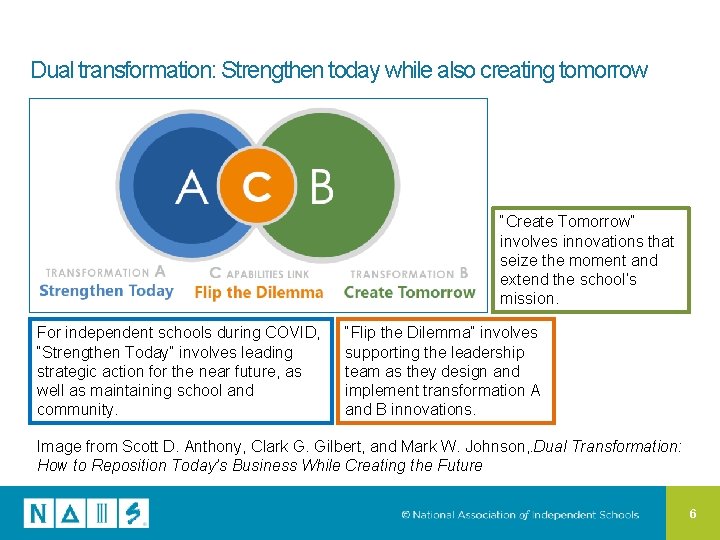
Dual transformation: Strengthen today while also creating tomorrow “Create Tomorrow” involves innovations that seize the moment and extend the school’s mission. For independent schools during COVID, “Strengthen Today” involves leading strategic action for the near future, as well as maintaining school and community. “Flip the Dilemma” involves supporting the leadership team as they design and implement transformation A and B innovations. Image from Scott D. Anthony, Clark G. Gilbert, and Mark W. Johnson, Dual Transformation: How to Reposition Today’s Business While Creating the Future , 6
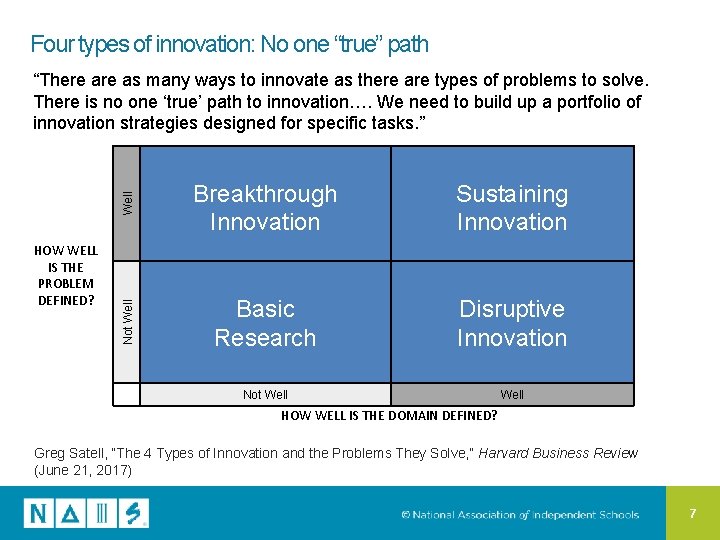
Four types of innovation: No one “true” path Well HOW WELL IS THE PROBLEM DEFINED? Breakthrough Innovation Sustaining Innovation Not Well “There as many ways to innovate as there are types of problems to solve. There is no one ‘true’ path to innovation…. We need to build up a portfolio of innovation strategies designed for specific tasks. ” Basic Research Disruptive Innovation Not Well HOW WELL IS THE DOMAIN DEFINED? Greg Satell, “The 4 Types of Innovation and the Problems They Solve, ” Harvard Business Review (June 21, 2017) 7
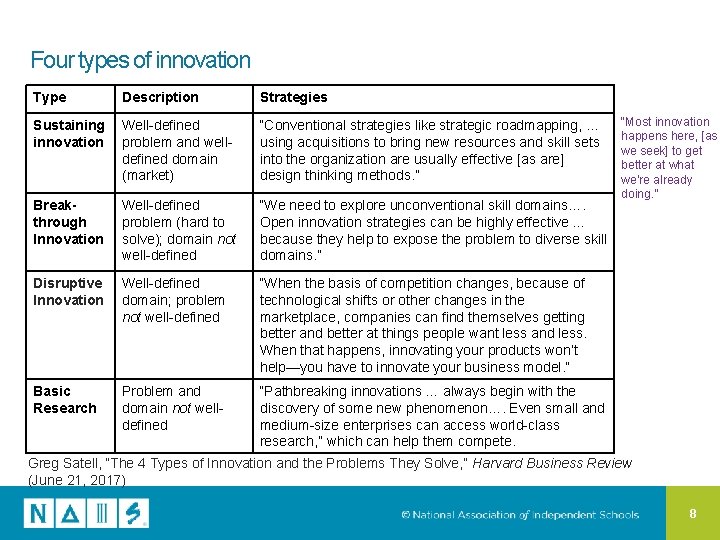
Four types of innovation Type Description Strategies Sustaining innovation Well-defined problem and welldefined domain (market) “Conventional strategies like strategic roadmapping, … using acquisitions to bring new resources and skill sets into the organization are usually effective [as are] design thinking methods. ” Breakthrough Innovation Well-defined problem (hard to solve); domain not well-defined “We need to explore unconventional skill domains…. Open innovation strategies can be highly effective … because they help to expose the problem to diverse skill domains. ” Disruptive Innovation Well-defined domain; problem not well-defined “When the basis of competition changes, because of technological shifts or other changes in the marketplace, companies can find themselves getting better and better at things people want less and less. When that happens, innovating your products won’t help—you have to innovate your business model. ” Basic Research Problem and domain not welldefined “Pathbreaking innovations … always begin with the discovery of some new phenomenon…. Even small and medium-size enterprises can access world-class research, ” which can help them compete. “Most innovation happens here, [as we seek] to get better at what we’re already doing. ” Greg Satell, “The 4 Types of Innovation and the Problems They Solve, ” Harvard Business Review (June 21, 2017) 8
New School Models/ Opportunities for Independent Schools
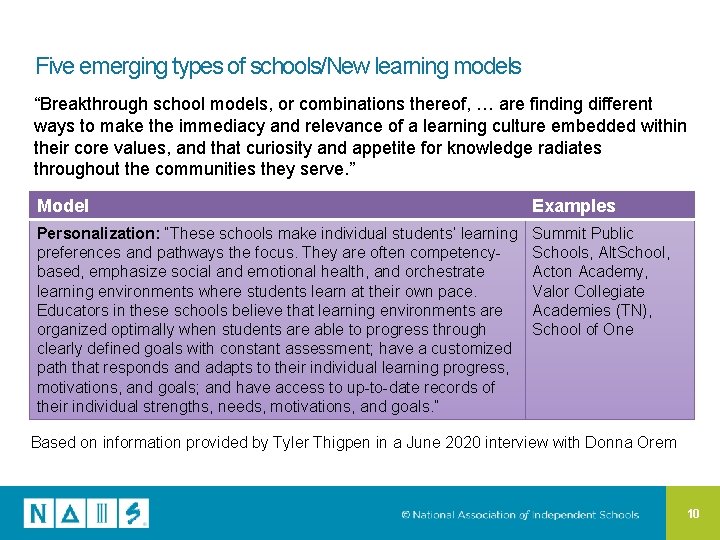
Five emerging types of schools/New learning models “Breakthrough school models, or combinations thereof, … are finding different ways to make the immediacy and relevance of a learning culture embedded within their core values, and that curiosity and appetite for knowledge radiates throughout the communities they serve. ” Model Examples Personalization: “These schools make individual students’ learning preferences and pathways the focus. They are often competencybased, emphasize social and emotional health, and orchestrate learning environments where students learn at their own pace. Educators in these schools believe that learning environments are organized optimally when students are able to progress through clearly defined goals with constant assessment; have a customized path that responds and adapts to their individual learning progress, motivations, and goals; and have access to up-to-date records of their individual strengths, needs, motivations, and goals. ” Summit Public Schools, Alt. School, Acton Academy, Valor Collegiate Academies (TN), School of One Based on information provided by Tyler Thigpen in a June 2020 interview with Donna Orem 10
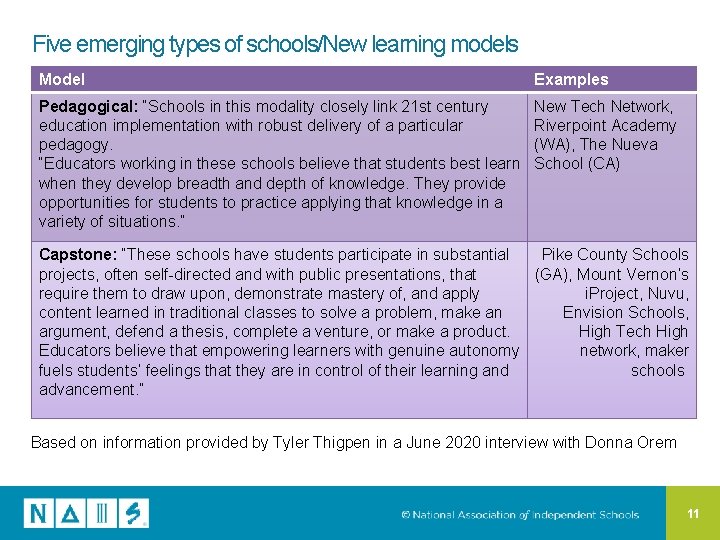
Five emerging types of schools/New learning models Model Examples Pedagogical: “Schools in this modality closely link 21 st century education implementation with robust delivery of a particular pedagogy. “Educators working in these schools believe that students best learn when they develop breadth and depth of knowledge. They provide opportunities for students to practice applying that knowledge in a variety of situations. ” New Tech Network, Riverpoint Academy (WA), The Nueva School (CA) Capstone: “These schools have students participate in substantial Pike County Schools projects, often self-directed and with public presentations, that (GA), Mount Vernon’s require them to draw upon, demonstrate mastery of, and apply i. Project, Nuvu, content learned in traditional classes to solve a problem, make an Envision Schools, argument, defend a thesis, complete a venture, or make a product. High Tech High Educators believe that empowering learners with genuine autonomy network, maker fuels students’ feelings that they are in control of their learning and schools advancement. ” Based on information provided by Tyler Thigpen in a June 2020 interview with Donna Orem 11
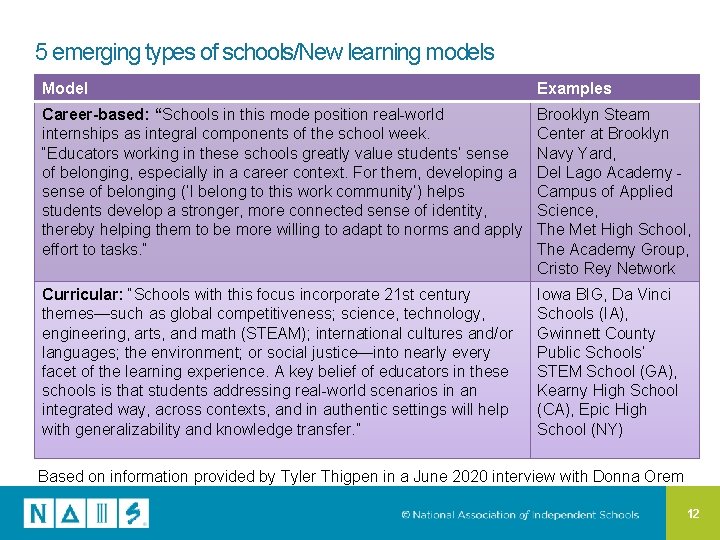
5 emerging types of schools/New learning models Model Examples Career-based: “Schools in this mode position real-world internships as integral components of the school week. “Educators working in these schools greatly value students’ sense of belonging, especially in a career context. For them, developing a sense of belonging (‘I belong to this work community’) helps students develop a stronger, more connected sense of identity, thereby helping them to be more willing to adapt to norms and apply effort to tasks. ” Brooklyn Steam Center at Brooklyn Navy Yard, Del Lago Academy Campus of Applied Science, The Met High School, The Academy Group, Cristo Rey Network Curricular: “Schools with this focus incorporate 21 st century themes—such as global competitiveness; science, technology, engineering, arts, and math (STEAM); international cultures and/or languages; the environment; or social justice—into nearly every facet of the learning experience. A key belief of educators in these schools is that students addressing real-world scenarios in an integrated way, across contexts, and in authentic settings will help with generalizability and knowledge transfer. ” Iowa BIG, Da Vinci Schools (IA), Gwinnett County Public Schools’ STEM School (GA), Kearny High School (CA), Epic High School (NY) Based on information provided by Tyler Thigpen in a June 2020 interview with Donna Orem 12
Creating conditions that drive transformation 1. Build conviction among adult communities. “I think it starts with the conviction that the traditional design of learning is no longer relevant for 2020 and beyond. The best way to build conviction is consistent adult learning journeys to expose school communities to learning science, the latest brain research, systemic inequities, new and inspiring learning models, and future trends, and to ask them to reflect on the implications for school design. It often takes 10 months to a year to lead adult communities through this type of journey, but after they consume the knowledge and experience, they’re hungry for a transformative model of learning. ” Include parents in this journey. 2. Have clarity on your school model and your strategy. 3. Encourage risk-taking to build a culture of innovation. Donna Orem, “A Conversation with Tyler Thigpen on School Transformation, ” Independent Ideas Blog (June 25, 2020) 13
Race and school transformation “As we work to incorporate design thinking, project-based learning, and other innovative approaches into our curriculum, what if we also were to retool our curriculum to incorporate a systemic analysis of racism and other aspects of systemic inequality? “School courses that deal with racism can present students with the kinds of cognitive conflicts, contradictions and dissonance that are important for the development of more complex structural thinking. What if we shifted from a focus on ‘diversity and inclusion’ toward a focus on understanding systemic oppression? And, what if we no longer relegated learning about racism to the annual Martin Luther King Day observance, and instead grounded it in classrooms where the scholarly work of oppression theory took a place beside other social science theory? What if all of our students were equipped with an understanding of the conceptual frameworks of racism so that informed and nuanced discussions about systemic inequality became a common part of our economics, history, civics, literature, and science courses? How could enhanced critical analysis skills further prepare them for college and beyond? What other aspects of society could become visible to them through an informed and critical lens? ” Sheri Lyn Schmidt, “We Need to Talk: The Case for Making a Place for Race in Schools, ” Independent School Magazine (Fall 2018) 14
The NAIS 2025 and Beyond Initiative In April, we challenged members to imagine what independent schools could be in our changing context. Inspired by a Stanford d. school’s higher education challenge, we offered “provocations” (Slide 16), that is, areas of independent school models ripe for innovation. Elements of some of your colleagues’ submissions are highlighted on the following slides. Thank you to all who took the time to think big and to share their ideas. Sylvie Andrews Paul Kim Alden Blodget Grant Lichtman David Brock Rick Malmstrom Sarah Brock Sean Marcus Thomas Carlson-Reddig Sara Rubinstein Alexa Carver Jim Scott Tracie Catlett Jeff Terwin Paul Chapman Sean Tracy Kevin Costa Linda Vasu Tomas Eliaeson Kelley Waldron Scott Erickson Andy Williams Lee Fertig 15
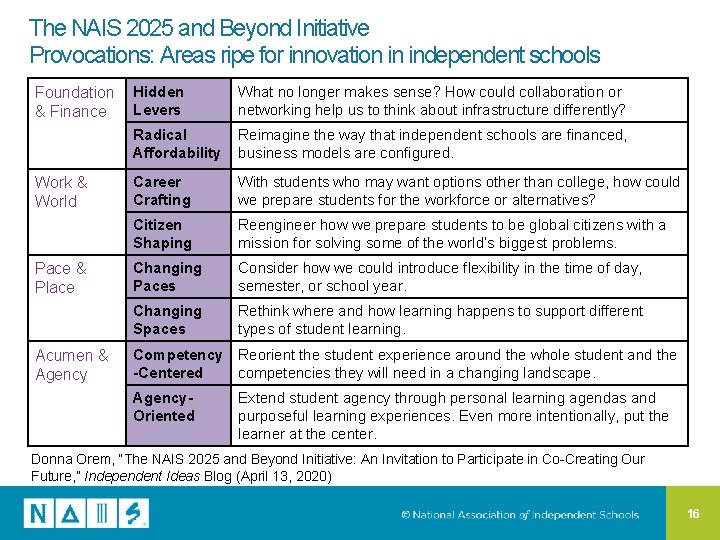
The NAIS 2025 and Beyond Initiative Provocations: Areas ripe for innovation in independent schools Foundation & Finance Work & World Pace & Place Acumen & Agency Hidden Levers What no longer makes sense? How could collaboration or networking help us to think about infrastructure differently? Radical Affordability Reimagine the way that independent schools are financed, business models are configured. Career Crafting With students who may want options other than college, how could we prepare students for the workforce or alternatives? Citizen Shaping Reengineer how we prepare students to be global citizens with a mission for solving some of the world’s biggest problems. Changing Paces Consider how we could introduce flexibility in the time of day, semester, or school year. Changing Spaces Rethink where and how learning happens to support different types of student learning. Competency -Centered Reorient the student experience around the whole student and the competencies they will need in a changing landscape. Agency. Oriented Extend student agency through personal learning agendas and purposeful learning experiences. Even more intentionally, put the learner at the center. Donna Orem, “The NAIS 2025 and Beyond Initiative: An Invitation to Participate in Co-Creating Our Future, ” Independent Ideas Blog (April 13, 2020) 16
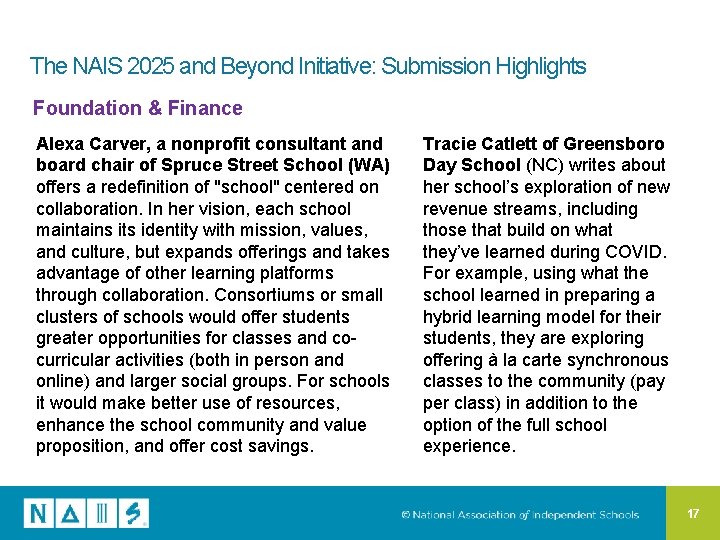
The NAIS 2025 and Beyond Initiative: Submission Highlights Foundation & Finance Alexa Carver, a nonprofit consultant and board chair of Spruce Street School (WA) offers a redefinition of "school" centered on collaboration. In her vision, each school maintains its identity with mission, values, and culture, but expands offerings and takes advantage of other learning platforms through collaboration. Consortiums or small clusters of schools would offer students greater opportunities for classes and cocurricular activities (both in person and online) and larger social groups. For schools it would make better use of resources, enhance the school community and value proposition, and offer cost savings. Tracie Catlett of Greensboro Day School (NC) writes about her school’s exploration of new revenue streams, including those that build on what they’ve learned during COVID. For example, using what the school learned in preparing a hybrid learning model for their students, they are exploring offering à la carte synchronous classes to the community (pay per class) in addition to the option of the full school experience. 17
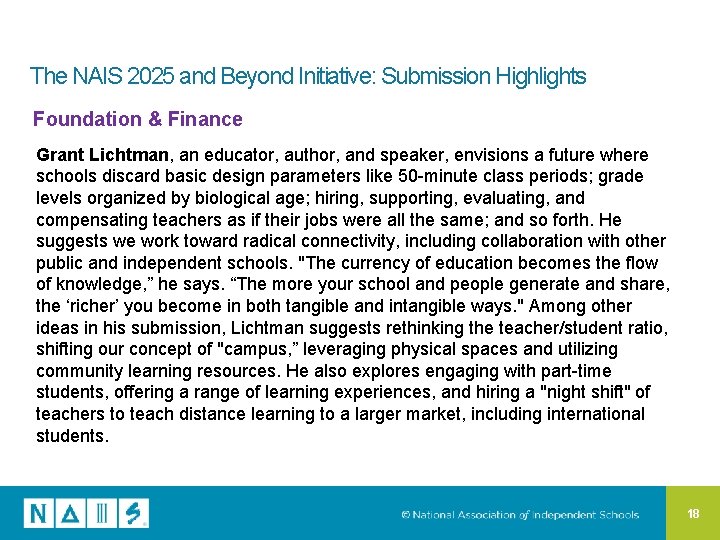
The NAIS 2025 and Beyond Initiative: Submission Highlights Foundation & Finance Grant Lichtman, an educator, author, and speaker, envisions a future where schools discard basic design parameters like 50 -minute class periods; grade levels organized by biological age; hiring, supporting, evaluating, and compensating teachers as if their jobs were all the same; and so forth. He suggests we work toward radical connectivity, including collaboration with other public and independent schools. "The currency of education becomes the flow of knowledge, ” he says. “The more your school and people generate and share, the ‘richer’ you become in both tangible and intangible ways. " Among other ideas in his submission, Lichtman suggests rethinking the teacher/student ratio, shifting our concept of "campus, ” leveraging physical spaces and utilizing community learning resources. He also explores engaging with part-time students, offering a range of learning experiences, and hiring a "night shift" of teachers to teach distance learning to a larger market, including international students. 18
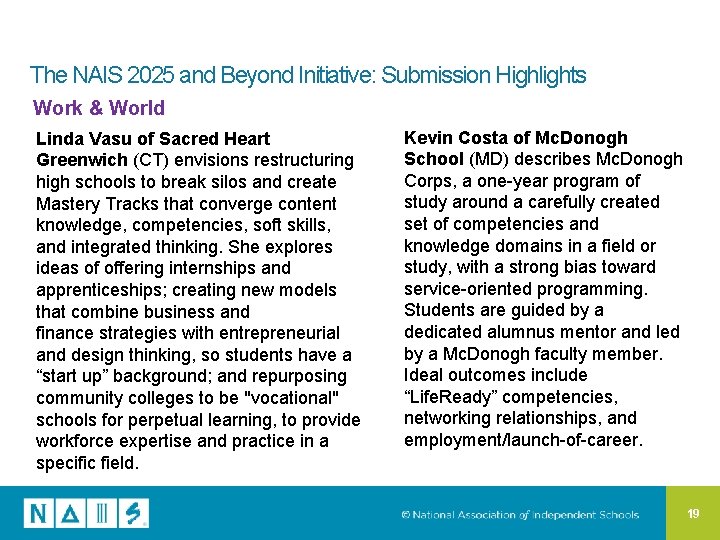
The NAIS 2025 and Beyond Initiative: Submission Highlights Work & World Linda Vasu of Sacred Heart Greenwich (CT) envisions restructuring high schools to break silos and create Mastery Tracks that converge content knowledge, competencies, soft skills, and integrated thinking. She explores ideas of offering internships and apprenticeships; creating new models that combine business and finance strategies with entrepreneurial and design thinking, so students have a “start up” background; and repurposing community colleges to be "vocational" schools for perpetual learning, to provide workforce expertise and practice in a specific field. Kevin Costa of Mc. Donogh School (MD) describes Mc. Donogh Corps, a one-year program of study around a carefully created set of competencies and knowledge domains in a field or study, with a strong bias toward service-oriented programming. Students are guided by a dedicated alumnus mentor and led by a Mc. Donogh faculty member. Ideal outcomes include “Life. Ready” competencies, networking relationships, and employment/launch-of-career. 19
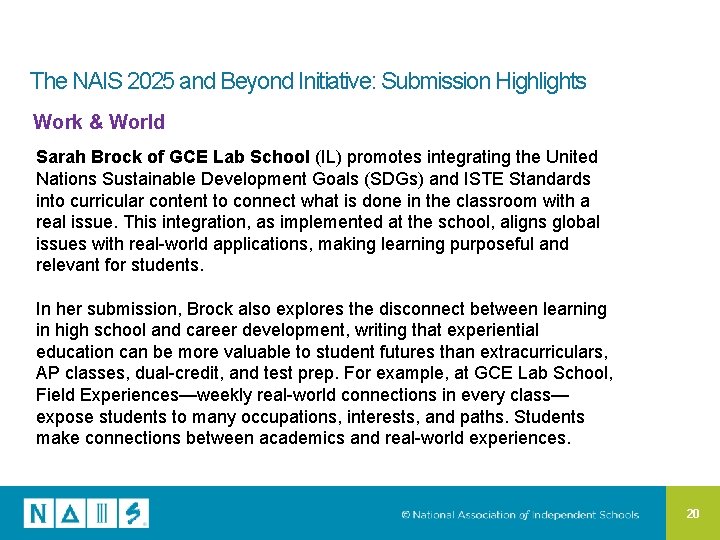
The NAIS 2025 and Beyond Initiative: Submission Highlights Work & World Sarah Brock of GCE Lab School (IL) promotes integrating the United Nations Sustainable Development Goals (SDGs) and ISTE Standards into curricular content to connect what is done in the classroom with a real issue. This integration, as implemented at the school, aligns global issues with real-world applications, making learning purposeful and relevant for students. In her submission, Brock also explores the disconnect between learning in high school and career development, writing that experiential education can be more valuable to student futures than extracurriculars, AP classes, dual-credit, and test prep. For example, at GCE Lab School, Field Experiences—weekly real-world connections in every class— expose students to many occupations, interests, and paths. Students make connections between academics and real-world experiences. 20
The NAIS 2025 and Beyond Initiative: Submission Highlights Work & World Sylvie Andrews of Flintridge Preparatory School (CA) believes that schools should offer students opportunities to experiment with different career paths to better prepare them for the world of work. In her submission, she also challenges schools to think differently about their role as citizens of the world, for example in how they approach global travel. She asks, "How can schools preserve exposure to global culture and ideas while lessening the carbon footprint of that exposure? " 21
The NAIS 2025 and Beyond Initiative: Submission Highlights Work & World Andy Williams of Avenues: The World School (Brazil) describes a partnership his school has undertaken with the Museum of Tomorrow to develop a new paradigm, a new concept to education, which they have termed Futures Literacy. The curriculum aims to help students connect with key global issues and themes of the 21 st century. Students meet with a cohort of faculty members to engage with interdisciplinary projects that focus on emergent themes (public health, regeneration, globalization, equity and identity, Systems Thinking) from the global, local, and personal perspectives. Each interdisciplinary project allows for a deeper dive into a futures-orientated threshold concept. Students develop competencies and skills in creativity, cognitive flexibility, leadership, and critical thinking. They also gain a deeper understanding of change, uncertainty, and complexity (a future-oriented mindset). 22
The NAIS 2025 and Beyond Initiative: Submission Highlights Pace & Place Kelley Waldron of St. Andrew's School (GA) and Sara Rubinstein of Carrollwood Day School (FL) explore in their joint submission how separation can enable inclusion. For students with severe health conditions (e. g. , cancer, sickle cell, mental illness), the ability to learn virtually has been a game changer. The ability to adapt and create solutions for individual students has broadened educators’ mindsets on how they can better serve students and families. Waldron and Rubinstein conclude, “With continued faculty support and a commitment to growing in our understanding of what missionappropriate learning can look like beyond the classroom and campus, we believe that this moment may allow independent school communities to take an important step forward in equity and inclusion. ” 23
The NAIS 2025 and Beyond Initiative: Submission Highlights Acumen & Agency Lee Fertig of The Nueva School (CA) writes that business models, operational protocols, character development, and personalized learning all depend on the ability to put the student at the center of improvement efforts. Fertig envisions an approach that brings together access, agency, and aspiration. • Increasing access and diversity: Increase financial assistance, develop opportunities for students with special learning needs, integrate therapeutic services into programs. • Enhancing agency: For all students, provide an Individual Learning Plan and a portfolio system to monitor their learning. Extend extracurricular offerings so students can pursue interests and direct their own learning. Enhance professional development for faculty and staff. • Supporting aspirations: Make guidance and mentoring available to children in younger grades, broaden internship and work-related programs, expand visiting authors/scholars programs, and offer service-learning activities that encourage environmental awareness and global citizenship. 24
The NAIS 2025 and Beyond Initiative: Submission Highlights Acumen & Agency Sean Marcus of Carrollwood Day School (FL) writes: “True agency originates from student curiosity and inquiry outside the constraints of time and an arbitrary division into disciplines. ” He advocates being willing to let go of the walls between disciplines and traditional structures confined to specific subject areas. In his vision: • Elective courses (not core courses) lead the way. Core learning is blended into the research and application of the high-interest subjects. • Students and families could participate in reverse school, where facilities and faculty could be utilized at each student’s pace and schedule. 25
The NAIS 2025 and Beyond Initiative: Submission Highlights Acumen & Agency Jeff Terwin of Wellington School (OH) believes that students deserve the freedom to explore big ideas. He envisions a school framework that allows the work to happen in a continuous flow and where students are active participants in their own education. Students pursue topics of personal interest and gain greater mastery of subjects. Wellington School recently unveiled Wonderlab, a research and creative works incubator that supports student “startups. ” Independent research opportunities encourage networking and communication skills in addition to data collection and analysis with an outside research expert. 26
NAIS resources to support innovation Networking and Collaboration • Meetups • Sharing Solutions, share. nais. org Training • NAIS Strategy Lab programs and online resources aim to help schools develop both a structured process and the overall capacity and disposition for innovation. • Online Course: Reopen Planning: A Course in Collaborative Rapid Prototyping. Using scenario planning and other frameworks for collaboration and project level innovation, this beta course (free for NAIS members) can help school teams think tactically about reopening. It includes three two-week sprints and cross-school meetups. Incubator Program (Fall 2020) A cohort of four to six schools will participate in a three-month virtual journey. Teams will reflect on their own practices, mindsets, and culture to identify the conditions of innovation necessary to make progress. They will research new school models. And they will create a blueprint for financial, pedagogical, and systemic steps necessary to bring their ideas to market. 27
References • Transcend, “ 3 Jobs That Matter for School Communities Navigating a COVID World” • Scott D. Anthony, Clark G. Gilbert, and Mark W. Johnson, Dual Transformation: How to Reposition Today’s Business While Creating the Future • Greg Satell, “The 4 Types of Innovation and the Problems They Solve, ” Harvard Business Review • Donna Orem, “A Conversation with Tyler Thigpen on School Transformation, ” Independent Ideas Blog • Sheri Lyn Schmidt, “We Need to Talk: The Case for Making a Place for Race in Schools, ” Independent School Magazine • Donna Orem, “The NAIS 2025 and Beyond Initiative: An Invitation to Participate in Co-Creating Our Future, ” Independent Ideas Blog • Sharing Solutions, share. nais. org • NAIS Webinars and Meetups, nais. org/webinars • NAIS Strategy Lab, strategylab. nais. org • NAIS Online Learning, learn. nais. org 28