
School Funding State Funded District How does it
- Slides: 20
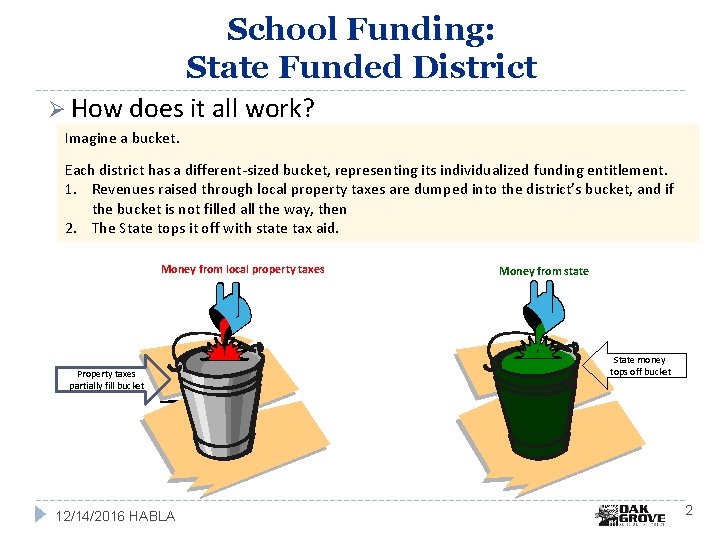
School Funding: State Funded District Ø How does it all work? Imagine a bucket. Each district has a different-sized bucket, representing its individualized funding entitlement. 1. Revenues raised through local property taxes are dumped into the district’s bucket, and if the bucket is not filled all the way, then 2. The State tops it off with state tax aid. Money from local property taxes Property taxes partially fill bucket 12/14/2016 HABLA Money from state State money tops off bucket 2
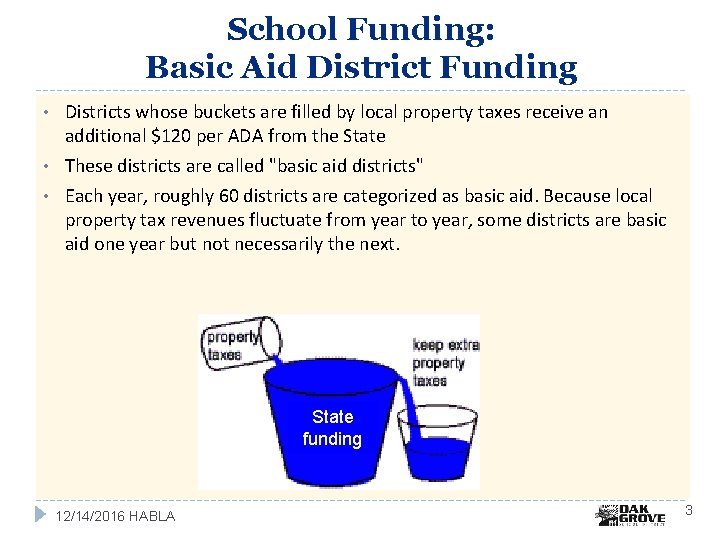
School Funding: Basic Aid District Funding • • • Districts whose buckets are filled by local property taxes receive an additional $120 per ADA from the State These districts are called "basic aid districts" Each year, roughly 60 districts are categorized as basic aid. Because local property tax revenues fluctuate from year to year, some districts are basic aid one year but not necessarily the next. State funding 12/14/2016 HABLA 3
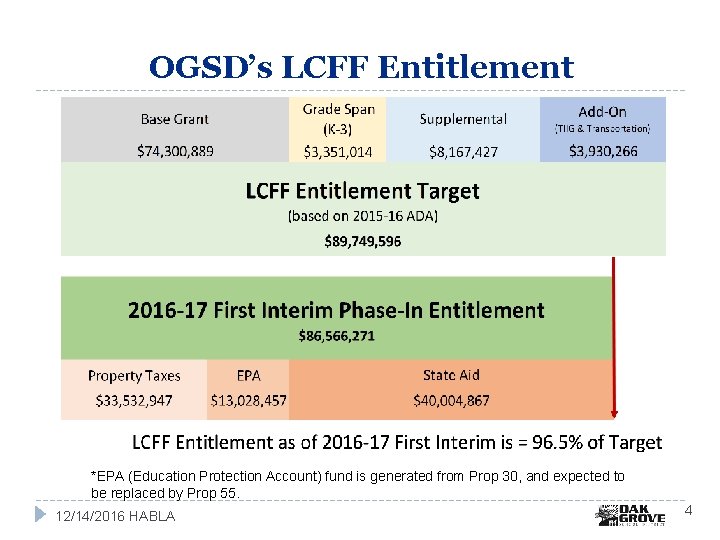
OGSD’s LCFF Entitlement *EPA (Education Protection Account) fund is generated from Prop 30, and expected to be replaced by Prop 55. 12/14/2016 HABLA 4
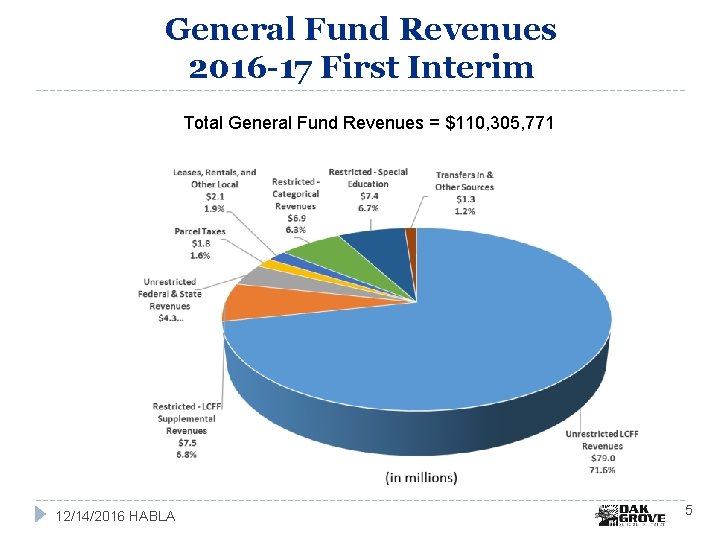
General Fund Revenues 2016 -17 First Interim Total General Fund Revenues = $110, 305, 771 12/14/2016 HABLA 5
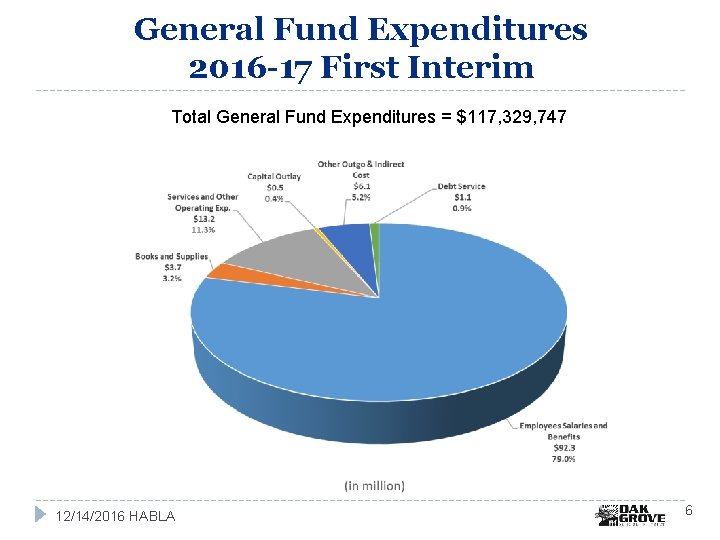
General Fund Expenditures 2016 -17 First Interim Total General Fund Expenditures = $117, 329, 747 12/14/2016 HABLA 6
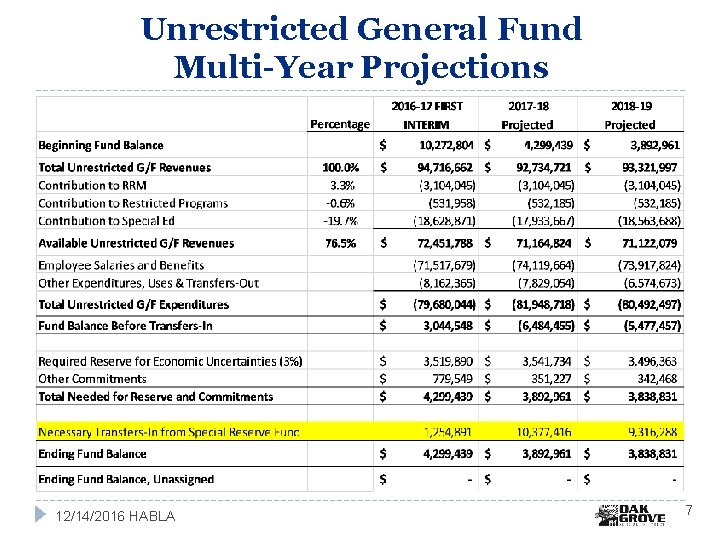
Unrestricted General Fund Multi-Year Projections 12/14/2016 HABLA 7
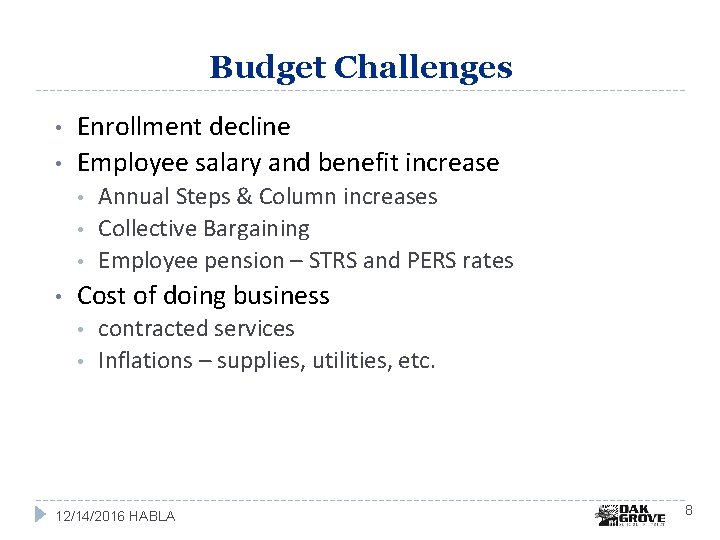
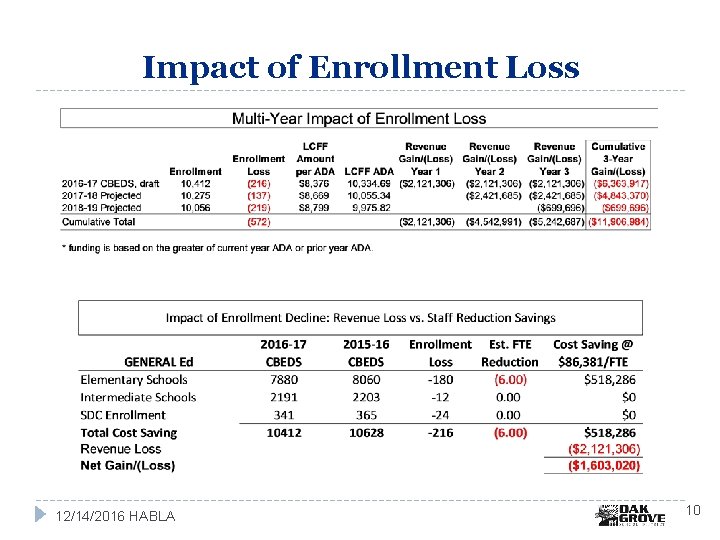
Budget Challenges • • Enrollment decline Employee salary and benefit increase • • Annual Steps & Column increases Collective Bargaining Employee pension – STRS and PERS rates Cost of doing business • • contracted services Inflations – supplies, utilities, etc. 12/14/2016 HABLA 8
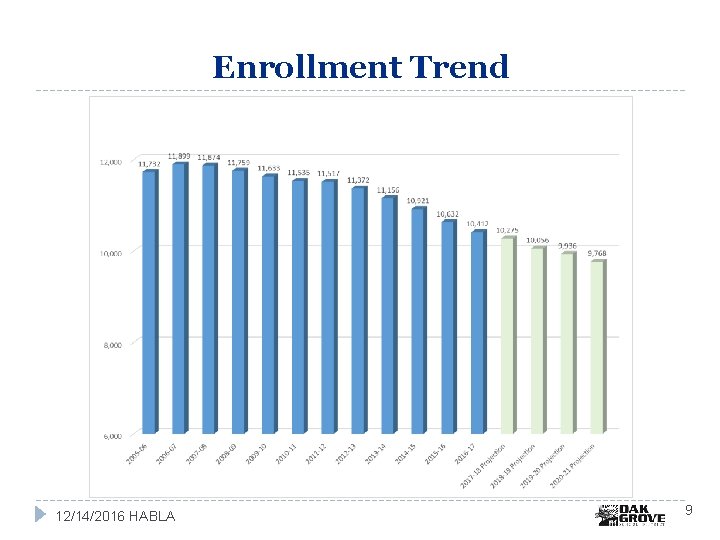
Enrollment Trend 12/14/2016 HABLA 9
Impact of Enrollment Loss 12/14/2016 HABLA 10
Facility Review 12/14/2016 HABLA 11
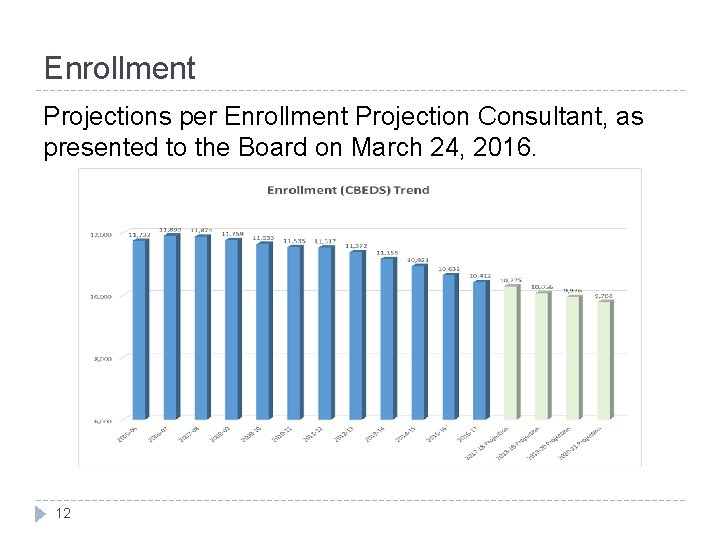
Enrollment Projections per Enrollment Projection Consultant, as presented to the Board on March 24, 2016. 12
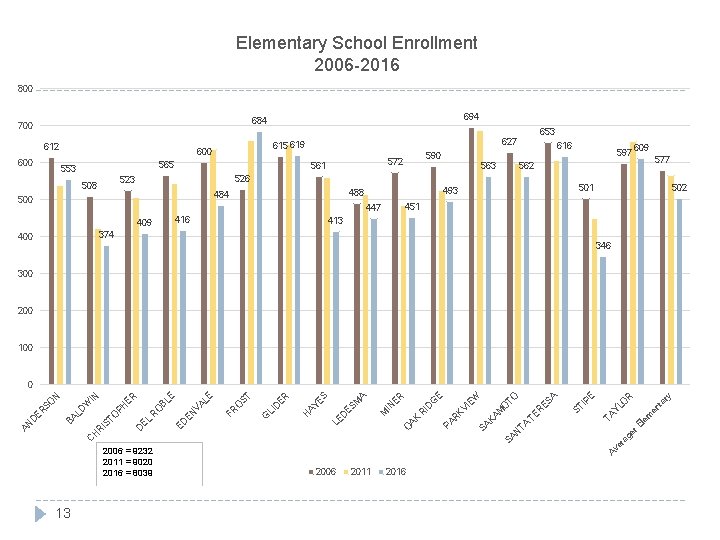
Elementary School Enrollment 2006 -2016 800 694 684 700 612 600 565 553 590 572 561 563 616 409 502 451 447 416 577 501 493 488 484 500 597 609 562 526 523 508 653 627 615 619 413 374 400 346 300 200 100 2011 2016 en t em El ag er Av 2006 ar y R YL O TA IP E er R SA N TA TE M KA ST ES A TO O W SA KV IE ID R AK O LE C 2006 = 9232 2011 = 9020 2016 = 8039 13 PA R G E ER M ES D IN A M ES AY H ER G LI D ST O FR VA L EN ED O R EL D TO IS H R E BL E ER PH W LD BA AN D ER SO N IN 0
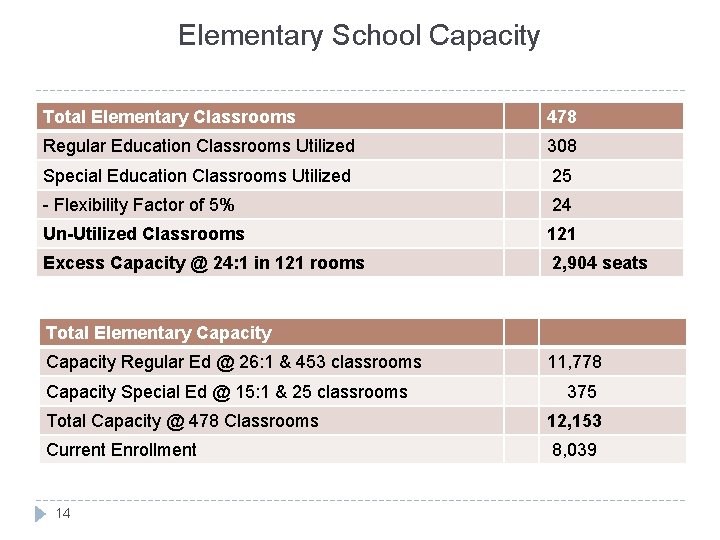
Elementary School Capacity Total Elementary Classrooms 478 Regular Education Classrooms Utilized 308 Special Education Classrooms Utilized 25 - Flexibility Factor of 5% 24 Un-Utilized Classrooms 121 Excess Capacity @ 24: 1 in 121 rooms 2, 904 seats Total Elementary Capacity Regular Ed @ 26: 1 & 453 classrooms Capacity Special Ed @ 15: 1 & 25 classrooms 11, 778 375 Total Capacity @ 478 Classrooms 12, 153 Current Enrollment 8, 039 14
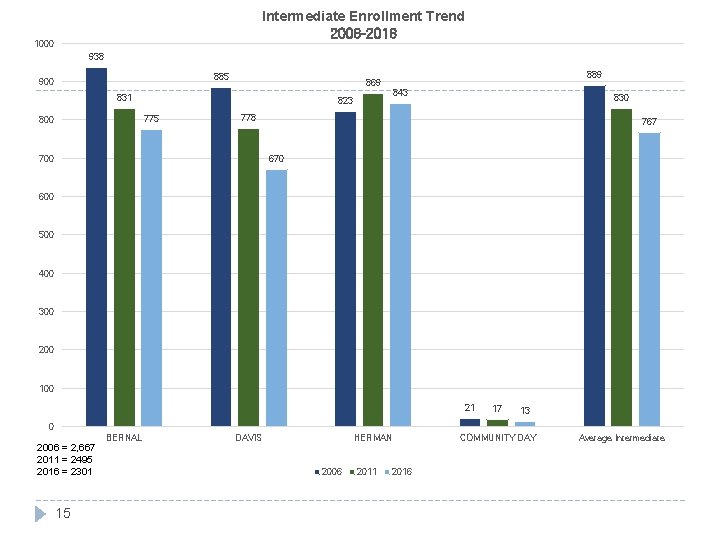
Intermediate Enrollment Trend 2006 -2016 1000 938 885 900 831 843 823 775 800 889 869 830 778 700 767 670 600 500 400 300 200 100 21 17 13 0 2006 = 2, 667 2011 = 2495 2016 = 2301 15 BERNAL DAVIS HERMAN 2006 2011 2016 COMMUNITY DAY Average Intermediate
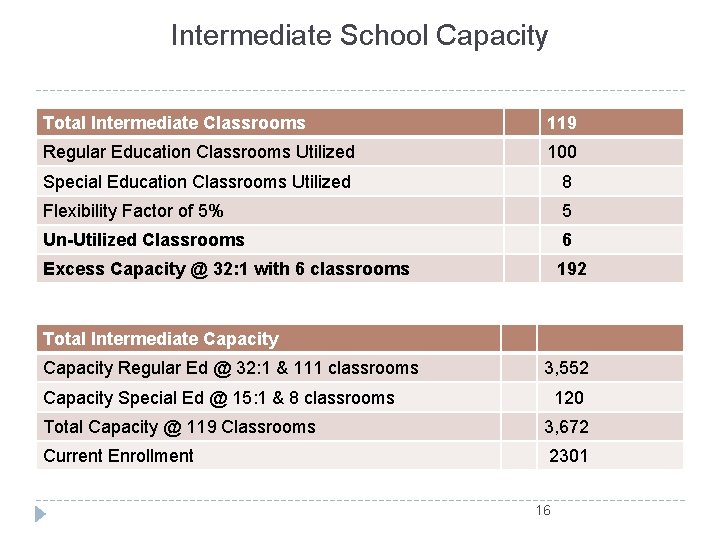
Intermediate School Capacity Total Intermediate Classrooms 119 Regular Education Classrooms Utilized 100 Special Education Classrooms Utilized 8 Flexibility Factor of 5% 5 Un-Utilized Classrooms 6 Excess Capacity @ 32: 1 with 6 classrooms 192 Total Intermediate Capacity Regular Ed @ 32: 1 & 111 classrooms 3, 552 Capacity Special Ed @ 15: 1 & 8 classrooms 120 Total Capacity @ 119 Classrooms 3, 672 Current Enrollment 2301 16
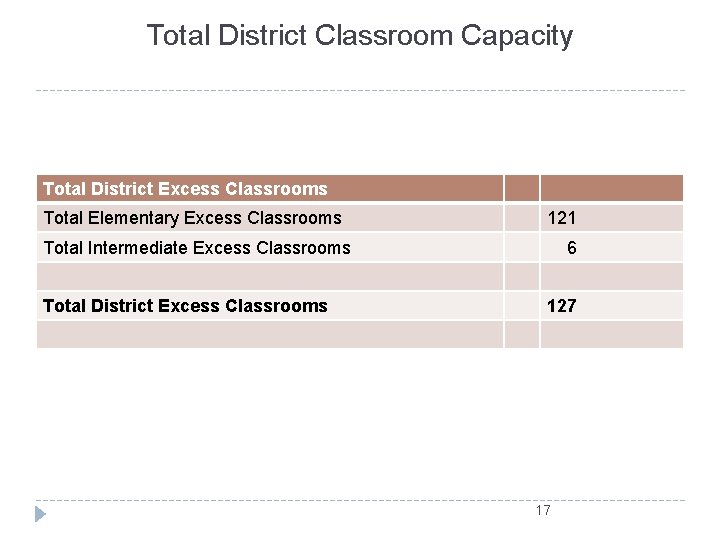
Total District Classroom Capacity Total District Excess Classrooms Total Elementary Excess Classrooms 121 Total Intermediate Excess Classrooms Total District Excess Classrooms 6 127 17
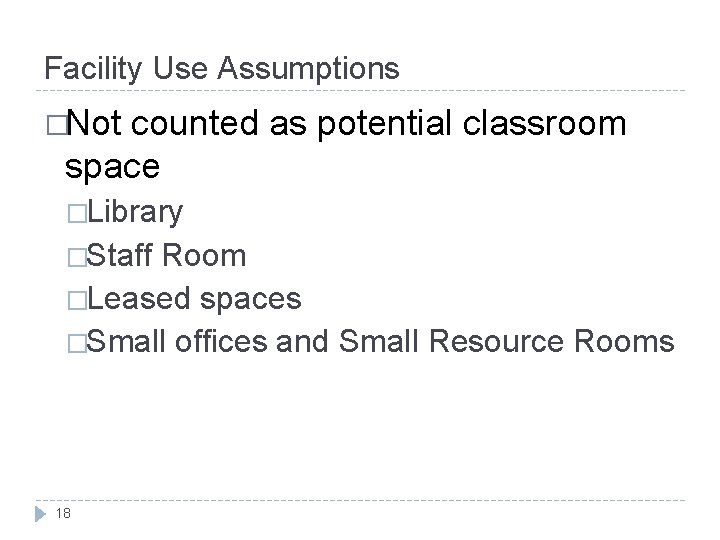
Facility Use Assumptions �Not counted as potential classroom space �Library �Staff Room �Leased spaces �Small offices and Small Resource Rooms 18
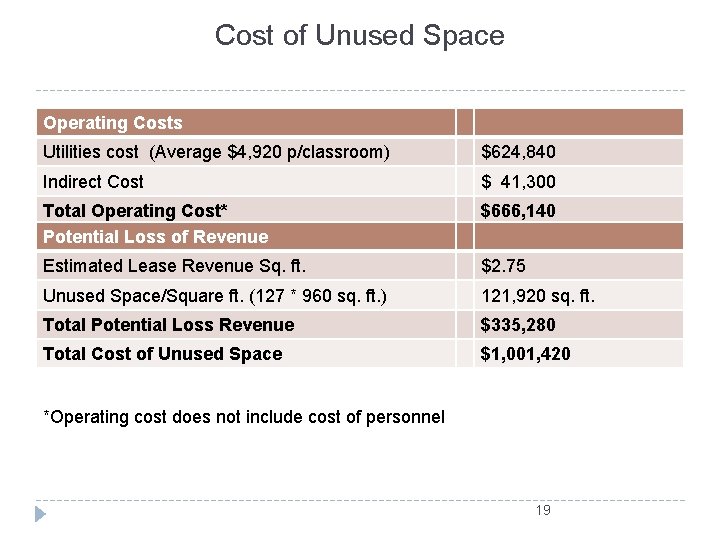
Cost of Unused Space Operating Costs Utilities cost (Average $4, 920 p/classroom) $624, 840 Indirect Cost $ 41, 300 Total Operating Cost* Potential Loss of Revenue $666, 140 Estimated Lease Revenue Sq. ft. $2. 75 Unused Space/Square ft. (127 * 960 sq. ft. ) 121, 920 sq. ft. Total Potential Loss Revenue $335, 280 Total Cost of Unused Space $1, 001, 420 *Operating cost does not include cost of personnel 19
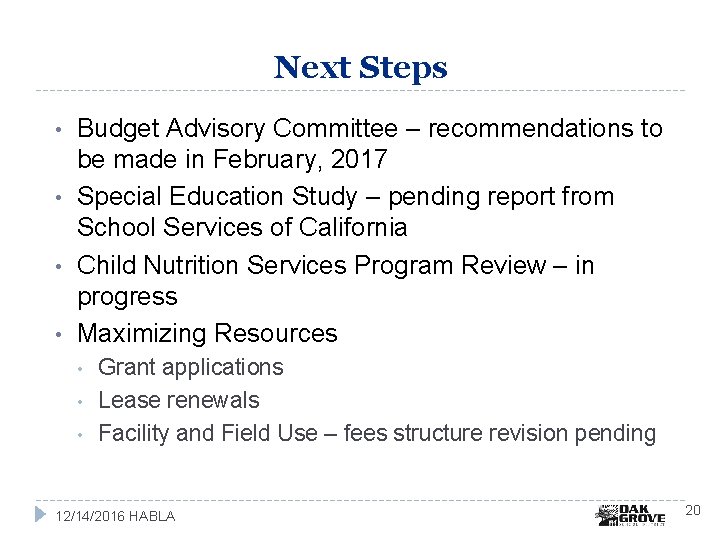
Next Steps • • Budget Advisory Committee – recommendations to be made in February, 2017 Special Education Study – pending report from School Services of California Child Nutrition Services Program Review – in progress Maximizing Resources • • • Grant applications Lease renewals Facility and Field Use – fees structure revision pending 12/14/2016 HABLA 20
Thank You 12/14/2016 HABLA 21