
School Experiences Delinquency Agnew 15 Which School Experiences


- Slides: 12
School Experiences & Delinquency Agnew (15)
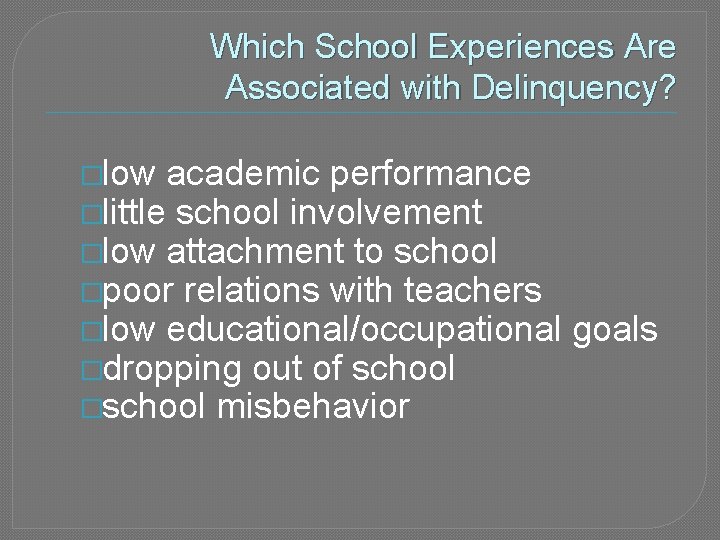
Which School Experiences Are Associated with Delinquency? �low academic performance �little school involvement �low attachment to school �poor relations with teachers �low educational/occupational goals �dropping out of school �school misbehavior
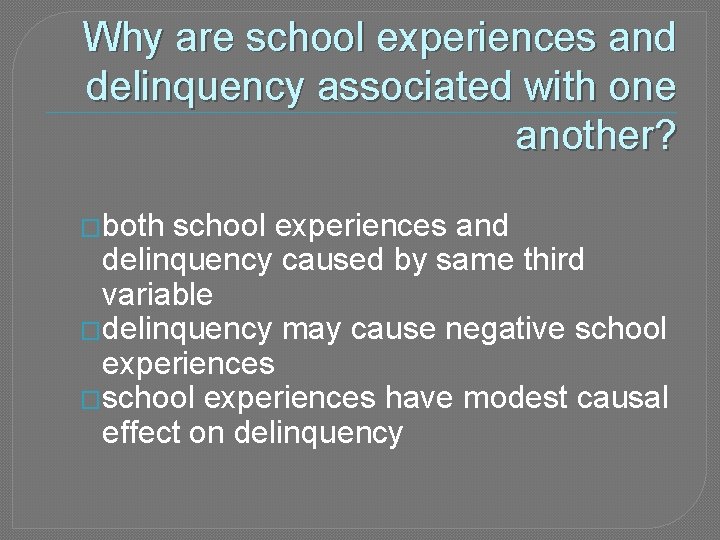
Why are school experiences and delinquency associated with one another? �both school experiences and delinquency caused by same third variable �delinquency may cause negative school experiences �school experiences have modest causal effect on delinquency
Negative School Experiences
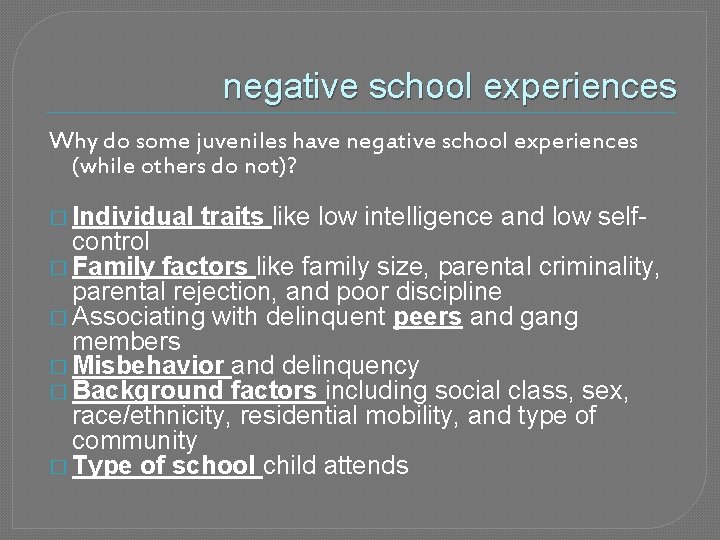
negative school experiences Why do some juveniles have negative school experiences (while others do not)? � Individual traits like low intelligence and low self- control � Family factors like family size, parental criminality, parental rejection, and poor discipline � Associating with delinquent peers and gang members � Misbehavior and delinquency � Background factors including social class, sex, race/ethnicity, residential mobility, and type of community � Type of school child attends
School Characteristics
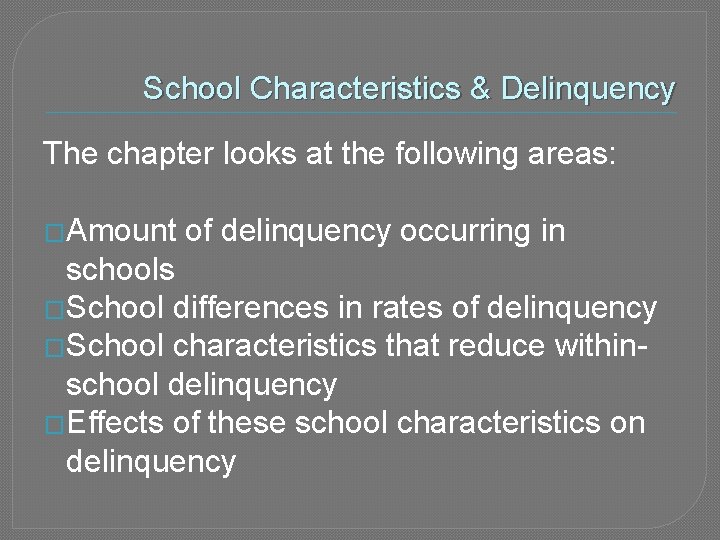
School Characteristics & Delinquency The chapter looks at the following areas: �Amount of delinquency occurring in schools �School differences in rates of delinquency �School characteristics that reduce withinschool delinquency �Effects of these school characteristics on delinquency
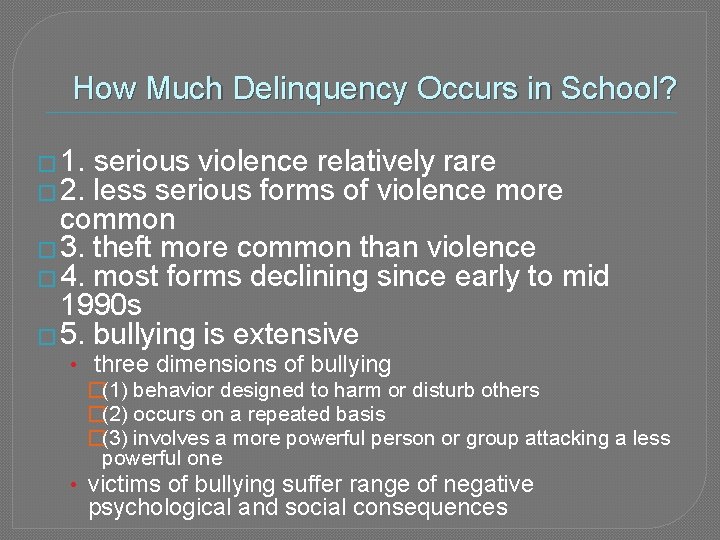
How Much Delinquency Occurs in School? � 1. � 2. serious violence relatively rare less serious forms of violence more common � 3. theft more common than violence � 4. most forms declining since early to mid 1990 s � 5. bullying is extensive • three dimensions of bullying �(1) behavior designed to harm or disturb others �(2) occurs on a repeated basis �(3) involves a more powerful person or group attacking a less powerful one • victims of bullying suffer range of negative psychological and social consequences
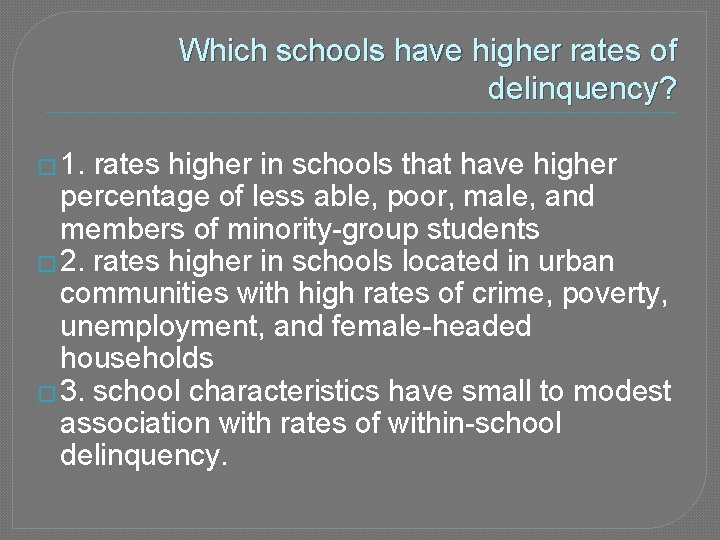
Which schools have higher rates of delinquency? � 1. rates higher in schools that have higher percentage of less able, poor, male, and members of minority-group students � 2. rates higher in schools located in urban communities with high rates of crime, poverty, unemployment, and female-headed households � 3. school characteristics have small to modest association with rates of within-school delinquency.
What characteristics reduce in-school delinquency? � 1. small, with good resources • average teacher instructs smaller number of different students • teachers are provided with needed materials and equipment � 2. good discipline • clear rules that are consistently reinforced • not overly punitive � 3. provide opportunities for student success and praise students for accomplishments � 4. high expectations for students
� 5. pleasant working conditions for students • teachers have positive attitudes toward and show concern for students • teachers create pleasant physical space for students to work � 6. good cooperation between the administration and teachers • administrators and counselors keep teacher informed of disciplinary problems • administrators and counselors assist teachers in their disciplinary efforts � 7. strong community involvement
How do these characteristics reduce delinquency? � 1. create less strain � 2. subject students to greater control � 3. more likely to punish delinquency and reinforce conformity � 4. provide less exposure to delinquent others � 5. less likely to label students as “bad”