
School Engagement with Particle Physics Francesco Gonnella Cristina
- Slides: 16
School Engagement with Particle Physics Francesco Gonnella, Cristina Lazzeroni, Konstantinos Nikolopoulos, Maria Pavlidou ICFNP 2018 – Kolymvari, Crete, Greece 7 July 2018 enthusing future Physicists at the Uo. B
A variety of school activities o Primary school project “The Particle World” o Secondary school projects “Physics & Dance” and “Physics and Art” o Loan system for cloud chamber and cosmic telescope to local schools, with an experiment pack for teachers (proper experiments, developing maths and computing skills as well as physics) o Hi. SPARC project (see dedicated talk) o MINERVA - ATLAS event display used to analysed data Only time to talk about the projects in red 7 July 2018 Francesco Gonnella - University of Birmingham 2
The Particle World: Why targeting primary schools? o children develop awareness and attitudes towards STEM related careers at an early age o children hear in the news about CERN and the discovery of new particles and ask questions to their teachers o particle “families” and interactions can be understood at a basic level due to their similarity to human family dynamics 7 July 2018 Francesco Gonnella - University of Birmingham 3
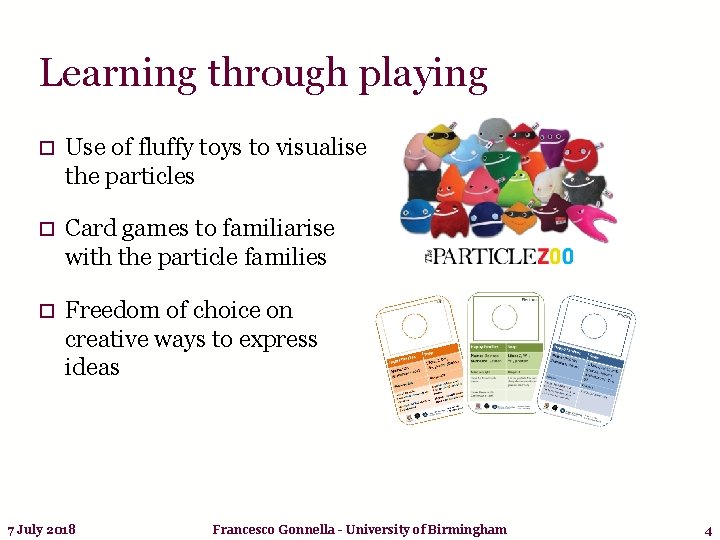
Learning through playing o Use of fluffy toys to visualise the particles o Card games to familiarise with the particle families o Freedom of choice on creative ways to express ideas 7 July 2018 Francesco Gonnella - University of Birmingham 4
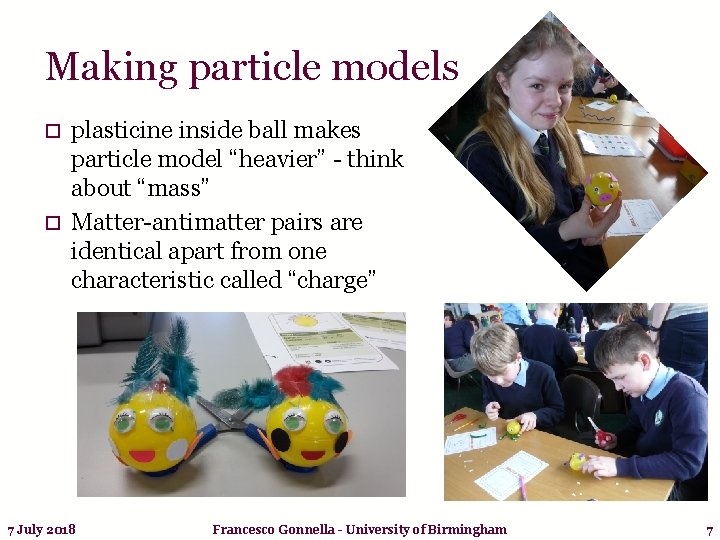
Structure of workshop o o o Introductory talk “Happy Families” card game to learn particle families Particle model making, using plasticine (for mass), plastic balls and decoration materials “Snap” card game to learn particle’s “likes” and “dislikes” Creative writing/playing to show the interaction between particles that “like” each other 7 July 2018 Francesco Gonnella - University of Birmingham 5
Examples of ideas delivered o o o Matter is structured like Russian Dolls (particles inside particles) The LHC accelerates particles to almost the speed of light Destroying particles (through collision) allows us to discover what they are made of The ATLAS detector at CERN acts like a very fast digital camera Particles are grouped into families: quarks, leptons, bosons, anti-quarks, anti-leptons (similar behaviour) Particles interact with other particles they “like” (strength of coupling constants) 7 July 2018 Francesco Gonnella - University of Birmingham 6
Making particle models plasticine inside ball makes particle model “heavier” - think about “mass” o Matter-antimatter pairs are identical apart from one characteristic called “charge” o 7 July 2018 Francesco Gonnella - University of Birmingham 7
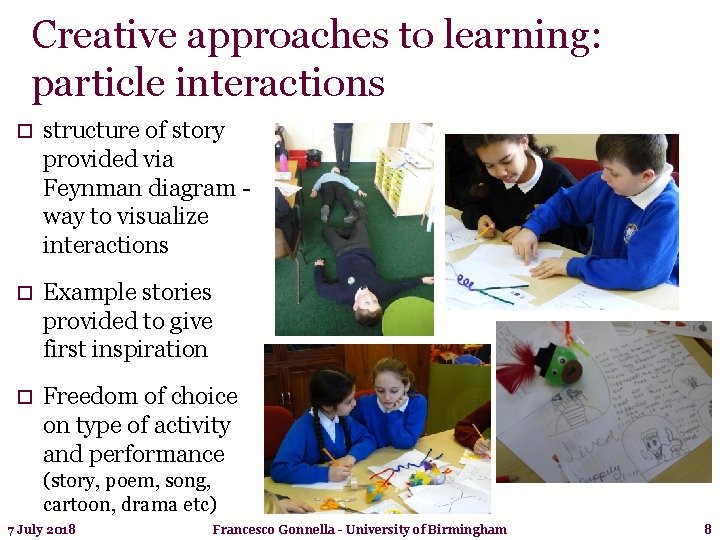
Creative approaches to learning: particle interactions o structure of story provided via Feynman diagram way to visualize interactions o Example stories provided to give first inspiration o Freedom of choice on type of activity and performance (story, poem, song, cartoon, drama etc) 7 July 2018 Francesco Gonnella - University of Birmingham 8
Evaluation Two student questionnaires: immediately after and a month later o 100% could describe new acquired knowledge after a month o 93% explained what they learned to friends and family o 93% admitted they are more interested in science as a result o 80% said the day made them more excited about going to University 7 July 2018 Francesco Gonnella - University of Birmingham 9
Legacy o Resources translated into Greek, Italian and used by EU project CREATIONS o Resources used in 12 UK Universities with the support of the Odgen Trust o Resources used by CERN and STFC o Resources recently translated into Braille and trialled at workshop for visually impaired children 7 July 2018 Francesco Gonnella - University of Birmingham 10
Particle Physics and Fine Art o Scientific developments have seen reality dissolved into smaller and smaller invisible particles that the physicist has to make visible o Mirrored by the artist attempting to express thoughts and emotions through the manipulation of materials, taking the same journey from something hidden to something revealed o Experiment with ways of visualising using markmaking, simple three-dimensional materials, photography and film 7 July 2018 Francesco Gonnella - University of Birmingham 11
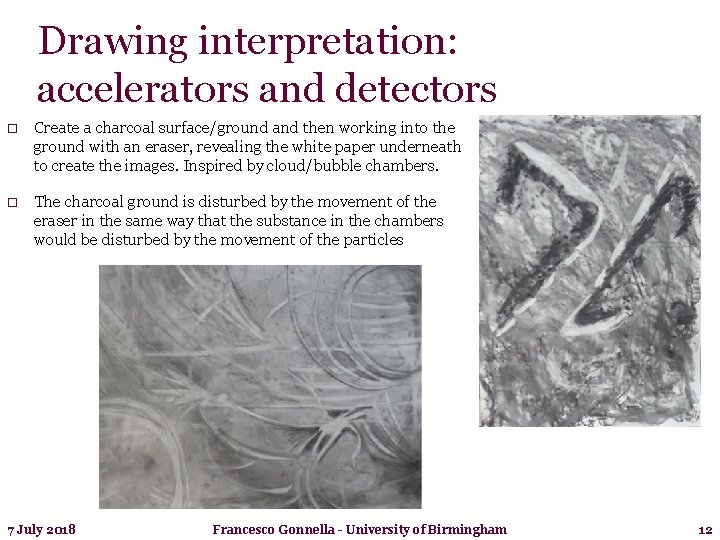
Drawing interpretation: accelerators and detectors o Create a charcoal surface/ground and then working into the ground with an eraser, revealing the white paper underneath to create the images. Inspired by cloud/bubble chambers. o The charcoal ground is disturbed by the movement of the eraser in the same way that the substance in the chambers would be disturbed by the movement of the particles 7 July 2018 Francesco Gonnella - University of Birmingham 12
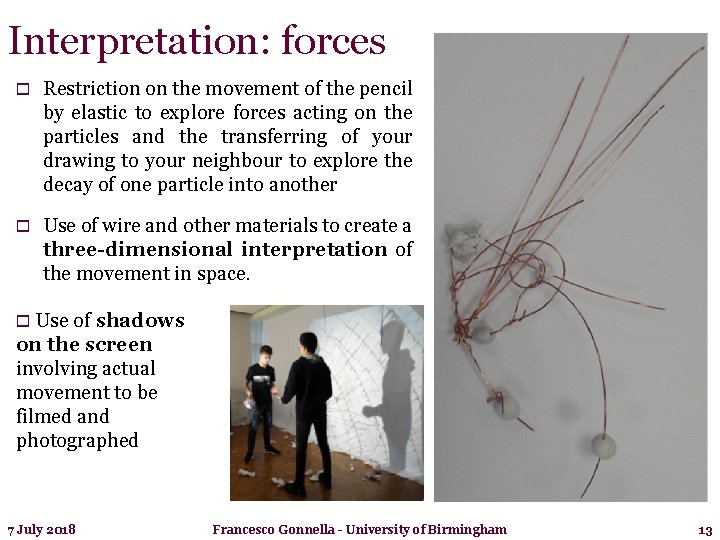
Interpretation: forces o Restriction on the movement of the pencil by elastic to explore forces acting on the particles and the transferring of your drawing to your neighbour to explore the decay of one particle into another o Use of wire and other materials to create a three-dimensional interpretation of the movement in space. o Use of shadows on the screen involving actual movement to be filmed and photographed 7 July 2018 Francesco Gonnella - University of Birmingham 13
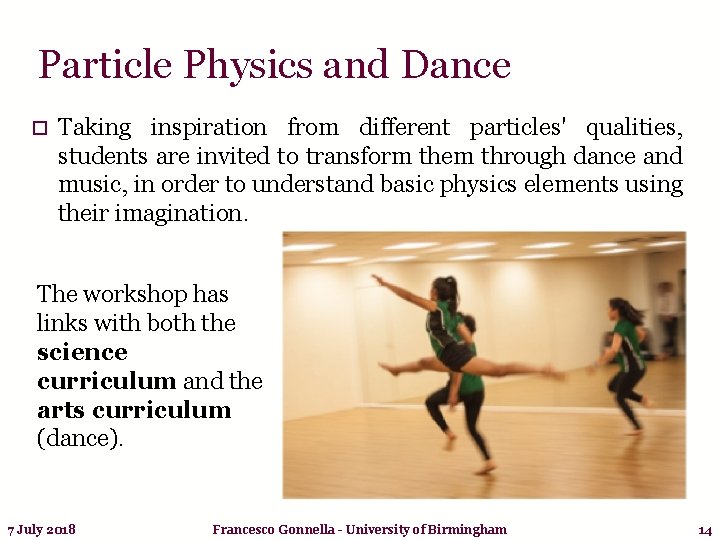
Particle Physics and Dance o Taking inspiration from different particles' qualities, students are invited to transform them through dance and music, in order to understand basic physics elements using their imagination. The workshop has links with both the science curriculum and the arts curriculum (dance). 7 July 2018 Francesco Gonnella - University of Birmingham 14
Particle Physics and Dance o Introduction to particle physics o Interpretation through movement: find a movement for each particle considering its characteristics (mass, behaviour) and associate a melody and a rhythm to each one of them o Introduction to particle movement patterns in space, and an itinerary for each particle o Particle interactions: working in pairs and small groups, interact with each other to form particle relationships. Mixing itineraries and interactions o Creating a theatrical storyline and a performance o Group discussion 7 July 2018 Francesco Gonnella - University of Birmingham 15
Conclusions Creative approaches to learning is a powerful tool to enthuse young students towards physics o Primary schools should be allowed to engage with modern physics – it aids motivation in tackling the perceived difficulty of the subject o Art / Dance & Science is a powerful way for less science-oriented students to approach physics o Learning through playing indicates knowledge is sustainable for longer periods o 7 July 2018 Francesco Gonnella - University of Birmingham 16