
SCHOOL EMERGENCY RESPONSE AND CRISIS MANAGEMENT CONFLICT OF












- Slides: 38
SCHOOL EMERGENCY RESPONSE AND CRISIS MANAGEMENT
CONFLICT OF INTEREST / COMMERCIAL SUPPORT DISCLOSURE This educational activity is being presented without the provision of commercial support and without bias or conflict of interest from the planners and presenters.
LECTURE OBJECTIVES • Describe situations that constitute a disaster at school • Describe the 4 phases of emergency planning • Understand the general concepts of the Incident Command • • • System Describe key differences between routine and mass casualty triage Discuss your role and nursing responsibilities during and after a disaster Discuss the composition and activation of the crisis response team Understand the ways in which students are more vulnerable to terrorist weapons than adults Identify specific issues to address in the emergency response and crisis management plan for students with special needs
DEFINING DISASTER • Many terms to refer to a situation that overwhelms readily available resources and disrupts normal operations within a community • Crisis • Multiple Casualty Incident • Mass Casualty Incident
LECTURE DEFINITIONS • Emergency Response - measures taken when internal or external disaster threaten to overwhelm school resources • Crisis Management – emotional and psychological support provided to students, staff and families during and after a disaster • Emergency Response and Crisis Management Plan – the plan that schools prepare for handling disasters
EMERGENCY RESPONSE & CRISIS MANAGEMENT PLAN Outline a structured approach for managing disasters of any scope • Provide guidance for the recovery process while seeking to minimize morbidity and mortality • Separate from the school’s Safety Plan •
CATEGORIZING DISASTERS • Natural Disasters • Disasters of human origin • Unintentional • Deliberately engineered • Technology related • Pandemics
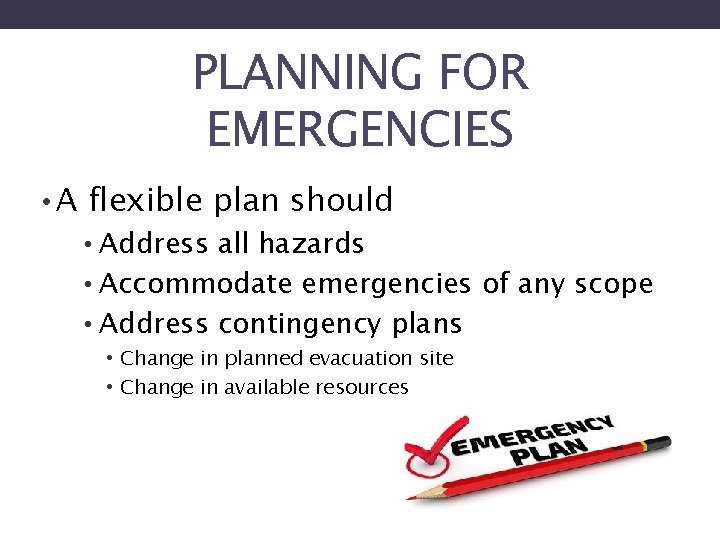
PLANNING FOR EMERGENCIES • A flexible plan should • Address all hazards • Accommodate emergencies of any scope • Address contingency plans • Change in planned evacuation site • Change in available resources
COMMUNITY PARTNERS DEVELOPMENT OF A COMPREHENSIVE PLAN IS A TEAM EFFORT • Collaborate within the school • Collaborate with law enforcement and EMS • Collaborate with local health department
NATIONAL INCIDENT MANAGEMENT SYSTEM (NIMS) • NIMS provides a consistent framework for emergency response • Based on Incident Command System (ICS) • All hazards • Modular structure
ICS MANAGEMENT SYSTEM • See Table 15 -1 • 5 MAJOR MANAGEMENT FUNCTIONS • Incident Command • Overall responsibility for incident management and resource determination • Operations • Establishes tactics and resource allocation • Planning • Maintains pertinent documentation • Logistics • Provides resources and services • Finance and Administration • Monitors associated costs
INCIDENT COMMAND STRUCTURE (page 363)
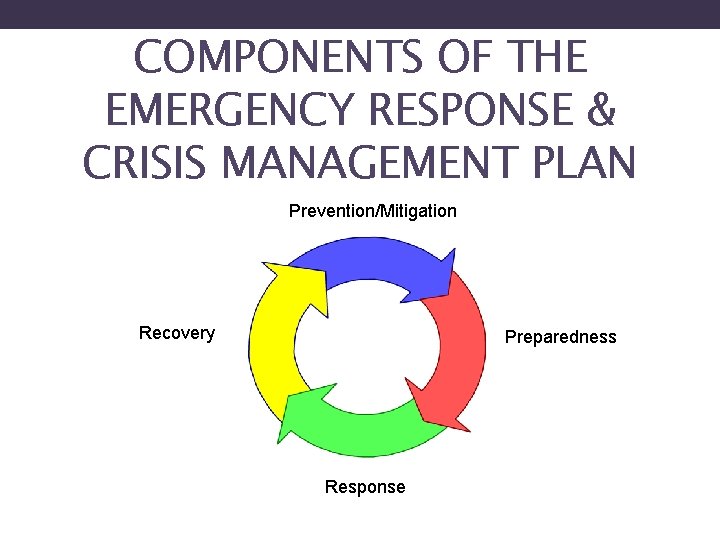
COMPONENTS OF THE EMERGENCY RESPONSE & CRISIS MANAGEMENT PLAN Prevention/Mitigation Recovery Preparedness Response
PREVENTION / MITIGATION • Develop written protocols for emergency procedures • Regularly update student contact information • Inspect and test equipment such as AEDs • Maintain and restock emergency supplies and medications • Place portable emergency kits in all classrooms • Syndromic Surveillance • School nurses are frequently the first to recognize and report disease outbreaks
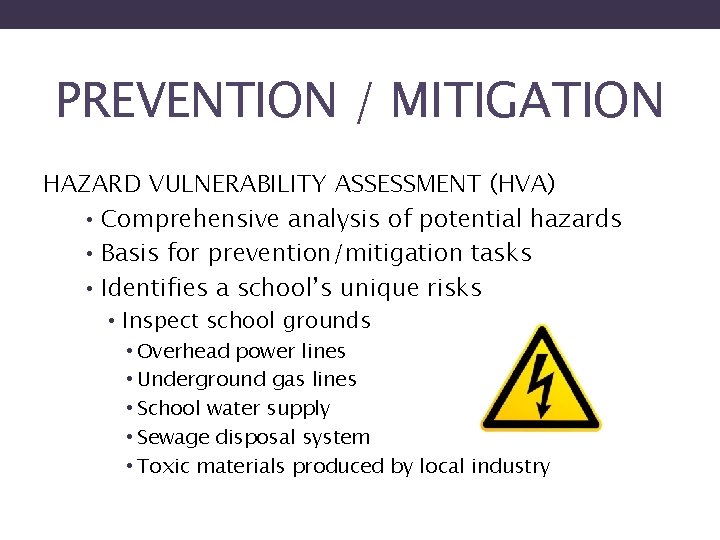
PREVENTION / MITIGATION HAZARD VULNERABILITY ASSESSMENT (HVA) • Comprehensive analysis of potential hazards • Basis for prevention/mitigation tasks • Identifies a school’s unique risks • Inspect school grounds • Overhead power lines • Underground gas lines • School water supply • Sewage disposal system • Toxic materials produced by local industry
PREPAREDNESS EDUCATION AND TRAINING • Drills and Exercises • Participate • Training • Debriefing • Recommending corrective action items • Gain experience • Rendering and directing First Aid • Anticipate needed medications and supplies • Recruit student volunteers for first aid training • Debriefing is essential
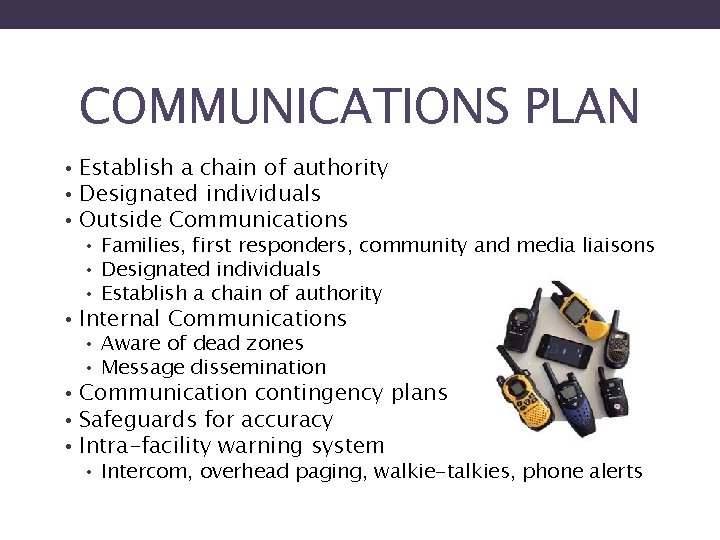
COMMUNICATIONS PLAN • Establish a chain of authority • Designated individuals • Outside Communications • Families, first responders, community and media liaisons • Designated individuals • Establish a chain of authority • Internal Communications • Aware of dead zones • Message dissemination • Communication contingency plans • Safeguards for accuracy • Intra-facility warning system • Intercom, overhead paging, walkie-talkies, phone alerts
PAST CRITICAL INCIDENTS ANNIVERSARIES OF SELECTED CRITICAL INCIDENTS • • • February 14: NIU shootings April 16: Virginia Tech shootings April 19: Oklahoma City bombing April 20: Columbine High School shootings June 12: Orlando nightclub shootings July 20: Aurora movie theater shootings September 11: Terrorist attacks October 1: Las Vegas mass shooting December 14: Sandy Hook shootings
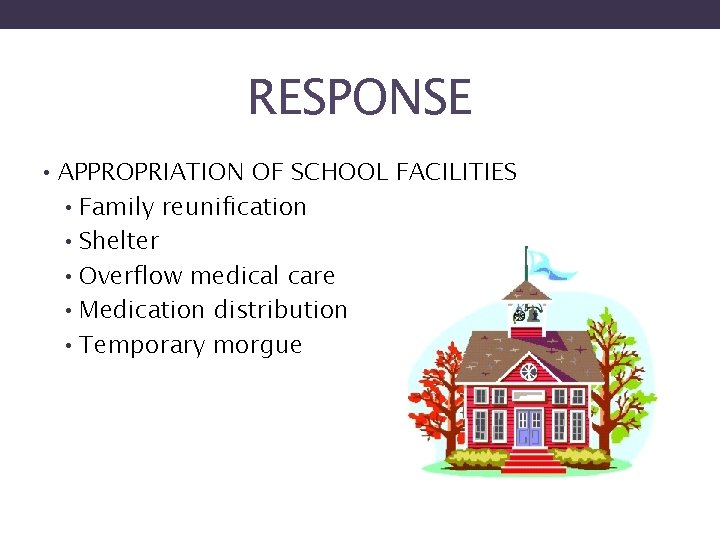
RESPONSE • APPROPRIATION OF SCHOOL FACILITIES • Family reunification • Shelter • Overflow medical care • Medication distribution • Temporary morgue
RESPONSE SPECIAL PROCEDURES FOR DEVELOPING INCIDENTS • Evacuation • Reverse Evacuation • Lockdown • Hard Lockdown (remain in classrooms) • Soft Lockdown (limited movement within the school) • Shelter in place (remain in the building)
RESPONSE NURSING RESPONSIBILITIES • First Responders • Leadership roles • Activating EMS • Mobilizing resources • Remain with the ill and injured until the transfer of care is complete
RESPONSE • MASS CASUALTY TRIAGE • Fundamentally different from daily routine triage • Goal is to do the greatest good for the greatest number of people in the least amount of time • Allocate resources to those who have the greatest chance of survival • Standardized triage system provides objective criteria for school nurses who may otherwise be influenced by emotional responses, particularly when wounded include children and friends
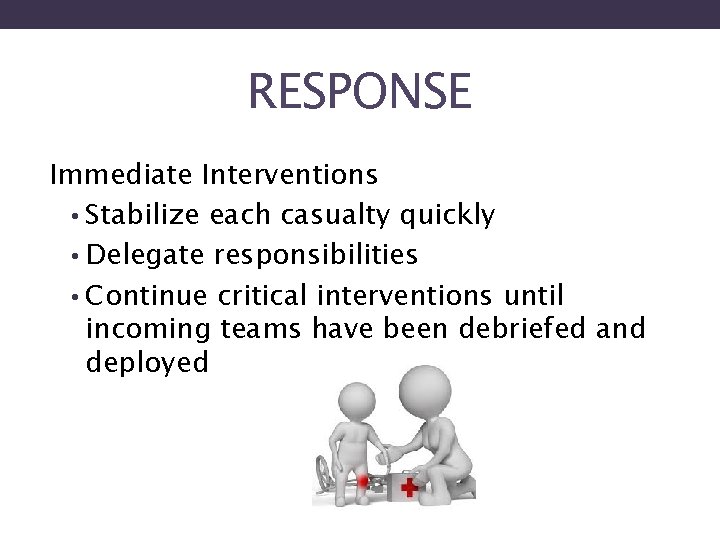
RESPONSE Immediate Interventions • Stabilize each casualty quickly • Delegate responsibilities • Continue critical interventions until incoming teams have been debriefed and deployed
PERSONAL RESPONSE • Monitoring your own response • Seek mental health or crisis intervention within 8 hours of event • Factors that may affect your judgment and ability to render care • Exhaustion • Exposure • Injuries • Hunger • Bathroom breaks • Family obligations
RECOVERY AND CRISIS MANAGEMENT • CRISIS RESPONSE TEAM • Principal • Assistant principal • School counselors, psychologists, social workers • Selected teachers • School nurses • CRISIS MANAGEMENT • Actions taken in the aftermath of a disaster or other emergency to • Protect and sustain life • Relieve emotional trauma • Assist in the recovery from physical trauma
RECOVERY AND CRISIS MANAGEMENT • RECOVERY • Ongoing mental, emotional, and physical healing of students, families, and staff members • School nurse plays as essential role in the process of healing, rebuilding, and returning the school community to a state of health and resilience • Reestablishing normal routines
RECOVERY AND CRISIS MANAGEMENT • SPECIFIC TASKS • Facilitate an evaluation of the school’s response to the incident • Implement revisions to plans and protocols • Monitor students and staff for early indications of posttraumatic stress
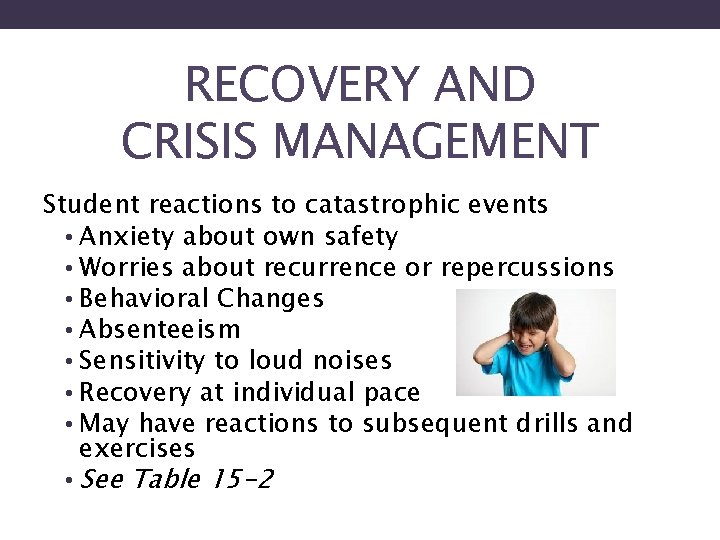
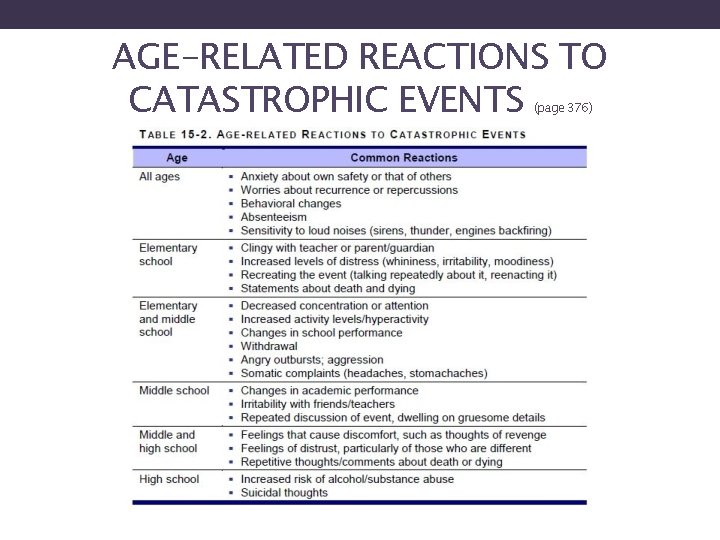
RECOVERY AND CRISIS MANAGEMENT Student reactions to catastrophic events • Anxiety about own safety • Worries about recurrence or repercussions • Behavioral Changes • Absenteeism • Sensitivity to loud noises • Recovery at individual pace • May have reactions to subsequent drills and exercises • See Table 15 -2
AGE-RELATED REACTIONS TO CATASTROPHIC EVENTS (page 376)
RECOVERY AND CRISIS MANAGEMENT Mobilizing the Crisis Response Team • Credentialed mental health team • Critical Incident Stress Management Team • Professional Crisis Consultant
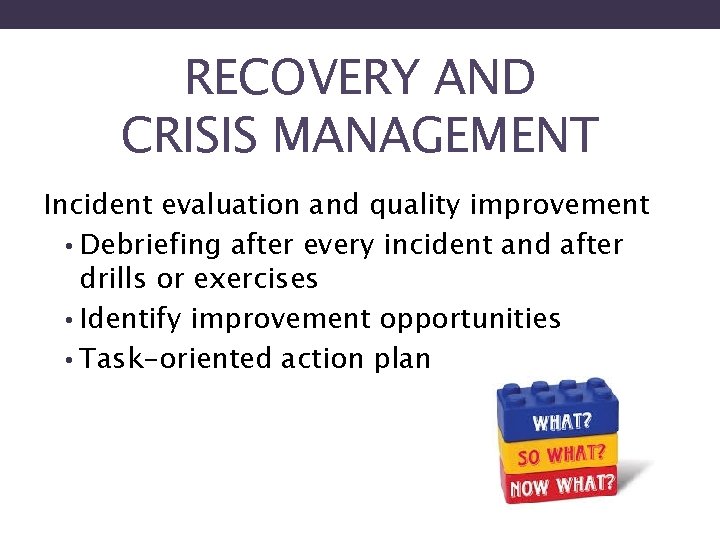
RECOVERY AND CRISIS MANAGEMENT Incident evaluation and quality improvement • Debriefing after every incident and after drills or exercises • Identify improvement opportunities • Task-oriented action plan
SPECIAL CONSIDERATIONS Pediatric Vulnerability to Terrorist Weapons Physiologic and developmental considerations � Aerosolized agents � Blistering agents � Radiation � GI agents � Traumatic Injury � Cognition/mobility Practical Considerations � Decontamination � Medical Accommodation
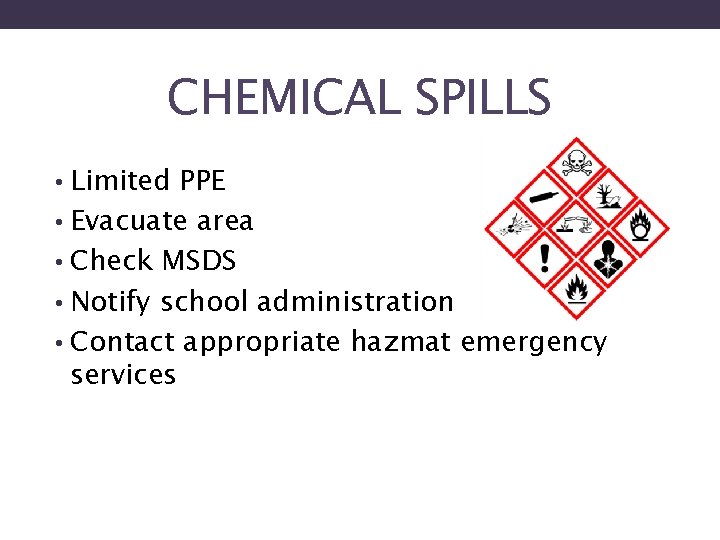
CHEMICAL SPILLS • Limited PPE • Evacuate area • Check MSDS • Notify school administration • Contact appropriate hazmat emergency services
PANDEMIC ILLNESS OR BIOLOGIC AGENTS • Best defense is advance preparation • Measures to reduce exposure to pathogens • Minimize transmission of communicable diseases • • Hand washing Respiratory etiquette Stay home when ill Annual flu shots • Preventive Measures • Surveillance Measures
STUDENTS WITH SPECIAL NEEDS • Plan should include procedures for students with special physical, cognitive, and/or emotional requirements • Class schedule • Anticipated location throughout the day • Evacuation • Shelter in place • Medications and supplies for > 72 hours • Fully charged batteries and auxiliary power supply
SUMMARY SCHOOL NURSES • Have a critical role in the safety of students during any emergency situation regardless of its size, severity, and complexity • Should participate in the 4 phases of emergency planning: prevention/mitigation, preparedness, response, and recovery • Immediate actions at the outset of a developing emergency can do much to minimize morbidity and mortality • Regular participation in drills and exercises will prepare you to respond decisively and to work collaboratively with your community partners • Can provide leadership in curtailing emotional and psychological trauma in students, their families, and staff members
RESOURCES CT DPH Emergency Medical Services Plan, 2015 -2020 http: //www. ct. gov/dph/lib/dph/ems/pdf/communication_statements/20152020_state_ems_plan_final_v 10. 26. 2015. pdf SNEMS-C Manual • Chapter 15, pp 357 -384 • Key points, p 596 • Appendices A and B
QUESTIONS?