
School Design and Innovation Jim Fliakas Katie Rossini





- Slides: 40
School Design and Innovation Jim Fliakas Katie Rossini Sarah Thomas Organization and Administration of Schools June 29, 2006
Enduring Understanding l Schools need to be innovatively redesigned to improve student achievement.
Objectives l l l Identify key school reform efforts of the 1900’s. Define politically-driven and market-driven schools. Explore common features of exemplary schools. Begin to challenge traditional school design. Identify implications of school design and innovation on your current/future leadership roles.
Agenda l l l l l Activator Tinkering Toward Utopia: A Century of Public School Reform Comedic Interlude: The American Teacher Politics, Markets, and American Schools Promenade Comedic Interlude: The Standardized Test Deborah Meier Articles Case Study Summarizer Other Resources
Activator l What are three greatest obstacles to improving student achievement? 1. 2. 3.
Tinkering Toward Utopia: A Century of Public School Reform Chapter 4: Why the Grammar of Schooling Persists David Tyack and Larry Cuban, 1995
Concerns Raised by Current School Structure and Assessment l l Teaching to the test Early withdrawal of failing students Nearly 1/3 of students performing below standard Poor and immigrant students underperforming Educators voiced these concerns in 1900 -1920
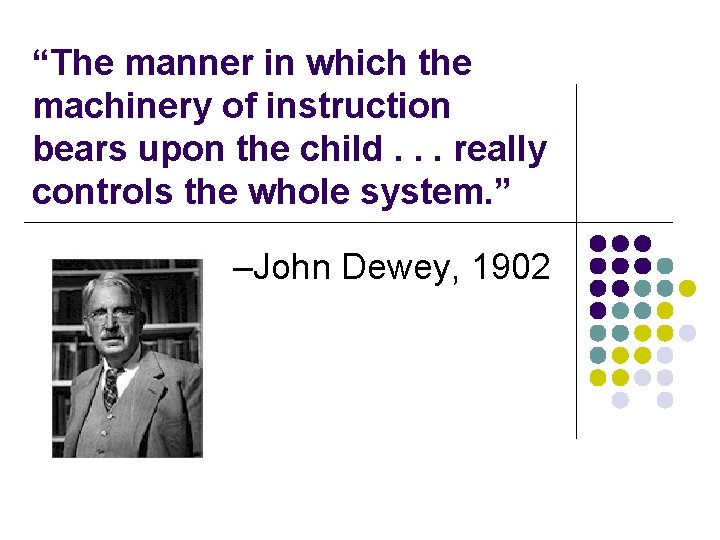
“The manner in which the machinery of instruction bears upon the child. . . really controls the whole system. ” –John Dewey, 1902
Graded School l l Alternative to one-room school house Students sorted by age and academic proficiency Curriculum divided into year-long batches Individual teachers in self-contained classes Most urban schools in 1860
Factory Model l l Division of labor Hierarchical supervision Efficient and equitable Standardized and easy to replicate Same curriculum at the same pace
Carnegie Units l l l Developed by elite educators and university presidents College Education Examination Board and National Education Association Academic course should consist of 5 class periods per week Class periods should be 50 -55 minutes Academic disciplines: English, math, Latin, Greek, foreign languages, history, science
Challenges and Reform Efforts The Dalton Plan— 1920’s-1930’s l l l Influenced by work of Maria Montessori Child-centered and paced Student contracts in projects of academic and social interest Collaborative teams of teachers Nearly 8% of schools nationally adopted aspects of Dalton Plan
Challenges and Reform Efforts The Eight-Year Study— 1933 -1941 l l l Interdisciplinary core courses Teams of teachers working together Joining of formal and informal curricular areas Emphasis on community service, artistic productions and publications, decisions on school affairs, etc. Individual and student-centered
Challenges and Reform Efforts Schools of Tomorrow— 1960’s l l l Influenced by ideas of Rousseau Schools without walls—freedom of thought, liberation Engagement in community projects and issues Retained departments but encouraged teacher teams Mini-courses and resource centers
Fading of Reform Efforts l l l Exhausted teachers Lacked clearly quantifiable results Return to traditional structures was “not so much a conscious conservatism as…unexamined institutional habits and widespread cultural beliefs about what constitutes a ‘real school’” –Tyack and Cuban, 1995
Reflections l l Current structure established by powerful political and educational groups Reform efforts have not been backed by broad community and political support Reform must be gradual Reform must be based on political and collective actions
Comedic Interlude: The American Teacher http: //www. youtube. com/watch? v=o. Snn. Pw. OSTgc
Politics, Markets, and American Schools Terry M. Moe and John E. Chubb, 1990
Politics vs. Markets The One Best System “Modern conditions require workers who are not only technically knowledgeable and well trained, but also who have the capacity for creative, independent thought and action. Americans must be taught how to think. They must learn how to learn. ” –Chubb and Moe, 1990
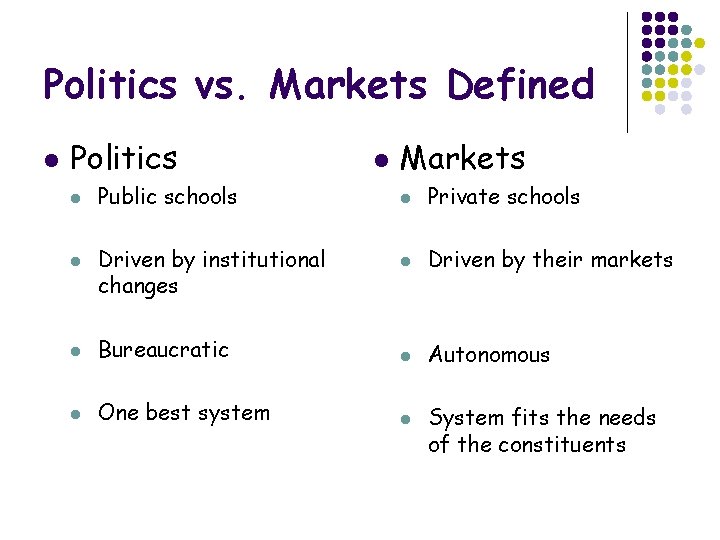
Politics vs. Markets Defined l Politics l l Public schools Driven by institutional changes l Markets l Private schools l Driven by their markets Autonomous l Bureaucratic l l One best system l System fits the needs of the constituents
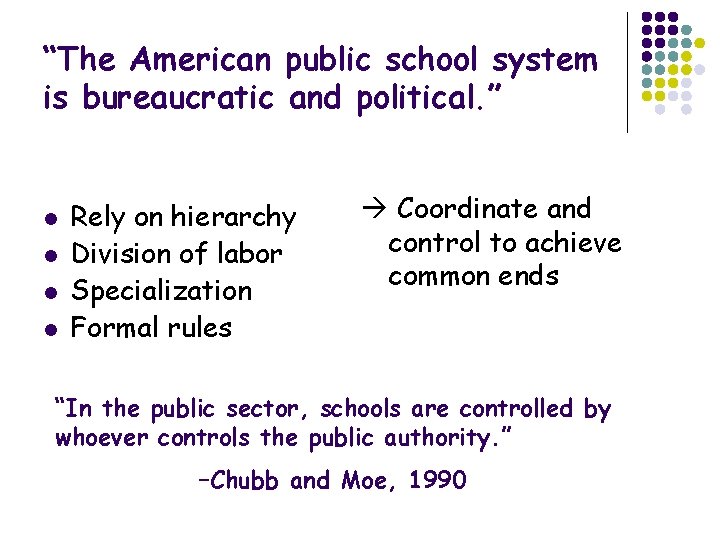
“The American public school system is bureaucratic and political. ” l l Rely on hierarchy Division of labor Specialization Formal rules Coordinate and control to achieve common ends “In the public sector, schools are controlled by whoever controls the public authority. ” –Chubb and Moe, 1990
“Schools in a market setting should tend to reflect a full, heterogeneous range of educational concerns. ”–Chubb and Moe, 1990 l l Schools seem to have the upper hand but are constrained to their ownership Incentive is higher to please clientele because they directly fund the school Constituents are free to leave at any time Despite all of this, schools do have more autonomy because they are market-driven and have a smaller needs-base
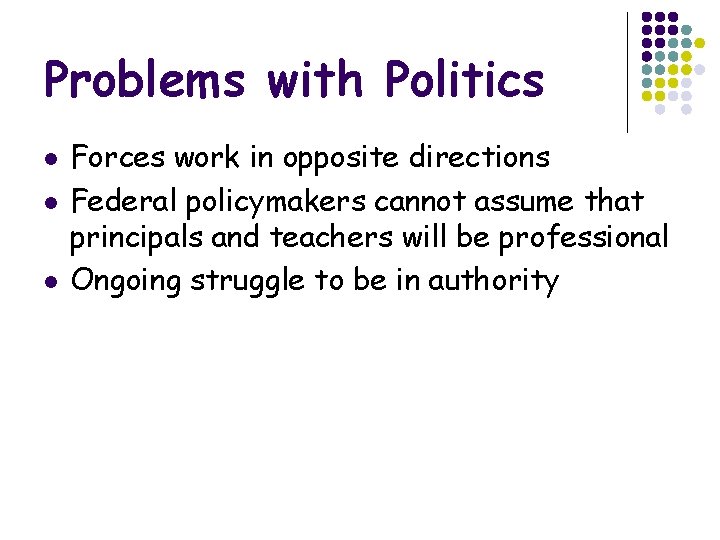
Problems with Politics l l l Forces work in opposite directions Federal policymakers cannot assume that principals and teachers will be professional Ongoing struggle to be in authority
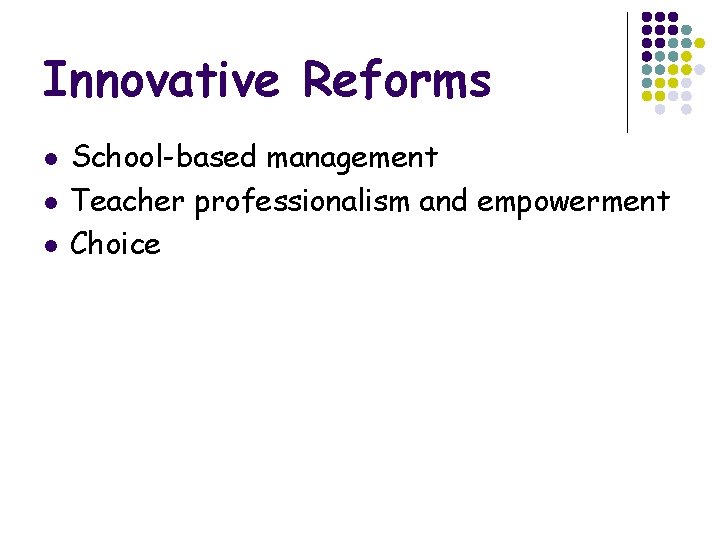
Innovative Reforms l l l School-based management Teacher professionalism and empowerment Choice
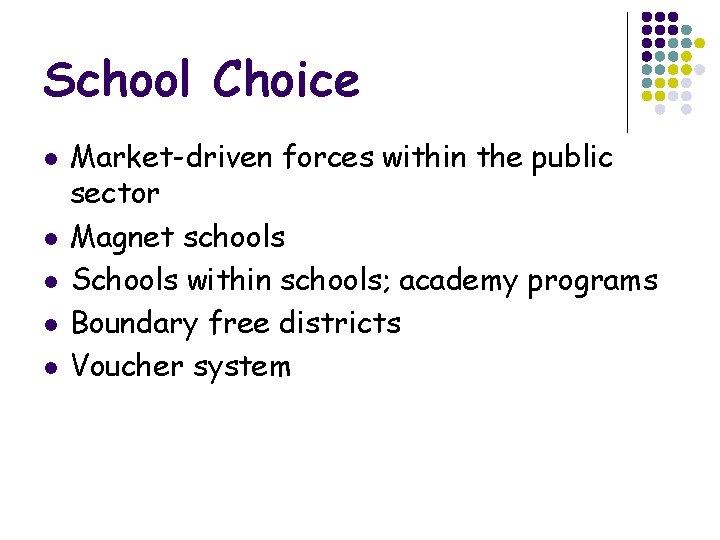
School Choice l l l Market-driven forces within the public sector Magnet schools Schools within schools; academy programs Boundary free districts Voucher system
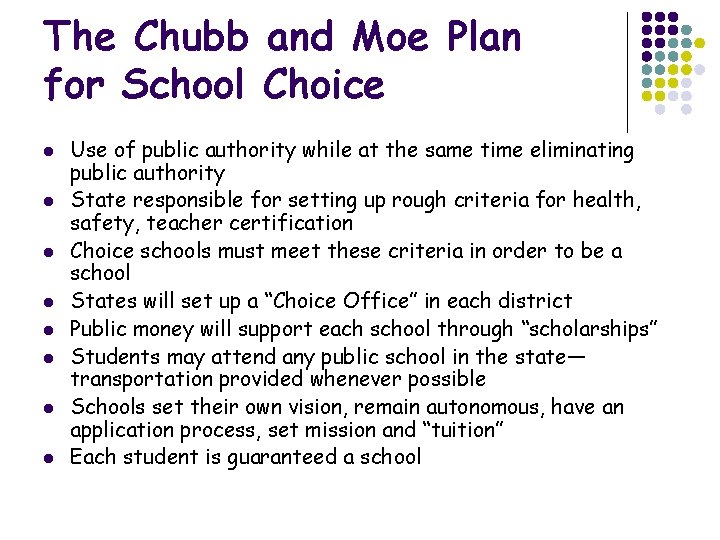
The Chubb and Moe Plan for School Choice l l l l Use of public authority while at the same time eliminating public authority State responsible for setting up rough criteria for health, safety, teacher certification Choice schools must meet these criteria in order to be a school States will set up a “Choice Office” in each district Public money will support each school through “scholarships” Students may attend any public school in the state— transportation provided whenever possible Schools set their own vision, remain autonomous, have an application process, set mission and “tuition” Each student is guaranteed a school
All Rise and Promenade l Does the market-driven, public school plan work for MCPS? l l l Magnet programs Special programs Is the Chubb and Moe Plan too radical for MCPS/Maryland? Why or why not?
Comedic Interlude: The Standardized Test http: //www. youtube. com/watch? v=c 3 ti. Amhr. VX Q%26 search=standardized%2520 test
Deborah Meier Articles (1998). Can the odds be changed? Phi Delta Kappan, 79(5), 358 -362. (2006, May). 'As though they owned the place': Small schools as membership communities. Phi Delta Kappan, 87(9), 657662.
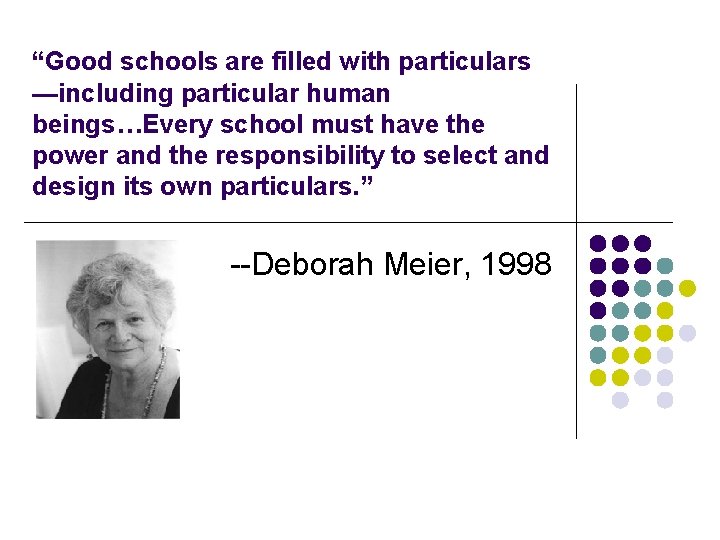
“Good schools are filled with particulars —including particular human beings…Every school must have the power and the responsibility to select and design its own particulars. ” --Deborah Meier, 1998
Redefining Systemic l Old School l Solutions that can be more or less simultaneously prescribed for all schools, irrespective of particulars l New School l Solutions that look at the particulars of schools, creating different possibilities
Common Features of Exemplary Schools l Smallness l l Self-governance l l Keep schools a reasonable size Give them sufficient autonomy over critical decisions Choice l Allow schools to be different from one another
Main Problems Creating Smaller Schools l l l Acknowledge that there will be tradeoffs Pay attention to genuine outcomes Be sure important constituents are on board Avoid false efficiencies Reassure the recalcitrant
Other Issues for Small Schools l l l l It takes time The importance of continuity Be inclusive Physical space Don’t be missionaries Keep lines of communication open Keeps lots of data
Other Issues for Small Schools l l l Accountability Professional development The union Leadership Parent involvement Building-wide issues
Roadblocks to Innovation l l l Tax the capacities of existing institutions Bring them into compliance Complain of weariness Need to be in the mainstream, not on the sidelines, of the system
Overcoming the Roadblocks l Increase constituents’ voices about the work in terms of student outcomes, equity and fiscal integrity l Create stronger internal accountability system l l Answer to one another for the quality of work l l Networks of sister schools Answer to noncollegial audiences l l Peer and external critics Formal review panels Need a shared body of credible information
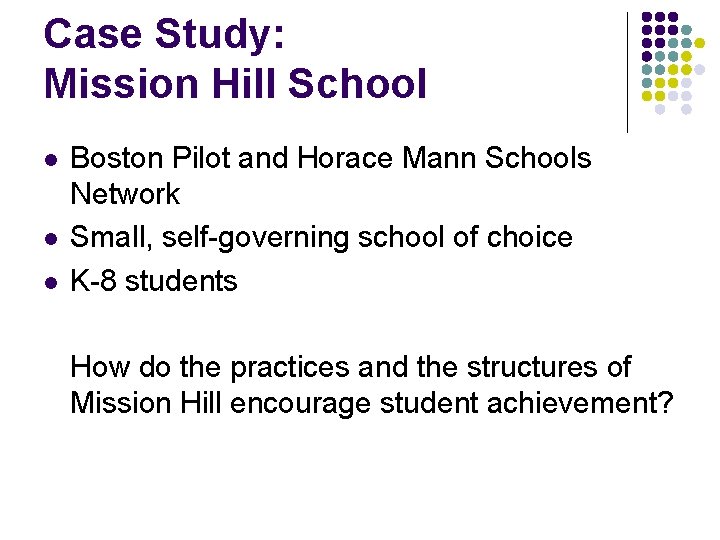
Case Study: Mission Hill School l Boston Pilot and Horace Mann Schools Network Small, self-governing school of choice K-8 students How do the practices and the structures of Mission Hill encourage student achievement?
Summarizer l What are three innovative solutions to improve student achievement? 1. 2. 3.
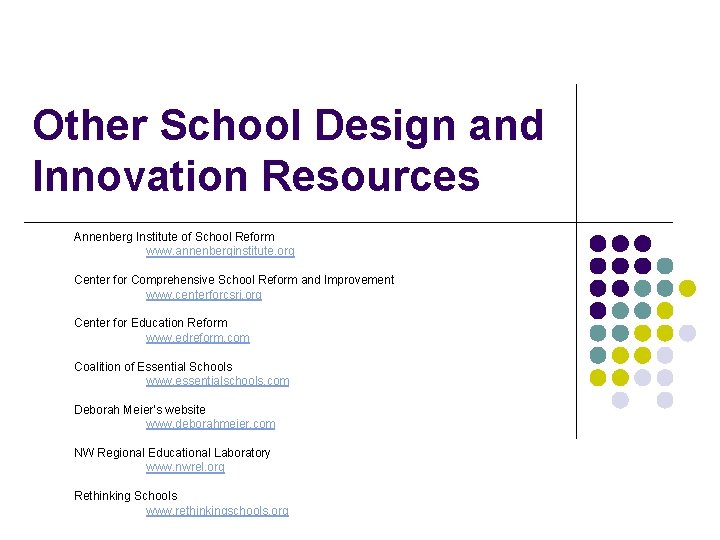
Other School Design and Innovation Resources Annenberg Institute of School Reform www. annenberginstitute. org Center for Comprehensive School Reform and Improvement www. centerforcsri. org Center for Education Reform www. edreform. com Coalition of Essential Schools www. essentialschools. com Deborah Meier’s website www. deborahmeier. com NW Regional Educational Laboratory www. nwrel. org Rethinking Schools www. rethinkingschools. org