
School Culture Methods of organizational development that favor
- Slides: 40
School Culture Methods of organizational development that favor a beneficial school culture KA 2 -Project 2016 -1 -AT 01 -KA 201 -016794 1
School Culture Overview • Organizational Development • Mission Statement • Principles and explanations • Developing a mission statement together • Key points for creating a mission statement for your school • Feedback culture - learning from each other • The Johari window • Feedback guide for working groups 2
Organizational development Why organizational development? Because change is necessary! Organizational development 3
Why organizational development? • Schools are changing more than ever. New technologies, social developments as well as constantly evolving basic conditions influence the educational system on a daily basis. School management and staff have to find suitable measures to deal with the everchanging demands placed on teaching. Organizational development 4
Why organizational development? • In phases of change, the quality of leadership culture becomes particularly evident. Great school management means involving teaching staff in change processes from the very beginning. Therefore, it is essential to make all measures as transparent as possible. The teaching staff must be informed about how, when and to what extent they will be affected by upcoming changes. You can only count on the support and cooperation of your employees if you involve them in all phases of the process. Organizational development 5
Why organizational development? • In order to be able to react adequately to changes, everyone working at the school needs a structure that provides support and clear orientation in uncertain times. A mission statement can serve as a guiding principle and provide orientation. Organizational development 6
The mission statement as a foundation for successful school development 7
The mission statement • Successful schools are based on a strong vision that teachers have developed together with the school management. Due to the rapid changes in modern society, these visions also need to be kept up to date. Therefore, an existing mission statement should be updated and adapted at least every ten years. The mission statement 8
The mission statement • A mission statement is basically a self-description of an organization created by its employees. As a guide for the entire school organization, it aligns the actions of all school employees with common goals. The mission statement is public and accessible for outsiders. All parties involved have to experience the outlined statements in daily school life. It reflects the school’s self-image and thus promotes identification with one's own school. The general pedagogic goals of the school also need to be outlined in the mission statement as a commitment towards students, parents and subsequent institutions that are part of the educational system. The mission statement 9
The mission statement • A mission statement is a standard tool for evaluating the performance of the school management and staff. Through the development of a mission statement, the school organization can be managed and improved in a goal-oriented way. The mission statement 10
Principles and explanations • The guiding principles form the core of a mission statement. They refer to values, goals and success criteria, determine the relationship between all parties involved and define the specific competencies of the school. Guiding principles are simple statements of one or two sentences. The explanation section then provides further details. The guiding principles must meet certain criteria in order to define realistic and understandable visions. The mission statement 11
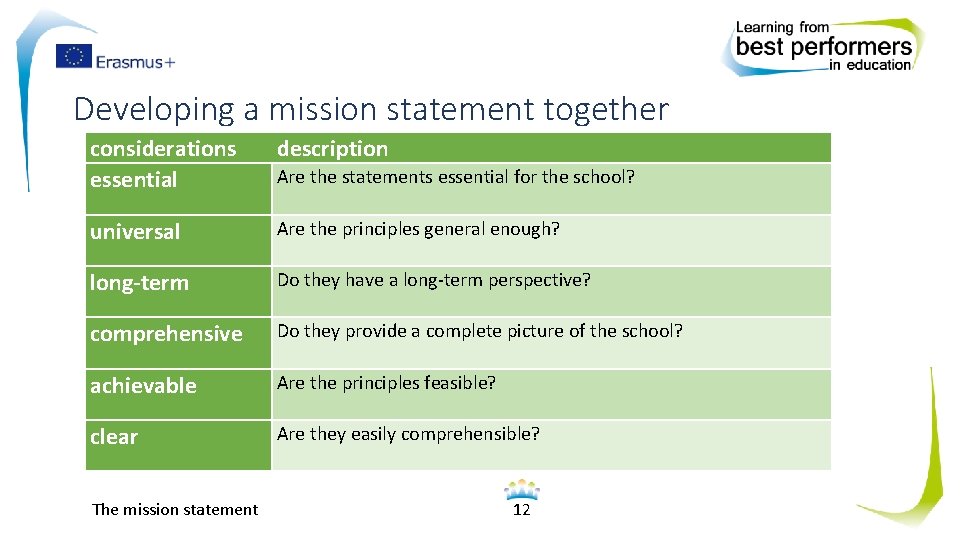
Developing a mission statement together considerations essential description universal Are the principles general enough? long-term Do they have a long-term perspective? comprehensive Do they provide a complete picture of the school? achievable Are the principles feasible? clear Are they easily comprehensible? The mission statement Are the statements essential for the school? 12
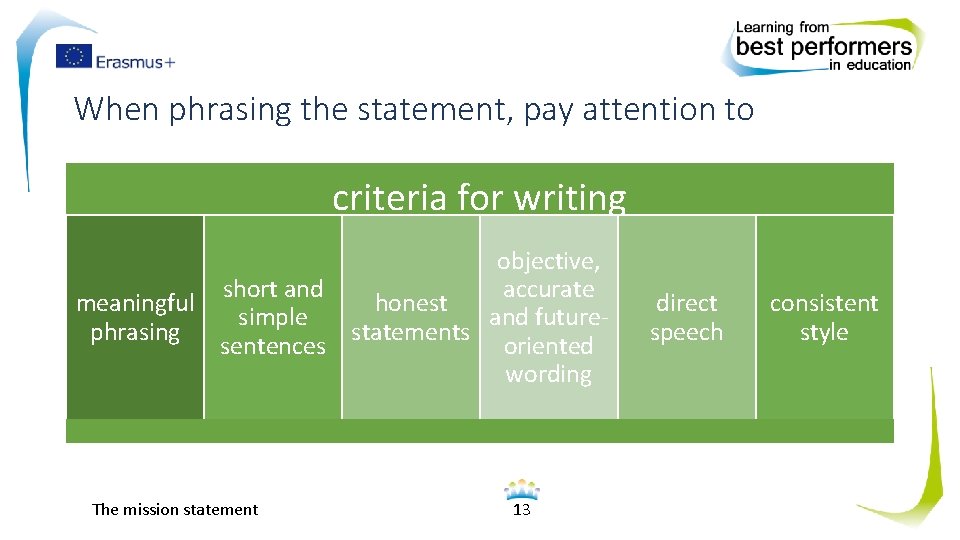
When phrasing the statement, pay attention to criteria for writing objective, short and accurate meaningful honest simple and futurephrasing statements sentences oriented wording The mission statement 13 direct speech consistent style
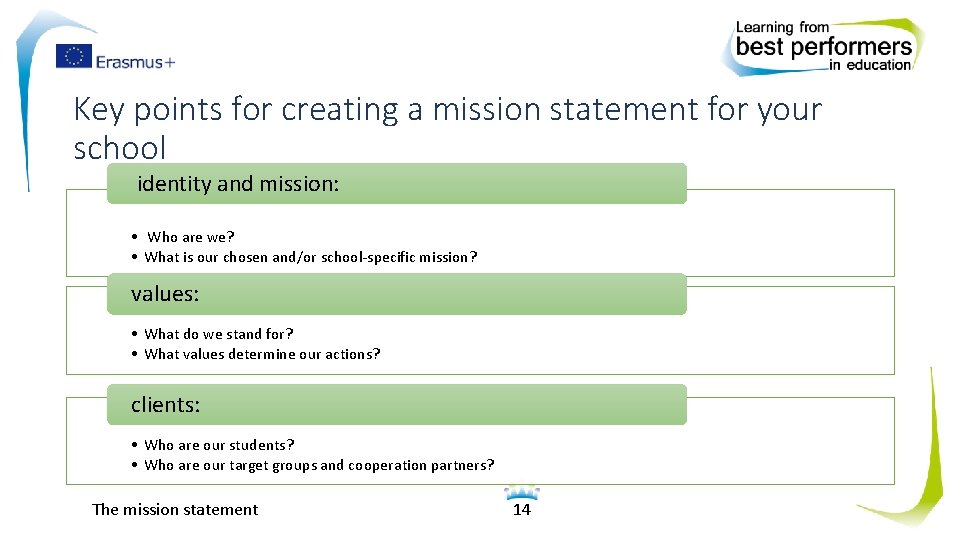
Key points for creating a mission statement for your school identity and mission: • Who are we? • What is our chosen and/or school-specific mission? values: • What do we stand for? • What values determine our actions? clients: • Who are our students? • Who are our target groups and cooperation partners? The mission statement 14
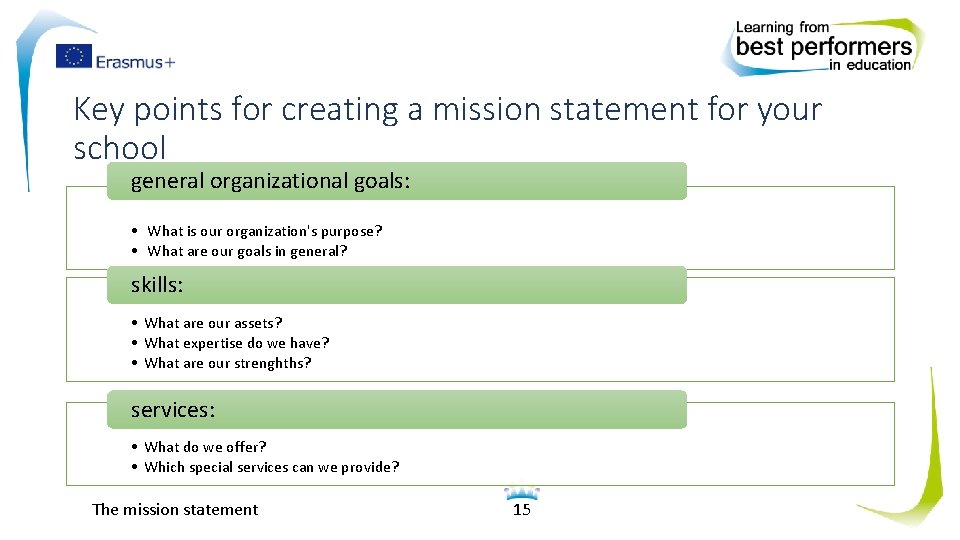
Key points for creating a mission statement for your school general organizational goals: • What is our organization's purpose? • What are our goals in general? skills: • What are our assets? • What expertise do we have? • What are our strenghths? services: • What do we offer? • Which special services can we provide? The mission statement 15
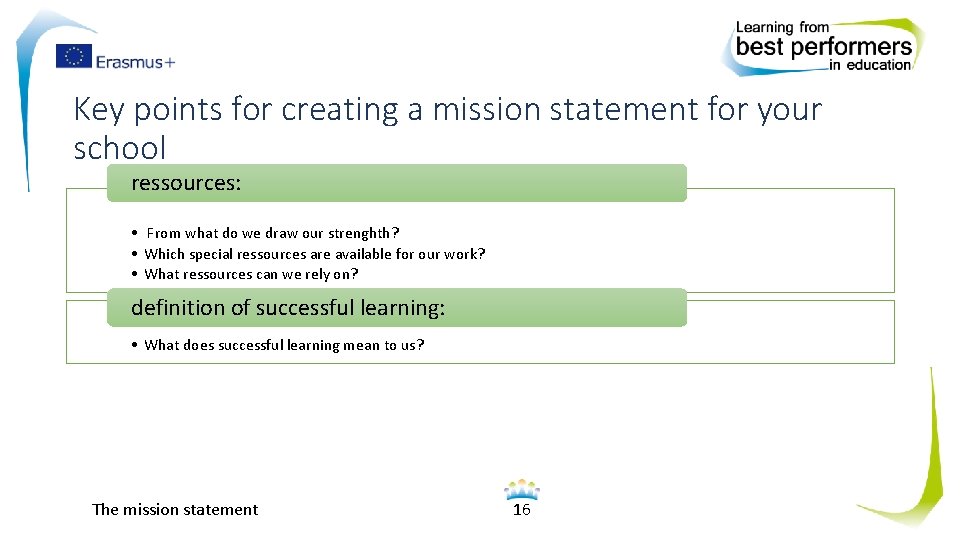
Key points for creating a mission statement for your school ressources: • From what do we draw our strenghth? • Which special ressources are available for our work? • What ressources can we rely on? definition of successful learning: • What does successful learning mean to us? The mission statement 16
Write a short report on profound changes Write a short report (2 pages) on the following questions: • What profound changes have happened at your school in the last 10 years? • How have these changes affected • you? • your employees? • your students? Assignment 17
Create an example mission statement • Create an example mission • When phrasing the statement, statement for your own school. pay attention to: Pay attentention to the following • meaningful phrasing considerations: • short and simple sentences • • • essential universal long-term comprehensive achievable clear Assignment • honest statements • objective, accurate and futureoriented wording • direct speech • consistent style 18
Get feedback to your example mission statement and improve it • Present your example of a mission statement to a colleague and get her/his feedback. • If possible, improve your previous work on the basis of the feedback. Peer learning 19
Get familiar with the Metaplan techniques Make yourself familiar with the following two methods in our Methods Database: • The Metaplan technique – the process • The Metaplan technique – the card method Self-study 20
Practice the Metaplan techniques Form an exercise group with three other colleagues and practice together: • The Metaplan technique – the process • The Metaplan technique – the card method Assignment 21
Design a workshop • Please design a workshop for your colleagues to work on a common mission statement for your school. • When designing this workshop, use the following two methods from our Methods Database: • The Metaplan technique – the process • The Metaplan technique – the card method Project work 22
Feedback culture Learning from each other Organizational development 23
Feedback culture • If you want to implement sustainable changes in your school, an active feedback culture is indispensable. It promotes constructive cooperation and exploring new paths together in order to find innovative solutions at the school. Feedback culture 24
Feedback culture • Many people view feedback as a more or less elegant way to criticize another person. "How can I tell my conversation partner something negative without her/him feeling offended? " • However, feedback is more than a skillful technique for politely expressing criticism. In companies and organizations, it is a constructive means of learning from one another, gaining new insights and thus making sustainable changes in daily operations possible. • People usually leave their comfort zone when giving feedback and, even more so, when receiving it. They immediately enter their learning zone, in which they can grow and make new experiences. Feedback culture 25
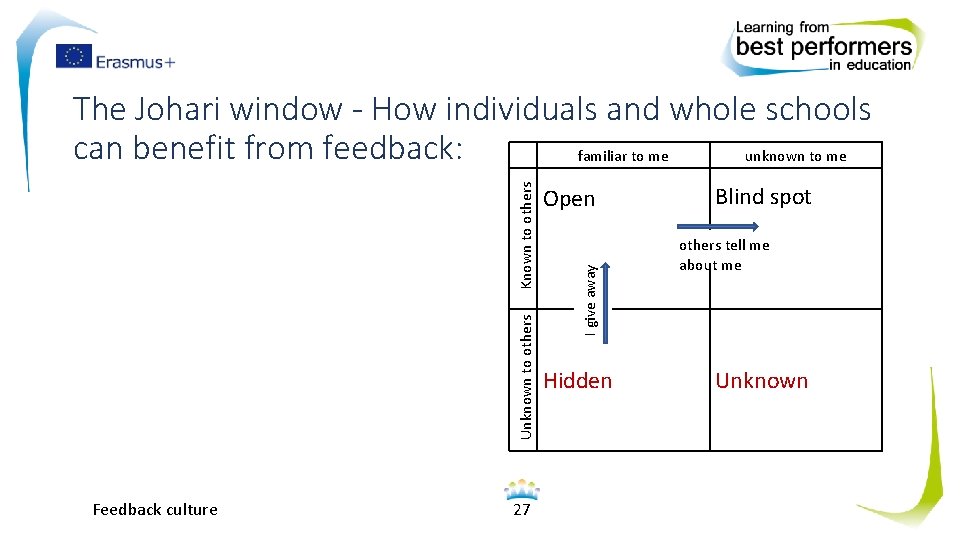
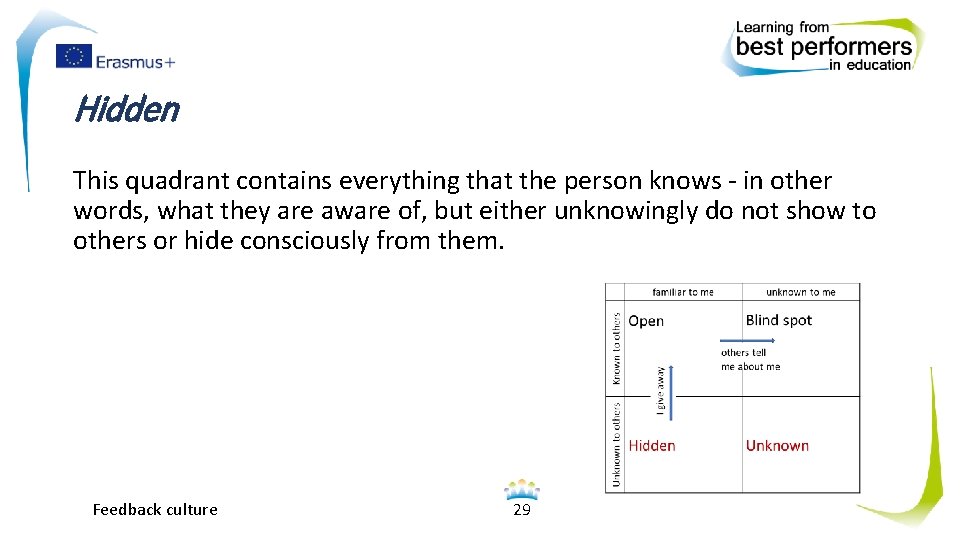
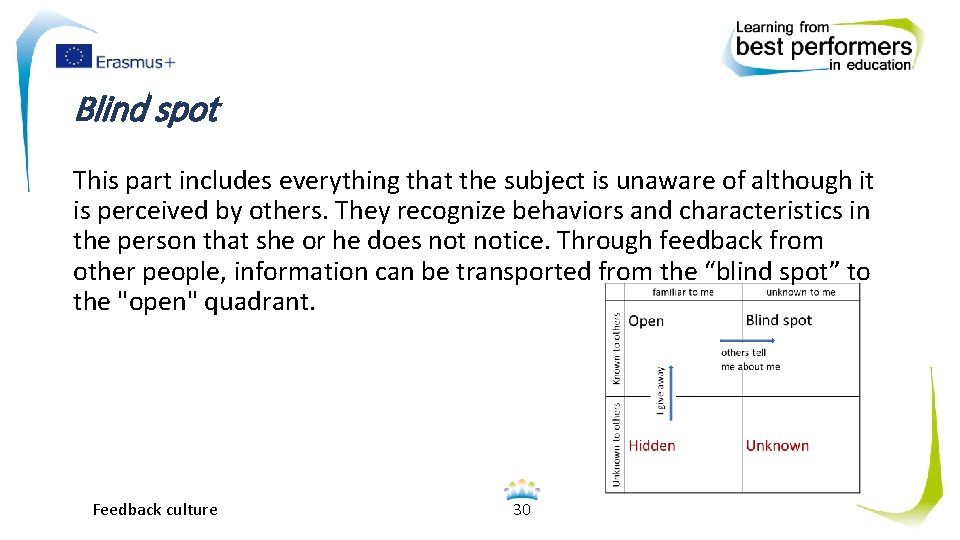
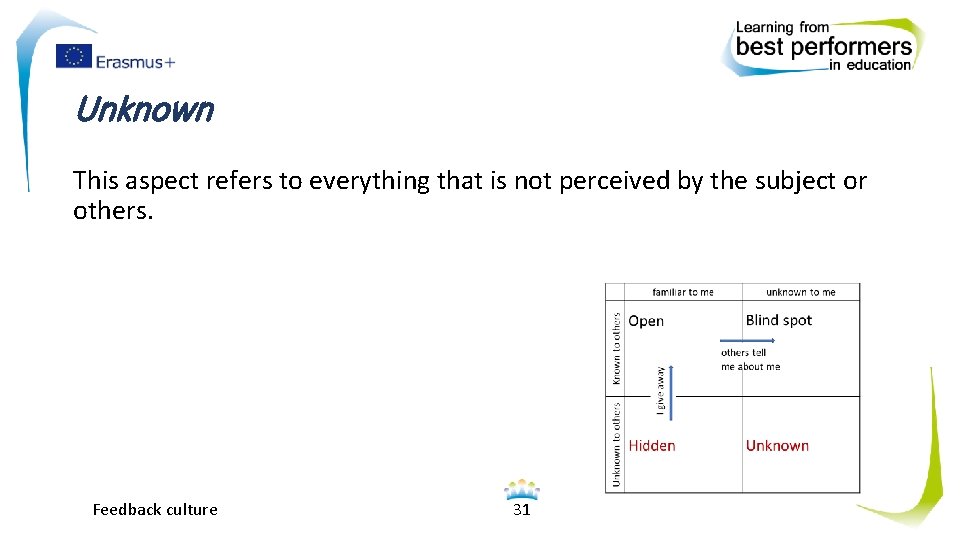
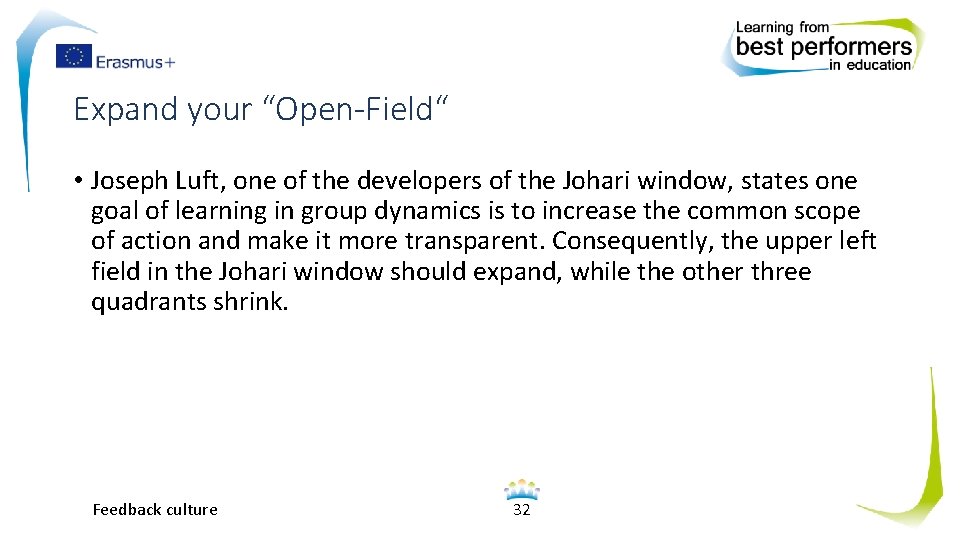
The Johari window • You can make use of this instrument to illustrate the potential of an active feedback culture at your school. • The Johari window is a proven technique to improve group dynamics. It consists of 4 quadrants: Feedback culture 26
Feedback culture 27 Open I give away Unknown to others Known to others The Johari window - How individuals and whole schools can benefit from feedback: familiar to me unknown to me Hidden Blind spot others tell me about me Unknown
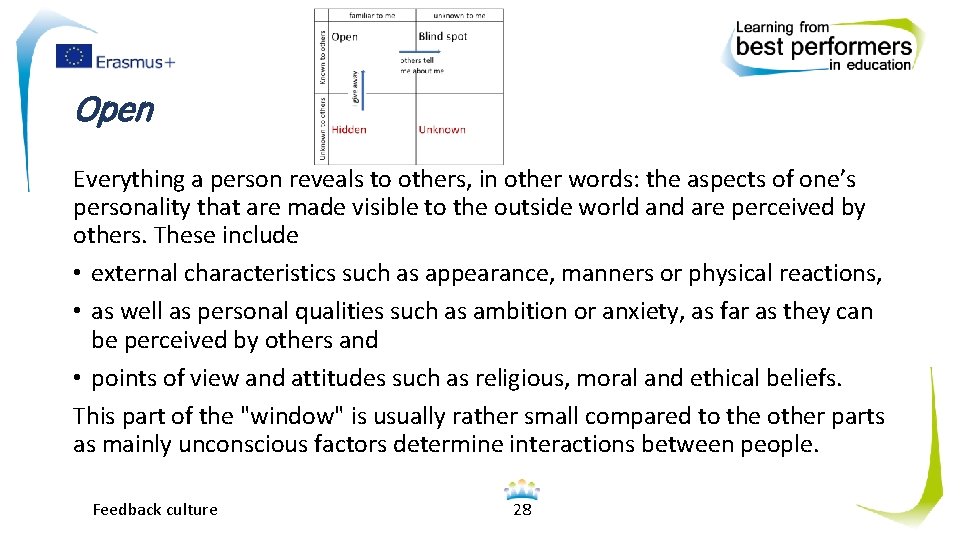
Open Everything a person reveals to others, in other words: the aspects of one’s personality that are made visible to the outside world and are perceived by others. These include • external characteristics such as appearance, manners or physical reactions, • as well as personal qualities such as ambition or anxiety, as far as they can be perceived by others and • points of view and attitudes such as religious, moral and ethical beliefs. This part of the "window" is usually rather small compared to the other parts as mainly unconscious factors determine interactions between people. Feedback culture 28
Hidden This quadrant contains everything that the person knows - in other words, what they are aware of, but either unknowingly do not show to others or hide consciously from them. Feedback culture 29
Blind spot This part includes everything that the subject is unaware of although it is perceived by others. They recognize behaviors and characteristics in the person that she or he does notice. Through feedback from other people, information can be transported from the “blind spot” to the "open" quadrant. Feedback culture 30
Unknown This aspect refers to everything that is not perceived by the subject or others. Feedback culture 31
Expand your “Open-Field“ • Joseph Luft, one of the developers of the Johari window, states one goal of learning in group dynamics is to increase the common scope of action and make it more transparent. Consequently, the upper left field in the Johari window should expand, while the other three quadrants shrink. Feedback culture 32
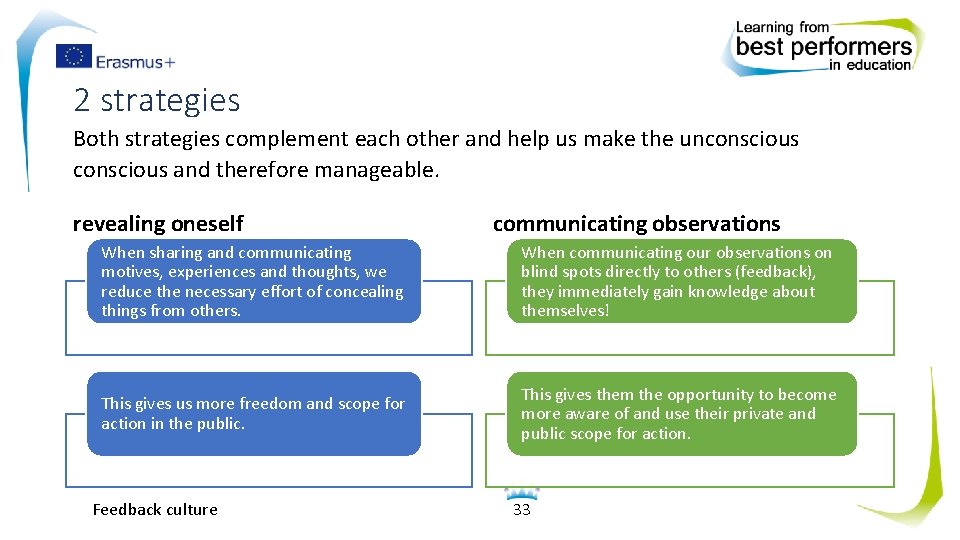
2 strategies Both strategies complement each other and help us make the unconscious and therefore manageable. revealing oneself communicating observations When sharing and communicating motives, experiences and thoughts, we reduce the necessary effort of concealing things from others. When communicating our observations on blind spots directly to others (feedback), they immediately gain knowledge about themselves! This gives us more freedom and scope for action in the public. This gives them the opportunity to become more aware of and use their private and public scope for action. Feedback culture 33
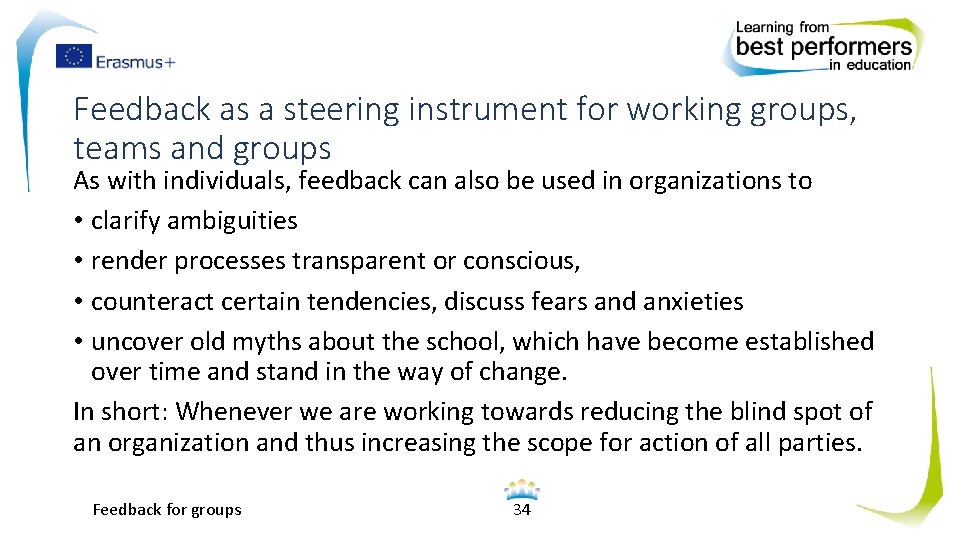
Feedback as a steering instrument for working groups, teams and groups As with individuals, feedback can also be used in organizations to • clarify ambiguities • render processes transparent or conscious, • counteract certain tendencies, discuss fears and anxieties • uncover old myths about the school, which have become established over time and stand in the way of change. In short: Whenever we are working towards reducing the blind spot of an organization and thus increasing the scope for action of all parties. Feedback for groups 34
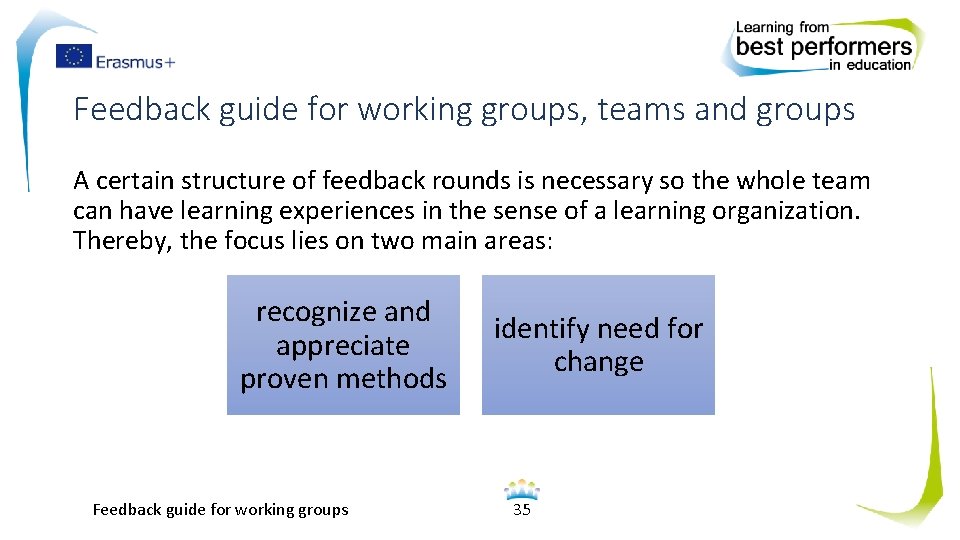
Feedback guide for working groups, teams and groups A certain structure of feedback rounds is necessary so the whole team can have learning experiences in the sense of a learning organization. Thereby, the focus lies on two main areas: recognize and appreciate proven methods Feedback guide for working groups identify need for change 35
Feedback guide for working groups, teams and groups Feedback rounds always require a neutral moderator who oversees the structure and compliance with the rules. A team member can take over this task, ideally a different person should assume the role at each meeting. Feedback guide for working groups 36
Get familiar with different feedback methods Make yourself familiar with the feedback methods described in our Guidebook for Schools (page 20 – 22). Self-study 37
Practice different feedback techniques Form an exercise group with three other colleagues and practice together: • Sociometric differentiation exercises • Flash • Personal query • Barometer of opinions Assignment 38
Get familiar with a feedback method to use in working groups Make yourself familiar with the Feedback guide for working groups, teams and groups described in our Guidebook for Schools (page 19). Self-study 39
Moderate a feedback round • Introduce the topic feedback to your colleagues by explaining the Johari window. • Organize a feedback session and use the feedback guide for groups. Project work 40