
School Breakfast Meal Pattern and Nutrition Standards Click
School Breakfast Meal Pattern and Nutrition Standards Click Arrow to Begin H Topic 1 Shortcut Buttons Home Button Found on each page. Selecting the Home button returns you to this page. Topic 2 These buttons link to major sections of this course. Double-Click to navigate. Topic 3 0
School Breakfast Meal Pattern and Nutrition Standards Put Course Name Here School Nutrition Toolbox NAVIGATION Navigation is pretty basic. Back Button, Forward Button, and Home Button. Back Button Found on each page. Selecting the Back button returns you to the previous page. Forward Button Found on each page. Selecting the Forward button advances you to the next page. Home Button Found on each page. Selecting the Home button returns you to the very beginning page. 1 H
Participants will: 1. State the component requirements for school breakfast 2. Describe the required limits on the offering of juice at breakfast 3. Explain the requirements regarding substitution of vegetables for fruit at breakfast 4. Describe the options for offering meat/meat alternates at breakfast 5. Explain how components credit in smoothies at breakfast School Nutrition Toolbox School Breakfast Meal Pattern and Nutrition Standards Put Course Name Here T OPIC 1: S CHOOL B REAKFAST M EAL P ATTERN General Meal Pattern Requirements This module reviews the School Breakfast Program meal pattern requirements for students in grades K-12. Schools serving breakfast to preschool children must follow the Child and Adult Care Food Program (CACFP) meal patterns unless the preschoolers are comingled with K-5 students for meal service. For information on the CACFP meal pattern requirements, see CN PEARS, Download Forms, Child and Adult Care Food Program (CACFP) section. Ø • • • Ø School Breakfast consists of three required components: Fruit Grain Milk The daily breakfast must consist of at least: 1 cup of fruits, 1 ounce equivalent (oz eq) of grains, and 1 cup of milk. Additional grains must be offered over the course of the week to meet the weekly requirements for each age/grade group. . There are three age/grade groups for breakfast: K-5 6 -8 9 -12 There is overlap in the requirements for all three groups. This means the same menu could be planned for grades K-12. 2 H

Breakfast: Fruit Component Ø Ø Schools must offer at least 1 cup of fruit/day to all grades. Fruit may be fresh; frozen with or without sugar; canned in light syrup, water, or fruit juice; or dried. School Nutrition Toolbox School Breakfast Meal Pattern and Nutrition Standards Put Course Name Here T OPIC 1: S CHOOL B REAKFAST M EAL P ATTERN One hundred percent, full-strength juice may also be offered. The amount of 100% juice offered cannot exceed half of the weekly fruit requirement. For example, because 1 cup of the fruit component is required each day at breakfast, ½ cup of juice may be offered along with ½ cup of whole fruit or fruit pieces: Example: If fruit is offered every day as follows, juice may be offered every day. Ø Ø Juice concentrates can be used only when reconstituted with water to 100% full-strength juice and can be credited in the forms of liquid (including 100% carbonated juice), or frozen juice. Dried fruit credits as twice the volume served (e. g. , ¼ cup of dried fruit credits as ½ cup of fruit). Continued on next slide. 3 H
Breakfast: Fruit Component (Continued) Ø • • Vegetables or vegetable juice may be substituted for fruits or fruit juice. Federal regulations require that the first two (2) cups of vegetables planned for the week must be from the: Dark green; Red/orange; Beans/peas/legumes; or “Other” subgroup. School Nutrition Toolbox School Breakfast Meal Pattern and Nutrition Standards Put Course Name Here T OPIC 1: S CHOOL B REAKFAST M EAL P ATTERN However, through a flexibility under the Appropriations Act, schools are permitted to credit any vegetable offered, including potatoes and other starchy vegetables, in place of fruit. This menu planning flexibility is in effect through June 30, 2021. Ø Schools may offer a single fruit/vegetable/juice or a combination of fruits/vegetables/juice to meet the required 1 cup fruit component. Ø Pureed fruits, pureed vegetables, and 100% juice (fruit, vegetable, and fruit/vegetable blends) can credit in smoothies. Pureed fruits/vegetables in a smoothie are credited by volume after being pureed, and count toward the weekly juice limit. 4 H
Grain Component Ø Ø Schools must offer a minimum of 1 ounce equivalent (oz eq) of grains daily to all grades. The minimum weekly requirement for grains varies by grade level: • K-5: 7 oz eq per week • 6 -8: 8 oz eq per week • 9 -12: 9 oz eq per week Ø Menu planners must offer more than the minimum 1 oz eq of grains on most days to meet the weekly requirements for each age/grade group. Ø Some examples of grain items include toast, bagels, ready-to-eat breakfast cereals, oatmeal, cream of wheat, muffins, granola, and combination foods with grains, such as breakfast sandwiches. Ø At least half of the grains offered each week at breakfast must be whole grain-rich products, and the remaining grains must be enriched grain products. Ø Whole grain-rich means that the grains in the product are at least 50% whole grain or whole flour by weight, and any remaining grains/flours in the product are enriched, bran, or germ. Ø For guidance on identifying creditable grain products and meeting the whole grain-rich and enriched criteria, see the Grains section in USDA’s Food Buying Guide for Child Nutrition Programs. School Nutrition Toolbox School Breakfast Meal Pattern and Nutrition Standards Put Course Name Here T OPIC 1: S CHOOL B REAKFAST M EAL P ATTERN 5 H
Milk Component Ø Ø • • • Ø Ø Ø Schools must offer 1 cup (8 fluid ounces) of milk per day for all grades. Schools must offer a daily variety (at least two) of the following, and at least one must be unflavored: Fat-free unflavored milk Fat-free flavored milk Low-fat (1% or less) unflavored milk Low-fat (1% or less) flavored milk Fat-free or low-fat lactose-reduced/lactose-free milk Whole milk and 2% milk. There are no fat or flavor restrictions on allowable milk substitutes. The milk quantity included in smoothies may credit toward the required milk component with a standardized recipe, Product Formulation Statement (PFS), or Child Nutrition (CN) label. However, unflavored fluid milk must also be offered separately in order to meet the milk variety requirement. School Nutrition Toolbox School Breakfast Meal Pattern and Nutrition Standards Put Course Name Here T OPIC 1: S CHOOL B REAKFAST M EAL P ATTERN 6 H
Breakfast: Meat/Meat Alternates (M/MA) Option Ø Ø There is no requirement to offer meat/meat alternate (M/MA) in the School Breakfast Program meal pattern. Schools have the option to offer M/MAs at breakfast. Examples of M/MA items include eggs, yogurt, cheese, nut/seed butters, breakfast sausage, and combination foods with M/MA, such as breakfast sandwiches and yogurt parfaits. Ø Schools may offer an optional M/MA to meet part of the grains component if the daily minimum grains (1 oz eq) are offered in the planned menu. Ø Schools that choose to offer a M/MA at breakfast have two options: • Count the M/MA as an “extra” in the meal (M/MA does not credit but counts toward the weekly limits on calories, sodium, saturated fat and trans fat); OR • Credit the M/MA toward the grain requirement (if at least 1 oz eq grain is offered daily). Continued on next slide. School Nutrition Toolbox School Breakfast Meal Pattern and Nutrition Standards Put Course Name Here T OPIC 1: S CHOOL B REAKFAST M EAL P ATTERN 7 H
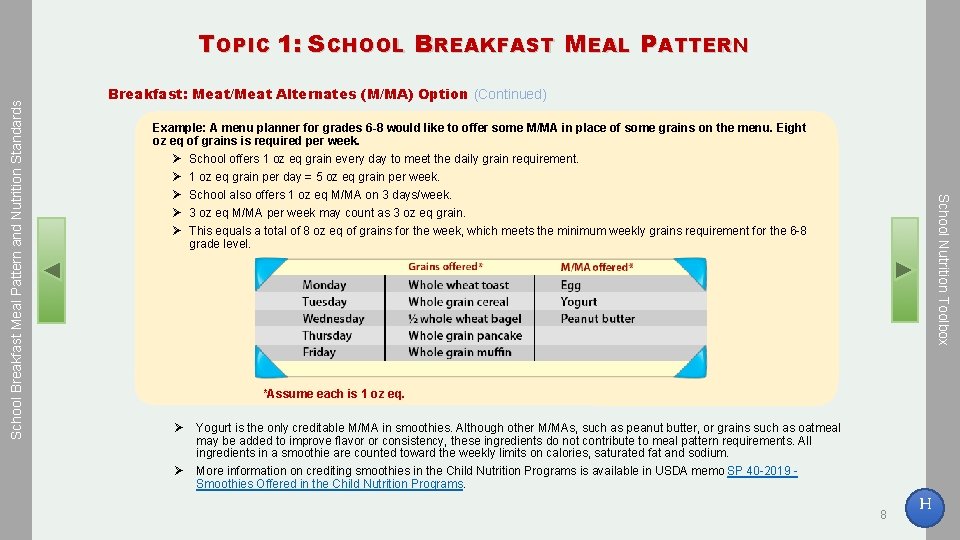
Breakfast: Meat/Meat Alternates (M/MA) Option (Continued) Example: A menu planner for grades 6 -8 would like to offer some M/MA in place of some grains on the menu. Eight oz eq of grains is required per week. Ø School offers 1 oz eq grain every day to meet the daily grain requirement. Ø 1 oz eq grain per day = 5 oz eq grain per week. Ø School also offers 1 oz eq M/MA on 3 days/week. Ø 3 oz eq M/MA per week may count as 3 oz eq grain. Ø This equals a total of 8 oz eq of grains for the week, which meets the minimum weekly grains requirement for the 6 -8 grade level. School Nutrition Toolbox School Breakfast Meal Pattern and Nutrition Standards Put Course Name Here T OPIC 1: S CHOOL B REAKFAST M EAL P ATTERN *Assume each is 1 oz eq. Ø Ø Yogurt is the only creditable M/MA in smoothies. Although other M/MAs, such as peanut butter, or grains such as oatmeal may be added to improve flavor or consistency, these ingredients do not contribute to meal pattern requirements. All ingredients in a smoothie are counted toward the weekly limits on calories, saturated fat and sodium. More information on crediting smoothies in the Child Nutrition Programs is available in USDA memo SP 40 -2019 - Smoothies Offered in the Child Nutrition Programs. 8 H
Participants will: 1. State the general requirements for Offer Vs. Serve in the School Breakfast Program. 2. Identify a resource for more detailed information about Offer Vs. Serve. Breakfast: Offer Vs. Serve School Nutrition Toolbox School Breakfast Meal Pattern and Nutrition Standards Put Course Name Here T OPIC 2: O FFER V ERSUS S ERVE ( OVS ) IN THE S CHOOL B REAKFAST P ROGRAM Ø Ø Offer Vs. Serve (OVS) for breakfast is optional at all grade levels. Under OVS, schools must offer three breakfast components in four items in at least the daily minimum required serving sizes: • Fruit (or substitute vegetable) • Grains (with optional meat/meat alternate) • Milk Ø NOTE: Unlike OVS for lunch, which is based on the number of components selected, a reimbursable breakfast under OVS is based on the number of items selected. Ø Student must select at least three food items for a reimbursable breakfast under OVS. Ø One selection must be at least ½ cup of fruit (or substitute vegetable) or ½ cup of juice. Ø Schools must offer one cup total of fruit/juice (or substitute vegetable) at breakfast. However, ½ cup of fruit may count as one item under OVS. This means a student may take one cup of fruit to count as two items. Continued on next slide. 9 H
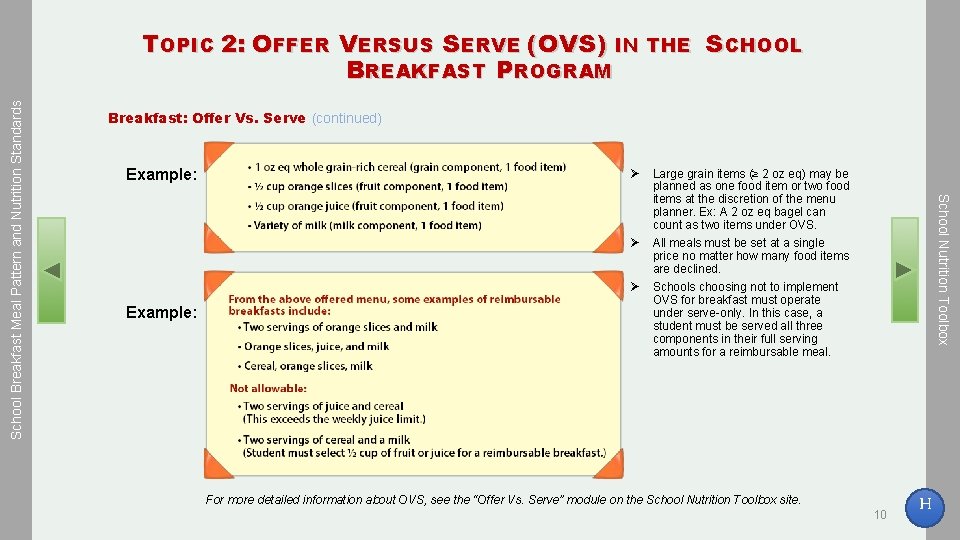
Breakfast: Offer Vs. Serve (continued) Example: Ø Ø Ø Example: Large grain items (≥ 2 oz eq) may be planned as one food item or two food items at the discretion of the menu planner. Ex: A 2 oz eq bagel can count as two items under OVS. All meals must be set at a single price no matter how many food items are declined. Schools choosing not to implement OVS for breakfast must operate under serve-only. In this case, a student must be served all three components in their full serving amounts for a reimbursable meal. School Nutrition Toolbox School Breakfast Meal Pattern and Nutrition Standards Put Course Name Here T OPIC 2: O FFER V ERSUS S ERVE ( OVS ) IN THE S CHOOL B REAKFAST P ROGRAM For more detailed information about OVS, see the “Offer Vs. Serve” module on the School Nutrition Toolbox site. 10 H
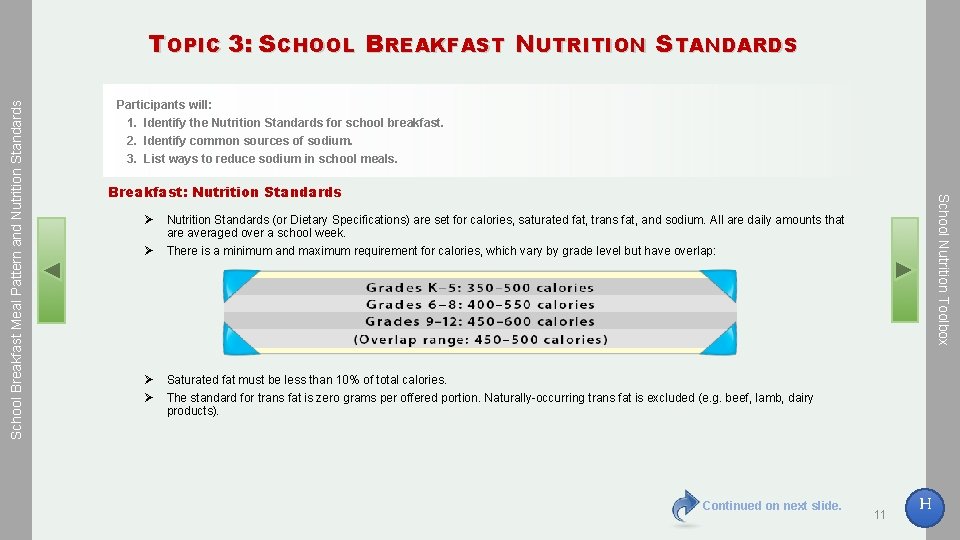
Participants will: 1. Identify the Nutrition Standards for school breakfast. 2. Identify common sources of sodium. 3. List ways to reduce sodium in school meals. Breakfast: Nutrition Standards Ø Ø School Nutrition Toolbox School Breakfast Meal Pattern and Nutrition Standards Put Course Name Here T OPIC 3: S CHOOL B REAKFAST N UTRITION S TANDARDS Nutrition Standards (or Dietary Specifications) are set for calories, saturated fat, trans fat, and sodium. All are daily amounts that are averaged over a school week. There is a minimum and maximum requirement for calories, which vary by grade level but have overlap: Saturated fat must be less than 10% of total calories. The standard for trans fat is zero grams per offered portion. Naturally-occurring trans fat is excluded (e. g. beef, lamb, dairy products). Continued on next slide. 11 H
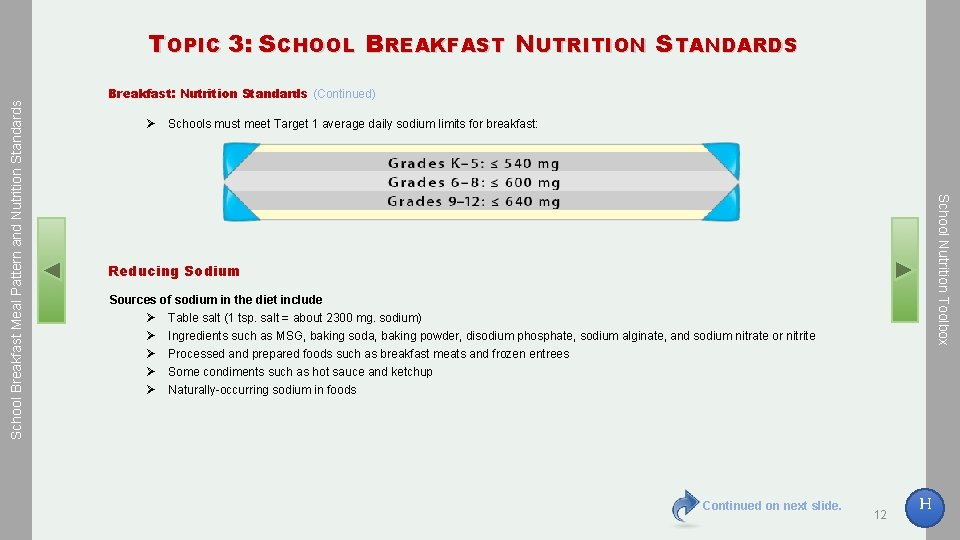
Breakfast: Nutrition Standards (Continued) Ø Schools must meet Target 1 average daily sodium limits for breakfast: School Nutrition Toolbox School Breakfast Meal Pattern and Nutrition Standards Put Course Name Here T OPIC 3: S CHOOL B REAKFAST N UTRITION S TANDARDS Reducing Sodium Sources of sodium in the diet include Ø Table salt (1 tsp. salt = about 2300 mg. sodium) Ø Ingredients such as MSG, baking soda, baking powder, disodium phosphate, sodium alginate, and sodium nitrate or nitrite Ø Processed and prepared foods such as breakfast meats and frozen entrees Ø Some condiments such as hot sauce and ketchup Ø Naturally-occurring sodium in foods Continued on next slide. 12 H
Reducing Sodium (Continued) Reducing Sodium in School Meals Ø Read Nutrition Facts labels to compare the sodium content for similar foods Ø Check with manufacturers for lower-sodium foods Ø Serve more fresh foods and fewer processed foods Ø Choose fresh or frozen vegetables, or lower-sodium canned vegetables Ø Modify recipes that use high sodium ingredients. Offer lower-sodium condiments Ø Remove or reduce salt from recipes where possible Ø Use herbs and spices rather than salt to flavor foods Ø NOTE: Salt substitutes containing potassium chloride can be harmful for some people and are not appropriate for use in schools School Nutrition Toolbox School Breakfast Meal Pattern and Nutrition Standards Put Course Name Here T OPIC 3: S CHOOL B REAKFAST N UTRITION S TANDARDS 13 H

School Breakfast Meal Pattern and Nutrition Standards Put Course Name Here School Nutrition Toolbox 14 H
- Slides: 15